
LIT-10 Pro Battery
5.0Editor score
10,500mAh rated capacity
Five-hour full-charge claim
Multiple circuit protections
Our guide compares 10 rechargeable lithium batteries for trail cameras, highlighting capacity, compatibility, charging, runtime, and field durability for
Rechargeable lithium batteries can help trail cameras run longer between maintenance visits while reducing the need for disposable cells. A worthwhile battery should match the camera’s voltage and connector, provide dependable cold-weather performance, recharge conveniently, and retain enough capacity for remote monitoring.
We compared all ten listed products by power format, stated capacity, charging method, camera compatibility, temperature claims, safety features, and intended deployment. The list includes dedicated camera battery packs, universal rechargeable AA options, and several products that only partially fit the requested category.
Each review explains what the product offers, where it fits best, and where its compatibility or battery design deserves closer attention. Ratings and specifications can change over time, so shoppers should confirm the latest camera fit, charging requirements, and current price before making a final purchase.
5.0Editor score
4.8Editor score
4.6Editor score
The comparison covers dedicated rechargeable packs, universal AA batteries, a camera with a built-in cell, and two non-matching battery products, making camera compatibility and power format the most important distinctions.


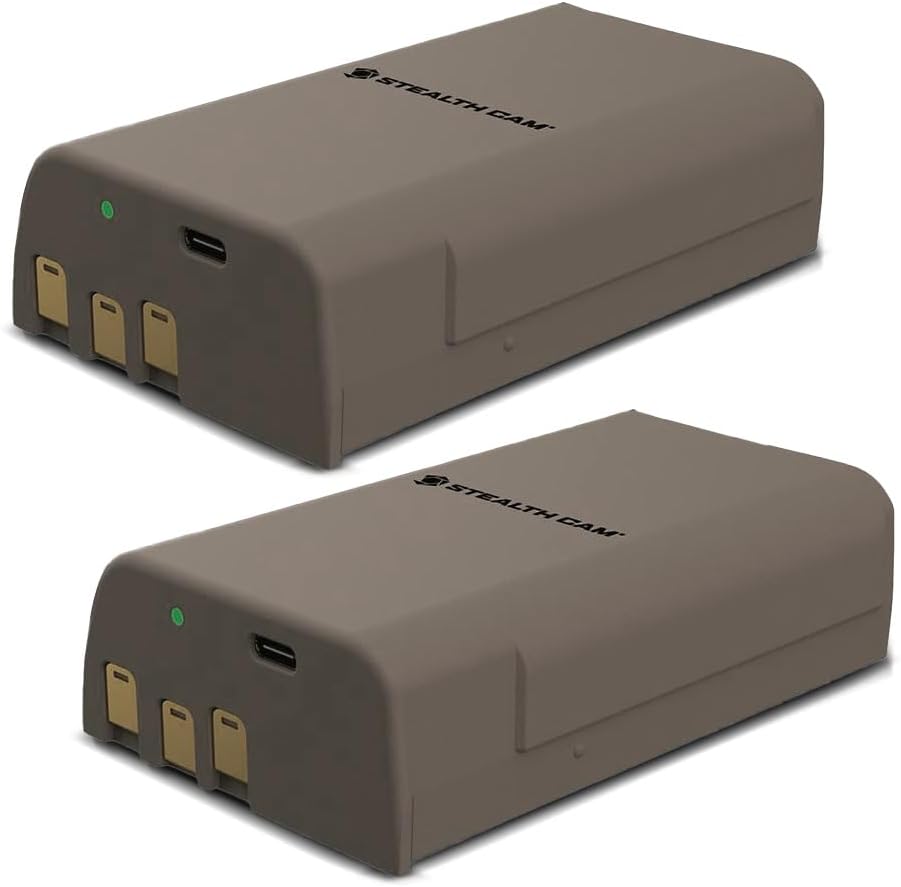
The Stealth Cam FieldMax MAX-PAK is a dedicated 12V, 5,000mAh lithium-ion battery cartridge offered as a two-pack, and it carries a 4.6 rating. Its strongest qualities are its focused compatibility, simple USB recharging, and the practical decision to include two batteries. A second cartridge can serve as a ready spare or help a user rotate a charged pack into a camera while another is recharging.
We may earn a commission when you buy through this link, at no additional cost to you.
The product information specifically identifies compatibility with the Stealth Cam Flashback, Deceptor MAX, Fusion MAX, and Connect MAX models. That narrower list is an advantage when the shopper owns one of those cameras because it reduces the ambiguity associated with universal batteries. Each cartridge contains a 12-volt, 5,000mAh lithium-ion power pack and recharges through the included USB cable, removing the need to repeatedly handle disposable common power units.
The MAX-PACK is also positioned for locations where sunlight is limited. Unlike a solution that depends entirely on a solar panel, it stores energy in advance and can continue supplying camera power in wooded areas. Its construction is described as capable of withstanding temperature swings, which makes it more credible for seasonal deployments than a basic indoor battery pack, although actual cold-weather runtime can vary with conditions and camera activity.
The trade-offs are compatibility and the absence of a stated solar-charging feature. It is not presented as a universal option for Moultrie, SPYPOINT, or TACTACAM cameras, and the external solar pack mentioned in another FieldMax product is not part of this two-pack description. For owners of a listed Stealth Cam model who want a simple, purpose-built cartridge, however, it is a strong and flexible choice.
The recommendation is straightforward: choose the MAX-PAK when you use one of the named Stealth Cam models, value a spare cartridge, and want USB recharging without a complicated field setup. Verify the exact camera model and battery-door design before ordering, since the product is not a one-size-fits-all solution for the entire trail camera market.
Having two 5,000mAh cartridges is useful when a camera is positioned where travel is difficult. One battery can remain in service while the other is charging, reducing the need to interrupt a long monitoring period.
The battery is designed for wooded and low-light environments where solar-only charging may be inconsistent. Its 12V lithium-ion format provides a purpose-built alternative to loose disposable cells.
We may earn a commission when you buy through this link, at no additional cost to you.
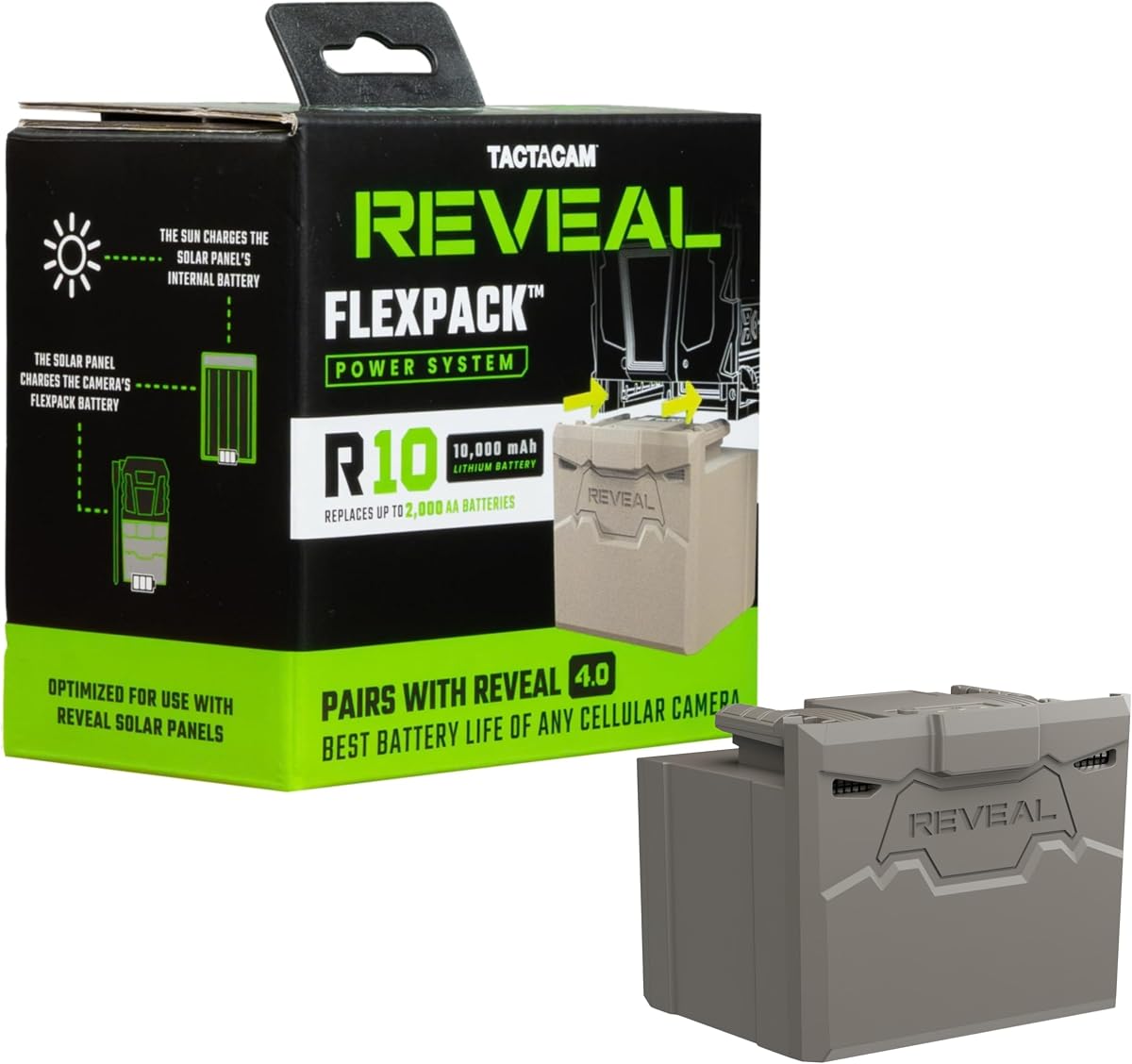
The TACTACAM Reveal FlexPack R10 is a 10,000mAh rechargeable lithium battery pack with a 4.8 rating, making it one of the strongest-rated dedicated options in this guide. It is presented as twice the capacity of the FlexPack R5 and specifically as the most powerful rechargeable battery in the REVEAL line. For users who want fewer battery interventions, that headline capacity is the central reason to consider it.
We may earn a commission when you buy through this link, at no additional cost to you.
Its quick-swap design is especially relevant to remote trail camera use. Instead of performing a complicated battery-change process, a user can remove and replace the pack more easily. The product information also claims that one R10 can replace up to 2,000 disposable AA batteries, while reducing waste and the number of trips required to replace dead cells. That comparison is a stated manufacturer claim rather than an independently verified test result.
The R10 can also integrate with the Solar Panel R5 and other TACTACAM power accessories. That creates a potentially self-sustaining power loop in which stored battery energy and solar charging work together, helping extend the interval between manual visits. The key word is potentially: a reliable off-grid setup still depends on suitable sunlight, compatible accessories, and correct configuration.
There are two practical limitations. First, this is a TACTACAM-centered ecosystem rather than a general-purpose AA battery, so users of other camera brands should not assume it will fit. Second, the product listing does not provide a specific number of days or trigger events per charge, meaning capacity cannot be translated directly into a guaranteed monitoring period.
The FlexPack R10 is recommended for REVEAL users seeking a high-capacity battery, convenient swapping, and possible solar integration. It ranks as the Editor's Choice because it combines a strong stated rating, unusually high capacity, and a clear field-service workflow. Confirm the compatible REVEAL camera and accessory configuration before buying.
A 10,000mAh rating gives the R10 a substantial capacity advantage over smaller dedicated packs in the list. That can be valuable where access is difficult, although trigger frequency and weather still determine actual runtime.
Compatibility with the Solar Panel R5 allows the battery to participate in a renewable charging setup. This is useful in open areas where the panel receives reliable sunlight.
We may earn a commission when you buy through this link, at no additional cost to you.
The LIT-10 Pro battery is a 3.85V, 10,500mAh rechargeable lithium pack rated at 40.42Wh, and its listed customer rating is 5.0. It is designed for SPYPOINT Link-Micro, Cell-Link, LM2, and Link-Micro-S-LTE cameras from the Cell-Link series. For owners of those models, it combines a high stated capacity with a particularly fast claimed recharge time.
We may earn a commission when you buy through this link, at no additional cost to you.
The product listing says the battery can reach a full charge within five hours. That is valuable for users who rotate batteries between deployments, because less charging downtime can make it easier to maintain a spare. Its claimed energy rating also provides a more complete technical specification than capacity alone, while the 10,500mAh figure distinguishes it from most other dedicated packs in this comparison.
A built-in smart chip is described as providing protection against overcharging, over-discharging, over-voltage, over-current, and overheating. These safeguards are important because a trail camera battery is repeatedly exposed to variable outdoor conditions and unattended charging cycles. The listing also states that circuit protection is designed to enhance safe use and extend battery life, though real-world longevity will depend on charging and temperature management.
The main limitation is model specificity. It is not presented as a general battery for every cellular trail camera, and users should not equate the word SPYPOINT compatibility with universal SPYPOINT compatibility. The 5.0 rating should also be interpreted as the current listed rating, not as proof that the battery has been tested across every season or camera configuration.
The LIT-10 Pro is the Best Budget selection for the compatible audience because it offers extensive protections and a strong capacity-to-price proposition without paying for a multi-battery premium bundle. It is recommended to SPYPOINT Cell-Link users who want a five-hour charging cycle, a 40.42Wh rating, and a compact dedicated solution. Verify the exact camera model before ordering.
The stated five-hour full-charge time supports a rotate-and-recharge workflow. Users can keep a charged pack ready for the next deployment while another battery is being prepared.
The listed protections cover common charging and electrical risks. They make the pack more appropriate for repeated outdoor use, although users should still follow the supplied charging guidance.
We may earn a commission when you buy through this link, at no additional cost to you.
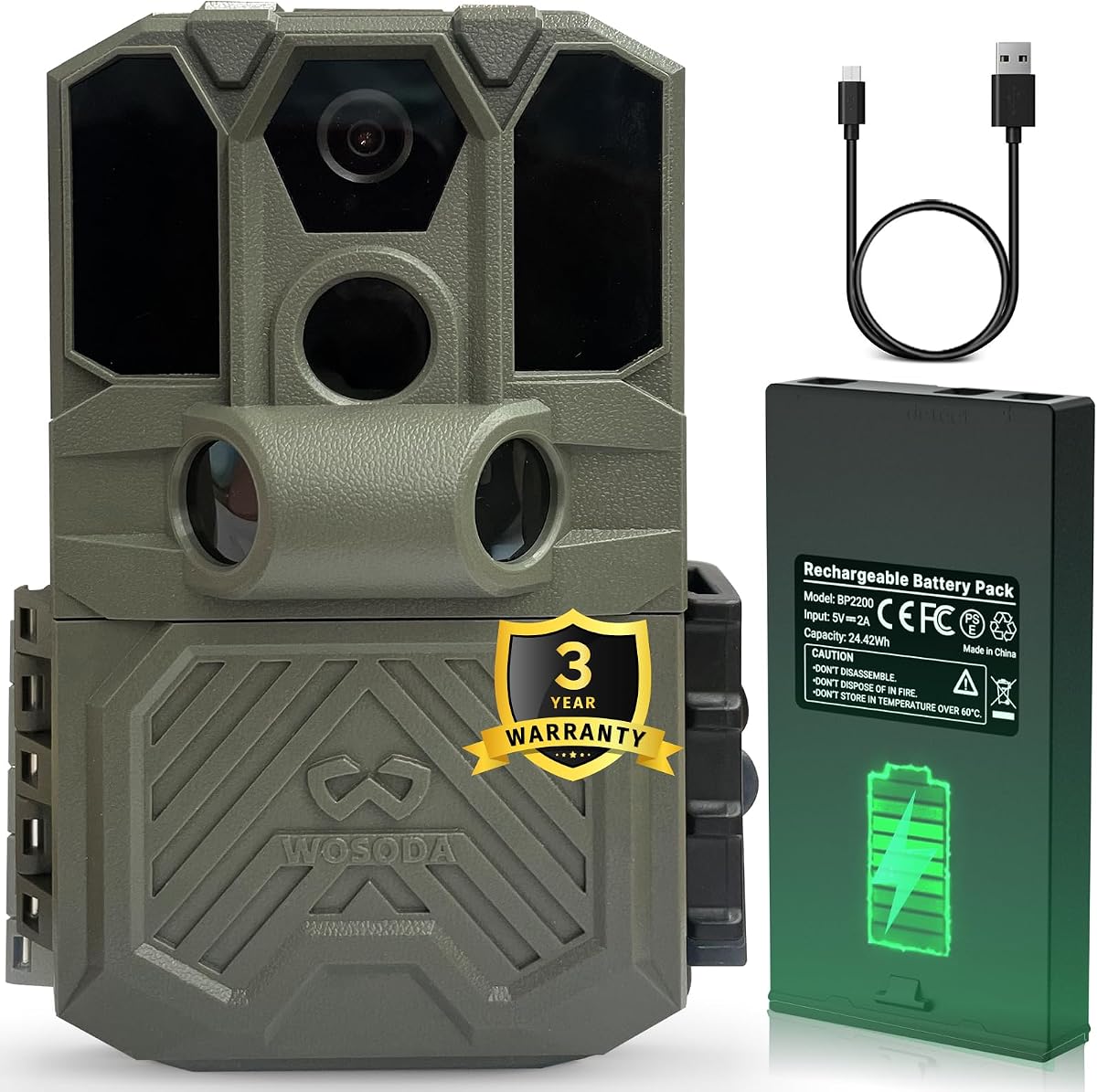
The WOSODA product is a complete trail camera rather than a replacement battery, and it includes a built-in 2,200mAh rechargeable lithium battery. Its 4.3 rating makes it the fourth-ranked option, but it deserves discussion because it demonstrates a different way to manage camera power. The battery must be removed and charged separately rather than charging the complete camera through its Type-C port.
We may earn a commission when you buy through this link, at no additional cost to you.
Its local-storage design may appeal to users who do not want cellular service or Wi-Fi connectivity. Footage is stored on an SD card, with support listed for cards up to 256GB, although the card is not included. The camera offers 40MP still photos, 2K video, a 0.2-second trigger speed, a 120-degree detection angle, and a detection distance of up to 80 feet.
The built-in battery supports a self-contained setup without loose AA cells. Because it is removable, the owner can take the battery into a protected location for charging, which is helpful during wet weather. The IP66 housing is also designed to resist water and dust, while the upgraded PIR system is intended to reduce false triggers and conserve battery life.
Its main drawback is obvious from the category mismatch: it cannot serve as a spare battery for another trail camera. The 2,200mAh capacity is also considerably lower than the dedicated packs listed elsewhere, and there is no stated solar integration. Buying this option means selecting a complete camera based on imaging and monitoring features, not simply adding power to an existing setup.
This product is recommended for a buyer who wants a new non-cellular camera and values local storage, a removable rechargeable cell, and 2K recording. It is not recommended for someone whose main goal is finding a universal battery for an existing trail camera. Check the charging procedure carefully, because the battery must be removed before charging.
Without cellular or Wi-Fi functions, the camera records to an SD card rather than sending footage to a cloud service. This simplifies connectivity but means card removal or remote retrieval is needed to review recordings.
Taking the battery out protects the camera and makes charging more convenient in bad weather. It also means the entire camera cannot remain operating while the battery is being recharged.
We may earn a commission when you buy through this link, at no additional cost to you.
This eight-pack of rechargeable lithium AA batteries provides a broadly useful alternative to dedicated camera packs. It has a 4.5 rating and is advertised for trail cameras among other high-drain devices, including Blink outdoor cameras, game controllers, portable fans, video doorbells, and wireless mice. Unlike a proprietary cartridge, the AA format may fit cameras designed to accept standard cells, subject to voltage requirements.
We may earn a commission when you buy through this link, at no additional cost to you.
The batteries are described as maintaining a constant 1.5V output until depleted, with an energy specification of 3,800mWh and an equivalence to 3,800mAh capacity. That distinction matters because some rechargeable AA cells operate at a lower nominal voltage. The charger can hold all eight batteries and uses an LCD to display the charging progress of each slot, making it easier to manage partially charged sets.
The package combines the charger with a magnetic-closure storage case. A Type-C cable is included, and the stated cycle life reaches 2,500 cycles. The batteries are also described as lightweight and capable of operating from -20°F to 131°F, making the set more flexible than one designed solely for indoor electronics.
Compatibility is the decisive concern. The product explicitly warns that the 1.5V maximum voltage is not suitable for smoke alarms, Nest Protect, solar lights, or camera flashes. Some Blink models may also display a low-battery warning even while operating normally. Trail camera users should check whether the camera accepts rechargeable lithium AA chemistry, and should be prepared for devices that interpret the chemistry differently from disposable alkaline cells.
This set is recommended for a camera that uses standard AA cells and whose manufacturer supports rechargeable lithium batteries. It is less appropriate for a proprietary camera that requires a dedicated pack. Its strengths are convenience, broad household utility, and an eight-cell charging setup, but voltage confirmation must come before purchase.
The stated 1.5V output remains steady until depletion, which helps devices that expect the voltage of a conventional AA cell. That feature does not guarantee compatibility with every camera or accessory.
The LCD and eight charging positions let users monitor the full set at once. Magnetic storage keeps the batteries and charger together, reducing the chance of leaving a cell behind during a trip.
We may earn a commission when you buy through this link, at no additional cost to you.
The Burflo three-pack is a 7,000mAh rechargeable battery replacement for the LIT-22 and selected SPYPOINT Flex-series trail cameras. No customer rating is supplied for this listing, so there is no numeric rating to use as a confidence measure. Its appeal comes instead from the three-battery format, broad model list, and integrated USB-C charging design.
We may earn a commission when you buy through this link, at no additional cost to you.
Compatibility is the package's defining strength. The product information names Flex-M, Flex-Dark, Flex-S-Dark, Flex-S, Flex-G-36, and Flex-Plus models, with several alternate formatting variations for the G-36 and Plus versions. Owners should still match the physical battery shape, voltage needs, and camera specification because model naming can be confusing and no universal fit should be inferred.
Each battery is described as fully charging in six hours. The listing recommends a 5V, 3A USB wall plug and warns that a 2A plug may result in unstable charging. A USB-C cable and the wall plug are included, and an LED indicator provides a charging-status reference. Those charging details make the included accessories more meaningful than a simple cable-only package.
The pack is also described as adaptable to varied weather and as a 7.7V upgraded alternative to the original 7.4V rechargeable LIT-22PRO battery. Buyers should treat the voltage difference as a compatibility point to verify, not as a universal improvement. The absence of a rating means there is no customer feedback signal in the supplied data, making the explicit compatibility list more important to examine.
This product is recommended for SPYPOINT Flex-series users who want three interchangeable packs and are comfortable following the specified charging equipment. It is a sensible choice for maintaining a larger deployment, although a single unit would be easier to carry for a single-camera setup. Confirm the camera model and charging guidance before ordering.
A three-pack allows one camera to operate while another battery charges and leaves a third in reserve. This is helpful for multi-camera properties where simultaneous maintenance would otherwise be inconvenient.
The recommended 5V, 3A wall plug and included USB-C cable create a more defined charging setup. The warning against a 2A plug indicates that charger capability may affect charging stability.
We may earn a commission when you buy through this link, at no additional cost to you.
The Stealth Cam FieldMax 5000mAh External Battery Combo combines an internal 5,000mAh lithium rechargeable battery with compatibility for a separate external solar charging pack. Its listed rating is 1.0, the lowest numerical score among the rated products, so it should be approached more cautiously despite its appealing all-in-one concept.
We may earn a commission when you buy through this link, at no additional cost to you.
The central benefit is flexibility. The internal battery can be charged through USB at home, in a vehicle, or in a remote location, while the optional external solar pack can recharge the camera directly in the field. This creates a useful hybrid for hunters and wildlife enthusiasts who want stored power during cloudy periods and solar replenishment when conditions are favorable.
The stated camera compatibility is broad, covering MAX, Fusion, Deceptor, and Revolver series models. That range could make the combo useful for owners of several cameras. The internal 5,000mAh lithium battery is also described as maintaining consistent output across temperature extremes and harsh outdoor conditions, supporting its use as the primary source when a solar panel cannot generate enough power.
The rating and bundle distinction deserve emphasis. A 1.0 rating may reflect limited customer feedback, an installation issue, or another unresolved concern, and the supplied information does not explain the cause. In addition, the external solar pack is sold separately, so the product does not provide the complete off-grid solar system that the term combo might initially suggest.
The recommendation is limited to shoppers who understand the 1.0 rating, own a compatible Stealth Cam model, and are interested in adding solar capability later. It may suit an established FieldMax user, but a buyer starting from zero should carefully review compatibility and consider the lower-rated MAX-PAK two-pack as a more conventional dedicated alternative.
The internal battery stores energy for periods when sunlight is weak, while the external pack can add field charging in suitable conditions. The combination is more adaptable than relying on either method alone.
With a listed rating of 1.0, the product has substantially less favorable customer feedback than the leading options. Prospective buyers should confirm fit and understand that the solar accessory is separate.
We may earn a commission when you buy through this link, at no additional cost to you.
The Artman three-pack is a 6,700mAh rechargeable lithium-ion replacement system for Moultrie Edge, Edge Pro, Edge 2, and Edge 2 Pro trail cameras. No rating is provided for this listing, so its evaluation relies on the stated electrical and environmental specifications. The three-pack format is the main practical advantage for buyers who monitor more than one location or want a rotation stock.
We may earn a commission when you buy through this link, at no additional cost to you.
The batteries use a plug-and-play design and are described as having the same chip as the original battery. Their 6,700mAh capacity is intended to provide extended runtime while replacing the inconvenience of traditional AA batteries. This makes the set most relevant to Moultrie users who want a direct rechargeable system rather than a collection of loose cells.
Charging is handled through USB-C, with a stated full-charge time of four hours. An LED indicator shows the charging status, and green lights indicate the power level while all lights turn off when the battery is full. Those details make it easier to know when a pack is ready without removing it from the charging setup.
Temperature performance is a notable feature. The listing states operation from -20°C to 60°C, or -68°F to 140°F, which covers a broad range of outdoor conditions. The pack also includes overcharge, over-discharge, and short-circuit protection, and its construction is described as rugged and weather resistant. Those protections are useful for unattended field equipment.
The recommendation is for Moultrie Edge-series owners who want three fast-charging packs with a high stated capacity. Because no customer rating is available and the list of compatible models is specific, buyers should verify the camera model, connector, and physical battery shape. The pack is not a general trail camera battery and should not be assumed to fit other brands.
The stated charging time is short enough to prepare a spare between regular field visits. The three-pack format improves that workflow by keeping multiple batteries at different charge stages.
A stated -20°C to 60°C operating range addresses cold winter and hot summer deployments. Actual performance can still depend on the camera, usage level, and prevailing conditions.
We may earn a commission when you buy through this link, at no additional cost to you.
This eight-pack of alkaline AA batteries is labeled for trail camera use and has a 4.5 rating. It is not a rechargeable lithium battery, so it does not meet the core requirement of the guide, but its inclusion provides a useful contrast. It represents the simple disposable approach against which the rechargeable packs are compared.
We may earn a commission when you buy through this link, at no additional cost to you.
The main benefit is convenience. Standard AA cells can be carried without a charger, USB cable, or proprietary charging system, which may appeal to users who change batteries infrequently or need a straightforward backup for a camera that accepts common cells. The pack contains eight batteries, reducing the need for separate purchases during a single maintenance visit.
The product description states that the batteries are mercury and cadmium free, addressing two materials commonly discussed in relation to disposable batteries. That characteristic does not make the pack rechargeable or eliminate all environmental considerations, but it provides useful information for shoppers who specifically want to avoid those materials.
The disadvantages are direct: the cells cannot be recharged, and continued operation requires additional disposable batteries. They also do not provide the charge-status visibility, dedicated connector alignment, or capacity management offered by a rechargeable camera pack. For a remote setup, this can mean either carrying enough cells for the entire deployment or planning more replacement visits.
The recommendation is not to choose this product as one of the best rechargeable options in the strict sense. It may be practical as an emergency or short-duration backup for a compatible AA-powered camera, but buyers seeking fewer trips and lower long-term waste should use the rechargeable AA set or a dedicated lithium pack instead.
A user can carry eight cells, install them, and leave without managing a charger. That simplicity is valuable when the camera accepts standard AA batteries and the deployment is brief.
The cells are alkaline rather than rechargeable lithium. They therefore add recurring waste and do not provide the convenience of a reusable power source for extended monitoring.
We may earn a commission when you buy through this link, at no additional cost to you.
The Surefire six-pack consists of 123A lithium batteries optimized for high-drain flashlights, and it carries a 4.7 rating. These are primary lithium cells rather than rechargeable batteries, and the product information gives no trail camera compatibility. They are included to clarify that not every lithium battery belongs in a trail camera power system, regardless of its chemistry or reputation for dependable output.
We may earn a commission when you buy through this link, at no additional cost to you.
Several battery characteristics could seem attractive in an outdoor setting. The cells have a stated 10-year shelf life, wide temperature tolerance, and built-in heat and fault protection for short circuits. They are made in the United States to Surefire specifications. Those traits make them well suited to equipment that may sit in storage for long periods and then draw substantial current, such as high-output flashlights.
A trail camera must accept the 123A form factor and its voltage and discharge requirements before any of those benefits become relevant. The supplied information does not state that it does, and a standard AA-powered trail camera generally requires AA cells rather than this larger lithium format. The word lithium alone does not establish that a battery is a suitable replacement for a camera's specified cell.
The package is also not rechargeable, despite being a lithium product. Users would replace the cells rather than restore them through USB or another charging method. For a fixed deployment, that may be less desirable than a dedicated rechargeable pack, and the flashlight-specific optimization does not establish suitability for seasonal camera loads.
The recommendation is therefore narrow. Surefire 123A cells may be useful for compatible flashlights or other 123A devices, but they should not be selected for a trail camera based solely on the lithium label. Trail camera shoppers should follow the battery format, voltage, and chemistry specified by the camera manufacturer or the battery replacement listing.
A ten-year stated shelf life is useful for batteries kept in a vehicle, locker, or emergency kit. It does not turn the cells into a rechargeable camera power source.
The 123A cell is a distinct format from common AA camera batteries. Without a stated trail camera fit, these batteries should remain associated with their intended high-drain applications.
We may earn a commission when you buy through this link, at no additional cost to you.
The right rechargeable battery depends less on a single headline specification than on physical fit, voltage, chemistry, capacity, charging method, and the environmental demands of the deployment.
Start with the camera's required battery format rather than searching only by voltage. Some trail cameras accept standard AA cells, while others use proprietary lithium cartridges or model-specific packs with a particular shape, connector, and electronic communication requirement. A battery that physically fits is not necessarily electrically compatible, and a high-capacity pack can still cause problems if the camera does not support its voltage or chemistry.
For the dedicated options in this guide, compatibility is explicit: the Stealth Cam MAX-PAK names Flashback, Deceptor MAX, Fusion MAX, and Connect MAX; the LIT-10 Pro names several SPYPOINT Cell-Link models; Burflo covers named Flex-series cameras; and Artman covers Moultrie Edge-series models. Match the exact model designation before considering capacity or charging convenience.
Rechargeable lithium batteries are not one universal category. The list includes a 12V cartridge, 3.85V and 7.7V model-specific packs, a 1.5V rechargeable AA system, and products that are not rechargeable. Each format serves a different installation. A cartridge generally integrates more cleanly with its camera, while rechargeable AA cells can be versatile if the camera manufacturer supports the chemistry and voltage.
Do not assume a battery is interchangeable because it says lithium. Verify the cell dimensions, voltage, charge protocol, and whether the camera expects disposable cells, a rechargeable pack, or a proprietary battery. When a listing does not provide enough information, contact the seller or camera manufacturer before ordering rather than relying on visual similarity.
Capacity indicates how much energy a battery can store, but it does not provide a guaranteed number of monitoring days. Camera trigger frequency, night vision, video length, transmission activity, temperature, and battery age all influence consumption. The TACTACAM R10 and SPYPOINT LIT-10 Pro offer stated capacities above 10,000mAh, while the WOSODA camera's built-in cell is 2,200mAh.
Choose capacity according to access frequency. Higher-capacity packs are particularly helpful at remote sites where each visit consumes time and travel. For a frequently checked camera or a location with dependable solar access, a smaller pack may be adequate. Treat any runtime estimate as a variable estimate rather than a guarantee.
Rechargeable power is only useful if it can be prepared before a deployment. USB charging is common across the dedicated options, but the details matter: the MAX-PAK includes a USB cable, the LIT-10 Pro states a five-hour charging time, the Burflo set recommends a 5V, 3A plug, and the Artman pack claims a four-hour full charge. Some bundles include wall plugs while others require the user to supply compatible charging equipment.
Consider whether you will charge one battery or rotate several. A quick turnaround is helpful when a spare is needed before a trip, while a multi-battery charger and storage case make a larger rotating set more manageable. Follow the supplied voltage and plug recommendations, particularly where unstable charging is specifically mentioned.
Trail cameras often operate through large seasonal temperature changes. The Stealth Cam packs are described as built for temperature swings, Burflo emphasizes temperature adaptability, the AA set states operation from -20°F to 131°F, and the Artman pack lists a -20°C to 60°C range. These claims make the products more relevant to outdoor use than batteries intended only for household electronics.
Capacity and charging claims should still be considered together. A pack that charges conveniently but loses usable capacity in cold conditions may require more frequent swaps, while a high-capacity pack benefits from thermal management. Keep batteries away from direct hot-vehicle storage and follow the manufacturer's guidance when charging or deploying them.
For long remote deployments, rechargeable power can work with solar charging, but only when the ecosystem and sunlight conditions align. The TACTACAM R10 integrates with the Solar Panel R5 and other compatible accessories, while the Stealth Cam FieldMax Combo supports a separately sold external solar pack. The second option's low rating makes the additional compatibility and customer-feedback details especially important to review.
Solar does not remove the need for a battery because weather and shade influence generation. A sound off-grid setup stores energy in the rechargeable cell, replenishes it when conditions permit, and reduces manual battery replacement. Confirm connector, voltage, and accessory support before assuming an off-grid workflow will work.
Electrical protection is valuable for batteries that will be repeatedly charged and exposed to variable conditions. The LIT-10 Pro lists overcharge, over-discharge, over-voltage, over-current, and overheating protection, while the Artman pack includes overcharge, over-discharge, and short-circuit protection. The Surefire cells also carry heat and short-circuit fault protection, although they are not rechargeable camera batteries.
Durability also concerns the battery housing, contacts, and charging arrangement. Some products emphasize weather resistance, while others are designed for indoor charging between field rotations. A protected, well-fitted pack with secure contacts is generally preferable for unattended equipment, but the camera's own enclosure and mounting stability remain equally important.
A single battery is simplest for a small deployment, while two- and three-packs make rotation easier. The Stealth Cam MAX-PAK includes two cartridges, the Burflo and Artman options include three, and the rechargeable AA product includes eight cells with a dedicated charger. Larger bundles can be inconvenient to carry but reduce the likelihood of a deployment ending with no prepared spare.
Plan the workflow around the number of cameras, charging location, and length of each monitoring run. For one camera with frequent access, a straightforward single-pack setup may be sufficient. For several cameras or a single remote installation, multiple batteries, a charger that handles all cells, and clear charge indicators are likely to create a more dependable routine.
Begin by confirming that the battery is approved for the exact camera model and checking its stated voltage, dimensions, and charging requirements. Install it only when the camera is powered down, align the contacts as directed, and secure the compartment so the pack cannot shift. For a universal AA option, verify that the camera supports 1.5V rechargeable lithium AA chemistry before inserting the cells.
Charge the battery in a dry, protected location using the specified cable, plug, and protocol. Do not use a charger that conflicts with the manufacturer's instructions, and do not leave a pack charging unattended if the product guidance advises otherwise. The Burflo set specifically recommends its 5V, 3A plug and warns about unstable charging with a 2A plug, while the WOSODA camera requires its removable battery to be charged separately.
Before deployment, inspect the contacts, housing, cable, and camera battery door for moisture, dirt, or damage. Keep the battery away from direct hot-vehicle storage and protect it from prolonged severe cold when possible. Rotate a spare pack into the camera rather than waiting for a complete shutdown, and record charge dates or inspection dates to keep track of batteries that are not being used regularly.
No. The camera must accept standard AA cells and support the voltage and chemistry of the rechargeable lithium pack. Some devices designed for disposable alkaline cells may show low-battery warnings with 1.5V lithium AA cells or may not operate as intended. Check the camera manual and the battery seller's compatibility notes before buying.
Higher capacity can reduce the frequency of battery changes, but only when the pack is electrically and physically compatible. Runtime also depends on camera activity, night illumination, video use, cellular transmission, and temperature. Capacity should therefore be considered alongside fit, charging convenience, and field reliability rather than used as the only selection criterion.
Only when the battery and panel belong to a supported power system. The TACTACAM R10 is described as compatible with the Solar Panel R5 and other suitable accessories, while the Stealth Cam FieldMax Combo supports a separate external solar pack. Confirm connector, voltage, and accessory requirements, and do not assume every solar panel can charge every rechargeable camera battery.
Store them in a dry, temperature-controlled place away from direct heat, moisture, and prolonged freezing. Keep contacts clean and prevent the battery from being crushed or punctured. If the camera will not be used for an extended period, storing the cells in a partially charged state with periodic inspection is generally more suitable than leaving them permanently connected to a camera.
A camera can determine battery condition differently for rechargeable lithium chemistry than for disposable alkaline cells. The rechargeable AA product specifically notes that some Blink models may display a low-battery warning while continuing to function normally. Users should confirm the camera's guidance and avoid assuming that a warning means the battery is already depleted.
A proprietary pack can provide tighter model integration, a known connector, and more predictable power management, but it limits camera choice. Rechargeable AA cells are more flexible when a camera officially supports them. The better choice depends on equipment ownership: dedicated packs suit compatible camera ecosystems, while AA cells make more sense for standardized or multi-device needs.
At least one prepared spare is useful for a single remote camera because it allows a quick rotation without powering the camera down completely. Multiple-camera installations benefit from one charged spare per camera or from a three-pack that can cover staggered deployments. Carrying more batteries adds weight, so match the stock to the trip length, access frequency, and expected energy demand.
Cold can reduce charging speed and available capacity, although several products in this guide are specifically designed to operate across wide temperature ranges. Keep batteries from freezing while they are charging and allow them to acclimate before use when possible. Actual runtime can vary with weather, camera settings, and battery condition, so leave margin in a long remote deployment.
The TACTACAM Reveal FlexPack R10 stands out for its 10,000mAh capacity, 4.8 rating, quick-swap design, and solar accessory integration. The SPYPOINT LIT-10 Pro offers a 5.0 rating, 10,500mAh capacity, five-hour charging claim, and extensive circuit protections, while the Stealth Cam FieldMax MAX-PAK two-pack combines 5,000mAh 12V cartridges with simple USB recharging and a useful spare.
For almost every buyer, camera compatibility should be the first filter, followed by voltage, battery format, and charging requirements. Capacity matters more when access is difficult, while solar support can improve long deployments in consistently sunny locations. Products such as the WOSODA camera, alkaline AA cells, and Surefire 123A cells illustrate why matching the actual camera and power format is essential.
Before ordering, verify the exact camera model, connector, operating temperature, charger requirements, and current product information. Ratings, availability, and prices can change, and the marketplace can contain conflicting compatibility descriptions. Taking those final checks seriously will help avoid choosing a high-capacity battery that cannot safely or practically power the trail camera you own.