
OXILAM 6000A Jump Starter
4.6Editor score
6000A peak starting power
Supports gasoline and 12L diesel
USB outputs and Type-C input
LED status display
Our Jump Starter for Motorhome guide compares 10 powerful portable units for 12V and 24V vehicles, diesel engines, camping, and roadside emergencies.
A motorhome can become vulnerable to a dead battery while parked for days, stored through winter, or stopped beside a remote road. A capable jump starter restores the engine and can also power lights, phones, laptops, and other camping essentials. The right unit must match your motorhome’s voltage, engine size, and travel habits.
We compared the supplied products by peak starting output, supported voltage, engine compatibility, battery capacity, charging options, safety features, lighting, portability, and useful extras. The list includes compact 12V boosters, professional heavy-duty units, models with AC or air-compressor functions, and a dual 12V/24V jump starter for larger motorhome applications.
Each review explains where a product stands out and where compromises remain. Ratings and specifications reflect the supplied listing information, while product details and prices can change. Use the comparison to match starting power to your motorhome, then verify the current listing and manufacturer instructions before purchase or use.
4.6Editor score

4.6Editor score

4.9Editor score
The table below highlights the starting output, supported vehicle systems, portable power features, and most notable functions across all ten jump starters considered for motorhome owners.




The WOLFBOX MV24 is a balanced all-around choice for motorhome owners who want meaningful jump-starting performance without carrying a large workshop battery. Its 4.6 rating reflects a favorable mix of power, display visibility, charging speed, and portable construction, while its stated 4000A peak output suits 12V vehicles with gasoline or diesel engines below 10 liters.
We may earn a commission when you buy through this link, at no additional cost to you.
The 88.8Wh internal battery is particularly useful during a motorhome trip because the unit can recharge a phone or laptop through its 65W Type-C input/output and QC3.0 USB-A port. Its one-touch booster simplifies recovering a low-voltage battery, while the flashlight offers SOS, strobe, and high-beam modes for roadside work after dark.
The main limitation is its stated support for engines under 10 liters. Many Class C motorhomes and smaller diesel coaches fall within that range, but owners of large diesel RVs should not assume compatibility. It is also a 12V-only unit, making it unsuitable for a motorhome with a 24V starting system.
This is an especially strong pick for campers who value a readable LCD, rapid recharging, and multi-use electronics support. It combines credible starting capacity with less bulk than traditional lead-acid boosters, while providing enough sophistication for regular roadside preparedness.
Beyond starting the engine, the 88.8Wh battery and 65W Type-C connection make this more useful than a basic jump box. It can keep essential devices charged when the motorhome is parked or the engine cannot be run.
The HD LCD presents operating status more clearly than a row of simple indicator lights. That visibility helps owners check the unit before a roadside attempt and review the available functions without guessing.
We may earn a commission when you buy through this link, at no additional cost to you.
The COSSIFTW BP13S combines 12,000A peak starting output with a true 110V, 200W AC outlet, making it one of the most versatile products in this guide. Its 4.1 rating is lower than the leaders, but the supplied specifications make it compelling for motorhomes that need both engine recovery and a compact portable power source.
We may earn a commission when you buy through this link, at no additional cost to you.
Starting capability extends across gasoline engines and diesel engines up to 15 liters, giving it broader engine coverage than many mid-sized jump starters. The 130Wh lithium-polymer battery supports a 60W USB-C port, dual USB-A ports, and the AC inverter, allowing laptops, phones, tablets, fans, and other small appliances to run during camping or outages.
Its weight of 5.62 pounds and included carrying bag improve portability, although it is not as compact as a basic booster. The 200W inverter also has clear limits and should not be treated as a substitute for a full-size generator. A less favorable rating suggests some buyers may have found aspects of overall performance inconsistent.
Choose the BP13S when a motorhome owner specifically values an AC outlet alongside jump-starting capability. It is a good fit for travelers who want to recharge and operate more than just a phone, provided the motorhome uses a 12V system and has a diesel engine no larger than the stated limit.
The 110V, 200W outlet is the feature that separates this unit from a conventional jump box. It gives motorhome travelers a way to run compatible laptops, fans, cameras, and other small devices without relying entirely on the vehicle's electrical system.
Reverse-polarity, spark-proof, and overcharge protection address common connection mistakes. A built-in LED floodlight also adds visibility when the motorhome is stopped in darkness or during an evening roadside emergency.
We may earn a commission when you buy through this link, at no additional cost to you.
The DM1264 is the premium choice for serious motorhome owners who want exceptional starting headroom. It carries the highest rating in the group at 4.9 and a listed 30,000A peak output, plus 3,000A rated current, making it substantially more capable than compact camping jump starters.
We may earn a commission when you buy through this link, at no additional cost to you.
Its stated support for gasoline engines and diesel engines up to 50 liters offers exceptional coverage for a large Class A coach, truck-mounted camper, or commercial motorhome. The listing also describes starting a fully depleted 12V battery in one second at minus 40°F, automatic voltage detection, and a high-definition display for battery level, voltage, status, and error codes.
The tradeoff is size, weight, and a kit that feels closer to professional roadside equipment than a travel accessory. The included 57W adapter recharges the unit in four hours, while 4AWG cables, a 60-inch tie-down strap, and a protected battery compartment support repeated professional use.
This is the most capable unit here for an owner with a large diesel motorhome or a desire to prepare for demanding conditions. It is less attractive for a smaller Class B van whose storage space and portability requirements favor a lighter booster.
The 50-liter engine ceiling and 30,000A peak figure provide exceptional margin for large motorhomes. That extra capacity can be reassuring during cold weather, when starting demand rises and battery performance commonly weakens.
Real-time voltage, battery-level, operating-status, and error-code information makes the unit useful beyond a simple emergency start. Automatic 12V detection also helps reduce connection errors, though the owner must still follow the instructions.
We may earn a commission when you buy through this link, at no additional cost to you.
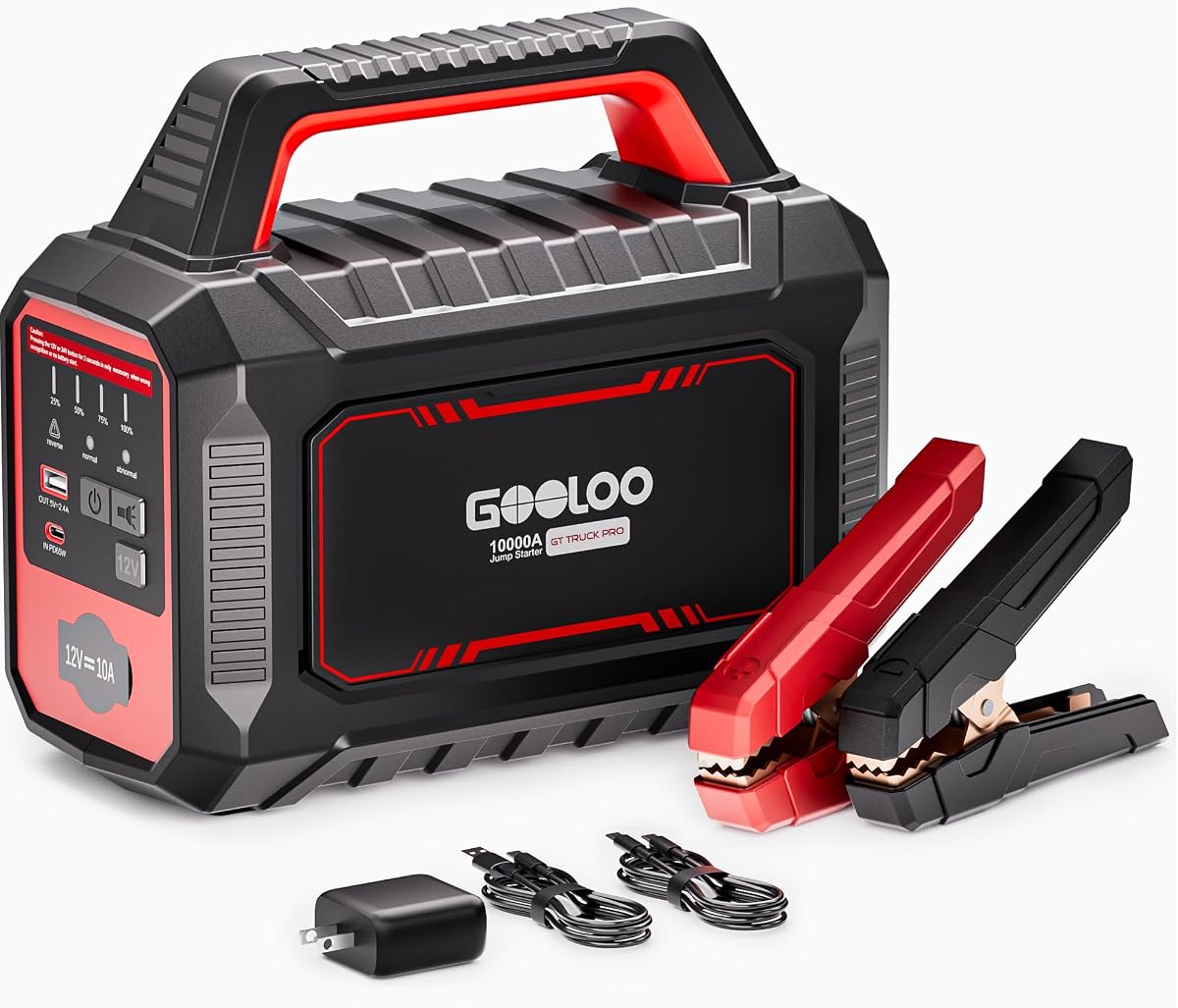
The GOOLOO GT Truck PRO delivers 10,000A peak output and a 64,000mAh battery, offering an impressive balance of starting power and reusable energy. Its 4.5 rating makes it one of the stronger-rated options, particularly for motorhome travelers who use their jump starter for more than emergency starts.
We may earn a commission when you buy through this link, at no additional cost to you.
The listing states that one full charge can deliver up to 80 vehicle starts or 17 mobile-phone charges, with standby time extended to 36 months. A 65W charging system reportedly restores the battery in 3.7 hours, and the outputs can support phones, tablets, drones, smartwatches, car refrigerators, and pumps.
Its stated temperature range of minus 40 to 60 degrees Celsius is notable, and eight LEDs provide constant, strobe, and SOS modes. However, it is limited to 12V vehicles and does not claim the 200W AC output offered by some competitors. The instruction to begin with at least 75% charge is also important to follow.
This is a strong option for a 12V motorhome that parks for extended periods and needs substantial reserve power. It is particularly attractive when the owner also wants to run 12V camping appliances or recharge multiple devices away from shore power.
The 64,000mAh capacity turns the unit into a long-duration mobile power bank. Its stated ability to run compatible refrigerators and pumps broadens its value for campground and roadside use.
A listed minus 40 to 60 degree Celsius operating range makes the unit relevant for winter storage and hot-weather travel. The BMS and ten-layer protection system add safeguards for demanding use.
We may earn a commission when you buy through this link, at no additional cost to you.
The OXILAM 6000A delivers substantial starting capability at a comparatively accessible position in this guide. Its 4.6 rating, broad vehicle compatibility, and support for gasoline engines and 12L diesels make it a practical budget-oriented selection for many 12V motorhomes.
We may earn a commission when you buy through this link, at no additional cost to you.
A full charge is advertised to provide up to 60 jump starts, and the upgraded cables are intended for cars, trucks, RVs, vans, tractors, motorcycles, boats, and other 12V equipment. The unit also works as a power bank with two USB outputs and a Type-C input, while its LED display reports remaining charge.
The lighting system is unusually capable for a portable booster, with flashlight, strobe, and SOS modes using 800-lumen LEDs. Its compact, non-slip housing and protective cover aid storage, although there is no AC inverter and no 24V support. Owners should also follow the recommendation to recharge the unit every three months when it has been idle.
This is a sensible choice for a moderate-size motorhome with a 12V electrical system and an engine within the stated displacement range. It gives many of the functions travelers want without requiring a professional-scale unit.
The three 800-lumen modes provide visibility for nighttime hookups, roadside repairs, and signaling. This makes the jump box useful even when it is not actively starting an engine.
Ten intelligent protections cover risks such as reverse polarity, short circuits, sparks, overheating, loose connections, and battery expansion. Users should still attach the clamps correctly and follow the supplied guidance.
We may earn a commission when you buy through this link, at no additional cost to you.
The WOLFBOX MV24A combines a 4,000A jump starter with a 160PSI air compressor, filling a common gap in motorhome emergency kits. Its 4.5 rating reflects a useful mix of engine-starting, inflation, and portable-power functions in a relatively compact package.
We may earn a commission when you buy through this link, at no additional cost to you.
The stated 88.8Wh battery supports 12V gasoline or diesel engines under 10 liters, while the air motor is advertised to inflate pickup-truck tires in about 2.5 minutes from 30 to 36 PSI. USB-C 65W, 12W and 18W USB-A outputs, and a 160W DC continuous output add device-charging flexibility.
The main inconvenience is that a compatible charging adapter is not included. Owners must supply one or follow the listed guidance, and the engine-size limit rules it out for larger diesel coaches. At approximately 3.42 pounds, however, it remains easier to store than a traditional lead-acid booster.
This model is well suited to motorhome owners who want both battery recovery and tire-pressure maintenance. The included EVA bag makes it convenient to keep the main unit, cables, and inflation accessories together in a storage compartment.
Starting a dead battery and correcting low tire pressure are both routine motorhome concerns. Combining both functions reduces the number of separate tools an owner needs to carry.
The 400-lumen flashlight includes distress, strobe, and high-beam modes. Those options improve illumination around a wheel well and make the unit useful as a signaling light during a roadside stop.
We may earn a commission when you buy through this link, at no additional cost to you.
The Clore JNC1224 stands apart because it supports both 12V and 24V starting systems. With a 4.3 rating, it is especially relevant to motorhome owners who operate equipment beyond a typical 12V coach or need one booster to cover two electrical systems.
We may earn a commission when you buy through this link, at no additional cost to you.
The unit provides 3,400 peak amps in 12V mode and 1,700 peak amps in 24V mode. Its 46-inch, number 2 AWG welding cable leads and industrial-grade Hot Jaw clamps suit repeated professional service, while the built-in automatic charging system simplifies keeping the battery ready.
Compared with lithium jump starters, this is a heavier workshop-style unit with fewer travel conveniences. It has no listed USB charging, flashlight, AC inverter, or compact power-bank function. Those omissions matter if the goal is an all-in-one camping device rather than dependable engine starting.
Choose the JNC1224 when voltage flexibility and rugged cable construction matter most. It is a strong fit for mobile mechanics, roadside operators, or owners of commercial vehicles, though a compact motorhome traveler may prefer a lighter modern alternative.
Dual 12V and 24V support is unusual in a portable jump starter. It simplifies tool selection for owners who service a motorhome alongside larger trucks or commercial equipment.
The 46-inch leads and industrial-grade clamps provide comfortable access to batteries positioned in awkward spaces. This makes the unit more useful for installation work and larger commercial vehicles.
We may earn a commission when you buy through this link, at no additional cost to you.
This DM1264 variant combines 30,000A peak output, 3,000A CCA, and a 236.8Wh battery for heavy-duty 12V use. Its 4.4 rating and professional construction make it a compelling choice for a large diesel motorhome, although the kit is designed more like fleet equipment than a lightweight camping accessory.
We may earn a commission when you buy through this link, at no additional cost to you.
The listing claims starts for gasoline and diesel engines up to 50 liters, even at minus 40 degrees Fahrenheit, and advertises up to three years of standby time. A diagnostic LCD shows battery level, voltage, and error codes, while a 12-layer BMS covers reverse polarity, over-current, over-voltage, and short-circuit risks.
The included 4AWG cables, rubber-insulated clamps, hanging strap, charging adapter, cigarette-lighter cable, and protective case support professional use. The IP65 housing is a notable advantage for rain, snow, and mud. However, long-term storage at low charge can damage the battery, and the instructions call for recharging within four hours after use.
Motorhome owners with large diesel coaches or professional roadside responsibilities will appreciate the high output and diagnostics. Those with smaller engines and limited storage may find an easier-to-carry lithium booster more appropriate.
The 64,000mAh capacity, advanced diagnostics, and heavy-gauge cables support repeated roadside work. The kit includes a strap and protective case intended to keep the unit organized in a truck or workshop.
An IP65 housing improves resistance to dust and water in harsh environments. It does not eliminate the need for sound charging habits, correct clamp placement, and careful storage.
We may earn a commission when you buy through this link, at no additional cost to you.
The YESPER 6000A emphasizes usable capacity and portability rather than the highest peak number in the guide. Its 78,000mAh battery, 4.4 rating, and 8.4-pound weight make it interesting for motorhome owners who want a large power reserve without moving a full-sized lead-acid unit.
We may earn a commission when you buy through this link, at no additional cost to you.
The jump starter is intended for 12V diesel systems, including semi-trucks, tractors, and RVs, and uses boost mode to provide an initial surge. A 145W charging system is included with a 16.8V AC adapter and USB-C cable, while dual USB outputs allow two devices to charge at once.
The listing advertises up to 152 vehicle starts from one full charge and more than 1,000 charge cycles. These are manufacturer-provided performance claims, so actual results will depend on the vehicle, battery condition, temperature, and usage. It also lacks an AC inverter and provides three LED modes rather than a more advanced display.
This is a good match for a 12V diesel motorhome owner who values reserve capacity and repeated starts. Its 8.4-pound weight is still substantial, but the listing positions it as smaller and easier to store than older 18-pound lead-acid alternatives.
The large battery can serve both engine-starting and device-charging needs away from a motorhome's electrical system. Dual USB outputs make it convenient to keep two small devices powered while traveling.
A stated operating range of minus 40 to 140 degrees Fahrenheit covers severe seasonal conditions. The boost mode is designed to provide a rapid initial current when the vehicle battery is fully depleted.
We may earn a commission when you buy through this link, at no additional cost to you.
The Clore JNC660 is a straightforward 12V jump starter for owners who prefer a simple mechanical booster over a multifunction lithium device. Its 4.6 rating is among the strongest here, and the design focuses on the essentials: starting power, long cables, and a replaceable-style professional battery format.
We may earn a commission when you buy through this link, at no additional cost to you.
A 22Ah Clore Proformer battery provides 1,700 peak amps, while 46-inch, number 2 AWG cables offer ample reach between the booster and a motorhome battery. A built-in voltmeter displays the on-board battery's charge state, and the DC outlet can power compatible 12V accessories.
The main limitation is its unspecified engine-size guidance. With no listed gasoline or diesel displacement limit, buyers should check the manual or manufacturer before using it on a large diesel engine. It also lacks a flashlight, USB charging, display, and AC inverter, and its likely bulk and weight make it less appealing for compact Class B storage.
The JNC660 remains a sensible choice for basic 12V emergency starting, especially for owners comfortable with traditional lead-acid equipment. It is less versatile than modern lithium options but concentrates on dependable cables, straightforward operation, and a built-in voltmeter.
The JNC660 avoids app controls, complex displays, and multifunction ports. For an owner who wants a straightforward battery box and straightforward recovery process, that simplicity can be a feature.
The onboard voltmeter helps determine whether the booster is charged, while the DC outlet expands its usefulness around the motorhome. These small features give it more flexibility than a purely dedicated starter.
We may earn a commission when you buy through this link, at no additional cost to you.
The right motorhome jump starter depends on engine size, starting voltage, storage space, battery condition, and whether the device must also support camping electronics. These factors help narrow a broad range of options without overspending on unnecessary peak power.
Most portable jump starters operate on a 12V system, which covers many Class B and Class C motorhomes. Some heavy motorhomes, trucks, and commercial vehicles use 24V starting systems, so verify the coach's electrical configuration before buying. The Clore JNC1224 is notable in this group because it supports both 12V and 24V modes, whereas most listed lithium units are explicitly 12V only.
Peak amps indicate the maximum current available during the starting attempt, while engine displacement and battery condition affect real-world performance. The OXILAM supports gasoline engines and diesel engines up to 12 liters, the COSSIFTW extends to 15 liters, and the two DM1264 units are advertised for engines up to 50 liters. More capacity can provide useful margin, but it usually also means greater bulk and weight.
A jump starter that can recover a battery once is useful, but one with enough reserve for repeated attempts or device charging is more versatile. Capacities in this guide range from 88.8Wh to 236.8Wh, while some products advertise larger mAh figures. Compare energy consistently and consider how often the motorhome will be parked without shore power. A unit that can also charge laptops or run 12V appliances may be particularly useful during boondocking.
A jump starter that cannot be recharged conveniently may sit empty when it is needed. Most products here support wall charging, and many also include car charging or USB-C input. The GOOLOO advertises a 3.7-hour recharge with 65W charging, while the WOLFBOX MV24A can recharge in about two hours but requires a separately purchased compatible adapter. Check exactly which cable and adapter are included before ordering.
Correct clamp placement is critical, especially when working in darkness. Reverse-polarity protection, spark-proof design, over-current protection, and short-circuit safeguards are common across the group. Diagnostic displays add value by showing voltage, remaining charge, operation status, and error codes. These features cannot replace careful setup, but they make a bad connection or low battery easier to identify before repeated cranking attempts.
Motorhome storage varies from a compact Class B cargo area to a generous Class A compartment, but weight still affects handling. The WOLFBOX MV24A is listed at approximately 3.42 pounds, the COSSIFTW at 5.62 pounds, and the YESPER at 8.4 pounds. Professional units with 4AWG cables and large batteries may deliver more output while being harder to move. Choose a size you can retrieve quickly and operate without assistance.
A bright LED is essential for nighttime hookups and roadside repairs. Most products offer steady, strobe, and SOS modes, with outputs ranging from 400 lumens to 2,000 lumens. USB-A, USB-C, DC, and AC outputs can serve phones, laptops, cameras, fans, and small appliances. The COSSIFTW's 200W AC outlet is the broadest household-style option, while the WOLFBOX MV24A stands out for its 160PSI air compressor.
A jump starter left in a discharged state may not be ready when needed. Several products specify periodic charging, and the DM1264 listing warns that long-term low-power storage can damage its battery. Use the supplied wall charger or appropriate vehicle adapter to maintain charge, inspect cables for damage, and keep terminals clean. A durable storage bag or case also helps organize accessories and protects the unit inside a motorhome storage bay.
Before using a portable booster, read its manual and confirm that the motorhome uses a compatible voltage. Inspect the charger, housing, and cables, then charge the jump starter fully before departure. If the product specifies a minimum charge level, such as 50% or 75%, meet that requirement before connecting it to a depleted vehicle battery.
Position the motorhome in a safe location, switch off accessories, and identify the battery's positive and negative terminals. Connect the red clamp to positive and the black clamp to negative, then confirm the unit's status indicator shows a correct connection. Start the motorhome while the booster is connected. If the engine does not start promptly, stop and investigate the booster's charge, terminal placement, and battery condition rather than repeatedly cranking.
After a successful start, disconnect the black clamp first and the red clamp second, then turn off the motorhome. Recharge the jump starter according to its instructions, inspect the clamps and cables, and store the unit in a dry, accessible location. Recharge during extended periods of inactivity and replace damaged accessories before relying on the unit again.
Engine displacement is a useful starting point, but vehicle design, battery condition, and temperature also matter. Models here cover different ranges, from the OXILAM's stated 12L diesel support to the COSSIFTW's 15L support and the DM1264 units' claimed 50L capability. Choose a rating comfortably above your engine's requirement and verify the manufacturer's compatibility guidance.
Most motorhomes use 12V starting systems, including many diesel coaches, but some larger vehicles use 24V. Check the voltage printed near the starter, battery, or fuse box rather than assuming from the engine type. The Clore JNC1224 supports both 12V and 24V, while nearly every other listed portable unit is 12V only.
Yes, but only within the unit's output limits. The COSSIFTW includes a 200W AC outlet, while several products provide USB, USB-C, or DC outputs for phones, laptops, lights, and compatible 12V equipment. Check wattage requirements, switch states, and battery capacity before running appliances for extended periods.
Charge it fully before a trip and top it up regularly during long periods of inactivity. The OXILAM recommends recharging every three months when it has not been used, while the DM1264 listing warns against long-term low-power storage. Periodic maintenance is especially important in cold weather, when battery performance naturally declines.
Peak amps describe the maximum current the unit can deliver during a brief starting attempt. They are not the same as sustained output, and a high peak number does not guarantee success with every battery or engine. The starter must also be charged, correctly connected, and compatible with the vehicle's voltage and engine requirements.
Some products explicitly advertise stronger environmental ratings, including an IP65 housing for one DM1264 variant, while others state broad temperature ranges without giving an ingress-protection rating. Keep the unit and charging ports protected whenever possible, avoid submerging it, and store it in a dry location. Cold-weather specifications do not mean the housing is waterproof.
A self-contained booster can be safer and more convenient because it eliminates loose cable runs across traffic. It still requires correct polarity, clean connections, and careful operation. Reverse-polarity and spark-protection systems add safeguards, but users should not attempt a connection until they understand the instructions for their specific model.
It can be useful for checking and inflating tires, especially because a flat or underinflated tire is a common roadside issue. The WOLFBOX MV24A combines a jump starter with a 160PSI air motor, while other units provide only electronic charging and lighting. A standalone inflator may still be worthwhile if your chosen booster lacks a pump.
The WOLFBOX MV24 stands out as the most balanced everyday choice because it combines a 4,000A starting output, 88.8Wh capacity, rapid USB-C charging, and a clear LCD in a travel-friendly package. The OXILAM 6000A provides the strongest budget-oriented balance, while the DM1264 30000A offers exceptional authority for large diesel motorhomes and demanding professional use.
Prioritize compatibility before every other feature. Verify the motorhome's starting voltage, engine displacement, battery layout, and the booster's required operating procedure. Then consider capacity, recharge time, lighting, cable reach, and whether you need USB, AC, DC, diagnostic, or inflation functions.
Ratings, specifications, availability, and prices can change, so check the current listing before ordering. Keep the booster charged, store it within easy reach, and review the manufacturer instructions before your first use.

