
Emergency Radio with Hand Crank & Solar
4.8Editor score
12000mAh internal battery
8500mm² solar panel
IPX6 water-resistant design
120dB SOS alarm
Explore best emergency hand crank radio, comparing 10 models for NOAA alerts, solar charging, battery capacity, lighting, portability, and emergency usefulness.
An emergency hand crank radio is designed to keep you informed and connected when household electricity, cellular service, or conventional charging methods become unavailable. The strongest models combine NOAA weather reception with AM/FM radio, hand-crank and solar charging, a dependable flashlight, and enough battery capacity to provide limited phone charging.
We compared the 10 featured radios using the supplied specifications and feature details, focusing on power options, battery capacity, weather-alert behavior, radio reception, lighting, portability, water resistance, and useful extras. The list covers models for home preparedness, camping, travel, vehicles, and compact emergency kits, with clear distinctions between automatic and manually tuned NOAA systems.
Each review identifies what the product does particularly well and where buyers should temper their expectations. The leading options include the Solar Radio Emergency Hand Crank 12000mAh with Clear Signal, the Emergency Radio with Hand Crank & Solar, NOAA Weather Band, AM/FM, 12000mAh, and the Emgykit Hand Crank Radio with AM/FM/NOAA Weather Band. Product listings and availability can change, so confirm current details before purchasing.
4.8Editor score

4.7Editor score

4.6Editor score
The comparison highlights the most consequential differences among these emergency radios: battery capacity, charging flexibility, NOAA alert behavior, physical size, lighting, and resistance to outdoor conditions. Manual NOAA tuning and automatic alert scanning are treated as separate features because they materially affect how quickly a user can receive information.




The Solar Radio Emergency Hand Crank 12000mAh with Clear Signal combines one of the largest listed internal batteries in this guide with a high-sensitivity reception chip, noise-reduction circuitry, and an extended antenna. Its 4.7 rating reflects a strong balance of information, lighting, and charging features. The result is a broad-purpose emergency radio for households, campers, and travelers who want more reserve capacity than a basic 2000mAh model.
We may earn a commission when you buy through this link, at no additional cost to you.
Its 12000mAh lithium battery is intended to keep the radio and lights operating while also providing emergency phone charging. The 8500mm² monocrystalline solar panel is substantially larger than the decorative panels common on compact radios, while the reinforced hand crank uses a larger copper coil and strengthened magnet. The supplied description states that three minutes of cranking can power the radio or phone when other sources fail, although real-world charging results will vary with technique and the device being charged.
Comfort and ease of use are unusually well addressed for a device with so many functions. The radio measures 6.8 by 2.9 by 4.7 inches and features a large tuning knob, responsive buttons, clear labels, and a nonslip grip. A focused flashlight reaches up to 260 feet, while a frosted lamp provides softer reading light, and both lights have two brightness levels. The tradeoff is that the large battery, panel, and ergonomic housing make this less compact than the smallest models in the comparison.
This is the strongest all-around recommendation for a home emergency kit, vehicle kit, or go-bag where battery reserve and solar collection matter. Its NOAA, AM, and FM coverage, powerful lighting, and generous power supply justify its size. For a travel-first buyer who prioritizes minimum weight over capacity, one of the smaller 2000mAh radios may be easier to carry, but this model offers more practical endurance for an extended outage.
The high-sensitivity chip, extended antenna, and noise-reduction circuitry are especially valuable in remote locations or during storms when stations are difficult to separate. Clear labels and a large tuning knob also make the radio easier to operate under stress or in the dark.
The 12000mAh battery powers the radio and lights while retaining some utility for charging a phone. Solar, hand-crank, and other charging options give users more ways to maintain readiness when household power and conventional outlets are unavailable.
We may earn a commission when you buy through this link, at no additional cost to you.
The FosPower NOAA Emergency Weather Radio A1 pairs a 7400mWh, or 2000mAh, internal battery with a particularly flexible set of power sources. Its crank lever, solar panel, and AAA batteries can all help keep the radio, lights, and SOS alarm ready. The 4.6 rating indicates a well-regarded general-purpose option with a useful combination of weather reception, charging, and illumination.
We may earn a commission when you buy through this link, at no additional cost to you.
The internal power bank can provide emergency power to a small tablet or phone, making the radio more useful than a simple receiver. The hand crank and solar panel are designed to regenerate enough energy to support essential functions when no external power is available. AAA batteries add a familiar fallback, which is useful for buyers who want to keep accessible spares in a drawer, vehicle, or emergency bag.
The radio receives NOAA emergency forecasts and emergency news broadcasts along with AM and FM stations. For illumination, it includes a four-LED reading light and a one-watt flashlight. Its principal limitation is the 2000mAh battery, which is much smaller than the 10000mAh and 12000mAh batteries found among the leading products in this guide. That means it is better suited to radio use and light output than prolonged phone-charging sessions.
The A1 makes sense for households seeking dependable three-way power and a straightforward emergency device without a large rechargeable cell. It is especially practical for a bedside, kitchen, garage, or office emergency drawer. Buyers expecting extensive phone use or several days of high-output lighting should examine a higher-capacity radio, while those prioritizing simple power recovery and a warranty will find this model compelling.
The combination of solar, hand crank, and disposable AAA batteries is valuable because each covers a different scenario. Solar works during daylight, cranking remains available during extended outages, and AAA batteries provide a straightforward reserve when stored power is low.
NOAA reception provides access to forecasts and emergency broadcasts, while AM and FM broaden the radio's everyday use. The internal power bank can also help maintain communication by providing limited charging for a small device.
We may earn a commission when you buy through this link, at no additional cost to you.
The Leaton Hand Crank Emergency Radio combines a 10000mAh battery, NOAA and AM/FM reception, USB-C charging, solar charging, a hand crank, two lights, and a compass. Its 4.5 rating reflects a well-equipped package for hurricane preparation, camping, RV travel, and vehicle kits. The radio weighs about 1.1 pounds and measures approximately 6.3 by 3.5 by 3.1 inches.
We may earn a commission when you buy through this link, at no additional cost to you.
Its 5V/1A USB output can provide emergency phone charging when grid power is unavailable. The supplied information estimates approximately 1 to 1.5 iPhone 14 charges while properly noting that conversion loss and device efficiency affect actual results. One minute of steady cranking is listed as providing roughly 15 to 20 minutes of radio listening, a useful benchmark for understanding that cranking is primarily a backup rather than an unlimited energy source.
The most important limitation concerns alerts. NOAA reception must be tuned manually by extending the antenna, selecting NOAA mode, and slowly turning the control until the clearest local station is found. It does not support SAME, automatic NOAA alerts, or location-based alerts. It also has no headphone jack, although audio plays through the built-in speaker. For outdoor resilience, its IPX6 rating protects against splashing but not immersion or heavy rain exposure.
This radio is a good fit for people who understand their local NOAA channels and want a large battery without the footprint of some 12000mAh competitors. The three-mode flashlight includes high, low, and SOS signaling, while the 1.3-watt reading lamp handles maps and supplies. The included USB-C cable, manual, and one-year warranty add useful support. It is less suitable for buyers who depend on unattended automatic warning tones.
The listed output and realistic phone-charging estimate make the 10000mAh battery easier to evaluate. It offers substantially more reserve than a 2000mAh radio without requiring the extra bulk associated with some higher-capacity models.
The compass, splash resistance, three charging methods, and multiple lighting modes make the radio more than a bedside receiver. It is well suited to campsites, hiking kits, RVs, and vehicle emergency supplies, provided users keep it protected from immersion.
We may earn a commission when you buy through this link, at no additional cost to you.
The Midland ER310 is a hand-crank emergency weather radio designed around AM/FM and NOAA reception, and it carries a 4.6 rating. Its recognizable red-and-black design makes it visually distinct from many generic emergency radios. The supplied product information is limited, so the strongest evaluation comes from the confirmed core functions: manual emergency cranking, weather broadcasts, and standard AM/FM listening.
We may earn a commission when you buy through this link, at no additional cost to you.
For household preparedness, the important advantage is straightforward operation centered on emergency weather reception. A dedicated hand crank removes dependence on wall electricity, while NOAA access allows users to monitor official forecasts and emergency programming. AM/FM reception also gives the radio a role beyond disaster use, making it practical for routine news, talk radio, and local broadcasts.
Compared with the other models in this guide, the ER310 has much less detailed information available in the supplied listing. Its battery capacity, charging methods, flashlight output, water-resistance rating, and exact NOAA alert behavior are not specified here. As a result, buyers should not assume that it includes the same power bank, SOS alarm, solar panel, or automatic scanning found elsewhere in the comparison.
The ER310 is a reasonable consideration for shoppers who favor an established emergency-radio name and a simple crank-radio format. It may be particularly useful as a dedicated home weather receiver rather than a multifunction portable power station. Prospective buyers should check the current product page for detailed specifications and verify the functions that matter most to their emergency plan.
The ER310 prioritizes hand-crank weather reception and familiar AM/FM listening. That simplicity can be helpful for households seeking a dedicated backup receiver without expecting a broad collection of power-bank features.
Because the supplied details are concise, buyers should confirm battery size, charging inputs, lighting, and alert functions on the current listing. Checking those details prevents assumptions based on other Midland emergency models.
We may earn a commission when you buy through this link, at no additional cost to you.
The Raynic Emergency Radio stands out with automatic NOAA alert scanning, a large HD LCD, digital tuning, shortwave reception, a headphone jack, and six charging options. Its 4.5 rating reflects a feature-rich design aimed at home safety, camping, fishing, hiking, and overnight listening. It weighs 1.2 pounds and measures 6.8 by 3.7 by 2.9 inches.
We may earn a commission when you buy through this link, at no additional cost to you.
Automatic scanning is the key benefit for anyone who needs weather warnings without continuously monitoring the radio. When switched on or placed in standby, the unit scans for emergency and weather alerts. The digital display shows the battery level and current frequency, and Tune plus or minus controls make station selection easier. AM, FM, SW, and NOAA coverage adds flexibility, while the 3.5-millimeter headphone jack allows private nighttime listening.
Charging can come from the built-in rechargeable battery, an AC adapter, a DC 5V USB input, the hand crank, the solar panel, or three AAA batteries, which are not included in the package. The radio also includes a three-watt flashlight, a 2.5-watt reading lamp, USB device charging, and an SOS button that activates a loud alarm and flashing red light. The 5000mAh battery is respectable, though smaller than the 10000mAh and 12000mAh alternatives.
This model is a strong option for someone who values automatic warning tones, a readable display, and numerous charging methods. It is also better suited than many compact radios to private listening because of the headphone jack. Those who need the largest possible phone-charging reserve may favor a higher-capacity model, while Raynic buyers should store compatible AAA batteries if they want that fallback method available immediately.
Automatic NOAA scanning can provide time-sensitive alerts while the radio is in standby. This is particularly useful overnight or when a household member cannot listen continuously, although users should still maintain an independent emergency notification plan.
Digital tuning, a high-contrast LCD, shortwave reception, and a headphone jack create a more connected listening experience. The SOS siren and flashing red light add another way to attract attention in a difficult situation.
We may earn a commission when you buy through this link, at no additional cost to you.
The Emgykit Hand Crank Radio delivers the essential emergency functions in a notably compact package. It combines AM, FM, and NOAA reception with a 2000mAh rechargeable battery, hand-crank, solar, and Type-C charging. Its 4.6 rating makes it a credible budget-oriented pick for backpacks, small emergency kits, and travelers who want more capability than a basic battery radio.
We may earn a commission when you buy through this link, at no additional cost to you.
The 3-watt three-LED flashlight produces 140 lumens, enough to illuminate a dark room, tent, or short outdoor path. A press-and-hold SOS control sounds a siren louder than 80 decibels, providing a simple method for attracting attention during a storm or other emergency. The radio weighs only 0.51 pounds and measures approximately 5.1 by 2.1 by 2.4 inches, making it easier to carry than many full-size alternatives.
The internal 2000mAh battery can charge phones during an emergency, but the capacity is modest. It is best treated as a limited communication reserve rather than a substitute for a comprehensive portable power station. The solar panel and hand crank should likewise be understood as backup charging methods, not guarantees of continuous high-speed recharging. The radio's strongest value comes from combining these functions in a small, straightforward body.
This is the top choice for buyers who want an inexpensive, portable radio with genuine NOAA access, multiple charging options, and a useful alarm without adding a large battery to their load. It fits naturally in a hiking pack, vehicle kit, or go-bag. Households that expect frequent phone charging or extended light use should move to a 10000mAh or 12000mAh model instead.
The radio retains NOAA, AM, and FM reception, a bright flashlight, an SOS siren, and three charging methods despite its small body. That makes it a more complete choice for travel than a simple AM/FM receiver.
A 2000mAh battery supports emergency phone charging but does not offer the reserve of the larger models. Treat phone output as a limited backup and recharge the radio routinely through USB-C or another available source.
We may earn a commission when you buy through this link, at no additional cost to you.
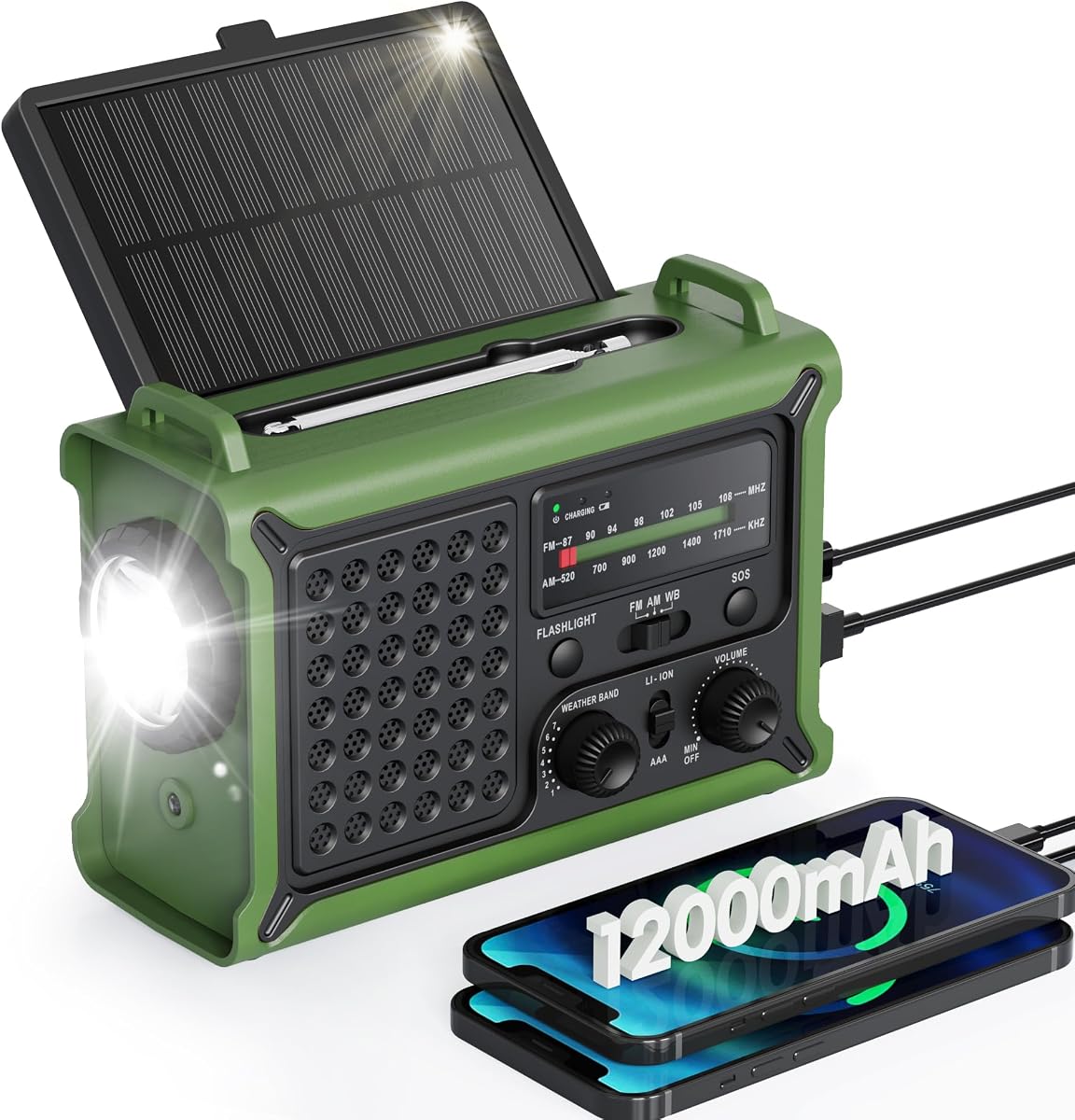
The Emergency Radio with Hand Crank & Solar, NOAA Weather Band, AM/FM, 12000mAh earns the highest rating in this group at 4.8. It combines a 12000mAh battery, an 8500mm² solar panel, hand-crank charging, Type-C input, NOAA and AM/FM reception, a five-watt flashlight, a 12-LED reading lamp, and a 120dB SOS alarm. The feature set makes it a premium all-purpose option for severe-weather readiness.
We may earn a commission when you buy through this link, at no additional cost to you.
DSP signal processing is intended to improve AM, FM, and NOAA reception by reducing noise, while the 57-millimeter speaker is designed to deliver clear, balanced audio. The oversized solar panel offers meaningful collection area for emergency recharging, and the hand crank provides another way to restore power when the grid is down. The large internal battery powers the radio, lights, and SOS functions while offering emergency charging for phones or small USB devices.
Lighting and signaling are unusually robust. The five-watt LED flashlight handles rooms, campsites, garages, and roadside conditions, while the 12-LED reading lamp is better suited to close work. The 120dB alarm can help attract attention if someone is injured, stranded, or lost. An IPX6 water-resistant design adds protection against rain, splashes, and outdoor conditions, though it should not be treated as waterproof for immersion.
This radio is best for buyers who want substantial battery capacity and outdoor resilience in a single device. Its NOAA experience is manual rather than automatic, so users must power the radio on and tune to a NOAA station. It is also less convenient for ultralight travel than the Emgykit or RunningSnail. Even so, the combination of power, reception, lighting, and signaling makes it the most complete premium selection in this comparison.
The 12000mAh battery can support radio use, lighting, and limited device charging while reducing the need to find a wall outlet. Multiple recharging paths make it easier to maintain readiness in changing weather and travel conditions.
DSP processing and a 57-millimeter speaker support clearer reception, while the five-watt flashlight and 12-LED reading lamp cover different lighting needs. The 120dB SOS alarm provides an additional attention-grabbing feature when conventional communication fails.
We may earn a commission when you buy through this link, at no additional cost to you.
The Emergency Weather Radio with Large Solar Panel, Real 12000mAh Battery pairs a 12000mAh battery with an 8500mm² monocrystalline solar panel and a reinforced hand crank. Its 4.7 rating makes it one of the strongest high-capacity choices in the guide. The supplied description emphasizes faster solar conversion and a faster crank generator than standard models.
We may earn a commission when you buy through this link, at no additional cost to you.
One minute of cranking is listed as enough to support emergency calls, lighting, or news updates, although actual performance depends on cranking speed and the function being used. Five charging options broaden the ways the radio can be restored, while the large solar panel offers a useful collection area during daylight outages. The internal battery is intended to run the radio, lamps, and charging functions when other sources are unavailable.
The lighting system includes a five-watt adjustable-beam flashlight and a soft 12-LED reading lamp, each with multiple brightness levels. NOAA alerts are supported, and the radio can trigger a nine-second alarm to provide preparation time. Its IPX6 construction is designed to handle outdoor rain, splashes, and general conditions. The model is therefore appropriate for hurricane preparation, camping, garage use, RV travel, and emergency go-bags.
This radio is a strong alternative to the similarly rated first-ranked model, particularly for buyers who value the large monocrystalline panel and adjustable flashlight. It is best treated as a home or vehicle backup because of its battery and panel size. NOAA operation requires attention, and buyers should verify whether they want automatic or manually maintained reception before making their final selection.
The 8500mm² monocrystalline panel is much larger than a small decorative panel and is designed to collect energy more efficiently. That makes daylight recharging more practical during prolonged outages, travel, and camping.
NOAA alert support and a nine-second alarm can provide warning before dangerous conditions arrive. The adjustable five-watt flashlight and softer 12-LED reading lamp cover immediate illumination and lower-level tasks.
We may earn a commission when you buy through this link, at no additional cost to you.
The Hand Crank Emergency Radio 7400mWh is defined by a 2000mAh internal battery and three built-in charging cables: Lightning, USB-C, and Micro USB. That cable storage is a practical differentiator when a household needs to charge several device types during an outage. With a 4.6 rating, it also offers NOAA, AM, and FM reception, multiple power sources, lighting, and an SOS alarm.
We may earn a commission when you buy through this link, at no additional cost to you.
The radio can be charged through USB-C, a hand crank, a solar panel, or AAA batteries. The supplied description states that these methods can keep the radio, lights, and SOS alarm available when regeneration is needed. A DSP chip and extended antenna support reception of NOAA weather information and local AM/FM broadcasts. The built-in cables reduce the chance of discovering that a required charging cable is missing at the worst possible moment.
Its flashlight offers low, medium, and high brightness modes, and six LEDs form the reading light. An SOS alarm can draw attention to an emergency. The 2000mAh capacity remains the limiting factor: it is enough for a small amount of phone charging but not comparable to the 10000mAh and 12000mAh models. The built-in cable assortment also does not eliminate the need for every modern charging standard.
This is a well-rounded pick for families that value organization and broad device compatibility in a compact emergency radio. It is appropriate for hurricane-season preparation, camping, and general household kits. Buyers whose primary goal is lengthy phone charging should select a larger battery, while those who often carry older USB-C or Micro USB devices may find the integrated cables particularly useful.
Keeping Lightning, USB-C, and Micro USB leads inside the device reduces clutter and avoids searching through drawers during an outage. This is a convenience feature that becomes more meaningful when normal organization and movement are disrupted.
USB-C, solar, hand crank, and AAA power offer several ways to keep the radio available. The internal battery still has only 2000mAh, so solar and cranking should be treated as regular replenishment methods rather than occasional miracles.
We may earn a commission when you buy through this link, at no additional cost to you.
The RunningSnail Hand Crank Radio is a compact 2000mAh model offering NOAA, AM, and FM reception, a hand crank, a solar panel, an LED flashlight, and emergency phone charging. Its 4.5 rating reflects a useful combination of functions for outdoor trips, evacuation, and household emergency preparation. At roughly 0.5 pounds, it is one of the easiest radios in this comparison to carry.
We may earn a commission when you buy through this link, at no additional cost to you.
The radio measures approximately 5 by 1.8 by 2.4 inches, allowing it to fit into small backpack compartments, vehicle kits, and emergency pouches. A retractable antenna supports reception in remote or weak-signal areas, while the 2000mAh rechargeable battery can supply limited charging to compatible USB devices. The one-watt flashlight offers basic illumination for dark environments and evacuation routes.
Solar and hand cranking provide two ways to replenish energy during extended failures. However, the absence of a larger internal battery means the radio should be charged before an emergency and kept ready rather than left untouched for long periods. Its lighting is also less capable than the five-watt or three-watt systems found in several competing models, making it best suited to navigation and immediate low-light tasks.
The RunningSnail is a sensible choice for hikers, campers, and travelers who prioritize low weight and simple three-way power. It also works as a compact home backup for weather broadcasts, though larger models offer more phone-charging capacity and brighter lighting. This model is best for buyers who want a no-frills radio that can be carried easily and operated without household power.
The radio's small dimensions and approximately half-pound weight make it convenient for hiking, fishing, camping, and evacuation bags. Its limited footprint also allows multiple preparedness items to fit within the same storage area.
The retractable antenna is designed to improve the practical reach of AM, FM, and NOAA stations in remote areas. It is particularly relevant for travelers who may move beyond strong urban or suburban broadcast coverage.
We may earn a commission when you buy through this link, at no additional cost to you.
The most useful emergency radio is not simply the one with the longest feature list. Start with the emergencies you expect, the locations where it will be used, and the amount of time it may need to operate without external power. Battery capacity, alert behavior, radio tuning, charging methods, lighting, and portability should then be weighed as a complete package.
Battery capacity is one of the clearest ways to separate emergency hand crank radios. Models with a 2000mAh internal battery are best treated as compact communication and lighting tools, while 5000mAh, 10000mAh, and 12000mAh models can support more demanding use. Larger cells may power the radio and lights for longer and provide more meaningful phone-charging support, although actual output also depends on conversion efficiency, device requirements, and the state of the battery.
Choose capacity according to need, not marketing language alone. For a small hiking kit, 2000mAh may be adequate. For a home outage involving several phones or prolonged lighting, 10000mAh or 12000mAh offers a more practical reserve. Always verify the stated internal cell capacity and realistic charging estimates before purchase.
NOAA reception is valuable because official weather broadcasts can remain available when cellular data and internet access are unavailable. Some radios automatically scan for alerts, while others require the owner to power the unit on and manually tune to the clearest local NOAA channel. Automatic scanning is more convenient and better suited to overnight warnings, whereas manual models can be less distracting and may consume less attention during normal use.
Confirm the behavior before buying. If the radio does not support automatic alerts, listen to the setup instructions and identify the correct local channel. Do not assume that possessing a NOAA radio replaces alerts from a phone, television, weather service, or other independent communication channel.
Hand cranking provides independence from the electrical grid, but it is usually most effective for maintaining radio and light functions rather than rapidly filling a large battery. Solar charging is useful during daylight, yet panel size and sunlight quality strongly affect results. USB-C or other wired charging is often the most efficient way to prepare a radio before an emergency, and disposable batteries can offer a familiar reserve when supported.
Look for at least two replenishment methods, ideally including wired charging, hand crank, and solar. Use wired charging to restore the unit before an expected event, test the crank periodically, and keep any required disposable batteries stored nearby.
A radio is often stored in a dark room or used during nighttime outages, making the flashlight and reading lamp core emergency features. Higher-wattage flashlights provide broader outdoor illumination, while lower-output reading lamps are more comfortable for maps, instructions, and supply checks. Models offering multiple brightness levels are more versatile because the same light can serve different tasks without always using maximum output.
An SOS alarm or siren can be useful for attracting attention, but it is not a substitute for proper signaling procedures or a personal emergency beacon. Check the alarm's activation method, volume, and whether the red visual signal is included.
A radio that is excellent at home may be frustrating to carry during evacuation. Compact models around five inches long and approximately half a pound are easier to place in a backpack or vehicle kit. Larger 10000mAh and 12000mAh radios often provide greater power but are more appropriate for a home, garage, RV, or vehicle emergency drawer. Consider the kit's available space and how quickly it must be retrieved in darkness.
Also consider the antenna, crank handle, and controls. A model that stays stable while being cranked is easier to use, and large knobs or clearly labeled buttons help family members operate it under stress.
Water-resistance ratings such as IPX3 and IPX6 indicate different levels of protection. IPX6 models are designed to withstand water spray and splashing, while IPX3 offers more limited protection. Neither designation normally means the radio can be submerged, and heavy rain exposure is best avoided unless the manufacturer expressly allows it.
Choose an IPX6 model for camping, fishing, hiking, and vehicle use where splashes are likely. Regardless of rating, store the radio in a sealed protective bag during severe weather and dry it before charging if it becomes wet.
NOAA weather radio is the priority for emergency information, but AM and FM add news, public affairs, music, and local programming. Some radios also include shortwave, which can provide additional information but requires familiarity with frequencies and propagation. DSP processing, an extended antenna, and noise-reduction circuitry may improve clarity in weak-signal areas.
Check the supported frequency ranges and the number of NOAA channels when those details are provided. For broad family use, manual digital or large-knob tuning can be easier to understand than a dense interface, but automatic scanning is beneficial for alerts.
Useful extras include phone charging, a compass, headphone jack, built-in charging cables, wrist lanyards, AC adapters, USB cables, and one-year or lifetime support. Evaluate extras against core needs: a device that already includes the right charging cable may be more valuable than a feature that duplicates another item in the kit. Warranty coverage also provides reassurance, but support should not replace regular charging and function checks.
Review the package contents before buying. Confirm whether AAA batteries, adapters, or cables are included. A complete package with clear instructions and accessible support is more useful for long-term preparedness than a long list of unfamiliar extras.
Before an emergency, fully charge the radio through its wired charging input and read the instructions for tuning NOAA channels, operating the flashlight, testing the SOS alarm, and identifying the battery-level indicator. If it uses AAA batteries, store suitable spares with the device. Place the radio where family members can find it without opening a complicated box, and place a laminated card nearby with local NOAA frequencies and emergency contacts.
During routine use, check the battery level regularly and recharge through a reliable outlet or computer rather than waiting until a warning appears. Test the hand crank briefly to confirm that it turns smoothly and that the radio responds. For a manually tuned NOAA model, extend the antenna and find the clearest local channel before conditions deteriorate. Keep the radio operating during a severe-weather watch so users recognize the controls and can hear the broadcasts.
For long-term care, keep the unit dry, avoid submerging it, and protect it from extreme heat. Recharge it every three to six months, particularly for models whose instructions recommend periodic maintenance. Clean the exterior with a lightly damp cloth, remove grit around the crank and ports, and never use a charging cable that feels damaged. Test the flashlight and alarm periodically, but avoid activating the loud SOS siren where it could disturb others.
A hand crank is primarily an emergency backup because generating useful electrical energy takes sustained effort. The listed performance varies significantly among models: one compact radio cites roughly 15 to 20 minutes of listening after one minute of steady cranking, while other products claim phone or lighting support in a similar period. Wired charging and solar are usually better for routine replenishment, so use the crank when other sources are unavailable.
Automatic scanning is convenient because the radio can watch for official alerts while in standby. It is especially useful overnight or in a home where someone is not continuously listening. A manually tuned NOAA radio can work equally well when the correct local station is selected in advance, but it will not provide unattended scanning unless the manufacturer states otherwise.
A 12000mAh model is better when you need longer radio and light runtime, more phone-charging reserve, or fewer recharge cycles between uses. A 2000mAh radio is lighter, smaller, and often sufficient for NOAA listening, a flashlight, and short emergency communication needs. The correct choice depends on which functions matter and where the radio will be stored.
Solar charging can be a useful supplement, especially during daylight outages, but charging speed depends on the panel area, sunlight, battery condition, and electronics. A large 8500mm² panel offers a stronger starting point than a small decorative panel. For dependable preparation, recharge through a wired input before an expected emergency and maintain the battery on a regular schedule.
They are designed to remain useful when grid power and cellular service may be unavailable, and the radio, crank, and battery can operate without a wall outlet. NOAA broadcasts, lighting, and alarms provide useful emergency support. However, no radio should be relied on as the only source of emergency information, so keep a separate alert method and follow official evacuation guidance.
IPX6 indicates protection against powerful water jets directed at the enclosure under specified test conditions. In practical terms, it is better suited to splashes and rain exposure than an IPX3 model. It does not mean the radio is submersible, and prolonged heavy rain or immersion can still cause damage.
Recharge it through its wired input, confirm that the battery indicator responds, and test the radio, flashlight, and alarm. Periodically exercise the crank to ensure the mechanism is not stiff, and clean away dust or moisture around the controls and charging port. Models with lithium batteries benefit from occasional maintenance charging, and keeping spare compatible batteries nearby adds another layer of readiness.
Many models include a USB output intended for limited phone charging, but capacity and charging speed vary considerably. A 2000mAh radio may provide only a small amount of power, while 10000mAh and 12000mAh models offer a more useful reserve. Phone requirements, conversion losses, screen use, and signal strength all affect the result, so preserve battery power for essential communications.
The Solar Radio Emergency Hand Crank 12000mAh is the most balanced overall recommendation because it combines a large battery, a substantial solar panel, strong radio reception, phone-charging capability, and comfortable controls. The Emergency Radio with Hand Crank & Solar is an equally compelling premium option, particularly for buyers who value IPX6 protection, a bright flashlight, and a 120dB alarm. For compact budgets, the Emgykit provides NOAA access, multiple power sources, useful lighting, and an SOS siren in a highly portable body.
Prioritize the functions that match your actual risks. Choose automatic NOAA scanning for unattended warnings, manual tuning if you want fewer controls and will select the channel in advance, and a larger battery if phones or extended lighting are central. Compact radios are more convenient to carry, while high-capacity units belong in a home, vehicle, RV, or go-bag where their weight and size create less friction.
Before ordering, verify the current listing for battery details, included accessories, NOAA behavior, water resistance, and warranty terms. Product features and availability can change, and charging performance varies with conditions and use. The best radio is the one that is fully charged, correctly tuned, placed where everyone can reach it, and actually familiar enough to operate during a stressful outage.