
HP Essential Laptop
4.4Editor score
Microsoft 365 included
Lightweight 3.24-pound design
Wi-Fi 6 connectivity
Anti-glare 14-inch display
A laptop for homeschooling must balance dependable performance, comfortable everyday usability, and enough flexibility for lessons, projects, video calls, and entertainment. The right model also depends on the operating system, curriculum, number of students, and whether the computer must travel between classes, libraries, or co-op spaces.
This guide compares ten laptops using the supplied specifications, including processor, memory, storage, display, connectivity, battery claims, operating system, and included productivity features. It covers premium MacBooks, Windows laptops, and ChromeOS Chromebooks to help families identify the most practical option for their curriculum and routine.
Each pick highlights a different reason to consider it, from strong integrated performance and long stated battery life to helpful accessory bundles and web-focused simplicity. Product ratings and configurations can change over time, so readers should confirm current specifications, compatibility, and pricing with the retailer before purchasing.
4.4Editor score

4.6Editor score

4.6Editor score
As an Amazon Associate we earn from qualifying purchases.
The comparison below organizes every laptop by platform, core specifications, connectivity, and practical homeschool use cases, making it easier to identify the right balance of capability, portability, and simplicity.





The Apple MacBook Neo 13-inch combines an A18 Pro chip, 8GB of unified memory, and a 256GB SSD in a compact aluminum design. It carries a 4.6 rating, placing it among the strongest products in this guide. Its standout qualities are the combination of strong performance, a high-quality Liquid Retina display, broad macOS application support, and a stated battery life of up to 16 hours.
We may earn a commission when you buy through this link, at no additional cost to you.
Homeschooling can involve more than reading articles and filling in worksheets. Students may edit videos, build presentations, write long essays, join live lessons, run educational software, or work simultaneously in a browser and a creative application. The A18 Pro chip and Apple Intelligence features are positioned to support those mixed workloads, while the 1080p FaceTime camera, dual-microphone array, and side-firing speakers improve virtual classes and presentations.
The main compromises involve the supplied memory and storage capacity. Eight gigabytes of unified memory should suit typical educational workloads, but demanding applications or numerous simultaneous browser tabs may benefit from more capacity. A 256GB SSD is also modest for a home computer that may accumulate assignments, photographs, videos, downloaded course materials, and backups. Families wanting extensive local media storage would need to plan accordingly.
Overall, the MacBook Neo is a strong choice for families using macOS-based creative tools, Apple devices, or a curriculum requiring polished productivity and media applications. Its portability, screen quality, battery claim, and performance make it a particularly versatile homeschool computer, provided the configuration suits the student’s software and storage needs.
The 13-inch format balances a usable work area with a manageable footprint, while the durable recycled aluminum enclosure supports use at home or on the move. The stated all-day battery gives families more freedom to complete lessons away from an outlet.
The Liquid Retina display supports one billion colors and is well suited to reading, video lessons, illustrations, and presentations. A 1080p camera and dual microphones also help the laptop function as a daily communication device.
We may earn a commission when you buy through this link, at no additional cost to you.
The HP Student Business Bundle pairs a 14-inch laptop with a 500GB external drive, wireless earbuds, mouse, mouse pad, USB extension cord, and HDMI cable. It has a 4.6 rating and stands out because it provides a broad collection of useful accessories rather than a bare laptop alone. Microsoft Office is included, and the system runs Windows 11 Pro.
We may earn a commission when you buy through this link, at no additional cost to you.
The Intel N150 processor has four cores and four threads, with boost speeds up to 3.6 GHz. For web-based lessons, document editing, email, streaming, and video calls, that is a practical foundation. LPDDR5 memory supports efficiency, while the internal 128GB UFS drive handles everyday files and the included external drive adds a useful 500GB for assignments, media, and backups.
Its 14-inch anti-glare display is designed to remain comfortable in bright environments, and the 720p camera with a dual microphone array supports online classes. The trade-off is that 4GB of RAM is modest by current standards. Heavy multitasking, large creative projects, and demanding software may feel constrained, and buyers should verify advanced application requirements before committing.
This is an appealing choice for families who want a ready-to-use Windows computer and dislike assembling accessories separately. It is especially useful when the student needs conventional productivity software, a larger local storage pool, and a straightforward path from unboxing to coursework. It may not be ideal for advanced technical work, but it covers common homeschool needs with fewer add-on purchases.
The combination of 128GB internal storage and a 500GB external drive gives students room to organize coursework and media without relying entirely on cloud space. The remaining accessories help with video calls, peripherals, displays, and comfortable everyday use.
Windows 11 Pro and the included Microsoft Office suite cover word processing, spreadsheets, presentations, and email. HP also highlights Copilot AI and an Intel N150 processor optimized for everyday learning tasks.
We may earn a commission when you buy through this link, at no additional cost to you.
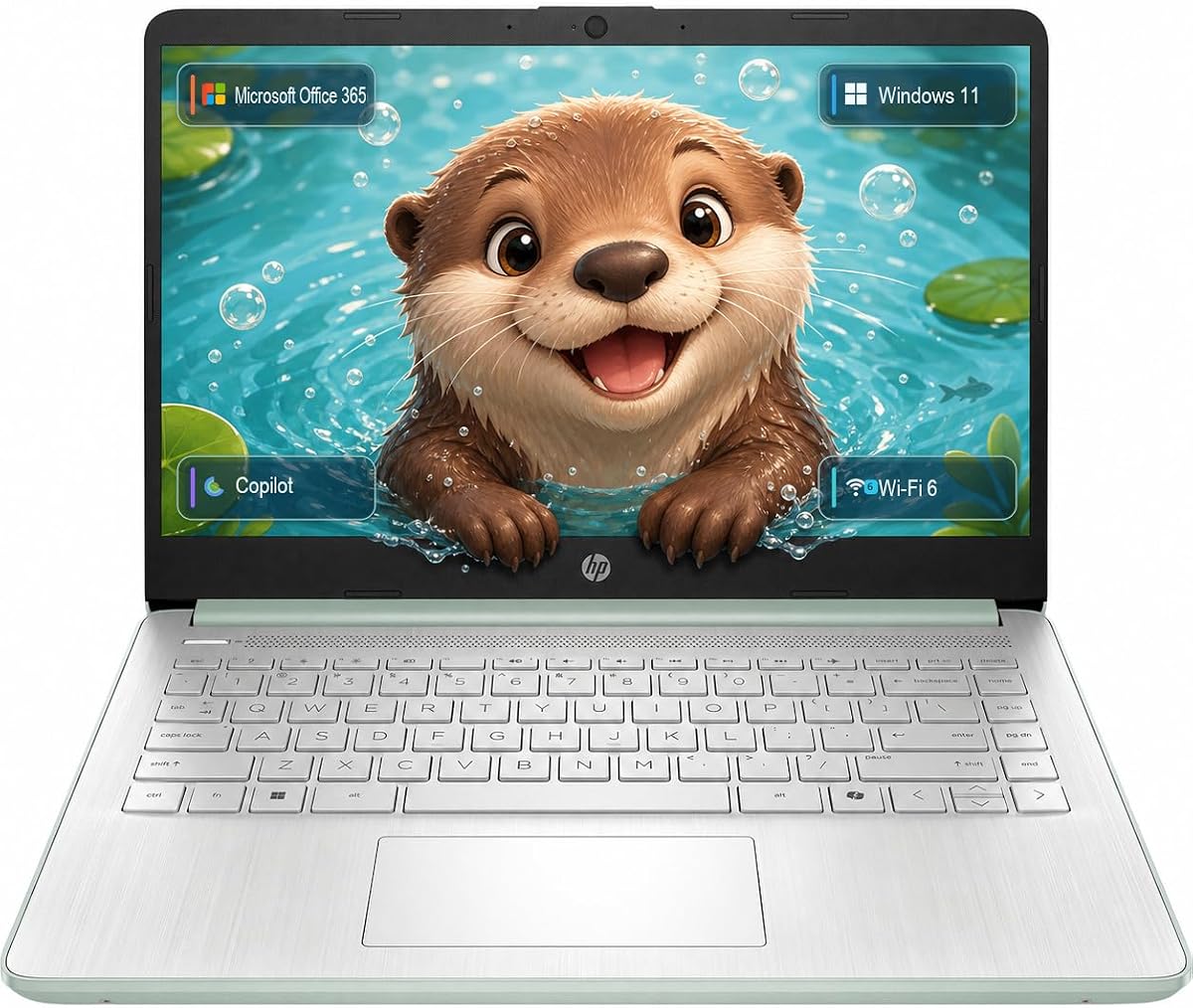
The HP Essential Laptop is a 14-inch Windows 11 system with an Intel N150 processor, 4GB LPDDR5 RAM, 128GB UFS storage, and a one-year Microsoft 365 Personal subscription. Its 4.4 rating reflects a generally well-rounded configuration for students who need word processing, spreadsheets, presentations, cloud storage, browsing, and video calls.
We may earn a commission when you buy through this link, at no additional cost to you.
Its strongest homeschool benefit is practicality. The anti-glare 1366-by-768 display reduces reflections, while the 720p camera and dual-array microphones support online learning. Connectivity is unusually useful for a compact model, including USB-C with DisplayPort, two USB-A ports, HDMI, a headphone and microphone jack, and a multi-format SD card reader.
The trade-offs are the modest resolution and 4GB memory, along with 128GB of internal storage. Families managing large video libraries, extensive creative projects, or large local media libraries may need external storage or cloud solutions. These limitations are less significant for a student focused on online curricula, written assignments, research, and communication.
Families seeking an affordable, portable general-purpose computer should find this configuration easy to justify. It weighs 3.24 pounds, offers useful stated battery figures, and includes the core productivity applications many homeschool families expect from a new Windows laptop.
USB-C DisplayPort output and HDMI make it practical to connect a larger monitor, while multiple USB-A ports support keyboards, mice, and other peripherals. The SD reader is useful for moving media from a camera.
At 3.24 pounds and less than an inch thick, the laptop is easy to move between a desk, couch, library, and co-op classroom. The manufacturer states up to 11 hours of video playback for typical daylong use.
We may earn a commission when you buy through this link, at no additional cost to you.
The HP 14-inch Chromebook uses an Intel Celeron N4120 quad-core processor, 4GB of LPDDR4x memory, and 64GB of eMMC storage. It carries a 4.4 rating and targets students whose lessons are primarily delivered through web-based tools, Google Workspace, and Android applications.
We may earn a commission when you buy through this link, at no additional cost to you.
ChromeOS reduces the amount of setup required for a web-centered school routine. Its 14-inch anti-glare display, webcam, HDMI output, two USB-A ports, and USB-C port cover the core needs of a family computer. The stated 14-hour battery life is particularly attractive for a device that may spend much of the day in classes and offline work.
Its limitations are predictable: 64GB of local storage is modest, and the Celeron platform is not intended for intensive video editing, advanced engineering software, large game libraries, or demanding creative applications. Families should also examine whether the curriculum requires a specific Windows or macOS application before choosing this model.
For a student who primarily writes in Google Docs, attends browser-based classes, researches topics, and uses lightweight Android tools, this Chromebook provides a focused and approachable device. It is a particularly sensible option for families prioritizing simplicity, battery endurance, and lower complexity.
ChromeOS integrates the browser and supported Android apps into a streamlined environment. That simplicity can reduce setup time and make a shared family computer easier for students to manage.
The 14-inch form factor provides enough room for writing and reference material, while the stated 14-hour battery supports lessons and projects away from a wall outlet.
We may earn a commission when you buy through this link, at no additional cost to you.
The HP Copilot Student Laptop combines an Intel N150 processor, 4GB of LPDDR5-4800 memory, and 128GB of UFS storage in a portable 14-inch chassis. It has a 4.3 rating and is designed for browsing, document editing, email, streaming, light productivity work, and video communication.
We may earn a commission when you buy through this link, at no additional cost to you.
Copilot integration adds an AI-oriented layer to an otherwise conventional Windows system. The laptop also includes a 720p camera, dual-array microphones, Wi-Fi 6, Bluetooth 5.4, USB-C with DisplayPort, two USB-A ports, and HDMI. These features make it a practical daily machine for online learning and conventional school productivity.
The 4GB memory and 128GB storage are the principal constraints. They encourage families to keep files organized, lean on cloud storage, and avoid demanding applications. The 1366-by-768 display is adequate for routine work but less detailed than higher-resolution alternatives in the guide.
This model makes sense for families seeking an affordable Windows laptop with current productivity features and AI assistance rather than a high-performance workstation. It should serve routine lessons, research, writing, meetings, and media consumption well when software demands remain moderate.
A dedicated Copilot key provides quick access to AI assistance. Families can use it to explore ideas, summarize unfamiliar material, and organize initial research, while still applying normal academic judgment to the output.
Wi-Fi 6, a 720p webcam, and dual-array microphones support a modern remote-learning setup. DisplayPort and HDMI outputs allow the student to work on a larger monitor when needed.
We may earn a commission when you buy through this link, at no additional cost to you.
The HP 14-inch Home Laptop is a straightforward Windows 11 Home device built around an Intel N150 processor, 4GB DDR4 RAM, and 128GB UFS storage. Its 4.1 rating is the lowest among the Windows configurations listed, so buyers should approach it as a basic education computer rather than a high-power creation machine.
We may earn a commission when you buy through this link, at no additional cost to you.
It includes a full-size keyboard with a numeric keypad, a 720p webcam, Wi-Fi 6, Bluetooth 5.0, USB-C, USB 3.2, HDMI, and a 3.5mm audio jack. One year of Microsoft 365 Personal provides Word, Excel, PowerPoint, Outlook, and cloud storage, covering the most common requirements of a homeschool assignment.
Its limitations are the 4GB of memory, 128GB of storage, and lower-resolution display. While the processor should handle web browsing, documents, streaming, and video calls, demanding applications and extensive multitasking may reveal constraints. Long battery life and the numeric keypad make it more useful for traditional coursework than its rating alone might suggest.
The laptop is best suited to families seeking a familiar, inexpensive Windows system for research, writing, spreadsheets, and remote classes. Buyers should check software requirements, and those with many simultaneous applications or large media projects may prefer a configuration with more memory or storage.
Windows 11 Home provides the standard environment many educational programs and families already recognize. The included Office subscription helps students begin working with documents, email, and spreadsheets immediately.
HDMI and USB-C make it straightforward to add a monitor, while USB ports accommodate a mouse, keyboard, printer, and other learning accessories. The 14-inch anti-glare screen is comfortable for standard study.
We may earn a commission when you buy through this link, at no additional cost to you.
The HP Student Bundle 500GB closely resembles the other N150-based HP laptops but adds a thin, compact 500GB external drive. With a 4.3 rating, it is positioned for families that need more file capacity than the 128GB internal drive can offer without purchasing another storage device.
We may earn a commission when you buy through this link, at no additional cost to you.
Its Intel N150 processor and 4GB LPDDR5 memory are intended for browsing, document editing, communication, streaming, and light productivity. The 14-inch anti-glare display has a 79% screen-to-body ratio, while the 720p camera and dual microphones handle online classes. Wi-Fi 6, Bluetooth 5.4, USB-C DisplayPort, HDMI, and two USB-A ports provide flexible connections.
The external drive increases total stated capacity to 628GB, but storage does not compensate for limited RAM. The computer remains best suited to standard educational workloads rather than advanced creative or technical programs. The drive should also be used with a sensible backup plan, since portable storage can be lost or separated from the laptop.
This is a good match for students who save presentations, PDFs, photographs, and media files locally but do not need workstation performance. Compared with an otherwise similar 128GB model, it reduces the need for an immediate extra purchase and offers more organized project space.
The included external drive can hold larger project files and keeps a local copy of important materials. It is particularly useful when internet access is inconsistent or when curriculum resources are downloaded ahead of time.
The system includes a full-size keyboard, touchpad, 720p camera, dual-array microphones, dual speakers, Wi-Fi 6, and multiple display outputs. That combination covers the essentials of a shared family learning computer.
We may earn a commission when you buy through this link, at no additional cost to you.
The HP Ultrabook 14-inch uses a dual-core Intel Celeron N4500 processor, 4GB of DDR4 memory, and 64GB of eMMC storage. It has a 4.2 rating and is tailored to document editing, web browsing, online learning, and other essential productivity tasks.
We may earn a commission when you buy through this link, at no additional cost to you.
Its portability is a major advantage. The machine weighs 3.24 pounds, measures 0.71 inches thick, and carries a clean snowflake white design. HP states up to 12 hours of video playback, while Wi-Fi 6, Bluetooth 5.4, USB-A, USB-C, HDMI, an SD reader, a 720p camera, and dual microphones cover common home and classroom needs.
The trade-offs are substantial for some students. Windows 11 Home in S mode can restrict installation of traditional desktop software, while 64GB of eMMC leaves relatively little room for documents and media. The dual-core processor is also less suited to intensive multitasking or advanced applications than the N150 and A18 Pro alternatives.
This Ultrabook works well for families committed to web-based tools and Microsoft 365, especially students who type essays, complete research, join meetings, and manage a light workload. Buyers should confirm curriculum compatibility before purchase, especially if specialized Windows applications are central to the program.
The compact dimensions and low weight make this model convenient for a mobile homeschool routine. A student can move from a dining table to a library without carrying a large, heavy computer.
The one-year Microsoft 365 Personal subscription includes Word, Excel, PowerPoint, Outlook, OneNote, Publisher, Access, and 1TB of OneDrive storage. It covers the core tools used in many homeschool routines.
We may earn a commission when you buy through this link, at no additional cost to you.
The HP Everyday Slim Laptop pairs an Intel N150 processor with 4GB of RAM and a 128GB SSD in a thin, portable Windows 11 design. It carries a 5.0 rating, the highest in this list. The supplied information emphasizes video-call quality, a dedicated Microsoft Copilot key, a multi-touch touchpad, and Microsoft 365 support.
We may earn a commission when you buy through this link, at no additional cost to you.
Compared with the many UFS-based HP models in this guide, its SSD designation is a useful distinction. SSD storage generally supports fast boot and application access, while 128GB still provides only a modest local capacity. The N150 processor and 4GB memory position the laptop for routine browsing, writing, spreadsheets, streaming, and virtual classes.
The 720p HP True Vision camera includes temporal noise reduction, and the dual-array microphones are designed to improve voice clarity. A full-size keyboard and Copilot key make the machine pleasant for regular work, although the supplied details do not list exact display resolution or weight. Buyers should confirm those details if screen quality or portability is a priority.
The high rating makes this model worth considering for a student who needs a straightforward school computer. Its 5.0 score should not be interpreted as evidence of heavy performance, so advanced creative or technical curriculum remains outside its clear area of strength. For standard lessons, communication, and productivity, however, it is a persuasive option.
The camera's noise reduction and dual-array microphones directly support lessons, group meetings, and tutoring sessions. These communication features can be as important as raw processing power during a typical school day.
The slim form factor and full-size keyboard aim to provide a comfortable balance between portability and usability. It is well suited to a student who works at a shared table but does not want a bulky home office computer.
We may earn a commission when you buy through this link, at no additional cost to you.
The HP Chromebook 14a is a ChromeOS laptop with an Intel Celeron N4120 quad-core processor, 4GB of RAM, 64GB of eMMC storage, and a 14-inch anti-glare display. Its 4.3 rating and stated 14-hour battery life make it a compelling option for browser-based learning.
We may earn a commission when you buy through this link, at no additional cost to you.
HP emphasizes the thin design, custom-tuned stereo speakers, Intel UHD Graphics 600 with 4K support, and a multi-touch pad with four-finger gestures. Fast Charge is claimed to raise the battery from zero to 50 percent in approximately 45 minutes, which is useful between classes or study sessions.
The principal limitations are age and platform scope. The listing identifies the 14a-na0226nr as a 2022 model, and the 64GB storage is small. ChromeOS is excellent for web applications and Android apps, but specialized desktop programs, some curriculum tools, and advanced creative workflows may not be available.
Despite those caveats, this Chromebook remains a coherent option for a student whose work centers on browsing, Google Workspace, video calls, and Android applications. The strong battery claim and comfortable 14-inch screen make it convenient for extended study away from an outlet.
A stated 14 hours of battery life offers considerable freedom for a full homeschool day. Families can reduce anxiety about charging when the computer is used for several consecutive lessons or co-op activities.
ChromeOS emphasizes the browser, Android applications, and a straightforward setup process. The updated Chrome browser and Google Play access support web research and lightweight academic applications.
We may earn a commission when you buy through this link, at no additional cost to you.
The best homeschool laptop is the one that comfortably runs the curriculum, fits the family’s workspace, and remains reliable throughout the school week. Rather than focusing on a single specification, compare software needs, processing demands, portability, connectivity, and long-term flexibility.
Begin by identifying every program the student expects to use. Web-based lessons and Google Workspace may run comfortably on a Chromebook, while Microsoft Office, educational desktop applications, creative tools, and some testing software may favor Windows. macOS can be valuable for families already invested in Apple devices or curriculum using Apple-specific applications. A hardware list from the curriculum provider is more reliable than assumptions based on a laptop’s processor.
Choose the operating system first, then confirm that every required application is supported and that the educational software will not place excessive demands on memory or graphics.
A modern entry-level processor is usually sufficient for web lessons, document editing, research, email, video calls, and streaming. The Intel N150 and N4120 configurations in this guide fit that general-use category, while the A18 Pro MacBook Neo offers more headroom for demanding applications and creative workflows. A faster processor helps when many browser tabs, educational apps, and media tools operate at the same time.
Match processor capability to workload rather than paying for unnecessary power. A capable chip is useful, but memory, storage, display quality, and battery life also shape the daily learning experience.
Memory determines how many applications and tabs can remain responsive at once. The 4GB configurations in this guide suit light schoolwork, but 8GB provides more breathing room for research, video calls, and multiple browser-based tools. Storage affects how many documents, images, videos, and downloadable curriculum files can be kept locally. The included external drives on two HP bundles expand capacity without changing the laptop’s internal memory.
Look for at least enough storage to hold active coursework and use cloud storage or an external drive for archives. For heavier programs, prioritize more memory before adding inexpensive external capacity.
A 14-inch display is a common homeschool compromise because it provides enough room for split-screen research and writing without the weight of a full-size notebook. Anti-glare surfaces are beneficial under bright household lighting, while higher resolution screens make small text and detailed images more comfortable. The MacBook Neo offers the sharpest visual specification in this group with its 13-inch Liquid Retina display.
Consider the student’s eyesight, desk space, and whether an external monitor will be used. Resolution matters, but a clear anti-glare panel, comfortable viewing angles, and suitable text size may matter more in daily use.
Homeschool schedules often include field trips, library sessions, co-op classes, and work away from a shared table. The listed battery claims range widely, with Chromebooks and the MacBook Neo making especially strong endurance claims, while several HP Windows models state up to 11 or 12 hours of video playback. Actual results vary with screen brightness, video calls, applications, and power settings.
Choose a weight and size the student can carry comfortably. A computer that is difficult to transport may be left behind or used only near an outlet, regardless of its theoretical battery capacity.
Wireless connectivity is essential for live lessons, research, and collaborative documents. Wi-Fi 6 appears across most of the Windows picks, while the older HP Chromebook 14a lists 802.11a/b/g/n/ac and Bluetooth. USB-A, USB-C, HDMI, headphone connections, and card readers make it easier to add a monitor, printer, wired network equipment, storage drive, or learning peripherals without replacing the computer.
The HP Student Business Bundle includes several accessories, reducing the need to buy them separately. However, families should compare included items against their existing equipment because a mouse or pair of earbuds may already be on hand.
A school computer may be used by more than one child, so durability and repairability deserve attention. The MacBook Neo uses a durable recycled aluminum enclosure, while the HP models emphasize thin, portable designs. Neither the supplied data provides detailed repairability ratings, so parents should investigate warranty coverage, replacement parts, and the availability of external storage before making a long-term purchase.
For a shared family device, a sturdy case, clear account profiles, and separate student storage can extend its useful life. A reliable keyboard, touchpad, webcam, and microphone are also important because every learner will depend on them.
Several picks include Microsoft 365 Personal, covering applications such as Word, Excel, PowerPoint, Outlook, and cloud-based storage. Chromebook systems instead center on Chrome and Android applications, while macOS provides Apple productivity and creative tools. Bundled subscriptions can make a new computer ready for school more quickly, but account activation, renewal terms, and regional availability should be verified.
Do not treat an included subscription as the only reason to choose a model. The operating system, hardware, and required curriculum applications should come first, with the software bundle acting as a convenience.
Set up the computer with separate accounts for each student and parent, enable automatic system updates, and create organized folders for assignments, media, and reference materials. Configure the display, text size, accessibility tools, backups, and privacy settings before the school year begins. A brief setup routine prevents interruptions when live classes or assignments begin.
Keep the laptop on a hard, ventilated surface and avoid placing it directly on soft bedding. Use a protective case during transport, clean the screen with a soft microfiber cloth, and keep liquids away from the keyboard. Periodic file cleanup helps limited storage models remain responsive, while regular backups protect irreplaceable schoolwork.
For daily use, save work in more than one location and sync active files to a trusted cloud service. Parents should check accounts, software updates, battery health, and parental controls periodically. When a computer is shared, establish a charging routine and a consistent shutdown or sign-out process at the end of each study session.
The best type depends on the curriculum and student’s workload. A Chromebook is well suited to browser-based lessons, a Windows laptop handles the widest range of familiar educational software, and a MacBook is useful for Apple-based creative workflows. Confirm required applications before purchasing any model.
A 4GB laptop can handle standard lessons, browsing, documents, spreadsheets, and video calls. It may struggle when many browser tabs and demanding applications are open simultaneously. Families using heavier software should prioritize 8GB or more, while lighter students may manage comfortably with 4GB.
A touchscreen is useful for interactive lessons, drawing, and certain educational applications, but it is not essential for every homeschool routine. The laptops in this guide prioritize keyboards, displays, and conventional productivity features, so students should verify whether touch input is required by the curriculum.
Storage needs depend on whether course files remain online or are downloaded for offline use. A 64GB model may fill quickly with documents, browser data, photos, and videos, while 128GB offers more room. Cloud storage and an external drive can expand capacity, and the HP bundle options include 500GB portable drives.
A Chromebook is often simpler and highly efficient for web-based curricula, Google Workspace, and Android apps. A Windows laptop is generally more flexible when educational software requires traditional desktop programs. Choose according to compatibility rather than assuming one operating system is universally better.
Most standard homeschool workloads, including online classes, research, and document editing, do not require a dedicated graphics card. Video creation, 3D design, programming simulations, and some games may benefit from stronger integrated or dedicated graphics. Those requirements should be checked before choosing a basic configuration.
Microsoft Office can make a Windows setup immediately useful for essays, spreadsheets, presentations, and email. Several picks in this guide include Microsoft 365 Personal, but families should confirm activation details, subscription duration, and future renewal terms. Chromebook and MacBook users may use different productivity workflows.
Battery life is important when lessons take place away from an outlet, such as during co-op activities, field trips, or library sessions. The listed models make claims ranging from roughly 11 to 16 hours, but real runtime varies with brightness, calls, video, and application use. A fast charger and consistent charging routine can further improve flexibility.
The MacBook Neo stands out as the most versatile and premium option, combining strong performance, an excellent display, a compact aluminum body, and a stated 16-hour battery. The HP Essential Laptop offers the most balanced value, while the HP Student Business Bundle is especially practical for families wanting Windows 11 Pro, Office, extra storage, and useful accessories together.
Before buying, prioritize curriculum compatibility, adequate memory, comfortable screen size, and the ports the student will actually use. Chromebooks serve web-centered learning especially well, Windows systems provide broader conventional software options, and premium laptops offer more headroom when a student handles advanced media or academic applications.
Specifications, configurations, ratings, and prices can change, so check the current product listing before ordering. Compare the computer with your family’s curriculum, existing accessories, display needs, and weekly routine, and choose the option that supports learning without creating unnecessary friction.
