
PalliPartners Compound Microscope
4.3Editor score
Magnification from 100X to 2000X
Top and bottom LED illumination
Twenty-eight included glass slides
Phone adapter and remote shutter
Best microscope for soil microbes guide comparing magnification, lighting, trinocular imaging, accessories, and usability for students, hobbyists, and
Observing soil microbes requires more than placing a soil clump beneath a lens. A useful microscope must provide enough magnification, controlled illumination, precise focusing, and a dependable way to prepare or examine specimens. Compound models are generally more suitable for serious biological observation, while digital handhelds can provide quick educational views of larger soil particles and organisms.
We compared all ten microscopes by magnification range, optical configuration, lighting, stage design, focus controls, imaging options, included accessories, and suitability for students, hobbyists, educators, and serious amateur researchers. The list covers compound binocular and trinocular models, a digital WiFi microscope, and a range of kits that differ considerably in capability and complexity.
Each review explains where a microscope is strongest, where its limitations become important, and which users may benefit most from its particular design. Higher magnification does not automatically mean better results: preparation, illumination, optics, and stable focusing are equally important. Product availability and pricing can change, so readers should verify the current listing and included accessories before buying.
4.3Editor score

4.6Editor score

4.2Editor score
The table below compares the ten microscopes across magnification, optical design, illumination, imaging access, and practical suitability for soil-related observation. Compound models offer the most conventional pathway to biological sample work, while the digital handheld is best understood as a portable viewing and recording tool rather than a laboratory-grade instrument.


The Research-Grade Trinocular Microscope earns the top position for users who want a conventional compound instrument capable of supporting detailed biological observation and digital documentation. It carries a 4.6 rating, the highest in this group, and combines 40X to 5000X claimed magnification with a trinocular head, 1.3MP camera, and USB 2.0 output. For soil-related work, the separate imaging path is especially valuable because images can be displayed, recorded, streamed, or projected while the operator continues using the binocular eyepieces.
We may earn a commission when you buy through this link, at no additional cost to you.
The optical configuration includes 4x, 10x, 60x, and 100x achromatic objectives. That range supports a sensible workflow in which low magnification is used to locate organisms or particles, 10x provides general survey views, and higher objectives are reserved for fine examination. The product description also highlights bright-field LED illumination, an NA1.25 spotting scope, a variable diaphragm, and a double-layer metal mechanical stage with X-Y movement. Those features are more relevant to reliable observation than a headline magnification figure by itself.
This is not a simple plug-and-play school scope. Users working with wet soil, dispersed particles, or very small organisms must understand slide preparation, cover slip placement, focus control, and clean handling. The 100x objective may also require careful attention to working distance and specimen thickness. The stage helps stabilize slides, but a stable specimen still depends on suitable preparation, and no microscope can compensate fully for an indistinct or poorly mounted sample.
The model is best recommended for serious amateur researchers, advanced students, educators documenting specimens, and users who want to record soil-related observations digitally. It is also the most balanced choice for people who may later explore bacteria, protozoa, algae, plant tissues, or prepared teaching slides. For a simple first look at a soil particle, it offers more than necessary; for a microscope intended to grow into a serious laboratory tool, its trinocular design and mechanical stage make it the most convincing all-around option here.
The trinocular head leaves both viewing eyepieces available while the camera occupies the dedicated imaging port. This makes it practical to show a specimen to a class, record changing field views, compare slides on a computer, or create a repeatable image record without repeatedly moving a camera between the eyepieces and a phone clip.
The double-layer metal stage and X-Y movement make it easier to reposition a slide without losing the area of interest. That control is valuable for soil suspensions because organisms, debris, and sediment may be unevenly distributed across a slide.
We may earn a commission when you buy through this link, at no additional cost to you.
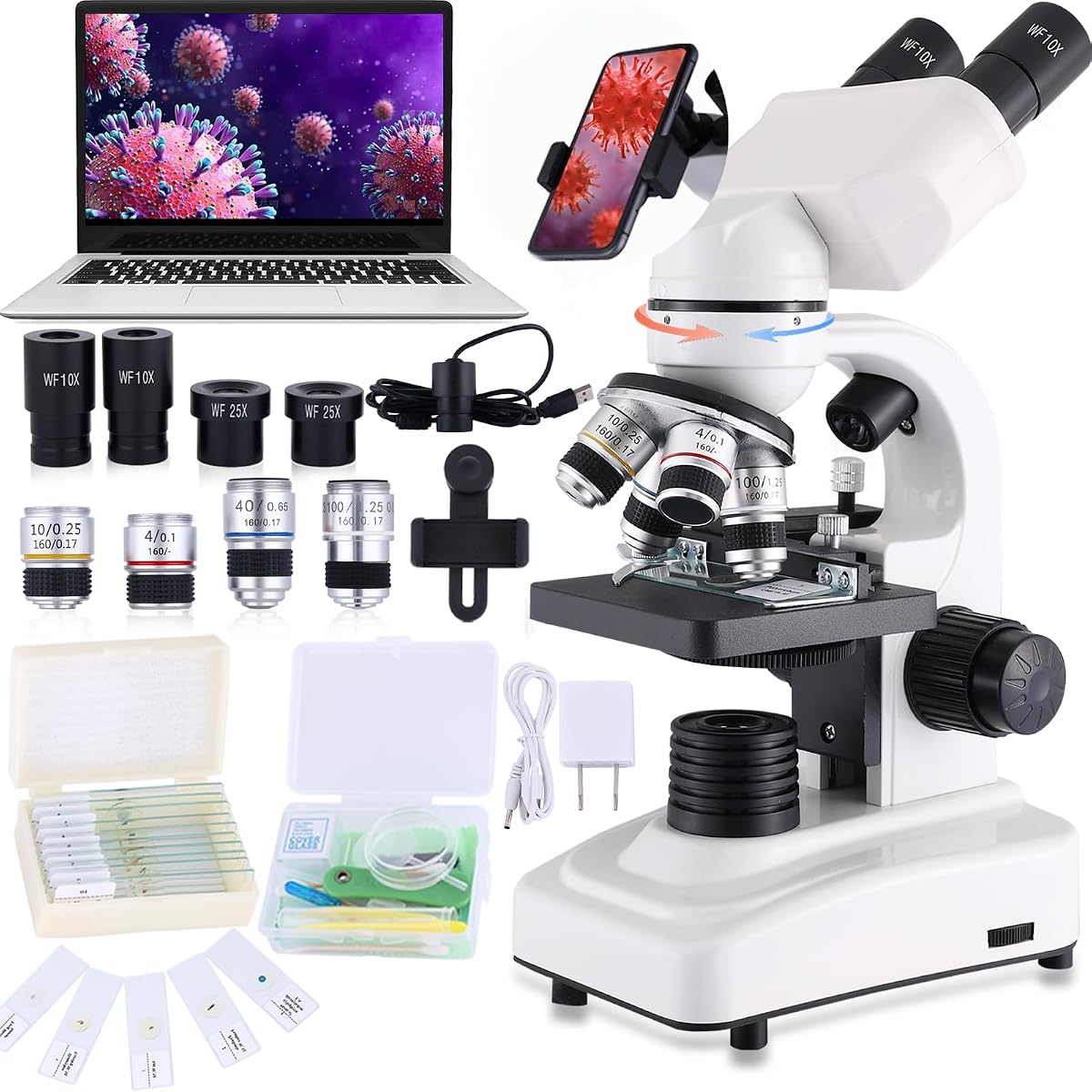
The PalliPartners Compound Microscope is the most approachable conventional option in this roundup, with a 4.3 rating and a specification set that covers the core needs of school-age learners, homeschoolers, and curious adults. It provides 4x, 10x, and 40x objective lenses, a WF25X eyepiece, and a 2X auxiliary lens, producing a claimed range from 100X to 2000X. It is a solid starting point when the goal is to learn specimen preparation and basic bright-field observation rather than purchase an advanced laboratory configuration.
We may earn a commission when you buy through this link, at no additional cost to you.
The strongest feature is the complete kit. Ten prepared slides and 18 blank slides are included, along with a universal phone clip adapter, a Bluetooth remote shutter, and a power adapter. The blank slides give users a way to create their own temporary mounts, which matters for soil samples. Adjustable top and bottom LEDs help accommodate both translucent material and opaque objects, while coaxial coarse and fine focus knobs make it easier to move from approximate positioning to a sharper final image.
The limitations are inherent to its simpler class of hardware. It does not provide the dedicated trinocular imaging port, broad accessory selection, or mechanical stage found in higher-ranking laboratory-style choices. Its maximum magnification is listed at 2000X, and effective detail still depends on slide quality, illumination, and whether the sample contains organisms that are large enough to resolve with visible light. Prepared demonstration slides are also not substitutes for field-specific soil samples.
This microscope is best for middle-school and high-school learners, new hobbyists, and families wanting a ready-to-use educational kit. Adults beginning a home microscopy hobby can also use it for basic slides and small translucent samples. It is less appropriate for users who immediately need repeatable digital imaging, advanced objective sets, or a large mechanical stage. Even so, it offers an approachable route into compound microscopy with fewer separate purchases required.
Prepared slides, blank slides, a phone adapter, a remote shutter, and a power supply give new users the main accessories needed to begin experimenting. The included materials also make it convenient to test the microscope before collecting and preparing environmental samples.
Bottom illumination is useful for translucent soil suspensions and thin biological material, while top illumination can provide useful reflected illumination for small opaque particles. The ability to combine or adjust these sources gives the basic setup more flexibility than a single-light design.
We may earn a commission when you buy through this link, at no additional cost to you.
The Wide-Angle Binocular Compound Microscope combines a 4.4 rating with a design centered on comfortable observation. Its binocular head, wide-angle eyepieces, 40X to 2500X claimed magnification, dual LED lighting, and two-layer mechanical stage make it a logical choice for adults, students, and amateur scientists who prefer viewing through two eyepieces. The wide field is particularly helpful when scanning a slide for soil particles or organisms that may be sparsely distributed.
We may earn a commission when you buy through this link, at no additional cost to you.
Both sides of the base have coaxial coarse and fine focusing controls, allowing quick positioning followed by smaller adjustments. The mechanical stage includes a spiral moving scale, which helps users track a location systematically across a specimen. Top and bottom LEDs provide primary observation and fill light, while the telescope lens and adjustable stage help keep the slide in a controlled position. This is a more structured platform than a simple monocular school microscope.
The supplied information does not clearly describe a dedicated camera port or bundled digital imaging system, so buyers should verify those requirements before purchase. The broad 2500X figure also should not be interpreted as a guarantee of laboratory-grade resolution at every setting. Observation of tiny soil organisms can be limited by specimen size, optical contrast, illumination, and preparation. A compound microscope can reveal biological structures, but it does not automatically identify species or replace more specialized microbiological methods.
This model fits users who value a wide visual field, binocular comfort, and a mechanical stage but do not necessarily need integrated digital documentation. It is a good fit for older students, homeschool families, and adult hobbyists beginning more systematic biological observation. Compared with the budget monocular option, it offers a more mature working arrangement; compared with the top trinocular model, it places less emphasis on connected imaging.
A wider field can make it easier to scan an unevenly prepared slide and keep track of small organisms or interesting particles. For exploratory work, seeing more of the specimen at once reduces the need to move the slide aggressively while searching.
Focus controls on both sides of the base let the operator use whichever hand position feels natural. Coarse focus supports quick changes, while fine focus helps resolve details without losing the target.
We may earn a commission when you buy through this link, at no additional cost to you.
The Laboratory-Grade Trinocular Microscope stands out for the breadth of its optical and accessory package. It has a 4.2 rating and offers 40X to 5000X claimed magnification through a compound trinocular design. Two WF10x eyepieces, two WF25x eyepieces, two 2X magnifying lenses, a high-pixel electronic eyepiece, and coated optics are included. The infinity optical system and stated 195 achromatic objective position it as a more advanced instrument for users building a sustained microscopy practice.
We may earn a commission when you buy through this link, at no additional cost to you.
Its physical design is well suited to detailed biological work. The double-layer stage offers mechanical positioning, while coaxial coarse and fine focus controls support rapid and precise adjustment. Other listed features include adjustable pupil distance, refractive-index correction, a 306-degree swiveling head, and LED illumination. The trinocular configuration allows visual observation through the binocular eyepieces while a camera occupies the third port, which is useful for teaching, remote viewing, and creating a visual record of specimens.
The extensive kit is both a strength and a source of complexity. It includes slides, cover slips, tissue sections, petri dishes, test tubes, droppers, brushes, tweezers, insect needles, a phone holder, a knife, wipes, a dust cover, and shock-absorbing foam packaging. Many of these items support general lab work, but serious soil observation still requires correct technique. The highest magnification settings may be of limited value if the sample is too thick, unevenly suspended, or poorly illuminated.
The model is best suited to serious hobbyists, educators, advanced students, and researchers who need a capable trinocular platform and extensive supporting equipment. It is a particularly strong choice for users who want to record images and inspect prepared slides across multiple magnification levels. Those seeking a simple first microscope may find it unnecessarily elaborate, but for a long-term laboratory-oriented setup, its optics, stage, camera access, and accessory breadth offer convincing versatility.
The included range of wide-field eyepieces and auxiliary lenses lets users move between general survey views and higher-power inspection. That flexibility is useful when one prepared soil suspension may contain particles of very different sizes.
Cover slips, droppers, petri dishes, slides, tools, and cleaning supplies cover many routine preparation tasks. The bundle is especially convenient for classroom or home laboratory users who do not want to assemble each supporting item separately.
We may earn a commission when you buy through this link, at no additional cost to you.
The PalliPartners Biological Compound Trinocular Microscope offers a relatively focused feature set for biological observation. Its 4.2 rating, 40X to 2000X magnification range, double-layer stage, dual LED illumination, and trinocular head make it a practical middle ground between a basic school compound microscope and a more elaborate laboratory configuration. The ability to connect an imaging device while retaining binocular viewing is the feature that distinguishes it from many conventional binocular models.
We may earn a commission when you buy through this link, at no additional cost to you.
The double-layer stage is designed to hold slides securely and reduce shifting during observation. Separate coarse and fine focus knobs allow a quick initial search followed by controlled refinement. Top and bottom LED sources accommodate transparent and non-transparent specimens, giving users flexibility when examining a mixed soil sample. The trinocular head also supports collaboration: one person can use the eyepieces while another views the image on a connected display or shares the observation remotely.
Its stated magnification tops out at 2000X, which is lower than the 5000X claimed by several competing trinocular models. That does not automatically make it less useful, because useful detail depends on optical quality and specimen characteristics. The listing also does not detail the exact camera connection method, so users should confirm cable type, software expectations, and device support before assuming a particular camera will work.
This microscope is well suited to home science learning, classroom teaching, basic laboratory work, and amateur researchers who want imaging capability without the full complexity of the most extensively equipped model. It is a good choice when documentation and collaboration matter but 5000X maximum magnification is not essential. Users who want a straightforward, balanced trinocular instrument are likely to appreciate its clean design and stable viewing platform.
Because the camera uses a separate port, the binocular eyepieces remain available for direct viewing. This is useful in a classroom where a specimen can be discussed at the microscope while its image appears on a larger screen.
A stable stage and separate fine-focus control help users hold a target in view while refining detail. This combination is especially helpful when suspended soil particles move after the cover slip is placed.
We may earn a commission when you buy through this link, at no additional cost to you.
The USB Camera Trinocular Microscope combines a 4.4 rating with a 40X to 5000X claimed range and a dedicated electronic eyepiece. It is a strong candidate for users who want to teach from a microscope, share a live field of view, or preserve images of soil-related samples. The trinocular arrangement supports direct viewing through the eyepieces while the digital system handles screen-based observation or recording.
We may earn a commission when you buy through this link, at no additional cost to you.
Its optical specification is extensive. The microscope includes two WF10x eyepieces, two WF25x eyepieces, two 2X magnifiers, a high-resolution digital eyepiece, and coated lenses. A stated 185 achromatic objective works with the infinity optical system, while adjustable refractive index and interpupillary distance help accommodate different users. The physical controls include dual coaxial coarse and fine focus, a dual-layer stage, diopter adjustment, and a 306-degree rotating tube.
The large accessory set is useful for building a home laboratory. Listed items include slides, cover slips, tissue sections, cotton swabs, insect pins, wipes, a petri dish, a pipette, tweezers, a phone mount, a scalpel, test tubes, a dropper, a brush, and a dust cover. Digital setup can be the less predictable part of the experience, however. Buyers should verify supported operating systems, camera software, connection requirements, and whether the included electronic eyepiece or separate USB camera is the preferred workflow.
The model fits educators, advanced students, and serious amateur scientists who want a capable trinocular microscope with digital teaching or documentation features. It is less attractive for someone who only needs a simple visual inspection of a soil grain or insect fragment. Compared with the top-rated research-grade model, it offers similar broad capabilities and an equally high claimed magnification ceiling, making software and accessory details the most important points to verify before choosing.
The trinocular head allows direct observation and camera output at the same time. This is useful for collaborative teaching because an instructor can discuss details at the eyepieces while a screen shows the same field to a larger audience.
Multiple eyepieces and magnifiers give users more than one way to frame a specimen. That flexibility helps when a slide contains both large debris and smaller forms that require a different viewing strategy.
We may earn a commission when you buy through this link, at no additional cost to you.
The Skybasic Wireless Digital Microscope is the most portable model in the roundup and is intended for quick inspection rather than conventional laboratory microscopy. It has a 4.2 rating, 50X to 1000X claimed magnification, eight adjustable LEDs, and a 2MP CMOS sensor. It can connect to a phone or tablet through its WiFi hotspot or to a computer through USB, making it convenient for examining soil grains, plant material, insects, and other accessible surfaces in the field or at home.
We may earn a commission when you buy through this link, at no additional cost to you.
The adjustable lights are central to its usefulness. They illuminate small objects without requiring a glass slide, and the included bracket and base can hold the microscope steady during close inspection. One-button photo and video capture makes it practical to document findings, while the digital connection allows images to be viewed immediately on a larger screen. The stated optimal focal range is 3 to 60 mm, so maintaining the correct working distance is important.
This is fundamentally a fixed-focus digital magnifier rather than a traditional compound microscope. It does not provide the optical clarity, stage control, specimen mounting, or high-power biological observation expected from the compound models. The product information specifically states that it is not suitable for professional serious biologists. It also has connection and software considerations: users must install the current application, remove the protective film, and follow device-specific camera permission steps.
The model is best for teachers looking for an inexpensive visual introduction, families examining outdoor specimens, and users who need a lightweight microscope that can travel easily. It can provide a satisfying first look at a soil aggregate, root surface, or insect feature, but it is not the right instrument for routine examination of small soil microbes. Its value lies in accessibility, immediate digital viewing, and portability rather than laboratory-grade resolution.
The handheld format allows a user to inspect an exposed soil particle, root, leaf, or insect directly. This removes the need to mount a sample on a slide when the goal is a quick educational or exploratory view.
WiFi connection and one-button photo or video capture make it easy to show another person what the camera sees. A phone or tablet can serve as a larger display, although users must account for the app and camera-permission setup.
We may earn a commission when you buy through this link, at no additional cost to you.
The Student Compound Microscope is designed primarily for education, school laboratories, and home learning. Its 3.7 rating is the lowest among the products reviewed, so buyers should evaluate it primarily as an entry-level teaching tool rather than a serious research platform. It nevertheless includes a useful combination of 40X to 2000X claimed magnification, upper and lower LED illumination, a five-color filter wheel, and accessories for preparing and capturing basic specimens.
We may earn a commission when you buy through this link, at no additional cost to you.
The objective set consists of 4X, 10X, and 40X lenses, paired with WF10X, WF25X, and 2X eyepieces. Adjustable brightness on both light sources allows the operator to adapt to translucent and opaque material. The five-color diaphragm filter can improve contrast for specimens that appear washed out under white light, a particularly useful feature in basic bright-field work where sophisticated contrast methods are unavailable.
The accessory kit includes blank specimen slides, cover slips, tweezers, prepared slides, and a phone adapter. These items make it possible to begin with the supplied materials and then prepare basic custom mounts. The lower rating suggests that some buyers may have encountered limitations in the overall experience, although the supplied information does not identify a specific defect. Buyers should therefore examine the listing carefully and avoid assuming that all compound microscopes offer equal optical consistency.
This model is best for younger students, classroom demonstrations, introductory biology projects, and users who want to learn basic microscopy without a large investment. It is less suitable for advanced soil microbiology, detailed digital imaging, or long-term professional research. As an educational microscope, its greatest strengths are the filter wheel, dual lights, and practical accessory set. Those features make it a sensible training tool for understanding why contrast and preparation matter before moving to a more advanced compound instrument.
The five-color filter wheel offers a simple way to change the appearance of a transparent specimen. It is a valuable teaching feature because students can see how lighting and contrast alter visibility without needing specialized microscopy techniques.
Blank slides, cover slips, prepared examples, tweezers, and a phone adapter cover common classroom tasks. The set provides enough material for supervised lessons and introductory sample preparation.
We may earn a commission when you buy through this link, at no additional cost to you.
The PalliPartners Compound Binocular Microscope emphasizes a complete kit alongside a capable 4x, 10x, and 40x objective set. It has a 4.2 rating and a 100X to 2000X claimed range. The binocular format makes it more appropriate for adults and older students than the basic monocular model, while the supplied collection tools, slides, phone adapter, remote shutter, and power adapter make it especially convenient for hands-on learning.
We may earn a commission when you buy through this link, at no additional cost to you.
The accessory package extends beyond the usual slide assortment. It includes 10 prepared slides, 18 blank slides, a four-bottle collection set, a hatching box, a dissecting needle, a ring cutter, scissors, tweezers, and a dropper. These additions are useful for collecting environmental material and handling small specimens. Dual LED illumination supports both translucent biological material and opaque surfaces, and coaxial coarse and fine focus provides a practical combination of rapid and precise adjustment.
It remains a binocular compound microscope rather than a trinocular laboratory model, so integrated camera access is less sophisticated. The phone clip and Bluetooth shutter provide a convenient alternative for recording, but they do not replace a fixed camera port or mechanically controlled imaging path. Users requiring extensive digital workflows, advanced objectives, or laboratory-grade mechanical positioning should look to the trinocular alternatives in this guide.
The model is best for users who want a generous collection kit and binocular viewing without moving into the most complex instruments. It suits family science projects, beginner soil investigations, older students, and hobbyists interested in environmental samples. The range of tools makes it particularly attractive for users who want to collect and examine specimens as part of a broader nature-study activity rather than only looking through a microscope at prepared slides.
Bottles, a dropper, blank slides, and collection tools help organize environmental samples before examination. This makes the kit more useful for actual soil and nature observations than a microscope supplied only with demonstration slides.
A universal phone clip and Bluetooth remote shutter reduce the need to touch the device while recording. The approach is less integrated than a dedicated trinocular camera, but it can still be useful for documenting a selected field of view.
We may earn a commission when you buy through this link, at no additional cost to you.
The Adult Binocular Microscope is a practical binocular compound model with a 4.1 rating and a 40X to 2000X claimed magnification range. It uses WF25X and WF10X eyepieces with 4x, 10x, 40x, and 100X achromatic objectives, providing several viewing combinations. The inclusion of a USB 2.0 electronic eyepiece makes it possible to capture photos and video on a computer, which is useful for users who want a straightforward path to digital documentation.
We may earn a commission when you buy through this link, at no additional cost to you.
Dual LED light sources illuminate specimens from above and below, supporting both translucent slides and small opaque objects. Coaxial and fine focus controls allow users to move quickly to a rough focus and then refine the image. Its binocular head is straightforward, and the available eyepieces and objectives offer a range that should be sufficient for basic biological observation, teaching slides, and prepared environmental mounts.
The listing is less detailed about stage construction and the broader accessory package than some competing products. That makes it particularly important to review the current product page, especially if mechanical positioning, a large stage, or specific collection tools are essential. The electronic eyepiece also introduces a digital workflow that may require compatible software and computer configuration. The product should be evaluated as a binocular microscope with imaging convenience, not as a fully specified trinocular research platform.
The model is best for adults, advanced students, and hobbyists who want binocular viewing plus computer-based image capture. It is appropriate for soil-related educational projects, prepared slides, and biological samples that benefit from digital documentation. Users needing collaborative screen viewing, a more elaborate accessory kit, or laboratory-style mechanical controls should compare the dedicated trinocular choices. For a simpler binocular setup with a 100X objective and electronic eyepiece, this is a clear and versatile option.
The USB electronic eyepiece allows supported computer systems to display and record what is visible through the microscope. This is helpful for documenting specimens without relying on a separate phone and clip.
The 4x, 10x, 40x, and 100X objectives support a progression from general scanning to detailed observation. Selecting the correct combination is still important because excessive magnification cannot reveal detail that is absent from the prepared sample.
We may earn a commission when you buy through this link, at no additional cost to you.
A microscope for soil microbes should be judged by optical design, specimen support, illumination, imaging, and the experience level of its operator. The largest advertised magnification is only one part of the equation, because effective observation also depends on sample preparation, contrast, focus stability, and whether the instrument supports the specimens a user intends to examine.
Compound microscopes use an objective lens near the specimen and an eyepiece that magnifies the resulting image. They are the conventional choice for biological samples because they support thin slides, careful focus changes, varied objective lenses, and high-resolution examination. A monocular model is economical and useful for introductory learning. A binocular head offers a more natural two-eye viewing experience, while a trinocular head reserves a dedicated port for a camera or other imaging device without occupying an eyepiece.
In summary, choose a compound model for real biological observation and select binocular or trinocular viewing according to comfort and imaging needs.
Advertised maximum magnification may be calculated by combining an objective, eyepiece, and auxiliary lens. The number shows potential optical enlargement, but it does not guarantee that a soil sample will remain visible, sharply focused, or diagnostically useful. Lower magnification is often more valuable for locating organisms in a suspension, while higher magnification becomes relevant only after a suitable specimen has been prepared. A 100x objective may also impose a short working distance and demand careful slide placement.
In summary, prioritize a usable range of objective lenses over the largest printed magnification figure.
Most microscopes in this guide use bright-field visible-light observation. They can reveal larger soil organisms, plant fragments, protozoa, algae, and some prepared biological structures, but very small bacteria generally require staining and oil-immersion techniques that vary by instrument. A digital handheld microscope adds no optical capability; it primarily turns a camera and light source into a magnifier. Users who need bacterial identification, viability assessment, or species-level analysis may need specialized laboratory methods beyond a general compound microscope.
In summary, match the instrument to the organisms and level of identification required, and do not confuse magnification with laboratory diagnostic capability.
Top and bottom LED illumination gives the operator flexibility. Bottom light is useful for transparent or thin specimens, while top light can illuminate opaque objects such as a seed coat, insect fragment, or soil aggregate. Adjustable brightness is important because too much light can wash out a transparent sample and too little can conceal detail. A five-color filter wheel is a simple way to increase contrast in an educational bright-field setup. Diaphragm or variable-iris control offers more nuanced light management on more advanced models.
In summary, look for adjustable dual lighting and a usable method for controlling brightness and contrast.
A plain stage can hold a basic slide, but a mechanical stage with X-Y movement makes it easier to scan large fields, return to a particular location, and keep tiny targets centered. Coarse and fine focus controls are essential for biological work because they allow a quick search followed by precise refinement. Separate controls may be easier for beginners to understand, while coaxial controls can make repeated adjustments more convenient. The important point is that both coarse and fine focus should be smooth and accessible during actual observation.
In summary, choose a stable stage and dependable fine focus, adding mechanical movement when regular slide navigation is expected.
Soil is not usually placed dry and unprocessed directly onto a slide. Depending on the intended observation, a user may need a suspension, a cover slip, a dropper, collection containers, a petri dish, or a prepared teaching slide. A kit with blank slides, cover slips, tools, and collection bottles can be more useful than a microscope with a slightly higher maximum magnification. The supplied accessories should support safe handling, repeatable preparation, and cleanup without requiring a large number of separate purchases.
In summary, consider the complete preparation workflow and choose a kit that includes the slides, coverslips, tools, and containers needed for your samples.
A dedicated trinocular camera port is the most flexible arrangement because users can observe through the eyepieces while displaying, recording, or projecting an image. An electronic eyepiece is a simpler binocular alternative, while a phone clip is portable but depends on device placement. Handheld digital microscopes are useful for field inspection but normally offer less optical control. Before purchasing, check computer and mobile operating-system support, software requirements, included cables, and whether a separate camera must be bought.
In summary, choose the imaging arrangement that matches your device and recording needs rather than assuming every camera connection is interchangeable.
Prepared slides and a beginner accessory kit are excellent for learning focus, illumination, and basic biological forms. Collection bottles, dissection tools, and blank slides become more valuable when moving outdoors to collect samples. Advanced users should prioritize objective quality, stage control, camera compatibility, and optical accessories. The scale of the setup should reflect the intended workload: a school demonstration does not need the complexity of a multi-user teaching microscope, while a serious amateur may appreciate a mechanical stage and interchangeable imaging options.
In summary, buy for your actual workflow, beginning with a simple supported kit and adding advanced optics or imaging only when needed.
Begin by learning the controls on a clean, stable surface. Start with the lowest objective, open the iris or diaphragm as appropriate, and use bottom illumination for a thin or translucent preparation. Place the slide on the stage, secure it if a mechanical stage is included, and use coarse focus only until the specimen is roughly visible. Switch to fine focus for the final image and adjust brightness to avoid washing out contrast.
For a soil suspension, collect a representative sample, place a small amount of liquid containing suspended material onto a clean slide, and add a cover slip if the observation method calls for one. Use the dropper and collection tools supplied with the kit rather than handling specimens directly. Work methodically from low to high magnification, move the stage rather than the slide, and record images through the available phone, electronic-eyepiece, or trinocular camera system when a particular organism or particle needs documentation.
After use, remove the slide, clean the objective and stage with an appropriate lint-free material, and return the instrument to a low-power objective before covering it. Keep dust away from the eyepieces and exposed optics, replace the dust cover, and store cables and accessories with the microscope. Keep liquids away from the base and power connections, and follow the manufacturer's guidance for cleaning agents and electrical safety.
There is no single magnification that works for every soil microbe. Larger protozoa, algae, and plant-associated organisms may become visible at lower compound-magnification levels, while very small bacteria usually require high-quality optics, staining, and sometimes oil immersion. Choose a microscope with several objective lenses so you can locate specimens at low power and increase magnification only when a suitable sample is in view.
A compound microscope can show cell-like forms, larger organisms, plant fragments, and some structural features, but appearance alone usually cannot confirm a species or classify a bacterium reliably. Definitive identification may require staining, culture, biochemical testing, or molecular methods. Treat the microscope as an observation tool unless its approved workflow specifically supports the identification method you need.
Digital handhelds are better for quick inspection of large surface features, plant material, grains, insects, and accessible soil particles. The product in this guide explicitly describes itself as a fixed-focus magnifier and not suitable for professional serious biologists. For routine biological slide work, a compound microscope with optical objectives, a stage, and controlled illumination is the stronger choice.
Binocular microscopes are comfortable for direct observation and usually cost less, while trinocular models add a dedicated third port for a camera or imaging device. A trinocular setup is preferable when you want to display, record, project, or share a specimen without giving up binocular viewing. For occasional notes or simple phone photographs, a binocular model with a phone clip may be sufficient.
The correct preparation depends on what you hope to observe. A basic suspension can expose larger mobile organisms and suspended particles, but the amount of soil, liquid, cover slip pressure, and viewing time can all affect what appears. Follow a recognized preparation method appropriate to the target, avoid overly thick mounts, and change slide areas systematically before concluding that an organism is absent.
Dual lighting provides useful flexibility because translucent preparations generally need transmitted bottom light, while opaque particles may respond better to reflected top light. Adjustable brightness is also important for controlling contrast. Neither light source improves resolution by itself, however, so good optics, careful focus, and a properly prepared specimen remain equally important.
A mechanical stage is not essential for simple prepared-slide demonstrations, but it becomes valuable when scanning a large area, centering small organisms, or returning to a specific location. It also helps keep a suspended soil sample steady while fine focus is adjusted. At the entry level, a stable plain stage and smooth fine-focus control may be adequate for short observations.
The Student Compound Microscope offers the most explicitly educational feature set, including dual LEDs, a five-color filter wheel, blank and prepared slides, cover slips, and a phone adapter. The PalliPartners Compound Microscope is another accessible choice with a broader supplied kit. Older students or adults who will work with slides regularly may benefit more from a binocular model's comfort and more stable mechanical controls.
The Research-Grade Trinocular Microscope is the strongest overall choice because it combines a 40X to 5000X claimed range, four achromatic objectives, a double-layer mechanical stage, variable illumination controls, and a dedicated USB imaging path. The PalliPartners Compound Microscope is the best budget option for learners who want an approachable, ready-to-use kit, while the PalliPartners Biological Trinocular Microscope offers balanced trinocular functionality for home and classroom use.
Prioritize the work you actually intend to perform rather than the largest magnification number. A compound microscope with controlled lighting, reliable fine focus, suitable slides, and a stable stage will serve most educational and amateur soil-observation tasks better than a portable digital magnifier. Add trinocular imaging when recording and sharing are important, and verify camera compatibility, objective details, and included accessories before ordering.
Finally, recheck the current product listing, customer feedback, package contents, and technical compatibility at the time of purchase. Product configurations can change, and the included microscope, camera, cables, slides, or software may vary from the information summarized in this guide. Confirm those details before making a final selection.