
NZXT H5 Flow
4.7Editor score
Fine-mesh airflow panels
Two Quiet Airflow fans
Large radiator support
Explore the best Silent Airflow Case options, comparing cooling, acoustics, radiator support, included fans, layout, and build flexibility.
A Silent Airflow Case must balance restrained acoustics with the airflow needed by modern processors and graphics cards. The right enclosure controls noise at its source, guides cool air through key components, exhausts heat efficiently, and gives builders useful cable-management options. It should also fit the hardware, cooler, storage, and dimensions planned for the build.
The ten cases in this guide were compared using the supplied specifications, with particular attention to airflow design, acoustic features, radiator positions, motherboard compatibility, included fans, front I/O, and practical expansion. Some emphasize fine mesh and open intake paths, while others use insulated panels, closed sections, or isolated chambers to reduce noise without sacrificing essential cooling capacity.
Each review explains where a particular case is strongest and where compromises may apply. The recommendations range from compact, acoustically damped enclosures to large modular mid-towers and premium airflow-focused designs. Product specifications and availability can change, so readers should verify current dimensions, included components, and retailer listings before purchasing.
4.7Editor score

4.7Editor score

4.7Editor score
This side-by-side comparison highlights each enclosure's core approach to cooling, noise control, radiator support, motherboard fit, fan provisions, and room for expansion.




The NZXT H5 Flow combines a compact ATX mid-tower format with a ventilation-oriented exterior and a 4.7 customer rating. Its standout feature is the perforated PSU shroud, which allows two optional 120mm fans to draw air beneath the power supply area. Ultra-fine mesh across the top, front, and side panels adds further intake opportunities while helping filter dust.
We may earn a commission when you buy through this link, at no additional cost to you.
Two 120mm Quiet Airflow fans arrive pre-installed, one at the front and another at the rear, giving the system useful airflow without requiring a separate fan purchase. The case supports a 360mm radiator in front and a 240mm radiator at the top, providing room for either substantial liquid cooling or a carefully configured air-cooling setup. Wide channels, hooks, and straps support tidy cable routing.
The trade-offs center on configuration flexibility rather than core cooling. A front-mounted 360mm radiator occupies much of the primary intake area, and the additional PSU-shroud fans are not included. The case also has a more restrained visual presentation than models offering tempered glass or elaborate RGB lighting. These limitations are reasonable for a builder seeking an efficient, uncomplicated enclosure.
This is a strong recommendation for a new ATX build that needs generous radiator placement, useful airflow, and two suitable fans from the outset. It works especially well for users who value a compact format and organized interior without paying for decorative features that do not improve cooling. Confirm the final component measurements before committing to a large graphics card or radiator.
The included front and rear 120mm Quiet Airflow fans give the H5 Flow a functional baseline for common ATX configurations. Their placement establishes both an intake and exhaust path, while the fine-mesh panels help maintain airflow through the enclosure.
Support for a 360mm front radiator and 240mm top radiator gives builders useful liquid-cooling options. The perforated shroud creates a separate lower intake zone, while the supplied cable channels and straps help maintain a clean interior.
We may earn a commission when you buy through this link, at no additional cost to you.
The Fractal Design Pop Air is a compact mid-tower for ATX, mATX, and Mini-ITX motherboards. Its 4.4 rating reflects a generally balanced design aimed at builders who want a colorful, storage-friendly case without moving into a large E-ATX enclosure. Vivid motherboard-plate colors, drive-tray accents, and exterior details help it stand apart from restrained office-oriented cases.
We may earn a commission when you buy through this link, at no additional cost to you.
Three 120mm Aspect 12 RGB fans are pre-installed, with room for two more for a maximum of five. Radiator support reaches 280mm in the front, 240mm at the top, and 120mm at the rear. Storage provision includes up to three hard drives and six solid-state drives, or two hard drives and five solid-state drives when an optical bay is occupied. The tempered-glass configuration also offers a convenient side-panel view.
Its most noticeable limitation is the smaller front radiator position compared with models that accept 360mm units. Builders using a large liquid cooler may need to rely on top or rear mounting and carefully verify that the motherboard, memory, and graphics card leave enough clearance. The RGB-equipped version may also be less suitable for a deliberately understated build.
The Pop Air is a good match for a compact gaming or general-purpose system that needs multiple storage drives and several fans. It suits builders who value visual personality and a tempered-glass view without paying for a premium wood-accented design. It is less compelling when a 360mm front radiator is a non-negotiable requirement.
Supporting up to six solid-state drives and three hard drives makes the Pop Air useful for projects that combine fast game storage with larger media libraries. The optional optical-bay use allows the builder to trade one drive position for another type of storage.
Three included RGB fans cover the basic intake and exhaust needs, while two additional positions allow more cooling pressure when required. Front, top, and rear radiator options provide several routes for assembling a balanced cooling setup.
We may earn a commission when you buy through this link, at no additional cost to you.
The CORSAIR 4000D RS ARGB Frame is one of the most adaptable mid-towers in the guide, earning a 4.7 rating through its combination of a high-airflow front panel, flexible fan rails, and a modular FRAME system. The front steel panel uses a three-dimensional Y-pattern perforation intended to reduce restriction while admitting cool air.
We may earn a commission when you buy through this link, at no additional cost to you.
Three CORSAIR RS ARGB PWM fans are installed at the front. They support daisy-chained four-pin PWM connections and Zero RPM mode, allowing them to stop during low-load conditions. The InfiniRail mounting system lets users slide fan positions along the rails, accept fans up to 200mm at the front, and mount up to 140mm fans in the roof for targeted airflow.
The internal side panel offers another meaningful decision. It can remain in place as a cable cover for a clean interior or be removed so additional fans can cool the motherboard area more aggressively. The FRAME concept also allows future changes such as a different front I/O panel or other component upgrades. These features add complexity, and some buyers may prefer a simpler fixed layout.
This case is a strong all-around recommendation for builders who expect to change fans, coolers, or components over time. It suits gamers who want ARGB and PWM control, as well as system builders who need intake flexibility. Prospective buyers should understand the FRAME system and compare compatible accessories before ordering.
InfiniRail changes the usual mounting pattern by allowing fans to slide into targeted positions. This makes it easier to align intake and exhaust with the exact dimensions of a graphics card, radiator, motherboard, or memory configuration.
The motherboard-side panel serves as a tidy cable cover when concealment matters. Removing it creates an additional fan zone for builders willing to prioritize cooling capacity over a streamlined interior.
We may earn a commission when you buy through this link, at no additional cost to you.
The white CORSAIR 4000D RS Frame provides the same flexible architecture as the modular platform while offering a clean, light exterior. Its 4.7 rating and supplied specifications emphasize strong airflow, three pre-installed RS PWM fans, and the ability to fit multiple 360mm radiators. Reverse-connector motherboard compatibility is also highlighted for builders using that wiring approach.
We may earn a commission when you buy through this link, at no additional cost to you.
The InfiniRail system supports front fans up to 200mm and roof fans up to 140mm. Sliding the rail allows fan placement to be adjusted around the particular hardware inside the chassis. A three-dimensional Y-pattern steel front panel provides a low-obstruction intake path, while the three-dimensional Y-pattern steel front panel provides a low-obstruction intake path, while the removable side panel can be used as a cable cover or opened for additional cooling.
Compared with the ARGB version, this model omits integrated lighting, which may be a drawback for a visible gaming build. Fan positions are flexible, but that flexibility means the builder must account for radiator thickness, tubing, motherboard clearance, and graphics-card dimensions before finalizing the arrangement. The white finish also requires care to keep visually clean.
This case is well suited to a white-themed system that prioritizes modularity, PWM cooling, and radiator options over decorative lighting. It is particularly useful for builders who want the freedom to reposition fans as their hardware changes. Review current component options and all clearance details before selecting a cooling configuration.
The perforated steel front is designed for unrestricted intake while giving the enclosure a restrained white appearance. That combination makes the case suitable for systems that prefer visible components without the visual intensity of extensive RGB lighting.
The ability to fit multiple 360mm radiators supports demanding CPU and GPU cooling arrangements. Adjustable rails help accommodate different fan and radiator dimensions, although careful clearance planning remains essential.
We may earn a commission when you buy through this link, at no additional cost to you.
The H2 (2026) HYXN is an ATX mid-tower built around substantial cooling capacity, with a 4.4 rating and eight pre-installed non-ARGB fans. Six are 140mm reverse fans and two are 120mm forward fans. A dual-chamber layout separates the main hardware from the power supply and drive area, which supports both thermal separation and more deliberate cable routing.
We may earn a commission when you buy through this link, at no additional cost to you.
Radiator support is the headline feature. The enclosure can accommodate either two 420mm radiators or three 360mm radiators simultaneously, including dual-layer fan configurations for 420mm units. It accepts E-ATX, ATX, mATX, and Mini-ITX motherboards, graphics cards up to 455mm, and power supplies up to 220mm. The listed exterior dimensions confirm that it is a spacious mid-tower rather than a compact model.
Eight included fans reduce the need to source a separate cooling set, but they also increase installation complexity and require careful planning to avoid turbulence. The lack of ARGB keeps the visual presentation restrained. A clear high-hardness tempered-glass panel displays the hardware, while the large rear compartment includes Velcro straps and dedicated mounting points for cleaner wiring.
The H2 is a compelling choice for a high-power build that already has a clear cooling strategy. It suits users who want maximum radiator and fan flexibility or who prefer a dark, non-RGB appearance. Buyers should verify that their desk, floor space, and planned components can accommodate the case's generous dimensions.
Support for several large radiators gives the H2 room for substantial CPU and GPU cooling. The included mix of 140mm and 120mm fans also creates multiple starting points for building balanced intake and exhaust paths.
Separating the power supply and drives from the main hardware creates a cleaner internal organization. The enlarged rear wiring compartment, built-in straps, and mounting points make it easier to route bulky power leads without obstructing airflow.
We may earn a commission when you buy through this link, at no additional cost to you.
The Fractal Design Pop XL Air RGB is a spacious mid-tower designed to combine strong cooling with generous storage and motherboard support. Its 4.7 rating reflects a well-rounded specification: E-ATX motherboards up to 280mm, ATX, mATX, and Mini-ITX support, a tempered-glass side panel, and four included 120mm Aspect RGB fans.
We may earn a commission when you buy through this link, at no additional cost to you.
Cooling flexibility is a major strength. The case holds radiators up to 360mm in the front, 280mm at the top, and 140mm at the rear. Two additional fan positions increase the total supported count to six. Storage options extend to four hard drives and six solid-state drives, or three hard drives and five solid-state drives with one optical bay in use.
The main consideration is physical scale. This is an XL enclosure, so it is less convenient for compact desks or restricted spaces. The RGB-equipped configuration may also be unnecessary for a restrained workstation aesthetic. Even with strong airflow positions, builders should account for the extra depth required by some front radiators and the dimensions of long graphics cards.
The Pop XL Air RGB is an excellent match for a spacious gaming system with significant storage and cooling ambitions. It gives a builder multiple radiator sizes, six fan spaces, and a broad motherboard range without requiring a custom water-cooling chassis. It is best for users who value capacity over a small footprint.
A 360mm front radiator can provide a substantial foundation for CPU cooling. Top and rear positions add alternatives, making it possible to distribute cooling across multiple hardware zones.
The Pop XL's concealed drive area supports a high mix of hard drives and solid-state drives. A magnetic cover keeps the components concealed while a storage drawer organizes two 5.25-inch bays.
We may earn a commission when you buy through this link, at no additional cost to you.
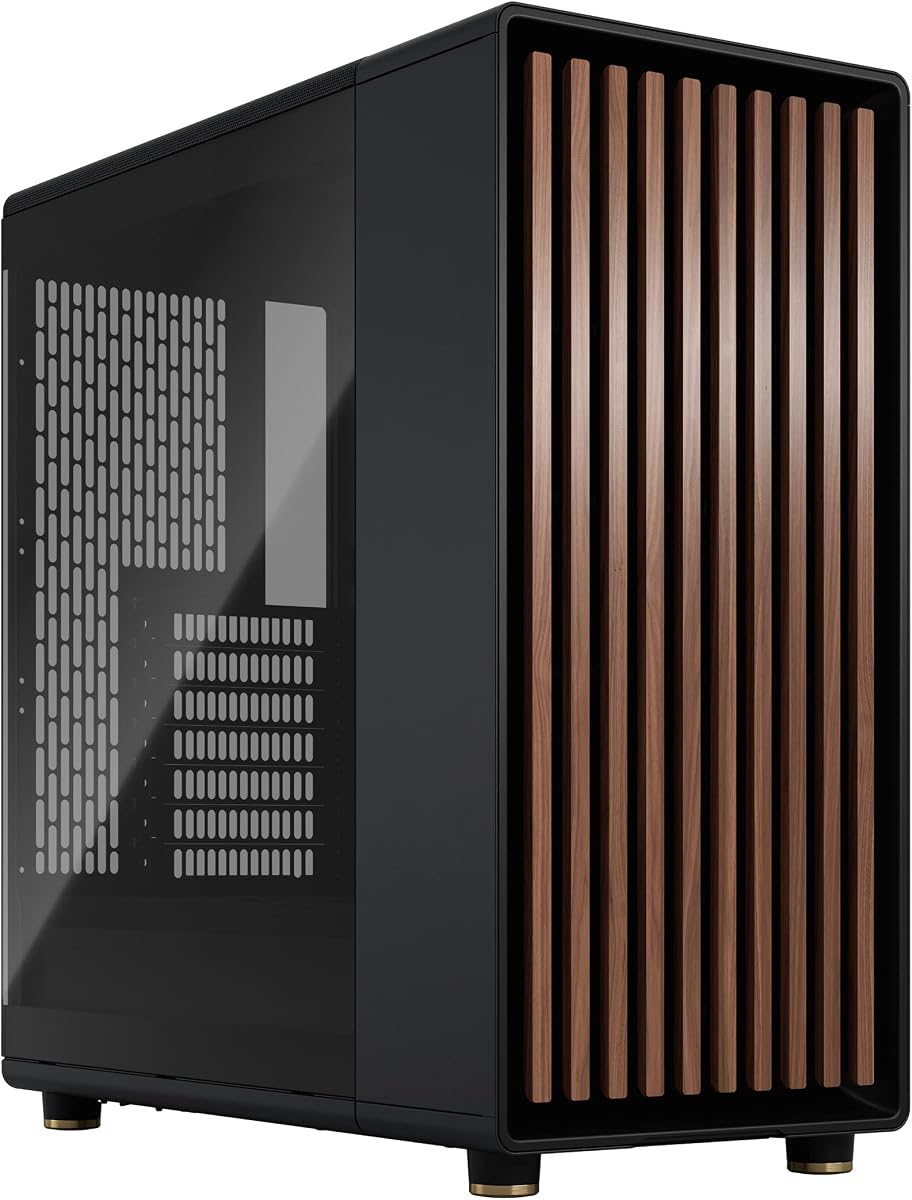
The Fractal Design North combines an ATX mid-tower format with walnut or oak front-panel bars, making it one of the most distinctive cases in the guide. Its 4.7 rating and supplied specifications show a balance of natural styling, open ventilation, and practical gaming features. The front uses an open layout and integrated mesh to bring air into the enclosure while filtering larger debris.
We may earn a commission when you buy through this link, at no additional cost to you.
Two 140mm Aspect PWM fans are included, which is a useful starting configuration for a mid-tower. The case supports ATX, mATX, and ITX motherboards, graphics cards up to 355mm, or up to 300mm with a 360mm front radiator, and seven bridgeless expansion slots. The tempered-glass side panel offers a clear view, while the front, side, and top panels can be removed without tools.
The major limitation is radiator scale. Although a 360mm front radiator can be accommodated, the resulting GPU length allowance drops to 300mm, which may constrain larger graphics cards. The natural wood aesthetic is also a more specialized design choice than a conventional black or white metal enclosure. Buyers who prefer understated traditional styling may not find it as versatile visually.
North is recommended for a builder who wants visible airflow, a distinctive desk-friendly appearance, and enough space for mainstream ATX hardware. It works particularly well with two 140mm fans and conventional air cooling, or with a compact liquid-cooling arrangement. Verify graphics-card and radiator clearances together before ordering.
The open front and integrated mesh allow air to enter without relying on a fully enclosed panel. This supports a natural appearance while maintaining ventilation around the main intake area.
Integrated tabs allow the side and top panels, along with the front, to be removed with less fuss. This makes component installation and routine maintenance more convenient than with many screw-secured panels.
We may earn a commission when you buy through this link, at no additional cost to you.
The CORSAIR AIR 5400 takes a chamber-based approach to cooling in a panoramic mid-tower. Rather than relying on one shared volume of air, it separates the CPU, graphics-card and motherboard area, and power-supply and storage area. This compartmentalized arrangement is designed to reduce interference between hot and cool airflow paths inside the chassis.
We may earn a commission when you buy through this link, at no additional cost to you.
The front CPU chamber can hold a 360mm radiator, allowing cooler air and the radiator to operate without drawing across heat from the central hardware area. The central chamber provides massive vertical airflow for the graphics card and motherboard, then directs the warmed air out of the chassis. The third chamber contains the power supply, storage, and cables, with separate intake and exhaust locations.
A crucial consideration is that the case does not include any PC fans. Buyers must provide enough fans and radiator hardware to establish the intended airflow. In addition, the supplied information provides no customer rating, so there is no rating history to support a reliability or satisfaction comparison with the other models. The design should therefore be assessed primarily through its chamber arrangement and compatibility details.
The AIR 5400 is best suited to an experienced builder with a high-power CPU and graphics card who wants carefully separated cooling paths. It is less convenient for a first-time builder because the empty fan configuration requires additional planning and purchases. Verify radiator dimensions, GPU clearance, and the complete accessory list before finalizing the build.
Separating the CPU, central hardware, and power-supply zones reduces the chance that one hot component directly heats another. Dedicated intake and exhaust locations make each chamber's airflow path more purposeful.
Because no PC fans are included, the cooling plan begins with the case itself. Builders must select compatible fans for the front radiator, central vertical path, rear exhaust, and lower power-supply chamber.
We may earn a commission when you buy through this link, at no additional cost to you.
The be quiet! Silent Base 802 is the guide's most explicitly acoustic-focused premium design, with a 4.7 rating and a 4.7 customer rating. Its interchangeable top cover and front panel can be configured for maximum airflow or silent operation, allowing the owner to change the enclosure's behavior according to the desired noise level and cooling demands.
We may earn a commission when you buy through this link, at no additional cost to you.
Three Pure Wings 2 140mm fans provide the main cooling hardware, while extra-thick insulation mats help reduce noise transfer through the panels. The state-of-the-art I/O panel includes a fan controller and USB 3.2 Gen. 2 Type-C connectivity. A decoupled motherboard tray can also be relocated for an inverted layout, adding structural and layout flexibility.
Silent operation inherently involves closing off some paths that would otherwise remain open, so the quiet configuration is not identical to maximum ventilation. The modular panel and tray choices also require more deliberate assembly than a straightforward fixed-layout case. As with any ATX enclosure, users should check graphics-card, cooler, and power-supply dimensions before finalizing the build.
This case is ideal for a workstation or gaming system where acoustic comfort matters but cooling must remain capable. It also appeals to builders who enjoy reconfiguring an enclosure as priorities change. The switchable design makes it a particularly versatile recommendation among the quieter options without abandoning high-performance fan support.
Interchangeable front and top panels allow the owner to choose between a more sealed acoustic configuration and a more open airflow setup. This is valuable for a system that must work in both quiet and high-load environments.
A front-panel fan controller simplifies fan management, while USB 3.2 Gen. 2 Type-C support suits modern peripherals. The decoupled and relocatable motherboard tray can improve the organization of larger builds.
We may earn a commission when you buy through this link, at no additional cost to you.
The Fractal Design Pop Mini Silent is built for smaller systems where noise control matters more than full ATX expansion. It has a 4.3 rating and uses a closed front, closed top, bitumen side panels, and sound-damping foam to reduce sound transmission. The design accepts mATX and Mini-ITX motherboards, making it most appropriate for compact gaming and office-oriented builds.
We may earn a commission when you buy through this link, at no additional cost to you.
Three 120mm Aspect fans are included, providing a practical cooling foundation in the small enclosure. Storage support includes up to two hard drives and six solid-state drives, or one hard drive and five solid-state drives when the optical bay is occupied. The tempered-glass side-panel version provides a view of the compact components without changing the core acoustic approach.
The central limitation is motherboard format. Builders planning around a standard ATX board, a long graphics card, or extensive expansion should choose a larger mid-tower instead. The closed front and top also make this model more appropriate for a dedicated acoustic role than for maximizing open-air intake. Internal layout planning is essential in such a compact chassis.
The Pop Mini Silent is a sensible recommendation for a quiet mATX or Mini-ITX system. It suits a builder who wants a small footprint, visible tempered glass, and genuine acoustic-damping features without starting with an empty enclosure. It is less suitable when future ATX upgrades or high-end full-size components are priorities.
Closed front and top panels, bitumen side panels, and sound-damping foam work together to reduce unwanted resonance. The approach is especially valuable when several fan-bearing components operate in the same confined space.
Despite its smaller motherboard support, the case can accommodate up to six solid-state drives. This makes it useful for portable or compact systems that need more fast storage than a basic small-form-factor enclosure usually offers.
We may earn a commission when you buy through this link, at no additional cost to you.
Choosing a silent airflow case requires balancing acoustic construction against open intake paths, then confirming that the enclosure fits the motherboard, graphics card, cooling hardware, storage, and daily workspace.
A case can reduce noise by limiting moving-air turbulence, insulating panels, separating vibration, and controlling resonances. Closed fronts and solid side panels often reduce direct airflow noise, while fine mesh and open fronts can improve cooling but may increase fan and air movement. Cases such as the Pop Mini Silent explicitly use closed panels, bitumen, and foam, while the Silent Base 802 offers interchangeable covers for quiet or open configurations.
Prioritize a case whose acoustic features match the intended workload. A quiet office PC may benefit more from closed, damped surfaces than a high-load gaming system that needs a large open intake.
Effective airflow needs cool air to reach the graphics card, processor, memory, power supply, and drives, with a clear route for warmed air to leave. Fine mesh can filter dust while maintaining a useful pressure differential, and perforated PSU shrouds can create a separate lower intake. Multi-chamber designs isolate major heat sources, while open fronts and adjustable fan rails offer more freedom to direct airflow.
Choose a layout that supports balanced intake and exhaust rather than relying only on the number of included fans.
Radiator capacity is only useful if the case has the depth, width, mounting points, and tubing clearance to install it. The guide includes cases supporting front radiators from 120mm to 420mm, with several allowing multiple large radiators simultaneously. Remember to include the combined thickness of the radiator and fans, as well as the space needed for fittings and tubes.
Match the radiator position to the graphics card, motherboard, and memory before choosing a cooling loop.
A case that supports ATX and mATX gives a builder more motherboard options, while Mini-ITX and mATX cases can reduce overall size. Some larger mid-towers even support E-ATX boards up to 280mm. The Pop Mini Silent, for example, accepts only mATX and Mini-ITX, whereas the H2, North, Pop Air, and Silent Base 802 cover broader ATX-oriented layouts.
Confirm the exact board standard before choosing the enclosure, especially for a new or custom system.
Included fans determine how much immediate cooling capacity the builder has. The NZXT H5 Flow includes two Quiet Airflow fans, the CORSAIR 4000D RS models include three PWM fans, and the H2 includes eight fans in mixed sizes. Conversely, the AIR 5400 explicitly includes no PC fans. A larger supplied set may be convenient, but it also increases cost, power use, and the need to configure a balanced intake-exhaust layout.
Check the number, size, type, lighting, and connector style of all included fans before adding more.
Long modern graphics cards can determine whether a case is usable even when it supports the desired motherboard and radiator. The H2 accommodates graphics cards up to 455mm, while the North supports up to 355mm and reduces that allowance to 300mm when a 360mm front radiator is fitted. Large air coolers, power-supply length, and hard-drive cages can also consume the same internal space.
Measure the entire planned system, including cooler overhang, power cables, and radiator thickness.
Storage needs vary from one boot drive to a large collection of hard drives and solid-state drives. The Pop Air supports up to six solid-state drives, the Pop XL Air also supports six, and the North provides combined 3.5-inch and 2.5-inch mounts. Good cable management reduces obstruction of intake paths and makes future maintenance easier. Wide channels, hooks, straps, rear compartments, and removable covers are all useful but not equivalent in capacity.
Choose based on both the number of drives and whether you need frequent access to cables.
A modern front panel should provide the connections used most often. The H2 includes USB-C 3.2, USB 3.0, USB 2.0, microphone, audio, and power controls. The North and Silent Base 802 also include Type-C connectivity, and the Silent Base 802 adds a built-in fan controller. Tool-free or easily removed panels can also improve the assembly experience.
Confirm connector compatibility and consider whether quick access to fans, storage, or controls matters in the finished setup.
Begin by comparing the case's mounting positions with every major component. Identify motherboard support, graphics-card clearance, power-supply length, cooler overhang, drive locations, radiator dimensions, and the space needed for cables before installing hardware. A simple paper layout or a clearance check in the case itself can prevent an expensive mismatch later.
Install the case fans, power supply, storage, and motherboard in an order that leaves room to connect cables and attach the front panel. Route power leads and data cables through the designated channels or behind the motherboard tray. Keep intake and exhaust openings unobstructed, and use the supplied straps or reusable ties so that expanding bundles do not restrict airflow.
After assembly, connect the front-panel controls and fans to the appropriate headers or controller, then use a controlled boot to verify that every fan spins in the intended direction. Begin with balanced fan speeds, check temperatures under realistic workloads, and adjust curves gradually. Clean removable filters and dust-sensitive intake surfaces periodically, and avoid blocking vents with objects stored against the case.
A quiet case balances restricted or directed airflow with acoustic materials, vibration control, and suitable fan hardware. Solid or insulated panels can reduce resonance, while well-placed mesh maintains a useful pressure path. The most effective result comes from combining a sensible case layout with quiet fans, balanced curves, clean filters, and unobstructed cable routing.
Not always, but it commonly allows more air to move through the case and can require higher fan speeds to maintain the same internal temperatures. A solid front may be quieter in a lightly loaded system because airflow needs are lower. The best choice depends on the hardware, cooling solution, and whether the case is used for quiet office work or sustained high-load computing.
Included fans provide a convenient starting point and show that the manufacturer expects the case to be usable out of the box. However, the included count may not match the required intake-to-exhaust ratio. Builders should confirm the fan size, connector type, direction, and speed-control method, then add or replace fans as needed for the selected cooling layout.
Compare the card's exact length with the case's published graphics-card clearance, then measure in millimeters. Also account for the power connector, cooler overhang, front radiator thickness, and any drive cage that occupies the same area. Cases with conditional limits, such as the North's shorter allowance when a 360mm front radiator is installed, require attention to the complete configuration.
It can if the motherboard, graphics card, cooler, power supply, and radiator all fit and the cooling arrangement is designed around the available space. Compact acoustic cases often use a closed front and smaller radiators, so the builder may need a high-quality air cooler or a carefully planned liquid-cooling loop. Larger cases generally provide easier access to unrestricted airflow.
Separate chambers isolate groups of components and give the designer more control over intake and exhaust routes. The CPU, graphics card, motherboard, power supply, and storage can receive more deliberate airflow instead of sharing one path. This can improve cooling organization, although it may require additional fans because some chamber-focused cases do not include them.
Matching is not strictly required, but compatible dimensions, mounting holes, connector types, and airflow direction make installation easier. A radiator needs a controlled flow through or across it, while case fans should support that path rather than fight it. Always follow the radiator and fan manufacturers' mounting instructions and confirm the case's stated fan limits.
Inspection frequency depends on the environment, dust levels, and how much intake air passes through the filters. Check the intake screens and fan areas every few months and clean them before visible buildup restricts airflow. Use gentle methods that avoid bending fins or damaging filters, and disconnect power before reaching inside the chassis.
The NZXT H5 Flow stands out as a balanced recommendation with fine-mesh intake paths, two included Quiet Airflow fans, and support for both 360mm front and 240mm top radiators. The CORSAIR 4000D RS ARGB Frame offers greater fan-placement freedom and modular customization, while the be quiet! Silent Base 802 leads the premium selections with switchable panels, insulation, and a relocatable motherboard tray.
For a different set of priorities, the Pop Mini Silent is a compact acoustic choice, the H2 supports extensive fan and radiator capacity, and the AIR 5400 uses isolated chambers for a highly deliberate cooling layout. Prioritize complete hardware compatibility first, then assess radiator clearance, included fans, acoustic materials, storage, and cable-management access.
Specifications and retailer listings can change over time, particularly for modular cases and recently introduced models. Before buying, verify the current dimensions, fan bundle, supported radiator sizes, front I/O, motherboard support, and included accessories. Those checks will ensure that the chosen Silent Airflow Case fits both the planned hardware and the level of quietness desired.


