
FiiO SNOWSKY Echo Nano Retro
4.8Editor score
CS43131 high-resolution DAC
Native DSD256 support
USB DAC connectivity
256GB microSD expansion
Our expert guide compares 10 lossless HiFi MP3 music players for DSD audio, covering DSD decoding, DAC performance, storage, outputs, and portability.
A lossless HiFi MP3 music player for DSD audio is designed to deliver high-resolution files with greater precision than a typical phone or entry-level media player. The most important qualities include native DSD capability, a capable DAC, clean headphone amplification, broad format support, reliable storage, and controls that work without a touchscreen.
We compared the ten featured players using their stated specifications, focusing on supported DSD and PCM formats, DAC hardware, headphone and line outputs, Bluetooth behavior, local storage, file management, displays, controls, and intended use. The list includes compact dedicated players, Android-based models, USB DACs, and traditional button-driven designs for different listening preferences.
Each review identifies the strongest feature and the compromises to consider, helping you match a player to your library and headphones. Ratings and specifications reflect the supplied product information, while availability, package variations, firmware details, and prices can change, so readers should verify current listing details before purchasing.
4.8Editor score
3.8Editor score

4.2Editor score
This side-by-side comparison highlights the major differences in DSD support, DAC hardware, wired outputs, wireless functions, and storage. It provides a quick way to distinguish dedicated offline players from Android-based and USB DAC models before reading the detailed reviews.


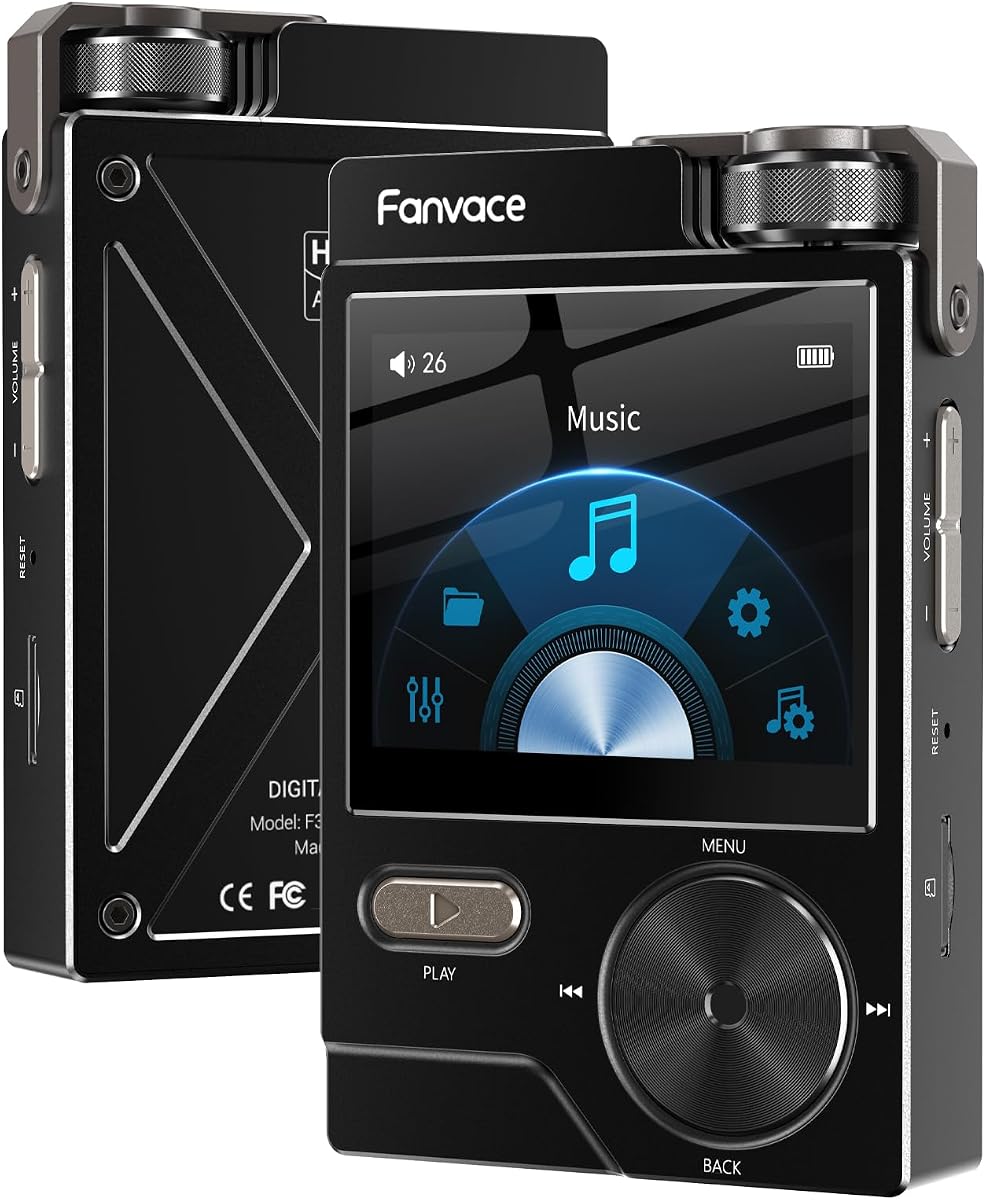


The Surfans F20 is a dedicated portable music player built around the ESS ES9018K2M DAC, combining local high-resolution playback with a practical collection of wired and wireless connections. Its 4.0 rating reflects a generally capable design, particularly for listeners who want FLAC, DSD128, WAV, APE, WMA, MP3, and other common formats in a straightforward offline device.
We may earn a commission when you buy through this link, at no additional cost to you.
Its strongest qualities are flexibility and balanced feature placement. The player supports PCM up to 32-bit/384kHz and native DSD128, while the included 64GB microSD card can be expanded to 512GB. A 3.5mm headphone output serves personal listening, the dedicated 1.5V line-out targets car AUX inputs and powered speakers, and Bluetooth 5.2 provides an option for compatible wireless headphones and speakers.
The F20 is not the specification leader in this group. Native DSD128 is below the DSD256 capability claimed by several alternatives, and its stated playback time of up to 10 hours is shorter than the endurance figures listed for some Android models. Its appeal instead comes from the combination of physical buttons, an ALPS scroll wheel, folder-based browsing, and a clear focus on local music without Wi-Fi, applications, or streaming subscriptions.
This is a strong recommendation for a listener who wants a no-nonsense DSD-capable player, a conventional control layout, and multiple ways to connect to existing audio equipment. It is especially suitable for commuting and travel because it avoids the distractions and complexity of a general-purpose operating system. Buyers seeking the highest DSD tier or substantially longer battery life should compare the HiBy R1 and ZAQE P30 before deciding.
The separate headphone and line outputs make the F20 useful beyond personal headphones. You can drive a car system through AUX, feed a home amplifier or powered speakers through line-out, or switch to Bluetooth 5.2 when a wireless route is more convenient.
An ALPS scroll wheel and physical playback buttons provide direct control over music without a touchscreen. Folder-based browsing also makes it straightforward to organize and access a large local collection of FLAC, DSD, WAV, and compressed files.
We may earn a commission when you buy through this link, at no additional cost to you.
The HIFI WALKER H2 is a compact, dedicated digital audio player with an ESS ES9018K2M DAC and support for DSD128, FLAC, WAV, APE, ALAC, and other high-resolution formats. Its 3.9 rating is supported by a capable feature set that includes 107dB signal-to-noise ratio, low distortion, a 64GB card, and expansion to 512GB.
We may earn a commission when you buy through this link, at no additional cost to you.
The H2 stands out for its ability to work as a USB DAC as well as a portable player. It also functions as a Bluetooth transmitter and receiver, with aptX support, while the separate 3.5mm line-out and headphone jack allow it to connect to computers, car systems, powered speakers, and wired headphones. That makes it a useful central device for someone who moves between portable and desktop listening.
Its limitations are meaningful for buyers focused on the absolute limits of DSD. Native playback tops out at DSD128 rather than DSD256, and the stated 10-hour playback figure may be modest for long journeys. Although the zinc-alloy chassis and physical controls feel appropriately dedicated, the 2-inch display is small compared with the touchscreen options in this roundup.
The H2 is best for a listener who wants a traditional dedicated player, reliable physical controls, and the ability to improve computer audio over USB. It is less compelling when native DSD256, a large display, Wi-Fi streaming, or a balanced headphone connection is the main priority. In those cases, the FiiO Echo Nano, HiBy R1, or H20 Pro offers a more relevant feature set.
USB DAC operation gives the H2 a role beyond offline mobile playback. Connecting it to a compatible computer allows the internal ESS DAC to serve as the audio interface, which can be useful for listeners who want a separate high-resolution decoding path.
The Bluetooth 5.2 implementation can transmit to compatible headphones and speakers or receive phone audio. That receiver function differentiates it from output-only portable players, although actual wireless quality still depends on the source, codec, and receiving hardware.
We may earn a commission when you buy through this link, at no additional cost to you.
The MECHEN M30 combines a compact 2-inch display with physical controls, dual-chip decoding, and a stated battery life of up to 25 hours. Its 3.9 rating reflects a well-equipped traditional player for local FLAC, WAV, APE, AAC, OGG, WMA, MP3, and DSD128 music, especially for listeners who prioritize endurance over wireless features.
We may earn a commission when you buy through this link, at no additional cost to you.
The stated decoding chain pairs a WM8965 DAC with a TPA6530 high-power amplifier. Supported formats include WAV and FLAC files up to 192kHz and DSD128 at 5.6MHz. A 1500mAh battery is said to charge fully in two hours, while the CNC-machined aluminum shell, scroll wheel, separate menu and return keys, and lock-screen function make the player feel purpose-built for physical operation.
The main compromise is that it lacks the advanced connectivity and high-tier DSD support found elsewhere. There is no stated Bluetooth or Wi-Fi function, native DSD stops at DSD128, and the player has no built-in memory, although a 64GB card is inserted. The 320-by-240 display is also modest, though it can show lyrics and song information.
The M30 is a convincing recommendation for commuters, travelers, and anyone who wants long offline playback in a small package. It is particularly attractive when battery endurance matters more than streaming, app support, or flexible wired outputs. For native DSD256, desktop USB DAC use, or large displays, choose one of the more specialized alternatives instead.
The stated 25-hour continuous playback is among the strongest endurance claims in this list. It makes the M30 suitable for long flights, full-day listening, and regular use without seeking a charger whenever the battery is only partially depleted.
A separate menu key, return key, and responsive scroll wheel allow direct navigation. The lock-screen function reduces accidental changes during pocket use, and the small screen keeps the device compact for listeners who do not need video or app interfaces.
We may earn a commission when you buy through this link, at no additional cost to you.
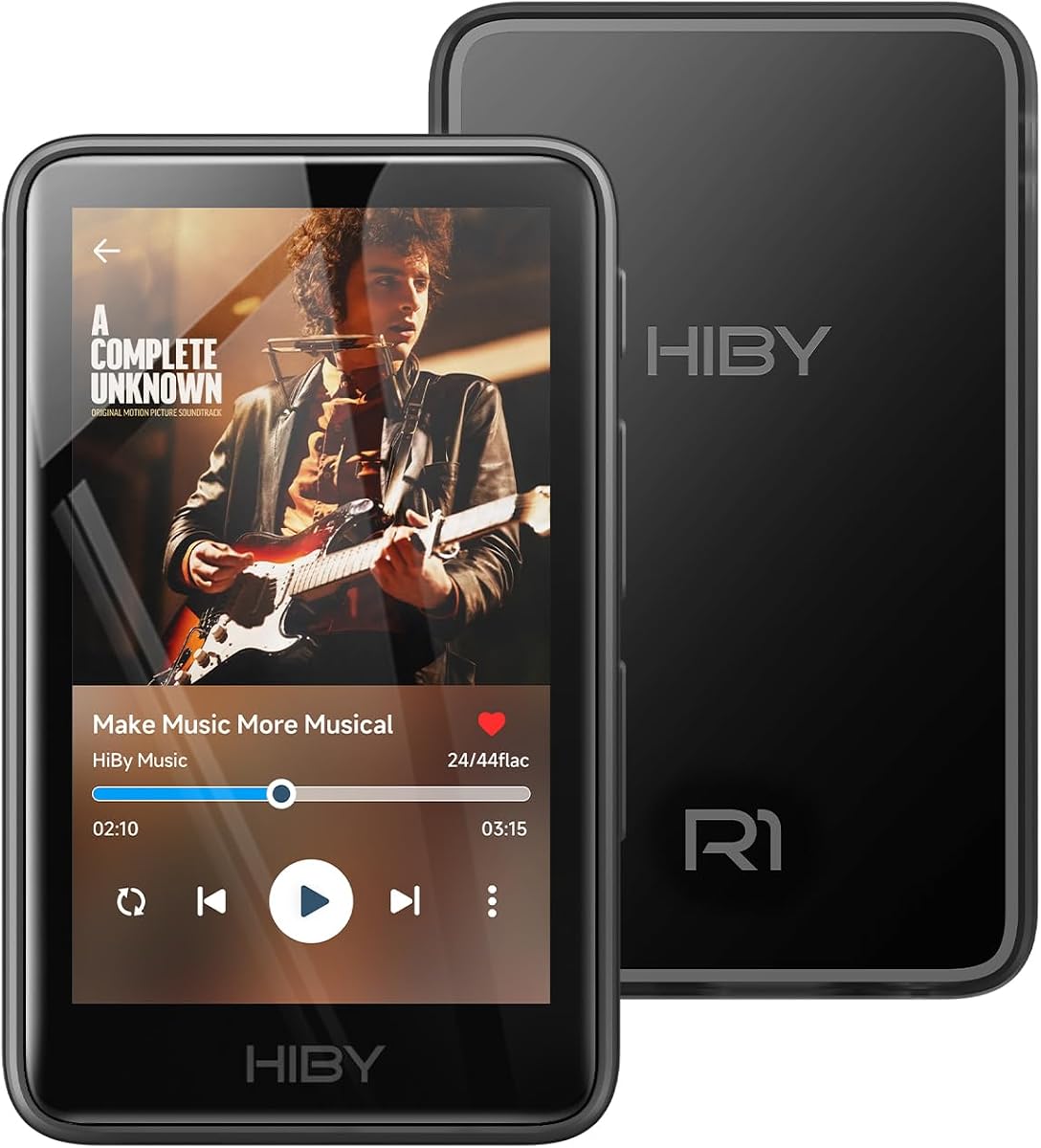
The HiBy R1 is a more open, software-oriented portable player than the traditional models in this guide. It combines the CS43131 DAC, native DSD256, PCM up to 384kHz, HiByOS, Bluetooth 5.1, and support for Tidal, Qobuz, and internet radio. Its 3.8 rating is the lowest among the featured products, but its specifications make it a strong choice for specific workflows.
We may earn a commission when you buy through this link, at no additional cost to you.
Storage is one of its major advantages. The player has no built-in memory and requires a compliant microSD card, but it supports cards up to 2TB, enough for approximately 50,000 high-quality songs according to the supplied information. It also handles a broad range of local formats, including MP3, WAV, APE, FLAC, DSF, DFF, ISO, CUE, WMA, OGG, AAC, Opus, and AIFF.
There are trade-offs to consider. Bluetooth is output-only, so it cannot pair with PCs, phones, or other players in the way a receiver-capable device can. The volume limiter must be disabled through the supplied Developer Options procedure when appropriate, and firmware updates are recommended to address known issues. A 1150mAh battery provides up to 15 hours of playback rather than the longest runtime in the list.
The R1 is best for a listener who wants native DSD256, extensive storage, online services, and a touchscreen-based operating system in a dedicated portable device. It is less ideal if you require built-in memory, Bluetooth receiving, or a simple button-only experience. For those priorities, the Surfans F20, HIFI WALKER H2, or MECHEN M30 may be easier to live with.
Tidal and Qobuz support gives the R1 access to online high-resolution services alongside locally stored DSD and PCM files. Internet radio is another useful option, making it a more versatile choice for listeners who do not want their portable experience limited entirely to offline albums.
The built-in MSEB mixer provides sound adjustments within HiByOS rather than leaving the output completely fixed. This is useful for experimenting with tonal balance, though listeners seeking a neutral reference chain may prefer minimal processing.
We may earn a commission when you buy through this link, at no additional cost to you.
The ZAQE P30 is an Android 12 portable HiFi player with 4GB of RAM, 32GB of internal storage, a 480-by-854 display, and a professional DAC and amplification chipset. Its 3.9 rating reflects a broad feature set, including DSD, FLAC, ALAC, WAV, APE, and MP3 support, dual-band Wi-Fi, Bluetooth 5.0, and both 3.5mm and balanced 4.4mm outputs.
We may earn a commission when you buy through this link, at no additional cost to you.
Its ESS9018Q2M2 DAC is paired with an OPA16122 and two RT6863D amplifier stages. The stated playback range reaches 192kHz at 24-bit, with a frequency response of 20–40kHz and total harmonic distortion plus noise of -101dB. The included internal memory is useful for a starter library, while microSD expansion to 512GB accommodates larger collections.
The P30 is less conventionally dedicated than the button-driven players because it runs Android 12. That creates access to apps, streaming services, downloads, and broader media functions, but also means it is bulkier and more complex than a minimal DAP. The product information says Bluetooth supports LDAC, SBC, and AAC, while the listing describes that transmission as lossless, so buyers should examine current codec and source details carefully.
This player is a good match for someone who wants DSD-capable hardware without giving up Android apps and wireless flexibility. It is especially appealing for balanced-headphone users because the 4.4mm output is stated to deliver up to 500mW per channel at 32 ohms. Listeners who want a pocketable, offline-only device may find the smaller Surfans F20 or MECHEN M30 more convenient.
The 4.4mm output is specified at 500mW per channel into 32 ohms, substantially more output power than the conventional 3.5mm connection. It can therefore serve more demanding portable headphones, subject to matching, volume limits, and the quality of the attached cable.
Android 12 supports apps, streaming, downloads, and a wider range of media than a closed dedicated player. Internal storage provides a place to begin, while the microSD slot allows a much larger library without relying entirely on wireless services.
We may earn a commission when you buy through this link, at no additional cost to you.
This 64GB portable player offers one of the most attractive specification combinations in the group: native DSD256, 24-bit/192kHz PCM, a 2000mAh battery, and a stated 35 hours of continuous high-resolution playback. Its 4.1 rating is also among the highest, while the traditional interface avoids the learning curve and distraction of a general-purpose operating system.
We may earn a commission when you buy through this link, at no additional cost to you.
Audio processing is handled by a WM8965 DAC and a TPA6530 amplifier, with stated signal-to-noise performance of 85dB per kilohertz and total harmonic distortion plus noise below 0.001%. The player supports MP3, AAC, FLAC, APE, WAV, WMA, OGG, and DSD, including native DSD256 at 11.2MHz. A 3.5mm headphone jack and line output support both personal and system-level listening.
Its principal limitation is the absence of Bluetooth and Wi-Fi, as explicitly stated in the product information. It also lacks the balanced connection and larger screen found in some rivals. The 2-inch 320-by-240 TFT display is functional for navigation, and the retro mechanical knob makes volume adjustment direct, but it is not a multimedia device.
The player is a strong recommendation for budget-conscious audiophiles who own DSD256 files but do not need streaming or wireless headphones. Its long stated battery life makes it particularly useful for travel, and the included card lets buyers begin loading music immediately. Compare it with the FiiO Echo Nano if a more established product name, USB DAC function, or a refined scroll-wheel design is important.
Native DSD256 at 11.2MHz is the headline specification, supported by a traditional offline design. That combination suits listeners who want high-resolution DSD playback without apps, notifications, or the added complexity of an Android-based portable.
The stated 35-hour runtime greatly exceeds the endurance figures of most dedicated DAPs in the guide. It should appeal to commuters and travelers, although actual results will depend on file format, output level, screen use, and battery condition.
We may earn a commission when you buy through this link, at no additional cost to you.
The 128GB HIFI WALKER H2 concentrates on local high-resolution playback with an ESS ES9018K2M DAC, MAX97220A headphone amplifier, 2-inch display, and physical controls. Its 4.0 rating reflects a capable dedicated design, while the included 128GB card distinguishes this package from standard 64GB H2 listings.
We may earn a commission when you buy through this link, at no additional cost to you.
Local format support includes WAV up to 32-bit/384kHz, FLAC and APE up to 24-bit/192kHz, DSF and DFF up to DSD128, SACD-ISO up to DSD64, and MP3. The MAX97220A stage drives the 3.5mm output at up to 70mW plus 70mW into 32 ohms and supports headphones from 16 to 150 ohms, giving it more scope than simple dongles.
Like the other H2 versions, it provides Bluetooth 5.2, a separate 3.5mm line output, and USB-C DAC operation. Its strengths are clear, but it does not reach native DSD256, and the 1500mAh battery is intended for a dedicated 2-inch screen and local playback rather than a large video experience. A line-out is valuable for an amplifier, but there is no balanced output.
This version is best for listeners who want a ready-to-fill 128GB library and value a well-supported DAC path for wired headphones. It works well as a compact source for a car, desk, or portable system, but buyers chasing the highest DSD rate should look to the FiiO Echo Nano, HiBy R1, or the 64GB DSD256 player.
The dedicated MAX97220A amplifier and stated 16–150 ohm support make the H2 more practical for full-size headphones than many entry-level portable players. The 70mW per channel output is not unlimited, but it provides a clearer upgrade path than a phone or basic media device.
A 128GB microSD card is included, giving buyers more room for FLAC, WAV, DSD, and mixed-format libraries from the outset. Expansion to 512GB adds flexibility for listeners who expect their collection to continue growing.
We may earn a commission when you buy through this link, at no additional cost to you.
This 64GB H2 combines an ESS ES9018K2M DAC with local DSD128, FLAC, WAV, APE, ALAC, and MP3 playback. The 4.0 rating aligns with a dependable dedicated player whose main strengths are connection flexibility, tactile controls, and a generous maximum storage capacity rather than flagship-level DSD support.
We may earn a commission when you buy through this link, at no additional cost to you.
The 3.5mm headphone output connects directly to personal headphones, while the dedicated line-out targets car AUX, powered speakers, and home audio systems. Bluetooth 5.2 with aptX supports compatible wireless headphones and phone audio receiving. The included 64GB microSD can be replaced or expanded to 512GB, and the player can read up to approximately 14,999 songs.
A zinc-alloy chassis, 2-inch display, physical buttons, and a scroll wheel make the H2 easy to operate without a touchscreen. The trade-offs are its DSD128 ceiling and stated playback time of up to 10 hours. It also has no internal storage, so the included card is essential, and the lack of a large display makes it more suitable for music than video.
This H2 is a good recommendation for someone who wants a small, dedicated player with both Bluetooth receiving and a proper line output. It is particularly useful in a car or as a simple front end for speakers. For native DSD256, balanced headphone power, Wi-Fi streaming, or long battery life, the HiBy R1, H20 Pro, or 64GB DSD256 player may be a better fit.
The dedicated line-out can feed a car AUX input, powered desktop speakers, or a larger home system. That turns the H2 into more than a personal headphone player and reduces the need to move the device between different listening environments.
Support for cards up to 512GB offers ample room for high-resolution albums and large mixed collections. The player can browse up to about 14,999 songs, while folder-oriented storage keeps the listening experience independent of streaming accounts.
We may earn a commission when you buy through this link, at no additional cost to you.
The HIFI WALKER H20 Pro is the most output-capable premium option in this group, combining dual ES9219PC DACs, a balanced 4.4mm headphone connection, Bluetooth, USB DAC operation, and a 3.2-inch touchscreen. Its 4.2 rating is the highest among the conventional dedicated players, reflecting a feature set designed for more demanding portable headphones.
We may earn a commission when you buy through this link, at no additional cost to you.
The 4.4mm output is specified at up to 380mW per channel into 32 ohms, while a standard 3.5mm output is also provided. Local files include FLAC, WAV, APE, MP3, AIFF, AAC, OGG, DSF, and DFF, and the included 64GB card can be expanded to 512GB. A volume knob and dedicated playback buttons complement the touchscreen, allowing quick changes without navigating every menu visually.
The key compromise is that the supplied specifications do not state native DSD256 support. It therefore does not have the same explicit high-DSD ceiling as the HiBy R1, FiiO Echo Nano, or 64GB DSD256 player. Buyers also need compatible wired hardware to benefit fully from the balanced section; ordinary wireless headphones will not access that output.
The H20 Pro is the recommendation for a listener with power-hungry or balanced headphones who wants a premium dedicated player. Its USB DAC function and flexible music browsing broaden its use at a desk, while local playback keeps it independent of streaming. If native DSD256 is the decisive requirement, prioritize a model that explicitly promises that format instead.
The 4.4mm output can deliver up to 380mW per channel at 32 ohms, providing meaningful headroom for portable headphones that need more voltage or current. A proper balanced cable and matching input are necessary to realize the full benefit.
Two ES9219PC chips provide dedicated high-fidelity processing for the stereo channels. Combined with the flexible control scheme and local file support, this makes the H20 Pro a serious portable source rather than a basic media player.
We may earn a commission when you buy through this link, at no additional cost to you.
The FiiO SNOWSKY Echo Nano Retro combines a nostalgic pocket-player design with a CS43131 DAC, native DSD256, and USB DAC operation. Its 4.8 rating is the highest in the group, while the absence of a touchscreen keeps the experience focused and the smooth scroll wheel provides a tactile way to browse music and adjust volume.
We may earn a commission when you buy through this link, at no additional cost to you.
The player supports DSD256, FLAC, WAV, APE, MP3, AAC, and other popular formats, and a microSD card can be added for up to 256GB of storage. A 3.5mm output supports wired headphones and in-ear monitors, while USB DAC mode allows use with a compatible computer. The CNC-machined aluminum body is designed to be lightweight, durable, and pocket-friendly.
The main compromises concern connectivity and storage. There is no stated built-in memory, so a card is required for local music, and the device offers only a 3.5mm wired connection rather than balanced output. It also lacks the large screens, streaming applications, expansive card limits, and multiple analog outputs found in the more advanced alternatives.
Despite those limits, the Echo Nano is an excellent recommendation for a listener seeking a simple high-resolution player with genuine DSD256 capability. It is particularly attractive for buyers who enjoy physical controls and a nostalgic aesthetic, or who want an affordable step up from phone-based listening. It also works well as a compact source when paired with compatible in-ear monitors or a portable USB DAC setup.
The smooth tactile scroll wheel and physical controls let you navigate playlists and change volume without repeated screen taps. That design reduces distraction and can feel more immediate than navigating a small capacitive display while walking or commuting.
The CS43131 provides native DSD256 and high-resolution PCM decoding in a compact enclosure. USB DAC operation extends that hardware beyond portable use, allowing the player to serve as a simple digital source for a compatible computer.
We may earn a commission when you buy through this link, at no additional cost to you.
The right lossless DSD player depends on your file library, headphone requirements, preferred controls, and tolerance for setup. Checking DAC hardware, DSD limits, outputs, storage, wireless functions, and battery specifications before buying can prevent an expensive mismatch.
A player advertised for DSD audio should ideally decode DSD files natively rather than relying on conversion. The rate matters as well: DSD64 is the baseline, DSD128 doubles the sampling rate, and DSD256 offers the highest level specified by several products in this guide. The HiBy R1, FiiO Echo Nano, ZAQE P30, and 64GB DSD256 player are the clearest choices when maximum resolution is a priority. The Surfans F20, HIFI WALKER H2 versions, and MECHEN M30 specifically support DSD128, which remains suitable for many high-resolution libraries.
Choose the DSD tier that matches your actual files and equipment. Paying for DSD256 support has limited value if your library consists mainly of FLAC, or if your DAC, amplifier, or headphones cannot reveal the difference.
The DAC converts digital files into an analog signal, while the headphone amplifier determines how well the output stage drives your headphones. Featured hardware includes the ESS ES9018K2M, CS43131, WM8965, ESS9018Q2M2, ES9219PC, and dual-chip arrangements. Amplifier specifications also matter: output power, supported impedance, distortion, and noise influence compatibility with demanding headphones. The H20 Pro's balanced 4.4mm output and the ZAQE P30's high-power balanced connection are notable for listeners who use larger portable headphones.
Look beyond the DAC model name and check output power and impedance support. A technically advanced converter cannot compensate for an underpowered output stage when using high-impedance or demanding headphones.
A 3.5mm headphone jack is the most common connection, while a line-out is useful with powered speakers, car AUX systems, and home amplifiers. A 4.4mm balanced output can provide greater power and lower channel interference when used with compatible wired headphones. Bluetooth provides convenience, but codec support and output-only versus bidirectional operation vary. The HIFI WALKER H2 is unusual in offering both transmitter and receiver roles, while the HiBy R1 and H20 Pro are output-oriented.
List every device you plan to connect before choosing. Bluetooth codec names alone do not guarantee the final listening result because the source, receiving device, firmware, and file format all influence performance.
Local high-resolution files consume substantial space, so storage is a practical constraint. Some players include a card, some require one, and the ZAQE P30 also provides internal memory. Maximum card support ranges from 256GB on the FiiO Echo Nano and 64GB DSD256 player to 512GB on most dedicated models and 2TB on the HiBy R1. Buyers should consider both physical card limits and the file manager's organization, folder, playlist, cue-sheet, and metadata support.
Choose enough capacity for your existing collection plus future growth. A larger limit is useful for DSD and 24-bit WAV libraries, but a huge card is not automatically easier to manage if the player offers limited sorting or metadata functions.
Dedicated offline players generally offer fewer distractions, physical controls, and simple folder browsing. Android-based devices add applications, streaming services, downloads, and broader media support, but they are usually larger and require more setup. The HiBy R1 supports Tidal, Qobuz, and internet radio, while the ZAQE P30 runs Android 12 and can handle apps, video, and image files. Traditional models focus on local playback and do not require recurring subscriptions.
Choose a dedicated player if your priority is predictable, distraction-free listening. Choose an Android model if access to services, flexible file transfer, and third-party applications is central to how you listen.
Physical buttons and scroll wheels make a player easier to operate while walking, riding, or wearing headphones, while touchscreens provide richer menus and metadata. Small 2-inch displays suit album and folder browsing, whereas the H20 Pro's 3.2-inch panel can show more information. Build materials range from zinc alloy to CNC-machined aluminum, and dimensions range from very compact to relatively substantial. The best interface is the one that lets you reach volume, playback, and track changes without prolonged navigation.
Do not assume a larger display automatically means a better music player. If your library and controls remain easy to access, a smaller screen can support a more pocketable and distraction-free design.
Stated playback times vary widely, from around 10 hours on the Surfans F20 and HIFI WALKER H2 to as much as 35 hours on the 64GB DSD256 player. These figures are useful for comparison but are not directly controlled laboratory conditions; file type, volume, screen use, codec, and output connection can alter the result. USB DAC operation adds another use case, letting selected players improve computer audio while remaining portable.
For frequent travel, prioritize a long stated runtime and easy charging. For a desk-based system, USB DAC capability, line-out quality, and stable local file access may matter more than battery life.
A versatile player should handle the formats already in your collection. All featured models support common compressed files and lossless FLAC, while specific DSD containers include DSF, DFF, and ISO. Some support APE, ALAC, AIFF, SACD-ISO, or OGG, and the H20 Pro includes gapless playback, EQ, MSEB, and resume options. Verify the exact format and sample-rate limits before transferring an unfamiliar library, particularly for 32-bit PCM and high-rate DSD files.
Build a short list of your most common formats first, then check maximum resolution. Feature compatibility prevents the frustrating experience of buying a capable player only to discover that a container or sample rate is unsupported.
Begin by inserting a properly formatted microSD card and copying files into clearly named folders. For the HiBy R1, the supplied guidance recommends FAT32 formatting, and checking file completeness can help resolve interrupted playback. Use a card with sufficient speed and capacity for your library, and confirm that the player recognizes the formats and maximum resolutions you intend to use.
For the best result, use a wired connection when sound quality is the priority. Connect compatible headphones to the 3.5mm output or a supported balanced output, and use the line-out with an appropriate amplifier or powered speakers rather than an unsuitable line-level input. When acting as a USB DAC, install only the drivers required by the operating system, select the player as the output device, and begin with a moderate volume.
Keep the charging port, card slot, headphone jack, and controls clean, and use a protective case or pouch during travel. Avoid exposing the player to excessive heat, moisture, or impact. Update firmware when the manufacturer provides fixes, but keep a copy of important music on your computer because firmware and storage changes can affect accessibility.
Not necessarily. DSD128 already offers greater native-resolution capability than many portable systems, and audible differences depend on the source, DAC, headphones, amplifier, room, and recording. DSD256 is most relevant when your library contains those files and your complete playback chain can reveal the additional detail.
A dedicated player can provide a cleaner, more focused experience with physical controls, local storage, and less notification-related distraction. Smartphones remain more convenient for streaming, apps, and communication. The better choice depends on whether your priority is effortless access or dedicated high-resolution offline listening.
Most of the featured models support Bluetooth output to compatible headphones or speakers, although codec support varies. The HIFI WALKER H2 also supports receiving phone audio, while the HiBy R1 is output-only. For the most predictable high-resolution connection, a wired headphone output is generally preferable.
A headphone output is designed to power earphones or headphones directly. A line-out provides a fixed-level signal intended for an amplifier, powered speakers, or car AUX equipment. Connecting a line-out to the wrong input can produce quiet sound, distortion, or an unusable connection.
It depends on the model. The Surfans F20, HIFI WALKER H2 listings, MECHEN M30, 64GB DSD256 player, and H20 Pro include cards, while the HiBy R1 requires one. The ZAQE P30 combines internal storage with expansion, and the FiiO Echo Nano has no stated built-in memory.
It can be useful when you want a dedicated external decoder with the player's DAC and headphone circuitry. The Surfans F20 and HIFI WALKER H2 versions, FiiO Echo Nano, and H20 Pro support this use. You will need a compatible USB-C cable and should follow the manufacturer's driver and output-selection instructions.
Physical controls are usually easier to operate blindly and work well in transit. Touchscreens offer richer menus, metadata, and settings but add complexity and can be harder to use with one hand. The HiBy R1 and H20 Pro combine touchscreens with physical controls, offering a middle ground.
The answer varies greatly with format and bit depth, but high-resolution FLAC, WAV, and DSD collections can fill even a 256GB card. Consider your current library, desired growth, card speed, and the player's maximum card support. The HiBy R1 leads the featured group with a stated 2TB expansion limit.
The FiiO Echo Nano is the standout budget-oriented choice because it combines a high rating, the CS43131 DAC, native DSD256, USB DAC operation, and a compact tactile design. The HiBy R1 is the most flexible all-round pick for native DSD256, extensive storage, streaming services, and touchscreen navigation, while the H20 Pro leads the group for balanced output power and premium headphone capability.
Before purchasing, prioritize the features you will actually use. DSD rate should match your files, DAC and output specifications should suit your headphones, storage must accommodate your library, and controls should feel convenient in daily use. A dedicated offline player is ideal for focused listening, while Android-based hardware earns its additional complexity when apps and streaming are important.
Specifications and prices can change over time, and listing packages may include different cards or accessories. Check the current product page, warranty terms, firmware instructions, and included components before ordering. Doing so helps ensure that the selected player remains the right fit for your DSD and lossless listening setup.