
AIMS 10000W 12V Modified Sine Inverter
4.0Editor score
10000W continuous power
20000W surge capability
Modified sine wave output
Voltage and amperage meters
Explore the best 10000W inverter options for home backup, solar, RV, and off-grid use, with key features, ratings, outputs, and protections compared.
A 10000W inverter can transform a large battery bank into a substantial source of household-style AC power, making it useful for RVs, mobile workshops, solar systems, emergency preparation, and whole-home backup. The right model depends on battery voltage, output waveform, surge requirements, solar integration, and installation complexity.
This guide compares ten inverters listed for the 10000W category, including true 10000W models, 5000W continuous units with 10000W surge, and 12000W hybrid models with 10000W continuous output. The comparison considers power type, waveform, output configuration, monitoring, protection features, and supported applications.
The picks reveal that no single design suits every situation. Battery-powered vehicle models emphasize portability and straightforward hookups, while 48V solar inverters add MPPT charging, split-phase output, battery-free operation, and grid interaction. Ratings and configurations reflect the supplied listings, and prices and availability can change.
4.0Editor score

5.0Editor score

4.5Editor score
The table below compares all ten models by continuous output, surge capacity, electrical configuration, waveform, and major system features. It also distinguishes portable battery inverters from permanently installed solar and grid-connected hybrid systems.




The Wagan EL3748 provides a true 10000W continuous rating with a modified sine wave output and 20000W surge capacity. Its 4.2 rating reflects a capable, established-format inverter, with the strongest qualities being its high continuous output, four standard AC outlets, terminal block, and included remote control.
We may earn a commission when you buy through this link, at no additional cost to you.
Its feature set is particularly complete for a portable power converter. Input and output LEDs, cooling vents, a power switch, and an integrated remote-control port make it practical for RV, van, camping, truck, and off-grid installations. Overload, overvoltage, overheat, short-circuit, reverse-polarity, and low-battery protections help protect both the inverter and connected equipment.
The main compromise is waveform quality. Modified sine wave output is generally suitable for ordinary tools, pumps, motors, and many appliances, but sensitive electronics may perform better with a pure sine wave source. A unit capable of 10000W continuous output also needs a robust battery bank, heavy-gauge cabling, ventilation, and an installation that can safely carry the current.
This is a strong choice for buyers who need genuine high continuous power without paying for the complexity of a whole-home hybrid inverter. Choose it when a 12V mobile setup, multiple household outlets, surge headroom, and remote operation matter more than pure sine wave compatibility or integrated solar charging.
The 10000W continuous rating makes this inverter more appropriate than lighter portable models for demanding appliances, power tools, and motor-driven equipment. A properly sized deep-cycle battery bank remains essential because the inverter cannot create power on its own.
Remote startup improves convenience in an RV or installation where the inverter is not easily reached. The listed low-battery, overheat, overload, overvoltage, short-circuit, and reverse-polarity protections support safer operation when loads or battery conditions change.
We may earn a commission when you buy through this link, at no additional cost to you.
The AIMS 10000W 12V inverter is a value-focused option for off-grid and emergency systems that need a large continuous rating. It has a 4.0 rating and delivers 10000W continuously with 20000W surge capability, using pulse width modulation and soft-start behavior suited to tools, motors, pumps, and common appliances.
We may earn a commission when you buy through this link, at no additional cost to you.
Four AC outlets and a terminal block give users a choice between convenient household connections and a hardwired high-current output. Front-panel voltage and amperage meters are useful for checking battery condition and real-time consumption, reducing the need to rely entirely on remote indications.
Its modified sine waveform is the most important limitation. Electronics with strict input requirements, audio equipment, medical devices, and some variable-speed products may benefit from a pure sine wave inverter. In addition, the listing specifically notes that the unit is not intended for standard vehicle use and requires a robust battery configuration.
The AIMS model makes sense for a workshop, emergency power hub, or stationary off-grid installation where high continuous and surge capacity are priorities. Buyers should treat it as a basic power conversion unit rather than a complete solar or grid-tied system, and should budget for proper cables, fusing, ventilation, and battery capacity.
A 20000W surge rating gives motors and compressors additional headroom during startup. That headroom is valuable in workshops and emergency systems where pumps, saws, and other inductive loads may briefly demand much more power than they consume while running.
Built-in voltage and amperage meters provide useful visibility into battery condition and load consumption. This is especially helpful in stationary installations where operators can quickly identify a depleted battery or an unexpectedly heavy load.
We may earn a commission when you buy through this link, at no additional cost to you.
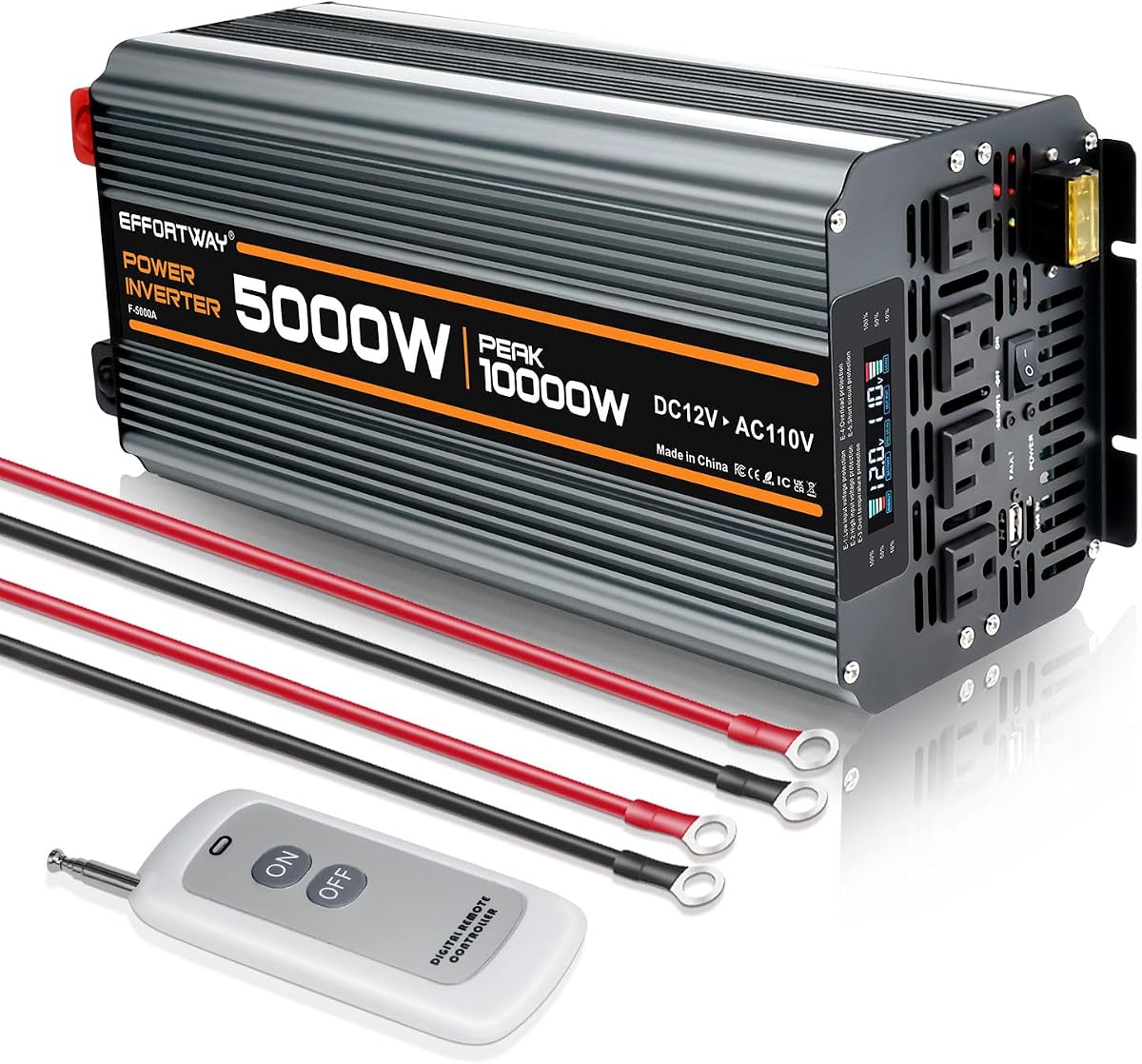
This 12V inverter offers 5000W of continuous power and a 10000W peak rating, making it a more compact alternative for RVs, camping systems, and off-grid solar projects. Its 4.4 rating and useful display, remote control, and broad protection package make it appealing for users who want visibility without a permanently installed hybrid system.
We may earn a commission when you buy through this link, at no additional cost to you.
The LCD reports input and output voltage, battery capacity, load capacity, and error codes. A wireless remote with a stated 150-foot range allows convenient remote control, although the inverter itself must first be switched off before the remote can turn it on. Conversion efficiency above 90% helps reduce energy losses during DC-to-AC conversion.
Despite appearing in a 10000W search, the sustained capacity is only half that figure. A buyer planning to run multiple high-draw appliances simultaneously should size the system around the continuous rating, not the surge rating. The listing also does not identify the waveform, so sensitive-load compatibility should be confirmed before purchase.
This model is a good middle ground for moderate RV and mobile-power needs. It suits users who want 10000W of startup headroom, four outlets, remote operation, and clear diagnostics without installing a 48V solar inverter. Verify load requirements, output waveform, and battery capability before treating it as a 10000W continuous solution.
Showing battery state, voltage, load information, and fault codes makes the inverter easier to troubleshoot than a basic LED-only model. The supplied error guide also gives users practical first steps for low battery, high voltage, overheating, overload, and short-circuit conditions.
The 5000W continuous rating covers many routine RV and camping appliances, while 10000W peak power helps accommodate startup surges. It is more realistic for routine mobile use than treating the headline peak figure as continuous capacity.
We may earn a commission when you buy through this link, at no additional cost to you.
The OLTEANP model combines a 3000W continuous 12V-to-120V inverter with 10000W startup surge, giving it a 4.6 rating and a broad set of connections. It is designed for van life, mobile offices, travel, emergency preparation, and off-grid use, with four AC outlets and a hardwired output terminal.
We may earn a commission when you buy through this link, at no additional cost to you.
Its all-in-one design includes a 5V/3.1A USB port and a 30W Type-C PD charging port. Five layers of protection cover undervoltage, overvoltage, overload, overheating, and short circuits, with built-in fuses for rapid power cutoff. Compatibility with LiFePO4, AGM, gel, and lead-acid batteries broadens its use with existing 12V systems.
The key caveat is the difference between surge and continuous output. Although the listing headline refers to 5000W and 10000W peak, the detailed description specifies 3000W continuous power and 10000W surge during startup. Heavy appliances, heating devices, and multiple high-wattage tools can quickly exceed the sustainable level, and the listed simultaneous microwave and skillet example approaches that limit.
This inverter is best for travelers who want a convenient combination of AC, USB, and Type-C outputs with remote status monitoring. It is less appropriate as the sole power source for a large household. Buyers should calculate sustained appliance demand and use the terminal block for higher-current tools where appropriate.
USB and Type-C PD ports make the unit useful for phones, laptops, and other USB-powered devices without occupying the AC receptacles. This convenience is particularly valuable in compact mobile-office and camping layouts.
Support for common 12V battery chemistries makes integration easier for existing RV, truck, van, and solar installations. Built-in fuses and multi-layer protections add another layer of safety around the battery and connected equipment.
We may earn a commission when you buy through this link, at no additional cost to you.
The TOPBULL 5000W inverter provides continuous 5000W output and 10000W peak capability from a 12V or 12.8V battery. It carries a 4.6 rating and focuses on mobile convenience, with four 20A AC receptacles, two USB fast-charging ports, a 30W Type-C interface, and three AC terminal blocks.
We may earn a commission when you buy through this link, at no additional cost to you.
A high-definition color display reports voltage, power, and operating status, while the remote controller can operate from up to 200 feet away. The listing also describes a metal shell with impact and weather resistance, an intelligent dual-fan cooling system, and use with common 12V vehicle batteries for camping, mobile offices, emergency response, and solar builds.
The protection package is unusually broad in the supplied information, including low- and high-voltage, overload, short-circuit, overheating, reverse, grounding, overcurrent, leakage, and battery protections. That breadth does not remove the need for proper installation, however. Five kilowatts of continuous output still demands substantial battery capacity, short cable runs, appropriate fusing, and careful attention to ventilation.
This inverter is well suited to buyers who need several AC outlets, wired outputs, and USB charging in one vehicle-oriented package. It is a practical fit for trucks, RVs, and mobile work setups, provided the chosen loads remain within continuous capacity and the installer confirms output compatibility for sensitive electronics.
Three terminal blocks expand the inverter beyond its four AC sockets, while USB and Type-C outputs cover charging needs. This variety helps reduce the need for separate adapters in a vehicle-based power station.
The color screen and long-range remote improve visibility and control in installations where the inverter may be mounted near a battery bank or hidden in a compartment. Real-time voltage and power data can help identify battery or load issues quickly.
We may earn a commission when you buy through this link, at no additional cost to you.
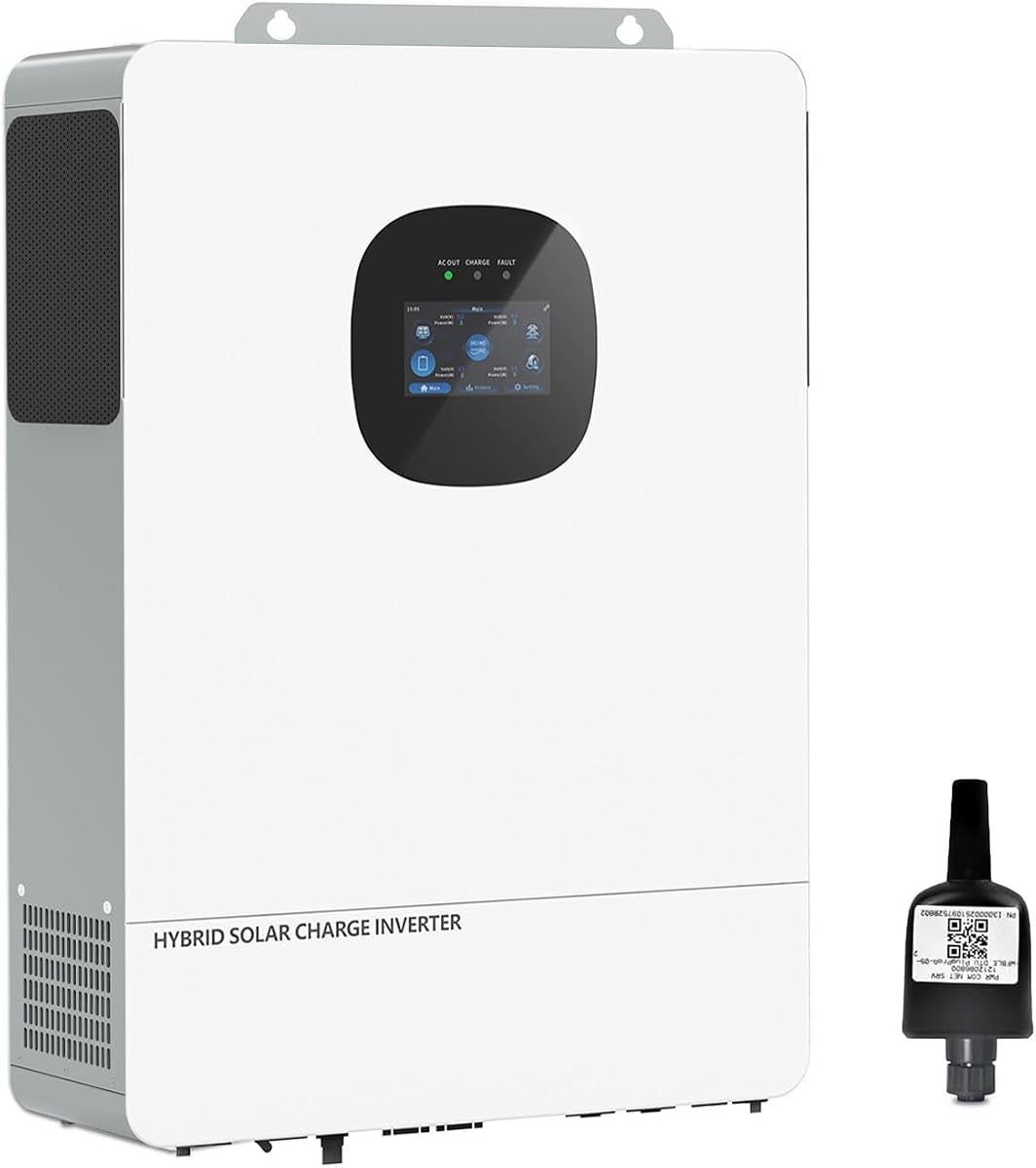
The SUNGOLDPOWER SPH10048P is an all-in-one 10KW, 48V pure sine wave solar inverter with two integrated MPPT controllers, up to 200A battery charging, and selectable 120V/240V split-phase or 120V single-phase output. Its 4.5 rating reflects a feature-rich design intended for serious off-grid and solar installations.
We may earn a commission when you buy through this link, at no additional cost to you.
Its 10000W rated output is paired with 20000W maximum peak power and support for loaded motors up to 6HP. Four charging modes and four output modes give users flexibility in balancing utility power, solar generation, and battery reserves. Time-slot charging and discharging can also be configured around local utility schedules.
The system supports AGM, sealed, gel, flooded, lithium, and user-defined battery types, with battery-free operation when mains and photovoltaic power can activate the system. Can, USB, and RS485 communication are listed for compatibility with SUNGOLDPOWER batteries. These features add sophistication, but a 48V architecture, 500VDC maximum open-circuit PV voltage, and potentially 240V output call for careful system design.
This is a compelling premium choice for a permanent home, cabin, or off-grid property where solar charging, battery management, and high-quality AC output need to work together. It is less appropriate for a simple vehicle outlet or temporary camping setup. Buyers should coordinate panel layout, battery bank, wiring, and code-compliant installation.
Two MPPT controllers allow the inverter to manage separate solar arrays and make better use of available photovoltaic energy. This is especially useful when panels have different orientations or when one array experiences partial shading.
Separate charging and output modes let an installer prioritize utility power, solar power, batteries, or a hybrid strategy. Scheduled charging and discharging adds another layer of control for users following time-based utility rates.
We may earn a commission when you buy through this link, at no additional cost to you.
This SUNGOLDPOWER 10KW, 48V model combines a pure sine wave solar inverter, two MPPT controllers, battery charging up to 200A, and selectable 120V/240V output. It has a 4.5 rating and is aimed at installers who want a high-capacity renewable-energy system that can grow over time.
We may earn a commission when you buy through this link, at no additional cost to you.
One standout feature is parallel operation for as many as six units. That creates a path to substantially greater system output, useful for a growing home or commercial installation. The unit also supports 20000W maximum peak power, loaded motors up to 6HP, four charging modes, four output modes, and programmable time-slot energy management.
Like the other advanced hybrid models, it demands more planning than a portable inverter. The system operates around 48V batteries, supports 500VDC maximum open-circuit photovoltaic voltage, and can provide 240V split-phase output. Battery type, BMS communication, solar-array layout, and utility interconnection all need to be considered before installation.
The SUNGOLDPOWER is an excellent candidate for buyers planning a permanent solar installation or future expansion rather than occasional vehicle use. It delivers a strong blend of pure sine output, integrated charging, and modular scalability. It is best for technically informed users or professional installers who can configure and maintain a full hybrid energy system.
Supporting up to six units in parallel lets a system grow in stages instead of requiring every future capacity increase to be planned into the original installation. It is a meaningful advantage for homes and workshops whose power demands may increase.
The combination of MPPT solar control, high-current battery charging, and selectable output priorities gives the installer several ways to manage energy flow. The user must select modes and schedules that suit the battery chemistry, solar production, and utility connection.
We may earn a commission when you buy through this link, at no additional cost to you.
This upgraded pure sine wave inverter is configured in the listing at 10000W, 12V DC to 220V AC, and has a 5.0 rating. It combines a high stated conversion efficiency of 95% with an aluminum alloy housing, an LCD status screen, and protection for several electrical fault conditions.
We may earn a commission when you buy through this link, at no additional cost to you.
The display can show battery power, battery input voltage, AC output voltage, output power, overvoltage and undervoltage warnings, overload or short-circuit warnings, and power status. Soft start is included, while the listed protections cover voltage, overload, overcurrent, undervoltage, overtemperature, and short circuit. A built-in fan helps reduce heat accumulation.
The main consideration is the 12V-to-220V configuration. A high-power 12V system experiences substantial current at the battery side, requiring a very large battery bank and appropriately heavy cabling. Users in 120V environments may also need a transformer if their connected equipment does not support 220V input. The broad 12V, 24V, and 48V options shown in the title are represented by one selected configuration on this listing.
This is a strong choice for a dedicated 12V system that needs pure sine output, efficiency, and detailed status information without a full grid-tied architecture. It is especially relevant to off-grid and mobile applications where appliance compatibility matters. Confirm output voltage, battery sizing, and installation requirements before ordering.
Pure sine output is generally better suited to sensitive electronics and modern appliances than a modified waveform. It can also reduce noise, heat, and stress associated with loads that dislike stepped or distorted AC output.
The listed 95% conversion efficiency reduces losses between stored battery energy and AC output. A detailed display helps users distinguish normal load operation from warnings involving battery voltage, temperature, or circuit faults.
We may earn a commission when you buy through this link, at no additional cost to you.
The POWLAND is a 10000W grid-tied hybrid inverter with 48V DC input, 120V/240V split-phase AC output, a built-in 250A MPPT controller, and a battery-free design. Its 5.0 rating reflects a feature-rich approach to combining solar, grid, and optional battery power for larger residential or specialty applications.
We may earn a commission when you buy through this link, at no additional cost to you.
Its distinguishing feature is the ability to operate without batteries, allowing excess solar energy to feed the home and grid when configured with the optional current transformer. A 250A MPPT controller supports a stated 90–485VDC solar range and a listed 99.9% efficiency. The system also supports LiFePO4 and lead-acid batteries when energy storage is wanted.
The listed protection suite covers overload, short circuit, reverse polarity, and over- or undervoltage, while an IP65 case provides resistance to rain and dust. A clear LCD and LEDs show operating status. Because it is grid-tied, anti-backflow behavior, utility permission, local electrical rules, and professional commissioning are essential considerations that differ from an ordinary stand-alone inverter.
This model suits a large home, RV park, or commercial property seeking solar integration and flexible operation with or without a battery bank. It is not the simplest choice for a small vehicle or temporary camping setup. The buyer should have the full electrical design evaluated, particularly for 240V loads and grid interconnection.
Battery-free operation can reduce the need for a large storage bank when the application does not require nighttime backup. Optional battery compatibility provides a path to resilience when grid outages and stored energy are priorities.
The 250A MPPT controller is designed for substantial photovoltaic arrays and is intended to capture energy efficiently across a wide input range. Proper panel voltage, current, and array design remain essential to operating within the listed limits.
We may earn a commission when you buy through this link, at no additional cost to you.
The HumsiENK combines a 10000W continuous pure sine wave inverter, 12000W MPPT solar charger, and 220A battery charger in a 48V split-phase hybrid system. Its 4.7 rating and under-10ms UPS transfer make it a strong candidate for home backup, off-grid living, and commercial workshops where continuity matters.
We may earn a commission when you buy through this link, at no additional cost to you.
The inverter provides native 120V/240V split-phase output and can be switched to 120V single phase for an RV or cabin. Dual independent MPPT channels can manage two solar arrays, while the stated parallel capability allows up to six units and 60kW total capacity. The LCD displays status, operating modes, and fault codes, while USB, RS485, CAN, WiFi, and Bluetooth support local and remote management.
There are important limitations behind the headline functionality. Battery-free operation is presented primarily as running on solar and grid power during the day, so it should not be confused with a fully battery-backed nighttime system. Transfer times, parallel behavior, and battery-free capability also depend on the configured source and operating mode. As a 48V, 240V installation, it belongs in a professionally evaluated electrical system.
This is an appealing premium choice for a large home, workshop, or expandable renewable-energy system that needs fast backup switching and flexible solar charging. It is best for users who value sophisticated monitoring and split-phase support more than simple plug-and-play portability. Confirm battery compatibility, panel layout, transfer behavior, and local installation requirements before purchase.
The stated UPS transfer time of no more than 10ms is designed to minimize interruption to computers, routers, and other sensitive loads. Actual performance depends on configuration, source availability, and the connected system, but the target is much faster than a conventional transfer switch.
Combining pure sine inversion, MPPT solar charging, and high-current battery charging can simplify a permanent installation compared with several separate devices. Six-unit parallel support gives owners room to scale the platform as their energy demand grows.
We may earn a commission when you buy through this link, at no additional cost to you.
Choosing a 10000W inverter requires matching continuous and surge output to the intended loads while considering battery voltage, waveform quality, solar controls, grid interaction, and safe installation. The largest advertised number is not always the most useful specification, so buyers should evaluate the complete system rather than capacity alone.
Choose based on the lower sustained figure, not the higher surge figure.
Use 48V for major fixed systems and 12V for simpler mobile installations.
Choose pure sine wave for electronics; modified sine can suit basic resistive loads.
Match 120V, 240V, split-phase, and single-phase output to the intended loads.
Ensure battery charging current matches the battery, array, and other charging sources.
Prioritize clear voltage, load, and fault information alongside remote controls.
Use proper fusing, grounding, ventilation, and cable sizing around every inverter.
Choose portability for temporary use and integrated controls for permanent systems.
Before connecting any inverter, identify the battery voltage, verify the inverter's continuous and surge ratings, and calculate the startup and running demand of every planned load. Use appropriately rated positive and negative cables, install the specified fuse or breaker close to the battery, and provide adequate ventilation around the unit. Do not exceed its input voltage, output current, or thermal limits, and never connect a 12V inverter to a 48V battery bank.
Switch the inverter off before attaching or removing battery cables and before operating the remote controller. After connection, confirm that input voltage, battery state, and output voltage appear correctly. Turn on the AC side with no load, then add devices gradually, monitoring the display for overload, overheat, or low-battery warnings. If a remote is used, follow the manufacturer's startup sequence, including any requirement that the main inverter switch be off first.
Care for the system by keeping cooling vents unobstructed, checking cable terminations for corrosion or looseness, and maintaining suitable battery charge levels. Clean the enclosure with a dry cloth and avoid moisture entering the vents. Respond promptly to fault codes rather than repeatedly resetting an overload or overheating condition. For permanently installed grid-tied or split-phase equipment, use a qualified electrician and follow local electrical and interconnection requirements.
It can support some household loads, but it does not automatically mean it can power an entire home at once. A refrigerator, router, lights, and several smaller devices may be manageable, while central air, electric water heaters, ovens, and other large loads require careful load calculation. Continuous, surge, and battery output all limit what can be run simultaneously. Many homes also need a transfer switch or compatible grid-interconnection equipment.
No. Peak output is intended for short-duration startup demand, while continuous output is the sustainable level for ongoing use. Several products in this guide advertise 10000W peak but provide 3000W or 5000W continuous capacity. Use the continuous rating for load planning, then leave additional headroom for motor startup and future equipment.
The answer depends on the inverter's input voltage, how long the loads must run, and the desired surge support. A 12V inverter requires a much larger battery bank and heavier cables than a 48V system for the same output. Deep-cycle batteries are generally more suitable than starting batteries for repeated discharge. Calculate required amp-hours from daily energy use, then account for inverter losses and adequate battery aging margin.
Yes, when the inverter has a compatible solar controller or is paired with a separate MPPT charge controller. Hybrid models with integrated dual MPPT inputs can simplify the system, but their maximum PV open-circuit voltage and charging current must match the panel array and battery bank. For non-hybrid models, proper charge control is important because panels connected directly to a battery can cause unwanted charging behavior and reduced battery life.
Pure sine wave is generally the safer choice for laptops, sensitive electronics, medical equipment, and some variable-speed appliances. Modified sine output may work with a microwave, especially for heating, but it can create noise or cause problems in sensitive electronics or certain motors. Verify the appliance manufacturer's guidance and the inverter's waveform before connecting important devices.
Only when the inverter's input voltage, current, and connection method match the vehicle electrical system. Continuous operation with the engine off can discharge a vehicle starting battery, and a high-output inverter may overload the factory alternator or wiring. For frequent use, a deep-cycle auxiliary battery with appropriate charging is usually safer. Follow the manufacturer's guidance regarding cable length, fusing, and vehicle use.
It means the hybrid inverter can switch from utility power to battery or another available source in approximately 10ms or less when configured for UPS behavior. That is fast enough to keep many computers and network devices operating without an obvious reboot. Actual continuity depends on source availability, load response, and the system's operating configuration, so critical equipment should still be tested with the intended battery setup.
Professional installation is strongly advisable for 240V split-phase, grid-tied, parallel, or permanently installed systems. Even a simpler 12V installation requires careful cable sizing, fusing, grounding, ventilation, and battery management. An electrician or qualified solar installer can verify code compliance, avoid overloaded circuits, and ensure protective equipment is placed correctly. Always follow local electrical requirements and the manufacturer's installation manual.
The strongest general-purpose choice in this guide is the upgraded pure sine inverter, which combines 10000W output, a 5.0 rating, 95% stated efficiency, and a useful operating display. The AIMS model is the budget-oriented option for buyers seeking 10000W continuous and 20000W surge capacity, while the SUNGOLDPOWER SPH10048P is the premium integrated solar solution with dual MPPT and 120V/240V output.
Before choosing, prioritize continuous output over headline surge power, match the battery voltage to the installation, and confirm output waveform and phase. Portable users should look for 12V compatibility, sufficient outlets, remote control, and clear fault indicators. Permanent solar and home-backup buyers should examine MPPT capacity, battery charging current, UPS behavior, grid-tie requirements, and expansion options.
Finally, review the current listing, manufacturer manual, compatibility information, and installation requirements before buying. Prices, configurations, and availability can change, and the same model family may be offered in several voltage options. The right 10000W inverter is the one whose continuous performance, safety features, and electrical design align with your specific loads and battery system.