
Benro CyanBird Pro Carbon Fiber Kit
5.0Editor score
Carbon fiber vibration damping
Hybrid tracking head
Arca-Swiss quick-release plate
A lightweight spotting scope tripod should make long observation sessions easier by balancing portability with enough stability for magnified viewing. The best support for a scope depends on head control, vibration damping, leg geometry, packed size, and compatibility with the equipment you already own.
This guide compares ten tripods using the specifications supplied for each product, focusing on weight, load capacity, height range, mounting hardware, and field convenience. It covers compact aluminum models, carbon fiber kits, tabletop stands, and versatile tripods that also support binoculars, cameras, and phones.
Each pick highlights a different use case, from portable glassing to more stable high-magnification observation. Ratings and product details can change over time, and current prices fluctuate, so readers should confirm the latest specifications, availability, and mounting requirements before purchasing.
5.0Editor score

4.7Editor score

4.6Editor score
As an Amazon Associate we earn from qualifying purchases.
The table below compares the ten tripods by the characteristics that most affect portability, equipment compatibility, and steady observation, including packed length, weight, height range, load capacity, and head or mounting system.


The Vortex Mountain Pass Tripod Kit earns a 4.7 rating and stands out as the most balanced option in this guide. It is designed specifically to support spotting scopes and binoculars while keeping the package compact enough for outdoor trips where every carried item matters.
We may earn a commission when you buy through this link, at no additional cost to you.
Its machined aluminum legs offer durability and a 22-pound maximum load, giving users room for larger optics without requiring a heavy full-size field stand. The two-way pan-and-tilt head uses an Arca-Swiss compatible quick-release system, while independently telescoping legs can be adjusted and secured with quick-flip levers.
The main compromise is material weight. Aluminum is not as light as carbon fiber, and the listed specifications do not provide an exact packed weight. However, the Mountain Pass balances that extra mass with a substantial load rating, straightforward controls, and mounting compatibility that make it practical for many users.
Choose the Mountain Pass if you want one dependable tripod for birdwatching, wildlife observation, and general optics use. It is especially attractive for owners of heavier scopes who need more support than a compact tabletop model can provide.
The 22-pound maximum load is the standout practical figure because it leaves considerable capacity for larger binoculars and spotting scopes. That headroom allows the stand to remain appropriate even when the supported optic is substantial.
Arca-Swiss compatibility simplifies setup with compatible optics and accessories. Independently adjustable legs are useful on uneven ground, where matching all three leg extensions may not be necessary.
We may earn a commission when you buy through this link, at no additional cost to you.
This Lusweimi tripod has a 4.3 rating and delivers one of the broadest accessory packages in the roundup. Its rectangular aluminum-tube design supports binoculars, spotting scopes, cameras, and phones while collapsing to a listed 16.9 inches for transport.
We may earn a commission when you buy through this link, at no additional cost to you.
The height system extends from 16.9 inches to 69 inches, with the shooting height reaching up to 72 inches when supporting binoculars or a scope. Two quick-release plates support rapid equipment changes, and the included rotating phone holder adds useful flexibility for digiscoping or general photography.
Its central caution is binocular compatibility. The binocular adapter requires a 1/4-inch threaded hole, and different brands may use varying thread depths. That means a binocular with a tripod eyepiece or another mounting arrangement may need an additional adapter not included in the package.
This is a value-oriented choice for buyers who want a tall, compact, multifunction stand and frequently use cameras or phones alongside optical equipment. Check the mounting requirements before ordering, especially if your binoculars lack standard threaded holes.
The adapter, two quick-release plates, rotating phone holder, and carry bag make the package convenient for mixed-use outings. It can support a spotting scope directly through the 1/4-inch screw while offering separate accessories for other devices.
The center hook can hold a backpack, giving the stand additional ballast in windy conditions. This simple feature can improve confidence during open-country observation, although it should be handled with care.
We may earn a commission when you buy through this link, at no additional cost to you.
The SIRUI Optics Travel Tripod is a lightweight aluminum travel setup built around the G5X fluid head. The supplied information lists a 3.5-pound tripod weight without the head, while the tripod itself is described as supporting up to 22 pounds and the head as supporting up to 6.6 pounds.
We may earn a commission when you buy through this link, at no additional cost to you.
The fluid head offers 360-degree panning with adjustable friction and stepless tilting from minus 60 to plus 90 degrees. Those controls are valuable when following birds or wildlife because they allow the optic to be repositioned without abrupt movements. A rubber-coated handle adds comfort during longer sessions.
The detachable, invertible center column supports both high and low viewing positions. The included BA-2 binocular adapter uses an Arca-standard base and a 1/4-20 thread, offering broad setup options for compatible optics, cameras, and accessories.
This tripod is a compelling option for users who prioritize smooth tracking and low-angle flexibility. The lack of a numeric customer rating in the supplied data makes field specifications and head capacity especially important to verify before buying.
Adjustable fluid friction is the defining feature here. It can make panning and tilting feel more deliberate, helping a scope settle smoothly when a subject moves or when the user changes viewing direction.
The four-section legs and invertible center column create a broad range of working positions. Low-angle use is valuable for tracking animals or birds closer to the ground, while full extension supports comfortable standing observation.
We may earn a commission when you buy through this link, at no additional cost to you.
This 69-inch spotting scope tripod earns a 4.3 rating and focuses on versatility at an accessible tier. It is built for birdwatching, wildlife viewing, hunting, and target shooting, with a detachable head that compresses the aluminum stand to 16.9 inches.
We may earn a commission when you buy through this link, at no additional cost to you.
The tripod adjusts from 16.9 inches to 69 inches, and the supplied information says it can reach 73 inches when supporting a birding scope. A standard 1/4-inch screw works with cameras and scopes, while the included binocular adapter, two quick-release plates, and rotating phone holder expand the possible uses.
The specification list does not provide a maximum load capacity, which makes the stand less straightforward for very heavy optics. As with the similar Lusweimi package, the binocular adapter requires 1/4-inch threaded holes, and thread depth can differ among manufacturers.
For users who need a tall, compact, multi-device stand, this model offers a useful combination of features. It is best suited to moderate equipment loads and to buyers who will verify both their optic's mount and the stand's stability before heading into the field.
The 16.9-inch folded length and included carry bag reduce the burden of carrying a full-size stand. Detaching the head also shortens storage, making the tripod easier to organize in a vehicle or pack.
Two quick-release plates let a user move between compatible equipment without repeatedly tightening a conventional threaded connection. The phone holder is a bonus for image capture, though it adds another accessory to carry.
We may earn a commission when you buy through this link, at no additional cost to you.
This 2-in-1 Camera Tripod and Hunting Stand has a 4.7 rating and combines a 68-inch camera tripod with a removable V-Yoke support. Its 3.85-pound listed weight and 16.5-inch folded length make it portable without giving up the strong 33-pound load rating.
We may earn a commission when you buy through this link, at no additional cost to you.
The 36mm CNC metal ball head provides separate pan and tilt controls, a 360-degree scale, and three bubble levels. Four-section legs use quick-release flip locks, while three-stage leg-angle adjustment helps maintain level support over uneven ground. A removable aluminum handle supports smoother horizontal camera movements.
The included V-Yoke turns the center column into a hunting rest, and the center column can also be configured as a monopod or hunting stick. This adds function but also makes the package less straightforward than a dedicated spotting scope tripod. Long-axis telescopes and telephoto zoom lenses may require separate mounting rings.
Choose this model when one stand must cover optics, cameras, phones, and shooting support. It is especially useful for users who value a high load capacity and a removable hunting configuration, not for those who want the simplest possible field setup.
The CNC-machined 36mm ball head is larger and more substantial than many basic heads. Separate locking controls and bubble levels support repeatable camera alignment, while the removable handle can be useful for smooth pans.
The removable V-Yoke provides a dedicated rest configuration for supported shooting. It expands the tripod's usefulness for hunting and target shooting, although users should use appropriate care and follow local safety rules.
We may earn a commission when you buy through this link, at no additional cost to you.
The Vanguard VS-82 Table Top Tripod has a 4.6 rating and is the most compact option here. At 0.86 pounds, it weighs less than a typical full-size field tripod and fits into small bags without taking up much room.
We may earn a commission when you buy through this link, at no additional cost to you.
Its listed folded height is 9 inches and extended height is 9 7/8 inches, with a two-way pan head that rotates through 360 degrees. Aluminum legs and non-slip rubber feet provide the basic structure, while the 5.5-pound maximum load makes this a stand for lighter binoculars, compact scopes, and cameras rather than oversized optics.
The limited height is the decisive trade-off. It works well on a vehicle hood, picnic table, cabin porch, or other elevated surface, but it does not provide a standing viewing position. Users planning long hikes may also find that a taller tripod offers a more comfortable eyepiece height.
This tripod is best for space-conscious observers who already have a reliable surface for placement. Choose it as a portable secondary support or for casual viewing, and consider a full-height model if a tripod must handle the entire observation session from the ground.
The 9-inch folded size is the clearest advantage for travelers. It can accompany almost any outing without adding much bulk, particularly when compared with 16.5- to 22.5-inch folded full-length tripods.
The VS-82 is designed for tabletop placement rather than standing use. Its compact pan head is useful for scanning from a stable surface, but users should avoid loading it beyond the stated capacity.
We may earn a commission when you buy through this link, at no additional cost to you.
The Benro CyanBird Pro has a 5.0 rating and is the premium choice for birding and wildlife observation. Its five-section carbon fiber legs combine a 17.1-inch folded length with a maximum height of 60 inches, emphasizing vibration control and packability.
We may earn a commission when you buy through this link, at no additional cost to you.
Carbon fiber is presented as helping damp vibrations during magnified viewing, which can make focusing easier and reduce the effect of small movement. The included FS20PRO hybrid head offers dual panning and separate ball and tilt locks, allowing controlled tracking while keeping the horizon level.
The 9.9-pound payload is lower than the Vortex Mountain Pass and the multi-purpose camera tripod in this roundup, so extremely heavy optics deserve special consideration. The benefit is a dedicated birding platform with an Arca-Swiss plate, three-angle leg stops, and a split center column for lower viewpoints.
This model is best for serious birders and wildlife observers who value steadiness, refined head control, and premium materials. It also includes a three-year limited warranty that can extend to five years for the original owner through online registration in applicable regions.
Carbon fiber is the defining construction choice because it is intended to reduce vibration transmission. That can help a scope settle and remain easier to use when small movements are magnified.
The hybrid head separates panning from ball and tilt adjustments. This gives users more precise control when following birds in flight, scanning a shoreline, or repositioning for a distant subject.
We may earn a commission when you buy through this link, at no additional cost to you.
The Vanguard Vesta 203AP has a 4.6 rating and provides a conventional full-size tripod for optics and photography. Its 2.38-pound listed weight remains relatively portable, while the 60.25-inch extended height offers a more natural standing position than a tabletop model.
We may earn a commission when you buy through this link, at no additional cost to you.
The three-section 20mm aluminum legs use quick-flip locks for rapid height changes. Anti-slip feet, two bubble levels, and an anti-twist QS-29 quick shoe help make setup and alignment more predictable. The PH-23 pan head provides smooth panning and a 360-degree top-panning arrangement.
Its 7.7-pound maximum load is lower than several aluminum competitors, so buyers with large or heavy optics should check total equipment weight. The 22.5-inch folded length also requires more pack space than the most compact models in the guide.
The Vesta 203AP suits birdwatchers, nature photographers, and general optics users who want a traditional tripod with straightforward controls. It is a balanced middle ground for people who need standing height but do not require a high-capacity or premium carbon fiber system.
Quick-flip leg locks allow the tripod to be raised or lowered quickly. Two bubble levels reduce the need for repeated manual adjustments when the terrain is not perfectly level.
The QS-29 quick shoe includes an anti-twist pin, helping keep compatible equipment oriented correctly when the shoe is attached. That feature is particularly useful when moving between photography and observation.
We may earn a commission when you buy through this link, at no additional cost to you.
The Bushnell Advanced Aluminum Tripod has a 4.6 rating and is a durable general-purpose platform for binoculars, spotting scopes, and cameras. Its three-way pan-and-tilt head, universal 1/4-20 mount, and quick-release plate provide the fundamentals needed for optical observation.
We may earn a commission when you buy through this link, at no additional cost to you.
Aluminum legs are individually adjustable in both length and angle, allowing the stand to fit uneven terrain more closely. The 11-pound load capacity gives it more support than many portable tripods, while a 63-inch maximum height keeps the eyepiece near a comfortable standing level.
This is not the most compact option. Its aluminum construction, full-size format, padded leg cushions, and large mounting platform are better suited to stability and comfort than minimum pack weight. Users who walk long distances may want to compare its packed bulk with a carbon fiber alternative.
Choose the Bushnell for a durable, flexible tripod that can serve several kinds of equipment. It is a strong fit for hunters, wildlife viewers, and photographers who value an adjustable head and enough capacity for medium-to-heavy optics.
Independent leg length and angle adjustment lets the user establish a level platform on irregular ground. This is more useful than equal-length-only tripods when one side of the stance is on a rock or slope.
Three padded foam leg cushions improve grip and comfort in hot or cold weather. The practical benefit appears during longer sessions when bare hands would otherwise remain in direct contact with bare metal.
We may earn a commission when you buy through this link, at no additional cost to you.
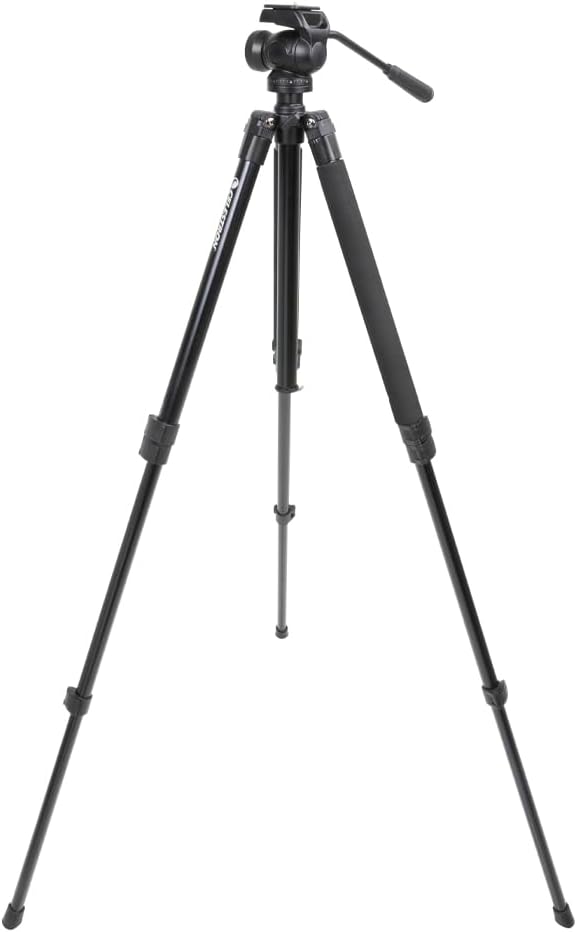
The Celestron TrailSeeker Tripod has a 4.4 rating and is a feature-rich support stand for spotting scopes, binoculars, cameras, and small telescopes. Its aluminum construction reaches 70.5 inches, giving it one of the tallest listed maximum heights in the roundup.
We may earn a commission when you buy through this link, at no additional cost to you.
Four-section legs can be set to three different angles and use flip-lever locks for quick height changes. The two-way fluid pan head and quick-release plate help position optics smoothly, while the extendable center column adds height when needed. A retractable hook allows a bag or other weight to improve stability.
The stand's main limitation is its full-size aluminum format, which is less attractive for hikers focused on minimizing every gram. The 877-square-inch footprint at the default standing angle supports a broad stance, but users should consider actual wind and terrain conditions rather than relying on the hook alone.
This model is a good fit for observers who want tall, adjustable positioning and fluid panning. It also includes a tripod case and shoulder strap, plus a two-year US warranty and support from Celestron's US-based team.
The 70.5-inch maximum height and three leg-angle settings offer substantial flexibility. Adjusting the center column and leg positions can make prolonged observation more comfortable across varied terrain.
The retractable center hook lets users add weight when conditions demand more stability. It is a simple way to improve the tripod's response to wind without changing the main setup.
We may earn a commission when you buy through this link, at no additional cost to you.
Choosing a lightweight spotting scope tripod involves balancing carried weight, packed size, stability, adjustment range, head control, and the mounting needs of your equipment. The smallest tripod is not automatically the most comfortable or capable for prolonged observation.
Weight matters most when the tripod must be carried across uneven ground, up stairs, or during a long approach to a birding area. Some models list the tripod weight without the head, while others specify the complete product weight, so buyers should check what the number actually includes. Carbon fiber generally offers a favorable strength-to-weight balance, but compact aluminum designs can also remain light enough for many outings.
Prioritize a weight you can comfortably carry for the full trip, not merely a specification that appears low on a product page.
Folded length determines how much space the stand occupies, but packed size is not the same as carrying weight. A tripod may be compact yet relatively heavy, or light but awkward in a pack. Compare the number of leg sections, center-column design, head dimensions, and whether the head detaches. Tabletop models around nine inches packed are extremely easy to carry, while full-size tripods may need a dedicated bag or generous pack space.
Choose the smallest folded design that still provides a practical working height and sufficient load capacity.
Load capacity indicates the maximum supported equipment weight under the manufacturer's stated conditions. Magnified observation becomes harder when vibration moves the optic, so extra capacity can be worthwhile for large scopes and heavy binoculars. Leg diameter, section count, foot spread, material, and head construction all influence real-world stability. A hook for adding weight may improve resistance to wind, but it is an addition to—not a replacement for—a stable platform.
Match the stated capacity to the combined weight of the scope, adapter, quick-release hardware, and any accessories.
Height determines whether the tripod can provide a comfortable standing position, a lower seated position, or only a tabletop arrangement. Adjustable legs and a movable center column offer more flexibility than a fixed-height stand. Users should also consider their typical posture and the eyepiece height of their optic. A tall model may reduce neck and back strain during long sessions, while a low model can be useful for discreet wildlife viewing.
Look for enough minimum height to get the eyepiece near eye level and enough maximum height for standing use.
A tripod head determines how smoothly the optic can be moved and how precisely it can be locked. Two-way pan heads are simple and suitable for general scanning. Three-way pan-tilt heads add separate tilt control, while ball heads offer flexible positioning for cameras. Fluid heads provide controlled movement that can be valuable when tracking wildlife. Look for independent locks, useful adjustment ranges, bubble levels, and a handle that can be removed when it is not needed.
Choose a head with the controls required for your activity, but avoid buying complexity that you will not use.
A spotting scope may connect through a standard 1/4-20 thread, an Arca-Swiss plate, or a manufacturer-specific arrangement. Binoculars can require a tripod eyepiece adapter, while some models have threaded holes on the body. Before purchasing, inspect the underside of the optic and the included adapter. The product data for several included tripods specifically calls for 1/4-inch threaded holes, and thread depth can vary between brands.
Confirm both the thread size and physical fit before buying, and account for the added height of any separate adapter.
Leg locks should be easy to operate without excessive force and should keep sections from creeping. Flip locks are fast and convenient, while twist locks may offer more consistent clamping. Independently adjustable leg angles help on slopes, rocks, and irregular ground. Rubber feet improve grip and protect surfaces, while padded leg sections can make a long setup more comfortable in extreme temperatures. The number of sections also affects packed length and the time needed to extend or collapse the tripod.
Prioritize secure locks, independent positioning, and reliable rubber feet for uneven outdoor terrain.
Some tripods are specialized observation stands, while others double as camera, phone, or hunting supports. Included binocular adapters, quick-release plates, phone holders, carry bags, and V-Yokes can improve convenience but may also add weight and complexity. A bundled accessory only helps if it matches the equipment and activity you actually use. Reviewing the package contents prevents disappointment over a missing adapter and helps distinguish a dedicated birding stand from a general-purpose accessory bundle.
Choose accessories based on your workflow, not simply on the number of items included.
Begin on firm, level ground whenever possible. Spread the legs fully, lock every section, and adjust each leg independently when the terrain is uneven. Attach the quick-release plate or adapter to the optic before lifting it onto the tripod, then tighten the head controls only enough to prevent unintended movement. A small amount of controlled looseness can make panning smoother, while the tilt and ball locks should be secure.
Use the center hook only with suitable weight and only when it will not obstruct the legs or create a tipping hazard. Avoid extending every section to maximum height on soft ground, since the feet can sink and destabilize the setup. Before moving location, release the equipment, collapse or shorten the tripod as appropriate, and inspect the ground for roots, rocks, mud, and other hazards.
After each outing, wipe dirt and moisture from the legs, head, adapter, and feet. Let wet components dry before storage, and clean the locking mechanisms without forcing lubricant into places where it can collect grit. Periodically check leg sections, flip locks, screws, and the head for looseness. Follow the manufacturer's instructions for service and warranty coverage, and replace worn rubber feet or damaged hardware before the next demanding field session.
The ideal weight depends on the duration of the trip and the equipment involved. Around three to four pounds is practical for many walking birdwatchers, while tabletop models can be even lighter for use from a vehicle or table. Carbon fiber can reduce carried weight, but head quality and stability matter as much as the material alone.
Many cameras, quick-release plates, and binocular adapters use a 1/4-20 thread, but not every spotting scope has a matching bottom connection. Some scopes use an Arca-Swiss plate or a manufacturer-specific mount. Check the underside of the optic and the tripod head before purchasing to avoid an incompatible or incomplete setup.
Yes, if the mounting system and load capacity match both devices. Some models include binocular adapters, Arca-Swiss plates, and quick-release plates that make switching faster. Binoculars that use body-mounted 1/4-inch threaded holes may work directly with an appropriate adapter, while others require a tripod eyepiece or another specialized connection.
A fluid head is useful when smooth movement and controlled tracking are priorities. Its friction adjustment can make following birds or wildlife less jerky, though a basic pan head is simpler and often sufficient for stationary observation. The better choice depends on how actively you pan and whether you also use the tripod for photography.
A well-designed lightweight tripod can be stable enough for high magnification, but stability depends on rigidity, leg spread, head quality, wind, and equipment weight. Carbon fiber can damp vibration, while a suitable load rating prevents overloading. Avoid maximum-height extension on unstable ground and consider adding approved weight through the hook when conditions are poor.
Collapse or shorten the legs, lock every section, and secure the head before putting the tripod in its bag. Keep adapters and quick-release plates in a separate compartment so they are not lost, and avoid placing heavy objects against the head controls. A padded case or shoulder strap, where supplied, helps protect the equipment during transport.
A tabletop tripod is designed to sit on a stable raised surface and usually has a much lower load capacity and limited height. A full-height tripod stands on the ground and can raise the optic to a comfortable eye level. Tabletop models are better for space-saving travel, while full-height models are better for long observation sessions away from a vehicle or table.
Inspect it before every outing, paying particular attention to leg locks, head controls, adapter threads, and foot pads. A more thorough check is appropriate after it has been dropped, exposed to severe weather, or used with a heavier load than expected. Loose locks or damaged threads should be addressed before the tripod is placed under another optic.
The Vortex Mountain Pass Tripod Kit is the strongest all-around choice because it combines a 22-pound capacity, Arca-Swiss compatibility, and independently adjustable aluminum legs. The Benro CyanBird Pro is the premium option for observers who prioritize carbon fiber vibration damping and refined tracking control, while the Bushnell Advanced Aluminum Tripod offers a durable, versatile platform with an 11-pound capacity.
Prioritize the tripod that matches your actual equipment and location. Lightweight shoppers may prefer a compact tabletop or travel model, while birders spending hours on their feet will benefit from a stable full-height head, secure locks, and a comfortable working height. Always verify thread type, adapter fit, stated capacity, and the precise contents of the package before buying.
Ratings, product specifications, availability, and prices can change, so check the current listing before making a final decision. The right lightweight spotting scope tripod is the one that combines manageable transport with enough stability and control to make observation easier rather than more complicated.