
Mini Tripod for DJI Osmo Pocket
4.7Editor score
Compact folding tabletop design
Broad DJI and Insta360 compatibility
Lightweight 45-gram construction
Standard 1/4-inch mounting thread
Portable nylon-and-fiber build
A DJI tripod stand should provide more than a place to rest a camera. The best models combine stable support, smooth angle control, useful height adjustment, secure camera attachment, and enough portability for travel. The right choice also depends on whether you use an Osmo Pocket, Action camera, phone, or larger camera system.
We compared all ten products by examining their stated compatibility, maximum height, folded dimensions, weight, load capacity, mounting hardware, head movement, base construction, remote-control features, and intended shooting situations. The list includes official DJI accessories, compact tabletop stands, and tall convertible selfie-stick tripods for creators working in different environments.
Each review identifies the strongest benefit and the practical compromises so you can narrow the field with confidence. The three featured selections represent especially attractive options for budget-conscious buyers, everyday creators, and premium DJI RS users. Product availability and pricing can change, so confirm the current listing and compatibility details before ordering.
4.7Editor score

4.6Editor score

4.7Editor score
As an Amazon Associate we earn from qualifying purchases.
The comparison below highlights the major differences in mounting style, reach, portability, stability, and device support, helping you identify the stand that best matches your DJI equipment and shooting workflow.



This 80-inch Osmo-Mobile floor tripod stand earns a 4.6 rating for its unusually broad range of functions. It is designed to support DJI Osmo Mobile, Osmo Pocket, and Osmo Action devices, but its standard 1/4-inch-20 connection also makes it useful with webcams, portable recorders, fill lights, and compact cameras. That mix of DJI-specific intent and broader mounting utility makes it a strong all-purpose choice.
We may earn a commission when you buy through this link, at no additional cost to you.
The stand's greatest strength is its three-way design. It can function as a conventional floor tripod, a comfortable handheld grip, or an extended selfie stick. Its ball head tilts vertically through 180 degrees, while the threaded base rotates through 360 degrees horizontally. This range allows a creator to frame a subject from overhead, switch to a low-angle composition, or reposition the camera without constantly readjusting the entire support.
Compatibility is handled through several included or described components. The adjustable phone bracket accommodates modern smartphones from 4 to 7 inches, while the action-camera adapter broadens support for major action camera models. The 652-gram listed weight keeps the whole package reasonably portable for an extended floor stand, although its full 80-inch form is much bulkier than a pocket tripod. The stated one-kilogram load limit also means it is intended for compact equipment rather than a heavy cinema camera or large telephoto lens.
This is the most versatile option in the guide for creators who move between phones, Osmo devices, action cameras, and other compact equipment. It is especially appealing for livestreams, vlogging, interviews, and group shots where a single support needs to change roles. If your main requirement is an ultra-compost tabletop stand, choose a smaller model instead; otherwise, this 3-in-1 design offers an unusually balanced mix of reach, control, and device flexibility.
The conversion between floor stand, grip, and selfie stick means the same tool can cover fixed-camera livestreams, handheld demonstrations, and extended-arm framing. That versatility reduces the need to carry separate accessories for each shooting style.
Combining 180-degree vertical tilt with 360-degree horizontal rotation gives the ball head useful compositional freedom. Creators can move quickly between front-facing, overhead, side, and low-angle perspectives while keeping the camera securely attached.
We may earn a commission when you buy through this link, at no additional cost to you.
The K&F CONCEPT 62-inch Phone Selfie Stick Tripod has a 4.4 rating and combines a tall telescoping support with a phone-oriented remote-control system. Seven leg sections extend the stand to 62.5 inches, making it suitable for elevated group framing, overhead demonstrations, livestream compositions, and travel selfies. It also includes a 1/4-inch-20 screw and action-camera adapter for creators who need more than the included phone cradle.
We may earn a commission when you buy through this link, at no additional cost to you.
The ball head provides 360-degree horizontal rotation and 90-degree vertical tilt, while the listed load capacity reaches 6.6 pounds, or 3 kilograms. That capacity is higher than several compact stands in the guide and gives the support more flexibility when paired with an action camera, DJI Osmo Pocket, mirrorless camera, or another supported device. The universal phone holder fits smartphone widths from 2.2 to 3.7 inches.
A major convenience is the detachable Bluetooth remote, which is designed exclusively for smartphones. It can trigger capture from up to 10 meters away and is described as operating for up to 10 hours on a continuous basis. That makes it practical for solo creators who want to step into a wider composition without touching the phone. It is important, however, not to expect the remote to operate a DJI camera or other mounted device.
The base uses widened legs, anti-slip silicone pads, and shock-absorbing rings to limit wobble during extension. This K&F CONCEPT option is a good fit for social creators who want remote phone control and substantial height without moving to the largest floor tripod in the list. Buyers using a very wide phone should check the holder's stated dimensions, and those primarily operating a camera should treat the remote as a phone-only convenience rather than a universal camera controller.
The included wireless remote lets a solo creator start phone recordings from a distance of up to 10 meters. Its phone-only design makes that feature straightforward, although camera operators need a separate trigger or another method of control.
Silicone feet and shock-absorbing rings help settle the extended legs and reduce movement. Those details are particularly valuable when the stand is used at full height for group photos, overhead content, or indoor livestreaming.
We may earn a commission when you buy through this link, at no additional cost to you.
This 53-inch Osmo Action selfie stick tripod kit stands out with a 4.8 rating, the highest rating among the ten products considered. Its integrated design switches among a handheld action-camera grip, an extension pole, a telescopic selfie stick, and a folding floor tripod. That four-use concept makes it a natural companion for travel diaries, skiing, hiking, group shots, and vlogging where a single compact accessory must perform several jobs.
We may earn a commission when you buy through this link, at no additional cost to you.
The extension rod uses an aluminum-alloy construction and extends from 11.6 to 53.5 inches. When folded, the entire kit measures 11.6 inches and weighs a listed 300 grams, a favorable balance for travel. Non-slip silicone pads provide grip on the floor, while the combination of modified nylon and aluminum alloy keeps the structure light without presenting it as a full-size professional tripod.
The supplied magnetic quick-release adapter is compatible with DJI Osmo Action 5 Pro, Action 4, and Action 3, as well as Osmo 360 cameras. A separate 1/4-inch adapter supports the broader list that includes many GoPro Hero models, GoPro Max 2, Osmo Pocket 3 and 2, and other action cameras. Compatibility is extensive, but the model's explicit Action 6 limitation makes the product title and accessory selection especially important to verify.
This kit is most compelling for creators who value portability and use an Action camera or Pocket device for third-person footage. Its low folded length is easier to fit into a small daypack than an 80-inch support, while the built-in tripod removes the need to carry a separate three-legged base. It is less suitable for someone needing an 80-inch reach, a phone remote, or a guaranteed Action 6 magnetic connection.
The built-in tripod unfolds directly from the extension pole, allowing the same accessory to move between handheld and stationary use. This makes packing simpler for creators who would otherwise need to carry a separate mini tripod.
The included magnetic quick-release mount supports several listed DJI models, while the 1/4-inch adapter broadens compatibility with GoPro and Pocket cameras. Confirm the exact camera and variant before selecting this kit because the magnetic connection is not universal.
We may earn a commission when you buy through this link, at no additional cost to you.
The mini tripod for DJI Osmo Pocket and Insta360 devices receives a 4.7 rating and focuses on portability rather than height. It folds to approximately 3 by 1.2 inches, opens to a span of about 5.1 inches between the legs, and weighs a listed 45 grams. That scale makes it useful for tabletop recording, close-up demonstrations, video calls, or any situation where the camera should remain stationary without demanding a larger support.
We may earn a commission when you buy through this link, at no additional cost to you.
Its listed compatibility is notably broad for such a small accessory. It supports DJI Osmo Pocket 4P, 4, 3, and 2; DJI Osmo Action 6, 5 Pro, 4, 3, and Nano; and Insta360 Luna Ultra X5, X4, and X3 through standard 1/4-inch screw mounts. That means a creator can potentially use one tiny stand across multiple compact-camera ecosystems instead of maintaining separate pocket-sized supports.
The body is made from nylon and fiber, which the product information describes as durable, resistant to deformation, and suitable for long-lasting support. Its small footprint means it can slide into a jacket pocket or remain attached to a compact camera kit between uses. The trade-off is obvious: there is no telescoping column, remote trigger, full-size ball head, or elevated angle control.
Choose this mini tripod when a low-profile desktop support is the main goal. It is a particularly strong budget option for Osmo Pocket owners who want to record hands-free demonstrations, monitor a livestream, capture a stable interview angle, or film a product on a flat surface. It is not the answer for overhead group framing, high-angle selfies, outdoor terrain, or long-distance remote operation.
At a listed 45 grams and only a few inches when folded, this stand occupies virtually no space in a creator's bag. It is easy to keep available for desktop recording sessions and spontaneous stationary shots.
The standard 1/4-inch connection supports a broad selection of listed DJI Osmo Pocket, Osmo Action, and Insta360 models. That cross-device flexibility adds useful value to an otherwise simple tabletop accessory.
We may earn a commission when you buy through this link, at no additional cost to you.
The 81-inch extendable tripod reaches 80.71 inches when fully expanded, giving it the greatest height in this guide. It is intended for creators who need high-angle views over crowds, group photos, wide landscapes, overhead demonstrations, or elevated livestream framing. Its eight telescoping sections and 180-degree vertical ball head provide useful compositional control, while the 1/4-inch interface connects it with several DJI, Insta360, camera, lighting, and accessory categories.
We may earn a commission when you buy through this link, at no additional cost to you.
The stand's reinforced base expands to a 15.75-inch diameter. Its wide footprint lowers the center of gravity and is intended to improve resistance to wind and support on uneven outdoor surfaces. The aluminum-alloy construction also gives the long telescoping sections a more durable feel than a basic all-plastic support, although 518 grams is still a manageable listed weight for travel.
It folds to 14.37 inches, making it longer than the most compact tripods but still appropriate for a backpack or side pocket. The support can switch between a handheld selfie stick and a floor stand. Compatibility extends to DJI Osmo Pocket 3 and 4, Insta360 X5, X4, and X3, action cameras, standard cameras, LED and ring lights, phone mounts, microphones, and projectors.
This is a good choice for travel creators who need maximum reach and a broader equipment ecosystem than a dedicated Pocket stand can offer. The main caution is that extra height always increases the leverage placed on the support and ground surface. Users should choose flat ground, open the base fully, and avoid lifting or moving the stand while it is extended. There is no listed remote control, so remote triggering must come from the attached camera or another accessory.
The 80.71-inch maximum reach helps creators frame group photos, landscapes, and overhead content without needing to climb furniture or seek a raised surface. Eight sections also allow the camera to be positioned at many intermediate heights.
The universal 1/4-inch connection extends beyond cameras to lights, microphones, projectors, and compatible phone mounts. This makes the tripod a broader production accessory rather than a device-specific support.
We may earn a commission when you buy through this link, at no additional cost to you.
The DJI RS Extended Grip/Tripod in metal receives a 4.7 rating and offers the most purpose-specific choice in the guide. Rather than serving as a universal phone or compact-camera stand, it connects directly to the battery grip on supported DJI RS stabilizers. That focused design makes it a natural premium accessory for filmmakers who already use a compatible RS-series gimbal.
We may earn a commission when you buy through this link, at no additional cost to you.
It serves two primary roles. During handheld operation, it extends the grip and improves comfort when the stabilizer is held low. Unfolded, it allows the complete RS product to stand upright on a flat surface, which is useful for unattended recording, menu adjustments, long timelapses, monitoring, or any workflow that benefits from a stable stationary setup.
Compatibility covers DJI RS 4 Pro, RS 4, RS 4 Mini, RS 3 Mini, RS 3 Pro, RS 3, RS 2, and RSC 2. The listed weight is 228 grams, and folded dimensions are 161 by 35 by 35 millimeters. It is therefore portable, although it is not a folding tripod with legs for elevating a small camera independently.
This accessory is the right choice for an owner of one of the listed DJI RS systems who values direct, official integration. It does not extend to Osmo Mobile, Osmo Pocket, or Osmo Action devices, and buyers who need a tall standalone support should choose one of the telescoping floor tripods. Within its narrow category, however, the metal construction and exact connection method make it the most specialized and premium choice here.
Connecting to the RS battery grip gives the accessory a direct role in the stabilizers' handling system. This focused compatibility avoids the uncertainty that can come from adapting a general-purpose tripod to a gimbal.
In extended-grip mode, the accessory offers a more comfortable hold for the RS system. In tripod mode, it creates a stable upright platform on a flat surface for stationary recording or monitoring.
We may earn a commission when you buy through this link, at no additional cost to you.
The official DJI Osmo Mini Tripod is tailored specifically to the Osmo Pocket 3 and carries a 4.7 rating. Its compact proportions make it one of the simplest solutions for creators who want a dependable tabletop support that matches their Pocket device without carrying a full telescoping stand.
We may earn a commission when you buy through this link, at no additional cost to you.
The tripod is made from TPU and uses a non-slip design for handling and placement. It folds back for convenient storage, measures 31.1 by 31.1 by 76.7 millimeters, and weighs a listed 44.8 grams. That makes it small enough to remain in a camera pouch or pocket between recording sessions, while still functioning as a stable three-point platform on a desk or other flat surface.
Its standard 1/4-inch-20 screw provides a standard connection point and the product description notes that it can be used for expansion. Despite that standard thread, the listed compatibility is specifically Osmo Pocket 3, so owners of Pocket 4, Pocket 2, Action cameras, phones, or larger cameras should not assume that physical attachment equals full support or intended functionality.
Choose this mini tripod when you use an Osmo Pocket 3 and need a compact official accessory for desktop filming, livestream framing, hands-free demonstrations, or stationary recording. It is less versatile than the similarly sized fourth-ranked model because its device list is narrower, but buyers who value the official DJI match may find that narrower specification preferable.
Designing the tripod around the Osmo Pocket 3 creates a clearly defined use case. For creators who want a straightforward DJI-made support, that specificity can be reassuring and helps simplify purchasing decisions.
At a listed 44.8 grams, the tripod is easy to keep with the camera or in a small bag. Its folding construction supports quick transitions between handheld Pocket filming and stable tabletop operation.
We may earn a commission when you buy through this link, at no additional cost to you.
The K&F CONCEPT 69-inch Selfie Stick Tripod combines extended reach with a remote-control accessory and compatibility for several types of photography equipment. It reaches approximately 175 centimeters, or 68.9 inches, through eight expandable sections. Its stated one-kilogram load capacity suits compact devices such as a DJI Osmo Pocket, action cameras, smartphones, and lightweight compact cameras.
We may earn a commission when you buy through this link, at no additional cost to you.
Stability is emphasized through a wider fixed structure, non-slip silicone pads, and a shock-absorbing rubber ring within the leg tube. The one-piece telescoping design stores at approximately 33 centimeters, or 13 inches, allowing it to fit into a backpack for travel. The top uses a standard 1/4-inch connection, and the package includes both a phone holder and an action-camera adapter.
The detachable Bluetooth remote provides one-button operation, an anti-loss design, and up to 10 hours of continuous operation. It is especially relevant for phone-based content because it allows a creator to start a recording from a distance. The product information does not indicate that the remote will trigger every camera model, so it should not be treated as a universal DJI camera shutter.
This tripod is a balanced pick for creators who want meaningful height, phone support, and a camera adapter in one package. Its extended reach helps with group photos, travel selfies, landscapes, and elevated viewpoints. The main trade-offs are its modest stated load capacity and the lack of a height-adjustable center column independent of the telescoping legs. It remains a versatile option for light DJI equipment and everyday social content.
Eight telescoping sections allow useful height changes without requiring a large full-size tripod. A 13-inch storage length keeps the support manageable for travel and location shooting.
The standard top thread, phone holder, and action-camera adapter let the support serve more than one device category. This is useful for creators who alternate between phone content, a Pocket camera, and an action camera.
We may earn a commission when you buy through this link, at no additional cost to you.
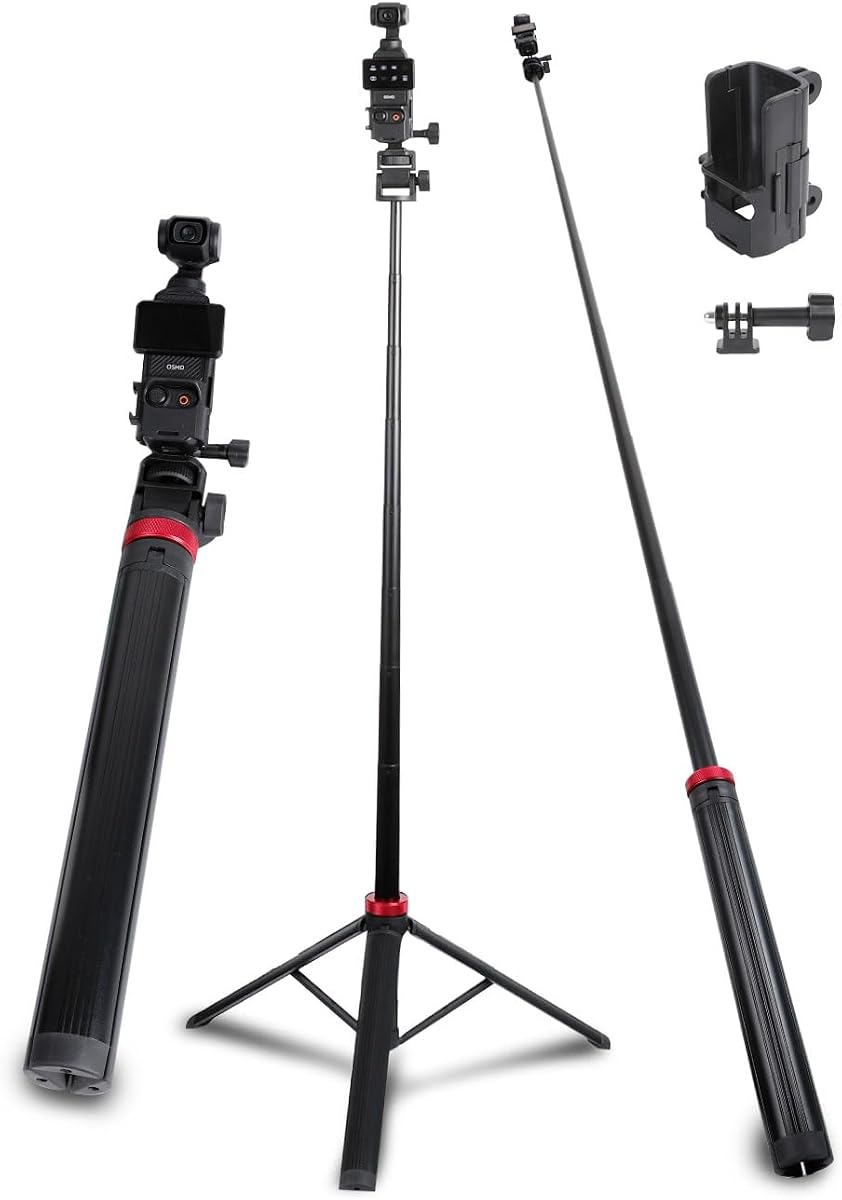
This 80-inch tripod and selfie stick is designed around DJI Osmo Pocket 3 and Pocket 4 use. It combines eight telescoping rods with a specialized expansion adapter intended to keep the camera secure while preserving access to buttons and the joystick. The adapter also avoids obstructing the bottom quick-release and charging operations, which are important details for an everyday Pocket workflow.
We may earn a commission when you buy through this link, at no additional cost to you.
The support adjusts from 14.37 to 80.71 inches, giving it enough reach for group photos, selfies, elevated filming, and broad landscape compositions. When opened as a tripod, its maximum edge span reaches 15.75 inches and can be adjusted to suit the available space. This creates a broad support footprint while retaining the ability to function as a handheld extension pole.
A listed weight of 518 grams makes it heavier than the compact 53-inch action-camera kit but similar to other tall telescoping stands in the guide. The package includes the selfie stick tripod, an action-camera adapter, a screw, and the Pocket expansion adapter. It is therefore equipped for a Pocket-centered kit as well as some other compact cameras, although it does not include the phone holder or remote controls found in some alternatives.
Choose this model if your primary device is an Osmo Pocket 3 or Pocket 4 and your priority is extended height without a full-size tripod. The dedicated adapter is its clearest advantage over a generic 1/4-inch stand. On the other hand, creators who need a phone holder, wireless remote, or broad cross-device kit may find a different product better aligned with those features.
The expansion adapter is shaped around access to the camera buttons and joystick. It also leaves the lower quick-release and charging area usable, which supports a smoother switch between handheld and mounted shooting.
The eight-section extension reaches 80.71 inches, while the broad tripod spread creates a stable base. The combination is useful for group framing, overhead views, and travel compositions that need more height than a desktop stand.
We may earn a commission when you buy through this link, at no additional cost to you.
The Kaitezenz 62-inch camera tripod has a 4.6 rating and offers a useful combination of reach, a rotatable ball head, and broad action-camera compatibility. Eight retractable sections extend from 12.7 inches to 62 inches, allowing the support to move from a compact carried length to a useful height for travel photos, group shots, sports, and everyday videography.
We may earn a commission when you buy through this link, at no additional cost to you.
Its 360-degree ball head supports horizontal and vertical repositioning, and a tightening knob locks the chosen angle. The tripod includes an aluminum-alloy lock and a stated load capacity of 1.5 kilograms, or 3.3 pounds. That capacity is greater than several one-kilogram supports in the guide and gives it room for a Pocket, Action camera, compact camera, or other suitably light device.
The included GoPro-style adapter supports a wide list of action cameras, including listed GoPro Hero, Max, Session, and Black models. The universal 1/4-inch screw also fits DJI Osmo Pocket 3 and 2, DJI Action 5 Pro, Action 4, and Action 3, Insta360 models, and Sony, Canon, and Nikon compact cameras. The ABS body weighs a listed 350 grams and includes an instruction manual.
This is a versatile option for creators who alternate among action cameras and compact DJI devices but do not need an 80-inch reach or phone remote. Its two-in-one construction works as a camera tripod, handheld grip, or selfie stick. It is best suited to lighter equipment and travel-oriented shooting, while users carrying larger mirrorless bodies should check both the stated load limit and the overall dimensions before relying on the extended configuration.
The 360-degree ball head makes it easy to change between landscape-oriented and more dynamic camera positions. Tightening the adjustment knob holds the selected angle during filming.
The support converts among a handheld grip, extension pole, and floor tripod. With a 12.7-inch retracted length and listed 350-gram weight, it remains manageable for outdoor kits while adding useful camera height.
We may earn a commission when you buy through this link, at no additional cost to you.
The most useful DJI tripod stand depends on your device, portability needs, and preferred shooting style. Review the connection method, physical dimensions, load limit, base design, and control features before making a selection.
Begin with the exact DJI model you own and the mounting method used by your camera. Pocket devices commonly rely on a 1/4-inch connection, while some Action camera kits use a magnetic quick-release mount and broader action-camera setups use an adapter. The mini tripod in this guide lists support for several Pocket, Action, and Insta360 models, whereas the DJI RS Extended Grip/Tripod connects specifically to supported RS battery grips.
A standard thread does not automatically guarantee full compatibility. Access to charging ports, buttons, joysticks, quick releases, and display areas may differ between adapters. Always compare the listed model, mounting direction, and included hardware before purchasing.
Tabletop stands are ideal for desk demonstrations, product filming, video calls, and stationary close-ups. Telescoping floor stands suit group photos, elevated selfies, overhead content, and wide scenes. The options range from a compact five-inch mini tripod to supports extending close to 81 inches. More height provides framing freedom but also makes the stand more sensitive to movement and uneven ground.
For most creators, a mid-range extension around 60 to 70 inches offers a useful compromise between reach and portability. Choose maximum height when filming crowds or obtaining a distinctly elevated perspective, and choose a short stand when stability and pocketability matter more.
The stated load capacity provides a basic guide to which equipment belongs on each stand. Compact Osmo devices generally suit supports with lower limits, while the K&F CONCEPT 62-inch model lists a 3-kilogram capacity and the Kaitezenz lists 1.5 kilograms. These figures are product claims, so they should not be treated as permission to attach an unusually heavy or unbalanced setup.
Base width, extension length, center of gravity, and terrain also affect real-world stability. Keep heavier devices closer to the support, use the legs as intended, and avoid adding equipment beyond the stated limit. For a heavy mirrorless camera or long lens, a dedicated full-size tripod is usually more appropriate than a compact DJI accessory.
A stable base begins with three planted feet, anti-slip contact points, and a broad spread. The 80-inch Osmo-Mobile model, 81-inch extendable tripod, and Pocket 3/4 stand all describe broad bases intended to improve stability. Shock-absorbing rings and reinforced locking mechanisms can also reduce movement in the extended leg sections.
Floor quality matters. Flat indoor flooring generally offers better results than loose beach sand, grass, or uneven trails. Test the fully extended stand before recording, keep the camera close to the centerline, and do not move the support while a shot is underway.
The smallest stands weigh roughly 45 grams and fit into a pocket, while tall telescoping models commonly weigh between 300 and 652 grams and occupy a larger portion of a bag. The 53-inch Osmo Action kit is especially compact because its floor tripod is built into the extension pole. The 81-inch supports offer more height but require more space and deliberate handling.
Consider how often you will actually need full extension. A shorter telescoping model may be easier to deploy quickly, while a large maximum reach becomes valuable for travel groups, scenic overlooks, and overhead demonstrations.
Ball-head movement determines how quickly you can change composition. The 80-inch Osmo-Mobile stand offers 180-degree vertical tilt and 360-degree horizontal rotation, the Kaitezenz provides a 360-degree ball head, and the K&F CONCEPT models use 90-degree vertical tilt or similar horizontal movement. A useful head should move smoothly and lock firmly enough to resist accidental movement.
For fast livestream or vlogging changes, broad rotation and quick repositioning can be valuable. For a fixed overhead setup, the ability to lock one angle may matter more. Always tighten the control knob after choosing the desired angle.
A wireless remote makes solo phone filming more convenient by allowing the creator to start or stop recording from a distance. The K&F CONCEPT 62-inch and 69-inch options include Bluetooth remotes, while the tall Osmo-Mobile floor stand includes a phone bracket but does not list a remote. Several camera-focused tripods similarly emphasize mounting and angle control rather than electronic triggering.
Treat phone remotes as device-specific unless the listing explicitly says otherwise. A remote that works with a phone may not operate a DJI Pocket, Action camera, or mirrorless camera, so separate camera-trigger methods may still be necessary.
A three-in-one or two-in-one design can reduce the number of accessories in your bag. Several products convert between a floor tripod, handheld grip, and extension pole, while the 53-inch Osmo Action kit adds a folding base directly to the pole. The DJI RS accessory converts between an extended grip and a compact upright stand.
Convertible products are convenient when one shooting session mixes static and mobile filming. However, confirm that the conversion does not make the device awkward to carry or complicate quick attachment. A simple dedicated tripod may be easier to deploy for a single fixed use.
Before attaching a camera, inspect the stand, adapter, screws, locking rings, and tripod feet. Confirm that the selected adapter matches the camera and that any quick-release or expansion mechanism locks completely. If using a magnetic action-camera mount, engage the magnet carefully and perform a short safety check to ensure the camera cannot shift or fall.
Set the tripod on level ground before extending the legs or telescoping sections. Open the base fully, tighten each section lock, and keep the camera balanced close to the support's center. After framing the shot, secure the ball head and make a brief test recording to check for movement. Do not move a loaded stand while it is extended, particularly in wind or on uneven terrain.
After use, retract the sections gradually, wipe away dust and moisture, and inspect silicone pads for debris. Clean the threaded connection with a dry, soft cloth rather than allowing grit to remain in the mount. Store the stand in a dry pouch or compartment, and avoid placing heavy equipment on it while partially folded.
The best choice depends on how you plan to use the Pocket 3. A compact mini tripod is convenient for desktop and handheld setups, while a telescoping floor stand offers group shots, elevated angles, and wider compositions. Check that the adapter is listed for Pocket 3 and that it does not block charging, buttons, or the quick release.
Many models can hold a phone, but only if they include a compatible phone holder. The 80-inch Osmo-Mobile floor stand and both K&F CONCEPT options include phone support, while several camera-focused stands rely on a separate phone mount. Also verify the holder's stated width range and whether the remote control works with your specific phone.
A tall support can be stable when its legs are fully opened, the sections are locked, and the camera remains balanced near the center. Stability decreases on uneven surfaces, in strong wind, or when a heavy camera is attached. For extended reach, use a broad base and avoid handling the stand while recording.
No. A standard screw can provide a physical connection while leaving model-specific fit or control access unresolved. Check the listing for the exact DJI model, included adapter, and any notes about magnetic mounts, charging ports, buttons, or joysticks before purchasing.
A mini tripod is a small, low-height support intended for tables, desks, and compact stationary shots. An extended grip tripod has telescoping sections and a broader base, allowing it to work as a floor stand, handheld pole, or selfie stick. The latter is more versatile for travel and group framing but takes up more space.
No. The DJI RS Extended Grip/Tripod is designed to connect to supported DJI RS stabilizers, including listed RS 4, RS 3, RS 2, and RSC 2 models. It is not a Pocket or Action camera tripod, so Osmo Pocket users should select a support with a standard camera thread or a compatible Pocket adapter.
Use the correct adapter, tighten every screw and locking mechanism, and keep the camera balanced close to the centerline. Perform a brief test before recording, and avoid lifting the stand while it is extended. Magnetic adapters should be checked for full engagement, especially on models with different magnetic interfaces.
The smallest mini tripods are generally the easiest to carry because they fold into compact shapes and weigh only about 45 grams. The 53-inch Osmo Action kit is another travel-friendly option, as its integrated floor tripod folds with the extension pole and its listed weight is 300 grams. Choose based on whether compactness or greater height matters more.
The 80-inch Osmo-Mobile floor tripod stands out as the strongest all-rounder because it converts among three roles, supports a wide collection of devices, and offers generous angle adjustment. The fourth-ranked mini tripod delivers the best budget balance of portability and compatibility, while the official DJI RS Metal Extended Grip/Tripod is the premium choice for supported RS stabilizers.
For most Pocket and Action camera creators, prioritize the exact mounting connection, the height required for typical shots, and a stable base that fits the available space. A remote is worthwhile for phone-focused solo videos, but it is less important than correct DJI compatibility. Tabletop work calls for a mini tripod, while travel groups and elevated compositions benefit from telescoping reach.
Before ordering, verify the current product listing, camera model, included adapters, and dimensions against your own kit. Availability and pricing can change, so use the current listing to confirm the latest configuration and make sure the chosen stand matches both your device and the way you plan to shoot.