
Diamond Lark LF-D588
3.6Editor score
4K front and 1080p rear
Three-inch IPS display
64GB card included
A dash camera can provide valuable evidence after a collision, document unexpected road events, and add protection while your vehicle is parked. The best inexpensive models balance useful resolution, wide-angle coverage, dependable low-light recording, and straightforward installation. They should also fit neatly behind a mirror without obstructing your view.
We compared these ten affordable dash cams by resolution, front and rear coverage, night-vision technology, storage support, smartphone connectivity, parking functions, displays, and installation considerations. The list includes compact single-camera designs, dual-camera systems, three-channel cabin coverage, and a four-camera 360-degree option for buyers with broader coverage needs.
Each pick below explains the features that matter most, the compromises worth considering, and the situations in which the camera makes the most sense. Ratings and product details reflect the supplied marketplace information, while availability and prices can change. Always confirm the current specifications, accessories, and card requirements before ordering.
3.6Editor score

4.4Editor score

4.5Editor score
As an Amazon Associate we earn from qualifying purchases.
The comparison below highlights each model's coverage, resolution, connectivity, and storage setup, making it easier to identify the most suitable low-cost dash cam for your vehicle and recording priorities.




The galphi 4K Dash Cam Front is our overall selection because it combines 4K UHD recording, a compact screen-free design, 5GHz Wi-Fi, and an included memory card without creating an unnecessarily complicated installation. Its 4.4 rating reflects a strong balance of capability and affordability, particularly for drivers who want detailed front-facing evidence but do not need cabin coverage.
We may earn a commission when you buy through this link, at no additional cost to you.
The camera records through a 160-degree lens and uses an F1.6 aperture with wide dynamic range to balance bright and dark portions of the road. The supplied description also highlights improved night performance, which is particularly valuable during rain, snow, dusk, and nighttime driving. A G-sensor can lock footage following sudden motion or an impact, while seamless loop recording makes unattended daily operation more practical.
The 5GHz connection is one of its most appealing features because the manufacturer claims downloads of up to 8MB/s, compared with 2MB/s on 2.4GHz networks. That speed makes phone-based previewing and file transfer more convenient than on many similarly priced systems. The screen-free body is another thoughtful choice, reducing dashboard clutter and keeping the camera near the rearview mirror. The main compromise is that it records only the road ahead. Parking surveillance also requires a separately purchased Type-C hardwire kit.
This is a strong recommendation for commuters, new drivers, rideshare drivers, and anyone who wants sharp front-camera evidence while keeping the installation visually minimal. It is particularly appealing when a bundled 32GB card removes the need for an immediate extra purchase. Buyers who require rear or interior coverage should look to the dual-channel and three-channel alternatives, but for a compact and capable front camera, this galphi model stands out.
The 4K UHD front sensor records substantially more visual information than a conventional 1080p camera, which can help when distant signs, lane markings, or vehicle details need later review. Its narrow, screen-free body can sit close to the mirror, avoiding a large display that might draw attention away from the road.
Connecting through the 5GHz Wi-Fi band allows supported phones to download clips more quickly while the app handles preview, playback, and sharing. This convenience is valuable for drivers who want to save an incident promptly without repeatedly removing the memory card.
We may earn a commission when you buy through this link, at no additional cost to you.
The Veement V300 is a straightforward front-only dash cam aimed at drivers who want 1296p recording, a broad field of view, and app control without paying for rear coverage. Its 4.1 rating places it among the stronger basic options in this group. Resolution is slightly below 2.5K QHD but remains higher than standard 1080p and can preserve useful road detail.
We may earn a commission when you buy through this link, at no additional cost to you.
Its 170-degree lens is especially notable for a compact budget model, offering broad coverage across adjacent lanes. An F1.7 aperture and six-layer lens support night recording, while the VeeCar app provides live preview, playback, downloads, editing, and sharing through the camera's local Wi-Fi connection. The product does not provide internet access through that Wi-Fi link, and the camera still requires a continuous USB-C power supply.
A useful safety-oriented design choice is the RTC circuit and removal of a conventional lithium battery. According to the supplied information, this reduces overheating concerns compared with battery-powered designs. The system also offers loop recording, a G-sensor, and 24/7 parking mode, with support for cards as large as 256GB. The trade-offs are a lower resolution than most competing picks and the need to buy a compatible memory card separately.
Choose the V300 when ease of use and a wide field of view matter more than native 4K or dual-camera recording. It works well for daily commuting, younger drivers, and owners who want phone access without a physical screen. Budget-conscious shoppers should factor the separate card into the overall purchase and verify current card specifications before ordering.
A 170-degree lens captures more of the roadway than many conventional dash cams, helping preserve context from neighboring lanes. That wider view can be useful in multi-lane traffic, complicated intersections, and parking-lot incidents where a narrow field of view may omit important surroundings.
The built-in Wi-Fi creates a local link between the camera and the VeeCar app for previewing and transferring recordings. The distinction matters because users should not expect the device to act as an internet-connected tracker or cloud storage system.
We may earn a commission when you buy through this link, at no additional cost to you.
The Diamond Lark LF-D588 stands out as the budget-oriented way to obtain both 4K front recording and 1080p rear coverage. It also includes a 64GB card, a three-inch IPS display, 5GHz Wi-Fi, and app control. Its 3.6 rating is the lowest in this list, so buyers should weigh its broad feature set against limited customer feedback compared with the more highly rated alternatives.
We may earn a commission when you buy through this link, at no additional cost to you.
The front camera uses a six-glass lens to record at 3840 by 2160p, while the rear camera records at 1080p with a four-glass lens. An F1.8 aperture and night-oriented exposure handling support low-light use. On-device controls include live monitoring and playback, while the Viidure app allows phone preview, review, downloading, editing, and sharing. A 170-degree front lens and reinforced mounting bracket add further practical value.
The G-sensor automatically locks footage after detected impacts, and loop recording overwrites only unprotected files. Parking surveillance offers both collision-triggered clips and time-lapse recording over selectable durations of 12, 24, or 72 hours. A hardwire kit must be purchased separately. The main concern is the relatively low listed rating, which may reflect customer satisfaction rather than a deficiency in the stated specifications, but it remains a fact shoppers should consider.
This model makes sense for buyers who want front-and-rear evidence on a limited budget and value a physical screen plus bundled storage. It is more versatile than the Veement V300 and galphi camera, although those alternatives offer stronger ratings or simpler compact designs. Choose the LF-D588 when dual coverage and the included card outweigh the desire for a stronger established rating.
Recording ahead and behind at the same time can help establish the sequence of a rear-end collision, parking incident, or traffic dispute. The lower 1080p rear resolution is still suitable for contextual coverage, while the front channel supplies the highest detail.
The three-inch IPS display supports immediate checks and playback without a phone, while 5GHz app control provides a faster route to transferring and sharing clips. Having both methods is useful for different habits and preferences.
We may earn a commission when you buy through this link, at no additional cost to you.
The XYGCACO D65 is the list's most comprehensive coverage system, using four synchronized cameras to record the front, rear, left, and right sides. Its 5.0 rating is the highest supplied rating, making it an attractive choice for drivers who want to minimize blind spots. The front channel records in 4K, while three adjustable cameras provide 1080p coverage.
We may earn a commission when you buy through this link, at no additional cost to you.
A three-inch IPS screen helps with setup and monitoring, and the synchronized view provides broader situational awareness than a conventional front-and-rear kit. Dual-band 5GHz Wi-Fi supports phone access through the Viidure app, while GPS allows the vehicle's route to be viewed and incorporated into the evidence. The included 64GB card makes initial setup easier, and loop recording with a G-sensor protects relevant incident files.
Low-light performance is supported by an F1.6 aperture, wide dynamic range, and eight infrared LEDs. Parking mode is designed to monitor nearby objects, begin quickly, and save a one-minute recording when an event is detected. That capability requires a separately purchased hardwire kit. The compromises are installation complexity, additional camera placement, and more cables around the vehicle compared with a single compact model.
This camera is best for someone who prioritizes full perimeter visibility, synchronized evidence, and route documentation. It may be excessive for ordinary commuting, but it can make sense for rideshare work, parking in exposed areas, or simply eliminating uncertainty about a vehicle's sides. Users should confirm windshield placement and local rules before installing a multi-camera system.
Front, rear, left, and right channels provide a more complete account than a standard two-camera arrangement. That can be especially helpful during lane changes, parking-lot movements, or incidents involving a vehicle approaching from the side.
Built-in GPS allows supported app or player software to display routes and locations associated with saved footage. The added context can make a clip more useful when documenting where a journey took place.
We may earn a commission when you buy through this link, at no additional cost to you.
The S60 Dual Camera offers a balanced combination of 2.5K front recording, 1080p rear coverage, a physical display, and a straightforward suction mount. Its 4.2 rating suggests solid overall appeal. For drivers seeking more detail than 1080p without moving to a native 4K premium system, this is a practical middle ground.
We may earn a commission when you buy through this link, at no additional cost to you.
The front camera records at 2560 by 1440p through a 170-degree lens, while the rear camera captures at 1080p. A starlight-oriented sensor, six-layer lens, and wide dynamic range help balance headlights against darker surroundings at night, in tunnels, and in parking lots. The G-sensor can lock clips following impacts, abrupt braking, or collisions, reducing the chance that valuable evidence will be replaced during loop recording.
The two-inch IPS screen is smaller than the displays on several competing products, but it supports quick angle checks and basic adjustments. A 360-degree rotating suction mount makes placement and removal convenient. Optional 24-hour parking surveillance uses time-lapse recording and needs a compatible Type-C hardwire kit. A memory card is not bundled, although cards up to 256GB are supported. Unlike some alternatives, the supplied details do not mention built-in Wi-Fi or app control.
The S60 is a strong fit for buyers who want a physical interface, reliable dual-channel capture, and broad road coverage without chasing premium sensor specifications. It is particularly suitable for family vehicles and everyday drivers. Those who prioritize wireless transfers should consider a model with app connectivity, while first-time owners should budget for the required storage card.
A 2.5K front channel preserves more detail than 1080p, while the rear channel adds the context needed after a rear-end or parking incident. This combination is often more useful than spending the entire budget on a higher-resolution front camera alone.
The two-inch display is convenient for checking framing and reviewing recent clips without connecting to a phone. Combined with the rotating suction mount, it also makes the camera easier to adjust if vibration changes the viewing angle.
We may earn a commission when you buy through this link, at no additional cost to you.
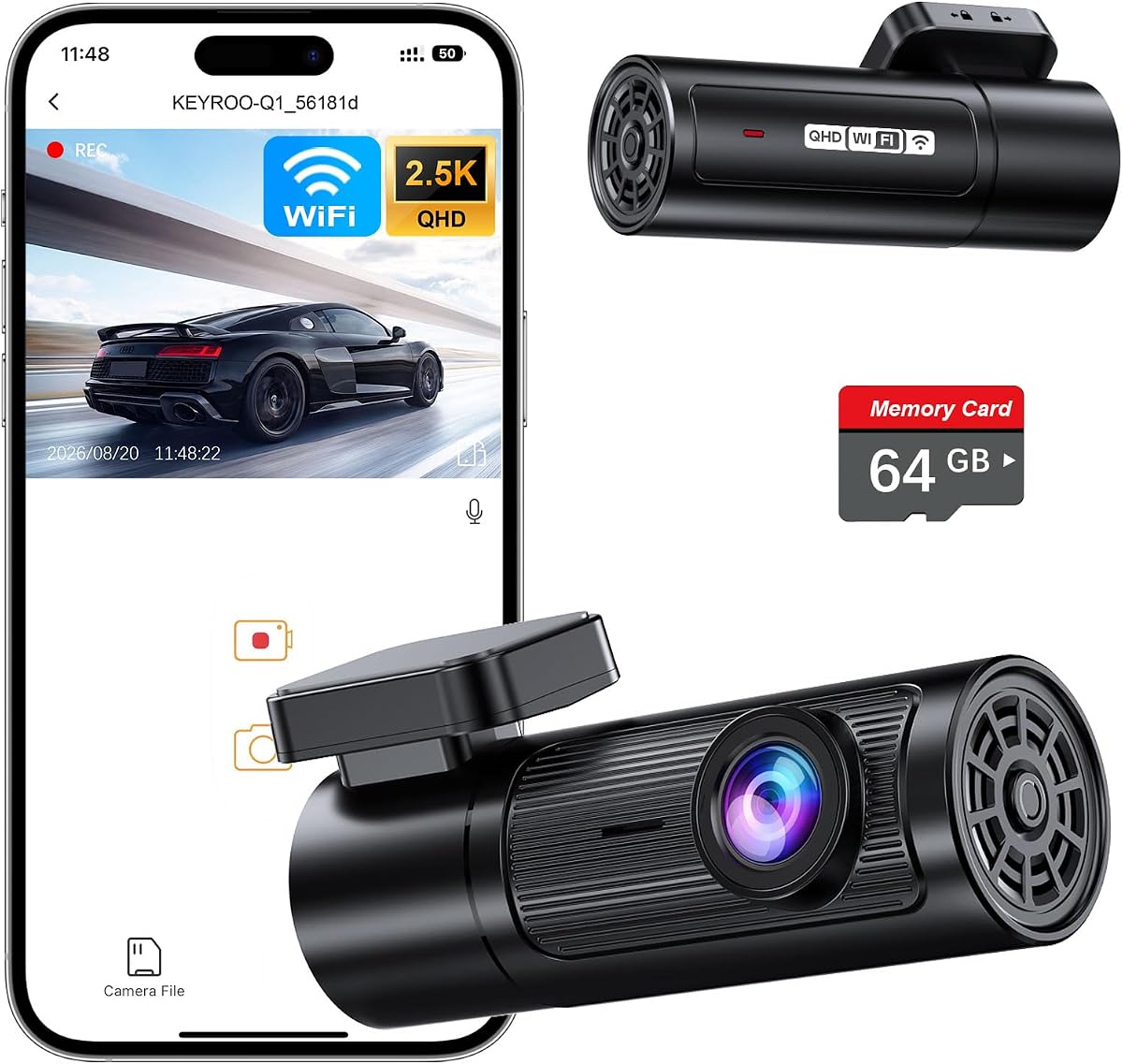
The KEYROO Q1 pairs a 2.5K QHD sensor with a compact, screen-free body, 5-star listed rating, and a preinstalled 64GB high-endurance card. It is an appealing choice for drivers who dislike a large dash camera near the rearview mirror. The supplied information also gives it a useful 160-degree field of view for reducing blind spots around adjacent lanes.
We may earn a commission when you buy through this link, at no additional cost to you.
Its six-layer lens is designed to capture clear footage in low light and high-contrast conditions, while the G-sensor locks recordings after detected collisions. The built-in Wi-Fi and companion app allow iOS and Android users to preview, download, replay, and share clips without removing the card. The detachable bracket makes the camera easy to reposition, and the rotatable lens can suit different vehicles, including sedans, SUVs, pickups, and rideshare cars.
Parking mode uses low-frame-rate time-lapse recording and switches on when the vehicle is appropriately powered. A professional hardwire kit must be purchased separately for this function. Loop recording automatically replaces older files while protected clips remain intact, and the included card can be replaced with one up to 256GB. The main limitation is that there is only one front-facing camera, so the cabin and rear are not recorded.
The Q1 is well suited to minimal installations, particularly for drivers who prioritize a clean dashboard, app access, and a generous included card. Its 5.0 rating is excellent, although ratings alone do not replace evaluating the fit and functions you need. Choose it for front-only evidence and easy phone transfers, or consider a dual-camera system if rear coverage is essential.
The mini body and screen-free design can reduce visual clutter and help keep attention on the road. Its detachable bracket also gives owners flexibility when moving the camera between compatible vehicles.
A 64GB high-endurance card is already installed, eliminating the common first extra purchase. Additional cards up to 256GB are supported, providing room to expand capacity as recording needs grow.
We may earn a commission when you buy through this link, at no additional cost to you.
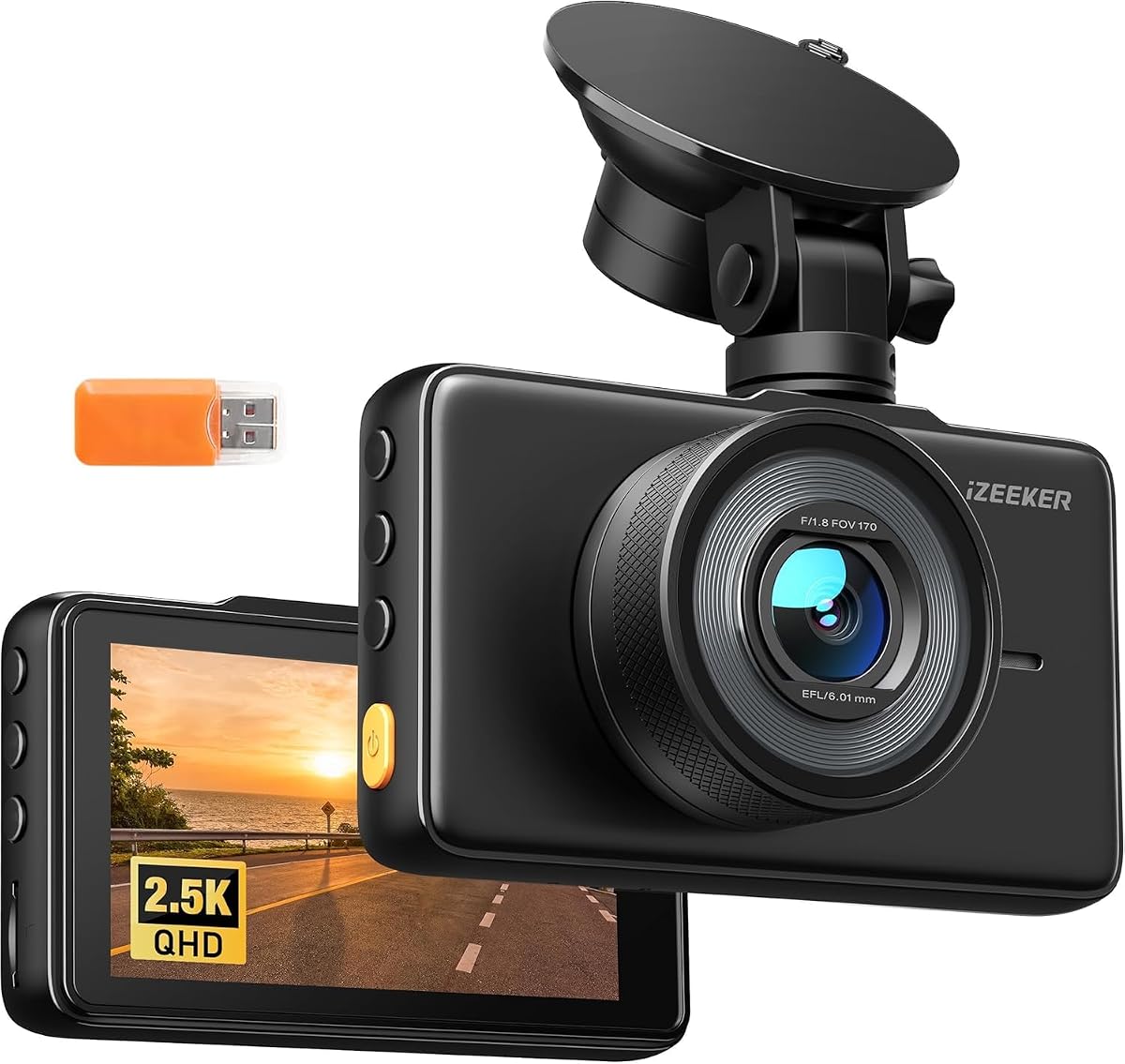
The iZEEKER 2.5K follows a familiar dash-cam design with a three-inch IPS display, physical controls, a suction mount, and 2.5K QHD recording. Its 4.2 rating reflects a well-rounded option for drivers who prefer immediate on-device operation over app-based management. The absence of required Wi-Fi makes it straightforward to check recordings while parked.
We may earn a commission when you buy through this link, at no additional cost to you.
The camera records at 2560 by 1440p and 30fps through a 170-degree lens, capturing multiple lanes and roadside details. An F1.8 aperture and wide dynamic range help improve visibility in darkness and when bright headlights contrast with dark surroundings. The G-sensor automatically locks footage after sudden vibration or collision, and a physical lock button lets the driver preserve a clip manually.
The microSD card is not included, and supported capacity extends to 128GB. Parking monitoring offers event recording and low-frame-rate time-lapse capture, but it requires a separate hardware kit. Power can come from the included cigarette-lighter adapter or a USB port through the detachable car charger. The product is backed by a two-year warranty, and its principal compromise is the lack of rear or cabin coverage.
This model is a sensible choice for drivers who value a large readable display, simple buttons, and broad road coverage. It works particularly well for anyone beginning a dash-cam setup without wanting to manage phone connections. Buyers should include a suitable memory card in their planning and verify that the chosen card meets the camera's requirements.
The IPS display and physical buttons make the camera accessible without learning a companion app. This is useful for quick checks, manual event locking, and situations where phone connectivity may be inconvenient.
The detachable car charger can be used with the cigarette lighter or a USB connection, giving owners more ways to power the camera. A simple suction mount and included instructions also reduce setup complexity.
We may earn a commission when you buy through this link, at no additional cost to you.
The ROVE R2-4K Dual is the premium choice in this roundup, combining a Sony STARVIS 2 front sensor, rear camera, GPS, high-speed Wi-Fi, a three-inch IPS screen, and an included 128GB card. Its 4.5 rating is strong, while the more advanced sensor and connectivity separate it from entry-level models. It suits drivers who want a refined feature set without moving to the most expensive category.
We may earn a commission when you buy through this link, at no additional cost to you.
The front camera captures at 2.5K and upscales the result to 4K for playback, while the rear records at 1080p. Buyers should understand that the front footage is not native 4K. The Sony STARVIS 2 IMX675 sensor, F1.5 front aperture, HDR, and wide F1.8 rear aperture are designed to improve low-light clarity. GPS data can add route, location, and speed information to recordings.
Dual-band 5.8GHz and 2.4GHz Wi-Fi support app-based management, with claimed download speeds up to 20MB/s. The package includes 128GB of storage, a dual USB fast charger, power and data cables, rear-camera cable, mounts, clips, a trim tool, and a cleaning wipe. Parking options include one-frame-per-second time-lapse, motion detection, and collision detection, but a hardwire kit is required. A built-in supercapacitor and thermal protection are additional durability-oriented features.
This is the best fit for owners who prioritize sensor quality, rapid clip transfer, GPS context, and generous storage. The main compromise is the upscaled rather than native 4K front resolution, plus the additional hardwire-kit cost for parking surveillance. Despite those qualifications, it offers a more advanced everyday package than most cheaper dual-camera picks.
The STARVIS 2 sensor and wide front aperture are designed to gather more light in tunnels and darker environments. This can improve the visibility of signs, vehicles, and other details when compared with a basic low-light sensor.
The 5.8GHz connection provides a faster route for moving recordings to a phone, while built-in GPS adds spatial context. Together, these features are particularly useful for fleet or rideshare drivers who regularly review and share clips.
We may earn a commission when you buy through this link, at no additional cost to you.
The Three-Channel 4K Dash Cam is designed to watch the road, rear, and passenger compartment. It has a 5.0 rating and stands out as an affordable option for drivers who want interior evidence, especially those involved in rideshare work, delivery driving, or shared-vehicle use. The front camera records in 4K, while the cabin and rear channels record in 1080p.
We may earn a commission when you buy through this link, at no additional cost to you.
The front lens covers 170 degrees, the interior camera 150 degrees, and the rear camera 160 degrees. All three use F2.0 apertures and six-layer optics, while wide dynamic range and four infrared light enhancements support night recording. A free 32GB memory card is included, and loop recording automatically replaces older footage when capacity is reached.
The G-sensor locks the first five seconds and last ten seconds around a detected collision, providing useful context around the event. A dedicated app supports live viewing and downloads over Wi-Fi for iOS and Android, along with camera-setting changes. Optional 24-hour parking mode records low-frame-rate time-lapse footage, but a separate hardwire kit is required. Installation is more involved because the rear cable must be routed around the vehicle.
This is a strong recommendation for anyone who wants a camera inside the cabin as well as in front of and behind the vehicle. Its limitations are the included card's modest capacity, the need to route wiring for the rear camera, and the extra purchase required for parking surveillance. For complete three-angle evidence, however, it offers excellent value.
Adding an interior camera broadens the story beyond road and traffic context. It can document passenger activity, cabin conditions, or events that a forward-facing camera cannot see, making the system more versatile.
Saving footage before and after a detected collision provides more context than locking only the instant of impact. This is especially useful when the beginning or end of a sudden event helps explain what occurred.
We may earn a commission when you buy through this link, at no additional cost to you.
The REDTIGER F7N TOUCH is a feature-rich front-and-rear system with native 4K front recording, a STARVIS 2 sensor, 5.8GHz Wi-Fi, GPS, voice commands, a touchscreen, and an included 128GB card. Its 4.3 rating is solid, and while it sits at the upper end of this inexpensive roundup, it offers features that many cheaper competitors lack.
We may earn a commission when you buy through this link, at no additional cost to you.
The front camera records in 4K UHD through a 170-degree lens, while the rear camera records at 1080p with a 140-degree field of view. Wide dynamic range, HDR, and enhanced night vision are intended to improve clarity in difficult lighting. Voice commands allow hands-free operation, and the touchscreen can lock emergency video, activate Wi-Fi, and capture scenery. Physical buttons are retained for additional control methods.
The REDTIGER Cam app provides phone management and claimed download speeds up to 20MB/s. Built-in GPS records traceable location, speed, and route information. Loop recording keeps memory use manageable, while the G-sensor automatically protects footage associated with sudden movement or impact. The included 128GB card offers substantial capacity, and 24-hour parking monitoring includes both collision-triggered and time-lapse options.
This camera is best for drivers who want a premium feature set, a large touch interface, and front-and-rear coverage in one package. Its compromises are the higher relative cost and the need to purchase a hardwire kit for parking mode. It is a strong choice when high-resolution front footage and a 128GB card matter more than minimizing the purchase.
Unlike upscaled 4K implementations, the stated 4K front capture is produced at 3840 by 2160p. Combined with the STARVIS 2 sensor, HDR, and wide dynamic range, it is aimed at preserving detail in both bright and dark portions of the road.
Voice commands reduce the need to interact with the device while driving, while the touchscreen and physical buttons offer direct alternatives. This mix of controls is useful for quickly locking evidence or navigating the camera's features.
We may earn a commission when you buy through this link, at no additional cost to you.
The right inexpensive dash cam depends on whether you prioritize front-only simplicity, front-and-rear evidence, cabin monitoring, complete 360-degree visibility, phone connectivity, or parking surveillance. Compare the complete recording system rather than comparing headline resolution alone.
Choose the highest practical resolution that meets your needs. For inexpensive systems, 2.5K and 1296p are still meaningful upgrades over 1080p, while native 4K is most beneficial when reviewing small details or extracting frames.
Pick one camera for straightforward road evidence, two for front-and-rear protection, and three or four when cabin or side coverage is essential. Check windshield placement carefully to avoid obstruction.
Prioritize models with wide apertures, wide dynamic range, and a recognized low-light sensor when driving after dark. Check whether infrared LEDs support the interior or side cameras rather than assuming they improve every channel.
Choose an included-card model for convenience, or add a suitable card to a lower-cost version. Confirm capacity and speed requirements before ordering, especially for high-resolution or multi-camera systems.
Pick app control when you frequently share clips or manage multiple recordings. Choose a physical-button design when simplicity, immediate review, or independence from a phone matters more.
Treat parking mode as a separate installation project rather than assuming it works out of the box. Verify the required hardwire kit, cutoff behavior, supported parking modes, and recording duration before purchase.
Choose a display for simple, phone-free operation, or a screen-free model for minimal visual distraction. In either case, mount the unit high enough that it does not block the driver's view.
Consider GPS if location evidence matters and check the stated warranty and support terms. Use a secure mount, inspect cables regularly, and avoid obstructed ventilation in hot conditions.
Begin by charging the camera with the supplied or compatible power cable, formatting a supported memory card in the dash cam, and confirming the correct time and date. Mount the camera high on the windshield or in the stated location without blocking the driver's view. Route rear and side cables along trim edges, away from airbags and moving window mechanisms, and test every angle before beginning normal recording.
After installation, drive a short familiar route and review front, rear, or interior footage to confirm stable alignment. Learn the app connection, event-lock control, loop-recording behavior, and parking-mode settings. Keep the memory card inserted during use, download important clips, and avoid formatting the card through an unrelated device unless the camera's instructions permit it.
Dash cams operate in heat, cold, vibration, and direct sunlight, so inspect the mount, cable routing, and power connection periodically. Clean the lens gently, keep ventilation openings clear, and check the recording screen after severe weather. For hardwired installations, verify the low-voltage cutoff and parking draw, and disconnect the system if the vehicle battery becomes strained.
A dash cam can provide useful visual evidence, but its usefulness depends on correct installation, legible footage, timestamps, and whether the relevant event was actually recorded. Owners should preserve the original file, avoid editing the master copy, and follow their insurer's instructions. No camera can guarantee that every incident will be captured, so a reliable power connection, adequate storage, and regular recording checks remain essential.
A 2.5K model can provide more detail than 1080p while using less storage and usually costing less. Native 4K is attractive when you need maximum detail or often review small objects, but file sizes increase and a genuine 4K sensor matters. Check whether a product's advertised 4K is native or upscaled from a lower-resolution recording before comparing models.
It depends on the model. The galphi, Diamond Lark LF-D588, KEYROO Q1, XYGCACO D65, three-channel system, ROVE R2-4K Dual, and REDTIGER F7N TOUCH include cards according to the supplied information. The Veement V300, S60, and iZEEKER 2.5K do not, so budget for a compatible card and check the required capacity and speed class.
Most listed models support some form of parking mode, commonly low-frame-rate time-lapse, motion detection, or collision-triggered recording. Nearly all require a separately sold compatible hardwire kit because they need continuous power after the engine stops. Choose a kit with an appropriate low-voltage cutoff, and avoid leaving the system active if it might drain the vehicle battery.
A built-in screen is faster for basic checks and avoids dependence on a phone connection, while Wi-Fi is more convenient for downloading, organizing, and sharing larger files. Screen-free cameras tend to blend more discreetly behind the rearview mirror. The best choice depends on how often you expect to review footage and whether immediate phone transfers are important to you.
A 160- to 170-degree lens is common among these models and offers broad coverage of the road and adjacent lanes. An excessively wide view can introduce edge distortion or make objects appear smaller, so position and angle matter as much as the specification. Check the image in daylight, confirm the license plate and road signs remain legible, and make sure the camera does not obstruct your view.
Check the recording status and sample a recent clip periodically, especially after installation, software updates, card replacement, or a change in vehicle power. Look for free-space problems, incorrect timestamps, blurred footage, and loose mounts. If parking surveillance or incident evidence is important, checking more frequently can reveal a disconnected power lead or full card before useful footage is lost.
A continuously powered hardwired installation can drain the battery if it lacks an appropriate low-voltage cutoff or remains active for too long. The cigarette-lighter setup generally stops when the ignition is switched off, although exact behavior varies by vehicle. Use a compatible automotive hardwire kit, confirm its cutoff settings, and inspect the system if the vehicle struggles to start after extended parking.
The galphi 4K Front is the strongest overall choice for buyers who want a compact front camera with 4K recording, fast 5GHz Wi-Fi, and an included card. The Diamond Lark LF-D588 offers the most budget-oriented route to front-and-rear coverage, while the ROVE R2-4K Dual is the premium pick for sensor quality, GPS, rapid transfers, and substantial included storage.
Prioritize the coverage you will actually use rather than selecting solely by resolution. A simple 2.5K front camera can be more useful than a complicated system with features you never configure, while dual or three-camera coverage is valuable for shared vehicles, parking concerns, and rideshare work. Confirm card support, app requirements, parking-kit needs, mounting placement, and low-voltage protection before completing the purchase.
Marketplace prices, ratings, product configurations, and availability can change over time, so check the current listing before ordering. Compare the included accessories carefully and avoid assuming that a feature mentioned in a product title is present in the box. With the right balance of resolution, field of view, storage, and installation, an inexpensive dash cam can still provide dependable everyday evidence.