
Callaway 300 Pro Golf Laser Rangefinder
4.6Editor score
Adjustable slope compensation
Six-times optical magnification
Integrated magnetic cart mount
An AI golf rangefinder goes beyond measuring the distance to a flag by combining laser precision with slope, weather, GPS, swing data, and personalized club information. The best model should help you select a target, understand the required playing distance, and make a faster decision without sacrificing tournament compatibility or everyday simplicity.
This guide compares ten laser rangefinders with AI-assisted or data-driven features. We evaluated the stated range, magnification, slope controls, environmental adjustments, GPS functions, display design, connectivity, shot tracking, durability, and practical extras such as flag-lock confirmation and magnetic mounting. The list covers both subscription-based systems and self-contained devices.
Each review explains the product's strongest benefits, relevant limitations, and ideal user, while the comparison table makes the differences easier to scan. Ratings and specifications can change over time, and live prices, promotions, bundle contents, and subscription terms may vary. Always verify the current listing and tournament rules before purchasing.
4.6Editor score

4.8Editor score

5.0Editor score
As an Amazon Associate we earn from qualifying purchases.
The comparison highlights each rangefinder's core measurement range, magnification, slope capability, and most important connected or AI-assisted function, helping you distinguish basic tournament tools from broader course-analysis systems.



Arccos Smart Laser is a subscription-connected rangefinder built around the idea that raw distance is only one part of club selection. Its 3.4 rating reflects the mixed reception associated with a more software-dependent product, but the stated capabilities extend well beyond basic laser measurement. The device displays actual yardage alongside a "plays like" figure adjusted for slope and live weather.
We may earn a commission when you buy through this link, at no additional cost to you.
Its most interesting features are the Arccos AI Strategy recommendations and Green Maps, developed with Edoardo Molinari and informed by a claimed database of more than 1.5 billion shots. The interactive digital yardage book covers more than 40,000 courses and supplies front, center, back, and layup information without requiring Arccos Smart Sensors. A compatible iOS 17+ or Android 11+ phone remains necessary for the connected experience.
The trade-offs are the subscription requirement, the need to carry a smartphone, and the lower customer rating relative to several simpler rangefinders. Some golfers may also prefer a dedicated hardware-only experience with fewer menus and account dependencies. Even so, the combination of slope, wind, precision laser readings, AI strategy, and course maps gives this model a distinctly different proposition from a conventional distance device.
This is the strongest recommendation for golfers who want more than a number and are comfortable managing an app-based membership. It is particularly useful for strategic players, frequent travelers, and members already invested in the Arccos ecosystem. Buyers should compare the recurring membership cost with how regularly they will use strategy tools, shot tracking, and course-specific guidance before committing.
By presenting both straight-line distance and a weather-adjusted plays-like value, Arccos helps answer the more important question: which club should produce the desired shot? The included strategy layer can also identify smarter targets, reducing the need to make every decision entirely from yardage.
Digital yardage information for more than 40,000 courses adds practical value beyond the laser. It can help golfers prepare layups and understand multiple green positions without adding clip-on sensors to the clubs.
We may earn a commission when you buy through this link, at no additional cost to you.
MILESEEY GenePro S1 is a feature-heavy AI rangefinder with a 4.4 rating and an emphasis on environmental compensation. It combines a 2,000-yard stated range, 7.5-times magnification, and claimed precision of plus or minus 0.5 inch on the green. Its SmartSlope system is designed to account for wind, temperature, humidity, barometric pressure, and elevation rather than adjusting for terrain alone.
We may earn a commission when you buy through this link, at no additional cost to you.
The targeting system offers 0.1-second vibration feedback and SmartFiltering intended to separate the flag from visual distractions in rain, fog, or dust. A 7.5-degree field of view, more than 95% light transmission, and an automatically adapting red-or-black display are designed to make the optic easier to read in changing light. The body carries an IP65 waterproof and dustproof rating, a magnetic mount, and an adjustable diopter.
Its principal trade-off is that the combination of exceptional specifications and several first-of-their-kind claims makes careful real-world evaluation especially important. A high magnification and large range can be useful, but they do not automatically guarantee better results for every golfer. The two-color display also has less flexibility than a fully adjustable display, and the device remains a substantial piece of technology to operate on the course.
Golfers seeking the longest stated range, aggressive environmental analysis, and a tournament-ready slope switch should give the GenePro S1 serious consideration. It suits players who routinely play long courses or want detailed readings around hazards. Those who prefer fewer operating modes may find simpler models easier to master.
The SmartSlope system gives the rangefinder a broader interpretation of distance than a simple incline calculation. By including atmospheric and elevation variables, it attempts to present a more representative playing distance for club selection.
SmartFiltering and rapid vibration feedback are intended to improve confidence when rain, fog, dust, or background targets make the flag harder to acquire. The long stated range also provides flexibility on expansive courses.
We may earn a commission when you buy through this link, at no additional cost to you.
FlightScope i4 is a 4.7-rated rangefinder that connects a laser measurement with GPS, local conditions, slope information, and swing data. The result is a focus on personalized club recommendations rather than presenting every golfer with the same generic distance-to-club chart. That distinction makes it particularly attractive to players who already track launch information or want to refine their gaps.
We may earn a commission when you buy through this link, at no additional cost to you.
The device measures from 5 to 1,000 yards through 6-times optical magnification. It adjusts for wind, temperature, and altitude to provide an effective playing distance, while an easy on-and-off slope control supports tournament play. A built-in magnet attaches it to a cart, and the USB-C rechargeable battery removes the routine inconvenience of disposable cells.
Personalization is both the main attraction and the main condition attached to the recommendation. The quality of the club advice depends on the availability and relevance of the golfer's swing data, while the connected features benefit from continued ecosystem use. A golfer who only wants an isolated distance reading may find that more complexity than necessary.
FlightScope i4 is best for golfers focused on repeatable club selection and smart gapping. It is also a sensible choice for those comfortable maintaining their performance data. Buyers should make sure the app and connected tools fit their routine before choosing it over a more conventional laser rangefinder.
The i4 uses launch information together with environmental conditions to suggest a club. For golfers who understand their dispersion, that tailored guidance can be more useful than a universal distance-to-club conversion.
USB-C charging and an integrated magnet simplify the physical design. The device can remain ready for several rounds and move easily between a golf bag and cart without a separate mount.
We may earn a commission when you buy through this link, at no additional cost to you.
Callaway 300 Pro with External Slope Switch is a focused laser rangefinder built around reliable distance measurement and uncomplicated slope control. Its 4.6 rating reflects a well-established feature set, while the physical design remains easy to understand. It measures from 5 to 1,000 yards, offers 6-times magnification, and provides plus or minus one yard accuracy.
We may earn a commission when you buy through this link, at no additional cost to you.
The external slope switch makes it straightforward to move between normal and compensated readings. That physical control is valuable for golfers who compete in tournaments and do not want to fiddle with menus before every shot. Pin Acquisition Technology can lock onto a flag up to 300 yards away, and the Pulse feature supplies a short vibration when a distance is confirmed.
The main limitation is that its intelligence is centered on slope rather than a broad collection of AI tools. It does not offer the strategy engines, GPS course views, personalized club gaps, or automatic shot tracking found in more connected models. That is not necessarily a disadvantage; for many golfers, fewer features mean a shorter learning curve and fewer distractions.
This model is an excellent choice for a player who wants a dependable rangefinder with tournament control and few distractions. It also makes sense for golfers comparing the AI category and concluding that precise slope compensation matters more than an app. Its molded hard case and included battery add practical value for storage and immediate use.
The external switch provides a clear operational advantage: slope can be disabled quickly when rules require it. This reduces menu time and makes compliance easier to manage during competitive rounds.
Pin Acquisition Technology and Pulse vibration work together to confirm that the distance came from the intended target. That feedback is especially helpful when several flags or reflective objects appear in the same line.
We may earn a commission when you buy through this link, at no additional cost to you.
Blue Tees Golf Captain Air combines a 1,000-yard laser with GPS distances and AI-powered club recommendations. It carries a 4.1 rating, placing it below the highest-rated products in this list, but its feature set is broad for a device designed to offer both course awareness and post-round analysis. True Distance technology is described as factoring in slope, wind, elevation, temperature, and humidity.
We may earn a commission when you buy through this link, at no additional cost to you.
GPS information provides front, center, and back-of-green distances alongside direct laser measurement. The connected Blue Tees Golf AI-powered GAME app supports club data, shot tendencies, performance insights, and access to more than 42,000 courses. Bluetooth tracking can help locate a ranger in a bag or cart, while shot tracking allows golfers to identify patterns after a round.
The trade-off is that the most compelling functions exist within an ecosystem rather than entirely in the optic. Its 4.1 rating suggests that some buyers may not have found the complete experience as polished as competing products. In addition, a 6-times magnification and 1,000-yard range are adequate rather than exceptional, so buyers should not choose it solely for the most aggressive optical specifications.
Captain Air is most appropriate for golfers who want club guidance, GPS green positions, and shot analysis without moving into a full wearable-based system. It may be especially useful to Blue Tees users who can use several compatible products together. Those wanting a simple, display-only rangefinder may prefer a less connected alternative.
Front, center, and back green readings provide a useful planning layer before the laser is used for a precise target. This makes the device useful for both strategic approach play and direct hole-by-hole measurement.
Bluetooth location through the app can reduce the frustration of leaving a rangefinder behind. Shot tracking and performance trends add value for golfers who want to learn from their distances rather than simply record them.
We may earn a commission when you buy through this link, at no additional cost to you.
Blue Tees Golf Captain Pro improves on the broader connected concept with a 4.4 rating, 1,200-yard stated range, 7-times magnification, and a bright adjustable OLED display. Its AI Distance Calibration accounts for wind, temperature, elevation, slope, and humidity, while club recommendations appear directly in the optic so golfers can make a decision without reaching for a phone.
We may earn a commission when you buy through this link, at no additional cost to you.
GPS front, center, and back green distances work alongside laser measurements, and Flag Lock technology confirms target acquisition through vibration. The Blue Tees Golf AI-powered GAME app adds shot tracking, club data, performance insights, Bluetooth location, and access to a stated library of more than 42,000 courses. The device also includes a magnetic cart strip and an IP67 waterproof rating.
Compared with the Captain Air, the Pro offers a longer range, stronger magnification, a more advanced display, and a higher stated water-resistance level. Those are meaningful upgrades, but the added software functionality also creates more to configure. A golfer who wants only slope-compensated distance may not use the GPS, app, and shot-tracking features enough to justify the more advanced design.
Captain Pro is a strong choice for connected golfers who want a premium-looking display and quick club guidance at the point of measurement. It is well suited to players who review their shots and use multiple compatible devices. A more basic rangefinder is easier to recommend for someone who will primarily use a laser and external slope switch.
The adjustable OLED is designed to remain legible in bright sunlight and low light. Placing club suggestions in the display reduces the need to stop the flow of play, open an app, and look away from the target.
The extended range, 7-times magnification, and IP67 rating make the Captain Pro better suited to demanding courses and variable weather. These physical specifications complement the GPS and environmental-calibration features.
We may earn a commission when you buy through this link, at no additional cost to you.
Bushnell Golf Tour V6 Shift is the most broadly convincing dedicated rangefinder in this guide, carrying a 4.8 rating. It combines a 1,300-yard range, 6-times magnification, slope compensation, and a physical switch for disabling slope in tournament play. The design focuses on information that a golfer needs immediately at the tee or on the approach.
We may earn a commission when you buy through this link, at no additional cost to you.
Visual Jolt and PinSeeker work together to indicate when the flag has been acquired. A red visual ring flashes, and the rangefinder vibrates, providing both visual and tactile confirmation. The BITE magnetic mount makes the unit easy to retrieve from a cart or metal surface, while the waterproof construction suits variable playing conditions.
The V6 Shift is not the deepest AI product in the list. It lacks the elaborate strategy tools, automatic shot tracking, and personalized club recommendations offered by the Arccos and Blue Tees systems. For many golfers, however, that restraint is a virtue: the device delivers a clear core measurement rather than requiring a membership or a more involved digital workflow.
This is the top general recommendation for golfers who prioritize flag acquisition, slope control, and immediate use. It is a compelling tournament choice because the external switch is unambiguous, and it is also a strong everyday device for players who do not want to manage club sensors. The included case, cloth, battery, guide, and other Patriot Pack items add convenience.
The combination of a red visual ring and vibration reduces uncertainty when a rangefinder might be measuring the wrong object. That feedback is particularly valuable on crowded greens or when a flag is difficult to distinguish from the background.
The external slope switch is easy to understand and quick to operate. The magnetic BITE mount also keeps the rangefinder visible and accessible without making the user search through a bag before every shot.
We may earn a commission when you buy through this link, at no additional cost to you.
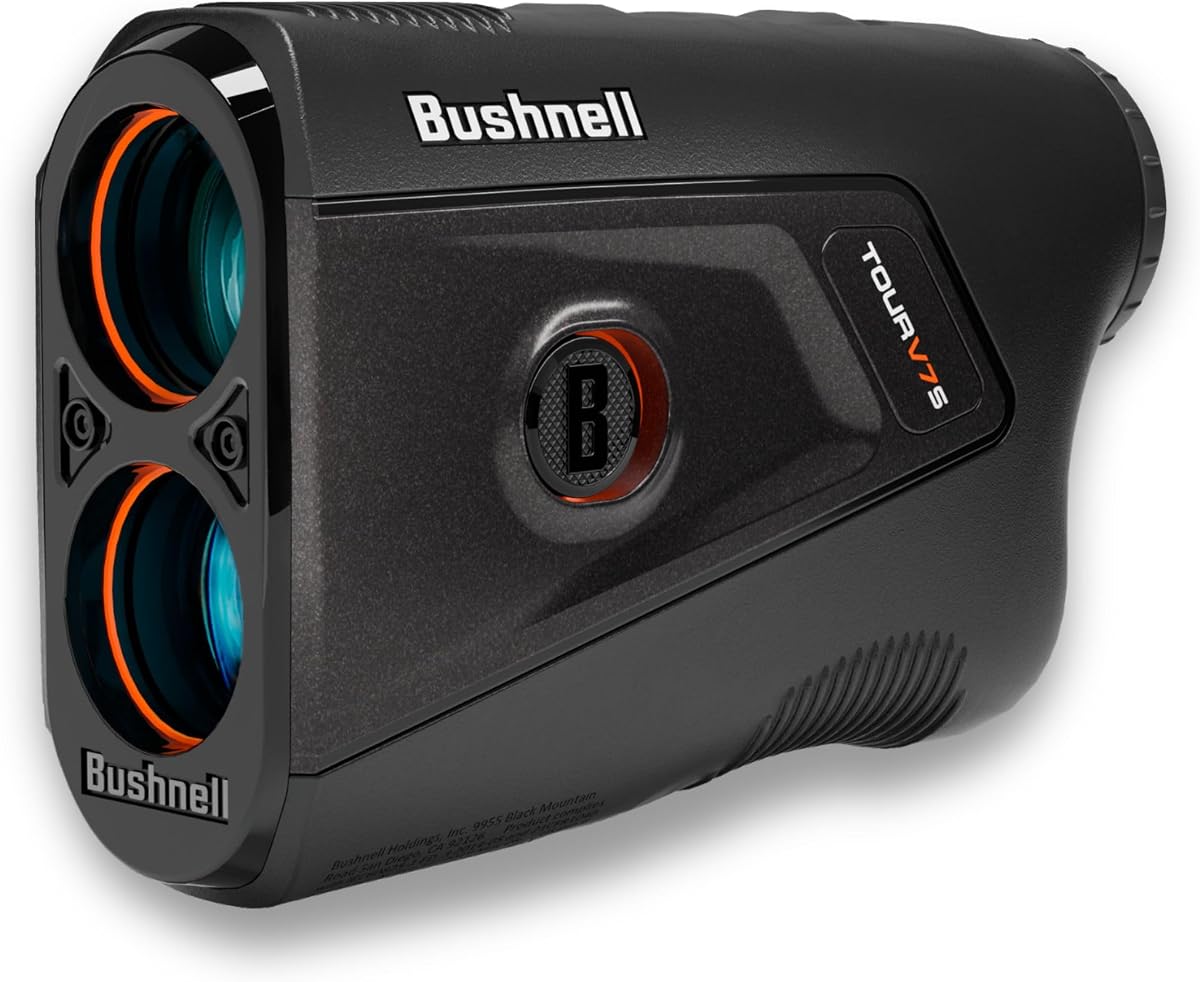
Bushnell Golf Tour V7 Shift builds on the V6 concept with a 4.6 rating and a dual-color OLED display. The screen presents slope-adjusted plays-like yardage in green and actual distance in red, allowing golfers to distinguish the two readings quickly. It retains a 1,300-yard range and 6-times magnification for long-course targeting.
We may earn a commission when you buy through this link, at no additional cost to you.
Yardage Range Recall returns the last measured distance with one press, which is useful for reviewing a target or comparing successive shots. LINK-enabled technology can pair the rangefinder with compatible Bushnell and Foresight launch monitors to display club suggestions based on personal yardage data. PinSeeker and Visual JOLT provide familiar target-confirmation behavior.
The central trade-off is that the most personalized LINK features require compatible equipment and a broader setup. The dual-color display is excellent for separating distance types, but it may not provide the same level of brightness adjustment or visual customization as devices with a single high-resolution OLED. Compared with the V6 Shift, the V7 adds useful display and recall functions rather than a fundamentally different measurement system.
The V7 Shift is a good choice for golfers who want more immediate information than a traditional laser while remaining within the Bushnell ecosystem. It is particularly attractive to launch-monitor users who want club suggestions to follow their own data. Buyers without compatible gear can still benefit from the slope display, recall feature, and flag-acquisition tools.
Separating actual and plays-like yardage by color reduces the need to interpret a single number in a hurry. The format makes the slope-adjusted value easy to compare with a familiar club distance while retaining the raw measurement.
LINK connects the rangefinder to compatible launch monitors, allowing club suggestions to reflect the golfer's own yardage data. That makes it most useful for players who already invest in connected training equipment.
We may earn a commission when you buy through this link, at no additional cost to you.
Arccos Air + Smart Laser is the most complete integrated system among the ten products and holds a 5.0 rating. Unlike conventional bundles that merely combine a rangefinder with a case or accessory, this pairing adds a lightweight wearable that automatically records shots. The Arccos Air uses GPS motion capture and AI, so golfers do not need club sensors, tagging, or a phone in hand during play.
We may earn a commission when you buy through this link, at no additional cost to you.
Smart Laser supplies actual and plays-like distances adjusted for slope and live wind, elevation, temperature, humidity, and altitude. The app adds AI Strategy, Green Maps, course layouts for more than 40,000 courses, club recommendations, and analytics comparing performance with a target handicap. It supports iOS 17+ and Android 8+, while the included charging case can power the wearable for up to 12 rounds.
The principal cost is ecosystem dependence and the annual membership that follows the included first year. Automatic shot capture still creates a learning system that requires time before its performance insights become meaningful. Some golfers may also prefer the lower physical complexity of a dedicated rangefinder without a wearable or ongoing software membership.
This bundle is the premium recommendation for serious golfers who want laser measurement, automatic shot tracking, strategy tools, and round analytics in one ecosystem. It is particularly attractive to players interested in Arccos data, personal development, and detailed green targeting. Those who only need a quick yardage should compare its complexity with the simpler Bushnell and Callaway options.
Putting the lightweight Air in a pocket allows the system to track shots through GPS motion capture and AI. This reduces tagging and sensor management, making the data-collection process more natural during a round.
The app is designed to show where a golfer gains or loses strokes relative to a target handicap. Combined with AI Strategy and Green Maps, this turns the rangefinder from a measuring tool into a broader decision and improvement platform.
We may earn a commission when you buy through this link, at no additional cost to you.
Callaway 300 Pro Elyte is a refined, conventional rangefinder with a 4.7 rating. Its core measurement range extends from 5 to 1,000 yards, while 6-times magnification and plus or minus one yard accuracy make it suitable for standard approach play. The physical controls prioritize quick operation rather than access to complex menus.
We may earn a commission when you buy through this link, at no additional cost to you.
Slope compensation measures the angle of incline or decline and calculates a corresponding adjusted distance. The external on-and-off switch makes tournament use straightforward. Pin Acquisition Technology can identify a flag up to 300 yards away, and the Pulse system confirms the result with a short vibration burst. A strong integrated magnet secures the unit to a golf cart.
Its limited AI footprint is both its simplicity and its boundary. There is no GPS green map, automatic shot tracking, weather-adjusted strategy engine, or personalized club analytics. A golfer who wants a quick answer at the bag will appreciate that restraint, while a data-focused player may find a more connected product more valuable.
Callaway 300 Pro Elyte is a solid all-around recommendation for golfers who want a trusted-looking, straightforward laser with slope compensation and tournament control. It is especially suitable for players who dislike subscriptions and app dependence. Its high rating, simple external switch, and vibration confirmation make it an uncomplicated tool for regular rounds.
The Elyte concentrates on accurate distance, slope adjustment, and target confirmation. That focus makes it a natural choice for golfers who want an instrument they can pick up and use without navigating a broader digital platform.
The Magnahold-style integrated magnet keeps the rangefinder attached to the cart frame and readily accessible. A physical slope switch also remains easy to identify and operate during competitive play.
We may earn a commission when you buy through this link, at no additional cost to you.
The most useful rangefinder is not necessarily the one with the largest specification list. Start with the information you need on the course, then consider how much setup, connectivity, maintenance, and ongoing membership you are willing to manage.
AI in this category can mean environmental compensation, personalized club recommendations, automatic shot capture, target strategy, or machine-assisted course analysis. Some models calculate a corrected playing distance from sensor inputs, while others build a complete performance record and suggest strategic targets. The best choice begins with identifying which decision you struggle with most: choosing a club, finding the right pin, reading a layup, or understanding where your shots lose distance.
Choose AI features that solve a recurring problem rather than adding novelty. If your priority is club selection, look for gapping data and on-screen recommendations. If you want strategy, prioritize green maps, front-center-back information, and course layouts. If you want improvement, automatic shot tracking and post-round analysis are more valuable than a larger stated laser range.
A slope-compensated distance is the distance a ball effectively plays from an elevated position, rather than the simple horizontal measurement. It can influence club selection on uphill or downhill approaches. Every competitive tournament has its own local rules and device restrictions, so a physical slope switch or clearly accessible disable control can be useful even if you seldom compete.
Verify that the device can actually turn slope compensation off and confirm current regulations with the event or governing organization. Do not rely solely on a vague claim of tournament legality. A simple external switch gives you visible control, while menu-based controls may be more vulnerable to accidental changes if the interface is not handled carefully.
Most golfers never need the maximum range printed on a rangefinder. A stated 1,000-yard range covers nearly all ordinary shots, while 1,200, 1,300, and 2,000-yard models provide additional margin on long courses or when a target lies behind trees. Magnification helps identify distant flags, but higher magnification can narrow the field of view and may make target acquisition more demanding.
Consider how the device feels when acquiring a target rather than focusing only on maximum numbers. Six-times is a common level that balances visibility and awareness of the surroundings. If you play on expansive courses or routinely need long layups, 7-times or 7.5-times may offer an advantage. Practice steady target acquisition before making a decision based on technical claims.
A display should present the essential number quickly in direct sunlight, shade, and early or late light. Single-color displays remain easy to read for many golfers, while dual-color OLED screens can separate raw and slope-adjusted readings. Red and black combinations also help preserve battery life and may provide better contrast in different conditions.
Look for a layout that makes actual distance and adjusted distance clearly distinct. Confirm whether brightness is adjustable and whether the font size suits your vision. A premium display is valuable only if you can interpret it without repeated squinting, accidental button presses, or prolonged pauses during the walk to the next shot.
GPS features can provide front, center, and back green distances, hazard positions, layups, and digital course layouts. These are useful for planning an approach before you reach the shot, particularly on unfamiliar courses. A laser remains important when you need a direct measurement to a specific pin, tree, bunker edge, or other target.
Check the stated course count, but also determine whether course information requires a phone, account, download, or membership. Large libraries sound impressive, yet availability in your preferred area matters more. Some devices are fully self-contained, while others are meaningful only when paired with a smartphone and compatible application.
Connected features can bring substantial value, but they also create account, battery, software, and subscription considerations. Compare the included first-year benefits with the renewal terms and determine how often you will use automatic tracking, AI strategy, or performance analysis. A product that is excellent for frequent users may offer little advantage to someone playing an occasional round.
Review smartphone compatibility, minimum operating-system requirements, and whether core ranging remains useful without a connection. Automatic updates can improve algorithms and features, but reliable offline measurement is valuable when reception is poor. Treat the app as part of the product rather than assuming that hardware specifications tell the entire story.
Pin-lock technology, visual alerts, and vibration are practical features that improve confidence in the displayed number. They help confirm that you measured the flag rather than a player, tree, rake, or reflective background object. On busy courses and over water, target separation can matter as much as raw measurement range.
Look for confirmation methods you can notice without looking away for long. Vibration is especially useful because it can be felt directly. Visual Jolt-style rings are helpful in bright conditions, and audible alerts may serve golfers who prefer sound. Choose a device whose confirmation method feels natural and does not create unnecessary delay.
Water resistance, dust protection, battery life, charging method, and mounting all affect how a rangefinder performs over a season. IP65 and IP67 ratings indicate different levels of protection against water and solids, but no rating means the device should be treated as immune to all weather. A magnetic cart mount is convenient, while a protective case helps during transport.
USB-C charging reduces battery waste, but confirm how many rounds the battery can support and whether a cable is included. Disposable batteries are simple and widely understood, yet replacements add ongoing cost and inconvenience. The best setup is one you can recharge or operate consistently without thinking about it before a round.
Before your first round, install any required app, create the associated account, update the firmware, and confirm that the device recognizes your phone or accessories. Calibrate the display and slope function if instructed, set units to yards or meters, and choose the correct brightness or color mode. Test pin lock on a nearby flag so you understand the vibration, visual alert, and time required to acquire a target.
On the course, stand in a stable position and aim the optic at the intended target rather than the center of the flagstick or a nearby object. Read the actual and adjusted distance only after the device confirms target acquisition. Check the wind, temperature, and course conditions before trusting an environmental adjustment, and use slope compensation only when the rules of the event permit it. For GPS and shot-tracking features, keep the relevant application active when required.
After the round, remove excess moisture and debris, inspect the optics and charging port, and store the device in its case away from extreme heat and direct prolonged sunlight. Recharge USB-C models promptly and follow the manufacturer's battery guidance. Clean the lens with an appropriate soft cloth, avoid abrasive materials, and check that software, course mappings, and settings remain current before the next outing.
A quality laser rangefinder can provide an accurate basis for club selection, while slope and environmental compensation can make the number more useful. Accuracy still depends on target acquisition, stability, weather input, and the quality of the calibration. Read the raw and adjusted distances, confirm the flag lock, and use your normal dispersion and playing conditions rather than treating any single reading as a guarantee.
Actual distance is generally the straight-line laser distance to the target. Plays-like distance adjusts that figure for factors such as slope, wind, and elevation so it better represents how far the ball will carry and roll. A plays-like value is not the same as every golfer's actual carry, but it can provide a more useful club-selection reference than an unadjusted number.
No. Tournament rules can restrict distance-measuring devices or slope compensation, and local rules may impose additional requirements. Many products include a physical or menu-based switch that disables slope, but golfers must still verify the current rule with the event and understand whether other connected functions are permitted. Carry the device in a way that allows immediate compliance if an official asks.
It depends on the model. Dedicated hardware-only rangefinders can provide slope and laser functions without a phone, while AI strategy, GPS, club recommendations, shot tracking, and anti-loss features often rely on an app. Arccos products explicitly require a compatible smartphone. If you prefer a self-contained device, choose one whose core functions work without connectivity.
No. A 2,000-yard maximum can be useful on long courses, but most golfers measure targets much closer than the stated limit. Magnification, flag acquisition, display readability, battery life, and slope controls may have a greater effect on daily use. Select the specification that solves your normal playing needs rather than assuming the largest number produces the best experience.
Usually not completely. A laser gives a direct reading to the selected target, while GPS maps provide broader information such as front, center, and back green positions, hazards, and layups. The best connected models combine both approaches, while simpler rangefinders focus on direct measurement. Golfers who plan unfamiliar holes can benefit from using the rangefinder alongside a course map or GPS device.
Choose a membership or connected system when you will regularly use automatic shot tracking, AI strategy, personalized club gaps, and post-round analytics. Choose a standalone rangefinder when you want direct measurement, slope compensation, and predictable operation without an account or recurring membership. The best choice depends on how much value you place on software-supported improvement.
An IP65 rating indicates protection against dust and water jets, while IP67 indicates protection against dust and temporary immersion under defined conditions. Neither rating means the device should be submerged or exposed to extreme weather indefinitely. Use a protective case, dry the device after heavy rain, and follow the manufacturer's storage and charging instructions.
The Bushnell Golf Tour V6 Shift is the strongest all-around dedicated choice for immediate flag acquisition, slope control, and tournament convenience. The Callaway 300 Pro with External Slope Switch offers an even more focused and familiar experience, while the Arccos Air + Smart Laser bundle takes the premium lead for golfers who want automatic shot tracking, AI strategy, and detailed course intelligence.
Prioritize the feature that directly improves your decisions. A golfer choosing a club should examine environmental compensation and personalized gapping; a strategy-focused player should look for green maps and course layouts; a data-driven player should assess automatic shot tracking and post-round analysis. Regardless of category, confirm target lock, slope controls, battery needs, smartphone compatibility, and tournament rules before buying.
Finally, check the current product listing, included accessories, compatibility details, subscription terms, and live pricing before making a purchase. Ratings, software features, course databases, and promotional bundles can change, so the latest listing provides the most accurate view of what you will receive.
