
Fully Assembled Mini 3D Printer
4.4Editor score
Ready-to-use starter package
Automatic leveling and cleaning
Compact 250mm/s design
Our 3D Printer for Kids guide compares ten kid-friendly printers for safety, ease of use, creativity, speed, model libraries, and STEM learning.
A 3D printer for kids can turn drawings, photos, and imagination into physical objects, but the best machine is not simply the one with the longest feature list. A child-friendly printer should combine approachable software, safe construction, simple maintenance, an engaging model library, and enough speed to keep young makers interested from one print to the next.
We compared all ten printers using the supplied specifications, customer ratings, included accessories, app ecosystems, build volumes, safety features, and learning resources. The list covers enclosed models designed specifically for children, compact beginner printers, school-friendly systems, and higher-speed machines that can handle more advanced projects as skills develop.
Each review explains who the printer is best for, the features that matter most, and the compromises families should consider. Ratings and specifications reflect the information available in November 2026, while prices and availability can change at any time, so shoppers should confirm current listings and terms before buying.
4.4Editor score

4.5Editor score

5.0Editor score
The comparison highlights the main differences in child-focused design, software, included materials, build capacity, connectivity, and maintenance features so families can identify the printer that matches their child's age, interests, and supervision level.


The AOSEED AI 3D Printer for Kids earns a 4.5 rating and stands out as the most complete child-oriented package in this guide. It combines an enclosed, pinch-resistant design with 8,000-plus human-reviewed and print-tested models, 17 themed modules, AI creation tools, real-time camera monitoring, and speeds reaching 400mm/s. The result is a platform designed to make the entire process—from idea to finished object—feel approachable.
We may earn a commission when you buy through this link, at no additional cost to you.
Its strongest feature is the range of ways children can begin. AI Doodle can turn voice, text, or image prompts into custom models, AI MiniMe can transform photographs into cartoon-style figures, and MINIMAKIE supports personalized avatars. Families that prefer structured choices can browse characters, accessories, decorations, and STEM projects, while more adventurous users can import compatible files or design their own. The inclusion of eight PLA rolls, tools, a magnetic build plate, and stickers makes the package especially useful as a complete gift.
The trade-offs are worth acknowledging. The printer supports one filament color at a time, so multicolor objects must be produced as separate pieces and assembled. The camera and automated time-lapse features add useful engagement but also make the device more connected than a simple offline printer. Fast speeds of 220–250mm/s with peaks up to 400mm/s help maintain a child's attention, although real project times still depend on model size, layer height, infill, and selected settings.
This is the most suitable overall choice for families seeking an enclosed, guided 3D printing experience with a large selection of age-appropriate content. It also works well for classrooms or after-school activities where an assistant can help children navigate the app. Parents should supervise operation, keep the chamber closed while printing, and introduce the difference between screen-based design and physical making to keep creativity at the center of the experience.
The AI tools lower the barrier between a child's imagination and a printable object. Voice prompts, simple text instructions, sketches, and photographs give young makers several ways to express an idea, while the curated library provides a structured alternative when they are not ready to design from scratch.
The enclosed chamber, pinch-resistant construction, leveling-free platform, and TÜV Rheinland ISO 16000-tested PLA support a child-focused use case. Meanwhile, the built-in camera, time-lapse recording, and quick prints help sustain excitement without requiring parents to sit beside the machine for its entire cycle.
We may earn a commission when you buy through this link, at no additional cost to you.
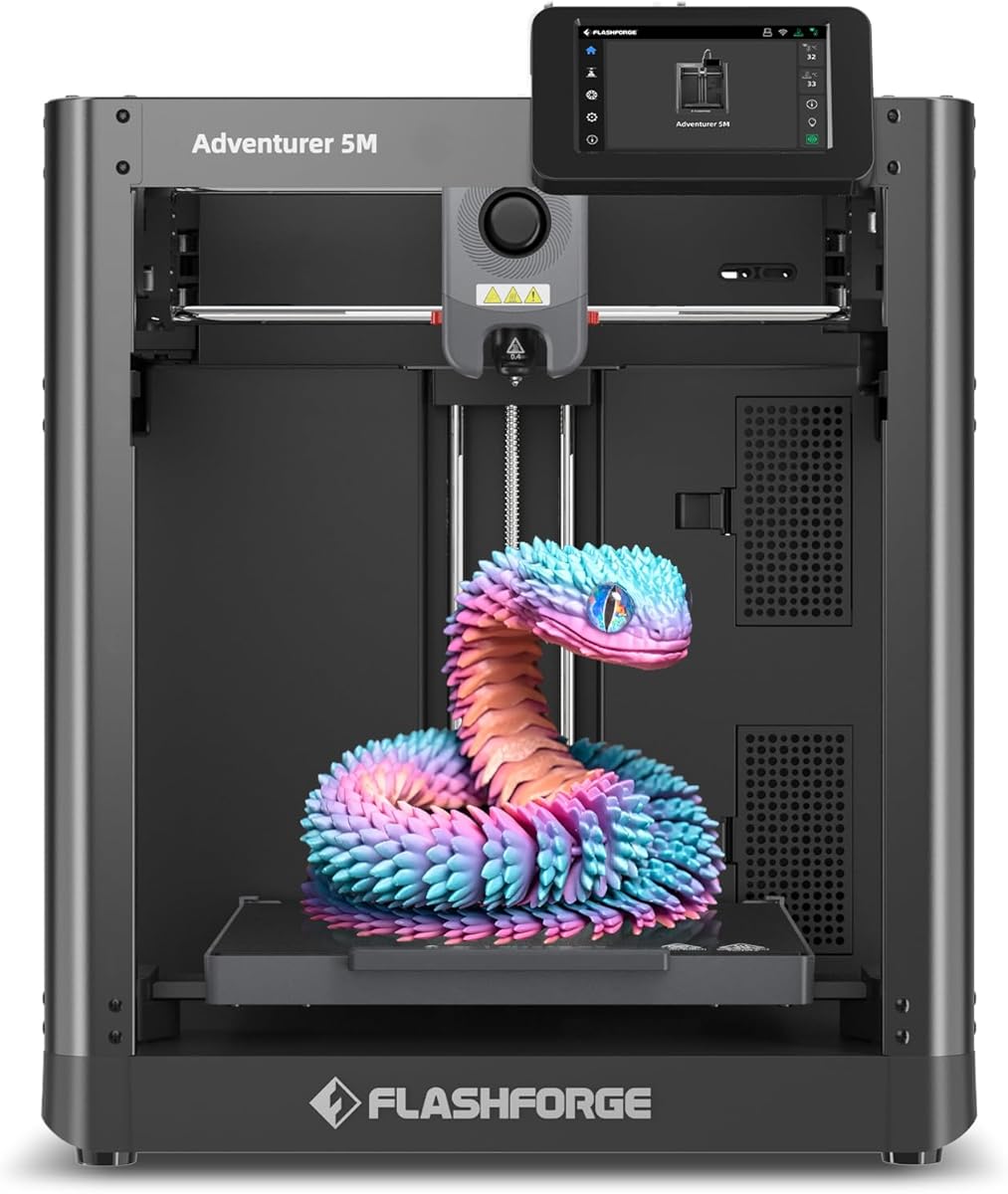
The FLASHFORGE Adventurer 5M holds a 3.9 rating and is the most technically advanced conventional printer in this roundup. It offers a 220 x 220 x 220mm build volume, a 600mm/s travel speed, an all-metal CoreXY structure, a 280°C direct extruder, and automatic bed leveling. These specifications make it attractive to older children, families, and teachers who want to move beyond simple library models into larger and more technically demanding projects.
We may earn a commission when you buy through this link, at no additional cost to you.
Speed is its defining advantage. A 600mm/s travel speed and 20,000mm/s² acceleration can reduce delays between movements, while the high-flow 32mm³/s nozzle and fast warm-up are designed to improve workflow efficiency. The detachable nozzle can be changed in about three seconds, and optional nozzle sizes from 0.25mm to 0.8mm give users a wider range of detail levels and material flows. A dual-sided PEI build plate improves removal and accommodates different projects.
The disadvantage is that this is not explicitly engineered around a child's creative software or ready-made model curriculum. Its strength is capability rather than a child-first experience. Younger users will need more help with slicing, temperature choices, bed adhesion, and file preparation. It also has the lowest listed rating in the group, so buyers should consider additional reviews and their specific needs carefully rather than assuming the advanced specifications will suit every household.
The Adventurer 5M is best for a teen or adult mentor working with motivated young makers. It can support larger models, rapid iteration, and more advanced experimentation than the compact educational printers. For a young child seeking guided one-tap projects and a curated toy library, one of the enclosed child-specific systems will generally be easier, but this model offers greater room to grow.
A 220mm cubic build area is substantially more versatile than the tiny volumes of many entry-level mini printers. It gives students room for larger models, organizers, articulated pieces, prototypes, and multi-part projects, provided the files and filament are prepared appropriately.
Rapid travel movement, quick nozzle changes, a short warm-up, and automatic leveling reduce many of the delays that can make learning feel repetitive. Remote monitoring through the Flash Studio app adds flexibility for parents and teachers managing a busy home or classroom.
We may earn a commission when you buy through this link, at no additional cost to you.
The Entina Tina2C has a 4.4 rating and is built explicitly around children, beginners, and STEM learning. Its defining advantage is a guided path into printing: the Poloprint Cloud app assists setup, users can reportedly begin their first print in as little as eight minutes, and more than 3,000 models are available alongside 20-plus creative modules and regularly updated learning courses.
We may earn a commission when you buy through this link, at no additional cost to you.
The app is central to the experience. It provides AI-powered search, photo-to-print features, and interactive creative activities, while 2.4GHz WiFi printing provides wireless convenience. A TF card offline mode gives families a useful alternative when connectivity is limited. Compatibility with Windows, macOS, Linux, and Chromebook broadens its classroom potential, while support for Cura and Simplify3D creates a path toward more advanced customization.
Its physical scale is the main limitation. The 3.9 x 3.9 x 3.9-inch build volume is intended for small models and prototypes rather than tall figures, broad organizers, or large assemblies. The machine also uses a compact body, rounded edges, low-noise operation, and integrated LED lighting to fit into home, classroom, or office spaces. Automatic leveling and power-loss recovery improve reliability, while a flexible magnetic plate makes finished models easier to remove.
The Tina2C is a strong choice for families seeking a compact, educational starter system that balances guided projects with emerging independent skills. It is particularly well suited to small toys, organizers, figures, and course-based activities. As children learn slicing, file selection, and model preparation, they can gradually move beyond the curated content and use familiar desktop tools.
Guided setup and a structured content library reduce the uncertainty that often accompanies a first 3D printer. Children can begin with ready-to-print ideas, then gradually learn to change models, use the AI search tools, and explore standard slicing software.
Low noise, rounded construction, LED visibility, cross-platform compatibility, and offline printing make the Tina2C practical for a family room or classroom. Its small footprint also limits the space required, although the same compact build volume restricts project size.
We may earn a commission when you buy through this link, at no additional cost to you.
This Magic Jimmy 3D Printer for Kids earns a 4.6 rating and offers an unusually broad set of ways for a child to create. AI Craft turns sketches or text into printable models, AI Doodle generates designs, AI MiniMe converts photos into cartoon figurines, and MiniMakie supports personalized avatars. Combined with 8,000-plus toy, animal, vehicle, and STEM models, it gives children both guided and open-ended starting points.
We may earn a commission when you buy through this link, at no additional cost to you.
The fully assembled enclosure is one of the most reassuring features for a family. It separates hot components and moving parts from small hands, while the cool-touch exterior and magnetic build plate support safer interaction. The supplied white PLA filament and one-tap printing remove much of the initial setup, and the app works with iOS, Android, and Windows. Children can also import STL files from communities such as Thingiverse and Printables.
The camera is especially useful because it turns a print into a visible process rather than a wait. It records a time-lapse, allowing children to see their digital idea become a physical object. With speeds reaching 400mm/s, small models can finish in around 20 minutes, while many library models take one to three hours. Actual duration depends on the object and print settings, so quick estimates should be treated as best-case scenarios.
This printer is a compelling gift for a child who wants to design rather than only assemble a supplied kit. The four AI tools make it especially useful for children who communicate ideas through drawings or photographs, although families may wish to guide the creative process and discuss what makes a model printable. It suits a home, classroom, or guided home-school environment where digital creation and physical making should be part of the same activity.
A sketch, a written idea, a photograph, and a ready-made library model are four different ways to begin. That variety helps children discover that digital design is not a single skill and gives parents multiple ways to nurture a particular interest.
The enclosed chamber protects children from moving parts and hot components, while the cool-touch exterior improves everyday confidence. The camera and time-lapse recording add an educational and entertainment element that helps make patience visible.
We may earn a commission when you buy through this link, at no additional cost to you.
The AOSEED X-MAKER AI+ carries a 5.0 rating and is the strongest premium option in this guide. It combines a fully enclosed design, a 3.5-inch touchscreen, eight TÜV-tested PLA rolls, a substantial creator-course library, and a built-in AI assistant. The stated target audience of ages nine to sixteen makes it particularly relevant for older children ready to work more independently.
We may earn a commission when you buy through this link, at no additional cost to you.
Its content system extends beyond a basic model catalog. The machine includes a 1,500-plus digital toy catalog, a customizer, 15-plus mini modules, two premium modules, and creator-course access. AI Doodle turns voice, text, or images into models, AI MiniMe transforms photos into cartoon versions, and MINIMAKIE helps children design avatars. A built-in assistant can guide the workflow, reducing dependence on a parent for every menu choice.
Physical performance is also strong for a child-oriented machine. It reaches 220–250mm/s with peaks of 400mm/s and offers precision down to 0.1mm or 0.05mm depending on settings. It is ready out of the box, supports WiFi, SD cards, and USB, includes power-loss recovery, and uses a magnetic build plate. Its under-50dB operation is intended for homes, study areas, and classrooms where a loud machine would be disruptive.
The principal trade-off is library depth. Its 1,500-plus models are more focused than the 8,000-plus catalogs offered by some rivals, although the premium modules and courses may be more valuable for a child who wants structured learning. This is a strong choice for a school-age maker, an ambitious beginner, or a family seeking a polished ecosystem with minimal assembly and plenty of guided material.
Creator courses, mini modules, premium modules, and an AI assistant create a progression path for older children. The goal is not merely to keep a child occupied but to help them move from selecting a model toward customizing, planning, and completing a more personal project.
The touchscreen makes the machine more self-contained, while quiet operation supports study sessions and shared learning spaces. Fast printing, simple wireless controls, and power-loss recovery help maintain momentum across longer creative sessions.
We may earn a commission when you buy through this link, at no additional cost to you.
The Fully Assembled Mini 3D Printer for Kids & Beginners has a 4.4 rating and provides a straightforward path into home printing. It arrives assembled and includes the printer, a roll of test PLA, an SD card, and basic accessories. That makes it a practical choice for families seeking the essential tools in one package without a complicated first-day setup.
We may earn a commission when you buy through this link, at no additional cost to you.
Convenience features are the main attraction. A one-button auto-leveling function removes the need to manually adjust the bed, automatic nozzle cleaning helps maintain consistent extrusion, and one-touch filament loading simplifies material changes. The PEI heated bed improves model adhesion and removal, while the top speed of 250mm/s can shorten print times. The listed precision of 0.01mm indicates the machine's resolution capability, though actual visible detail also depends on the model and print settings.
Compared with the heavily app-centered competitors, this printer offers fewer details about guided curricula or an expansive child-specific model library. Families should therefore be prepared to provide models through the included SD card or another compatible source. The package includes a pre-sliced 1kg filament spool holder file on the TF card, although using a 1kg roll requires a compatible holder design as noted in the product information.
It is a sensible budget choice for older children or beginners who already have some guidance from a parent, teacher, or hobbyist. The supplied warranty information includes a 30-day return or replacement policy, a 12-month free repair service, and lifetime professional technical support. The main limitation is not capability but ecosystem simplicity: it is easier to operate, yet less focused on structured learning than the child-specific bundles.
The printer, filament, storage card, and accessories reduce the need for separate starter purchases. A family can focus on learning how a design becomes an object rather than searching for compatible files and basic accessories.
Automatic leveling, nozzle cleaning, one-touch filament loading, and a removable PEI surface target the tasks beginners find most intimidating. These features help keep attention on the creative result and away from repetitive setup adjustments.
We may earn a commission when you buy through this link, at no additional cost to you.
This Magic Jimmy listing shares the same core strengths as the other identically named products: a 4.6 rating, 8,000-plus child-oriented models, a fully enclosed chamber, and a suite of AI design tools. It is a particularly compelling option for families that want children to explore beyond the included library, because compatible STL files can be imported from Thingiverse, Printables, and other sources.
We may earn a commission when you buy through this link, at no additional cost to you.
The child-friendly workflow remains straightforward. A fully assembled machine needs no tools, the included white PLA provides an immediate starting point, and one-tap printing removes much of the file-preparation burden. At the same time, importing models gives older children a chance to learn how scale, orientation, support, and printability affect a design. The enclosed body, cool-touch exterior, non-toxic PLA, and magnetic platform create a more controlled environment for daily use.
Speed and engagement are strong. The printer reaches up to 400mm/s, and small models may finish in around 20 minutes, although typical library projects can take one to three hours. The integrated camera records the process as time-lapse footage, giving children a satisfying record of their work. The major constraint is single-color output, which means a model requiring several colors must be separated into parts and assembled afterward.
This version is best for a child who already shows curiosity about finding models, comparing shapes, or adapting existing designs. It is also suitable for a classroom that wants a broad catalog alongside imported STEM files. Families should establish clear file-review habits, particularly for younger users, and treat external models as opportunities to discuss design and assembly rather than as instant, supervision-free downloads.
The 8,000-plus models give children many ready-to-print starting points, while STL import support creates a bridge to online maker communities. This combination supports both quick success and more deliberate, independent exploration.
A high peak speed can keep small projects moving, and camera-based time-lapses make progress easy to follow. Rapid feedback is particularly useful for children, who are more likely to remain engaged when they can see each layer and final result develop.
We may earn a commission when you buy through this link, at no additional cost to you.
The Entina Tina2C Bundle has a 4.4 rating and differentiates itself with approximately one kilogram of PLA across four colors. For children, that variety can make a major difference on the first day of use because they can immediately make different characters, accessories, decorations, and small objects without waiting for additional filament to be sourced.
We may earn a commission when you buy through this link, at no additional cost to you.
The underlying Tina2C platform remains focused on accessibility. The fully assembled machine uses guided setup through the Poloprint app, provides WiFi and offline printing, and includes 3,000-plus models and more than 20 DIY modules. Smart search and photo-to-print features add creative options, while automatic leveling reduces manual setup. A flexible magnetic build plate lets users remove a finished model by bending the plate, and the quick-swap printhead simplifies maintenance.
The 3.9 x 3.9 x 3.9-inch build volume is the key compromise. It suits small figures, toys, organizers, and classroom-scale projects but not large objects or tall assemblies. The included colors should also not be confused with automatic multi-color printing. Each part may use a different filament, but a separate print and physical assembly are required to combine the colors.
This bundle is a good fit for families or educators who want an immediately usable, compact creative system with visually varied projects. It is especially appealing for younger children because the included material eliminates the first consumable-purchase decision. The app-led approach and small format make it suitable for a desk, while its low-noise operation and LED lighting help it fit into shared learning spaces.
Four included colors allow immediate experimentation with character choices, decorative pieces, and color-coded projects. For a child, access to multiple rolls at the outset may be more motivating than beginning with a single color and discovering the need to expand the palette later.
Guided app setup, a broad model catalog, creative modules, offline printing, and cross-platform learning workflows create a coherent system for small projects. The small build volume keeps the footprint manageable but defines the kinds of creations the printer can complete.
We may earn a commission when you buy through this link, at no additional cost to you.
The third Magic Jimmy listing retains a 4.6 rating and provides the same carefully child-focused combination of AI design tools, an enclosed chamber, and an extensive model library. Its photo-to-cartoon figurine workflow gives it a particularly memorable hook: a child can start with a picture and create a personalized physical character rather than immediately choosing from a catalog.
We may earn a commission when you buy through this link, at no additional cost to you.
AI Craft, AI Doodle, AI MiniMe, and MiniMakie cover several levels of design complexity. A child can use a sketch, written idea, photograph, or avatar, while parents can guide more detailed customization. The inclusion of Thingiverse and Printables import options means the child is not limited to a single set of characters or STEM projects. The printer's fully assembled state and one-tap workflow also lower the initial barrier.
The enclosed chamber keeps hot components and moving parts away from small hands. A cool-touch exterior and magnetic build plate make the surrounding area easier to manage, and the included white PLA offers a straightforward first material. The camera records time-lapse footage, while the 400mm/s peak speed and approximately 20-minute small-model target help maintain momentum. As with any estimate, larger or detailed models can take substantially longer.
This product is best for a child interested in characters, personalized keepsakes, and digital storytelling. It can support conversations about privacy and image use, visual design, and the transformation from screen to solid object. Parents should establish age-appropriate limits around external content and imported files, but within a supervised setting, the creative range is impressive for a beginner platform.
AI MiniMe can turn photographs into cartoon-style figurines, making it easy to connect a familiar image with a hands-on project. The result is not merely a completed model but a visible step in learning how simple prompts can become physical designs.
The enclosed chamber protects moving and hot components, yet the machine still supports high-speed printing, camera monitoring, and a large library. This balance makes it practical for supervised family use without turning the printer into a simple novelty toy.
We may earn a commission when you buy through this link, at no additional cost to you.
The Bambu Lab A1 mini with LED Lamp Kit earns a 4.4 rating and offers a different kind of first 3D printing experience. Instead of centering the package on an AI toy library, it combines a beginner-oriented printer with an LED lamp kit that can turn compatible printed parts into a functional decorative light.
We may earn a commission when you buy through this link, at no additional cost to you.
The A1 mini uses automatic calibration and straightforward setup to reduce the initial learning curve. The Bambu Handy app manages prints, while MakerWorld provides a large selection of ready-to-print models. The included lamp kit expands the usual toy-and-figure focus into home decor, room projects, and personalized gifts. It is a useful way to demonstrate that 3D printing can make functional objects as well as characters and models.
The package does not detail the same age-specific curriculum, AI design suite, or enclosed child-safety system emphasized by several competitors. Quiet operation and a compact footprint do make it suitable for a home, studio, or workspace, but young children will still need supervision around the printer and any lamp components. The LED project also depends on using compatible models, so children should follow the kit's intended assembly instructions rather than assume any downloaded model will fit.
The A1 mini is best for a family interested in a general-purpose beginner printer rather than a narrowly child-branded learning system. It is especially attractive when the goal is to create a visible, functional result together. The combination of easy calibration, app-based control, MakerWorld access, and a purposeful first project offers a balanced introduction to design, assembly, and real-world making.
The LED lamp kit gives the bundle a clear endpoint: children print compatible components, assemble them, and produce a working object. That can make the learning process more concrete than printing a free-standing model that looks similar to something already available.
Automatic calibration and the Bambu Handy app lower the barrier for first-time users. MakerWorld access provides ready-to-print starting points, while the quiet compact design is well suited to a shared room or creative workspace.
We may earn a commission when you buy through this link, at no additional cost to you.
The right child-focused printer depends on age, supervision, creativity, project size, and the type of learning environment. Comparing safety design, software, included materials, build volume, and maintenance is more useful than focusing on a single headline specification.
A fully enclosed chamber is the clearest advantage when children will be near the machine. It helps separate hands from the hot nozzle, moving axes, and other internal components. The AOSEED models and Magic Jimmy printers specifically describe enclosed or pinch-resistant designs, while the Entina Tina2C uses a compact body with smooth rounded edges. An enclosure should be treated as one layer of safety rather than permission for unsupervised use; moving parts and hot components still warrant adult supervision.
Choose an enclosed printer when young children, pets, or busy shared spaces are involved. Look for cool-touch surfaces, secure doors, and a build plate that is easy to remove without reaching near the nozzle.
A child will lose interest quickly if setup feels like an adult repair project. Fully assembled machines eliminate much of the initial assembly, while auto leveling removes the repeated bed adjustments that often cause first-layer problems. The Entina Tina2C guides setup through its app, the AOSEED X-MAKER AI+ has a touchscreen, and the fully assembled mini printer includes one-button leveling, nozzle cleaning, and filament loading.
Favor tools that automate common chores. The best beginner setup should make the first print achievable with clear instructions and minimal manual calibration.
A strong model library lowers the barrier to a successful first project, but creative tools determine whether the printer can grow with the child. The AOSEED AI model provides AI Doodle, AI MiniMe, and MINIMAKIE, while Magic Jimmy offers AI Craft, AI Doodle, AI MiniMe, and MiniMakie. Entina adds AI-powered search and photo-to-print functions. Bambu focuses on a connected MakerWorld library and app-based print management.
Look for a blend of guided choices and open-ended design. Easy library models create early success, while text, image, sketch, and file-import tools support longer-term creativity.
The sheer number of models matters less than whether they are understandable, age-appropriate, and useful. The largest catalogs in this group contain 8,000-plus models across 17 themed modules or similarly broad collections. Entina offers more than 3,000 models with 20-plus creative modules and STEM courses, while the X-MAKER AI+ combines 1,500-plus models with premium modules and creator courses. Families should also consider whether external STL import is supported.
Choose a library that offers both ready-to-print projects and a path toward custom files. A large catalog without guidance can still leave a child searching, while structured lessons can keep a smaller collection purposeful.
Speed matters in a child-focused printer because long waits can break concentration. Several models advertise peaks of 400mm/s, the FLASHFORGE Adventurer 5M offers 600mm/s travel, and the budget mini printer reaches 250mm/s. These are maximum or travel figures rather than guaranteed completion rates, and actual duration depends on size, detail, infill, material, and settings. Small projects may take about 20 minutes on the fastest child-focused models, while common library models can take one to three hours.
Prioritize quick small-project capability rather than comparing peak speeds alone. A useful camera, reliable first layer, and easy file preparation may contribute more to a child's experience than the highest possible motion rate.
Build volume defines what can physically be made. The Entina Tina2C supports a 3.9 x 3.9 x 3.9-inch volume, making it suitable for compact toys, figures, and small organizers. The FLASHFORGE Adventurer 5M offers a much larger 220 x 220 x 220mm area suitable for bigger models and prototypes. A larger volume is valuable for older children and school projects, but it usually requires more desk space and may be less convenient for a child to manage.
Match the machine to the projects a child actually wants to create. Mini printers work well for portable projects, while a larger build area supports articulated figures, organizers, and multi-part creations.
PLA is the most common beginner material in this category because it is easy to print and the included products emphasize it. Several bundles include multiple rolls, while the budget starter kit includes one roll and an SD card. The Entina bundle includes four colors, and the AOSEED AI package includes eight rolls. A larger color selection encourages children to experiment but does not make a printer automatically capable of multicolor printing; separate colors generally require separate prints and assembly.
Check what filament is included, how much is supplied, and whether the listed accessories are genuinely useful for a child's first projects. Treat the included material as starter stock rather than an unlimited supply.
WiFi and app control make a printer easier to place in a family room, while offline modes protect the workflow when a network is unavailable. Camera monitoring and time-lapse capture turn waiting into an engaging part of the process. At the same time, a simpler SD-card workflow can be more dependable for young beginners who need to focus on one task at a time.
Consider both convenience and reliability. Features such as auto leveling, quick-swap nozzles, runout detection, power-loss recovery, magnetic plates, and easy filament loading are often more valuable over time than a small software distinction.
Begin with a child-friendly project that finishes quickly and leaves plenty of space around the printer. Read the manual, place the machine on a stable surface, connect power only as directed, and ensure the enclosure and moving mechanisms are clear. Load the specified PLA filament using the printer's supported procedure, then follow the app's calibration or leveling process before attempting a more complicated design.
For the first print, use a simple library model or a small test object and keep the default settings recommended by the manufacturer. Let the child watch the first layers develop, but keep hands away from the nozzle, build plate, and any opening. If the model lifts, clogs, or stops feeding, pause the machine and follow the troubleshooting instructions rather than repeatedly restarting the print. A camera or time-lapse feature can be used to review the finished result with the child.
After printing, allow the build plate and deposited material to cool before removing an object, particularly if the design uses PLA. Clean the nozzle and plate according to the manual, store filament in a cool, dry location, and replace the kind of material specified in the product instructions. Periodic care should include checking the nozzle and plate for residue, keeping the enclosure free of dust, and following all manufacturer guidance for software, accessories, and replacement parts.
Age recommendations vary by model, and the supplied product information specifically identifies the AOSEED X-MAKER AI+ for ages nine to 16. Younger children can still benefit from a child-focused printer when an adult selects models, loads materials, monitors the machine, and handles the initial setup. The child's ability to follow instructions and remain away from moving or hot parts matters more than a printed age label alone.
An enclosed chamber helps isolate hot components and moving parts, making products such as the enclosed AOSEED and Magic Jimmy models more suitable for supervised home use. It does not eliminate all risks or permit unsupervised operation. Adults should still control the power, check the chamber, guide filament changes, and ensure that children never reach inside while the printer is active.
Yes, but build volume and material determine what is practical. The Entina Tina2C is better suited to small figures, toys, and compact organizers, while the larger FLASHFORGE Adventurer 5M can accommodate more substantial projects. Functional items should use the filament and design approved for the printer, and any moving, heated, electrical, or load-bearing component needs careful review.
The AOSEED AI 3D Printer for Kids explicitly supports single-color printing, and multicolor designs must be produced as separate parts and assembled. The Entina Tina2C bundle includes four filament colors, but that does not mean the machine automatically switches colors. Buyers should verify automatic multicolor capability separately if they require it.
It usually reduces the number of initial steps because there is no frame assembly or initial leveling. Several products also add automatic leveling, nozzle cleaning, one-touch filament loading, and guided apps. The remaining skills—such as selecting a model, understanding the print, and troubleshooting a failed layer—still benefit from adult support, especially for younger children.
App support varies. AOSEED's child-focused printer lists iOS, Android, and Windows compatibility, the Entina Tina2C supports Windows, macOS, Linux, and Chromebook, and the Bambu Lab A1 mini uses the Bambu Handy app. Families should confirm current operating-system requirements and ensure that the selected WiFi network is compatible with the printer's stated connection method.
PLA is the most clearly supported beginner material across these products, and several bundles include tested or TÜV-tested PLA. Using the material specified by the manufacturer reduces the risk of unsuitable temperatures, odors, or adhesion problems. New users should avoid unsupported materials until they understand temperature, ventilation, retraction, and filament-drying requirements.
It is important because a child is more likely to stay engaged when a small project finishes promptly. Peak speeds of 250mm/s to 400mm/s appear in the child-focused choices, and the FLASHFORGE Adventurer 5M offers 600mm/s travel. Speed alone does not determine total time, however; model size, detail, infill, and printer setup remain equally relevant.
The AOSEED AI 3D Printer for Kids is the strongest all-around choice because it combines an enclosed design, a very large curated catalog, multiple AI creation methods, camera-based time-lapses, fast printing, and a generous set of included materials. The Fully Assembled Mini 3D Printer offers the clearest budget-oriented package, while the AOSEED X-MAKER AI+ provides the most polished premium learning ecosystem for school-age makers.
For a younger child, prioritize an enclosed chamber, guided setup, a helpful model library, and an adult-friendly workflow. For an older child or a classroom, look more closely at file import, standard slicing compatibility, build volume, course content, and the ability to progress toward independent projects. A colorful starter bundle can improve motivation, but a larger build area may be more useful once ambitions extend beyond small characters and accessories.
Ratings, product details, availability, and prices can change, and current listings may contain revised bundles or support information. Before purchasing, confirm the exact model, included filament and accessories, operating-system requirements, build dimensions, safety guidance, and current price on the linked product page.