
Ultra Clarity Cables Cat 6
4.7Editor score
Eight solid copper conductors
10 Gbps bandwidth capability
Molded strain-relief boots
Our 250 foot Ethernet Cable guide compares 10 indoor and outdoor options by category, shielding, bandwidth, conductor material, burial readiness, and connector
A 250 foot Ethernet cable can connect an entire building, garage, garden, or remote device without forcing a wireless extension into an awkward role. The right cable depends on where it will run, whether it will be buried or exposed, what category your network uses, and whether shielding or pure-copper construction is necessary.
The products in this guide cover outdoor direct-burial runs, indoor installations, shielded high-bandwidth alternatives, and bulk reels that require your own connectors. We compared stated category, conductor material, shielding, frequency support, weather resistance, installation accessories, connector design, and intended equipment compatibility.
Each review identifies the cable's strongest use case and its important trade-offs, while the comparison table shows how the ten options differ. Ratings and specifications can change over time, so confirm the latest listing, device requirements, and installation conditions before ordering.
4.7Editor score

4.6Editor score

4.7Editor score
The comparison covers outdoor-ready patch cables, indoor bulk wire, and higher-category alternatives. The key differences are installation environment, shielding, conductor type, stated bandwidth, and whether the cable arrives with connectors or must be terminated by an installer.




The GEARit Cat 6 Ethernet Cable is a 250-foot outdoor patch cable with a 4.6 rating and a practical direct-burial design. It is built for connecting an outdoor router, backyard office, detached structure, temporary installation point, or another network location where a long indoor patch cable would be unsuitable. Its combination of 10 Gbps support, 550 MHz bandwidth, and preinstalled RJ45 connectors makes it the most balanced choice in this group.
We may earn a commission when you buy through this link, at no additional cost to you.
The cable uses four twisted pairs of copper-clad aluminum wire, enclosed in a jacket described as suitable for direct burial. Gold-plated RJ45 connectors are covered by flexible PVC bubble boots designed to protect the locking tabs and make the cable easier to disconnect. That connector treatment is useful for temporary outdoor connections because it reduces the chance of damaging either the plug or the equipment's socket during repeated handling.
The main compromise is conductor material. Copper-clad aluminum can provide a practical connection for a long run, but it is not the same as solid pure copper. This cable is also unshielded according to its construction details, which may matter in locations with strong electrical interference. Buyers who require foil shielding or pure-copper conductors should examine the Cat 7 and bulk-copper alternatives instead.
This is an excellent choice for homeowners, contractors, and IT professionals who need a complete outdoor Cat 6 run without cutting and terminating raw cable. It suits ordinary homes, offices, and outdoor access points where the stated 10 Gbps and 550 MHz capabilities align with the network. Choose it when installation simplicity, outdoor jacket protection, and ready-to-use connectors matter more than premium conductor or shielding specifications.
The direct-burial jacket allows the cable to run underground without requiring conduit or additional exterior protection. That makes it suitable for trenching between a main building and an office, garage, router, or camera location.
Gold-plated contacts support dependable connectivity, while the flexible bubble boots help protect locking tabs. The boots also improve handling when a temporary connection must be disconnected and reinstalled.
We may earn a commission when you buy through this link, at no additional cost to you.
Ultra Clarity Cables' 250-foot Cat 6 Ethernet cable earns a 4.7 rating and focuses on straightforward networking with solid copper conductors. It is a sensible long-run option for connecting routers, switches, computers, servers, printers, NAS systems, VoIP phones, network media players, and other standard RJ45 equipment. The cable supports 10GBASE-T while remaining compatible with Fast Ethernet and Gigabit Ethernet.
We may earn a commission when you buy through this link, at no additional cost to you.
Eight solid copper conductors are arranged into four unshielded twisted pairs. PE cross insulation separates the pairs, and a 5.8 mm PVC jacket surrounds the assembly. Gold-plated RJ45 contacts and molded strain-relief boots add protection and improve handling. The listed 500 MHz frequency and 10 Gbps support make this a versatile option for a wide range of LAN installations.
Unlike products specifically marketed for trenches, the listing does not state that the jacket is for direct burial. Its indoor-and-outdoor wording should not be interpreted as permission to place it underground without checking local requirements and the manufacturer's installation guidance. The unshielded design may also be less ideal near motors, heavy electrical equipment, or sources of substantial electromagnetic interference.
Choose this cable for an indoor network extension, a non-exposed exterior route, or a home and office installation where solid copper is preferred. It is particularly appealing for buyers who want a ready-made 250-foot run with strong compatibility and do not need a direct-burial jacket. Confirm the complete physical route before installation, especially if the cable will cross soil, concrete, or damp spaces.
Solid copper conductors distinguish this cable from many copper-clad aluminum alternatives. The construction is intended to provide a consistent connection over the full 250-foot length for standard home and office networks.
The cable supports 10BASE-T, 100BASE-TX, 1000BASE-T, 1000BASE-TX, and 10GBASE-T standards. That range allows it to work with many routers, switches, servers, and other standard RJ45 devices.
We may earn a commission when you buy through this link, at no additional cost to you.
The GEARit Cat 7 Outdoor Ethernet cable is the premium outdoor option here, combining pure copper, SFTP shielding, and a 250-foot length. Its 4.7 rating reflects a strong overall proposition for installations where the cable must withstand outdoor conditions or run near sources of interference. It supports Gigabit Ethernet, 100BASE-T, and 10GBASE-T with bandwidth stated as high as 600 MHz.
We may earn a commission when you buy through this link, at no additional cost to you.
Shielded Foiled Twisted Pair construction provides isolation from stray currents and signal interference, a meaningful distinction from the unshielded products in this list. The robust jacket is described as waterproof, UV resistant, and suitable for direct burial. Gold-plated shielded RJ45 connectors include snagless boots and molded strain relief, helping maintain a stable connection at both endpoints.
The trade-off is compatibility. Cat 7 is not automatically the best choice for every router, switch, or patch panel, and the connected equipment must support the cable's category and connector arrangement. It is also likely bulkier than ordinary Cat 6, which can make routing through tight conduits or wall cavities more involved. Buyers should not assume that a higher category alone guarantees better performance on a basic 10/100 or Gigabit network.
This cable is ideal for a premium outdoor network segment, a shielded direct-burial run, or an environment with elevated interference risk. It is particularly appropriate for buyers who value conductor material, shielding, and outdoor durability together. For basic home internet at Gigabit speeds, a suitable Cat 6 cable may be more economical and easier to integrate.
SFTP construction adds both overall shielding and foil around the pairs. This helps reduce interference from nearby electrical sources and can be valuable around equipment rooms, commercial pathways, or outdoor powered devices.
Pure copper conductors, a 600 MHz bandwidth claim, and a waterproof direct-burial jacket form a well-rounded construction. The result is aimed at long outdoor runs where durability and signal integrity are priorities.
We may earn a commission when you buy through this link, at no additional cost to you.
This 250-foot Cat 6 and Cat 5e cable is designed as a versatile outdoor run with a 4.7 rating. Its defining feature is a double-layer protection system consisting of a waterproof outer jacket and PVC inner jacket. The cable is presented as suitable for underground, in-wall, garage, and direct-burial installations, giving it flexibility across several common project types.
We may earn a commission when you buy through this link, at no additional cost to you.
Four twisted pairs of 24AWG copper-clad aluminum conductors support Cat 5e and Cat 6 performance up to 10 Gbps and 550 MHz. The jacket is UV resistant, while gold-plated RJ45 connectors and snagless fittings help simplify installation. The listing also states compliance with TIA/EIA 568-C.2, ETL verification, and RoHS standards, providing useful specification context for buyers.
The copper-clad aluminum construction and unshielded design keep it from matching the pure-copper or shielded alternatives. A 250-foot run can also encounter more interference and signal loss than a short patch cable, particularly when passing near electrical equipment. Installation quality, including proper grounding and avoiding sharply compressed cable, remains important.
Choose this option for outdoor cameras, park connections, garage networking, or an in-wall run where a double-jacket cable is desired. Its broad compatibility with routers, modems, switches, printers, game consoles, smart TVs, and other RJ45 equipment makes it a practical general-purpose solution. It is particularly attractive when the cable must serve both indoor and outdoor portions of the same route.
A waterproof outer jacket and separate PVC inner jacket add protection against sunlight, rain, frost, and other outdoor conditions. This construction targets long runs that may be buried or installed in exposed areas.
The same cable can serve outdoor monitoring systems, garages, offices, or home-office networks. That flexibility makes it useful for mixed projects rather than highly specialized one-location installations.
We may earn a commission when you buy through this link, at no additional cost to you.
The 250FT Cat 6 Outdoor Ethernet Cable is a direct-burial patch cable with a 4.6 rating and several practical installation features. It is intended for severe outdoor conditions, including sun, thunderstorms, blizzards, frost, soil, and underground runs. Its 24AWG copper-clad aluminum conductors are arranged in four pairs and rated for data transfer up to 10 Gbps at 550 MHz.
We may earn a commission when you buy through this link, at no additional cost to you.
A UV- and rain-resistant jacket makes the cable suitable for exposed or in-ground installations, while its UTP construction keeps it relatively uncomplicated to route. It also supports PoE applications and works with common office, gaming, home, router, modem, switch, and network-adapter equipment. Compatibility extends backward to Cat 5e and Cat 5, which helps when replacing an older segment of a mixed network.
Twenty-five cable ties are included, which is helpful when securing a long run along a wall, fence, trench edge, or mounted structure. The main technical limitations are the use of copper-clad aluminum and the absence of shielding. Buyers operating in electrically noisy locations or seeking premium signal integrity should consider a more robust alternative.
This cable is a good choice for an outdoor router, camera, access point, game-room connection, or detached building where the route crosses soil or remains exposed to weather. The included accessories and stated after-sales support add convenience. Before burying it, the manufacturer recommends checking data transmission and avoiding connector handling while connected equipment is powered.
The LLDPE jacket is designed for UV exposure, rain, temperature variation, abrasion, and underground use. It is a more specialized choice than a basic indoor patch cable.
Twenty-five cable ties help organize and secure the run. This is particularly useful for keeping a 250-foot cable controlled at walls, posts, junction boxes, and along exterior pathways.
We may earn a commission when you buy through this link, at no additional cost to you.
This Cat 6 outdoor Ethernet cable is a 250-foot, direct-burial option with a 4.6 rating. Its long-lasting LLDPE outer jacket is described as abrasion resistant, waterproof, UV resistant, and capable of handling extreme cold or heat. That makes it relevant for courtyards, homes, shops, businesses, and other outdoor environments where an ordinary indoor cable would be inadequate.
We may earn a commission when you buy through this link, at no additional cost to you.
The cable uses a 24AWG single-stranded core and four pairs of copper-clad aluminum conductors. The stated support for 10 Gbps and 550 MHz makes it suitable for long-distance network transmission, while the construction is intended to reduce interference and crosstalk. Gold-plated 8P8C RJ45 connectors and flexible release tabs support easy plug-and-play use.
The package includes two dust covers and 60 cable ties, giving users more organization hardware than many competing runs. The manufacturer also states that the cable withstands more than 10,000 bends. As with other copper-clad aluminum models, it does not offer the conductor purity or shielding of premium alternatives, so the intended installation environment matters.
Choose this cable for a buried route between buildings, an outdoor camera, a business location, or a home network spanning an exposed yard. It is especially useful for installers who want ties and dust covers supplied with the cable. Verify local burial practices and avoid placing sharp rocks or abrasive material directly against the jacket.
LLDPE is used to provide resistance to water, UV exposure, abrasion, and temperature extremes. The jacket is designed to remain serviceable when the cable is placed directly underground.
Sixty cable ties and two dust covers help protect the connectors and keep a long run orderly. These accessories reduce the need for separate organization supplies during installation.
We may earn a commission when you buy through this link, at no additional cost to you.
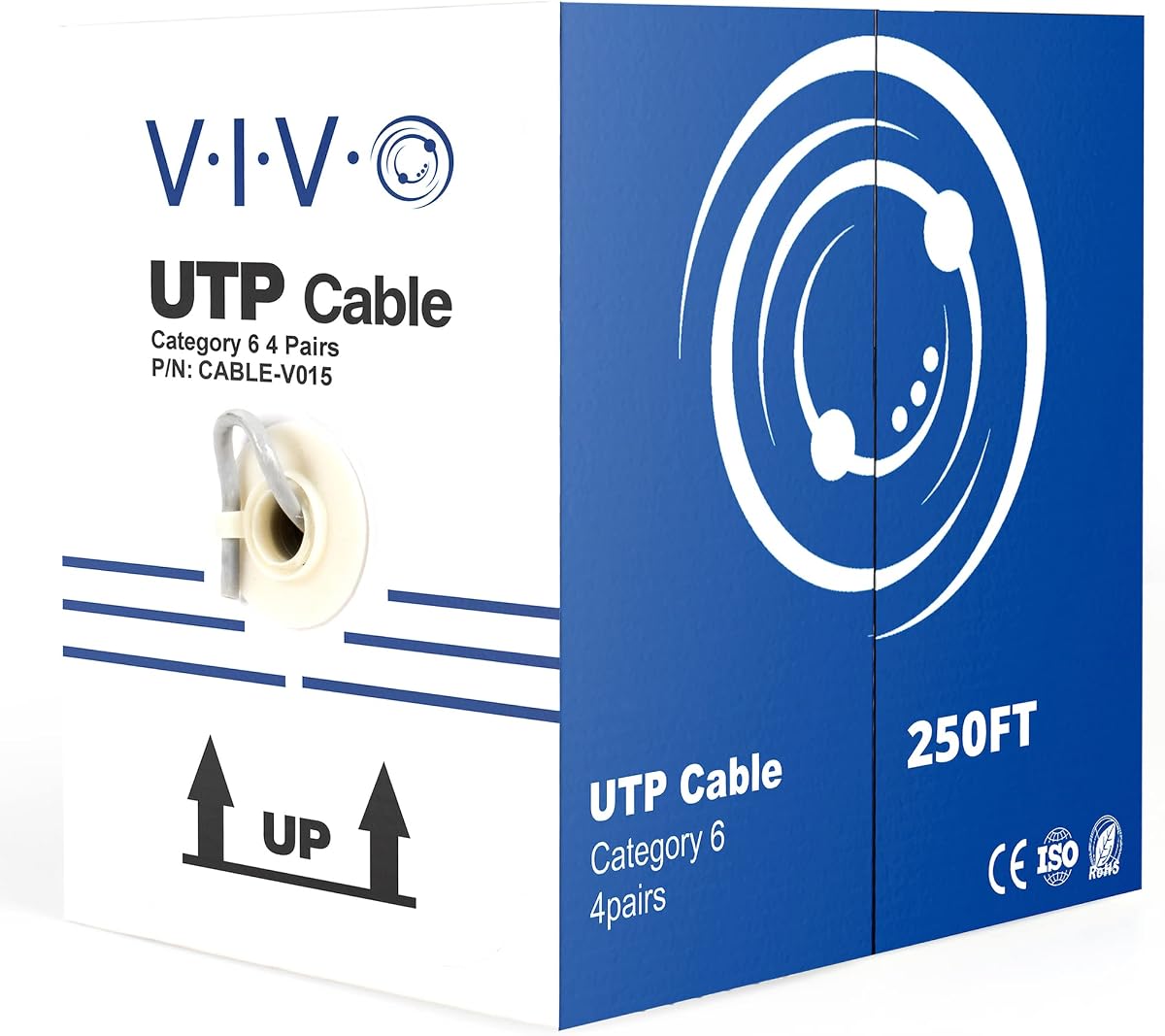
The VIVO Gray 250-foot Bulk Cat 6 reel is intended for installers who want control over final cable length and connector placement. It is a connector-free 250-foot roll of 23AWG copper-clad aluminum, solid UTP wire packaged in an easy-spool box. That format is useful for structured cabling, custom patch leads, and crossover cables where standardized patch-cable lengths do not fit.
We may earn a commission when you buy through this link, at no additional cost to you.
The four unshielded twisted pairs provide a practical network backbone for indoor installations. Because the cable arrives without RJ45 connectors, installers can terminate it to suit their own jack, plug, patch panel, or keystone requirements. It is also easier to route a bulk reel through walls, ceilings, and conduit than to work with multiple pre-terminated lengths.
The listing describes the shielding as waterproof but explicitly notes that it is not UV rated. It should therefore be treated as an indoor product unless the manufacturer provides different guidance for a specific exposure. Buyers also need appropriate termination tools, compatible connectors, a tester, and enough experience to maintain the twist and pair mapping of each installation.
Choose this reel for an IT contractor, custom network build, or homeowner comfortable terminating Ethernet. It is less convenient for a simple plug-and-play connection, but it offers greater flexibility than any ready-made cable in this guide. Its 4.3 rating is the lowest here, making clear that its value rests on installation flexibility rather than turnkey convenience.
A bulk reel avoids unnecessary slack and allows each run to be cut to its exact measured length. It can be terminated with the connectors, jacks, and patch-panel hardware already used in the target network.
The jacket is not UV rated, so prolonged sunlight exposure is not its intended use. For an exterior segment, choose a cable specifically labeled and constructed for outdoor exposure or direct burial.
We may earn a commission when you buy through this link, at no additional cost to you.
The Cat6A Outdoor Ethernet Cable provides a 250-foot run with a 4.7 rating and a higher category than ordinary Cat 6. It supports data rates up to 10 Gbps and bandwidth of 550 MHz, making it suitable for routers, servers, computers, cameras, gaming consoles, and other network devices. Its stated backward compatibility with Cat 6, Cat 5e, and similar equipment makes it flexible for mixed installations.
We may earn a commission when you buy through this link, at no additional cost to you.
The cable uses four twisted pairs of 23AWG copper-clad aluminum conductor with an insulating layer intended to support signal stability. A high-density LLDPE jacket provides waterproofing, weather resistance, abrasion resistance, and UV protection. The listing also emphasizes anti-tangle properties for easier direct underground installation.
Two dust caps and 80 cable ties are supplied, making this one of the most accessory-rich options in the roundup. As with most Cat 6A outdoor products here, however, it uses copper-clad aluminum rather than pure copper and remains unshielded. Those compromises should be considered when the route passes close to high-power electrical equipment or when future signal-integrity margin is important.
Choose this cable for a garden, garage, office, home, or direct-burial project that needs a complete patch cable and a substantial installation kit. It works well for standard 10 Gbps networks and backward-compatible equipment. Buyers seeking a more advanced category should carefully confirm that the connected devices support the intended network standard.
The higher category and 23AWG conductor offer additional performance headroom over thinner Cat 5e alternatives. They are useful for long routes connecting modern routers, access points, and network switches.
Eighty cable ties help manage a long run throughout an exterior installation. Dust caps protect the connector ends during storage and handling before the cable is put into service.
We may earn a commission when you buy through this link, at no additional cost to you.
The Cat 8 Ethernet cable is the highest-specification product in this guide, with a stated capacity of 40 Gbps and bandwidth up to 2,000 MHz. It uses 26AWG pure copper conductors within a shielded F/FTP design, while gold-plated RJ45 connectors support reliable termination. Its 4.7 rating and broad compatibility make it appealing for high-speed LAN, server, data-center, and smart-device connections.
We may earn a commission when you buy through this link, at no additional cost to you.
Shielding is intended to reduce EMI and RFI interference, and the cable is described as suitable for both indoor and outdoor use. Its UV-resistant PVC jacket is intended to resist sunlight, aging, and changing weather conditions. Compatibility extends across many routers, switches, IP cameras, modems, consoles, NAS devices, printers, patch panels, and RJ45-equipped computers.
The listing itself cautions that signal attenuation increases on Cat 8 runs longer than 100 feet, so the 250-foot length should not be treated as a guarantee of 40 Gbps at the endpoint. It also does not state that the jacket is suitable for direct burial, despite the outdoor rating. Connected devices, switch capabilities, installation quality, and Ethernet standards all affect the attainable result.
Choose this cable when your equipment explicitly supports Cat 8, interference control is important, and a 2,000 MHz design target is worthwhile. For a typical home network, Cat 6 or Cat 6A will usually be more straightforward. Its premium specifications are most meaningful in controlled professional environments rather than ordinary internet access.
The 2,000 MHz and 40 Gbps specifications position this cable for demanding local networking. It is designed for applications where future equipment changes may benefit from more performance headroom than basic Cat 6 provides.
Four shielded foiled twisted pairs surround 26AWG pure copper conductors. The thicker construction and shielding are intended to improve stability in high-interference or high-performance local networks.
We may earn a commission when you buy through this link, at no additional cost to you.
The VIVO Blue Full Copper 250-foot bulk Cat 6 wire is a connector-free reel for professional or enthusiast network installations. It has a 4.6 rating and uses solid 23AWG pure copper conductors in a four-pair UTP design. Unlike the other bulk reel in the guide, its stated material is full copper rather than copper-clad aluminum, making it a notable option for long-run custom wiring.
We may earn a commission when you buy through this link, at no additional cost to you.
The listing states that the wire is suitable for Fast, Gigabit, and 10-Gigabit Ethernet and that its material conforms to TIA/EIA. Its CM jacket is designated for in-wall use, and the spool format supports structured network installations, patch leads, and crossover cables. A dark-blue jacket makes the cable easier to identify within an otherwise crowded wall or ceiling cavity.
The reel has no RJ45 connectors, so the buyer must perform all termination work with compatible hardware. Correct pair untwisting, connector alignment, and testing are essential to achieving intended performance. It is also not presented as a direct-burial or UV-resistant outdoor product, making it better suited to indoor structured wiring than exposed exterior paths.
Choose this reel for a custom home network, office build, wall installation, or professional cabling project where pure copper and installer control are priorities. It is less convenient for a quick plug-and-play extension, but it can produce clean, correctly sized finished cables for the target layout. Confirm your planned route, termination method, and local building requirements before purchasing.
Solid 23AWG pure copper is a meaningful distinction from copper-clad aluminum bulk cable. It offers a familiar conductor option for installers who prioritize long-run material consistency.
The CM-rated jacket is intended for use within walls and similar indoor pathways. The blue jacket also provides straightforward identification when several service cables occupy the same cavity.
We may earn a commission when you buy through this link, at no additional cost to you.
The most important choice is not simply the highest category; it is the cable that matches the installation environment, network equipment, conductor quality, and level of interference. A long run also demands careful routing, strain relief, and testing at both ends.
Begin by identifying every place the cable will pass. A cable used entirely inside a finished room, wall cavity, or ceiling can use a standard indoor jacket, while a route through a garage, yard, crawlspace, or trench requires a cable explicitly designed for outdoor exposure or direct burial. Words such as weather resistant, waterproof, UV resistant, and direct burial are not interchangeable, so read the full construction description rather than relying on a broad indoor-and-outdoor label.
Cat 6 is the common middle ground in this list, supporting 10 Gbps with bandwidth stated around 500 or 550 MHz. Cat 6A offers a higher category while retaining a similar 10 Gbps and 550 MHz specification, and Cat 7 and Cat 8 provide additional bandwidth or shielding. The actual service rate depends on both ends of the connection, so a higher-rated cable cannot make a 1-Gigabit switch deliver 10 Gbps. Match the category to current and planned equipment rather than selecting solely on the largest number.
Pure copper and copper-clad aluminum are the two conductor approaches found here. Pure copper is generally preferred for long custom runs, particularly where the listing specifies solid copper, while CCA can provide a lower-cost alternative for many ordinary patch-cable installations. Copper-clad aluminum is not inherently unusable, but buyers should understand that it is a different material with different conductivity and environmental characteristics. The most important point is to avoid assuming that a CCA and pure-copper cable are fully interchangeable in every installation.
UTP cables reduce interference by twisting each pair, while shielded designs add another layer of protection from electromagnetic and radio-frequency interference. Shielding is helpful near electrical equipment, heavy machinery, industrial pathways, or poorly separated power and data routes. It is not automatically required in every home, and it may add bulk, complicate connectors, and increase cost. Match the shielding to the environment rather than assuming a higher category also means heavier shielding.
Preinstalled RJ45 connectors make a patch cable convenient, while bulk wire offers precise lengths and cleaner routing. Look for gold-plated contacts, snagless boots, molded strain relief, and dust caps on finished cables. Cable ties are useful for securing long runs, and a reel on a convenient spool helps with structured wiring. If you choose bulk cable, budget separately for quality connectors, a proper termination tool, a cable tester, and any required jacks or patch-panel hardware.
A 250-foot cable may be 5.8 mm thick, as in the Ultra Clarity model, or have a different diameter depending on category, conductor material, shielding, and jacket. Diameter affects ease of installation in conduit, wall cavities, and tight pathways. Higher categories and shielding can be bulkier, and thicker cable is sometimes easier to handle over long distances. Before ordering, measure the available opening and plan bends so the cable is not forced into a tight radius.
Most standard Ethernet devices use RJ45 connections, but cable category, shielding, PoE requirements, and supported speeds should still be checked. The listed cables support a broad range of routers, switches, cameras, consoles, computers, NAS devices, and access points, but a connected device must support the intended standard. PoE applications also warrant attention to the cable's stated support and the voltage and power requirements of the network equipment.
A cable that is longer than needed can introduce unnecessary slack, difficult bends, and connection strain, while an undersized cable may not reach the intended route. Measure the complete path, including service loops at both ends, turns, and the depth needed for equipment connections. Very long runs, especially Cat 8, can experience greater signal attenuation, so claims about maximum bandwidth should be treated as product specifications rather than guarantees for every device combination and installation.
Plan the complete route before unpacking the cable. Identify both endpoints, measure the distance, check connector clearance, and decide whether the cable will be mounted, routed through conduit, placed in a wall, or buried in a trench. If it will be buried, confirm that the product is specifically labeled for direct burial and use suitable trenching practices. Avoid sharp rocks, construction debris, and roots that could abrade the jacket.
Install the cable without creating tight bends, hard kinks, or excessive tension at either RJ45 connector. Secure it with appropriate ties, clips, or clamps at reasonable intervals, while preserving enough service loop to allow connectors to be removed without pulling against the socket. For bulk cable, maintain correct pair twisting as close as practical to each termination, use compatible connectors, and test the finished run before closing a wall or covering the cable.
After installation, test the connection with an appropriate cable tester and verify the negotiated link speed on the router or switch. Keep connectors dry and clean, avoid repeatedly unplugging a cable while connected equipment is powered, and inspect outdoor portions for jacket damage, UV wear, water entry, or abrasion. A small protective cover can help during storage, but it should not be left tightly sealed around a connector that needs to dry.
Several products in this guide are rated for data transfer up to 10 Gbps at 250 feet. Actual performance also depends on the connected router, switch, network adapter, installation quality, and whether the complete path meets the relevant category standard. A cable marked for 10 Gbps cannot make slower equipment transfer data faster.
Yes, an outdoor or direct-burial cable can normally be used indoors. Its heavier jacket may be less convenient for furniture routing or tight wall cavities, but it provides a durable path between buildings or outdoor equipment. If a cable is specifically for direct burial, it can also be used above ground unless its instructions state otherwise.
Cat 6 is suitable for most conventional home and office networks. Cat 6A provides more category headroom, while Cat 7 and Cat 8 offer higher stated bandwidth and often stronger shielding. Higher categories matter most when both endpoints support them; they are unnecessary for a basic Gigabit connection but may be valuable in professional or interference-prone environments.
A pre-terminated cable arrives with RJ45 connectors at both ends and is ready to plug in. Bulk cable has no connectors, so the installer chooses the length, plugs, jacks, and termination method. Bulk wire is helpful for walls, ceilings, and structured cabling, while pre-terminated cable is easier for a quick connection or long outdoor run between two fixed points.
Many of the outdoor patch cables in this guide use 24AWG or 23AWG copper-clad aluminum conductors and are marketed for long runs. They can be suitable for many networks, particularly when paired with appropriate equipment and installed carefully. Pure copper is generally the preferred choice for demanding custom installations, while buyers with interference concerns may also want shielding.
Shielding can be useful when the route passes near power equipment, motors, industrial machinery, or strongly interfering electrical systems. It may also provide additional performance margin in professional installations. In a typical home or office with ordinary routers and switches, properly twisted unshielded cable is often sufficient when routed away from noisy sources.
Confirm that the cable is designed for the exact exposure, especially if it will be buried. Route it away from sharp objects, avoid hard bends, secure it with suitable hardware, and keep both connectors dry until they are connected. For a buried cable, test data transmission before the trench is closed, as recommended by one of the outdoor cable manufacturers.
The fastest device on the path usually limits the result, followed by cable quality, installation condition, and network configuration. A 10 Gbps-rated cable may provide a stable 1 Gbps connection, while a faster switch or adapter may use the cable's higher capability. Internet service speed is another separate limit because Ethernet carries local traffic between devices.
The GEARit Cat 6 Outdoor is the strongest all-around choice for a ready-made direct-burial run, while Ultra Clarity's solid-copper Cat 6 cable is a straightforward option for protected indoor or non-buried routes. For buyers seeking a premium outdoor construction, the shielded and pure-copper GEARit Cat 7 provides greater bandwidth and interference resistance.
The most important priorities are the installation environment, network equipment, and conductor construction. Outdoor and buried routes need an explicitly suitable jacket, high-interference areas benefit from shielding, and custom structured wiring may justify choosing a pure-copper bulk reel and performing professional terminations. Measure the route carefully and avoid buying for a specification that the connected equipment cannot use.
Product details, ratings, and availability can change, so review the current listing before making a final decision. Confirm the cable category, conductor material, jacket rating, connector type, and intended installation conditions, and use a tester after installation to verify that the completed 250-foot run performs as expected.