
CasaZenith Six-Height Foot Rest
4.4Editor score
Six height adjustments
Four massage rollers
Portable ABS construction
Ergonomic footrests for desks can make long workdays more comfortable by supporting the feet, encouraging a better seated position, and reducing pressure on the legs and lower back. A useful model combines an appropriate height with a stable base, a comfortable surface, and enough adjustability to fit your chair, desk, and body.
This guide compares ten footrests across essential factors such as height settings, tilt or rocking motion, cushioning, stability, portability, cleaning, and massage surfaces. The list includes basic plastic platforms, layered foam supports, wooden rockers, and a carbon-steel model designed for frequent height changes, giving readers a broad range of options.
Each review identifies the strongest reasons to consider a particular footrest while also noting practical trade-offs. The selections show that there is no single construction or adjustment method for everyone; shoppers should prioritize the features that match their workspace, seating style, and comfort needs. Product prices can change, so confirm current details before purchasing.
4.4Editor score

4.7Editor score

4.7Editor score
As an Amazon Associate we earn from qualifying purchases.
The comparison below highlights the main differences in height adjustment, cushioning, motion, portability, and stability across all ten footrests, making it easier to identify the design best suited to your desk setup.


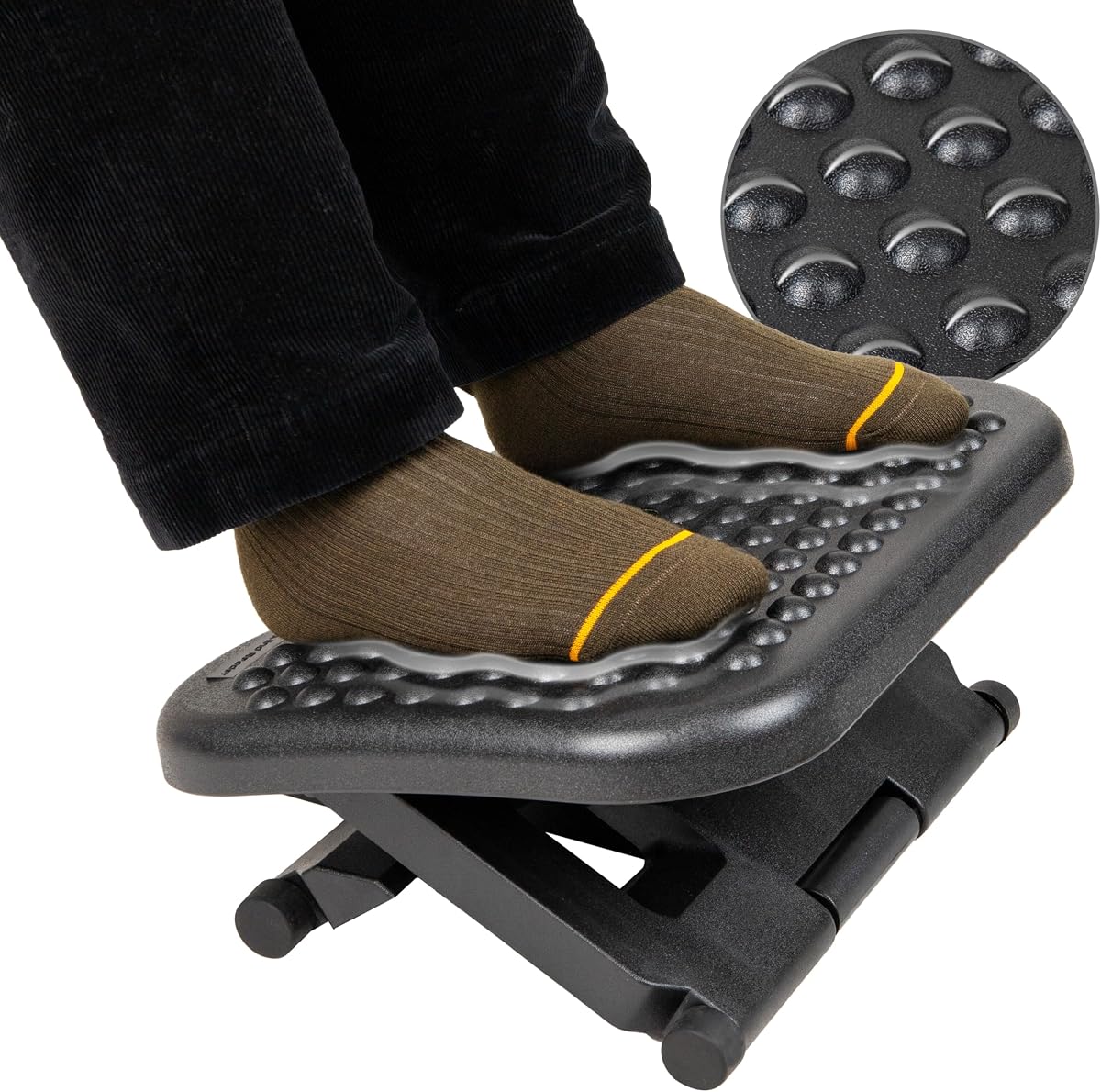



The CasaZenith Six-Height Foot Rest is an affordable, compact platform designed to support the feet while working at a desk. Its 4.4 rating reflects a generally positive reception, and its standout combination of six height settings, four massage rollers, and detachable construction gives it more functionality than a basic fixed footstool. The listed heights range from 3.1 inches to 7.3 inches, offering meaningful vertical flexibility.
We may earn a commission when you buy through this link, at no additional cost to you.
Height is changed by rotating screws on both sides of the footrest, so users can select a position based on their chair and desk. The support structure is made from ABS, while non-slip pads on the legs help prevent movement. The small-particle massage surface and rollers add a tactile feature that may be particularly appealing to people who want to move their feet during long computer sessions.
The main compromise is the relatively firm, utilitarian construction. Unlike a memory-foam model, this footrest is not designed to contour deeply around the feet or provide a soft cushion. Adjusting the height also requires turning screws by hand, meaning a user cannot reposition it as effortlessly as someone using a foot-operated mechanism. Nevertheless, the six available levels, portability, and easy-clean material compensate for those limitations.
This is a strong choice for budget-conscious buyers who want more than a single-position plastic platform. It is particularly useful for people alternating between a standard office chair, a home workstation, and occasional travel, since the detachable construction makes the product easy to carry. For shoppers seeking plush cushioning or effortless adjustments, a foam or step-operated design may be preferable, but the CasaZenith delivers useful versatility at an approachable level.
Six height positions allow the support to change as your posture, chair, or desk setup changes. This makes the model more adaptable than a fixed platform and useful for shared or mobile workspaces.
The four rollers and textured surface provide a way to stimulate the soles while working, while the detachable ABS body is simple to carry and clean.
We may earn a commission when you buy through this link, at no additional cost to you.
The ComfiLife Memory Foam Foot Rest is designed for shoppers who prioritize a soft, contoured surface over the firm feel of a molded platform. It carries a 4.6 rating and uses high-density memory foam intended to conform to the shape of the feet. Its adjustable height, larger platform, removable cover, and carry handle make it especially practical for office workers, students, and gamers.
We may earn a commission when you buy through this link, at no additional cost to you.
The foam support offers a different type of ergonomics from plastic or wood. It cushions the heels and ankles while providing enough structure for the lower legs, and the adjustable design allows users to change the elevation rather than committing to one fixed position. The product can also sit beneath the knees while reclining or be flipped into a rocker, giving it uses beyond standard desk support.
Its main limitation is that memory foam is bulkier and may retain warmth over long sessions. A foam footrest also occupies more visual and physical space than a compact rigid platform. The provided information states that the cover is removable and machine washable, while the base is designed to grip hardwood, tile, carpet, and laminate, making it suitable for shared or home environments.
The ComfiLife is a strong recommendation for anyone who finds hard footrests uncomfortable or wants one product that can alternate between an elevated footrest, knee support, and rocker. It may be less compelling for users who need a very compact platform or prefer a cool, firm surface. Even so, its 4.6 rating, flexible construction, and easy maintenance make it one of the most versatile options in this roundup.
High-density memory foam adapts to the feet and cushions pressure points around the heels and ankles. The larger surface also provides room to reposition, roll the ankles, or stretch the legs without moving the entire footrest.
The foam block can elevate the feet, support the knees while lying down, or flip into a rocking position. A built-in handle and lightweight construction make it easier to carry between rooms and workstations.
We may earn a commission when you buy through this link, at no additional cost to you.
The StrongTek Wooden Rocking Foot Rest is a rigid, attractive platform that combines a 350-pound capacity with a naturally rocking design. It earns a 4.7 rating, making it one of the highest-rated products in the guide, and its wooden construction gives it a more permanent, furniture-like appearance than a typical plastic desk accessory.
We may earn a commission when you buy through this link, at no additional cost to you.
Instead of relying on preset mechanical positions, the board changes angle through gentle pressure from the calves. That movement encourages the lower legs to shift rather than remain completely static. The grippy surface is designed to maintain secure footing across different surfaces, including carpet, while the wood frame provides a stable platform that does not depend on compressible foam.
The trade-off is that height adjustment is not among its features. Users who need a precise elevated position may find a conventional flat platform more versatile. The continuous rocking also takes up more floor space and may not sit comfortably beneath a very low desk. Aesthetically, the dark wood can complement office furniture better than a brightly molded plastic model.
The StrongTek is best for people who want subtle movement while working, study, or relaxing, and for anyone who prefers durable wood over foam. It can also be used during breaks for balance or stretching exercises, adding value beyond desk support. For shoppers seeking a stable, attractive rocker with no complicated controls, it is a particularly well-rounded recommendation.
Pressure from the calves causes the board to rock, allowing the lower legs to move without repeated manual adjustments. This can make a static desk setup feel less restrictive while remaining entirely under the user's control.
The wooden construction supports up to 350 pounds and avoids the gradual flattening associated with soft foam. A grippy surface helps keep the feet planted as the platform moves.
We may earn a commission when you buy through this link, at no additional cost to you.
The HUANUO Adjustable Foot Rest combines a three-position height mechanism with a broad tilt range. Its 4.2 rating reflects a solid, versatile design, while the ability to adjust both vertical elevation and angle separates it from simpler fixed platforms. It is already assembled and intended for immediate use in an office, home workspace, or gaming setup.
We may earn a commission when you buy through this link, at no additional cost to you.
The listed height settings are 4.3, 5.5, and 6.7 inches, which covers a useful range for many standard chairs. The platform can tilt from 30 degrees backward to 30 degrees forward. Because that angle is not fixed, the platform rocks when weight is applied, encouraging movement instead of locking the legs into one static position.
A 17.13-by-13.19-inch textured platform provides generous contact area, and the geometric circular bumps are intended to add texture and massage the feet. The product arrives pre-assembled and uses non-slip feet for stability. The main limitation is that only three heights are available, so it cannot accommodate the same range as models with more levels or continuous adjustment.
This footrest suits users who want the feet elevated but also value the ability to change the angle throughout the day. It works well for general office comfort and gaming, particularly when some movement is desired. People who require a firm, locked platform or a very wide height range should look toward a six-level or continuously adjustable alternative.
Three height positions establish the basic elevation, while the tilting platform lets the legs move forward and backward. Together, these controls provide more positional variety than a fixed-height board.
The broad platform gives both feet room to settle without feeling cramped. Its raised geometric texture adds massage-like contact and helps keep the feet from sliding.
We may earn a commission when you buy through this link, at no additional cost to you.
The Mind Reader Foot Rest is a straightforward plastic platform that offers height adjustment from 3.25 to 6.25 inches. Its 4.2 rating places it among the solid mid-range choices in the roundup. The 17-by-13-inch platform provides enough room for both feet while its relatively low listed weight makes it convenient to move.
We may earn a commission when you buy through this link, at no additional cost to you.
The main ergonomic feature is the broad height range, which lets users align the top of the footrest more closely with the position of the knees and ankles. Its massage-textured upper surface is intended to stimulate the feet while also improving grip. The product is suitable for home offices, workstations, dorm rooms, and general relaxation areas.
As a rigid plastic design, it does not provide the pressure-relieving softness of memory foam or high-density foam. It also lacks the continuous rocking motion offered by wooden models and does not include separate massage rollers. Those omissions are not necessarily flaws for someone who values a stable, easy-to-place platform over cushioned comfort or dynamic movement.
The Mind Reader works best for users who want adjustable elevation without foam bulk or a complicated mechanism. It is a particularly useful travel companion for people who divide their workday between different chairs or locations. Buyers seeking deep cushioning should choose a foam model, while those who value a simple textured platform will find this design more directly focused.
The three-inch adjustment span gives users meaningful control over how high the feet are supported. It is a good match for standard office and home chairs without requiring a large piece of foam.
At 17 by 13 inches and a listed weight of 5.5 pounds, the platform can be moved between workstations without much effort. Its textured top doubles as a secure foot surface.
We may earn a commission when you buy through this link, at no additional cost to you.
The CasaZenith Portable Foot Rest is a compact, lightweight option designed to move easily between an office, home, or travel destination. It has a 4.2 rating and distinguishes itself with a swingable foot platform, a textured massage surface, and rollers. Unlike taller ergonomic models, it focuses on portability and gentle movement rather than elevation adjustment.
We may earn a commission when you buy through this link, at no additional cost to you.
The foot area measures 13 by 9.6 inches, which is more compact than many platforms in this guide. It can swing forward or backward, allowing the feet to move while remaining supported. A textured top and integrated roller provide tactile stimulation, while the thickened polypropylene construction is designed to be durable and straightforward to clean.
The main drawback is its limited surface area and lack of height adjustment. Both feet may not fit comfortably for users with larger feet, and the fixed height cannot be aligned with different chair or desk configurations. It is also not a true rocking platform; the swingable component offers a different kind of movement without a broad tilt range.
This is a practical choice for people who frequently work in temporary spaces, travel with a laptop, or want a footrest that can be packed into a bag. The snap-on design requires no tools, and the material can be wiped directly. For users who need a large platform or precise height control, one of the adjustable models will be a better fit.
The lightweight snap-on construction fits into a backpack or handbag without taking up much room. It can therefore provide a familiar foot-support setup wherever work takes you.
The platform can swing forward and backward beneath the desk, encouraging subtle lower-leg movement. A textured surface and roller add foot stimulation in a compact format.
We may earn a commission when you buy through this link, at no additional cost to you.
The TranquilRelax Adjustable Foot Rest uses a layered foam design to offer three different height configurations. Its 4.5 rating indicates a well-received balance of comfort, support, and convenience. The main foot platform is 3.7 inches thick, and two additional 2-inch base layers can be attached or removed with touch fasteners.
We may earn a commission when you buy through this link, at no additional cost to you.
Because the adjustment method is based on removable layers, users can change the overall height without tools or complicated mechanisms. High-density foam is used to resist sinking and losing its shape, while the contoured height and curvature are intended to support the lower legs. A non-slip bottom keeps the structure stable during daily use.
The removable zippered cover can be machine washed, which is useful in home offices or shared workspaces. The product can also be placed under the knees for support while reclining or flipped into a rocking footrest. Its limitations are the limited number of preset heights and the bulk inherent in a thick foam construction.
The TranquilRelax is well suited to buyers who want a soft support surface but do not need continuous or mechanical height adjustment. It is particularly attractive for shared environments because of the washable cover. Those seeking a more sculpted platform or a larger range of elevations may prefer the ComfiLife or step-operated alternative.
The two base layers use touch fasteners, so users can add or remove them according to the desired elevation. This is simpler and quieter than manipulating screws or mechanical levers.
High-density foam is intended to retain its supportive shape, while the non-slip base improves stability. The zippered cover can be removed and machine washed for routine maintenance.
We may earn a commission when you buy through this link, at no additional cost to you.
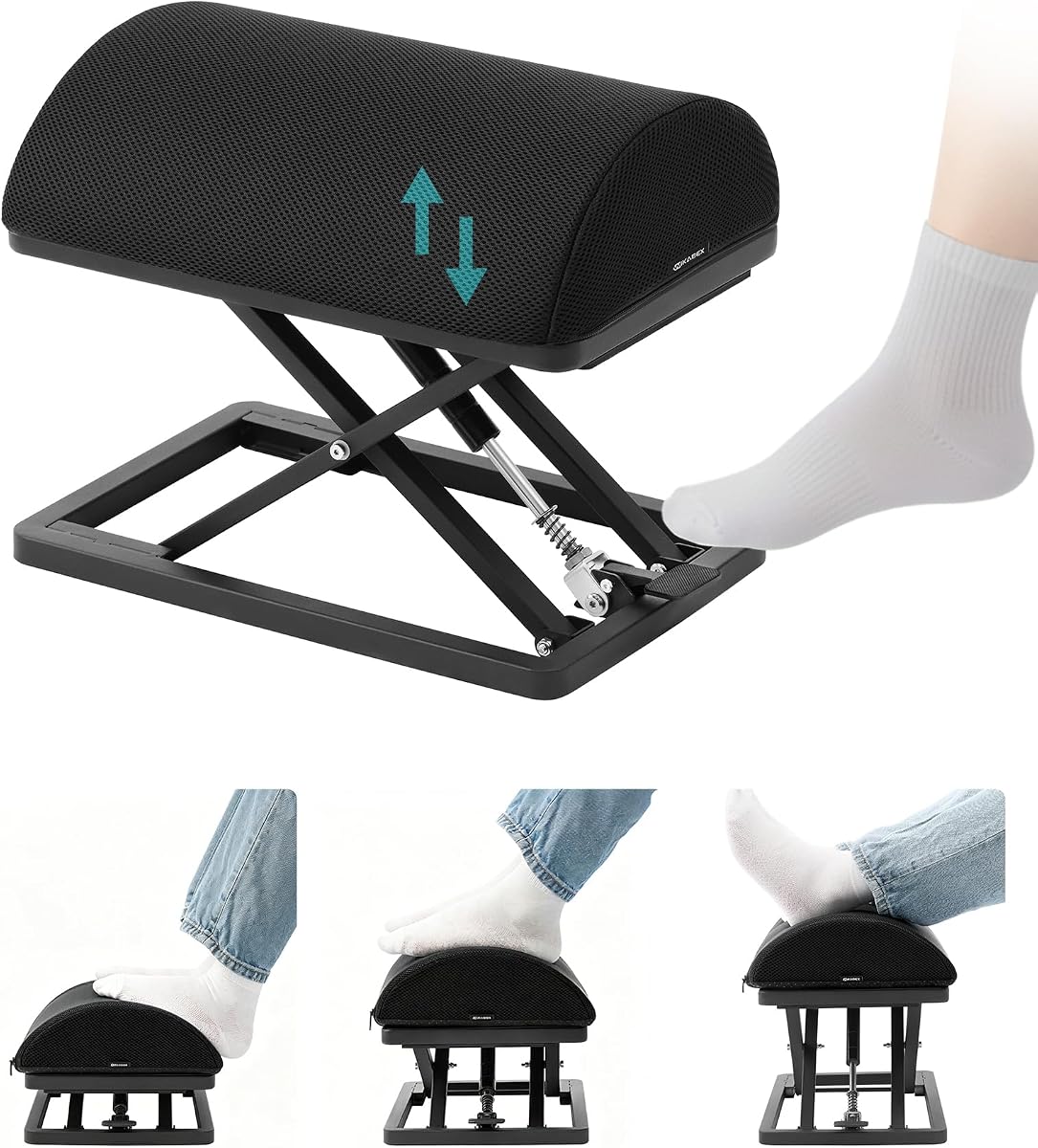
The Step-to-Adjust Foot Rest is the most mechanically ambitious option in this guide, offering a continuous height range of 2.7 to 13.1 inches rather than a few preset positions. With a 4.5 rating, it stands out for foot-operated adjustment, a carbon-steel frame, and a contoured high-density foam cushion designed to accommodate several foot positions.
We may earn a commission when you buy through this link, at no additional cost to you.
The defining feature is the ability to change height with a foot tap. That removes the need to bend beneath the desk and repeatedly adjust a screw, knob, or lever. The broad height range supports many postures, from relatively flat positioning to substantially elevated legs. Its semi-circular cushion is shaped to remain supportive whether the feet are angled, flat, or sideways.
The carbon-steel construction provides stability, and the product is listed at 9.5 pounds. The manufacturer also states that the mechanism was tested for 100,000 adjustments. Those are notable attributes, but the substantial frame takes up more floor space and may be less convenient to move repeatedly than a foam block. The product also includes an explicit warning about finger-entrapment risk, so it should be kept away from children.
This model is ideal for users who change posture often, work across multiple chair heights, or dislike reaching down to adjust a conventional footrest. Its premium construction and broad range justify consideration over simpler platforms. The safety warning and heavier frame deserve attention, but for an adult user who values quick, precise positioning, the foot-operated system is a compelling solution.
A simple foot tap raises or lowers the platform, making it easier to respond to changes in posture during the day. The continuous range accommodates substantially more setups than conventional preset models.
The rust-resistant carbon-steel frame is heavier than most foam and plastic alternatives, but that mass supports stability. A contoured foam cushion adds softness while a removable zippered cover simplifies cleaning.
We may earn a commission when you buy through this link, at no additional cost to you.
The Seven-Angle Walnut Foot Stool combines a solid wood body with a carbon-steel adjustment mechanism and seven selectable support angles. Its 4.6 rating makes it one of the stronger-rated products in the comparison. Rather than changing the overall height, it focuses on finding a comfortable angle for the feet and lower legs.
We may earn a commission when you buy through this link, at no additional cost to you.
The seven positions provide more variation than a standard flat platform, allowing users to change how the feet are supported during the workday. A sleek walnut appearance is designed to blend with modern office furniture. Non-skid strips on the support surface and rubber pads underneath help maintain footing and protect the floor from scratches.
The rigid surface is the main limitation for people who prefer a cushioned or contoured feel. Changing the angle may also require more effort than tapping a foot-operated mechanism, although the product arrives ready to use and requires no assembly. The mixed wood-and-steel construction appears oriented toward durability and a furniture-like appearance rather than maximum portability.
This footrest is a strong option for design-conscious users who want adjustable angles and a natural-looking platform. It fits particularly well in a home office or professional workspace where a plastic accessory might feel out of place. Buyers seeking deep cushioning should choose foam, while those who value angled support and appearance will find this model distinctive.
The range of angle settings allows the lower legs to rest differently as the workday progresses. It offers more positional choice than a fixed board without requiring a large electronic mechanism.
Solid wood gives the footrest a natural look, while the carbon-steel mechanism provides structural support. Non-skid strips and rubber floor pads help prevent slipping and floor damage.
We may earn a commission when you buy through this link, at no additional cost to you.
The ErgoFoam Adjustable Foot Rest is a cushioned, high-density foam option that holds a 4.7 rating. It is positioned as a supportive alternative to soft foam products that may flatten under sustained weight. The adjustable design accommodates different chair and leg lengths, while the larger arched platform provides support across the feet and lower legs.
We may earn a commission when you buy through this link, at no additional cost to you.
The foam is intended to maintain firmness and resist compression over time, making it a better fit for daily desk support than a thin pad. A double-sided non-slip base helps keep the footrest from moving, and the broad design creates space for the feet to shift. The product can be flipped over to become a rocker, introducing movement and a different way to support the legs.
Foam is bulkier and less compact than a rigid platform, so this model may be less convenient to carry or position in a tight under-desk area. It also lacks the continuous mechanical adjustment offered by the step-operated footrest. The removable velvet cover can be washed, which helps offset the usual maintenance concerns associated with a cushioned product.
The ErgoFoam is a compelling choice for people who need meaningful cushioning without the soft, flattening feel associated with lower-density foam. It works especially well for extended work sessions and for users who appreciate the option to switch from a fixed supportive position to a rocking motion. For a balanced combination of foam comfort, stability, and flexibility, it ranks among the strongest picks in the guide.
The high-density foam is developed to resist compression and maintain its shape. This makes it more appropriate for long-term desk support than an ordinary memory-foam pad that may flatten.
The arched foam platform provides broad support in its normal orientation. Flipping it over creates a rocker for movement, and the double-sided non-slip base helps keep either configuration stable.
We may earn a commission when you buy through this link, at no additional cost to you.
The most useful footrest is one that fits your body, chair, desk, and daily routine. Consider elevation, surface comfort, movement, stability, footprint, and maintenance before choosing a model.
Height determines whether your knees and hips can settle into a comfortable angle. If the feet rest too low, the legs may remain angled downward; if the support is too high, pressure can shift into the knees or hips. Look for a range that accommodates your chair and desk rather than focusing on the tallest listed setting. Options in this guide span three, six, or seven preset configurations, as well as a continuous mechanical range.
Firm platforms provide stable support and tend to occupy less space, while foam products cushion the heels and ankles more effectively. Memory foam conforms closely and feels plush, whereas high-density foam is intended to resist flattening. A contoured or arched shape may also encourage a more natural leg position. Consider whether you will wear shoes, use bare feet, or need a textured massage surface when choosing the surface type.
A footrest that slides can make it harder to maintain a consistent position, especially when rocking or changing angles. Look for non-slip feet, grippy upper surfaces, and rubber pads that also protect hard flooring. Rigid wood and steel designs generally provide stable foundations, while foam products need a dependable non-slip base. Check whether the product is designed to remain stable on carpet, tile, laminate, and hardwood.
Screw-based, layered, preset, and foot-operated systems each have different strengths. Manual screws are straightforward but require reaching below the desk. Removable foam layers are quick and tool-free, while preset angle mechanisms provide more defined positions. A foot-operated design offers the most convenient changes because the user does not need to bend or use both hands.
Rocking and tilting can keep the lower legs from remaining completely still. Some models move in response to calf pressure, while others use a broad platform that rocks across a wider range. A fixed angle may feel steadier, whereas continuous movement can be preferable during long work or gaming sessions. If you use the footrest for balance exercises as well as desk support, a pronounced rocking surface may offer added versatility.
A large platform gives both feet room to reposition and accommodates wider stances, while a compact model saves floor space and is easier to carry. Very small designs may become uncomfortable if both feet need to rest flat. Consider shoe size, barefoot comfort, and whether you sometimes cross your ankles or extend your legs. Check the stated dimensions before assuming a model will fit beneath your particular desk.
People who work across home offices, shared spaces, or travel destinations need a model that can be moved without excessive effort. Lightweight foam and compact plastic designs are generally easier to carry, while carbon-steel and wood constructions tend to be heavier but more permanent. A removable or washable cover is especially useful when the footrest will be used by more than one person.
Consider how often you will use the footrest and whether your shoes or feet will transfer dirt to the surface. Plastic and ABS platforms can generally be wiped clean, while fabric-covered foam products benefit from removable washable covers. Dense foam should resist sagging, and rigid wood or steel platforms may show wear more slowly. Inspect the base, cover fasteners, and adjustment mechanism periodically for looseness or damage.
Begin by setting your chair at a comfortable working height and placing the footrest beneath it. Adjust the platform so that your feet rest flat, your ankles remain relaxed, and your knees are roughly level or slightly below the hips. If the platform has a massage texture, start with light contact and increase pressure only if the sensation feels comfortable.
Change the position as your posture changes. Use preset levels, remove or add foam layers, tilt a platform, or tap a foot-operated mechanism according to the design. Avoid repeatedly forcing a locked mechanism, and keep fingers, loose clothing, and cords away from moving joints. For rocking models, use controlled pressure from the calves instead of abrupt pushing.
Clean the surface according to its material. Wipe plastic and ABS platforms with a damp cloth, remove and wash fabric covers according to the care instructions, and avoid saturating foam. Check non-slip pads and adjustment screws periodically, and do not use a footrest with visible cracking, instability, or a weakened base. Replace or repair damaged components before returning it to service.
Your feet should rest flat while your knees remain roughly level with or slightly below your hips. The correct height depends on your chair, desk, and leg length, so adjustable models are often more useful than fixed platforms. Test the position while keeping your shoulders relaxed and your back supported.
A footrest can reduce pressure on the lower back by supporting the legs and helping the pelvis maintain a more comfortable seated position. It is not a substitute for an ergonomic chair, movement breaks, or medical care. Persistent pain or numbness should be discussed with a qualified healthcare professional.
Memory foam is usually more comfortable for people who prefer cushioning and pressure relief around the heels and ankles. A firm plastic platform is easier to clean, often more compact, and typically provides more consistent structural support. The better choice depends on your comfort preferences and the space available under your desk.
Rocking models can encourage subtle movement and provide a different way to support the legs during extended work. They work best when users apply controlled pressure rather than making abrupt movements. Ensure the base is stable, the desk has adequate clearance, and moving components are kept away from children.
Compare the footrest dimensions with the available width, depth, and height beneath your desk. Also account for the platform's highest position, since a model may fit flat but collide with a drawer or crossbar when raised. Measuring the workspace before ordering is the most reliable approach.
A footrest can be useful with a standing desk when you periodically sit or when you want to change leg position. It is not a substitute for proper sit-stand movement, and a traditional footrest may be unnecessary while standing. Choose a model that is easy to move if your desk height changes frequently.
Height adjustment changes the vertical elevation of the platform, while angle adjustment changes the slope on which the feet rest. A footrest can offer either feature or both. Height is important for aligning the knees and hips, while angle can encourage leg movement and improve the position of the ankles.
Wipe rigid plastic, ABS, wood, and metal surfaces with a damp cloth according to the manufacturer's care guidance. Removable fabric covers can usually be machine washed, but check the care label first. Do not soak foam cores, and allow all parts to dry fully before reassembling or using the footrest.
The CasaZenith Six-Height Foot Rest is the best budget-oriented choice because it combines six elevation levels, massage rollers, and easy portability. The StrongTek Wooden Rocking Foot Rest stands out for natural motion, stability, and a 350-pound capacity, while the ErgoFoam Adjustable Foot Rest is the strongest premium option for buyers who want supportive high-density foam and a reversible rocker configuration.
Your priorities should determine which feature matters most. Choose resilient foam for pressure-sensitive users, a continuous mechanism for frequent position changes, a rigid platform for stability, or a rocking design for movement. Before buying, measure the space under your desk, test the likely sitting position, and confirm that the product's cleaning requirements fit your routine.
Ratings, product configurations, and prices can change over time, so review the current listing and seller details before making a final decision. The most effective footrest is not necessarily the most elaborate one; it is the model that supports your feet in a comfortable, stable position and can remain there throughout the workday.