
Coast XPH30R
4.7Editor score
Up to 1200 lumens
Pure Beam focusing
Detachable magnetic body
Four specified output levels
Our 10 best caving headlamp guide compares brightness, beam control, waterproofing, battery options, comfort, and red light for safer underground use.
A caving headlamp must illuminate narrow passages, muddy chambers, and steep routes without adding unnecessary weight to your equipment. The best models combine a focused beam for distance with enough flood illumination to reveal nearby walls, obstacles, and footing while preserving battery life underground.
We compared the following headlamps using the specifications and features supplied for each product, including maximum output, beam flexibility, water resistance, power options, mounting features, comfort, and low-light modes. The list covers rechargeable models, dual-power designs, compact travel lights, and higher-output options for demanding cave routes.
Each review explains where that particular headlamp fits within a caving kit and which users may benefit most from its feature set. Ratings and specifications reflect the supplied product information, while availability and pricing can change, so confirm the current listing and specifications before making a purchase.
4.7Editor score

4.6Editor score

4.6Editor score
The comparison below highlights the core differences among all ten headlamps, including output, beam control, protection ratings, power configurations, and practical caving-oriented features.


The Fenix HM60R V2.0 is a strong all-around choice for cavers who need reliable illumination across both confined passages and larger chambers. Its supplied rating is 4.6 out of 5, and the specification list combines up to 1600 lumens, a beam distance of 185 yards, USB-C charging, a red mode, and an IP68 waterproof rating. That combination covers most common underground lighting needs without turning the lamp into a specialized tool.
We may earn a commission when you buy through this link, at no additional cost to you.
Its four spotlight levels and three floodlight levels provide useful control over the shape and strength of the beam. A focused beam helps identify a passage, a formation, or a distant obstacle, while broad flood coverage reveals nearby walls and uneven ground. Two red-light brightness options preserve dark adaptation during breaks, and the flash function can assist with signaling. The glove-friendly top switch and separate brightness control are particularly valuable when gloves, ropes, helmets, or bulky clothing make fiddly operation more difficult.
The headlamp weighs 6.1 ounces and includes a fast USB-C recharge cycle, with a fully recharged runtime stated at up to 292 hours on low. Its IP68 rating and impact resistance up to two meters support its reputation as a rugged outdoor model. The trade-off is that multiple switches and several brightness levels can take more practice than a simpler control layout, and users who want a red beacon rather than a simple red illumination mode may need a more specialized signaling headlamp.
This is a particularly strong recommendation for recreational cavers, expedition members, and anyone who also hikes, camps, or performs outdoor work. It offers enough output for demanding passages, enough runtime for extended exploration, and a useful red mode for low-light tasks. For a single headlamp that must cover a wide range of underground activities, the HM60R V2.0 is a particularly balanced choice.
The ability to move between a narrow spotlight and wider flood is essential because caves change from tight crawlways to open chambers without warning. These dedicated controls also let users moderate output when maximum brightness is unnecessary, helping preserve usable battery time on long routes.
Large, glove-friendly switches and red illumination make the lamp practical around ropes, in group camps, and during quiet periods. Flash and red modes also add value beyond standard forward-facing cave travel.
We may earn a commission when you buy through this link, at no additional cost to you.
The Fenix HM71R is aimed at cavers and technical explorers who prioritize maximum output and long-range beam reach. It carries a 4.5 rating in the supplied information and produces up to 2700 lumens with a spotlight capable of illuminating objects 251 yards away. A separate 500-lumen flood mode gives it the flexibility needed for close walls, passages, and campsite tasks.
We may earn a commission when you buy through this link, at no additional cost to you.
The defining feature is the detachable, 90-degree right-angle design. Removing the lamp from the headband allows it to be clipped to a pocket, stood upright, or attached to a magnetic surface, which can be useful when hands need to remain free for rope work, route checks, or equipment handling. The reflective and breathable wide headband is designed for longer wear, while the stated temperature tolerance ranges from -31 to 113 degrees Fahrenheit.
As with many high-output lamps, the main consideration is power management. USB-C charging takes approximately four hours, and the stated maximum runtime is 48 hours on low. A cave trip rarely relies exclusively on the lowest setting, so users should carry an appropriate charging solution and monitor battery state. The larger construction and 2700-lumen capability also make it less compelling for ultralight missions than the smaller models in this guide.
The HM71R is a strong fit for expedition cavers, survey teams, and anyone working routes where both reach and local flood coverage matter. Its detachable right-angle capability extends its usefulness beyond a conventional headlamp. Choose it when output and modular operation take priority over minimum weight.
A 251-yard stated beam distance helps in large chambers, on steep passages, and when checking a route from a distance. The 500-lumen flood mode complements that reach by illuminating the area immediately around the wearer.
The quick-release format lets the light move from the headband to a pocket, flat surface, or magnetic attachment point. That flexibility is useful during rigging tasks and whenever hands-free area lighting is needed.
We may earn a commission when you buy through this link, at no additional cost to you.
The Coast XPH30R combines strong output with a relatively compact 4.37-ounce body, making it one of the most balanced options in the roundup. Its supplied rating is 4.7 out of 5. Maximum output reaches 1200 lumens, while the Pure Beam Twist Focus system transitions between short-range flood and longer-distance spot use without the need to cycle through separate physical controls.
We may earn a commission when you buy through this link, at no additional cost to you.
Four stated brightness levels make output selection straightforward: 1200 lumens in Turbo, 500 in High, 160 in Medium, and 46 in Low. Runtimes are listed at 6.75 hours for High, 10 hours for Medium, and 28 hours for Low. This tiered structure gives cave travelers a practical way to move from maximum visibility to conservation, which is particularly helpful on long routes where every watt-hour matters.
The headlamp body detaches from the strap and bracket to function as a handheld flashlight with a magnetic base. That makes it easy to aim light at a wall, inspect a formation, or illuminate a work area without shining directly into another caver's eyes. The main limitation is its IP54 water-resistance rating rather than the deeper IP67 or IP68 ratings found on several alternatives. It is also designed for one-meter drop protection and carries the Coast lifetime warranty against defects in materials and workmanship.
This is an excellent choice for cavers who value straightforward beam adjustment, detachable functionality, and a compact form. It is particularly suitable for cave touring, route reconnaissance, and mixed outdoor use where the lamp can be removed for close inspection. Those entering wetter, heavily flooded passages may prefer a model with a more comprehensive submersion rating.
The twist-focus mechanism offers a direct way to change between broad and narrow light. This is especially helpful in caves, where wall distance and passage shape can change within a few steps.
The removable magnetic body provides a practical inspection light and can point illumination away from the wearer's face. It adds flexibility without requiring a separate flashlight in the kit.
We may earn a commission when you buy through this link, at no additional cost to you.
The Blukar LED Headlamp is a feature-rich option for beginners, casual cavers, and users building a general-purpose outdoor lighting kit. It has a supplied rating of 4.6 out of 5 and uses a T6 and XPE light source with a rear red light. That combination makes it useful for general passage travel, campsite visibility, and low-light signaling.
We may earn a commission when you buy through this link, at no additional cost to you.
Five modes cover the main white light, a white side light, all white lights, a flashing white mode, and the main red mode. Rotating the main lens changes the focal length, allowing the user to choose a flood or spotlight configuration. The lamp body can also tilt through 90 degrees, which helps illuminate the ground, ceiling, side passages, and equipment without constantly repositioning the entire headband.
USB-C charging takes about five hours, and the supplied information notes that the built-in battery is integrated and non-removable. That design simplifies the lamp's overall construction and makes it easy to carry, but it also means users cannot exchange batteries in the field. The IPX6 rating provides solid water protection, although it is not equivalent to the IP67 or IP68 submersion protection offered by several stronger models.
The Blukar is most attractive to users who want many lighting options at an accessible entry point. Its elastic headband is breathable, adjustable, and can be worn directly or secured to a helmet. For technically demanding, heavily wet cave routes, however, a headlamp with a higher water-protection rating and a replaceable power system may be the safer long-term choice.
The combination of main, side, and rear lighting broadens the lamp's usefulness beyond a single forward beam. Side illumination can reveal wall texture and nearby passages, while the rear red light improves group awareness.
Zoom control and a 90-degree tilt make it easier to inspect the floor, ceiling, and surrounding passage walls. The adjustable elastic band also helps maintain a steady fit during crawling and walking.
We may earn a commission when you buy through this link, at no additional cost to you.
The Coast XPH34R is built for users who need a long-reaching beam and substantial endurance. Its supplied rating is 4.6 out of 5, with maximum output of 2700 lumens, a stated beam distance of 295 meters, and a maximum runtime of 120 hours. Those figures make it appealing for expedition work, large cave systems, and routes with long sightlines.
We may earn a commission when you buy through this link, at no additional cost to you.
Pure Beam Twist Focus combines a wide Ultra View flood beam with a focused BULLS-EYE spot. The flood is useful for navigating close passage walls, while the spot can reach distant chambers, passages, and route features. The headlamp is made from aluminum, includes a dust-resistant and storm-resistant body, and detaches from its bracket to become a handheld flashlight with a magnetic tailcap and power indicator.
Its rechargeable-dual-power arrangement provides an important advantage in remote caves: users can rely on the included rechargeable battery system while retaining the ability to use compatible alkaline or other brand-name batteries, depending on the exact battery configuration included. This makes the lamp less dependent on finding a charging source during a long trip. The trade-off is greater bulk than compact models, and the IP54 rating does not offer the full-submersion protection of IP67 or IP68 designs.
The XPH34R is a strong recommendation for expedition cavers, survey teams, and anyone entering large, complex cave systems. It can also serve as a general-purpose work and outdoor headlamp because of its magnetic handheld mode. For compact overnight cave kits or routes with significant water exposure, a smaller or more deeply waterproof model may be more convenient.
The 295-meter stated beam distance provides substantial reach for identifying distant passage shapes and navigating large chambers. Users can still choose a broad flood when close-range detail matters more.
Rechargeable-dual-power capability is valuable for multi-day trips where carrying spare cells adds little weight or where charging access is uncertain. A visible power indicator helps prevent unexpectedly low output.
We may earn a commission when you buy through this link, at no additional cost to you.
The Coast WPH20R stands out for its combination of an IP67 waterproof rating, 2000-lumen output, and three-in-one mounting approach. It can be worn as a headlamp, clipped to a pocket or hat, or used as a magnetic work light. Its supplied rating is 4.5 out of 5, placing it among the most highly rated products in this comparison.
We may earn a commission when you buy through this link, at no additional cost to you.
The dual optic system combines PURE BEAM flood illumination with a BULLS-EYE spot, allowing the user to move between broad cave coverage and focused distance lighting. Six lighting modes provide more granular control than a basic two-mode lamp, although the supplied specifications do not break down the output or runtime for every mode. For a caver, that flexibility supports everything from close route checks to scanning a larger chamber.
USB-C recharging reduces cable inconvenience, while the built-in power lockout helps prevent accidental activation inside a pack. Pocket and hat clips are particularly useful for tasks where the user does not want a headband or needs illumination directed away from the eyes. The IP67 rating supports full submersion up to one meter and protection from dust and debris, making it a more convincing choice for wet passages than models limited to IP54 or IPX6.
The WPH20R is a well-rounded option for recreational cavers, wet-cave explorers, and anyone who wants a headlamp that can become a clip light. Its main uncertainty is the lack of detailed runtime and beam-distance figures in the supplied data, so users who routinely require long expedition endurance should investigate those specifications. For general-purpose underground versatility and water protection, however, it is a compelling all-rounder.
An IP67 rating is a meaningful advantage in wet caves, splash zones, and damp passages. It provides more confidence around moving water than an IP54 design while remaining easy to carry.
Pocket clipping, hat clipping, and magnetic work-light use let the same unit serve route inspection and task lighting. Lockout further prevents unwanted activation while the light is stowed.
We may earn a commission when you buy through this link, at no additional cost to you.
The BLACK DIAMOND Icon 700 offers a different approach to expedition planning: it can run on four included AA batteries or an optional rechargeable Icon Battery. Its supplied rating is 4.4 out of 5, and its 700-lumen output is more modest than the brightest models in the guide. That restraint can still be useful for passage travel, campsite work, and caves where maximum lumen output is rarely necessary.
We may earn a commission when you buy through this link, at no additional cost to you.
The lighting modes include full strength, dimming, strobe, red night-vision, and lockout. Red mode helps preserve the user's ability to see in low-light conditions, while lockout prevents accidental activation. The IP67 rating supports full submersion and provides strong protection for wet, snowy, or dusty environments, making the Icon 700 credible for varied outdoor and cave conditions.
The primary appeal is battery logistics. Standard AA cells are widely available, easy to carry, and allow a team to standardize its spare battery inventory. The optional rechargeable battery can reduce ongoing consumable use, but it must be purchased separately and adds another item to track. The rugged housing and secure headband are designed for demanding use, although 700 lumens will not equal the punch of a 2000-, 2700-, or 3000-lumen lamp.
The Icon 700 is a solid recommendation for expedition cavers who value replaceable cells, an IP67 rating, and a straightforward mode selection. It is also useful for guides, climbers, and responders who need a dependable lamp that does not depend on proprietary battery availability. Those seeking maximum brightness for huge chambers should look toward a higher-output alternative, but many cave routes will be illuminated effectively by the Icon 700.
Four-AA operation makes spare planning easy and gives a user access to widely available cells. The optional rechargeable battery offers a reusable path without forcing that choice at purchase.
Red illumination is useful during quiet breaks and group staging, while lockout helps when the lamp is packed near other equipment. These modes improve control beyond simply changing brightness.
We may earn a commission when you buy through this link, at no additional cost to you.
The BLACK DIAMOND Storm 500-R is a compact, rechargeable option aimed at hikers, cavers, and outdoor users who prioritize a comfortable fit. Its supplied rating is 4.4 out of 5, and it produces up to 500 lumens. While that is lower than the headline output of many competitors, it may be sufficient for many passages, tunnels, and routine underground routes.
We may earn a commission when you buy through this link, at no additional cost to you.
The integrated 2400 mAh lithium-ion battery charges through micro-USB, eliminating the need for replaceable cells. Full strength, dimming, strobe, and red night-vision modes cover general travel, signaling, and close-range tasks. The adjustable headband and low-profile housing are designed to remain stable without adding bulk, which is useful during long walks, crawls, and overhead climbing.
The main compromises are output and charging format. No beam-distance figure is supplied, so prospective buyers cannot compare its throw with products that list a precise range. Micro-USB is still widely used, but a USB-C lamp can be more convenient when a group already carries a modern USB-C charging setup. The integrated battery also means the user cannot carry a standard spare cell as a quick backup.
The Storm 500-R is a sensible recommendation for lightweight cave trips, local exploration, and users who want a comfortable rechargeable lamp with useful low-light modes. It is less suited to large-chamber exploration where a high-output model could provide more visibility. For most caving routes, though, 500 lumens combined with dimming and red modes can form a capable everyday kit.
A compact housing and adjustable band help reduce bulk during extended wear. That is valuable when the headlamp must coexist with a helmet, hood, or cave pack.
The 2400 mAh integrated battery removes the need to manage replaceable cells. It suits users who prefer one self-contained light, although the micro-USB connection should be considered when planning group charging.
We may earn a commission when you buy through this link, at no additional cost to you.
The OLIGHT Perun 3 is the most powerful option in this roundup, with a maximum output of 3000 lumens and a supplied rating of 4.6 out of 5. It is designed for high-output users who want serious illumination in large chambers or demanding routes, while also offering red light, a detachable right-angle configuration, and IP68 water and dust protection.
We may earn a commission when you buy through this link, at no additional cost to you.
Its proximity sensor is one of the most distinctive features. According to the supplied information, the lamp can detect an object before or within approximately half a second after Turbo mode is selected and automatically reduce output. This can help control glare when the beam approaches a wall, although users should still be aware of how quickly the setting changes. Red light includes two brightness levels and a flashing mode for signaling or low-light work.
The headlamp can detach from the headband and operate as a right-angle flashlight. Its large metal side buttons are designed for straightforward operation, including when the wearer has gloves on. The headband incorporates a rugged stainless-steel mount, breathable construction, and an anti-sweat rubber strip. The maximum runtime is stated at 20 days, although that figure represents the lowest-power use rather than performance at 3000 lumens.
The Perun 3 is a strong option for expedition cavers, technical explorers, and users who want abundant light with automatic near-object adjustment. Its IP68 rating provides excellent environmental protection, and the removable right-angle design increases versatility. The main caution is power consumption at the highest output, so a team heading far underground should still carry a dependable charging and battery plan.
The proximity sensor can lower output when the beam approaches an obstruction, reducing the need for constant manual correction. The short response time helps the transition feel immediate, though it still requires user awareness.
The detachable right-angle body, large controls, and stainless-steel headband mount give the lamp a durable, adaptable feel. Red signaling and an IP68 rating broaden its use beyond ordinary route lighting.
We may earn a commission when you buy through this link, at no additional cost to you.
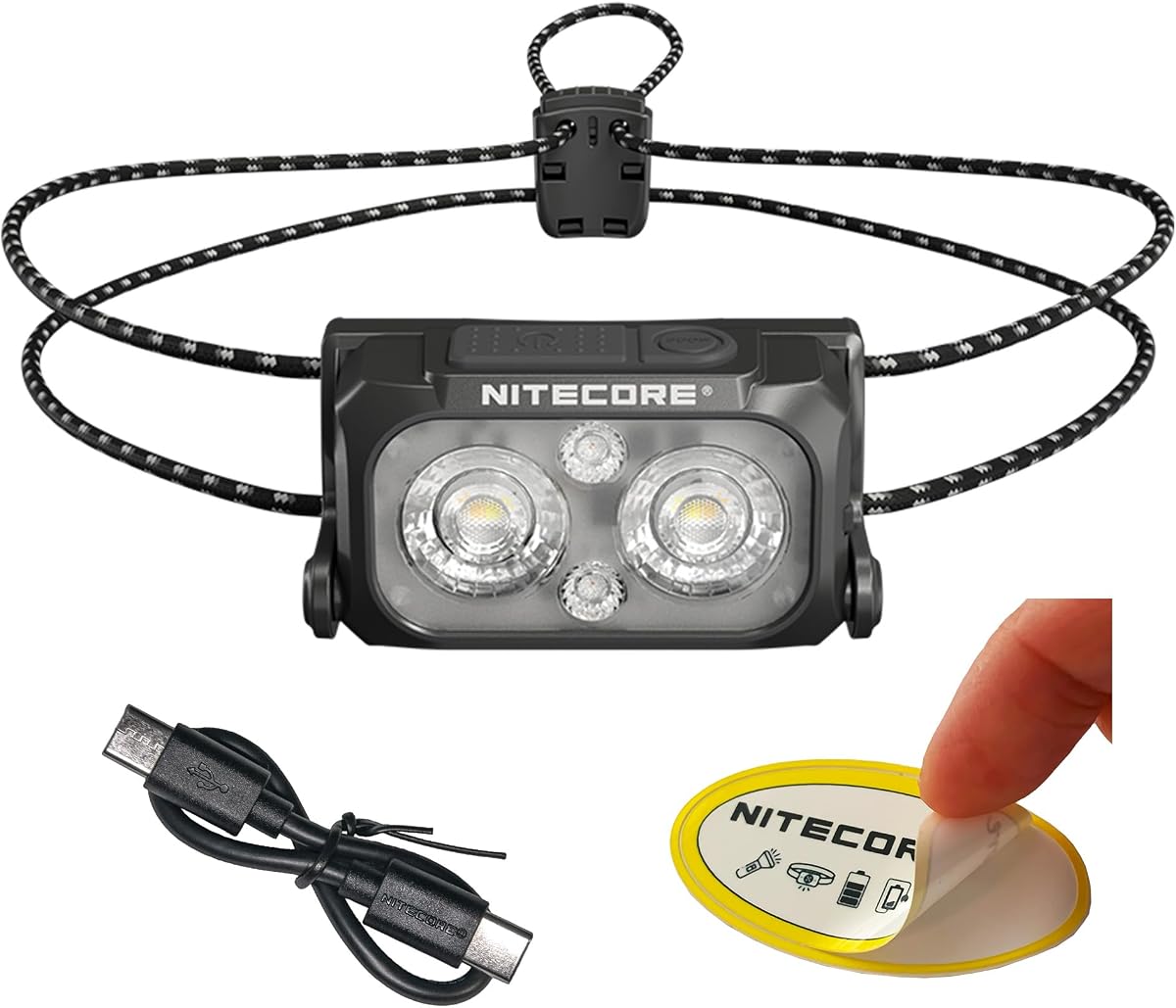
The Nitecore NU25 MCT UL is the ultralight choice in this guide, weighing just 1.65 ounces and carrying a supplied rating of 4.7 out of 5. It provides up to 400 lumens and a maximum beam distance of 144 yards, making it most appropriate for compact cave trips, hiking routes, camping, and situations where carrying weight matters more than maximum brightness.
We may earn a commission when you buy through this link, at no additional cost to you.
Its defining feature is color-temperature selection. Warm light is easier on the eyes and useful in fog or rain, neutral light produces a more natural view for daily tasks, and cool white can improve outdoor contrast. The lamp also provides four main outputs, SOS, a beacon, and an auxiliary red light with three outputs. This makes it a flexible general-purpose light even though its maximum output is the lowest in the roundup.
USB-C charging takes just over one hour, and runtime is stated at up to 45 hours. A power indicator helps users track charge state, while the included diffusing stuff sack, bracket, headband, cable, and sticker make it easy to organize in a pack. The polycarbonate body has an IP66 rating and impact resistance up to one meter, which is suitable for rain and typical cave conditions but not equivalent to the deeper protection of IP67 or IP68 models.
The NU25 MCT UL is a compelling recommendation for fast-moving cavers, backpackers, and travelers who want minimal weight. Color selection and the auxiliary red mode are especially useful for changing conditions and campsite breaks. It is less appropriate for wide chambers, muddy routes, or trips where group members need maximum reach from every headlamp, but it delivers specialized utility in a remarkably compact format.
At 1.65 ounces, the NU25 MCT UL places a low burden on the head and in a small cave pack. It is well suited to travelers who measure gear by every gram.
Warm, neutral, and cool white output can make a substantial difference in changing environments. Warm light is easier on the eyes, while cool output can accentuate contrast in outdoor terrain.
We may earn a commission when you buy through this link, at no additional cost to you.
The right caving headlamp balances illumination, protection, endurance, fit, and control. Because underground conditions are unpredictable, consider how the light will perform in wet passages, narrow crawlways, large chambers, and long-duration trips before choosing a model.
Maximum lumens describe the lamp's brightest setting, but raw output is only one part of underground performance. Beam distance helps indicate how far a focused beam can carry, while a flood beam is equally important for revealing nearby walls, floor texture, and obstacles. High-output models such as the OLIGHT Perun 3 and Fenix HM71R can be useful in large chambers, whereas lower-output lamps may be more appropriate for close passages and ultralight travel. Choose based on the size of the spaces you expect to explore rather than assuming that the brightest specification is always necessary.
Cave routes alternate between long corridors, tight squeeze passages, sloping floors, and open chambers. A good spot beam can reveal distant route features, while a wide flood beam illuminates the immediate surroundings and helps with balance and foot placement. Twist-focus systems, rotating lenses, and separate spotlight and floodlight controls each offer different ways to manage this transition. Look for controls that remain easy to operate with gloves on and that do not require navigating a complicated menu when the light is being used quickly.
Caves often contain dripping water, streams, wet clay, and narrow rock surfaces. IP54 products offer water resistance but are not designed for full submersion; IP66 adds stronger water protection, while IP67 and IP68 models are better suited to wet passages and complete submersion conditions. Impact resistance is also important because headlamps can be knocked against rock, crawls, and equipment. Review the stated rating carefully and avoid assuming that a product marketed for outdoor use is automatically appropriate for a flooded cave.
Long cave trips require dependable power, and maximum-lumen output drains batteries much faster than the headline runtime suggests. Compare runtime at lower levels, not only the maximum specification. Rechargeable integrated batteries are convenient and often support USB-C charging, while removable cells provide field redundancy. Dual-power designs offer the strongest flexibility by allowing rechargeable and compatible disposable batteries. Whichever system you choose, carry a planned backup for long routes and recharge whenever the expedition provides a safe opportunity.
Red light can help preserve night adaptation during rest stops, camp tasks, and quieter moments in a cave. It can also make the wearer easier for companions to see. Some models add a white strobe, an SOS pattern, or a beacon, while others provide adjustable red brightness. These features are not substitutes for primary route lighting, but they improve control around groups and reduce the need to switch to a completely separate signaling device. For group trips, a simple red mode is often more useful than a complicated suite of extra colors.
A caving headlamp may be worn continuously during long descents, crawls, and waits at a camp. Weight, headband width, breathability, adjustability, and the stability of the light housing all affect comfort. Compact lamps such as the Nitecore NU25 MCT UL minimize bulk, while wide industrial-style bands may distribute pressure more comfortably. Users who also wear helmets should look for a stable profile and consider whether the headband or attachment method works with their protective equipment. A secure fit is particularly important when climbing or moving through narrow passages.
A removable lamp body can function as a handheld flashlight, inspection light, or right-angle task lamp. Magnetic bases and clips are useful for illuminating a wall, checking a route, or keeping light out of another person's eyes. Pocket and hat clips can provide downward illumination when a headband is inconvenient. These mounting options increase versatility, but they also mean the headband and lamp may separate if straps are not secured correctly. Check the attachment mechanism and consider the orientation required for the tasks you expect to perform underground.
A caving headlamp should be operable without looking at it. Large buttons, a top switch, mechanical zoom, or a straightforward twist-focus system can all work well. Dedicated controls reduce menu navigation, while lockout prevents accidental activation in a pack. Glove-friendly switches are especially useful in cold caves and during rigging. A simple interface also matters when the lamp is clipped to a helmet or used one-handed, because users should be able to change brightness and beam pattern quickly under changing conditions.
Before entering a cave, install or fully charge the battery according to the manufacturer's instructions, inspect the headband and housing, and test every brightness, beam, red, and signaling mode. Confirm that the lamp is securely attached to your head or helmet and adjust the strap so it cannot rotate or slip. If your route may include water, check the stated ingress rating and ensure every port or compartment cover is properly closed before exposure to spray or submersion.
Use the lowest output that provides a safe view, increasing brightness for large chambers, route confirmation, and detailed inspection. Begin with a spot beam to see farther, then use flood illumination to check the surrounding floor, walls, ceiling, and nearby obstacles. Avoid pointing high output directly into other cavers' eyes, and use red light or the dimmest usable mode during breaks when preserving night adaptation is important. A detachable or magnetic body can be aimed at a wall or formation for close inspection without shining directly toward companions.
After the trip, switch the headlamp off and follow any lockout procedure before storage. Remove dirt, mud, and moisture from the housing and headband, then allow the lamp to dry in a ventilated location. Do not charge a wet light unless the manufacturer explicitly permits it. Check the charging contacts, cable, and ports for debris, recharge the lamp according to its instructions, and store it with an appropriate battery level for the next trip. Replace damaged straps or cracked components before returning the lamp to service.
The right output depends on the size and complexity of the cave. A 400- to 700-lumen model can cover many ordinary passages, while 1200 lumens or more provides additional reach and visibility in large chambers. Beam control, runtime, and water protection often matter more than the maximum number alone. A versatile setup with both spot and flood modes is usually more useful than a very bright lamp that cannot sustain its output.
It is strongly recommended because caves frequently contain dripping water, wet floors, streams, and spray. Models rated IP67 or IP68 offer more comprehensive protection than IP54 or IP66 designs. A suitable rating does not replace careful handling, so users should still close ports, inspect the housing, and avoid charging a wet lamp unless the manufacturer allows it.
A red mode is useful for preserving night adaptation during rest periods and for helping companions locate the wearer in darkness. It is especially valuable in group expeditions and sensitive cave environments. Red light should supplement rather than replace the main beam, because detailed route navigation and obstacle recognition are generally easier with white light.
Rechargeable models are convenient for repeated trips and often recharge through USB-C, while removable batteries make it easy to carry spares. Integrated batteries reduce loose parts, whereas dual-power models offer the most flexible approach. For long or remote trips, the best choice depends on your charging opportunities, access to compatible cells, and the backup plan that fits the expedition.
A combination of flood and spot light is ideal. Flood illumination reveals nearby walls, floor texture, and obstacles, while a focused spot helps identify the direction of the passage. Lamps with an accessible twist-focus or zoom control let users respond quickly as passage dimensions change. For very tight crawls, a lower-output flood setting may be easier on the eyes and more practical than maximum brightness.
Lockout is especially useful when a headlamp is carried in a pack alongside other equipment or when the light may brush against objects during a crawl. It prevents unintended illumination, conserves battery life, and avoids drawing attention to the group. It is particularly helpful on long expeditions where small power savings and equipment discipline become meaningful.
Most of the models in this guide also support climbing, hiking, camping, or work because they offer durable construction, adjustable mounting, and multiple lighting modes. A stable headband, low profile, and glove-friendly controls are important when combined with a climbing helmet. Choose a model whose fit and protection rating suit the environment, and keep a separate backup light in remote trips.
A backup is prudent for long or remote cave trips, even if the main headlamp has a long stated runtime. A small second light, spare batteries, and a reliable charging method can protect the group if the primary lamp fails, gets wet, or loses its charge. The backup should be familiar enough to operate in darkness and kept accessible rather than buried in the bottom of a pack.
The Fenix HM60R V2.0 is the most balanced overall choice because it combines focused and wide beams, red illumination, fast USB-C charging, solid environmental protection, and a relatively compact 6.1-ounce design. The Coast XPH30R stands out for simple twist-focus operation, detachable magnetic use, and a lower 4.37-ounce weight, while the high-output OLIGHT Perun 3 offers the strongest performance ceiling with advanced proximity sensing and IP68 protection.
Prioritize the conditions you will actually encounter rather than selecting solely on maximum lumens. Tight passages call for controlled flood illumination, large chambers reward reach and high output, wet routes favor IP67 or IP68 protection, and long expeditions demand realistic runtime and a solid backup plan. Comfort and simple controls matter just as much because a capable light is only useful when it can be operated quickly and worn consistently.
Ratings, product features, and availability can change, and current prices vary across retailers and over time. Check the latest listing, verify the specifications that matter to your route, and confirm what is included with the lamp before purchasing. With the right balance of beam control, protection, power management, and fit, one of these headlamps can form the foundation of a dependable caving lighting kit.