
AHT30 Temperature Humidity Module
5.0Editor score
I2C digital communication
0.01°C temperature resolution
2–5.5V operating range
Our Arduino Temperature Sensor guide compares ten digital probes for accuracy, range, voltage, humidity support, interface, and Arduino compatibility.
Arduino temperature projects can range from simple room monitors to greenhouse controllers, aquarium thermometers, equipment monitoring, and automated climate controls. A useful sensor must fit the enclosure, communicate cleanly with the board, and provide readings appropriate for the environment rather than simply offering attractive specifications.
The ten products in this guide were compared by examining their stated measurement ranges, accuracy, operating voltage, communication interfaces, included components, environmental suitability, and Arduino compatibility. The list covers single-wire DHT modules, I2C humidity sensors, and waterproof DS18B20 probes for indoor, outdoor, and wet-location projects.
Each review explains the sensor's strongest benefits, practical limitations, and best-fit projects, while the comparison table highlights the differences between protocols and measurement capabilities. Product ratings and availability can change, so readers should verify current listings and confirm that the electrical specifications match their project before purchasing.
5.0Editor score

4.7Editor score

4.5Editor score
This side-by-side comparison organizes the ten sensors by sensing capability, measurement range, communication method, voltage, and practical project suitability.




The HiLetgo DHT11 five-pack combines a familiar single-wire digital sensor with five ready-to-connect modules, making it a practical starting point for Arduino temperature and humidity projects. It holds a 4.5 rating, and its standout quality is the balance between useful environmental sensing, straightforward wiring, and a generous bundle of components.
We may earn a commission when you buy through this link, at no additional cost to you.
Each module combines a DHT11 sensing element with an onboard pull-up resistor and bypass capacitor. The stated operating range is 3.3 to 5.5 volts, which suits common Arduino boards, while the single-bus output reduces the number of required connections to power, ground, and data. Five modules and five cables make it especially useful for distributed monitoring, classroom demonstrations, or comparisons between locations.
The trade-offs are the relatively narrow 0–50°C temperature range and stated accuracies of approximately 2°C and 5% relative humidity. The provided information also describes a 20–90% relative-humidity measurement range, so this is not the option for demanding industrial sensing or extreme-temperature monitoring. DHT11 readings can also be relatively coarse, making it better suited to simple displays and basic controls than precision applications.
Choose this bundle for home monitoring, weather stations, greenhouse experiments, or classroom builds where a straightforward Arduino library and minimal wiring are priorities. It is less appropriate when fine temperature resolution, wide environmental range, or fast repeated measurements are essential. For a beginner-friendly multipack with both temperature and humidity capability, it remains a sensible, flexible choice.
The three-wire arrangement and included cables reduce setup time, while the onboard support components help the module function as a compact unit. It is particularly useful when a project should be assembled before extensive breadboard wiring is planned.
Adding relative humidity to a temperature-only project can improve alerts and environmental context. The DHT11 is best for general conditions rather than calibrated laboratory measurements or precision climate-control decisions.
We may earn a commission when you buy through this link, at no additional cost to you.
The AHT30 two-pack is a compact I2C temperature and humidity option with a 5.0 rating, broad environmental range, and fine stated resolution. It stands out for projects that want more informative readings than a basic DHT11 module without moving to a long waterproof probe.
We may earn a commission when you buy through this link, at no additional cost to you.
Its listed specifications cover a temperature range of −40 to 85°C, a humidity range of 0–100% relative humidity, temperature accuracy of ±0.3°C, and humidity accuracy of ±2% at 25°C. Temperature resolution is stated at 0.01°C, while humidity resolution is 0.024% relative humidity. The 2.0–5.5-volt supply range also gives it flexibility across 3.3-volt and 5-volt Arduino environments.
I2C is the main complication. The module shares a communication bus with other compatible devices, so the sketch must use the correct library and address. Multiple I2C devices can coexist, but address conflicts need to be resolved, and the four-pin connection offers less simplicity than the three-wire DHT interface. A common beginner mistake is wiring the data and clock lines incorrectly, so the board labels should be checked carefully.
This pair is well suited to indoor climate displays, smart shelves, plant-monitoring stations, and compact environmental loggers. It is also a good candidate for a project with several I2C peripherals because the bus can support multiple devices. Choose it when resolution, operating-voltage flexibility, and compact dual sensing outweigh the extra protocol considerations.
The stated 0.01°C resolution is useful when a display or data logger needs more granular temperature changes. Actual precision still depends on the sensor, wiring, power quality, and the environment around the module.
I2C keeps wiring tidy and permits several compatible sensors to share communication lines. Ensure the Arduino library supports the AHT30 and that every device on the bus has a unique address.
We may earn a commission when you buy through this link, at no additional cost to you.
The Teyleten SHT31 three-pack combines strong stated accuracy with one of the broadest temperature ranges in this guide. Its 4.7 rating reflects a well-rounded specification set for Arduino users who need both temperature and humidity data from compact digital modules.
We may earn a commission when you buy through this link, at no additional cost to you.
The listed measurement range extends from −40 to 125°C for temperature and from 0 to 100% relative humidity for humidity. Stated accuracy reaches ±0.3°C and ±2% relative humidity, while the 2.4–5.5-volt operating range supports common Arduino power arrangements. Each module communicates through I2C, allowing compatible devices to share a bus and making the format familiar to experienced makers.
The shared-bus design introduces a small learning curve. Users need a compatible SHT31 library and must account for the sensor's I2C address when multiple modules are connected. These are board-level sensors rather than waterproof probes, so exposure to condensation, splashing, or direct outdoor weather is not appropriate without a suitable protective enclosure.
The three-module quantity is valuable for distributed room sensing, comparative experiments, or a multi-node environmental network. This is a strong all-around choice for indoor monitoring, controlled test chambers, HVAC experiments, and educational projects that benefit from a broad measurement range. It is less suitable for submerged or exposed wet locations, where a DS18B20 probe would be a better fit.
A −40 to 125°C range creates room for cold-storage, heated-equipment, and environmental experiments. The module still needs protection from moisture and appropriate thermal coupling to the object being measured.
Having three identical units makes side-by-side comparisons easier and reduces differences caused by using sensors from different batches. Place each one in a controlled location and use consistent wiring and sampling methods.
We may earn a commission when you buy through this link, at no additional cost to you.
The Gikfun DS18B20 three-pack is built for temperature measurements where the sensing point must sit away from the Arduino board. It carries a 4.4 rating and pairs one-meter waterproof probes with adapter modules, making it a common choice for tanks, cabinets, pipes, and machinery.
We may earn a commission when you buy through this link, at no additional cost to you.
Each DS18B20 offers a stated measurement range of −55 to 125°C and works with a 3.3- to 5-volt supply. The probe uses red for power, yellow for data, and black for ground. An adapter board includes a pull-up resistor, which simplifies connection to many microcontrollers, although the source data still recommends understanding resistor placement for reliable testing.
The waterproof probe protects the sensor in moist environments, but the lead itself has a maximum stated temperature rating of 85°C. This distinction matters: the sensing range does not mean every part of the cable can safely tolerate the maximum reading. The probe should also be thermally coupled to the target rather than merely surrounded by air if the goal is an accurate object or liquid temperature.
This bundle fits aquarium monitoring, greenhouse sensing, refrigerator tests, temperature-controlled equipment, and embedded industrial-style projects. Choose it when a long, moisture-resistant probe and adapter convenience matter more than humidity output. For a dry indoor display, a smaller board sensor may be easier to mount, but for remote or wet sensing points, these probes offer clear advantages.
The extended cable allows the Arduino to remain in a dry, accessible enclosure while the probe reaches into a tank, cabinet, or equipment compartment. Route the lead away from sharp edges and hot surfaces.
The included adapters provide a convenient path from probe leads to a microcontroller. Confirm that the data pull-up arrangement is suitable for the board and cable length before running long-term measurements.
We may earn a commission when you buy through this link, at no additional cost to you.
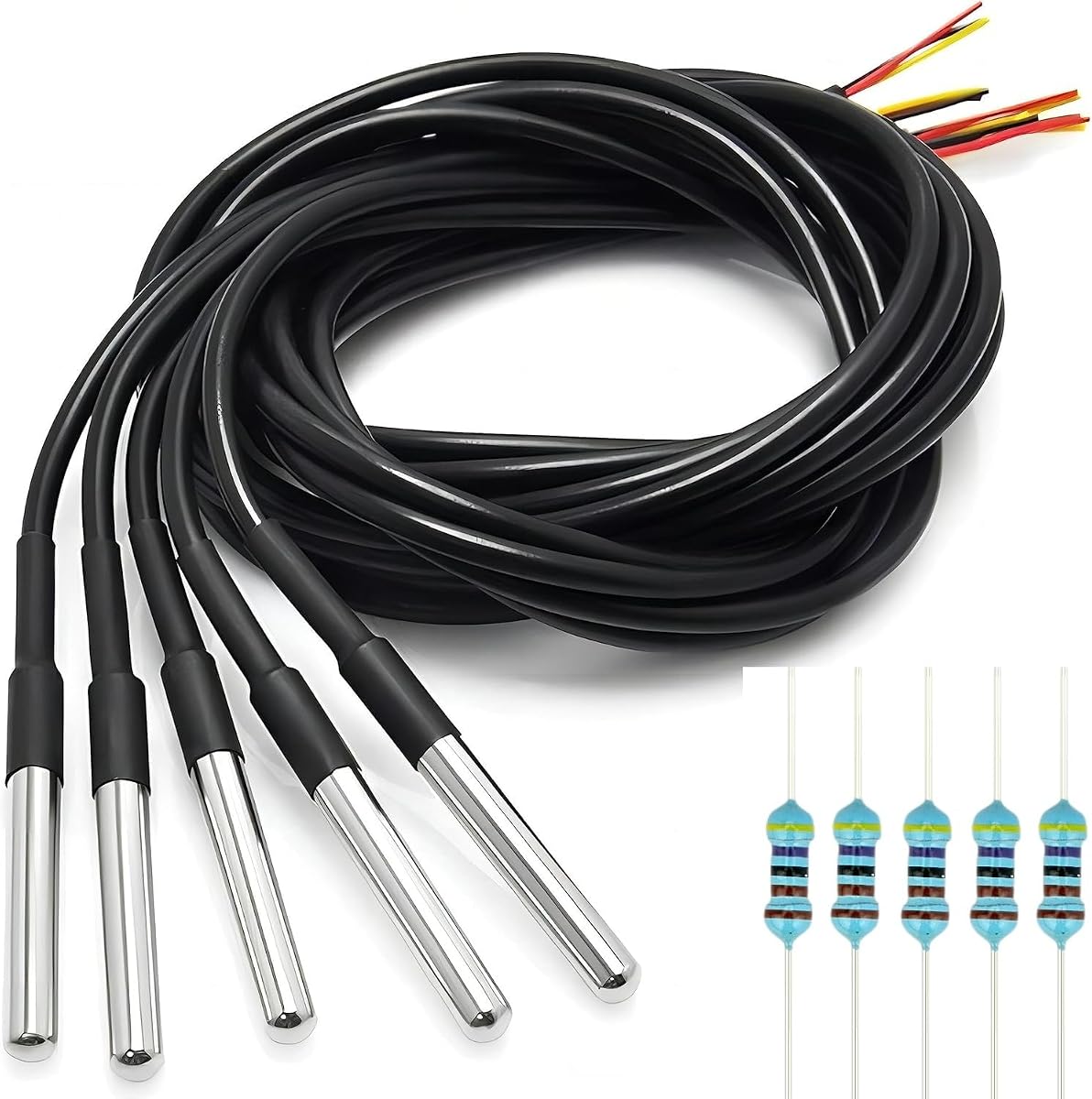
The WWZMDiB DS18B20 five-pack is a well-equipped starter option for projects that need several temperature points. It has a 4.4 rating and includes five waterproof probes along with five 4.7K resistors, reducing the need to source small supporting components separately.
We may earn a commission when you buy through this link, at no additional cost to you.
Each probe uses the familiar DS18B20 measurement range of −55 to +125°C with stated accuracy of ±0.5°C. The listed supply range is 3–5.25V, and the color-coded connections are red for VCC, yellow for data, and black for ground. The stated compatibility includes Arduino, Raspberry Pi, ESP32, and STM boards, although the required library and pull-up arrangement depend on the platform.
The main limitation is that this is a temperature-only solution. It cannot replace a humidity sensor for a weather station, bathroom monitor, or soil environment where both measurements are needed. A single data bus can also make address management and wiring more complicated when several probes are installed. Long cables and numerous branches may require attention to signal integrity and power quality.
Choose this kit for multi-point temperature logging, freezer or greenhouse experiments, classroom exercises, and projects that will need several probes over time. The included resistors make it especially convenient for beginners who already know the standard 1-Wire arrangement. A single probe could be sufficient for a basic display, but the five-pack adds flexibility for comparisons and distributed installations.
Five matching probes and five pull-up resistors make it easier to plan a multi-location project without improvised wiring. Keep each 1-Wire branch organized and verify that every sensor is detected before finalizing the installation.
The probe housing is designed for wet or moist environments, making it useful in tanks and outdoor installations. The Arduino itself should remain protected, and cable joints should be kept above standing water where possible.
We may earn a commission when you buy through this link, at no additional cost to you.
The DHT11 two-pack is a straightforward environmental sensor for Arduino projects that want both temperature and relative humidity without a separate probe. Its 4.3 rating reflects a simple, familiar design, and the included wires make the modules approachable for first-time builders.
We may earn a commission when you buy through this link, at no additional cost to you.
The module outputs a digital signal over a single-wire connection and operates from 3.3 to 5 volts. Its stated temperature range is 0–50°C, while humidity covers 20–95% relative humidity with an error of about 5%. Temperature accuracy is stated at approximately 2°C. A dedicated microcontroller and calibrated sensing technology are integrated into the module, allowing the Arduino to read complete values rather than calculate raw analog levels.
The primary compromise is measurement quality. The relatively broad steps and modest accuracy make the DHT11 appropriate for general awareness, simple thresholds, and educational demonstrations, but not precision environmental control. Repeated reads should also be spaced appropriately in the sketch because these sensors are not intended for rapid, high-frequency temperature profiling.
This pair works well for classroom weather stations, simple thermostat demonstrations, room-condition displays, and beginner projects that need an uncomplicated library. It can also serve as a temporary or noncritical environmental indicator. For tighter accuracy, finer resolution, lower-voltage operation, or wider temperature coverage, an AHT30 or SHT31 module is the more capable choice.
The digital output and straightforward pin arrangement reduce the difficulty of first-time temperature and humidity projects. The Arduino reads both values through the same data connection.
The DHT11 is useful when the goal is to display room conditions or trigger a broad alert. Avoid treating its readings as laboratory-grade measurements or using them to regulate equipment that requires tight tolerances.
We may earn a commission when you buy through this link, at no additional cost to you.
The DROK two-pack combines stainless steel DS18B20 probes with adapter boards, jumper wires, and 4.7K resistors. It has a 4.9 rating and presents a polished option for builders who want a complete temperature-probing setup rather than a bare sensor and separate support parts.
We may earn a commission when you buy through this link, at no additional cost to you.
The probes use a corrosion-resistant stainless steel housing with thermally conductive sealant and are described as suitable for continuous submersion and harsh conditions. Their stated measurement range is −55 to 125°C with ±0.5°C accuracy. A 3.0- to 5.5-volt operating range covers common Arduino boards, while red, yellow, and black leads identify power, data, and ground.
The adapter includes an integrated pull-up resistor, allowing direct connection to a Raspberry Pi GPIO without a separate resistor on some arrangements. The instructions nevertheless recommend a 4.7K resistor between data and power for optimal stability, so the supplied components allow users to choose or verify the correct setup. As with every 1-Wire installation, address management and wire length deserve attention.
Choose this kit for continuous wet-environment monitoring, such as aquarium temperature controls, industrial-style test rigs, outdoor cabinets, or embedded equipment. The complete bundle is convenient for building two stations without gathering additional pieces. It does not provide humidity data, and the probe must be connected to a supported 1-Wire library on the chosen microcontroller.
The metal housing and sealing approach make the probe a better fit for moisture, splashing, and demanding installations than an exposed plastic sensor. Secure the cable and protect connections from abrasion and prolonged submersion where needed.
Two probes, two adapters, jumper wires, and resistors support a dual-location installation. Keeping both channels on a clean 1-Wire layout can simplify addressing and troubleshooting.
We may earn a commission when you buy through this link, at no additional cost to you.
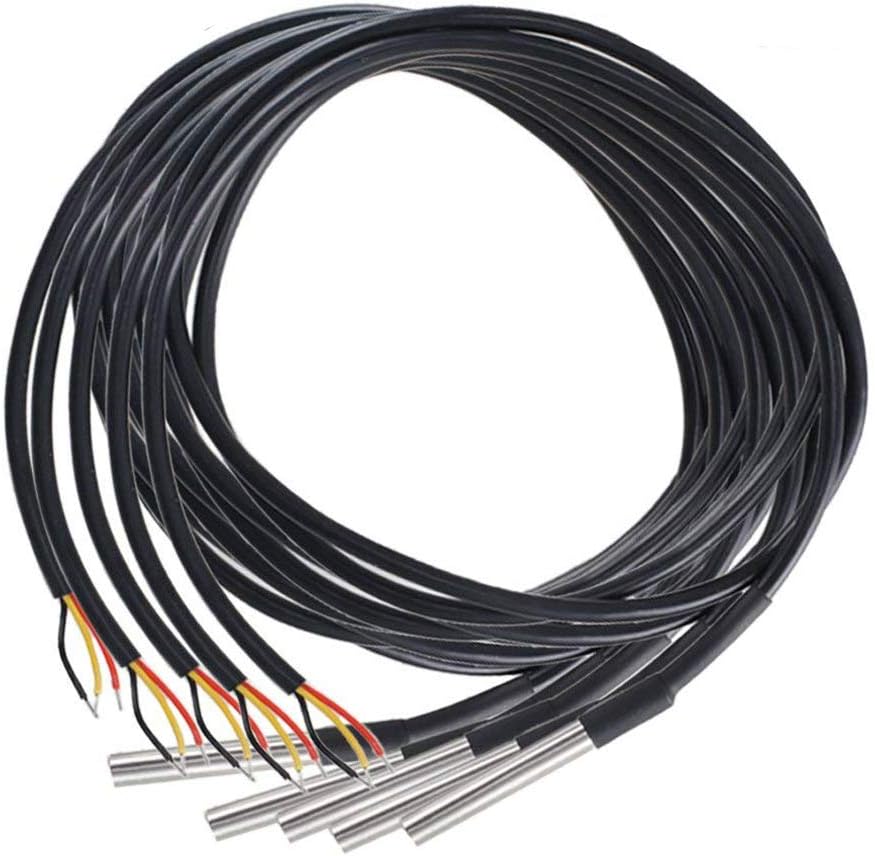
The Gikfun five-pack offers five one-meter DS18B20 probes for distributed Arduino temperature projects. It has a 4.5 rating and is a flexible choice for makers who need several remotely positioned sensing points with a consistent interface.
We may earn a commission when you buy through this link, at no additional cost to you.
The listed power supply range is 3.0–5.5V, and the probes use red for VCC, yellow for data, and black for ground. Their single-bus interface allows compatible sensors to share a data line when the wiring and pull-up arrangement are correct. The approximately one-meter cables offer useful placement flexibility, while the five matching units support room, appliance, and outdoor comparisons.
Unlike bundles that include adapters or resistors, this one lists no other components. A 4.7K resistor between the data and VCC lines is specifically recommended to make probe testing easier, so that part must be sourced separately if the board does not already provide an appropriate pull-up. Multi-probe layouts also require unique addresses, and very long or poorly branched buses can become less reliable.
Choose this product for multi-point logging, greenhouse sensing, temperature comparison exercises, and projects with several enclosed compartments. It is a temperature-only solution, so humidity requirements call for a different module. It is most attractive to users comfortable with basic resistor placement and 1-Wire wiring rather than beginners seeking an all-in-one adapter bundle.
The one-meter leads let each probe reach a different location while the Arduino remains in a central enclosure. Use separate branches where possible and label the sensors for easier data interpretation.
A suitable 4.7K pull-up between data and power supports the recommended 1-Wire arrangement. Confirm the board's existing components before adding a duplicate that could change the effective resistance.
We may earn a commission when you buy through this link, at no additional cost to you.
The HiLetgo DHT22/AM2302 two-pack is a step up from basic DHT11-style sensing, offering a wider temperature range and tighter stated accuracy. Its 4.4 rating makes it a familiar middle ground for Arduino users who need both environmental measurements.
We may earn a commission when you buy through this link, at no additional cost to you.
The main chip is identified as an AOSONG AM2302, and the module provides a single-bus digital signal with bidirectional serial data. The listed temperature range is −40 to 80°C, with ±0.5°C accuracy. Humidity covers 0–100% relative humidity with stated accuracy of ±2%. A fixing hole is included, which helps with stable mounting in an enclosure or near a controlled airflow path.
As with other single-bus environmental sensors, correct pull-up support and library configuration are essential. These modules are intended for periodic environmental readings rather than high-rate temperature profiling. Readings can also change with placement, nearby heat sources, airflow, and condensation, so the sensor should be positioned away from processors, power regulators, and direct sunlight.
Choose this product for indoor climate monitoring, weather-related demonstrations, controlled greenhouses, and Arduino projects that need a straightforward digital interface. It is more capable than a basic DHT11 for wider and more accurate conditions, but the AHT30 and SHT31 alternatives offer finer stated resolution and I2C bus flexibility.
The stated ±0.5°C temperature accuracy makes the AM2302 appropriate for more useful condition monitoring. Placement and stable power remain important because environmental influences can still affect the readings.
The fixing hole supports a stable position away from electronics that generate heat. Consistent mounting also makes comparisons between different units and locations more meaningful.
We may earn a commission when you buy through this link, at no additional cost to you.
The HiLetgo DS18B20 five-pack provides five waterproof, stainless steel temperature probes with one-meter cables. Its 4.5 rating makes it a strong option for multi-point Arduino installations that need temperature readings in wet or inaccessible locations.
We may earn a commission when you buy through this link, at no additional cost to you.
The stated measurement range is −55 to 125°C, and the operating supply is 3.0–5.5V. Red identifies VCC, yellow carries the data signal, and black is ground. The stainless steel package is described as waterproof, allowing the sensing section to be placed in tanks, outdoor cabinets, or other damp environments while the controller remains safely indoors.
The probes use a one-wire-style single-bus interface, so one Arduino can read multiple sensors when addresses are handled correctly. A 4.7K resistor between data and power is recommended to make testing easier, and it is not listed as part of this bundle. The five long leads can also create a large wiring network, so careful routing and organization are important.
Choose this product for aquariums, greenhouse monitoring, refrigeration experiments, temperature-controlled machinery, and educational projects that need several probes. It is less suitable when humidity data is required or when a compact exposed board sensor would be easier to mount. For repeated wet-location readings, it offers a practical combination of probe length, quantity, and protection.
The waterproof stainless steel sensing section can tolerate moist environments while keeping the electronics separate. Seal exposed connections and verify the enclosure rating before using the probe outdoors.
Five probes allow a controller to monitor several tanks, shelves, pipes, or equipment positions. Maintain consistent address handling and read intervals so every channel remains easy to interpret.
We may earn a commission when you buy through this link, at no additional cost to you.
The right Arduino temperature sensor depends on the measured environment, required precision, communication protocol, power supply, physical installation, and whether the project also needs humidity data.
Begin by deciding which variables the project must measure. DS18B20 models are temperature-only sensors designed around a probe format, while DHT11, DHT22/AM2302, AHT30, and SHT31 modules measure relative humidity as well. Adding humidity can improve context for a room, greenhouse, aquarium, or weather display, but it also brings more calibration, placement, and library considerations than a simple temperature probe.
Choose a temperature-only DS18B20 when the sensing point may be wet, remote, or surrounded by equipment. Choose a digital temperature-and-humidity module when indoor air conditions and a compact board are the priority.
Compare the stated range with the temperatures the sensor will actually encounter. The DHT11's 0–50°C range is narrow, while the DS18B20 family extends from −55 to 125°C and the SHT31 module is listed up to 125°C. Accuracy matters when a reading controls a fan, heater, alarm, or product; wider ranges and finer stated accuracy are generally more useful than headline resolution alone.
Select a sensor whose normal operating region sits comfortably inside its stated range. Do not confuse resolution with accuracy, and account for cable and housing temperature limits.
The communication interface determines wiring complexity, library requirements, and how easily additional sensors can be added. Single-bus DHT modules use one data line and are intuitive for basic projects. DS18B20 probes also use a 1-Wire-style bus and can share a data line when addresses and pull-up support are configured correctly. I2C modules use clock and data lines and can be especially convenient in systems that already contain other I2C peripherals.
Choose the protocol your Arduino library supports and the one that best matches the project's wiring plan. For several I2C sensors, check address conflicts; for several 1-Wire probes, plan the bus and pull-up arrangement.
Supply voltage must remain within the sensor's stated operating range. Products in this guide cover combinations including 2–5.5V, 2.4–5.5V, 3–5.25V, and 3.3–5V, allowing use with many 5V and 3.3V Arduino boards. However, a sensor accepting 5 volts does not guarantee that every data line is safe for a 3.3-volt microcontroller.
Confirm the board voltage, the sensor's permitted range, and any level-shifting requirements. Use a regulated supply and avoid connecting the data line to an unsupported voltage.
Board modules are convenient indoors but generally need an enclosure when exposed to moisture, dust, condensation, or direct weather. Waterproof DS18B20 probes place the sensing element in a sealed metal housing, making them more suitable for tanks, damp cabinets, and outdoor installations. Their cables, seals, and connections still require care, and the Arduino should remain in a dry enclosure.
Choose a probe when the sensing point is separated from the controller or exposed to wet conditions. Choose a compact module when the sensor can remain inside a protected indoor enclosure.
The number of sensors in a package can materially affect project design. Five-module bundles suit multi-location monitoring, classroom exercises, and comparison tests, while two-module packs are convenient for a small installation. Some DS18B20 bundles include adapter boards, jumper wires, and 4.7K resistors, whereas others require those parts to be sourced separately.
Choose a bundle that matches the number of sensing points and the hardware already in the workshop. For first-time builders, included adapters and resistors can reduce early assembly errors, even if a single module would otherwise be enough.
A project that displays a room temperature every few seconds has different requirements from one measuring rapid temperature changes in moving equipment. Environmental modules and DS18B20 probes are generally better for periodic measurements than for high-frequency thermal analysis. The sketch should include sensible delays and should not request readings faster than the chosen sensor and library support comfortably.
Use periodic readings for rooms, weather stations, and water tanks. For fast-response control or thermal profiling, investigate specialized sensors designed for those tasks instead of assuming every Arduino module can sample rapidly.
A sensor is only as usable as the software available for it. DHT11 and DS18B20 devices have widely established Arduino library workflows, while AHT30 and SHT31 boards require the appropriate manufacturer-compatible or community library. Confirm the imported class name, supported board, voltage assumptions, and example sketch before assembling a permanent enclosure.
Prefer a sensor with maintained library examples and familiar addressing behavior. After wiring, verify that the Arduino reports plausible values and that every connected sensor has a unique identity before relying on the data.
Begin by identifying the sensor's pins, protocol, and supply requirements. Connect power and ground to matching Arduino connections, then attach the data, clock, or single-bus line as specified by the module. Confirm the Arduino's logic voltage, install a compatible library, and upload a basic example sketch that prints readings before adding displays, alerts, or automated controls.
For a DS18B20, verify that the bus has an appropriate pull-up resistor and that each sensor receives a unique address. For I2C modules, check the sensor address and make sure no other device uses the same one. For a DHT-style module, allow a sensible interval between reads and avoid placing the board directly beside a hot processor or voltage regulator.
Secure the sensor where it can sense the intended air, liquid, or object, while keeping the Arduino and electrical joints dry. Probe cables should be routed away from sharp edges, excessive heat, and moving parts. Check periodic readings against a trusted reference, inspect seals and connections, and recalibrate or replace a probe if values become implausible or erratic.
A DHT11 module is among the easiest starting points because it measures both temperature and humidity over one data line and works with familiar Arduino libraries. It is best for general indoor awareness rather than precision measurement. A DS18B20 is easier to choose when only temperature is needed and the sensing point must be waterproof or remote.
The DHT11 offers the simplest general-purpose starting point, while the DHT22 provides a wider temperature range and tighter stated temperature accuracy. The AHT30 and SHT31 use I2C and offer fine stated resolution, broad humidity ranges, and useful accuracy figures. Choose based on protocol support, required range, project size, and the importance of precision.
Yes, the waterproof probe housing is suitable for wet environments and is commonly used in aquarium and tank projects. Keep the Arduino dry, protect connections above the waterline where possible, and place the sensing tip in the liquid rather than against the container wall. Verify that the probe's stated range covers the expected water temperature.
Only certain models do. DHT11, DHT22/AM2302, AHT30, and SHT31 products include humidity sensing, whereas the DS18B20 models listed here measure temperature only. Humidity-capable modules are useful for room conditions, weather displays, greenhouses, and similar ambient-air projects, but they still need protection from condensation and direct exposure.
I2C uses separate clock and data lines and supports multiple compatible devices when their addresses do not conflict. Single-bus sensors use one data line and may also support multiple devices through device-specific identification. I2C is tidy for shared buses, while DHT-style wiring can be more familiar for simple standalone projects.
Many DS18B20 1-Wire arrangements benefit from a pull-up resistor, commonly 4.7K, between the data and power lines. Some listed adapter boards already include this component, while some bare-probe bundles do not. Check the board and existing components before adding another resistor, since multiple pull-ups can change the effective resistance.
The Arduino board, voltage regulator, display, and other powered components can emit heat and affect nearby readings. A DS18B20 probe can be moved away from the board, while a small environmental module should be placed in a ventilated or separately mounted enclosure with an airflow path. Consistent placement improves repeatability.
Several of the listed products explicitly mention compatibility with Raspberry Pi, ESP32, or STM boards, while the others use protocols that can also be supported on those platforms. The key requirements are the correct voltage, suitable pull-up or I2C arrangement, and a library compatible with both the sensor and the board's software environment.
The AHT30 two-pack stands out as a compact, high-resolution option with flexible voltage operation, while the Teyleten SHT31 three-pack combines a broad temperature range with strong stated accuracy. The HiLetgo DHT11 five-pack remains an approachable choice for general temperature-and-humidity projects and provides multiple ready-connected modules.
For wet locations, remote sensing points, or long probe leads, the DS18B20 options are more suitable than exposed board modules. Prioritize the protocol your code supports, verify voltage compatibility, and consider accuracy rather than resolution alone. Accessories such as adapter boards and pull-up resistors can make the first build smoother, but they do not replace correct wiring.
Before ordering, review the current listing, documentation, package contents, and electrical specifications, and check the final project environment. Ratings, availability, and product configurations can change, while the most reliable choice is the sensor whose range, interface, construction, and included components align with the installation you actually intend to build.

