
Mdbebbron Foldable Projector Screen
4.5Editor score
Folds for compact transport
Supports front or rear projection
Includes flexible mounting options
Explore the best easy setup projector screen options, comparing size, portability, stand stability, viewing angle, image gain, and outdoor versatility.
An easy setup projector screen should do more than unfold quickly. It needs a stable support system, a viewing surface that suits your projector, and enough portability for moving between a living room, backyard, classroom, or campsite. The right model makes setup feel simple while preserving a stable, immersive image.
This guide compares ten projector screens based on the supplied specifications, including screen dimensions, aspect ratio, gain, viewing angle, stand design, setup method, weight, carrying case, and outdoor stabilization accessories. It covers freestanding tripod models, a stake-down design, and a wall-mountable fabric option for buyers with different spaces.
The selections show how quick assembly varies from a few simple steps to installation in a couple of minutes. They also demonstrate the trade-offs between compact 50-inch screens, flexible 80-inch models, and expansive 100- or 120-inch viewing areas. Product availability and pricing change, so check the current listing before purchasing.
4.5Editor score

4.3Editor score
4.6Editor score
The comparison below organizes the ten screens by design, viewing area, setup method, image characteristics, and included support accessories, making it easier to identify the model that best fits your room and routine.


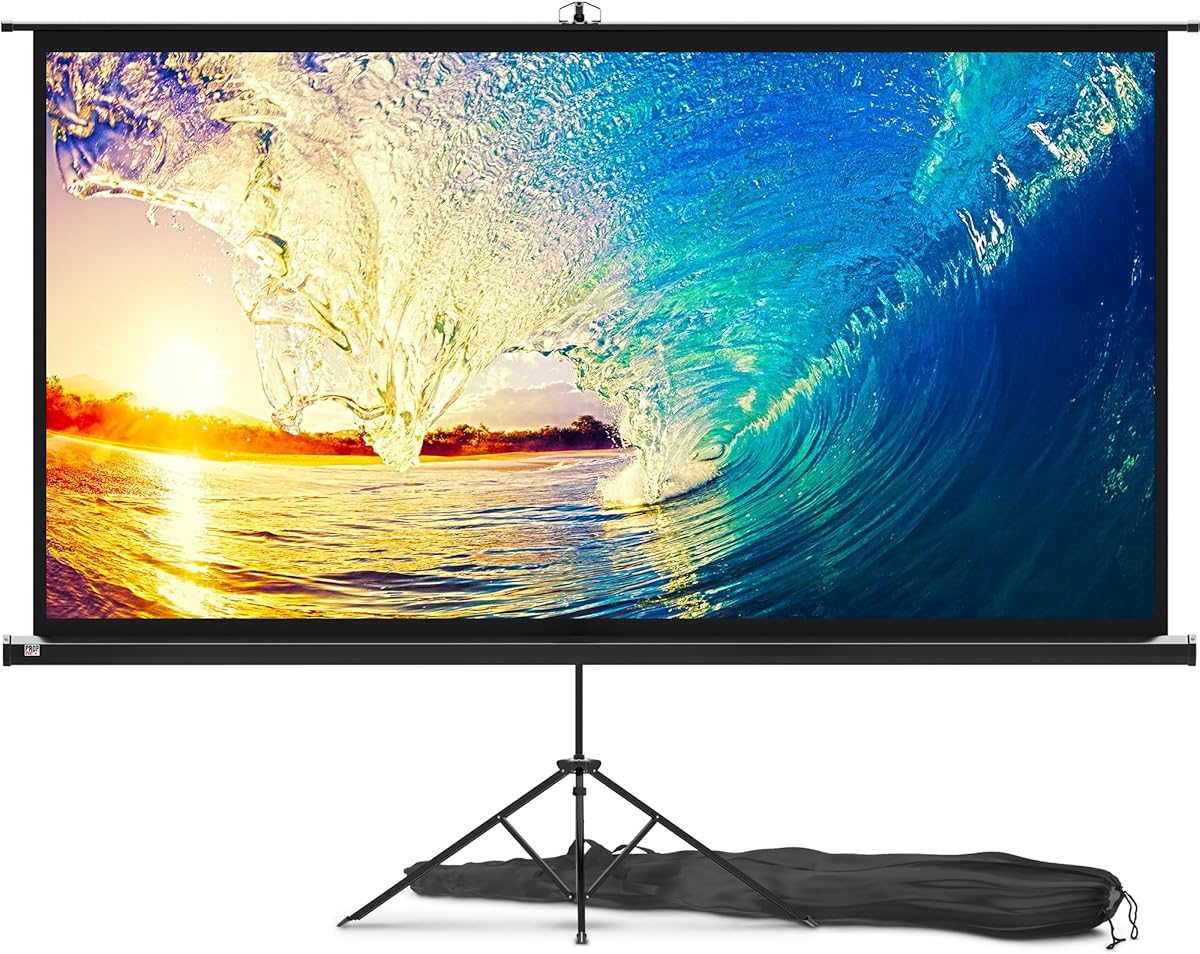


This 120-inch freestanding projector screen combines a broad 16:9 viewing area with a reinforced steel support system. Its supplied 4.4 rating reflects a generally positive reception, while the stand, sandbags, stakes, and ropes make it especially appealing to buyers planning backyard movies, camping, or other outdoor gatherings.
We may earn a commission when you buy through this link, at no additional cost to you.
The screen is described as premium washable milk silk, and its integrated installation is intended to fit closely to the frame and reduce edge wrinkles. A 160-degree viewing angle allows the image to remain shareable across a larger audience, while front and rear projection support adds flexibility when arranging the projector and seating.
Its biggest strength is the complete outdoor support package. Four sandbags, four ground stakes, and ropes help prevent swaying or collapse, while the extended, reinforced base addresses the instability associated with some lightweight stands. The trade-off is the size of the assembled system and the number of components that must be packed and deployed.
This is a strong recommendation for outdoor entertainers who want a large theater-style image without hiring a permanent installation. It is less suitable for small rooms, quick spontaneous use, or anyone who prefers a single compact item. Confirm that the intended location can accommodate the full 120-inch surface and stand footprint.
The reinforced base, steel accessories, sandbags, ground stakes, and wind ropes create several layers of support. This makes the screen better suited to uneven outdoor ground than a basic tripod, provided the stakes can be secured properly.
A 120-inch diagonal offers generous room for movies and shared viewing, yet the screen folds flat and fits into a dedicated bag. That makes repeated use practical, although a vehicle with enough storage space is advisable.
We may earn a commission when you buy through this link, at no additional cost to you.
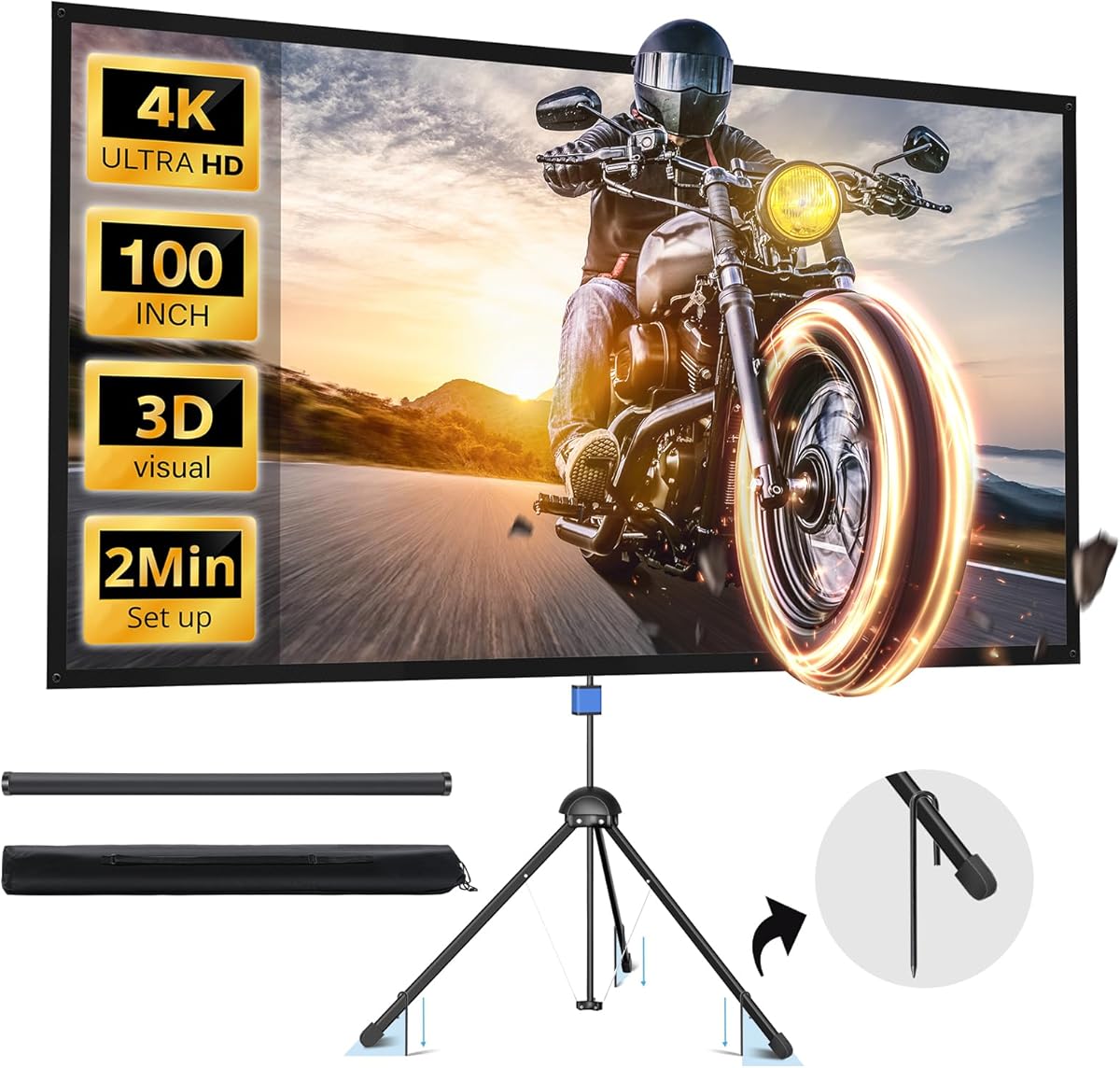
This 80-inch tripod screen balances portability with a familiar 16:9 format and a 1.2 gain fiberglass surface. It carries a supplied 4.5 rating, and its claim of setup within two minutes makes it one of the most approachable options for moving a screen between indoor and outdoor locations.
We may earn a commission when you buy through this link, at no additional cost to you.
Four spring-tension aluminum tubes help keep the viewing surface taut, while the adjustable tripod can be stretched, folded, and positioned to suit the site. A 160-degree viewing angle supports group viewing, and the listed 8.5-pound weight remains manageable for most adults who need to carry it from a vehicle or between rooms.
The primary limitation is its outdoor support system. Unlike several competitors, the supplied information does not mention sandbags, ground stakes, or wind ropes, so extra stabilization may be advisable in exposed locations. Its 80-inch diagonal also offers less impact than a 100- or 120-inch screen for large groups.
Choose this model for home cinema, classrooms, gardens, and backyards where quick deployment and easy carrying matter most. It is a particularly useful middle ground between compact 50-inch screens and larger outdoor systems.
The folding tripod and spring-tension frame reduce the number of separate pieces involved. The stated two-minute setup is ideal for spontaneous movie nights, although all locking points should be checked before projection begins.
The 16:9 aspect ratio matches common widescreen content, while 1.2 gain is designed to support bright, colorful output. It offers a useful compromise between footprint and viewing impact.
We may earn a commission when you buy through this link, at no additional cost to you.
This 100-inch projector screen is designed for movies, presentations, classes, events, and other group activities. With a 4.4 rating, a 16:9 format, and 1.1 gain, it targets buyers who need one screen for both entertainment and professional-looking displays.
We may earn a commission when you buy through this link, at no additional cost to you.
Its retractable, adjustable design assembles in three steps, and the supplied information emphasizes convenient tight-straps and a fitted bag. The tripod has wide legs intended to improve reliability, while the height adjustment makes it easier to align the image with a projector or audience.
The supplied specifications do not describe dedicated sandbags, stakes, or ropes for outdoor stabilization. That means the screen may be more directly suited to protected patios, rooms, schools, and event spaces than exposed locations. Its 100-inch size also demands adequate ceiling height and floor area.
This is a good recommendation for buyers who split their time between movies and presentations or need a large screen for classroom and event use. Choose it when versatility and a familiar widescreen format matter more than the lightest possible packed weight.
The 16:9 surface accommodates movies, sports, video games, and online video, while its adjustability helps support projected slides and demonstrations. That versatility makes it useful beyond a dedicated home theater.
A compact assembly sequence reduces setup time. The included bag and retractable construction also make the screen more practical to move between temporary venues than a permanently mounted display.
We may earn a commission when you buy through this link, at no additional cost to you.
The Pyle 50-inch projector screen uses a familiar pull-up design that removes much of the work associated with assembling a multi-piece frame. It has a supplied 4.3 rating and a 4:3 aspect ratio, making it most suitable for standard presentations, classroom content, and older video formats.
We may earn a commission when you buy through this link, at no additional cost to you.
Its white matte fabric provides a neutral projection surface, while the black masking border helps focus and align the image. The viewing height can range from 25 to 48 inches, offering flexibility for placement on a flat floor or table. The retractable structure also makes storage more convenient.
The main compromise is size. A 50-inch diagonal creates a much more modest image than the 80-, 100-, and 120-inch alternatives, and a 4:3 ratio may leave space around modern widescreen content. Outdoor use is possible, but the supplied information does not identify dedicated anchoring components.
This screen is best for presenters, teachers, travelers, and small-room viewers who value a familiar pull-up mechanism. Choose it when quick operation and compact storage matter more than creating a large theater-style display.
The pull-up format allows the viewing surface and support to rise together. It is intuitive for users who want a screen that can be opened without unfolding a complex external frame.
A black masking border around the white matte surface can improve perceived image focus and alignment. The result is especially useful when the projection environment does not offer a perfectly dark wall.
We may earn a commission when you buy through this link, at no additional cost to you.
The TOWOND 100-inch screen combines a generous 16:9 viewing area with a tool-free assembly process. Its supplied 4.3 rating reflects a solid overall proposition, particularly for users who want front or rear projection and detailed guidance for assembling the stand.
We may earn a commission when you buy through this link, at no additional cost to you.
A detachable crossbar opens quickly, while hook-and-loop fasteners help attach the thick polyester milk-silk screen evenly. The supplied setup tips emphasize extending and locking the tripod legs, balancing the screen tension, and adding sandbags for stability. A stated 7.4-pound weight is manageable for one person to carry.
Outdoor support is thorough for its size, with ground nails, windproof rope, and a sandbag included. However, the package information lists one sandbag even though the setup guidance refers to filling two sandbags separately, creating a minor ambiguity about the included quantity. Buyers should verify the package contents before relying on the full described setup.
This is a strong fit for backyard theaters, camping, classrooms, offices, and parties where a large image and no-tool assembly are priorities. It is less appropriate for people who need the absolute largest screen or a fully automatic retraction system.
The detachable crossbar and quickly opening tripod reduce the need for tools. This is useful when arriving at a venue with little time or when operating the stand with only one person available.
Supporting both projection directions gives buyers more freedom when arranging equipment. It can simplify setups where the projector cannot be placed directly in front of the audience-facing surface.
We may earn a commission when you buy through this link, at no additional cost to you.
This 80-inch fiberglass screen combines a 4.5 rating with detailed size information, useful when planning where the projector and audience will be placed. Its 16:9 surface, 1.2 gain, and 160-degree viewing angle are designed for colorful, wide-audience viewing.
We may earn a commission when you buy through this link, at no additional cost to you.
The stand uses a thick metal main pole, diagonal braces, and aluminum tubes with spring tension. It can be assembled or disassembled in less than three minutes and rolled into a storage tube. A black-coated back is intended to support more reproducible color and contrast than an untreated translucent surface.
Its listed 10-pound weight is heavier than the most compact 50-inch alternatives, and the supplied information does not specify ground stakes, ropes, or sandbags. A protected outdoor area is therefore more practical than a fully exposed campsite unless additional stabilization is available.
This is a good recommendation for buyers who want a mid-sized screen with clear measurements, a quick setup, and a high-gain surface. The detailed dimensions are particularly helpful for checking projector placement before an event.
The stated viewing area is 70 by 39 inches, and the tripod adjusts the floor-to-bottom height from 59 to 89 inches. Clear measurements help prevent the disappointment that can occur when buyers assume a nominal diagonal reflects the entire physical footprint.
The black-coated fiberglass back and 1.2 gain are intended to improve brightness and color reproduction. These characteristics suit projectors used for movies, sports, and gaming where consistent color matters.
We may earn a commission when you buy through this link, at no additional cost to you.
This compact retractable screen has a supplied 4.6 rating, tying for the highest rating among the listed products. At 50 inches and a stated 5.51-pound weight, it is particularly practical for presenters, travelers, and small viewing spaces.
We may earn a commission when you buy through this link, at no additional cost to you.
The frame opens by pulling the legs to 90 degrees and pressing the lock, while the auto-lock assists with opening and closing. Fiberglass, a 1.2 gain specification, a 160-degree viewing angle, and a lifting handle make the design straightforward to transport and operate.
The supplied data contains an aspect-ratio inconsistency: the product title describes a 4:3 screen, while the operation and dimensions section states that the screen adopts a 16:9 ratio. The listed unfolded area of 40.16 by 29.92 inches is close to 4:3, so buyers should verify the actual surface and compatibility before purchasing.
This model is best for small rooms, presentations, and users who prioritize speed and low packed weight over a large theater image. It is less suited to backyard events where a 50-inch diagonal would provide only a modest shared display.
The pull-out legs and auto-lock are designed to make the screen open in seconds. Reversing the movement closes it, reducing the number of separate assembly actions users must remember.
The folded dimensions are listed as 34.25 by 3.46 by 3.15 inches, and the integrated handle supports easier movement. The screen can be placed in a vehicle or stored without occupying much room.
We may earn a commission when you buy through this link, at no additional cost to you.
This 120-inch outdoor screen takes a different approach to stability by using a widened, thickened base plate designed to accept ground stakes. Its supplied 4.3 rating and stake-down foundation make it an interesting option for buyers with soft soil and a permanent backyard viewing location.
We may earn a commission when you buy through this link, at no additional cost to you.
The bracket uses rust-resistant steel, while four ground stakes and two windproof ropes add outdoor support. The base plate is intended to provide counterweight and a larger force-bearing area, potentially avoiding the need to transport multiple heavy sandbags for every outing.
Its stated installation time is eight minutes, longer than the quick-pull or folded-frame alternatives. The method also depends on ground conditions: a wide base and stakes are most useful where they can be driven securely into soil. The 120-inch surface itself requires substantial space and careful tensioning.
Choose this model for regular backyard viewing where permanent outdoor anchoring is acceptable. It is less convenient for renters, paved locations, or users who need to assemble and pack the screen in the fewest possible minutes.
The widened base and stake holes are intended to keep the screen from shifting on soft ground. This design can be more convincing than relying only on freestanding tripod legs when the location is consistently outdoors.
Splicing tubes, a clear bracket structure, and Velcro straps simplify construction. Although the process is described as taking eight minutes, it avoids the need for separate tools during assembly.
We may earn a commission when you buy through this link, at no additional cost to you.
The Mdbebbron 120-inch screen is the most flexible mounting option in this group because it does not require a freestanding tripod. It has a supplied 4.5 rating and a 16:9 format, offering a large 104-by-58-inch viewing area for buyers who already have a suitable wall or frame.
We may earn a commission when you buy through this link, at no additional cost to you.
The polyester screen can be attached with hooks, ropes, a bracket, nails, or double-sided tape. Its foldable construction is designed to resist creasing, while front and rear projection support and a 160-degree viewing angle broaden placement options. The absence of a stand also means fewer bulky parts to transport.
The trade-off is that installation quality depends on the chosen attachment method and the wall or support surface. A large fabric screen needs secure, evenly spaced mounting points, and wind or accidental contact may create movement when it is installed outside. It is therefore not automatically as stable as a dedicated outdoor stand.
This is a strong choice for renters, apartment dwellers, and travelers who want a large screen without carrying a tripod. Choose it when you already have a reliable mounting point or want to test outdoor viewing before investing in a framed system.
Hooks, ropes, brackets, nails, and double-sided tape let the screen adapt to different spaces. Buyers should select the method that matches the surface and ensure the fabric is stretched evenly for the cleanest image.
The material can be hand washed or machine washed, spot cleaned, and air dried. Its one-piece folding design also compresses into a backpack or suitcase more easily than a rigid tripod system.
We may earn a commission when you buy through this link, at no additional cost to you.
The Paris RHÔNE 100-inch screen pairs a high-gain PVC surface with a fast, flexible stand system. Its supplied 4.6 rating ties for the highest in the group, while the multi-layer coating, 1.5 gain, and 160-degree viewing angle are intended to deliver bright, color-accurate imagery.
We may earn a commission when you buy through this link, at no additional cost to you.
The reinforced aluminum X-shaped tripod adjusts from 64 to 85 inches, giving the projected image some placement flexibility. The screen can also be wall-mounted, and the foldable design is intended to resist wrinkles. Setup takes three steps and is described as achievable by one person in two minutes.
The outdoor package includes three ground nails, but the supplied information does not mention wind ropes or sandbags. The tripod therefore provides some support, though exposed outdoor use may call for additional anchoring. As with most foldable PVC surfaces, storing it without sharp creases is important for long-term appearance.
This is a strong premium recommendation for buyers who want flexible placement, a substantial 100-inch image, and one of the highest stated gain specifications. It is well suited to home theaters, backyards, classrooms, and temporary indoor event spaces.
A 1.5 gain rating is designed to amplify projected brightness, which can be useful in rooms that are not fully dark. The coating also supports clear color rendering and a broad viewing angle.
The screen can rest on the adjustable tripod or hang on a wall, making it useful for renters and for permanent indoor theater arrangements. The aluminum support and included ground nails add flexibility for both temporary and outdoor use.
We may earn a commission when you buy through this link, at no additional cost to you.
The easiest projector screen is not always the smallest or fastest to unfold. Select the format that matches your projector, available space, audience size, and indoor or outdoor priorities while paying close attention to the support system.
Screen size should reflect both the room dimensions and the number of people expected to watch. A 50-inch model is practical for travel, presentations, and compact rooms, while 80-inch screens offer a stronger home-theater presence. A 100- or 120-inch diagonal creates a more immersive shared image but requires greater viewing distance, ceiling clearance, and floor space. For modern movies and games, 16:9 is the familiar choice, whereas 4:3 may better fit older programming, some business content, or a particular projector output. Always compare the actual viewing width and height rather than relying only on the diagonal.
A stable stand is essential because even a flat screen can produce a distracting image when it sways or tilts. Tripod models with wide legs and spring-tension tubing are suited to temporary indoor use, while stake-down bases offer stronger anchoring for regular backyard setups. Retractable pull-up frames are convenient in smaller spaces, whereas wall-mounted or fabric-only screens are best when a strong fixed mounting point already exists. The best outdoor stand should combine a supportive frame with ground stakes, ropes, or sandbags so that wind does not turn a movie night into a frustrating equipment adjustment.
Gain describes how strongly the screen reflects projected light compared with a standard white surface. A higher-gain surface can make content appear brighter and may help in a room that is not completely dark, although it can also alter perceived contrast depending on the viewing environment. Fiberglass and PVC options are commonly chosen for smooth, clean surfaces, while polyester fabric emphasizes portability and easy cleaning. A wrinkle-free or elastic surface is valuable because folds, ripples, and uneven tension can distort straight lines and make an otherwise sharp image look uneven.
The quickest setup methods are pull-up retractable frames and folding tripods with spring-tension surfaces. Multi-piece frames can still assemble without tools, but buyers should count the number of joints, fasteners, and attachment steps before an event. Tool-free construction is convenient when arriving at a venue without equipment. The stated assembly times range from a few seconds or minutes for compact models to eight minutes for a stake-down system. Actual time depends on experience, so the advertised figure is best treated as a practical indicator rather than a guarantee.
Portability involves more than the stated weight of the screen. A compact 50-inch model may fit in a small bag or vehicle, while a 100- or 120-inch system needs a dedicated case and sufficient cargo room. Check whether the frame breaks down into manageable sections, whether the carry bag is included, and whether one person can lift the packed product. A stated weight of roughly 8.5 to 10 pounds remains portable for many adults, but assembling the stand at a destination can still be awkward when the individual pieces are long or awkward to carry.
Outdoor capability depends on more than a product being labeled weather-ready. Ground stakes require soil that can accept them, ropes can limit movement, and sandbags add useful counterweight without requiring permanent anchors. A compact carry bag is useful for both indoor and outdoor travel, while a screen that can also be wall-mounted provides extra placement freedom. If the screen will be used on a patio, at a campsite, or in a rented venue, think through where it can be secured before the event and whether nearby trees, furniture, or walls provide safer support.
A wide viewing angle is useful when the audience spreads across a backyard or an angled living-room seating arrangement. Most products in this guide specify a 160-degree viewing angle, making that feature less decisive for many comparisons. More important are the screen's physical dimensions, stand height, and whether the projector can be placed far enough away to fill the image without distortion. Users should also consider cable reach, ambient light, and the distance between the projector and the viewing surface before committing to a larger format.
Fabric screens should be kept dry when possible, cleaned according to the manufacturer’s instructions, and allowed to dry fully before packing. Foldable PVC surfaces benefit from being opened and relaxed after long storage, while polyester cloth is generally easier to wash. A carry bag protects the screen and frame from dust, abrasion, and accidental tangling, but it does not prevent creases if the screen is folded while damp. For outdoor products, separate the fabric from metal stakes and ropes before cleaning so that dirt does not damage the viewing surface.
Begin by checking the viewing area, projector placement, power access, and the direction of the projected image. Remove the screen from its bag, unfold or extend the stand, and make sure every locking point is fully engaged. For fabric models, attach the screen evenly and pull the fasteners with balanced tension so the edges remain straight and the lower border does not sag.
For outdoor use, position the screen where it will be viewed from the front and project from the appropriate side for front or rear projection. Extend all tripod legs before attaching accessories, then add sandbags, ropes, and ground stakes where included. Test the stability with a gentle push before starting the projection, and never leave the screen unattended in strong wind.
After the event, disconnect the projector and allow the screen to cool and dry if it has been exposed to moisture. Wipe or wash the viewing surface according to its material instructions, remove stains promptly, and let it air dry. Fold it loosely or roll it as directed, pack the components separately if needed, and inspect the fasteners and fabric before the next use.
A pull-up retractable screen is usually the simplest because the legs and viewing surface open together with few separate actions. Folding tripod models with spring-tension frames are also quick, while stake-down and large multi-piece systems need more careful assembly. The easiest option for repeated indoor use will generally be the model you can operate without unpacking numerous accessories.
A 50-inch screen suits small rooms, presentations, and travel, while an 80-inch model offers a stronger home-theater experience without excessive floor space. A 100-inch or 120-inch screen creates a more immersive image for a backyard or large room but requires adequate viewing distance, ceiling height, and assembly space. Measure the intended area before purchasing.
Many models are designed for indoor and outdoor use, but the support system matters more than the label alone. Protected patios and gardens may work with a basic tripod, while exposed locations benefit from ground stakes, ropes, and sandbags. Also consider wind direction, ground softness, cable routing, and whether you can remove the entire setup if conditions deteriorate.
No. Higher gain can help a projected image appear brighter, which may be useful in a room with some ambient light. However, gain interacts with projector brightness, room darkness, image settings, and the viewing environment. A smooth surface and an appropriate aspect ratio are just as important as the gain figure.
That depends on the model. The Paris RHÔNE screen specifically supports both tripod and wall-mounted placement, while the Mdbebbron fabric model is designed to attach to walls or frames using hooks, ropes, brackets, nails, or tape. Most tripod models are intended to remain freestanding and should not be hung by their projection surface.
Use every included support item in the recommended manner. Fully extend and lock the tripod legs, attach ropes and stakes where supplied, and add sandbags to increase counterweight. Test the assembled screen before projection, position it in a sheltered area, and bring it down if wind becomes strong enough to move the frame or surface.
A 16:9 screen is generally the most natural match for modern widescreen movies, streaming content, and games. A 4:3 surface can suit older videos, certain educational material, or a projector with a 4:3 native output. Because one supplied listing gives conflicting aspect-ratio information, check the actual dimensions and projector compatibility before buying.
Follow the material-specific cleaning instructions and avoid harsh chemicals that could damage the coating. Spot-clean stains promptly, let the screen dry completely, and do not store it damp in a tight fold. Use the included case when available, keep stakes and hardware separate from the fabric, and open a folded PVC screen periodically if it is stored for long periods.
The Mdbebbron foldable screen stands out for buyers who want a large display without carrying a tripod, while the Pyle 50-inch model offers a simple pull-up mechanism for presentations and compact spaces. The Paris RHÔNE 100-inch screen combines a high-gain surface, a fast three-step setup, and flexible wall or tripod placement.
Prioritize the factors that affect your actual use: screen size for the room, aspect ratio for your content, gain for ambient light, and the support system for the location. Outdoor buyers should give particular attention to stakes, ropes, sandbags, and wind, while indoor users may prioritize pull-up operation, compact storage, and a carry bag.
Check the latest product listing, dimensions, package contents, and current pricing before making a final decision. Projector compatibility and setup habits also influence the value of each option, so measure the space and confirm the screen's specifications rather than choosing solely by diagonal size.