
LC/UPC to SC/APC OS2 Cable
4.7Editor score
OS2 single-mode fiber
LC/UPC to SC/APC connectors
Factory-tested construction
Low-smoke zero-halogen jacket
Fiber patch cable LC to SC guide comparing connector polish, fiber type, length, fire rating, testing, and compatibility for reliable network links today.
Fiber patch cable LC to SC connections bridge two widely used connector formats, but choosing the right jumper requires attention to fiber mode, connector polish, length, jacket rating, and transceiver compatibility. A cable can look nearly identical to another while producing very different results in data centers, telecom rooms, enterprise networks, and structured cabling systems.
We compared all ten options by examining their stated specifications, supported applications, construction details, testing claims, environmental ratings, and installation features. The list includes single-mode and multimode choices, simplex and duplex assemblies, several lengths and multipacks, and both UPC and mixed-polish configurations.
Each review explains the cable's strongest qualities, limitations, and ideal installation scenario so buyers can choose with confidence. Ratings and specifications reflect the supplied product information, while marketplace details and prices can change, so readers should verify current listings and equipment requirements before ordering.
4.7Editor score

4.8Editor score

5.0Editor score
The table below compares the ten cables by fiber type, connector configuration, length or pack format, and physical construction. Because small differences in polish, simplex versus duplex design, or fire rating can determine whether a jumper is suitable for a particular installation, compatibility should be checked before purchase.


This LC to SC OS2 patch cable combines duplex single-mode construction, one-meter lengths, and a five-pack format at a 4.8 rating. Its standout feature is the stated individual testing of every cable, which is especially useful when a rack contains several links that need consistent performance. The assembly uses OS2 9/125-micron fiber and precision UPC connectors.
We may earn a commission when you buy through this link, at no additional cost to you.
The cables are intended for 1G and 10G optical links where the attached equipment specifically requires LC-to-SC connectivity. An LSZH jacket suits structured-cabling areas where reduced smoke and halogen emissions under fire conditions are desirable. Product information also identifies data center interconnects, telecom networks, enterprise intranets, broadcasting, and security systems as possible uses.
A five-pack offers practical flexibility for installers working on several short connections, while individually tested assemblies can simplify matching links during troubleshooting. The main limitation is length: one meter fits short cabinet or panel connections but may not reach a distant equipment position without a bend, extension, or different jumper. Because this is single-mode, it should not be selected for an OM1, OM2, OM3, or OM4 multimode link.
This is the strongest general recommendation for users who need several short, standardized, single-mode jumpers. It combines clear specifications, factory testing, consistent polish, and a low-smoke jacket without requiring unusual connector combinations. Verify both ends of the connected equipment, confirm the required transmission distance, and check whether a longer cable would simplify the planned route before buying.
Because each cable is described as individually tested, the five-pack can be useful for building or servicing multiple short links. Matching assemblies are also convenient when one link must be replaced without changing the connector or fiber configuration used throughout the cabinet.
OS2 9/125-micron fiber and UPC connectors suit compatible 1G and 10G equipment. The specified applications cover switches, transceivers, patch panels, media converters, servers, and network cabinets, provided the installed hardware uses matching optical characteristics.
We may earn a commission when you buy through this link, at no additional cost to you.
This one-meter OS2 patch cable has a 4.7 rating and pairs an LC/UPC end with an SC/APC end. That mixed-polish arrangement is the defining feature, making it relevant for installations where one port expects UPC and the other expects APC. It uses 9/125-micron single-mode fiber and a compact 2.0-millimeter outer diameter.
We may earn a commission when you buy through this link, at no additional cost to you.
The stated support for 10GBASE-L at 1310 nanometers and 10GBASE-E at 1550 nanometers makes it suitable for compatible high-speed links. The cable has an LSZH sheath described as resistant to corrosion, moisture, and high temperatures. FLYPROFiber also states that every cable is tested in the factory against quality-control and insertion-loss requirements.
The principal consideration is polish compatibility. SC/APC uses an angled physical contact and must be matched correctly to the equipment or adapter on that end; an LC/UPC interface does not make the connection automatically interchangeable with every UPC setup. Buyers should confirm both connector polish and fiber mode at each endpoint. The listing also mentions indoor and outdoor use, so local environmental and installation requirements should be verified.
This cable is a strong value-oriented choice for a specific mixed-polish installation, especially where a short one-meter link is needed in a data center, LAN, or commercial setup. It is less suitable for buyers seeking a matching-end cable or a multipack. Its key advantage is not merely low cost but a clearly specified LC/UPC-to-SC/APC configuration combined with factory testing and a low-smoke jacket.
The LC/UPC and SC/APC combination can bridge equipment with unlike polish requirements without an additional adapter cable. That makes this option useful in legacy migrations, mixed transceiver estates, and carefully planned structured-cabling systems.
At one meter long and 2.0 millimeters in diameter, the cable is easy to route between nearby panels or devices. Its compact form can reduce excess storage and help maintain a tidy cabinet layout, although bend-radius and strain-relief rules still apply.
We may earn a commission when you buy through this link, at no additional cost to you.
The Cable Matters 10Gb OM1 cable earns a 5.0 rating and distinguishes itself with an OFNP plenum-rated jacket. It is a three-meter duplex multimode cable using 62.5/125-micron fiber, connecting legacy SC interfaces to compact LC interfaces in installations where space and fire-performance requirements matter.
We may earn a commission when you buy through this link, at no additional cost to you.
Installation-oriented details are a major strength. Removable dust caps protect the connector ends during handling, adjustable clips allow individual fiber access, and embossed A/B labels along with numbered jacket tags help identify transmit and receive paths. Its 2.0-by-4.0-millimeter zipcord design provides separate fiber access and reduces tangling, while durable boots offer strain relief.
The cable is described as factory tested and compliant with TIA/EIA color conventions. It uses a PC polish finish and zirconia ceramic ferrules for alignment and signal integrity. The stated OM1 classification supports listed Gigabit Ethernet, Fibre Channel, and legacy Fast Ethernet applications, but compatibility must be checked against the exact transceiver and optical budget.
This is an excellent choice for a plenum-space connection using OM1 equipment, especially for installers who value clear channel labeling and straightforward handling. It should not be chosen for an OS2 single-mode network, because the two fiber types have different core sizes and optical characteristics. Confirm the equipment's OM1 status, connector orientation, and required link specifications before ordering.
The stated OFNP safety rating distinguishes this assembly from ordinary riser-rated patch cords. That makes it more relevant when local building codes or environmental specifications call for plenum-rated fiber in a particular pathway.
A/B markings and numbered fiber tags reduce uncertainty when identifying transmit and receive channels. Adjustable clips, removable dust caps, and a separable zipcord layout also make the cable more practical for repeated installation and maintenance work.
We may earn a commission when you buy through this link, at no additional cost to you.
This three-meter OS2 SC-to-LC patch cable has a 4.8 rating and is designed for high-density single-mode networking. It supports stated transmission distances of up to 10 kilometers at 1310 nanometers and 40 kilometers at 1550 nanometers, although the practical reach always depends on the transceivers, optical budget, and network configuration.
We may earn a commission when you buy through this link, at no additional cost to you.
Its low 15-millimeter minimum bend radius is one of the most useful characteristics. The listing says this makes it four times more flexible than standard 50-micron fiber cables without introducing macro-bending loss, making it appropriate for cabinet wiring, SAN environments, and installations with many bends or limited routing space.
UPC polish and Japanese-made zirconia ceramic ferrules are specified for high return loss, low insertion loss, and low attenuation. The jacket is LSZH, while adjustable connector clips and embossed A/B labels help with installation and troubleshooting. The construction remains single-mode OS2, so it is unsuitable for a multimode link unless the connected equipment and link budget specifically support it.
This cable is ideal for users who need more route length than a one-meter jumper but still value flexible single-mode construction. It is particularly appropriate in cabinets requiring numerous bends and in 1G or 10G links using compatible SFP, GBIC, media converter, or optical NIC equipment. Confirm the wavelength, transceiver type, and required bend clearance before installation.
The stated 15-millimeter minimum bend radius helps installers fit a three-meter cable into tighter spaces. This makes the assembly more suitable for crowded SAN cabinets and dense enterprise wiring than a standard patch cable with a larger minimum bend radius.
The listed 1310-nanometer and 1550-nanometer capabilities provide useful single-mode range, but the actual link distance remains equipment dependent. Transceiver specifications, connector quality, loss budget, and environmental conditions must be evaluated for the intended route.
We may earn a commission when you buy through this link, at no additional cost to you.
This five-pack of two-meter OS2 duplex cables has a 4.7 rating and stands out for quantified optical specifications. Every cable is stated to be individually tested with insertion loss at or below 0.3 decibels and return loss at or above 50 decibels, giving buyers more measurable quality information than many competing listings.
We may earn a commission when you buy through this link, at no additional cost to you.
The assembly uses 9/125-micron single-mode fiber, UPC ferrules, an LSZH jacket, and a 3.0-millimeter outer diameter. Included plastic clip connectors allow individual fibers to be connected or separated. The listed standards reference includes TIA/EIA 568-C.3, and the cable is positioned for LAN, SAN, Fast Ethernet, and Fibre Channel applications.
The product information lists transmission up to 10 kilometers at 1310 nanometers and 40 kilometers at 1550 nanometers, with bandwidth attenuation values of 0.36 and 0.22 decibels per kilometer respectively. As with every cable, those figures do not create a link by themselves; transceiver wavelength, optical budget, connector condition, and installation quality determine actual performance.
This pack is a good match for installers or network maintainers who need five matching two-meter jumpers. The length provides more routing flexibility than a one-meter option, while the individual test criteria are useful for formal installations. Its 3.0-millimeter diameter may be less space-efficient than thinner 2.0-millimeter alternatives, so tight cabinet pathways deserve consideration.
Stated insertion-loss and return-loss limits make this listing particularly useful when documenting an installation. The values are product-level specifications and should still be checked against the system's complete optical budget and required channel standards.
Two meters offers enough slack for many equipment-to-panel or panel-to-panel routes without the bulk of a much longer patch lead. Five matching assemblies make it easier to complete several links using one configuration.
We may earn a commission when you buy through this link, at no additional cost to you.
This four-pack of two-meter OS2 duplex cables has a 4.7 rating and emphasizes compact installation alongside broad network compatibility. Its 2.0-millimeter diameter is thinner than the three-millimeter alternative in this list, which can help with routing in crowded data center cabinets.
We may earn a commission when you buy through this link, at no additional cost to you.
The SC/UPC-to-LC/UPC configuration uses 9/125-micron fiber, 1310- and 1550-nanometer wavelengths, and an LSZH jacket. The product information identifies compatibility with 10G SR, 40G BIDI SR, QSFP+, and SFP+ transceivers and lists use across 1G, 10G, 40G, 100G, and 400G Ethernet connections.
A 15-millimeter minimum bend radius is stated to improve duct utilization, while zirconia ceramic ferrules are described as supporting stable transmission. The listed operating range is minus 20 to 70 degrees Celsius, and each product is said to be inspected. These details make the pack relevant to data centers, cloud storage networks, server farms, community networks, and computer-room wiring.
The four-cable quantity is the main tradeoff for buyers who want a larger project kit, but it remains convenient for a small cluster of links. Users should avoid treating listed Ethernet speeds as proof that any transceiver will work over any distance. Instead, match the transceiver's optical specification, wavelength, fiber type, and link budget before connecting the cable.
The 2.0-millimeter cable diameter supports tidier routing in equipment racks and patch-panel areas. Combined with a 15-millimeter bend radius, it can help installers conserve space when links must turn sharply.
The listed support for common SFP+, QSFP+, SR, and BiDi transceiver families makes this assembly relevant to many modern networks. Actual operation still depends on the exact transceiver model, connector arrangement, and optical budget.
We may earn a commission when you buy through this link, at no additional cost to you.
The BEYONDTECH PUREOptics two-pack combines one-meter duplex single-mode jumpers with a 4.7 rating. Its 9/125-micron core and UPC connectors suit conventional single-mode equipment, while the listing states compatibility with both OS1 and OS2 networks. That broad wording is convenient but should still be checked against the exact cable's intended application.
We may earn a commission when you buy through this link, at no additional cost to you.
Standards are a major strength of the product description. The cables are listed as meeting ITU-T G.652A, G.652B, and IEC 60793-2-50 Type B1.1 specifications, as well as RoHS requirements. Low attenuation is stated at 0.35 decibels per kilometer at 1310 nanometers and 0.25 decibels per kilometer at 1550 nanometers, supporting long-distance optical communication and applications such as GPON and FTTX.
Installation guidance is unusually specific. The listed operating range is minus 20 to 70 degrees Celsius, with minimum bend radii of five centimeters during installation and three centimeters during use. The latter figures are larger than those given for several other options in this guide, so installers should preserve the recommended clearance rather than forcing the cable into tight paths.
This pair is well suited to a network requiring two short, standards-documented single-mode links. Its strengths are detailed compliance information, low attenuation, and a two-cable format. The main limitation is that its one-meter length and relatively conservative bend radius may not suit a particularly distant or crowded installation. Verify the route before selecting it.
The listed ITU-T and IEC specifications make this cable attractive to buyers who need documented standards compliance. Compliance claims still do not replace checking the connector, fiber mode, wavelength, and transceiver requirements of the intended link.
The stated attenuation values make the assembly relevant to FTTX, GPON, LAN, WAN, and SAN-style applications. Real link reach remains dependent on the active equipment and all optical losses in the installed channel.
We may earn a commission when you buy through this link, at no additional cost to you.
This half-meter trueCABLE assembly is a compact simplex option with a 4.7 rating. It uses OS2 single-mode 9/125-micron fiber, UPC polish, and a yellow jacket. The unusually short length makes it most relevant to tightly arranged equipment, shelf-level connections, and compact rack installations where extra cable would be undesirable.
We may earn a commission when you buy through this link, at no additional cost to you.
The construction centers on G.652.D-compliant bend-insensitive glass operating at 1310 and 1550 nanometers. It has a stated 10-millimeter minimum bend radius, a 2.0-millimeter overall diameter, and separate 1.25-millimeter LC and 2.50-millimeter SC zirconia ceramic ferrules. The product is described as compatible with a broad range of speeds depending on transceiver type and cable length.
Its OFNR riser-rated jacket is intended for indoor, non-plenum spaces and is described as not promoting flame spread. The product listing also cites performance testing with a Versiv CableAnalyzer, compliance with ANSI/TIA 568.3-E, IEC 61300-3-35 end-face certification, and UL listing. These are detailed quality claims, but buyers still need matching equipment.
This is a strong pick for a single short single-mode path, especially one requiring a simplex cable rather than a duplex pair. It will not serve a conventional two-fiber transmit-and-receive connection without an appropriate simplex strategy or additional path. Its half-meter length may be too short for a panel-to-equipment route, so measure the intended placement before ordering.
A half-meter lead and 2.0-millimeter diameter reduce excess cable around compact devices. This is useful where patch cords must fit into limited space without creating large service loops.
G.652.D bend-insensitive construction, ceramic ferrules, and cited end-face certification support precision and repeatability. The stated analyzer testing and standards references add useful documentation for structured installations.
We may earn a commission when you buy through this link, at no additional cost to you.
This five-pack of one-meter OS2 duplex cables holds a 5.0 rating and serves as a premium choice for compact, standardized high-density installations. The SC/UPC-to-LC/UPC configuration directly connects standard SC equipment to higher-density LC switches, routers, and transceivers without requiring a separate adapter.
We may earn a commission when you buy through this link, at no additional cost to you.
OS2 single-mode fiber is intended for high-bandwidth links over extended distances with low attenuation. The listing identifies metro networks, campus backbones, and long-reach data center interconnects as representative applications. Its duplex zip-cord arrangement combines two connector sizes while allowing individual fibers to remain identifiable and accessible.
The smaller LC connector side can conserve rack space and assist cable management around dense panels. A potential airflow benefit may follow from tidier routing, although the cable should never be placed in a way that blocks ventilation equipment. The LSZH sheath is intended for safer indoor pathways by limiting smoke and corrosive gas emissions during thermal events.
This pack is an excellent option for a contractor building several similar short single-mode links or replacing a group of compact LC-to-SC jumpers. The five-cable quantity and matching configuration simplify deployment, while the 5.0 rating supports its position as the premium pick. Buyers should confirm the physical port types, optical mode, and available routing distance for every connected device.
The factory-assembled SC-to-LC design removes the need to combine separate leads and adapters. It is particularly convenient for storage networks and enterprise equipment where SC ports and denser LC ports coexist.
Five matching duplex jumpers are useful for cabinet standardization. The compact LC end and short lead length support organized routing, provided each connection has enough service slack for maintenance.
We may earn a commission when you buy through this link, at no additional cost to you.
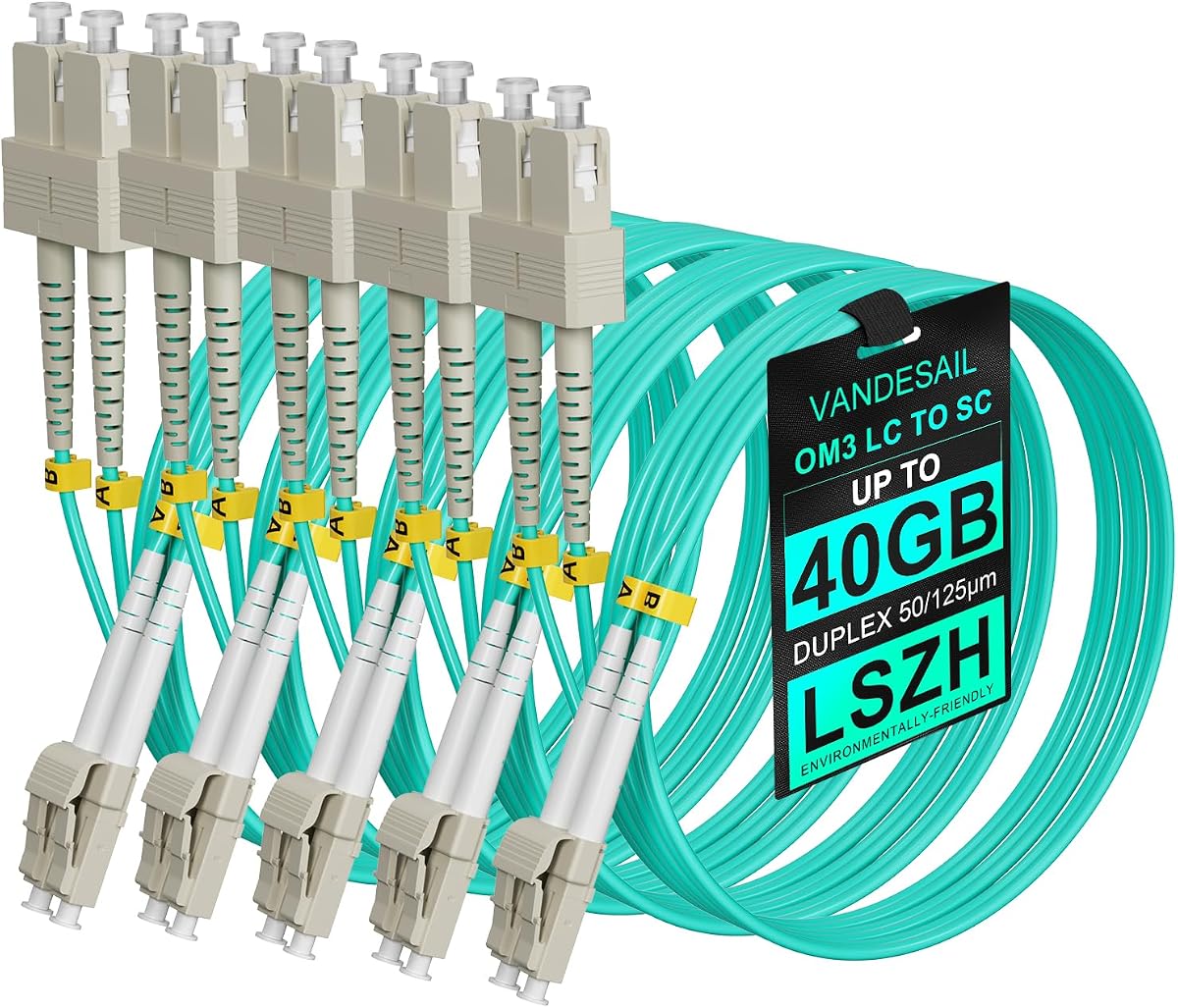
This individually tested LC-to-SC cable has a 4.6 rating and is built as a duplex OM3 multimode assembly. Its key distinguishing feature is an emphasis on individual testing, while the product information highlights a UPC-polished fiber core, strong bend resistance, and support for 10-Gbps and higher-class applications within appropriate OM3 equipment.
We may earn a commission when you buy through this link, at no additional cost to you.
The cable's multimode construction is important. OM3 is intended for short-reach, high-bandwidth links using compatible transceivers, and it cannot be treated as an interchangeable replacement for an OS2 single-mode cable. The listing mentions 10 Gbps and beyond, but actual speed and distance remain governed by the connected optical modules, the fiber, and the selected transceiver type.
The LSZH jacket is described as limiting smoke and toxic fumes during a fire, and the stated operating range is minus 20 to 70 degrees Celsius. Intended uses include LANs, WANs, communication networks, fiber modules and converters, data center interconnection, servers, and storage devices. These broad applications make the cable potentially versatile, but the precise physical length, connector polish on each end, and detailed test values are not stated in the supplied description.
This cable makes sense for a buyer explicitly seeking an individually tested, duplex, high-speed multimode link rather than a single-mode jumper. Its bend resistance and broad compatibility claims are useful for dense equipment-room routing. Before ordering, check the listing for exact length, both connector ends, and any formal test results, then confirm that all attached equipment supports OM3.
Individual testing is a useful quality indicator because it shows that the assembly was checked rather than merely packaged. Buyers handling critical links can also request or review any available test documentation from the seller.
OM3 duplex construction suits compatible high-speed short-reach networks. It should be selected only when the transceivers and existing fiber are designed for OM3, since a connector match alone does not overcome a mismatch in fiber mode.
We may earn a commission when you buy through this link, at no additional cost to you.
Choosing a reliable LC-to-SC jumper requires matching the physical connectors, optical fiber type, polish, link technology, transmission distance, and installation environment. The following factors help prevent the most common compatibility and routing problems.
Fiber mode is the first compatibility decision because single-mode and multimode cables use different core sizes and optical characteristics. OS2 is a 9/125-micron single-mode option used for longer links, while OM1, OM3, and OM4 belong to the multimode category and serve different short-reach environments. A physically similar connector does not make a single-mode cable compatible with multimode equipment. Check the label on the transceiver, the existing backbone cable, and the adapter or port specification before ordering.
Choose the exact fiber category named by the equipment manufacturer and the installation standard. If documentation is unavailable, do not guess based solely on connector shape or a product photograph.
UPC and APC refer to the physical geometry of the connector end face. UPC connectors have a straight polish, while APC connectors have an angled polish. Connecting unlike polishes can produce excessive loss, poor reflection performance, and potentially damage an end face. Most of the options in this guide use UPC connectors, while the second product deliberately combines LC/UPC with SC/APC for a specific mixed-polish requirement.
Treat the polish designation as a required part of the connection, not a minor preference. Confirm the specification for both endpoints and use a correctly matched cable whenever possible.
A duplex cable contains two fibers and is commonly used for a full-duplex link with separate transmit and receive channels. A simplex cable contains one fiber and may suit a single-direction path, split-transmission arrangement, or specialized system. The trueCABLE product is simplex, while most others listed are duplex. A duplex cable cannot be substituted for a simplex cable merely because it contains an extra fiber unless the equipment and architecture support that arrangement.
Identify the number of fibers required at both ends, including any need for separate transmit, receive, or service channels. This prevents unnecessary bulk or an unusable assembly.
The catalog includes one-meter, two-meter, three-meter, and half-meter assemblies, along with multipacks. Choose enough length for a smooth route, connector engagement, strain relief, and a small amount of service slack, but avoid excess cable that must be coiled in a crowded cabinet. Measure the actual path from the port to the panel rather than estimating only the straight-line distance.
Longer is not automatically better. A short route may need a compact cable, while a route with bends and equipment clearance may justify the two- or three-meter options.
Fiber performs best when it is not bent more sharply than its specified minimum bend radius. Some products in this list state a 15-millimeter or 10-millimeter minimum radius, while the BEYONDTECH listing provides separate installation and in-use figures of five and three centimeters. A smaller stated radius can make routing easier in dense panels, but the cable should still be installed without sharp pulls, crushing, or tight service loops.
Leave space for the connector boot and keep the fiber away from sharp edges, cabinet hardware, and power cables. If the planned route cannot preserve the manufacturer's bend guidance, select a more flexible assembly or revise the path.
Jacket ratings describe expected fire-performance behavior for particular installation spaces. LSZH reduces smoke and halogen emissions, OFNR is used for non-plenum interior pathways, and OFNP is intended for plenum-rated spaces. These labels are not interchangeable. The Cable Matters cable is distinguished by its OFNP rating, trueCABLE is rated OFNR, and most other selections use LSZH jackets.
Check local codes, building requirements, and the intended pathway before purchasing. A connector that fits technically does not make an unsuitable jacket rating acceptable in every location.
The listed 1310- and 1550-nanometer wavelengths, supported Ethernet classes, and stated maximum distances are only useful when they align with the active equipment. Transceivers determine the optical signal, while the fiber and connectors form the path. Verify transceiver type, wavelength, fiber mode, reach, and the complete optical budget. Products that mention SFP, SFP+, QSFP+, GBIC, Fibre Channel, GPON, or FTTX are intended to be assessed against the corresponding hardware.
Avoid choosing a cable from a headline speed or distance alone. The end-to-end link budget and physical medium must support the intended service.
Individual testing, stated insertion-loss or return-loss limits, ceramic ferrules, dust caps, and TX/RX labels can make a product more attractive for maintenance and structured deployment. The five-pack OS2 cable provides explicit loss limits, while several other cables state that they are individually or fully factory tested. A/B markings, numbered fiber tags, and adjustable clips help reduce errors during installation and troubleshooting.
Prefer documented testing and clear identification over vague claims of premium construction. Also look for strain relief, flexible boots, and a jacket diameter that can be routed without crowding the equipment.
Before installation, power down or follow the equipment manufacturer's hot-swap procedure, then verify the connector type, fiber mode, polish, wavelength, and link requirements at both ends. Inspect each ferrule and end face under magnification if possible. Dust, skin oils, scratches, or a bent fiber can cause severe loss even when the cable itself is new, so handle the assembly by its connector body and boot rather than touching the optical tip.
Remove dust caps only when the connector is ready to be inserted, align the keying and connector geometry carefully, and insert the plug without twisting or forcing it. Route the fiber with a smooth bend, secure it with appropriate management hardware, and avoid leaving tight coils or pulling the plug sideways. Label both ends and record the transmit and receive orientation where duplex channels could be confused.
For testing, use the appropriate optical power meter, light source, loss tester, or transceiver diagnostic supported by the active equipment. Confirm that the link reaches a stable state and that its received power, errors, and link speed fall within the transceiver specifications. When a link fails, inspect and clean the end faces, reseat both connectors, check polarity, and compare the installed fiber mode before replacing equipment.
They can be either. Most of the products in this guide are OS2 single-mode cables, while the Cable Matters model is OM1 multimode and the individually tested option is described as OM3 multimode. The fiber type must match the transceivers and existing cabling, so confirm the specifications rather than choosing by connector shape alone.
A direct UPC-to-APC connection is generally not advisable because the different polish geometries can cause high loss and poor return performance. The second product in this guide intentionally has an LC/UPC end and an SC/APC end for a specific installation. For other links, use matching polish at both ends or an appropriately designed, tested conversion method.
A simplex cable contains one optical fiber, while a duplex cable contains two. Duplex assemblies are common for links requiring separate transmit and receive paths. A simplex assembly is appropriate only when the equipment and network design use one fiber in the required direction, so check the channel arrangement before selecting a cable.
The best length is the shortest one that provides a smooth, serviceable route with adequate bend clearance and strain relief. Half-meter and one-meter cables suit very short connections, while two- and three-meter options can help when equipment and patch panels are farther apart. Measure the actual path rather than estimating from equipment position.
LSZH means Low Smoke Zero Halogen and describes a jacket engineered to reduce smoke and halogen gas emissions under fire conditions. It is useful in many indoor structured-cabling environments, but it is not automatically approved for every pathway. Plenum spaces may require an OFNP-rated cable, while non-plenum indoor riser routes may call for an OFNR-rated jacket.
The cable may be physically capable of carrying those services when the fiber, connectors, transceiver, and optical budget support the intended application. A listed speed is not an independent guarantee of performance. Check the transceiver's mode, wavelength, reach, connector arrangement, and loss requirements before selecting a patch cable for a higher-speed link.
Inspect the end face with a suitable optical microscope and clean it using a connector-specific cleaning method or tool approved for the equipment. Avoid touching the ferrule or optical fiber, and keep the cap off only for as long as necessary. Always follow the connector manufacturer's cleaning instructions because improper tools can damage the end face.
Start by checking that the fiber mode, connector type, polish, and transceiver wavelength match on both sides. Inspect and clean both connector end faces, reseat the cables, and verify transmit and receive orientation for a duplex link. Then test received optical power and compare it with the transceiver specifications, because a correct-looking connection can still be affected by dirt, a tight bend, or an excessive optical budget.
The LC to SC OS2 five-pack is the most versatile general choice in this guide because it combines one-meter duplex jumpers, UPC connectors, individual testing, and an LSZH jacket. The LC/UPC-to-SC/APC model is a compelling budget-specific option for a verified mixed-polish installation, while the premium OS2 SC-to-LC five-pack offers a compact mixed-interface design for dense deployments.
Compatibility should take priority over headline specifications. Confirm the fiber type, connector polish, number of fibers, transceiver wavelength, transmission distance, and pathway rating before selecting a product. For compact routes, the trueCABLE simplex cable may be ideal, while installers needing plenum-rated OM1 construction should examine the Cable Matters option in detail.
Marketplace ratings, product details, and prices can change, so check the current listing before making a final purchase. Compare the latest manufacturer or seller specifications, connector drawings, and installation requirements with the equipment already in the network. The right fiber patch cable LC to SC is the one that matches the optical path precisely and can be routed cleanly within its stated limits.