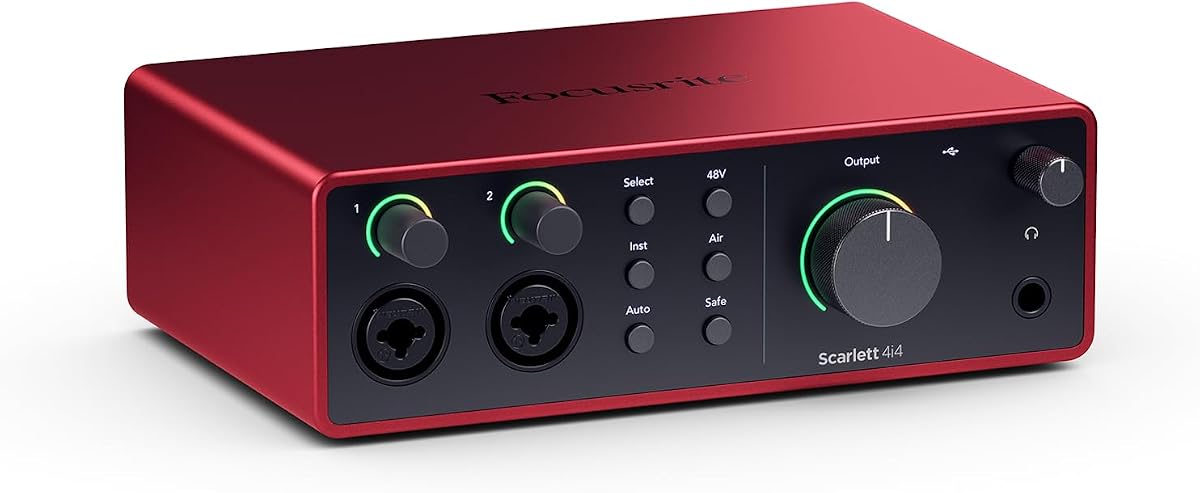
Focusrite Scarlett 4i4 4th Gen
4.7Editor score
Four balanced analog inputs
120 dB converter dynamic range
Auto Gain and Clip Safe
Thunderbolt 4 Pro Audio Interfaces guide comparing 10 models for recording, monitoring, expansion, portability, and studio control.
Thunderbolt 4 Pro Audio Interfaces sit at the center of a modern recording setup, combining fast computer connectivity, capable preamps, flexible monitoring, and the expandability needed for serious home or project studios. The best choice depends on channel count, software ecosystem, workflow, and whether portability matters more than maximum I/O.
This guide compares ten professional audio interfaces using the supplied product specifications, customer ratings, connectivity, preamp features, monitoring tools, bundled software, and expansion options. It covers both dedicated Thunderbolt 4 and USB4 models, as well as several USB-C interfaces that can be strong alternatives for smaller or more portable rigs.
Each review highlights the features that distinguish the interface, practical strengths, and honest limitations. The list includes desktop units for two-person sessions, larger recording consoles, software-rich studio centers, and portable creator devices. Product prices and availability change, so check current listings before purchasing.
4.7Editor score
4.7Editor score

The comparison below organizes all ten interfaces by their strongest use cases, from compact USB-C recording to high-channel Thunderbolt 4 systems, while keeping the supplied ratings and specifications in view.


The Apollo Twin X DUO Gen 2 is a feature-rich Thunderbolt 3 audio interface for musicians who want much more than basic conversion. Its 4.5 rating reflects a well-regarded package centered on Apollo preamps, UAD processing, monitor correction, and practical gain control. The result is a studio ecosystem rather than a simple box of inputs and outputs.
We may earn a commission when you buy through this link, at no additional cost to you.
Its standout strength is access to more than 200 UAD DSP and Native plug-ins, including processors associated with Capitol Chambers, Sound City Studios, and EL8 Distressor. Unison preamps can emulate the character of Neve, API, Avalon, Manley, and Fender while you record. Auto-Gain helps establish levels across multiple inputs, while Apollo Monitor Correction powered by Sonarworks can make headphone and room monitoring more dependable.
The main limitation is the need to match the hardware to the recording task. With two preamps, it is less suitable for a large ensemble than a four-preamp or high-channel-count interface. It also uses Thunderbolt 3 rather than the newest Thunderbolt 4 specification, although that distinction matters most for users who need very high channel counts or multiple downstream peripherals. The software and hardware integration is the reason to accept those trade-offs.
Choose this model for songwriters, producers, and engineers who value emulated analog character, integrated plugins, and a polished monitoring workflow. It is a particularly strong recommendation for a project studio where one person records vocals, instruments, and overdubs, or for a producer who wants a familiar Apollo ecosystem without moving to the larger QUAD model.
The plug-in library and Unison preamp system make this more than a conventional converter. Those tools can shape sounds during tracking, helping a producer move from a raw performance to a more finished mix without relying entirely on plug-ins added later.
Apollo Monitor Correction and bass-management features make it easier to judge mixes across different listening conditions. Auto-Gain also reduces the chance of a weak recording level, which is particularly helpful for fast home-studio sessions.
We may earn a commission when you buy through this link, at no additional cost to you.
The Apollo Twin X QUAD Gen 2 is the four-preamp member of the Apollo Twin X family, giving it more room for multitrack recording and band sessions. It carries a 4.5 rating and combines Apollo conversion with Unison preamps, a broad UAD plug-in catalog, and monitoring features intended to make the interface useful throughout a project.
We may earn a commission when you buy through this link, at no additional cost to you.
Compared with the DUO model, the QUAD offers two additional preamps, making it the more natural choice when tracking a singer, guitarist, bassist, and another source at the same time. The stated conversion design emphasizes low distortion and wide dynamic range. UAD DSP and Native plug-ins bring modeled consoles, dynamics, and creative effects into the same environment, while Auto-Gain helps keep multiple inputs consistently leveled.
This is still a desktop studio interface rather than a travel-first model, and its Thunderbolt 3 designation means it does not offer the newest host-device standard. That is a reasonable compromise for Apollo users because the meaningful benefit here is the mature hardware-and-software workflow. Buyers who need dozens of simultaneous channels should look farther up this list, but the QUAD is more versatile than a compact two-channel unit.
It is best suited to producers recording small ensembles, musicians building home-studio catalogs, and engineers who want four preamps plus Apollo's integrated tools. Within the Apollo line, it is the stronger all-around recommendation when the additional inputs justify the larger footprint.
The additional preamps create room for drums, guitar, bass, and vocals without immediately reaching for an external analog device. Combined with Auto-Gain, this makes the interface more convenient for repeatable tracking sessions.
The extensive UAD library provides a substantial creative toolbox. It is especially useful for producers who want tracking-time emulations from respected hardware and software in the same workflow as their DAW.
We may earn a commission when you buy through this link, at no additional cost to you.
The Apollo Solo Heritage Edition is a compact, bus-powered interface aimed at musicians who want Apollo sound and processing in a portable setup. Its 4.6 rating is among the strongest in this group. While it lacks Thunderbolt, USB-C simplicity makes it a credible option for small rigs, laptop-based recording, and users who value portability over channel count.
We may earn a commission when you buy through this link, at no additional cost to you.
UAD SOLO Core Processing provides vintage-style compressors, EQs, tape machines, preamp, and guitar-amp emulations with near-zero latency. Unison mic preamp and amp emulations draw on recognizable Neve, API, Avalon, Manley, Marshall, and Fender styles. The included heritage plug-in bundle adds value for owners who want to begin recording immediately, while LUNA provides an integrated Mac recording environment.
The most obvious compromise is capacity. This interface is intended for a small footprint and is not a solution for a full band requiring many simultaneous mic or instrument inputs. LUNA is also Mac only, although UAD Powered Plug-Ins can run in VST, AU, and AAX formats across major DAWs, including Logic Pro, Pro Tools, Cubase, and Ableton Live. The headphone amplifier and bus-powered construction are meaningful advantages for mobile creators.
Buy it for a solo musician, mobile producer, or songwriter who wants first-class Apollo processing in a small box. It is less appropriate for a growing room-tracking setup, where the four-preamp and high-channel-count options in this guide provide more room to expand.
Bus power and a compact enclosure make this one of the easiest Apollo systems to move between locations. It also supports both Mac and Windows, giving it broader desktop compatibility than the Mac-only LUNA component might initially suggest.
The combination of UAD SOLO Core processing and Unison emulations lets performers record through modeled analog tools while monitoring with minimal delay. That makes the Heritage Edition particularly relevant to guitarists, vocalists, and producers who monitor while playing.
We may earn a commission when you buy through this link, at no additional cost to you.
This Apollo Twin X QUAD Gen 2 listing offers the same broad four-preamp and UAD-focused concept as the other QUAD entry, but it has a 4.0 rating. It is aimed at users who want an established Apollo production environment with Thunderbolt connectivity, monitor correction, Unison preamps, and a deep collection of plug-ins.
We may earn a commission when you buy through this link, at no additional cost to you.
The hardware combines four mic preamps with next-generation Apollo conversion and an extensive software package. Unison preamps cover familiar Neve, API, Avalon, Manley, and Fender character. More than 200 UAD DSP and Native plug-ins are available, and Apollo Monitor Correction powered by Sonarworks is included for headphone and room-based calibration. Auto-Gain helps prevent inconsistent levels across several inputs.
The main question is why a buyer would select this listing over the closely related QUAD option with the stronger 4.5 rating. The supplied data does not identify meaningful hardware differences, so prospective buyers should compare the exact package contents and current availability at the point of purchase. Its older Thunderbolt 3 connection may also be less attractive for a setup that specifically requires Thunderbolt 4 expansion.
Even with that ambiguity, the product remains appealing for producers who prioritize the Apollo ecosystem over the newest cable standard. Choose it when the included UAD library, monitor correction, and four-preamp recording workflow are the decisive features, and verify the package details before ordering.
The QUAD format is well suited to recording several sources simultaneously, including a full band in stages. Auto-Gain and Unison preamps help simplify level management and add character during the take.
UAD plug-ins and Apollo Monitor Correction make this more than a basic I/O box. The combination is valuable for users who want to judge tracks and build polished mixes within the same hardware ecosystem.
We may earn a commission when you buy through this link, at no additional cost to you.
The Focusrite Scarlett 4i4 4th Gen is the most convincing budget-oriented choice in this list, with a 4.7 rating and a useful balance of recording, monitoring, and software. It is not a Thunderbolt 4 interface, but its USB-C design is easier for most musicians to deploy and remains a strong alternative for a compact project studio.
We may earn a commission when you buy through this link, at no additional cost to you.
The front and rear connections support two Scarlett 4th Gen mic preamps, two Hi-Z instrument inputs, four line inputs, four line outputs, and MIDI I/O. Its 120 dB dynamic range uses the same converters found in Focusrite's flagship interfaces. Auto Gain sets a starting level for microphones or guitars, Clip Safe helps prevent overload, and Air mode adds presence and harmonic character to vocals and guitars.
The included software is unusually useful. Owners receive Pro Tools Intro+, Ableton Live Lite, Cubase LE, and Hitmaker Expansion with effects, instruments, and mastering tools. As a result, the box can serve a new producer who is building a first home studio as well as an established musician who wants a dependable secondary interface. The trade-off is that it lacks Thunderbolt-class channel capacity and the onboard DSP found in the Apollo and Antelope systems.
It is an excellent recommendation for a singer-songwriter, podcast producer, electronic musician, or small-band rehearsal. If the budget is the first priority but four inputs are useful, this model is more versatile than the 2i2 while remaining easier to justify than a large studio console.
Two mic preamps, two instrument inputs, and additional line inputs provide enough flexibility for a singer with a guitar, a duo, or a compact streaming setup. The MIDI connections add another layer of usefulness for keyboard-focused creators.
Auto Gain and Clip Safe reduce common beginner errors without taking creative decisions away from the performer. Air mode provides a quick tonal alternative when a flatter, more present recording is needed.
We may earn a commission when you buy through this link, at no additional cost to you.
The Scarlett 2i2 4th Gen is a compact USB-C interface for a solo artist who wants quality conversion and a simple workflow. Its 4.5 rating indicates a well-liked product, though the smaller 2×2 format makes it most appropriate for one microphone, a microphone plus instrument, or a two-source session.
We may earn a commission when you buy through this link, at no additional cost to you.
The fourth-generation design uses Focusrite's flagship converters and offers a stated 120 dB dynamic range. Two Hi-Z inputs make it convenient for direct guitar recording, while Auto Gain handles initial level setting and Clip Safe helps protect against digital clipping. Air mode adds presence and harmonic drive to vocals and guitars without requiring a separate outboard processor.
Compared with the 4i4, the 2i2 is easier to transport and less visually and financially demanding. That simplicity can be an advantage for a bedroom studio, mobile recording, or a first interface. The compromise is obvious once a drummer, keyboardist, and vocalist need to be recorded together: there are not enough inputs, and the model does not offer Thunderbolt bandwidth, hardware processing, or extensive digital expansion.
This interface is best for beginners, podcasters, singer-songwriters, and anyone who needs a dependable two-channel path to a DAW. The included Pro Tools Intro+, Ableton Live Lite, Cubase LE, and Hitmaker Expansion bundle helps new users begin without immediately assembling a large software catalog.
Bus-powered USB-C operation keeps the 2i2 straightforward for laptop and desktop users. Its familiar Scarlett workflow makes it easy to move from plugging in a microphone to recording in an included DAW.
The 120 dB dynamic range and fourth-generation converters provide a technical foundation beyond the entry-level category. Air mode adds a useful recording choice for performers who want a more pronounced vocal or guitar presence.
We may earn a commission when you buy through this link, at no additional cost to you.
The Fender Quantum LT 4 is a 4×2 USB-C interface built around the needs of guitarists, bassists, and modern content creators. Its 3.7 rating is the lowest among the listed products, so buyers should evaluate the feature set carefully. Its strongest appeal is a specialized combination of instrument inputs, loopback routing, low-latency monitoring, and Fender software.
We may earn a commission when you buy through this link, at no additional cost to you.
Two MAX-HD mic preamps provide up to 75 dB of gain, while two purpose-designed instrument inputs target guitars, basses, and line-level sources. Balanced TRS outputs, a headphone amplifier, and loopback audio support recording, livestreaming, podcasting, and general content creation. The supplied Fender Amp and FX Pack adds modeled Fender amplifiers and effects through the Fender Studio app, with a six-month Fender Studio Pro trial included through registration.
The limitations are significant for larger sessions. Two mic preamps are not enough for a band, and the 4×2 analog configuration leaves less flexibility than the four-input alternatives in the guide. The 3.7 rating may reflect the relative immaturity of the product or a mismatch between expectations and the hardware's modest channel count. The included software is impressive, but it should not be confused with a Thunderbolt DSP system.
It is most suitable for a guitarist or bassist building a focused recording setup, or a creator who values direct monitoring and loopback more than high channel capacity. Purchase it for its instrument-focused design, not as a general-purpose studio console replacement.
The two dedicated instrument paths make it easy to move from an amp and pedal setup into the DAW. Fender's involvement also gives the interface a clear identity for guitar-focused recordings.
Loopback routing is useful when a performer needs to combine system audio, backing tracks, or game sound with a microphone signal. Direct monitoring controls through Fender Studio Pro or Universal Control add further flexibility.
We may earn a commission when you buy through this link, at no additional cost to you.
The MOTU 10pre 26×28 is the clear high-channel-capacity selection in this roundup. It combines native Thunderbolt 4 and USB4 connectivity with 26 inputs, 28 outputs, ten mic channels, extensive digital I/O, and AVB networking. The supplied product data has no customer rating, so the feature set rather than a rating trend should guide the decision.
We may earn a commission when you buy through this link, at no additional cost to you.
Its 3.9-inch 480 x 128 RGB display provides metering and hardware-status information for analog and digital channels. ESS Sabre32 DAC technology delivers a stated 125 dB dynamic range, and round-trip latency can reach 1.8 ms at 96 kHz with compatible hosts. Ten flexible combo inputs, eight TRS outputs, two banks of optical I/O, and two headphone outputs create a broad analog and digital foundation.
The unit also offers 32-bit floating-point DSP for 64-channel mixing, 32 busses, and effects. AVB networking through two Gigabit Ethernet ports can daisy-chain multiple interfaces, computers, and compatible previous-generation MOTU AVB devices. The second Thunderbolt port supports peripherals, hubs, and docks, while class-compliant firmware broadens host compatibility. These are major benefits for a large or expanding facility.
That scale also makes the interface less appropriate for a simple bedroom setup. Its size, complexity, and feature density exceed what most solo creators need. It is a premium recommendation for a professional project studio, commercial production room, or multi-instrument recording facility that values long-term expansion and precise control-room management.
The Thunderbolt 4 and USB4 connection supports up to 256 audio channels depending on the host. Optical I/O, a second Thunderbolt port, and AVB networking create several paths for building a larger interconnected studio.
A dedicated display keeps channel status visible, while talk, A/B/C speaker selection, mute, and mono functions support professional monitoring decisions. The front-panel design reduces the need to move windows during critical playback checks.
We may earn a commission when you buy through this link, at no additional cost to you.
The PreSonus Quantum ES 4 is a USB-C interface aimed at producers who want four preamps, mobile control, and a tightly integrated PreSonus software workflow. Its 4.1 rating places it in the middle of the group. It does not use Thunderbolt, yet its combination of signal flow, app control, and included software can make it a strong choice for a modern production room.
We may earn a commission when you buy through this link, at no additional cost to you.
Four newly designed MAX-HD mic preamps provide up to 75 dB of gain, and the instrument input was co-developed with Fender engineers for guitar and bass. The custom low-latency driver supports responsive recording, while the interface supports operation through 24-bit and 192 kHz. Auto Gain establishes a level for microphones and instruments, reducing the chance of losing a take to inconsistent gain staging.
Studio One Pro perpetual-license access is a meaningful inclusion for users who want a complete production environment. The Universal Control app can manage preamp gain, phantom power, and other critical functions from a phone, tablet, or desktop. The trade-offs are the absence of Thunderbolt, the lack of an onboard DSP feature comparable to the Apollo or Antelope systems, and a less exceptional customer rating than several alternatives.
Choose this interface for a producer who uses PreSonus software, wants remote hardware control, or needs a guitar-friendly four-channel setup. It is less compelling for a large room that needs digital expansion or a computer owner who specifically wants Thunderbolt bandwidth.
The MAX-HD preamps offer substantial gain while maintaining a low-noise, transparent presentation. Four channels make the Quantum ES 4 more practical for a duo or compact band than a typical two-channel interface.
The Universal Control app can handle settings that would otherwise require reaching for hardware. That convenience is valuable during mobile sessions where quick, visual control is more useful than permanently open desktop windows.
We may earn a commission when you buy through this link, at no additional cost to you.
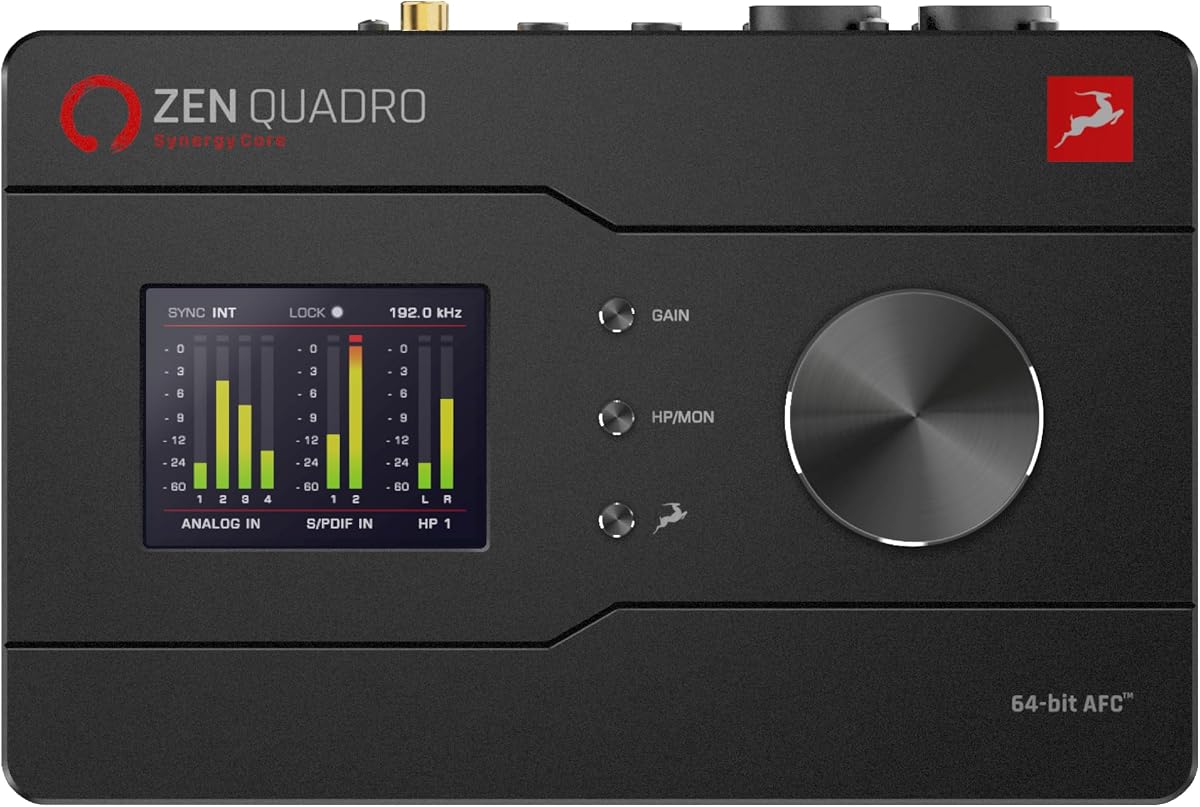
The Antelope Audio Zen Quadro combines a 4.7 rating with a rare combination of portability, real-time effects, flexible connectivity, and high-end clocking. It is a USB-C design rather than a Thunderbolt 4 model, but the dual USB-C arrangement and bus-powered construction make it attractive to creators who need a mobile recording path or control over computer routing.
We may earn a commission when you buy through this link, at no additional cost to you.
Four Discrete six-transistor preamps provide up to 75 dB of gain, while two Hi-Z inputs are ready for guitars and basses. Synergy Core FX includes 37 effects, with more than 90 available. Compressors, EQs, preamps, amps, and cabinet models run on dedicated DSP and FPGA hardware, allowing near-zero-latency tracking without placing the same processing load on the host CPU.
Antelope's clocking and conversion technology are major selling points. The interface offers up to 130 dB AD/DA dynamic range and 64-bit AFC clocking. Dual USB-C ports can connect a computer and phone or tablet, or two computers, and can support loopback and audio routing between them. ADAT and S/PDIF expansion add up to eight channels, and there are two independent headphone outputs. The trade-off is that a buyer seeking native Thunderbolt 4 will not find it here.
The Zen Quadro is a strong recommendation for a mobile musician, producer working across two computers, or studio that values real-time modeled effects and clocking quality. It is also a credible compact home-studio centerpiece for a singer, instrumentalist, or small session.
Dedicated DSP and FPGA processing allow performers to track through compressors, EQs, preamps, amplifiers, and cabinets with near-zero latency. This is especially helpful for guitarists who want to hear a more complete sound while recording.
The dual USB-C design is unusual in a compact interface and can connect a computer with a phone or tablet, or two computers. Loopback support and standalone presets make the unit adaptable to streaming, mobile, and travel-focused sessions.
We may earn a commission when you buy through this link, at no additional cost to you.
A professional interface should match the way you record rather than simply maximize specifications. Start with channel count, preamp requirements, computer workflow, monitoring needs, and expansion plans, then balance those priorities against portability and software support.
Thunderbolt 4 and USB4 are the most relevant standards for a modern high-performance interface, but a USB-C label alone does not reveal the underlying speed. Thunderbolt 4 is useful for large channel counts, low-latency monitoring, and connecting docks or other peripherals. USB-C interfaces can be perfectly adequate for a small studio and often offer simpler portability. Confirm the actual transfer specification rather than treating every USB-C connection as equivalent.
In practice, choose Thunderbolt when your session needs many inputs, extensive digital I/O, or a large monitor-control ecosystem. Choose USB-C when the interface meets your current channel count and you value a compact, bus-powered setup.
Count not only microphones but also instruments, playback channels, talkback, and any external gear you expect to add. A two-channel model suits a solo performer, four channels are useful for a duo or small ensemble, and ten or more preamps support fuller tracking. Plan for headroom in your workflow, because a project can grow faster than the initial interface.
Digital expansion can help, but it does not replace good front-end preamps. Choose enough native microphone channels for the most important sources and use line-level or digital inputs for the rest.
Preamp gain, noise, headroom, and clarity determine how usable a source will be before it reaches the converter. The featured models offer substantial gain ranges, while some include automatic level setting to reduce recording errors. Consider ribbon microphones, quiet vocals, and quiet preamps that may require more gain, and check whether gain and phantom power can be controlled remotely.
For most home studios, a transparent preamp with reliable gain staging is enough. Emulated or modeled preamps can add character, but they should complement rather than replace a clear signal chain.
The interface's converters affect how accurately a performance is captured and how confidently it is monitored. Look for useful dynamic-range figures, a strong headphone amplifier, flexible output routing, and direct monitoring that avoids frustrating delay. A calibration system or monitor-correction tool is also valuable if you work across speakers and headphones.
Do not rely on a single specification alone. Pair converter quality with clean headphone output, low-latency monitoring, and a workflow that makes it easy to compare references.
A growing studio may need ADAT, S/PDIF, Thunderbolt daisy-chaining, or network audio. These options let you add converters, monitors, and channels without replacing the main interface immediately. They also make compatibility important: confirm the format, sample-rate support, and whether expansion devices can be synchronized with the main unit.
If future growth is likely, pay more attention to expansion and clocking than to a modest improvement in bundled software. A well-designed system can evolve, while a fixed four-channel box has a clear ceiling.
Some interfaces include effects that run on dedicated DSP or FPGA, providing low-latency tracking without using host CPU. Others bundle a DAW, virtual instruments, and plug-ins for immediate productivity. Decide whether onboard processing is important or whether computer-based plug-ins meet your needs. Also verify operating-system support, since some companion applications remain limited to one platform.
The best bundle is the one you will use. Do not let a large plug-in list compensate for inadequate connectivity, input count, or monitoring in your particular room.
Desktop interfaces vary from tiny bus-powered units to large, control-room-style consoles. Portability depends on size, weight, power requirements, heat, and whether the device can operate from a laptop. A permanently installed studio may benefit more from robust front-panel controls and extensive display information, while a mobile creator may prioritize a small footprint and simple setup.
If you travel frequently, verify cable requirements, supported power sources, and the availability of an appropriate protective case. A portable interface is useful only if it is genuinely easy to deploy.
Before connecting the interface, confirm that the computer, DAW, and operating system are supported. Install the manufacturer’s current drivers and control software, then connect the interface with the specified cable. Use a direct connection for the initial setup when possible, and verify that the DAW sees the expected sample rate and input count before recording.
Set gain deliberately for each source. If a microphone needs substantial gain, raise it gradually while watching the meter, and use padding only when the signal is genuinely too hot for the preamp. Establish a repeatable monitoring level, enable direct monitoring only when you understand the expected latency, and test headphone and speaker outputs before beginning a critical session.
Treat the converter and preamp as sensitive studio equipment. Keep the unit ventilated, avoid placing drinks or loose objects near the connectors, and clean the enclosure with a dry or lightly damp cloth rather than harsh liquids. Save useful presets, back up software configurations, and update firmware and drivers when the manufacturer recommends it. For a permanent installation, use a stable support and cable management that does not place strain on the ports.
No. Thunderbolt 4 is most valuable for high channel counts, very low-latency workflows, and connecting multiple peripherals. A USB-C interface can be the better choice for a small, portable studio that records only a few sources at a time. Choose based on your actual session requirements rather than the connector label alone.
Not necessarily. If you record vocals, a guitar, and one other source, a four-channel USB-C interface may provide enough bandwidth and keep the setup simpler. Thunderbolt becomes more attractive when you plan to add many channels, integrate a larger monitor-control system, or connect several high-bandwidth devices.
Unison preamps are part of the Apollo ecosystem and emulate the character of specific microphone preamps during recording. Dedicated onboard DSP or FPGA effects, such as those described for the Zen Quadro, can run multiple processors with very low latency. They are different approaches, so compare the available emulations and your preferred recording workflow.
One is enough for a solo vocal or instrument, while two or four support common singer-songwriter and duo sessions. A drummer, full band, or multi-person podcast may require more. Also count the number of simultaneous line and instrument sources, since microphone channels alone do not describe the entire recording requirement.
They can be highly valuable, especially for a new producer, but they should not be the only consideration. Prioritize converter quality, preamp performance, low-latency monitoring, stable drivers, and enough connectivity for the intended session. Included software is most useful when it complements a workflow you already want to use.
Some models explicitly support mobile-device workflows. The Zen Quadro has dual USB-C connectivity for a computer plus phone or tablet, while the MOTU supports an iPad through USB-C or an appropriate adapter kit. For other products, verify compatibility and required cables before assuming mobile operation is available.
Check supported expansion formats, sample-rate synchronization, available host channels, clocking behavior, and the number of physical outputs you still need. For networked systems, confirm compatibility with existing devices and the required switches or cabling. A prospective expansion path is most useful when the main unit and add-on converters can operate as a synchronized system.
Use the manufacturer's lowest-latency driver setting, keep buffer sizes as low as practical, and bypass software monitoring when your DAW and operating system support a stable direct-monitor path. The MOTU 10pre specifies round-trip latency as low as 1.8 ms at 96 kHz with high-performance hosts. Always test the complete signal path because conversion and plugin delays also contribute to perceived latency.
The best overall choice depends on the size of the studio. The MOTU 10pre 26×28 is the strongest native Thunderbolt 4 and expansion platform, the Apollo Twin X DUO and QUAD models offer deep software ecosystems, and the Antelope Zen Quadro stands out for portable real-time processing. For a smaller budget, the Focusrite Scarlett 4i4 provides a balanced and approachable entry point.
Prioritize the parts of the signal path that affect every take: adequate preamps, clean conversion, dependable monitoring, compatible drivers, and enough inputs for realistic sessions. Add Thunderbolt 4 when bandwidth or expansion justifies it, and treat bundled plug-ins and DAWs as useful extras rather than substitutes for good hardware.
Ratings, bundle contents, and product availability can change, and current prices should be checked before buying. Compare the final package with your computer, DAW, microphones, and planned session to make sure the interface supports your workflow rather than only matching a headline specification.