
MAYU Swirl Structured Water Device, 1.5L Pitcher & Rechargeable Base, Earth
1.5L borosilicate glass carafe
Rechargeable magnetic vortex base
Seven-minute swirl cycle
Our Structured Water Device guide compares 10 options for hydration, flow, portability, filtration, hydrogen output, installation needs, and daily convenience.
Structured water devices range from countertop pitchers to portable hydrogen bottles and whole-home flow systems. The best choice depends on the mechanism you prefer, the space available, and whether your priority is taste, portability, filtration, or convenient hydrogen-rich water. Understanding these differences is essential before buying.
We compared all 10 products by examining their stated mechanisms, capacities, power requirements, materials, filtration roles, portability, maintenance, warranty coverage, and target use cases. The list includes countertop devices, portable ionizers, passive flow products, a whole-home system, and one conventional filtration pitcher for a practical point of comparison.
Each review shows what a product is best suited to do, along with any limitations suggested by its specifications. Ratings reflect the available marketplace feedback, while products without a listed rating are clearly identified. Prices and availability can change, so check the current listing before purchasing.

4.5Editor score

4.1Editor score
This side-by-side comparison highlights the major differences among countertop pitchers, portable hydrogen bottles, passive flow devices, whole-home systems, and filtration-focused options. It is the quickest way to identify the right format before reading the detailed reviews.



The Natural Action Portable is the most balanced option in this guide because it combines a simple, non-electric format with broad compatibility and unusually strong warranty coverage. Its listed rating is 4.5, giving it a favorable marketplace history, while its lightweight, food-safe construction and top-rack dishwasher-safe design make it practical for home, office, travel, and outdoor routines.
We may earn a commission when you buy through this link, at no additional cost to you.
Its central feature is internal chamber geometry inspired by hydrodynamics, which the manufacturer says restructures water through natural flow dynamics. Unlike hydrogen bottles, it does not require charging, consumable cartridges, or a particular type of tap water. It can be used with tap, filtered, or bottled water, making it a flexible choice for travelers and households that already depend on several water sources.
The main compromise is that the product does not publish a hydrogen concentration, runtime, or measurable performance specification in the supplied information. It also has no stated reservoir size, so buyers should verify its dimensions and holding capacity before ordering. Those omissions make it less suitable for people who prioritize numerical output or want a self-contained bottle with a known volume.
Even with those limitations, the device is the strongest general recommendation for most readers. It avoids the recurring costs and charging routines associated with electrolysis, is designed for broad daily use, and is backed by a 10-year manufacturer warranty. Choose it when portability, low-maintenance operation, and freedom from replacement consumables matter more than visible concentration data.
Because the device operates without electricity, batteries, or replacement cartridges, it can move easily between a kitchen, gym bag, office, or trip. There is no charging schedule to maintain and no need to buy proprietary water for each use. The same device can handle tap, filtered, or bottled water, adding flexibility that many powered alternatives cannot match.
The listed food-safe materials, dishwasher-safe top-rack compatibility, and 10-year manufacturer warranty make longevity a central selling point. Warranty terms can vary by seller and region, so buyers should confirm the current conditions before purchase, but the stated coverage is considerably more substantial than the one-year support commonly advertised for portable hydrogen bottles.
We may earn a commission when you buy through this link, at no additional cost to you.
The MAYU Swirl is the premium centerpiece of the category, combining a 1.5-liter borosilicate glass carafe with a rechargeable magnetic vortex base. No marketplace rating is currently supplied, so its reputation should be evaluated from the product's stated design and features rather than a numerical customer score. Its strongest appeal is the visible, continuous flow created inside a dedicated countertop pitcher.
We may earn a commission when you buy through this link, at no additional cost to you.
The device is intended to work especially well with reverse-osmosis or filtered water, whose flavor some users can perceive as flat. A continuous kinetic vortex is used to move and aerate the water, while the product description also discusses restructuring, oxygenation, and a smoother drinking experience. The glass carafe also allows users to see the motion, making it as much a functional hydration appliance as a countertop feature.
Its main disadvantages are the need to recharge the base, the space occupied by the pitcher and base, and the lack of a published customer rating. While the stated cycle is about seven minutes, daily users may not want to operate the vortex for every refill. No numerical hydrogen or mineral measurement is provided, so the experience should not be confused with a laboratory-certified molecular-hydrogen system.
This is the best choice for someone who wants a substantial, attractive pitcher and values a visible vortex ritual in the kitchen. It is less appropriate for travel or small living spaces, and buyers who want objective performance data should look beyond the available description. For a premium countertop experience, however, the combination of glass capacity, rechargeable base, and filtered-water focus is compelling.
The continuous vortex gives the MAYU a strong sensory appeal. Users can observe the water's movement, hear the gentle motor hum, and pour directly from the integrated carafe. That makes it easier to build a consistent hydration habit than with a device that works invisibly inside a pipe or bottle.
MAYU specifically positions the Swirl as a companion to countertop reverse-osmosis or filtration systems. Its stated goal is to restore motion and aeration to water that may taste flat after filtration. Using it with the water type it was designed to accommodate may produce a more satisfying result than applying it to water that has already been heavily treated for a different purpose.
We may earn a commission when you buy through this link, at no additional cost to you.
Charge The Water You Drink is a compact copper-based product with a 5.0 listed rating, the highest numerical score among the products here. Its short marketplace title provides little context, but the supplied description identifies it as a structured-water copper device associated with H3O2, crystals, trace minerals, and a kit format. It appears aimed at personal hydration rather than whole-home treatment.
We may earn a commission when you buy through this link, at no additional cost to you.
Its most distinctive feature is the combination of a copper vessel with mineral and crystal components. The H3O2 positioning suggests an interest in water organized around the H3O2 form, although the available information does not provide laboratory measurements, operating instructions, or a quantitative comparison with other devices. Buyers should therefore evaluate the product primarily by its format and included materials rather than unstated performance claims.
The sparse listing information is the biggest drawback. There is no stated reservoir size, weight, cleaning method, treatment duration, or compatibility guidance in the supplied data. A 5.0 rating indicates favorable feedback from the marketplace sample, but it does not establish a technical metric or prove that the device produces a particular level of hydrogen or molecular restructuring.
The device may appeal to a buyer interested in portable copper hydration accessories and a kit-based approach. It is less suitable for anyone who needs clear operating instructions, measurable concentration output, or a large serving capacity. Confirm the full package contents and dimensions on the listing, but if its compact copper-and-crystal concept matches your preferences, its strong rating makes it a noteworthy contender.
Copper gives this product a clear material identity that distinguishes it from electrically powered hydrogen bottles and passive flow devices. The inclusion of trace minerals and crystals also makes it appealing to users who prefer a kit-based ritual involving multiple physical components rather than a single automated appliance.
The product is framed as portable and intended for individual water preparation, making it more convenient than a countertop or whole-home system. Because capacity and exact use steps are not provided, buyers should check whether the vessel meets their daily serving needs before considering it a primary hydration device.
We may earn a commission when you buy through this link, at no additional cost to you.
The Mirtade Hydrogen Bottle has a 4.7 rating and is the most technically detailed hydrogen ionizer in the group. It uses SPE/PEM electrolysis to separate hydrogen and oxygen, with a stated output of more than 10,000 PPB in ten minutes. A five-minute mode is also available at more than 7,800 PPB, allowing users to choose between quick preparation and a longer cycle.
We may earn a commission when you buy through this link, at no additional cost to you.
The body is made from 316 stainless steel, and the drinking spout is also stainless steel rather than plastic. A display shows hydrogen concentration, a countdown, and battery status, while a self-cleaning mode is designed to clean the interior without full disassembly. The integrated handle and stated dimensions of 9.77 by 2.76 inches make the 12-ounce format clearly portable.
Its trade-offs are charging and runtime. A full charge takes two hours, after which the bottle offers 125 minutes of continuous operation—about 25 five-minute cycles or 12 ten-minute cycles. Those figures are sufficient for regular personal use, although heavy travelers may need to plan around the battery rather than expecting unlimited operation.
This is a strong choice for someone who wants a portable bottle with a clearly stated high-concentration target and appreciates status displays and stainless-steel construction. It is less attractive for buyers seeking a passive device with no charging routine. Even so, its rating, cycle flexibility, leak-focused design, and self-cleaning feature make it one of the most complete powered options here.
The dual-cycle design accommodates different schedules. Five minutes offers a faster option for everyday use, while the ten-minute cycle targets the manufacturer's highest stated concentration. A display that reports concentration and remaining time is particularly useful when the user wants more visibility than a simple indicator light can provide.
The ergonomic handle, stainless-steel body, and stated leak-resistant pressure design support use at the gym, office, or outdoors. A self-cleaning mode reduces the need for manual interior cleaning, and the battery indicator helps prevent unexpected loss of power during a cycle.
We may earn a commission when you buy through this link, at no additional cost to you.
The Natural Action Whole Home Revitalizer differs from every other product here because it treats water at the main entry point rather than at a single pitcher, bottle, or faucet. Its vortex-inspired flow design is intended to affect water throughout the house, including kitchen sinks, showers, laundry, appliances, gardens, and outdoor faucets. No marketplace rating is supplied, so independent research into local installation requirements is especially important.
We may earn a commission when you buy through this link, at no additional cost to you.
The device requires no electricity, replacement filters, chemicals, salt, or ongoing maintenance. That is a major convenience compared with many whole-house treatment systems, particularly those that need media replacement or powered controls. It is manufactured in the United States and carries a 10-year manufacturer warranty, along with a stated 90-day satisfaction guarantee.
Installation is the main complication. A device connected to the main water line may require cutting into plumbing, selecting an appropriate location, and hiring a qualified professional. Unlike a countertop pitcher, it cannot be moved easily, and unlike a portable bottle, it cannot be taken on a trip. Buyers should also confirm local plumbing rules and warranty installation requirements.
Choose the Whole Home Revitalizer if the goal is one centralized system for a residence rather than personal preparation at a single vessel. Its passive operation and lack of consumables make routine ownership simple after installation. The best candidates are homeowners comfortable with a permanent plumbing upgrade and those who want the stated flow treatment to apply consistently across multiple fixtures.
A main-line position means the device does not need to be moved between the kitchen, bathroom, laundry room, and garden. Once installed, every fixture supplied through the home's water entry point can experience the same flow-form treatment, simplifying the idea of a household-wide hydration setup.
The absence of electricity, filters, salt, and chemicals simplifies operation after installation. That makes the system appealing to owners who do not want recurring consumables, but professional plumbing work should still be budgeted separately from the product itself. Confirm compatible pipe materials and installation instructions before purchasing.
We may earn a commission when you buy through this link, at no additional cost to you.
The Bio-Resonance Water Treatment Device is an automatic console that combines four functions and uses stated low-frequency, active-magnetic, and terahertz concepts. It is also described as an Iteracare water therapy system. No customer rating or objective performance measurements are supplied, so the strongest reasons to consider it are its automatic mode and broad feature set rather than verified output.
We may earn a commission when you buy through this link, at no additional cost to you.
Automatic operation is a meaningful convenience for a tabletop treatment device. Rather than requiring the user to manage a particular water level, time, or portable vessel, the unit appears designed to perform a cycle automatically. Its multifunctional format may also appeal to users interested in different treatment approaches, although the supplied information does not define how each of the four modes works.
The product language is dominated by wellness and therapeutic terminology, and buyers should distinguish a feature-rich design from independently verified performance. There is no stated hydrogen measurement, filtration certification, filter life, power rating, exact capacity, or warranty in the available data. Those missing details make it difficult to compare the device objectively with the more transparent hydrogen bottles.
This device is best suited to a buyer who specifically wants an automatic, feature-rich water treatment console and is comfortable researching its detailed operating instructions. It may fit a wellness-focused routine, but it is not the most transparent choice for someone who needs a known concentration, certified filtration performance, or simple bottle portability. Verify dimensions, included accessories, cleaning requirements, and warranty terms before ordering.
The automatic mode is the most useful practical feature in the supplied description. It suggests that the user can prepare water without manually controlling a countertop pitcher or repeatedly filling and activating a portable bottle, making it potentially convenient for a dedicated wellness area.
Low-frequency, magnetic, terahertz, and molecular terminology should be considered alongside concrete specifications. The listing does not provide measured output or independent validation, so buyers should review the manual and manufacturer documentation carefully and avoid assuming that multiple technologies automatically translate into a measurable hydration benefit.
We may earn a commission when you buy through this link, at no additional cost to you.
The Fakllod Hydrogen Bottle is the budget-focused selection in this guide, with a 4.1 rating and a stated hydrogen output of 1,600 to 2,000 PPB. Its 460-milliliter capacity is generous for a portable hydrogen bottle, while the borosilicate glass body provides a clear view of the bubbles produced during electrolysis.
We may earn a commission when you buy through this link, at no additional cost to you.
Operation is refreshingly simple. A short press starts a three-minute cycle with a blue-to-green light transition, while a long press starts a five-minute cycle with a red light. The longer setting is also intended to clean limescale and reset the electrode plate. One-button operation makes the device approachable for new users and suitable for travel, an office, or a home gym.
Compared with higher-output models, its maximum stated concentration is considerably lower, and it lacks the detailed concentration display, cycle-count information, and battery-status reporting found on more advanced bottles. It also requires recharging, and mineral content is said to influence electrolysis performance, so water choice may affect the visible result.
This bottle is best for budget-conscious buyers who want the experience of making hydrogen water in a portable, visible format without paying for the most advanced electronics. The large capacity and short controls are particularly attractive. If measurable high concentration, longer battery life, or a display is the priority, consider a more advanced model; otherwise, the Fakllod covers the basic portable use case well.
The 460-millilimeter glass reservoir is larger than many compact hydrogen bottles, making it useful for personal hydration throughout the workday. Clear glass also lets users observe bubbling during the cycle, although the 316 stainless-steel construction used by some premium alternatives may be preferable for travel durability.
A single button keeps operation approachable, with different press durations selecting short or long cycles. The five-minute mode doubles as a maintenance routine for limescale and electrode reset, reducing the number of separate steps needed for regular care.
We may earn a commission when you buy through this link, at no additional cost to you.
The PUREPEBRIX Hydrogen Bottle is a 4.2-rated model distinguished by unusually specific output information. It lists average concentrations of 4,340 PPB after five minutes, 6,590 after ten minutes, 7,430 after fifteen minutes, 8,160 after twenty minutes, and up to 9,060 after thirty minutes. The listing also references independent testing by H2 Analytics and invites buyers to scan a QR code for the report.
We may earn a commission when you buy through this link, at no additional cost to you.
The device uses SPE/PEM electrolysis, a dual-chamber membrane, and platinum-iridium-coated electrodes. Its BPA-free Tritan body is lightweight and suitable for commuting, gym use, or outdoor activities. The battery is stated to support up to 20 cycles per charge, which is useful for users who want measured control rather than a fixed short cycle.
The main drawback is the time required to reach the highest output. Thirty minutes is substantially longer than the five- or ten-minute cycles offered by some competitors. Buyers who need rapid hydration during a workout or busy commute may prefer a shorter-cycle model, and the extensive testing language may still warrant independent review before purchase.
Choose PUREPEBRIX when output transparency, staged concentration, and lab-oriented documentation matter most. It is also attractive for users willing to plan around a longer preparation window. Its 1-year warranty, lifetime technical assurance, and stated remedy for bottles verified below specification add reassurance, though the verification process should be reviewed before purchase.
The staged timings let users select a practical cycle instead of committing to a single fixed output. A busy user may choose five or ten minutes, while someone preparing water at a desk or campsite can use a longer cycle to reach a higher stated concentration before drinking or storing it.
Platinum-iridium coatings, separate exhaust routing, published concentration stages, and references to independent testing make this listing more measurement-focused than many alternatives. The stated refund commitment for verified underperformance adds a clear incentive for owners to check the bottle's output as advertised.
We may earn a commission when you buy through this link, at no additional cost to you.
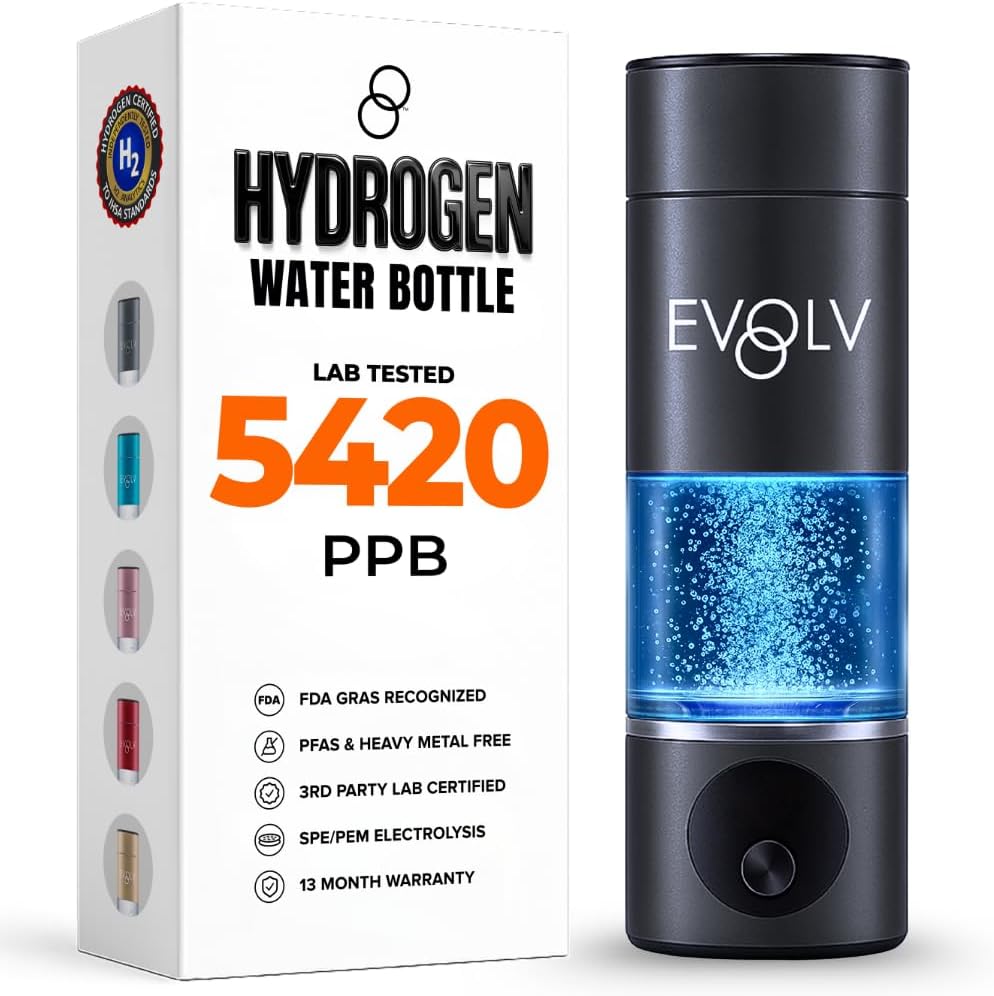
The EVOLV Hydrogen Bottle is a compact hydrogen water generator with a 4.0 rating. Its most important listed feature is a built-in exhaust valve intended to remove chlorine and ozone. The listing also says that the bottle is made from chemical-free materials and tested by SGS for safe ionized hydrogen water and zero heavy-metal leaching.
We may earn a commission when you buy through this link, at no additional cost to you.
That exhaust system addresses a practical concern in portable electrolysis: gases generated during a cycle need to leave the drinking chamber safely. The leak-resistant design and portable bottle format make the product suitable for users who want to prepare hydrogen water at home, carry it to work, or use it during travel.
The listing is limited compared with the more technical descriptions available for competing bottles. It does not state a hydrogen concentration, cycle duration, battery capacity, number of cycles, charging time, reservoir volume, or warranty. Those missing specifications make it difficult to compare output and convenience directly with models from Mirtade, PUREPEBRIX, or Fakllod.
EVOLV is best for buyers who prioritize a portable format, an integrated exhaust valve, and the cited SGS material testing over detailed performance data. It may be a practical entry-level ionizer, but buyers should review the full product page for battery life, capacity, and operating instructions. Confirm that the current package includes the charging cable and any required components.
A built-in valve gives the device a clear functional distinction from bottles that leave exhaust handling ambiguous. Removing chlorine and ozone during electrolysis can make the drinking process more comfortable while keeping the gases separate from the water.
The SGS testing and heavy-metal leaching claims are useful points of differentiation. Buyers should look for access to the underlying test scope and documentation, and confirm what was included in the testing. A general reference to safe materials is not the same as a certification for every possible aspect of the product.
We may earn a commission when you buy through this link, at no additional cost to you.
The LifeStraw Home Glass is included as a practical reference point because it focuses on verified-style filtration rather than flow restructuring or hydrogen generation. With a 4.0 rating, this seven-cup pitcher states that it removes bacteria, parasites, and microplastics while reducing lead, mercury, PFAS, chlorine, herbicides, pesticides, dirt, sand, and cloudiness.
We may earn a commission when you buy through this link, at no additional cost to you.
The filter also retains essential minerals such as magnesium and potassium. Its membrane is stated to last for 264 gallons, or about one year, while the activated-carbon and ion-exchange filter lasts for 40 gallons, or approximately two months. This two-stage replacement schedule should be considered when estimating ownership costs over time.
Unlike a hydrogen bottle, the LifeStraw does not produce molecular hydrogen, and unlike the MAYU, it does not use a vortex. It is therefore not a direct substitute for those products. Its advantage is a clearly defined filtration function, a familiar pour-and-serve format, and specific contaminant and replacement claims that are easier to evaluate than many broader hydration-device promises.
Choose this pitcher when contaminant reduction and everyday filtered water are your priorities rather than hydrogen output. It is a strong companion to a countertop reverse-osmosis or carbon system and a more conventional alternative to structured-flow products. Buyers focused on a dedicated structured-water effect should look at the MAYU or Natural Action options instead.
The stated removal list covers a broad mix of contaminants, including microbes, heavy metals, chemicals, PFAS, and particles. The ability to retain magnesium and potassium is also relevant for buyers who want filtration without stripping away all mineral character from the water.
The membrane and carbon filter do not expire together, so owners should track both replacement schedules. The carbon filter is replaced much more frequently, while the longer-life membrane provides the primary microfiltration. Tracking both components helps maintain consistent performance.
We may earn a commission when you buy through this link, at no additional cost to you.
The right structured water device depends on the treatment method, portability, capacity, maintenance, and type of water you plan to use. Comparing those factors before buying is more useful than focusing only on headline claims or numerical output.
The products in this guide use several fundamentally different approaches. The MAYU creates a continuous kinetic vortex, Natural Action uses passive flow-form chamber geometry, the hydrogen bottles use electrolysis, the Bio-Resonance console combines several stated technologies, and the LifeStraw relies on physical filtration. These methods are not interchangeable. A vortex-focused buyer may value visible movement and taste, while someone seeking a stated hydrogen reading should look for an ionizer with measurable output.
Choose the mechanism that matches your intended routine rather than assuming one category is universally superior. Consider the type of source water, whether you want an active appliance, and whether you need portable, countertop, or whole-home use.
Portable options range from a compact ionizer bottle to a small passive vessel, while the MAYU occupies countertop space and the Natural Action Whole Home requires a fixed plumbing connection. For commuting, exercise, and travel, a sealed personal bottle is generally easier to manage. Battery life, dimensions, weight, and drinking-spout construction can matter more than adding a vortex or advanced control display.
If you plan to use the device away from home, prioritize a comfortable handle, secure seal, useful capacity, and a battery plan. If your water is always available at one counter, a larger pitcher may offer better convenience without the need to carry or recharge anything.
Capacity is one of the simplest ways to separate a personal bottle from a household pitcher. The Mirtade holds 12 ounces, the Fakllod offers 460 milliliters, and the MAYU provides a substantially larger 1.5-liter carafe. A small format may encourage repeated personal servings, while a larger reservoir can support a family or a full day of countertop use.
Match vessel size to realistic drinking habits. A device that is too large may become inconvenient to clean or store, while one that is too small may need repeated preparation during a workday. Check dimensions as well as volume, particularly if the device must fit in a bag, cup holder, cabinet, or under-counter space.
Some structured water devices require charging, while others operate passively or with a fixed electrical connection. The Mirtade needs two hours for a full charge and then offers a stated 125 minutes of continuous operation. The Fakllod also requires recharging. By contrast, both Natural Action products are non-electric, and the LifeStraw uses no electricity but does require replacement filters.
Ongoing costs deserve the same attention as the initial purchase. A rechargeable device has no recurring cartridge expense, yet its output depends on battery availability. A passive device avoids both power and consumables. A filtration pitcher requires scheduled replacement components, so total ownership should be evaluated over the expected life of the product.
Hydrogen-focused products differ substantially in the information they provide. Mirtade states more than 10,000 PPB at the top setting, Fakllod lists 1,600 to 2,000 PPB, and PUREPEBRIX provides timed results up to 9,060 PPB. EVOLV and Charge The Water You Drink do not provide comparable numerical concentration information in the supplied data. For those who care about performance, a stated measurement is more useful than a broad claim.
Also consider whether testing is independently performed and whether the result is an average, minimum, peak, or target value. Published cycle times and concentration stages let you compare products more meaningfully. Lab documentation is an added advantage, but it should still be read for the exact water, method, and conditions tested.
Materials affect taste, durability, weight, and cleaning. The MAYU uses borosilicate glass, Fakllod combines borosilicate glass with food-grade rubber, Mirtade uses 316 stainless steel, and PUREPEBRIX uses BPA-free Tritan. Each material has advantages: glass reveals bubbles and resists flavor retention, stainless steel is robust, and Tritan is lighter than glass.
Check whether the device is dishwasher safe and whether electrodes or other parts require special care. A self-cleaning mode can simplify an electrolysis bottle, while a passive pitcher can be washed as part of the normal kitchen routine. Replaceable parts and their availability should also be considered before committing.
Most products need little more than filling and cleaning, but a whole-home system is fundamentally different. The Natural Action Whole Home Revitalizer connects to the main water line, requiring a suitable location and potentially professional plumbing work. Countertop pitchers and portable bottles are reversible and easy to move, making them much more suitable for renters or temporary setups.
Before buying a fixed installation, review the manufacturer's instructions and consult a qualified plumber. Confirm available space, connection compatibility, local code, and whether the warranty assumes professional installation. The convenience of serving multiple fixtures can be worthwhile, but only if the plumbing requirements fit the home.
Warranty length varies from one year for several hydrogen bottles to 10 years for the two Natural Action devices. Mirtade and PUREPEBRIX also advertise technical support, while the LifeStraw's replacement schedule provides another form of long-term support. A long warranty can make a less familiar brand more attractive because it signals greater manufacturer confidence in materials and construction.
Read what the warranty covers, including pumps, batteries, electronics, accidental damage, and normal wear. Portable hydrogen bottles depend on rechargeable cells and electrolysis components, so battery coverage is especially important. Confirm the current terms directly with the seller because policies and regional availability can change.
Begin by following the manufacturer's instructions for the specific model, especially for devices that use electrolysis, magnets, copper crystals, or a main-line installation. Use clean drinking water in a vessel approved for the device, and do not assume that every source water or additive is compatible. A countertop pitcher can generally be filled directly, while a portable ionizer should be charged before the first cycle and a whole-home system should be professionally connected.
For battery-powered hydrogen bottles, select the cycle that suits your needs and allow the device to complete it without interrupting the process. Clean the drinking spout and interior according to the manual, and use the self-cleaning or electrode-reset function when available. Passive flow devices and pitchers require less intervention, but they should still be rinsed regularly and allowed to dry with parts separated where directed.
Replace filtration components on the stated schedule, track battery charge for portable ionizers, and inspect seals, electrodes, and tubing for wear. Never submerge an electrical base or charging component unless the manufacturer explicitly permits it. For a whole-home unit, periodic visual inspections and professional servicing can help identify leaks or installation issues before they affect household use.
A structured water device is a broad category that includes products using vortex flow, passive flow chambers, electrolysis, mineral accessories, or related technologies to alter the physical experience of water. The products do not all perform the same function. Some are intended to create hydrogen-rich water, while others focus on flow characteristics, aeration, or filtration. Buyers should first decide which mechanism and outcome matter most.
No. Only the portable products specifically designed as hydrogen bottle generators use electrolysis to produce dissolved molecular hydrogen. The MAYU uses a kinetic vortex, the Natural Action products use passive flow-form designs, and the LifeStraw performs filtration. Their outputs should not be treated as equivalent or directly compared without considering the underlying mechanism.
A higher stated PPB value indicates a greater measured hydrogen concentration under the manufacturer's stated conditions, but it is not the only factor to consider. Cycle time, battery life, water mineral content, measurement method, consistency, and ease of use also affect the practical experience. A device that reaches its stated result consistently and fits your routine may be more useful than one with the highest maximum figure.
Choose a countertop device if you prepare water at home and want a larger carafe or a visible routine. Choose a portable bottle if you commute, exercise, travel, or want water ready throughout the day. A passive portable model offers the fewest charging requirements, while an electrolysis bottle provides explicit hydrogen output and cycle information. Consider how often the device will leave the house.
A structured-flow or hydrogen device should not automatically be treated as a substitute for certified filtration. The LifeStraw specifically focuses on removing listed contaminants, while the other products make broader claims about restructuring, aeration, activation, or hydrogen production. Anyone concerned about microbiological safety, lead, PFAS, or other contaminants should verify the water source and use an appropriate certified filtration method.
Hydrogen bottles need periodic cleaning and may require an electrode-cleaning or limescale-reset cycle, depending on the model. Battery-powered versions also need recharging, and wear on seals or electrodes can affect performance. Follow the stated cycle schedule and avoid interrupting an electrolysis session unless the manual instructs you to stop. Proper care is especially important for portable devices that travel regularly.
A whole-home device generally requires more planning than a pitcher or bottle because it connects to the main water line. Installation may involve cutting pipe, selecting an appropriate location, and using a qualified plumber. Confirm local requirements, warranty conditions, and physical space before ordering. Once professionally installed, the stated passive design is intended to need no electricity, filters, salt, or routine maintenance.
Start with your primary goal, then narrow by portability, capacity, maintenance, and measurable specifications. Choose the Natural Action Portable for a battery-free daily format, the MAYU for a premium countertop vortex, a hydrogen bottle for portable electrolysis, and the LifeStraw for contaminant filtration. Also review the limitations of any product you consider, because a concise description may not disclose every operating detail.
The Natural Action Portable earns the top recommendation because it combines non-electric operation, broad water compatibility, portability, dishwasher-safe construction, and a 10-year warranty without recurring consumables. The MAYU Swirl is the premium option for a dedicated countertop hydration ritual, while the Fakllod Hydrogen Bottle delivers the most approachable portable hydrogen format at a budget-focused level.
Prioritize the feature that genuinely fits your routine: measurable hydrogen concentration for an electrolysis user, visible flow and serving capacity for a countertop buyer, passive convenience for travel, certified-style contaminant removal for filtering, or whole-home coverage for a permanent installation. Avoid choosing solely on a broad wellness claim when capacity, cycle time, cleaning, and warranty information can be checked directly.
Marketplace ratings provide useful context, but they do not replace technical specifications or personal needs. Review the current listing, included accessories, warranty conditions, and return policy before ordering. Prices, promotions, and availability can change, so confirm the current offer and ensure that the selected device fits your water source, space, and daily habits.