
Purple Cable Kit 6 Pack
4.9Editor score
Twelve feet coaxial cable
Six pairs of mono plugs
Right-angle low-profile design
Builds C and S shapes
Our solderless cable kit for pedalboards guide compares ten DIY patch-cable kits for connector style, cable quality, build, and pedalboard fit.
A solderless cable kit for pedalboards lets musicians create custom-length patch cables without a soldering iron, helping keep signal connections tidy and easy to rearrange. The best kits balance sturdy connectors, dependable shielding, suitable cable length, and low-profile geometry for crowded pedalboards.
We compared ten products based on their supplied connector types, cable materials, included tools, cable quantity, assembly method, intended applications, and stated construction. The list includes traditional build-your-own kits, compact right-angle options, fixed-length ribbon cables, and a premium system designed for exceptionally close pedal placement.
Each review explains who benefits from a particular design and where its trade-offs may matter. Ratings reflect the supplied product information, while product availability, configurations, and prices can change, so readers should verify current details before purchasing a kit for their signal chain.
4.9Editor score

4.9Editor score

3.1Editor score
The comparison covers cable quantity, connector configuration, construction materials, assembly requirements, and pedalboard versatility. Although several kits share a similar DIY format, differences in right-angle design, shielding, included accessories, and fixed versus custom-length cables can materially affect the best choice for a particular rig.




The Crosby Solderless Pedalboard Cable Kit has a 4.6 rating and provides a straightforward way to make five custom patch cables. Its defining feature is an assembly process that requires no cable stripping: musicians cut the included cable to length and secure it with the supplied magnetic screws and screwdriver. That approach suits players who want a cleaner board without using a soldering iron.
We may earn a commission when you buy through this link, at no additional cost to you.
The kit includes 10 feet of shielded oxygen-free copper cable and 10 gold-tip right-angle connectors. The cable is described as low capacitance and designed to reduce noise and electronic interference, while the rugged construction is intended for stage and studio use. The connectors can remain angled for tight layouts, or their caps can be removed to create straight-ended cables, giving the kit more flexibility than a fixed right-angle design.
Its principal trade-off is output. Five cables may be enough for a compact collection of pedals, but players with more devices or several boards will need additional supplies. The straight-cable conversion also involves an extra assembly step compared with choosing a purpose-built straight connector kit. Even so, the magnetic screw system makes the kit straightforward for a first custom cable build.
Choose this kit if you want a balanced combination of shielded cable, corrosion-resistant contacts, and tool-free soldering skills. It is especially appealing for bassists, electric guitarists, and pedalboard builders who need short right-angle patch runs but occasionally require straight ends as well.
The magnetic screw connectors clamp the prepared cable without requiring insulation removal or exposed conductor soldering. The included screwdriver tightens each connection, making the process approachable for musicians assembling their first board.
The right-angle connectors support low-profile board layouts, while removable caps allow straight cable configurations. This versatility helps when connecting effects to an amplifier, switcher, or rack unit.
We may earn a commission when you buy through this link, at no additional cost to you.
The GHOSTFIRE SP-02 carries a 4.5 rating and focuses on connector flexibility. Its right-angle and straight-angle design is useful for routing between closely spaced effects as well as connecting the board to an amplifier, rack effect, or switcher. The kit includes a multi-function screwdriver and a cable-cutting device to support the full assembly process.
We may earn a commission when you buy through this link, at no additional cost to you.
Signal-related specifications include 78 inches of oxygen-free copper cable, pure copper gold-plated plugs, and tinned oxygen-free copper shielding. The stated low-capacitance construction is intended to reduce noise and electronic interference, while the nickel-plated connector design is described as resistant to corrosion and able to withstand studio and stage conditions.
Compared with a kit committed to only one connector angle, SP-02 offers more layout freedom. The corresponding trade-off is that the connector arrangement must be selected and assembled according to the desired cable direction. It also provides enough material for five patch cables, so players with a larger signal chain may need to plan purchases more carefully.
This is a practical choice for builders who want a mix of straight and angled runs without completing a soldering project. It is particularly suitable for electric guitar and bass pedalboards where short, adaptable patch cables are needed around instrument, drive, modulation, and effect pedals.
The SP-02 supports both right-angle and straight configurations. That makes it easier to match different pedal jacks and external connections without committing to one fixed cable style.
Low-capacitance oxygen-free copper cable and shielding are intended to preserve the original signal while reducing interference. These characteristics are important when several effects occupy a compact board.
We may earn a commission when you buy through this link, at no additional cost to you.
The Solder-Free Guitar Pedal Patch Cable Kit 6 Pack has a 4.5 rating and provides enough material to build six custom patch cables. It contains 12 feet of high-quality coaxial shielded instrument cable, 12 solderless 1/4-inch mono plugs, a small Phillips screwdriver, a cable cutter, and an instruction sheet. The complete accessory set makes it a practical starter package.
We may earn a commission when you buy through this link, at no additional cost to you.
A major advantage is its cable count. Six pairs of plugs provide more finished patch cables than many five-cable kits, which is useful for a signal chain containing several pedals or a board with both internal and external connections. The included cable can be cut to different lengths and formed into C or S shapes to help organize routing around the board.
The supplied details are less extensive than those of some competing kits. There is no stated nickel or gold connector finish, oxygen-free conductor detail, or straight-versus-right-angle conversion. Those omissions do not prevent basic custom patch-cable assembly, but buyers who place a high priority on connector metallurgy may want to compare those features before choosing.
This kit is best for players who want a straightforward six-cable package with the essential tools already included. It is a logical option for building a first pedalboard, replacing a group of mismatched factory patch cables, or creating a tidy set of short custom runs without learning a soldering technique.
Twelve feet of cable and 12 mono plugs can produce six finished patch cables. That makes the set easier to plan around a multi-pedal signal chain than a five-cable alternative.
A cable cutter, Phillips screwdriver, and instruction sheet cover the basic workflow. Having the essential items together reduces the need to source separate accessories before assembly.
We may earn a commission when you buy through this link, at no additional cost to you.
The GHOSTFIRE SP-01 earns a 4.5 rating and specializes in straight-angle solderless patch cables. This configuration can suit a pedalboard with moderate spacing, a signal chain that routes around the outside of the board, or connections between devices positioned in a line. The included multifunction screwdriver and cable-cutting tool support assembly and length adjustment.
We may earn a commission when you buy through this link, at no additional cost to you.
The kit contains 78 inches of oxygen-free copper cable and 10 pure copper nickel-plated plugs. Its tinned oxygen-free copper shielding is described as providing low capacitance and low noise, while the connector finish is designed to resist corrosion. The stated construction is also presented as sturdy enough for recording studios and stage performances.
Straight plugs are the central trade-off. They can leave more open space around a jack than a right-angle connector, but they may not be the most efficient solution in a densely packed board where every centimeter matters. The kit also creates five cables rather than six, so larger pedal collections may require more than one build.
Choose SP-01 when you prefer a dedicated straight-angle connector and want shielded oxygen-free copper construction without soldering. It is particularly suitable for open layouts, larger boards, and players who prioritize a conventional cable direction while retaining the option to cut custom lengths.
The SP-01 focuses on straight-angle connections, avoiding the cap-removal step used by convertible kits. It is a direct choice for pedalboards where the jacks face open space.
Low-capacitance shielded cable is designed to minimize noise and interference between effects. Nickel-plated connectors add corrosion resistance for repeated assembly and transport.
We may earn a commission when you buy through this link, at no additional cost to you.
The Low-Profile Solderless Guitar Pedal Cable Kit has a supplied rating of 4.9 and combines a generous cable allowance with compact right-angle connectors. It includes 12 feet of coaxial shielded instrument cable, 12 pairs of 1/4-inch mono plugs, a small Phillips screwdriver, a cable cutter, and an instruction sheet, allowing up to six custom patch cables.
We may earn a commission when you buy through this link, at no additional cost to you.
Its low-profile geometry is the main attraction for crowded pedalboards. Right-angle plugs can reduce the depth required around connected effects, while the ability to create C and S shapes lets the cable follow the board more closely. The solderless assembly process supports users who want precise lengths without maintaining a soldering setup.
The main limitation is specialization. The stated features emphasize right-angle construction without offering a straight-angle conversion. Buyers whose board needs a mix of angled and straight runs may find a convertible kit such as the GHOSTFIRE SP-02 more accommodating. The supplied information also gives less detail about the conductor and connector plating than some competing products.
This is an excellent match for electric guitarists and bassists who want six tidy, low-profile patch cables in a compact board. Its high supplied rating, straightforward tools, and dedicated right-angle design make it one of the strongest general choices for custom pedalboard wiring.
Low-profile right-angle plugs are designed for close pedal spacing. Compact connectors can also make the board look cleaner when cables turn immediately toward the next effect.
The included cable, 12 plugs, cutter, screwdriver, and instructions form a self-contained project. It produces up to six custom leads rather than relying on a collection of premeasured cables.
We may earn a commission when you buy through this link, at no additional cost to you.
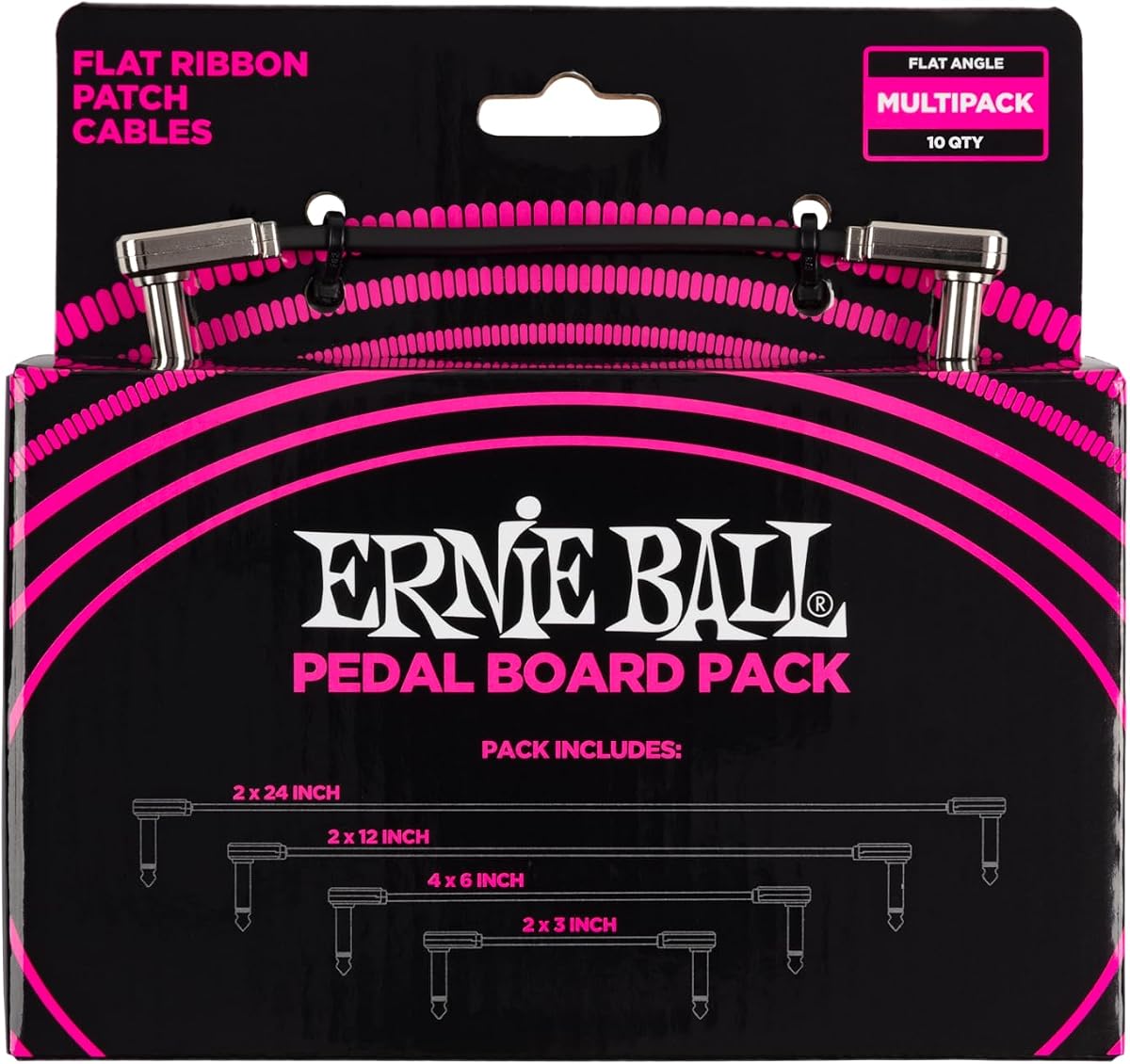
The Ernie Ball Flat Ribbon Patch Cable Multi-Pack has a 4.8 rating and offers a different approach from DIY cable kits. It contains ten factory-finished, flat ribbon cables: two 3-inch, four 6-inch, two 12-inch, and two 24-inch leads. This assortment provides common lengths for organizing a pedalboard without measuring, cutting, or assembling individual connections.
We may earn a commission when you buy through this link, at no additional cost to you.
The flat ribbon design is intended to make cables easier to maneuver and pedals easier to position. Low-profile metal connectors with built-in strain relief create a clean layout while supporting durability. The signal path uses 99.95 percent oxygen-free copper, shielding designed to preserve the signal with low handling noise, and a durable PVC exterior.
Its limitation is flexibility. These are fixed-length patch cables, not a kit for creating arbitrary dimensions. A pedalboard with unusual spacing may require a custom cable in addition to the included leads. The multi-pack also does not offer the same all-in-one DIY experience as products containing raw cable, loose connectors, and assembly tools.
Choose this product if you want an organized pedalboard quickly and prefer a set of common lengths over building every connection yourself. It is well suited to players with conventional layouts who value flat routing, compact connectors, and the certainty of factory-finished leads.
Ribbon-shaped cables sit more neatly between pedals than many round patch leads. They make it easier to position effects while maintaining a visually consistent signal chain.
The mix of short and long leads covers many common pedalboard distances. Extra length gives users options for wider spacing, while the shorter cables suit compact groups of effects.
We may earn a commission when you buy through this link, at no additional cost to you.
The 6pack Solderless Guitar Pedal Patch Cable Kit offers about 12 feet of shielded instrument cable, 12 right-angle TS connectors, a Phillips screwdriver, and a cable cutter. That material is sufficient to build six custom patch cables, giving it the same broad output capacity as other six-patch kits in the guide.
We may earn a commission when you buy through this link, at no additional cost to you.
Its distinguishing feature is the locking screw structure. The design is intended to fasten the plug and cable securely, reduce loose connections, and avoid intermittent signal problems during extended use. The cable also emphasizes bending resistance and a tough outer jacket, both useful qualities for a board that will be moved between a home space, rehearsal room, and stage.
Signal handling is addressed through a high-purity conductor and multi-layer shielding structure. The product information says these features reduce attenuation and high-frequency loss while blocking electromagnetic interference associated with hum and current noise. The kit can create both S-shaped and C-shaped routes to conserve space and keep the pedalboard orderly.
This product suits guitarists and bassists building or reorganizing a standard pedal signal chain. However, no current numerical rating is supplied, and the product specification does not identify a straight-angle option. Buyers should therefore place greater weight on the locking construction, included accessories, and stated shielding when comparing it with similarly sized kits.
The locking screw structure tightens the cable inside each plug. That design is intended to preserve a stable connection through repeated bending and long-term use.
The cable uses a high-purity conductor and multi-layer shielding to reduce signal loss and electromagnetic noise. These attributes are valuable near densely grouped effects and other interference sources.
We may earn a commission when you buy through this link, at no additional cost to you.
The BOSS BCK-12 has a supplied rating of 3.1 and offers the most specialized construction in this guide. Its 24 bi-directional connectors can be arranged for straight or right-angle connections, allowing pedals to sit as close as 1 centimeter apart. The kit includes 24 feet of studio-grade cable, enough to make twelve custom patch cables.
We may earn a commission when you buy through this link, at no additional cost to you.
Signal-related construction is the clearest premium feature. The contacts use 24K gold plating, while the low-capacitance cable is made with oxygen-free copper and braided shielding. The cable is described as ultra-pliable for clean management, and the assembly process consists of cutting the cable, clicking on a connector, and tightening the grub screws without stripping or soldering.
The rating is an important consideration. Its 3.1 score is lower than every other product with a supplied numerical rating, and the information does not explain the reasons. The extensive connector system, close-spacing design, and premium materials may still justify the kit for users focused on a densely packed professional layout, but it is not the automatic choice for every pedalboard.
Choose the BCK-12 when compact spacing, connector versatility, and high-grade contact materials matter most. It is particularly compelling for a carefully planned board in which effects need to sit exceptionally close together, provided the buyer is comfortable with the kit's more specialized design.
Bi-directional connectors support straight or right-angle arrangements and permit effects to sit approximately 1 centimeter apart. This can create room for additional gear or a cleaner physical layout.
The connectors use 24K gold-plated contacts, while the cable combines oxygen-free copper, braided shielding, and low capacitance. The stated design prioritizes signal transmission and quiet operation.
We may earn a commission when you buy through this link, at no additional cost to you.
The Purple Cable Kit 6 Pack has a supplied rating of 4.9 and a straightforward package for making six custom pedalboard leads. It includes 12 feet of high-quality coaxial shielded instrument cable, 12 pairs of solderless 1/4-inch mono plugs, a small Phillips screwdriver, a cable cutter, and an instruction sheet.
We may earn a commission when you buy through this link, at no additional cost to you.
Right-angle, low-profile connectors make the kit a natural fit for compact boards where space around each jack is limited. Players can cut the cable to their preferred dimensions and create C or S shapes to route between pedals. The complete tool set removes the need to gather basic assembly equipment separately, while the shielded cable provides a conventional foundation for instrument-level connections.
The trade-off is that the product information is concise and does not specify a straight-angle option. It also gives limited detail about the conductor material and connector finish. Those omissions make it harder to evaluate against kits that describe oxygen-free copper, gold plating, nickel plating, or multi-layer shielding in greater detail.
This kit is a strong pick for players who want six custom right-angle patch cables and value a simple, organized package. Its high supplied rating, low-profile design, and inclusion of the necessary tools make it an appealing choice for building or reorganizing a compact electric guitar or bass pedalboard.
Twelve feet of cable and 12 plug pairs allow builders to make six finished patch cables. The result is a useful foundation for a typical multi-effect board.
Low-profile right-angle connectors help cables clear neighboring effects. Their compact form supports a tidy arrangement without requiring a straight plug at every jack.
We may earn a commission when you buy through this link, at no additional cost to you.
The Orange Cable Kit 6 Pack has a 4.5 rating and provides the materials for six custom-length pedalboard patch cables. The package contains 12 feet of high-quality coaxial shielded instrument cable, 12 pairs of solderless 1/4-inch mono plugs, a small Phillips screwdriver, a cable cutter, and an instruction sheet.
We may earn a commission when you buy through this link, at no additional cost to you.
Its main organizational benefit is support for both C-shaped and S-shaped cables. Those routes can follow the edges and spaces around pedals more closely than loose coils of equal-length factory leads. Since the cable is cut to individual requirements, builders can make short runs between adjacent effects and reserve longer sections for switches or external connections.
As with several other six-packs, the product information does not detail the conductor material, plating, or connector-angle options. It is therefore best judged as a straightforward custom-cable package rather than as a premium specification-driven system. The included cutter and screwdriver nevertheless reduce setup friction for first-time builders.
Choose this kit for players who prioritize six finished custom cables, a complete basic accessory set, and tidy board routing. It is especially relevant for electric guitar and bass pedalboards that need a flexible mix of short and medium patch connections.
Cutting each lead to the actual distance between devices avoids excess cable and makes routing easier to control. The result is a cleaner signal chain and a more organized physical layout.
Coaxial shielded instrument cable provides the core connection for effects pedals. The six-plug-pair allowance supports a complete set of common internal board connections.
We may earn a commission when you buy through this link, at no additional cost to you.
The most useful kit is the one that matches your pedalboard dimensions, signal-chain length, connector direction, and assembly experience. Cable material, shielding, included tools, and connector design also influence long-term usability.
Start by estimating the number of finished patch cables your signal chain needs, then check how much raw cable and how many connector pairs the kit provides. A five-cable package may suit a compact collection of effects, while a six-cable kit gives more flexibility for common signal paths. Pay attention to the stated cable length as well, because the manufacturer may describe it in feet or inches, and the usable amount for each finished lead depends on how much is trimmed at each connector.
Choose enough material to complete the board without a large leftover margin. For most conventional pedalboards, a package yielding six custom cables is a versatile baseline, but specialized dense or multi-board systems may need considerably more.
Right-angle plugs preserve space around a jack and make short connections between closely spaced pedals easier to manage. Straight plugs can be useful at board edges, near amplifiers, or wherever the connector has open room to extend. Some kits support both styles through removable caps or bi-directional hardware, while others are dedicated to one angle.
Match the connector geometry to the physical layout. Right-angle models are generally stronger candidates for compact pedalboards, while straight or convertible products are more adaptable across different signal chains.
Pedal patch cables carry low-level instrument signals through an electrically busy environment. Shielding helps reduce electromagnetic interference, while low-capacitance cable is intended to preserve high-frequency detail and minimize unwanted loading. Oxygen-free copper, tinned copper shielding, braided shielding, and coaxial constructions appear among the supplied specifications, but buyers should distinguish the conductor from the shielding material rather than treating every cable description as equivalent.
Prioritize clear shielding information, especially for densely populated boards. Conductor purity and plating can also influence long-term durability, but they should be considered alongside fit and assembly rather than treated as the only quality indicators.
Most solderless kits avoid exposed conductor work by using screws to secure the cable within a plug. A cutter is needed to establish the finished length, and a Phillips screwdriver or multifunction tool is commonly included to tighten the connection. Instruction sheets are useful for first-time builders, particularly when the connector mechanism is not immediately intuitive.
Confirm that a cutter and suitable screwdriver are included before buying. If your kit has separate screws, caps, or other small parts, keep them in one place during assembly and check each plug for a secure connection before placing it under load.
The best custom cable is not simply the shortest one; it should also follow the board without crossing unrelated controls or pulling against a jack. C-shaped and S-shaped routes are specifically mentioned by several kits because they can link pedals while conserving space. Low-profile connectors add another layer of savings around the cable and jack area.
Measure the board and the distance between each effect before cutting. Build a little extra into the route where the cable must bend, and consider whether a right-angle plug leaves enough space for the adjacent pedal housing.
Gold, nickel, and other plated finishes are presented as corrosion-resistant options, while metal bodies and built-in strain relief can help during repeated handling. The supplied product details do not provide a universal laboratory test for every connector, so the practical indicators are the stated finish, construction, locking method, and intended stage or studio use. A locking screw design is particularly relevant where movement or repeated bending is common.
Look for a connector design that matches your habits. Screw-secured plugs suit players who expect to disassemble or rebuild boards, while fixed ribbon cables are more convenient for a board that will remain largely intact.
A solderless DIY kit offers freedom to match the exact dimensions of a board, but it requires planning, cutting, and assembly. A factory-finished multi-pack is faster to deploy and often provides a useful selection of common lengths. Flat ribbon designs can also make pedal positioning easier because their low profile and broad shape keep the connections visually organized.
Choose fixed lengths when convenience and immediate deployment matter most. Choose custom lengths when compactness, precise routing, or future board changes are more important than immediate plug-and-play use.
Most of the listed products are intended for guitar and bass effects pedals, switchers, amplifiers, and rack effects. They use 1/4-inch mono plugs suited to conventional pedalboard signal connections, but specific devices should still be checked for unusual jack requirements. The BOSS system's bi-directional connectors offer a specialized alternative rather than the same raw-cable format as the standard kits.
Confirm that the supplied connector type matches the pedals and equipment in the signal chain. The best kit is one that supports the full route without requiring adapters or leaving unnecessary cable across the board.
Begin by laying out the pedalboard and identifying every connection in order. Measure the space between adjacent effects, including the room needed for right-angle plugs and the bend where a cable changes direction. Mark the desired finished length, then cut the cable with the supplied cutter while allowing enough material for the connector entry and the planned route.
Insert the cable into the connector according to the kit's instructions, then tighten the retaining screw with the supplied screwdriver. A secure connection should hold the cable without deforming its outer jacket excessively. If a connector has a removable cap or interchangeable orientation, fit it for the intended straight or angled route. Before installing the board, test each finished cable for a stable signal and inspect the plug for looseness.
Route the cables in C or S shapes as appropriate, avoiding sharp bends, tension on the jack, and contact with footswitches. During transport, secure the board so plugs are not levered sideways. Periodically check each connection after movement, and keep the kit's small screws, caps, and tools together so missing hardware does not interrupt a rebuild.
A solderless pedalboard cable kit contains raw instrument cable, reusable 1/4-inch connectors, and usually the tools needed to cut and secure the leads. Instead of stripping and soldering a conductor to a plug, the builder inserts the cable and tightens a screw or locking mechanism. This approach makes custom patch cables more accessible and allows a board to be reorganized without a soldering setup.
Durability depends on the connector design, cable quality, assembly, and handling. A properly tightened solderless connector can provide a stable connection, while a loose one may introduce intermittent signal problems. Stage and studio use requires careful assembly, regular inspection, and adequate strain relief. Solderless designs also have the practical advantage of being repairable or reconfigurable with the correct connector hardware.
Right-angle connectors are usually better for closely spaced effects because they preserve space around each jack. Straight connectors can work well at the edge of a board or when there is ample clearance. Convertible kits suit builders who want both options, while dedicated right-angle kits simplify crowded layouts. The best choice depends on the actual spacing and the direction of the surrounding plugs.
Count the connections between effects, plus cables from the guitar or bass, to the first pedal, and from the last pedal to the amplifier or other equipment. A typical compact signal chain may need fewer finished leads than a large multi-pedal board. Kits that produce five or six cables cover many conventional arrangements, but switchers and complex routing can require more.
Most kits require a cutter to set the finished length and a screwdriver to tighten the connector screw. Many products include both, along with an instruction sheet, but shoppers should verify the package contents. A small Phillips screwdriver is commonly used, although some multi-function tools cover the required fastener. Keeping the correct tool available helps prevent overtightening or an incomplete connection.
Yes, several kits explicitly support C and S routing shapes. C-shaped leads curve around the edge of a pedal, while S-shaped leads provide a longer path between devices. The shape is created by choosing the correct length and routing the finished cable around the board. Custom lengths are especially helpful because they minimize excess cable that could create clutter.
Shielding is important because pedal-level signals are relatively low and can pick up electromagnetic interference. A coaxial or layered shielded cable is designed to reduce hum, current noise, and other unwanted effects. The overall result also depends on proper connector assembly and secure plugs, so shielding should be paired with careful installation rather than treated as the only factor affecting signal quality.
A DIY kit is preferable when precise board spacing, custom routing, or frequent reorganization matters. A fixed multi-pack is faster and often more convenient for a stable layout, especially when it includes several common lengths. Flat ribbon cables can be particularly organized, but they cannot be resized. Consider how often the board changes and how much you value a fast, finished installation.
The Low-Profile Six-Pack Kit and Purple Cable Kit 6 Pack stand out for their strong supplied ratings, six-cable output, right-angle geometry, and complete basic tool sets. They are excellent choices for compact boards that need tidy custom runs, while the Orange Cable Kit 6 Pack provides a similar practical foundation for C-shaped and S-shaped routing.
Prioritize the factors that match your physical board. Right-angle connectors help when space is tight, straight or convertible connectors suit open layouts, and fixed ribbon cables offer fast organization. For highly compact professional arrangements, the BOSS BCK-12 adds specialized bi-directional connectors, premium contacts, and the ability to place pedals extremely close together.
Before purchasing, verify the current product configuration, included accessories, connector quantity, and compatibility with your pedals. Prices and availability change over time, so check the latest listing details rather than relying on a previous observation. A careful layout plan and a properly tightened connection remain the final steps in a dependable custom patch-cable build.