
USB C SD Card Reader
4.5Editor score
Dual SD and microSD slots
Bi-directional file transfers
Works with USB-C devices
No additional software required
Looking for the best SD Card Reader for iPhone? Our expert guide compares ten options for Lightning, USB-C, card formats, speed, portability, and ease of use.
An SD card reader for iPhone is essential when photos, videos, or camera footage remain trapped on removable storage. The right adapter should match your phone’s connection, accept the cards you use, and make importing files straightforward without requiring unnecessary apps or complicated setup.
We compared ten readers based on connector design, supported card formats, transfer capabilities, device compatibility, portability, and ease of use. The list includes dedicated USB-C models, Lightning-and-USB-C options, dual-slot readers, and adapters designed for iPhones, iPads, computers, and Android devices.
Each pick highlights a different practical advantage, from broad device support to a compact format for travel or trail-camera viewing. Ratings reflect the information available for the listed products, while specifications and availability can change, so readers should confirm current details before purchasing.
4.5Editor score

4.4Editor score

3.6Editor score
This side-by-side comparison covers connector type, card support, transfer direction, and the devices each reader is designed to serve, helping you identify the most suitable option for your iPhone and storage setup.




This reader combines an iPhone connector and USB-C connector in one compact body, giving it unusual flexibility for an iPhone accessory. Its 4.4 rating reflects a well-rounded feature set, and the standout quality is the ability to move between Lightning-era iPhones, USB-C iPhones, iPads, computers, and Android devices.
We may earn a commission when you buy through this link, at no additional cost to you.
The two card slots accept SD and microSD media, which is useful for photographers and action-camera users who carry different formats. Listed transfer speeds of 20–30MB/s make it a practical option for moving photos and videos, while support for JPEG, RAW, H.264, and MPEG-4 expands the range of usable content.
Its main inconvenience is the brief five-second wait after connecting before accessing files. Older-device compatibility also depends on the stated iOS version, so buyers using an older phone should verify requirements. Even so, the combination of connectors, card support, and stated capacity handling makes the compromises reasonable.
This is the strongest general recommendation for someone who wants one reader for several devices or iPhone generations. Choose it if a single adapter must bridge Lightning and USB-C hardware and if support for both full-size SD and microSD cards matters.
The dual connector design reduces the need to carry separate adapters for older Lightning iPhones and newer USB-C models. That versatility also extends to iPads, Mac computers, laptops, and selected Android devices.
Dual slots let users access common SD and microSD cards without changing adapters. Stated support for standard photos, RAW files, and HD video formats makes the reader useful across several camera workflows.
We may earn a commission when you buy through this link, at no additional cost to you.
This reader offers a balanced set of features for photographers, trail-camera users, and anyone moving files between an iPhone and removable storage. It carries a 4.4 rating and stands out for a detachable USB-C-to-Lightning adapter, allowing the main USB-C body to serve modern devices while reaching older Apple hardware.
We may earn a commission when you buy through this link, at no additional cost to you.
The adapter supports standard SD, SDHC, microSD, and TF cards, but explicitly excludes Wi-Fi-enabled SD memory cards. Its female USB interface adds OTG functionality for compatible peripherals such as card readers, flash drives, headphones, electric guitars, and MIDI keyboards, subject to a stated 500mA current limit.
Import and export directions are both supported on iOS 13 through 18, which is more useful than a one-way import-only design. The unsupported printer and hard-drive categories, along with the restriction on Wi-Fi SD cards, limit some applications but are clearly stated limitations rather than hidden shortcomings.
This is a compelling choice for iPhone owners who want both Lightning access and modern USB-C connectivity. It is particularly attractive for users who need two-way file movement or a broader OTG adapter role rather than a basic card reader alone.
Two-way transfers allow photos, videos, documents, and other compatible files to move between an iPhone or iPad and an SD or microSD card. That flexibility supports both backups and device-to-card exports.
The female USB interface expands the reader beyond memory-card access. Compatible accessories can be connected directly, although powered or high-current devices remain outside the supported range.
We may earn a commission when you buy through this link, at no additional cost to you.
This compact reader is designed around the needs of USB-C phone, tablet, and laptop users. Its 4.3 rating is supported by a straightforward feature set: dual SD and microSD slots, plug-and-play operation, and a lightweight form suited to travel or everyday carry.
We may earn a commission when you buy through this link, at no additional cost to you.
The stated 16–31MB/s transfer range is appropriate for moving high-resolution images and video files without an application. It supports SD, SDHC, SDXC, MMC, microSD, microSDHC, and microSDXC cards, while compatibility extends to iPhone 15-series devices, iPad Pro, MacBook, Samsung Galaxy, Google Pixel, and other USB-C hardware.
The flexible TPE housing and reinforced oxygen-free copper core are presented as durability features, with the manufacturer stating resistance to more than 10,000 bends. Unlike several alternatives, it does not include a Lightning connector, so owners of older iPhones would need a separate suitable adapter.
This is a good fit for USB-C-focused users who value portability and straightforward file management. It is less suitable for anyone who needs one reader to handle both Lightning and USB-C iPhones without carrying another accessory.
The small, lightweight enclosure can move easily between a camera bag and a pocket. That makes the adapter practical when reviewing images in the field or transferring footage after a trip.
Support for standard SD, high-capacity SD, extended-capacity SD, MMC, and several microSD families covers common camera and mobile storage. No separate application is needed to access the files.
We may earn a commission when you buy through this link, at no additional cost to you.
This dual-slot USB-C reader combines a 4.5 rating with broad operating-system support and a practical port-friendly design. It is a strong value-oriented option for iPhone 15 and 16 owners, iPad users, MacBook owners, and anyone working across Windows, macOS, Linux, or Chrome.
We may earn a commission when you buy through this link, at no additional cost to you.
Both SD and microSD cards are accepted, with support listed for SDHC, SDXC, MicroSDHC, and MicroSDXC. The reader supports bi-directional movement, including batch uploads of photos and videos, and it can save data from a phone or computer onto a card through the adapter.
Its built-in expandable USB-C cable is intended to save space and allow neighboring ports to remain accessible. The main limitation is that it relies on USB-C and OTG compatibility, so it does not directly serve Lightning-equipped iPhones without an additional adapter.
This reader is an easy recommendation for buyers who want a straightforward, dual-slot adapter with strong compatibility and no app requirement. It suits everyday imports, card-to-computer transfers, and travel workflows where simplicity is more important than old-device support.
Batch uploads can reduce the repetitive work of moving many photos or videos. Reverse transfer support also makes the adapter useful for copying compatible phone or computer files onto removable storage.
The expandable built-in cable helps manage desk or bag clutter and can leave adjacent device ports usable. It is a small design benefit that becomes noticeable during repeated transfers.
We may earn a commission when you buy through this link, at no additional cost to you.
The defining feature of this reader is its 4-in-1 interface design. USB, USB-C, micro-USB, and an iOS charging port give it broad connection options, while the separate SD and microSD slots cover common removable formats. Its 4.3 rating reflects a versatile accessory for mixed-device users.
We may earn a commission when you buy through this link, at no additional cost to you.
A notable benefit is the ability to charge an iPhone or iPad while transferring data, which addresses a common concern when working with external accessories for extended periods. The reader also supports high-speed two-way transmission and real-time viewing and management of files across phones, tablets, and computers.
Compatibility covers iPhones and iPads running iOS 8.0 or later, OTG-capable Android phones, and computers with USB ports. Stated card capacity support reaches 1TB, while the keychain-style, slim enclosure makes it easier to carry or attach to a bag.
This is a sensible choice for users who own several generations of accessories or need charging during transfers. Those seeking only a modern USB-C reader may find its additional interfaces unnecessary, but the versatility gives it a distinct niche.
The integrated charging port allows an iPhone or iPad to receive power while files are being moved. This is especially helpful during longer imports from cameras or trail cameras.
The slim keychain design makes the reader easy to place in a pocket or keep near a camera bag. The attached loop also reduces the chance of leaving such a small accessory behind.
We may earn a commission when you buy through this link, at no additional cost to you.
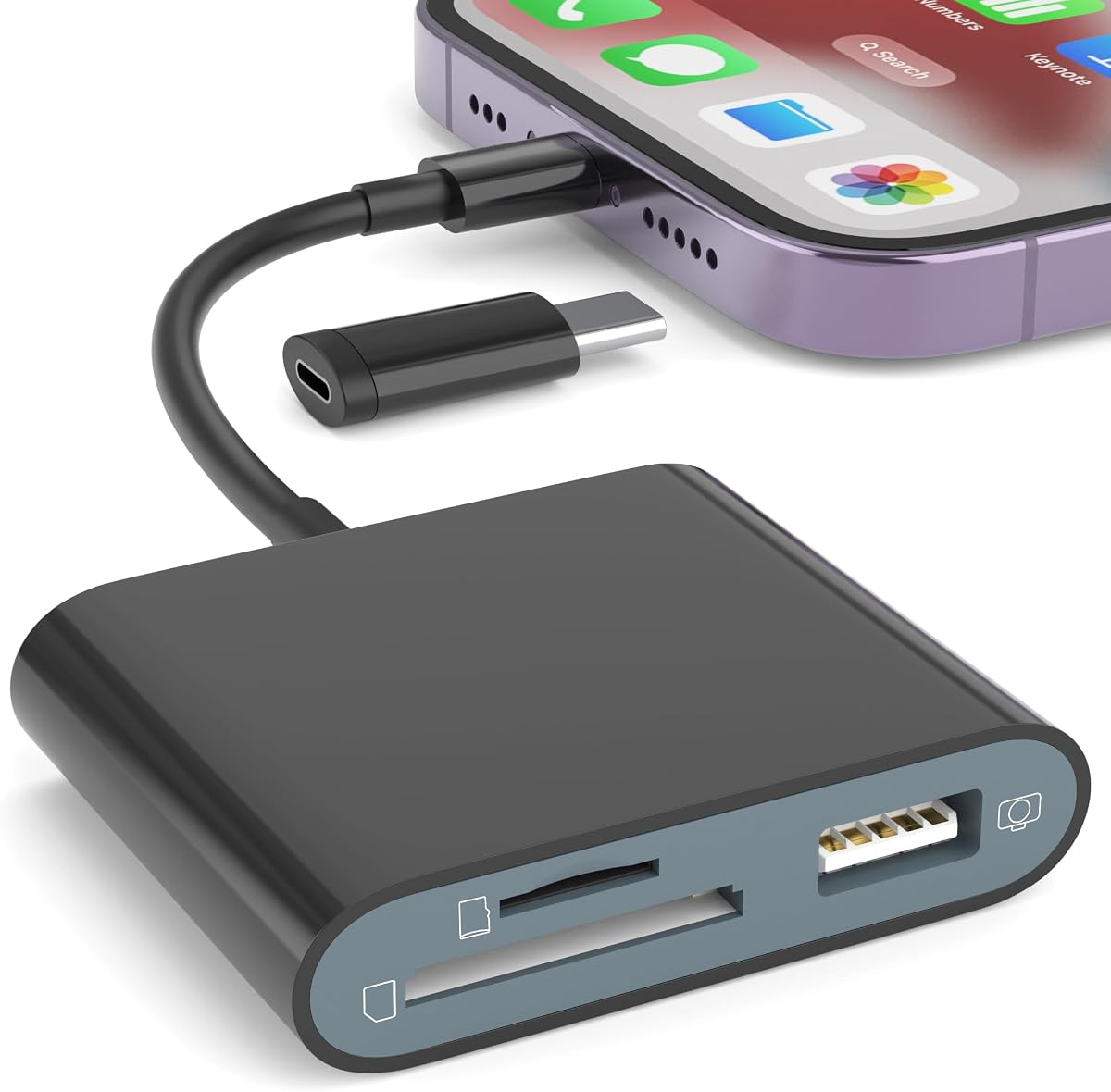
This black reader is aimed at users who want more than a simple memory-card adapter. It combines a detachable USB-C-to-Lightning adapter, dual card slots, and a female USB interface that can connect compatible cameras, flash drives, headphones, instruments, and MIDI keyboards.
We may earn a commission when you buy through this link, at no additional cost to you.
Its 4.4 rating reflects a feature-rich design that supports standard SD, SDHC, microSD, and TF cards. The reader works with modern USB-C iPhones, older Lightning devices, iPads, Macs, Android phones, and PCs, while JPEG, RAW, H.264, and MPEG-4 media are listed as supported.
Two-way transfers are specified for iOS 13 through 18, allowing imports to an iPhone or iPad and exports back to a card. However, printers and hard disk drives are explicitly unsupported, and peripheral power is limited to 500mA, so the OTG function is not unlimited.
This is a good option for mobile photographers, musicians, and trail-camera users who value one adapter for several kinds of equipment. Buyers who only need to import standard memory cards can find a simpler design elsewhere, but the OTG and export capabilities justify the extra flexibility here.
The female USB interface is useful with compatible digital cameras and SLR cameras, allowing supported workflows without removing the camera's own card. It can also serve other low-power peripherals.
Importing footage and saving compatible files back to a card makes the reader useful for more than one-way backups. The stated iOS range should be checked before relying on export functions.
We may earn a commission when you buy through this link, at no additional cost to you.
This reader is built for modern USB-C devices and delivers the highest stated transfer rate in the group. Its 4.5 rating, 60MB/s claimed speed, and support for modern iPhone families make it a strong choice for users who frequently move large photo and video collections.
We may earn a commission when you buy through this link, at no additional cost to you.
Compatibility is listed across iPhone 15 through 18 series, several iPad Pro and iPad Air models, MacBook Air models, and numerous Galaxy and other USB-C devices. The reader supports SD and microSD media, including digital-camera, sports-camera, drone, and trail-game-camera cards.
JPEG, RAW, H.264, and MPEG-4 are among the stated supported formats. It operates without third-party applications or an internet connection, though the instructions recommend waiting three to five seconds after connection. Importantly, the product does not support Lightning and therefore excludes older iPhones and some iPads.
This is a strong choice for USB-C-only users who prioritize fast transfers and broad modern-device support. Anyone needing older Apple compatibility should choose a dual-connector model instead, since the lack of Lightning support is the defining trade-off.
The stated transfer rate of up to 60MB/s is particularly useful for high-resolution images and video files. Users should still consider the card, device, and workload involved in each transfer.
The plug-and-play design is helpful in travel, fieldwork, and other situations where connectivity is limited. Native device functions handle access and transfers after the brief connection period.
We may earn a commission when you buy through this link, at no additional cost to you.
This white 5-in-1 adapter is the most connectivity-focused product in the roundup. It combines USB-C and USB-A connections, SD and microSD card access, an additional memory-card format, and two USB-A ports. Its 4.4 rating makes it a credible choice for users who want one device to serve an entire workspace.
We may earn a commission when you buy through this link, at no additional cost to you.
The three card slots support SD, SDHC, SDXC, microSD, TF, microSDHC, microSDXC, and listed UHS-I and UHS-II camera cards. Stated capacity support reaches 2TB, and the reader supports both reading and writing, allowing it to function as more than an import accessory.
The dual USB-A ports can support compatible devices such as digital cameras, flash drives, keyboards, and mice while a card is being accessed. The product also states over-current and short-circuit protection for safer operation. Its many interfaces make it less pocket-simple than a dual-slot reader.
This is best for MacBook, iPad Pro, recent iPhone, and Android users who regularly connect multiple accessories. It is less appropriate for someone wanting a minimal travel adapter, and older Lightning iPhones remain outside its direct connector coverage.
The dual USB-A ports allow compatible peripherals to be attached at the same time as a card is in use. That turns the device into a compact multiport hub for selected setups.
Three slots expand the reader beyond standard SD and microSD use, including listed MS-compatible media and UHS camera cards. Buyers should still confirm the exact requirements of their devices and cards.
We may earn a commission when you buy through this link, at no additional cost to you.
This USB-C adapter takes a deliberately simple approach: two card slots and a stable connection for iPhone 17, 16, and 15 models, iPads, MacBooks, laptops, and other USB-C devices. Its 4.4 rating reflects a dependable core feature set without unnecessary application requirements.
We may earn a commission when you buy through this link, at no additional cost to you.
The principal advantage is simultaneous access to SD and microSD cards. That is helpful for photographers, content creators, and users moving footage from a trail or action camera, particularly when cards contain different media and need to be reviewed together.
No drivers or software installation are required, so setup is limited to inserting a card and connecting the reader. The supplied information does not state a maximum card capacity or specific transfer speed, making those details less certain than they are for several alternatives.
This is an appealing choice for users who want uncomplicated access to two common card types. It is best suited to USB-C-only setups, while buyers with Lightning iPhones or specialized memory-card requirements may prefer a model with more explicitly listed specifications.
Supporting both SD and microSD simultaneously reduces the need to remove and replace media during a workflow. It is particularly useful when comparing images from different cameras.
The lack of required drivers keeps the setup uncomplicated across phones, tablets, and computers. Users can begin transfers immediately after inserting a compatible card.
We may earn a commission when you buy through this link, at no additional cost to you.
This corded reader is purpose-built for viewing trail-camera photos and videos on late-model Apple devices. Its 3.6 rating is the lowest among the products listed, but the specialized case-friendly connection and straightforward Files app workflow make it relevant for outdoor users who value reliability in the field.
We may earn a commission when you buy through this link, at no additional cost to you.
The cord reaches the phone's USB-C port while fitting comfortably with thick or rugged cases, including the cited OtterBox and LifeProof examples. The design specifically avoids forcing users to remove protective cases in the woods, where moisture, dirt, and limited handling time can make that inconvenient.
It supports SD, SDHC, SDXC, microSD, and standard memory chips up to 256GB. There is no auto-importing, so users can browse, save, share, or delete media while controlling how much content is copied to limited phone storage. It requires no batteries, Wi-Fi, or cellular service.
This is the best fit for trail-camera users, hunters, and outdoor enthusiasts with iPhone 15 or newer or a compatible USB-C iPad. Its 3.6 rating and narrower compatibility prevent a broader recommendation, but its corded design solves a specific problem that direct-plug readers can struggle with.
The extended connection reaches the port without requiring case removal. That makes the reader more practical in outdoor settings where keeping a phone protected is important.
Direct browsing lets users select what to save, share, or delete instead of automatically importing every file. This is helpful when a trail camera card contains a large collection of footage.
We may earn a commission when you buy through this link, at no additional cost to you.
The most important decision is connector compatibility, followed closely by card format, transfer direction, device support, and intended use. A reader that looks universal can still be unsuitable if its connector or operating requirements do not match your devices.
Choose a reader whose physical connector and stated iPhone support match your devices exactly. Also consider the iPad, Mac, and Android products you may want to use, since one adapter can cover several ecosystems only when its interfaces align.
Prioritize a reader with slots for every card you regularly use. If your work depends on a particular capacity, speed class, or bus type, confirm those details rather than assuming every card with the same physical name is fully supported.
Choose one-way transfer for straightforward card-to-device use. Choose bidirectional transfer when you need to move files in both directions or create backups directly on removable storage.
Favor a plug-and-play reader when convenience and broad compatibility are priorities. Confirm whether the product works directly with the built-in Files app, Photos app, or both before planning a specific transfer workflow.
Look for a speed figure that suits your typical workload, but do not treat it as the only performance measure. Confirm file-format support and whether the reader handles the capacity class of your card.
Balance portability against useful features. A simple dual-slot adapter is easy to carry, while a multiport or charging model may be better for a desk, field kit, or mixed accessory setup.
If you regularly use a rugged or protective case, prioritize a design that explicitly accommodates it. Otherwise, a direct USB-C or Lightning connection offers the simplest everyday carry.
Treat OTG capabilities as a bonus rather than the main selection criterion. Check the stated current limit and supported peripheral list before assuming an extra port will handle the equipment you own.
Begin by checking the card type and connector, then insert the memory card into the appropriate slot. Connect the reader directly to the iPhone or iPad using the appropriate USB-C or Lightning connector. After the short device-recognition period, open the native Photos or Files app to locate the card.
For imports, select the photos or videos you want to copy and confirm the destination in the device's storage. When using bidirectional transfer, check the iOS version and supported file types before copying files back to a card. Eject or disconnect the reader according to the device workflow before removing the card.
Handle the reader and card gently, keep the slots free of dust and moisture, and avoid forceful insertion. Do not use the reader with unsupported Wi-Fi SD cards, printers, hard drives, or high-current peripherals unless the manufacturer explicitly permits them. For outdoor use, protect the device and card from moisture even if the phone has a rugged case.
It depends on your iPhone model. iPhone 15 and later use USB-C, while older supported iPhones use Lightning. A reader with both connectors or a detachable Lightning adapter is more convenient if you use devices from both generations.
No. Connector type is only one requirement; the device must also support the needed OTG functions and a compatible iOS version. Check the product's stated compatibility list, particularly for older iPhones, older iPads, and export or two-way transfer features.
Most products in this roundup are designed for plug-and-play use with native device functions. The relevant Photos or Files app is generally used to browse and import files, rather than a separately downloaded card-reader application. Allow a few seconds for the device to recognize the reader.
Yes, if it has slots for both formats. Dual-slot readers let you use full-size SD and microSD or TF media without buying separate adapters. Some readers also offer a third slot for additional card formats, so verify the exact standards supported before use.
Only with a reader that explicitly supports two-way transfers. Several products in this guide can export compatible files from an iPhone or iPad to an SD or microSD card on listed iOS versions. The feature may not support every app, file type, or device configuration.
That depends on the reader's connector and the case's opening. Direct-plug readers can be blocked by thick cases, while a corded reader may reach around the case. The corded trail-camera option in this guide was designed specifically with thick protective cases in mind.
First confirm that the card is seated correctly and that the reader uses the connector required by your device. Wait several seconds after connecting, then reopen the app. Also verify card compatibility, device OS support, and whether the reader supports the specific card format or capacity you are using.
No. A higher stated transfer rate can help with large files, but the card itself, its write speed, the phone or computer, file sizes, and background activity all affect results. Matching realistic workflow needs matters more than focusing on the largest advertised speed alone.
The dual-slot USB-C reader with Lightning support is the most versatile general option, while the SZHAIYIJIN adapter stands out for two-way transfers and a useful female USB OTG port. For newer USB-C-only users, the compact dual-slot model and the high-speed USB-C option provide especially clean, app-free workflows.
Prioritize connector type first, then confirm the card formats, capacity, transfer direction, and device compatibility you actually need. Outdoor and trail-camera users should also consider cord length, case fit, and whether a native Files app workflow is preferable to a more elaborate multiport design.
Ratings, specifications, device support, and availability can change, and prices fluctuate over time. Before purchasing, verify the current product listing, connector, supported operating systems, and card requirements to ensure the reader remains a good match for your devices.