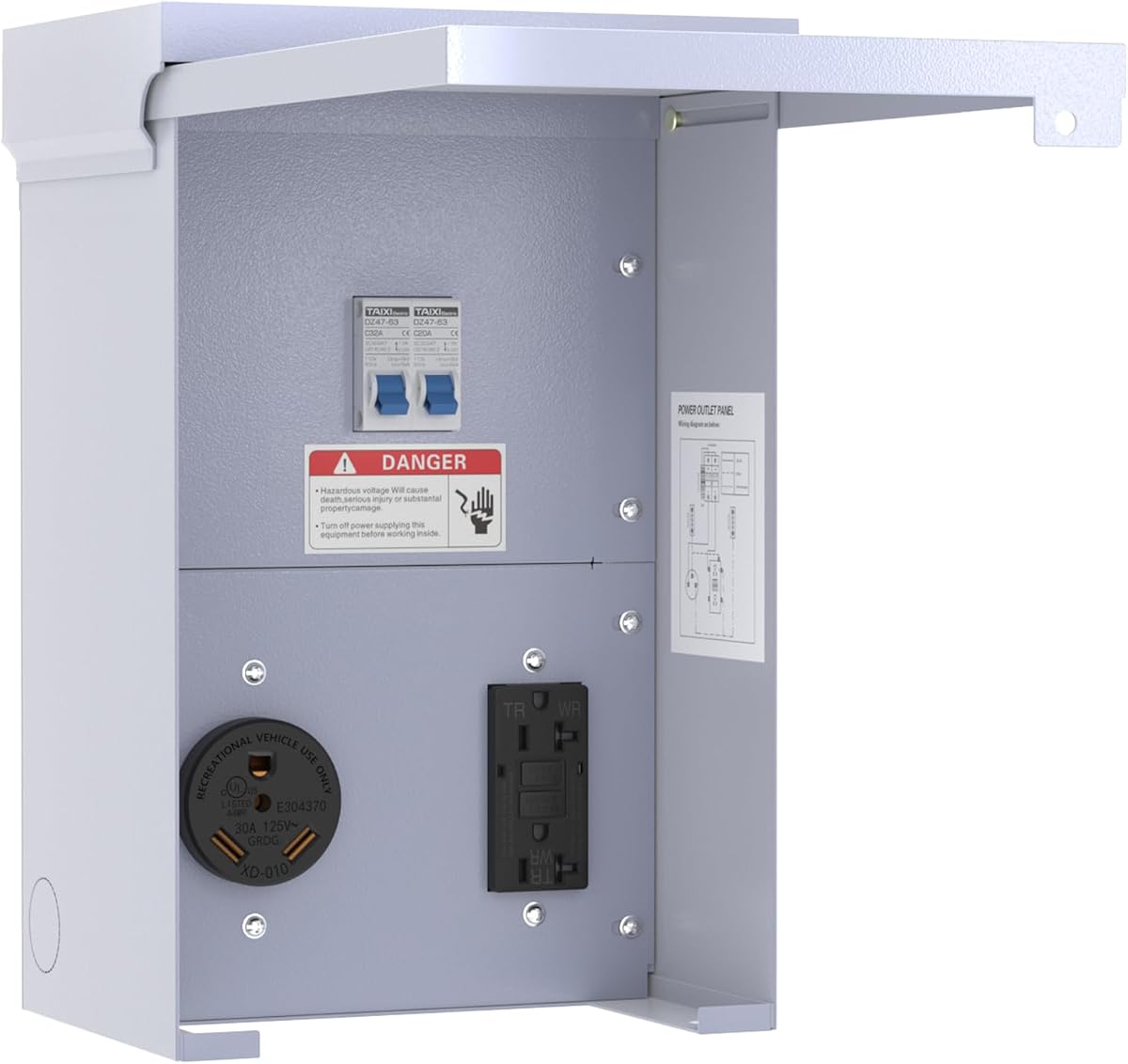
20 30 Amp RV Box
4.7Editor score
Matched 20 and 30 amp breakers
Cold-rolled steel construction
Three selectable cable knockouts
Compare 10 RV Electrical Panel with Breaker options for temporary power, RV distribution, weather resistance, breakers, and installation in this expert guide.
An RV electrical panel with a breaker can make temporary hookups safer and more convenient by combining protected receptacles, organized connections, and a durable outdoor enclosure. The right unit depends on whether you need a portable power box, an onboard distribution center, or a residential-style load center, as well as which amperage and voltage your RV uses.
This guide compares ten RV electrical panel with breaker listings based on the supplied product information, including supported amperages, breaker protection, enclosure construction, pre-wiring, mounting provisions, weather resistance, and intended applications. It covers temporary outdoor power boxes as well as integrated AC and DC distribution panels, while clearly identifying listings with limited information.
Each review explains the most useful features and the trade-offs visible from the available specifications. The top selections emphasize practical balance, installation convenience, and panel organization, while detailed buying guidance explains how to match capacity, wiring, and environmental needs. Product listings and availability can change, so confirm current specifications before purchasing.
4.7Editor score

4.4Editor score

5.0Editor score
The comparison below highlights each listing's intended role, capacity, enclosure, and installation features. Temporary power boxes appear alongside onboard distribution centers, while listings without supplied specifications are included transparently for completeness.
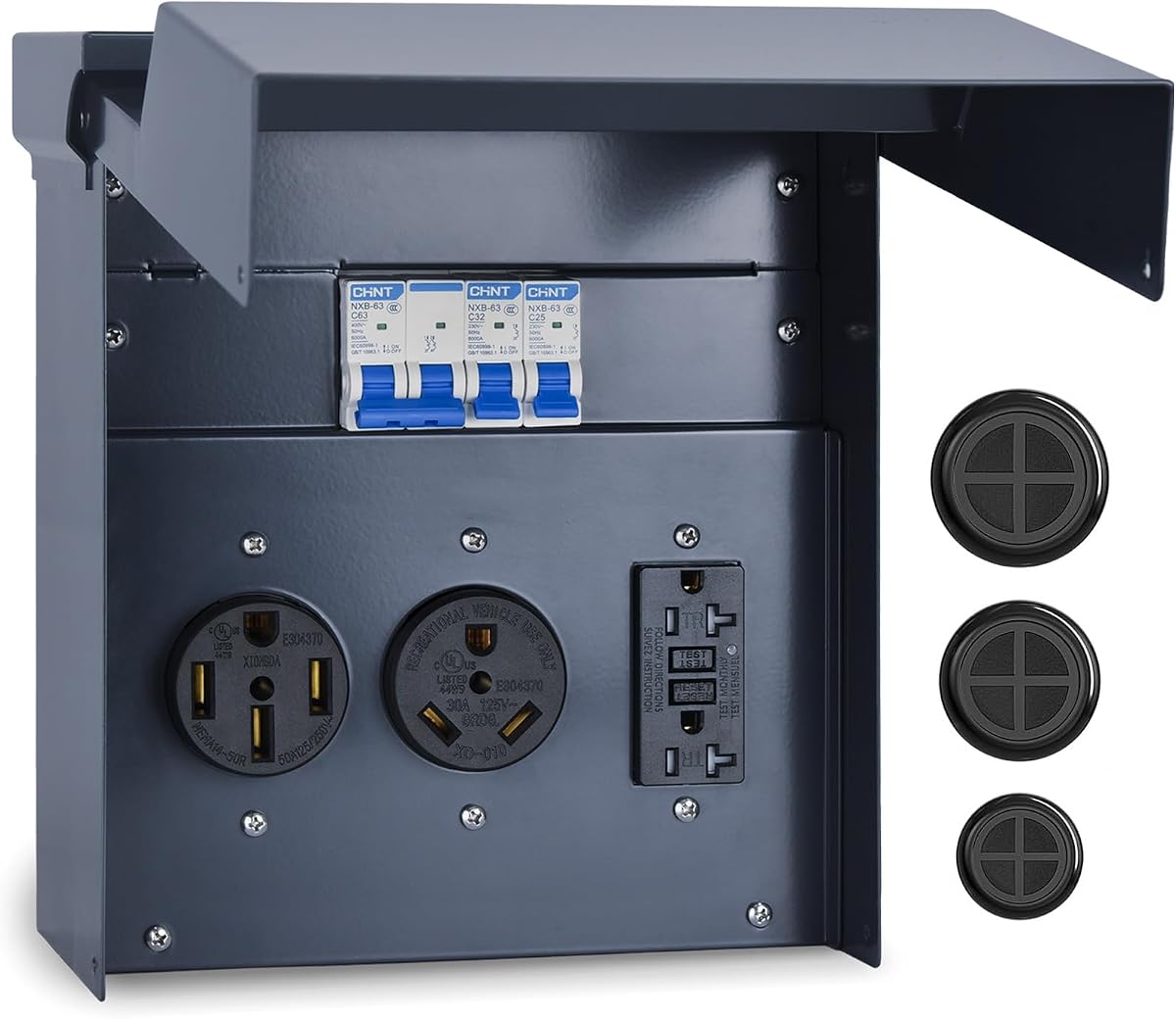


This temporary power RV outlet box is the most versatile dedicated hookup option in the group, with a supplied 4.4 rating and configurations covering 20, 30, and 50 amp power needs. Its defining advantage is the unusually accommodating enclosure, whose stated 3.5-inch panel closing height is intended to fit large plug handles and heavy cables without preventing the door from closing and locking.
We may earn a commission when you buy through this link, at no additional cost to you.
The enclosure uses high-strength cold-rolled steel with an AkzoNobel electro-galvanized anti-corrosion coating. The manufacturer reports testing to more than 2,000 hours of salt spray under ASTM B117 and resistance to fading or cracking at temperatures up to 80°C, or 176°F. Internally, the listed UL-certified socket designs use silver-plated contacts, while high-conductivity copper wiring is intended to promote stable current flow and reduce heat generation.
Installation is streamlined because the breakers and sockets arrive professionally pre-wired. Buyers connect the ground, neutral, and live conductors to the terminal board using the illustrated guide, although the panel does not remove the need for correct electrical work. The available information does not clarify every model variation within the broader 20, 30, and 50 amp offering, so buyers should verify the receptacle layout and amperage before ordering.
This is a strong choice for RV parks, construction sites, travel trailers, motorhomes, and other temporary outdoor power applications. It is especially attractive when a single hookup box must serve more than one common plug format, when cable bulk makes door closure difficult, or when corrosion resistance is a priority. It earns the Editor's Choice position for its broad fit and practical enclosure design, not because it replaces a professionally installed onboard distribution system.
The widened closing area is more than a cosmetic convenience. RV power plugs frequently have broad handles, and thick conductors need room to bend inside the enclosure without forcing the cover open. That can reduce weather protection and create an awkward installation, so the stated 3.5-inch closing height directly addresses a common practical problem.
The electro-galvanized finish is described as more resistant to salt spray, fading, cracking, and minor scratches than standard coatings. Those claims make the enclosure better suited to rain, sun, and travel environments, although owners should still keep the door closed and inspect the finish periodically.
We may earn a commission when you buy through this link, at no additional cost to you.
This blue temporary RV power box combines 20, 30, and 50 amp receptacle options with a weatherproof metal enclosure and a supplied 4.3 rating. It targets users who need a straightforward outdoor hookup panel for campers, travel trailers, mobile homes, construction sites, or EV charging, with installation features designed to make both wiring and mounting less cumbersome.
We may earn a commission when you buy through this link, at no additional cost to you.
Three pre-cut power-entry openings measure 1.18 inches, 1.45 inches, and 1.18 inches. Each uses double-sided rubber plugs intended to help exclude insects and improve resistance to moisture while retaining installation flexibility. The cover closure depth is stated to have been increased by three inches so plugs with large handles and thick cables can be accommodated more reliably.
All breakers and outlets are supplied pre-wired, leaving the installer responsible for connecting ground, hot, and neutral conductors to the corresponding terminals. A 90-degree self-latching hinge removes the need to hold the cover during wiring, while pre-installed hook slots support wall or pole mounting. The manufacturer also advises checking wire connections after shipping because movement during transport may affect terminal tightness.
This is a particularly useful alternative for temporary installers who value a hinged setup process and several cable-entry sizes. Its weather-resistant steel construction and corrosion-resistant finish suit outdoor use, while the mounting slots offer more placement flexibility than a fixed tabletop box. It does not lead the list because the supplied information offers less detail about internal conductor materials and closure depth than the first product, but it remains a well-rounded outdoor hookup option.
The self-latching hinge is a meaningful installation improvement because the cover stays in position without a second hand. That can make terminal access easier and reduce the chance of pinched conductors while the ground, neutral, and hot wires are being attached.
Three differently sized openings allow the installer to select a location that better accommodates the cable diameter and bend. Double-sided rubber plugs add some environmental protection without requiring a permanently sealed conduit fitting for every temporary setup.
We may earn a commission when you buy through this link, at no additional cost to you.
The WF-8930/50NPB is the leading onboard distribution choice, pairing a supplied 5.0 rating with support for 30 amp and 50 amp service. Its dual-mode design is intended for 120 VAC and 240 VAC input frequencies, allowing one power center to suit different RV shore-power and portable-generator access arrangements without requiring separate panels for each amperage.
We may earn a commission when you buy through this link, at no additional cost to you.
This model is notably more comprehensive than a simple temporary receptacle box. It provides 15 independent DC branch circuits and up to 12 dedicated AC branch circuits, creating room to partition lighting, appliances, pumps, electronics, and other loads. The product description also states compatibility with WF-9800 series switch-mode converters in 55A, 65A, and 75A ratings, making it potentially relevant to aftermarket builders, engineering projects, and original-equipment production teams.
Its enclosure measures 13.75 by 9.5 by 4 inches and weighs 3.75 pounds, a compact format intended for tight cabinet walls in travel trailers and motorhomes. Integrated internal wiring, electromagnetic shielding, and damping are presented as supporting quiet operation and avoiding current ripple or frequency interference with televisions, refrigerators, lighting, and Bluetooth equipment.
Choose this panel when you are building or renovating an onboard AC and DC power center rather than creating a single temporary hookup. It offers the broadest integration features in the group, including consultation and troubleshooting support, but the explicit note that an inverter is not included reminds buyers to plan the entire power system. It earns the Best Premium designation for its capacity, compactness, and distribution breadth.
Combining AC branch capacity with 15 DC circuit positions reduces the need for separate distribution hardware in a crowded service area. This is especially valuable in smaller travel trailers and motorhomes, where every cabinet inch affects storage and equipment layout.
The stated shielding and damping measures are intended to maintain stable power for sensitive onboard devices. Buyers should still verify the converter, inverter, and connected load requirements, because panel compatibility does not replace system-level electrical design.
We may earn a commission when you buy through this link, at no additional cost to you.
The 20 30 Amp RV Box is a focused temporary power panel with a supplied 4.7 rating, making it an appealing option for users who need both 20 amp and 30 amp service without the broader receptacle lineup found in some competing boxes. It is built from heavy-duty cold-rolled steel and measures 12.6 inches high by 8.5 inches wide by 6.10 inches deep.
We may earn a commission when you buy through this link, at no additional cost to you.
Each receptacle is paired with a matched circuit breaker designed to interrupt the circuit during an overload. The description states that both the RV receptacles and circuit breakers are UL certified, adding a useful layer of component-level safety and reliability. A whole-body spraying process is claimed to resist splashing water, rain, dust, snow, oil, and ultraviolet exposure, making the enclosure suitable for outdoor service.
Installation is simplified by pre-wired and assembled components, rear screw holes for hanging, and three knockouts in different positions for connecting the incoming power cord. That design can reduce routing constraints, although its stated depth of 6.10 inches should be checked against the available mounting space. The box is marketed for temporary power at construction sites and RV parks.
This is the best budget-oriented selection for 30 amp RV hookups and compatible 20 amp connections. It may be the simplest option for a user who does not need 50 amp service, a complete onboard AC and DC panel, or several mounting configurations. Correct conductor sizing, grounding, and breaker selection remain essential; the pre-wired construction saves assembly time but does not make unsafe wiring acceptable.
A 20 and 30 amp layout covers many common RV and temporary power requirements while keeping the panel simpler than a three-amperage system. It is a sensible choice when the higher-capacity 50 amp connection is unnecessary and would only add cost or unused complexity.
The full-body spray finish is intended to resist rain, dust, snow, oil, and UV exposure. Routine inspection remains important because seals, knockouts, and cable entries can wear over time even when the main enclosure coating remains in good condition.
We may earn a commission when you buy through this link, at no additional cost to you.
The supplied data for ASIN B0H25XCRCX contains no product name, rating, image, or descriptive specifications. That limited record prevents a responsible comparison of amperage, voltage, breaker design, enclosure type, or installation method. It is included in the roundup because every listed product must be represented, but its position in the ranking should not be interpreted as evidence of performance.
We may earn a commission when you buy through this link, at no additional cost to you.
The product page URL is available and should be the next source for details. A shopper should look for the exact receptacle ratings, whether each outlet has a correctly matched breaker, the enclosure material, environmental claims, wire gauge, mounting provisions, and documentation. Any required connector, conduit, or additional protection also needs to be identified before installation.
Because the record does not state the intended use, it would be speculative to classify this listing as a temporary hookup box, an onboard RV distribution center, or a residential-style load center. The safest approach is to treat it as an unverified candidate until the live listing and manufacturer documentation establish its function. Similar caution applies to any claims involving UL certification, weather resistance, or suitability for 30 or 50 amp RV service.
Do not select this option solely because it appears in a ranked list. First confirm that it is actually an RV electrical panel with a breaker, then compare its capacity and protection scheme against the verified temporary or onboard models elsewhere in the guide. If the listing lacks current specifications, a better-documented option is generally the more defensible choice for a high-voltage installation.
Open the product page and confirm the model identity, electrical ratings, included components, and installation requirements. A listing can be entirely legitimate while still providing too little information for a confident comparison.
This guide does not infer weather resistance, certification, or breaker quality where no supporting information was supplied. Accurate selection begins with documentation that identifies what the product actually is and what it includes.
We may earn a commission when you buy through this link, at no additional cost to you.
This WF-8930/50NPB power distribution center has a supplied 5.0 rating and is designed for RV AC and DC power management. It supports 30 amp or 50 amp service configurations, making it suitable for builders and replacement projects that want one organized center rather than separate AC and DC distribution components.
We may earn a commission when you buy through this link, at no additional cost to you.
The right side contains a DC fuse board with up to 15 circuit positions for 12-volt loads such as lights, fans, and pumps. On the left, the AC section accepts compatible residential-style breakers, while dedicated neutral and ground bars separate the AC wiring paths. This arrangement makes the panel easier to label and service than a loosely wired collection of inline breakers.
Status indicator lights and a door assembly with a viewing window add visibility during operation and inspection. The installation guidance is unusually direct: disconnect power, secure the panel, connect the battery positive and negative leads, land DC circuits on the fuse board, complete the AC breaker, neutral, and ground wiring, and check every terminal before energizing it.
This model is best suited to RV builders, remodelers, and owners creating a comprehensive onboard panel. It is less relevant to someone who only needs a weatherproof receptacle box at an RV park. The requirement for compatible breakers and careful battery, AC, neutral, and ground connections means it should be integrated by someone comfortable with RV electrical systems or a qualified installer.
Separate DC and AC sections make it easier to trace each load and identify the appropriate protection device. Dedicated neutral and ground bars also support a cleaner installation and can reduce wiring complexity in a crowded cabinet.
The viewing window allows users to look inside without opening the enclosure, while status indicators provide an immediate visual reference. These features are useful for routine checks, although they should supplement rather than replace physical inspections of terminals and wiring.
We may earn a commission when you buy through this link, at no additional cost to you.
ASIN B0C2CNLBLR is another listing for which the provided dataset contains no usable product details. There is no title, rating, image, description, or verified electrical specification to distinguish it from a temporary outlet box, onboard RV panel, or standard load center. Its inclusion maintains the requested ten-product structure without inventing unsupported attributes.
We may earn a commission when you buy through this link, at no additional cost to you.
A prospective buyer should open the listing and identify the manufacturer, model, panel category, voltage, amperage, number of circuits, and whether the breakers are included. Confirming the enclosure rating and intended indoor or outdoor use is equally important. Wiring diagrams, terminal markings, conductor capacity, and included mounting hardware should be checked before the panel is considered compatible with an RV.
The listing's rank is not a recommendation. Because no performance data was supplied, it cannot fairly be compared with the documented 20, 30, and 50 amp hookup boxes or the WF-8930/50NPB onboard distribution centers. In particular, it would be inappropriate to assume that a product bearing the requested keyword includes a correctly matched breaker for every outlet or can handle 50 amp RV service.
Use the live product page and manufacturer documentation as the deciding sources. If the listing confirms a well-specified RV panel with appropriate protection and installation guidance, it may become a viable candidate. If those details remain unavailable, select one of the better-documented products in the guide, because dependable electrical selection depends on known ratings and wiring information rather than search placement alone.
Start by determining whether the listing is for temporary hookup power, onboard AC and DC distribution, or a conventional residential-style load center. Each category serves a different role and should not be substituted solely by wattage.
Look for input ratings, branch-circuit capacity, terminal specifications, and the inclusion or exclusion of breakers. Those details determine whether the product can safely serve the intended RV and connected load.
We may earn a commission when you buy through this link, at no additional cost to you.
The provided record for ASIN B00H8L4WLM does not include a product title, description, image, or rating. As a result, this listing cannot be responsibly characterized as a 30 amp RV hookup panel, a 50 amp distribution center, or a breaker-equipped outdoor enclosure. Its position in the list is solely a structural inclusion rather than a performance judgment.
We may earn a commission when you buy through this link, at no additional cost to you.
Before considering it, check the product page for model identity, intended use, and included components. The key question is whether it is designed for RV service and whether every receptacle or branch circuit has the appropriate breaker. Also verify the input and output voltage, conductor capacity, environmental suitability, and whether additional hardware such as a receptacle, conduit, or bonding jumper is required.
RV electrical panels vary significantly in purpose. A temporary receptacle enclosure protects a cord connection at a campsite, while an onboard panel distributes power through an RV's internal circuits. A standard outdoor load center may be useful for a permanently installed application but could be inappropriate where a compact RV-specific interface or 30/50 amp configuration is required.
This candidate should be rejected unless its live documentation provides the missing information and demonstrates a proper match for the planned installation. Among the documented choices, the 20 30 Amp RV Box offers a straightforward temporary hookup solution, while the two WF-8930/50NPB listings are stronger options for comprehensive onboard distribution.
An outdoor enclosure does not automatically qualify as an RV-specific panel. Verify connector geometry, voltage, amperage, breaker matching, and intended application before using the listing for an RV installation.
A clear manual, wiring diagram, and specification sheet make installation planning more reliable. If those documents are not available, choose a product whose identity and electrical ratings are already established.
We may earn a commission when you buy through this link, at no additional cost to you.
No usable descriptive data was provided for ASIN B00002N7KR. The entry therefore cannot be compared on breaker type, receptacles, voltage, amperage, enclosure construction, mounting method, or environmental protection. It appears in the roundup only because the instructions require one review for every supplied product.
We may earn a commission when you buy through this link, at no additional cost to you.
The live listing should be consulted before drawing conclusions. Look for the exact model, manufacturer, and whether this is a temporary RV hookup box, a replacement onboard panel, a generator-transfer panel, or a conventional load center. If it is a distribution panel, identify the number and type of branch breakers, bus capacity, neutral and ground arrangements, and the voltage of every connection.
The distinction matters because an RV can contain both 12-volt DC loads and 120- or 240-volt AC circuits. A 30 or 50 amp shore-power connection is also not the same thing as a 30 or 50 amp branch breaker. Confusion between service amperage and branch capacity can lead to an unsuitable purchase even when the enclosure itself looks robust.
Until the missing information is confirmed, this listing is not a stronger choice than any documented model in the guide. It could become suitable for a specific installation, but only after its documentation proves that it includes the required breaker protection and is designed for the environment and connection type involved.
A 50 amp RV service rating identifies the incoming supply capacity, not the rating of every individual circuit. Confirm branch breakers separately so the panel matches both the RV wiring and the loads it must protect.
Check whether the product is intended for outdoor exposure, whether the door seals against moisture, and how the enclosure is mounted. Indoor electrical-box assumptions are not appropriate for a campsite or exposed construction site.
We may earn a commission when you buy through this link, at no additional cost to you.
The Siemens W0816ML1125CU is a 125 amp, eight-space, 16-circuit outdoor center load center with a supplied 4.7 rating. Unlike the RV-specific temporary boxes and onboard distribution centers in the list, it is presented as a conventional outdoor load center, which gives it potential value for a permanent auxiliary installation where RV-specific receptacles are not the primary requirement.
We may earn a commission when you buy through this link, at no additional cost to you.
Its listed dimensions are 15.5 inches long by 13 inches wide by 5.3 inches high, and the product information identifies a weight of 13 pounds. The gray outdoor enclosure is the supplied product identifier. Those physical details are important for cabinet planning, while the 125 amp and circuit-space ratings form the basis for determining whether it can support the proposed loads.
The supplied information does not explicitly identify this unit as an RV electrical panel with a breaker, list a 30 or 50 amp RV receptacle, or explain which breakers and accessories are included. It also does not provide a detailed installation guide. These omissions mean it should not be assumed to replace a purpose-built RV hookup box with matched 20, 30, and 50 amp outlets.
Consider the Siemens load center for a permanent, properly engineered auxiliary distribution system where a standard outdoor center is appropriate. For a temporary campsite hookup, choose one of the documented RV power boxes instead. For onboard AC and DC management, the WF-8930/50NPB models provide a much clearer specification match. A qualified installer should confirm branch breakers, conductor sizing, grounding, bonding, and local requirements.
The eight-space, 16-circuit layout and 125 amp rating suit many auxiliary distribution applications. Because the listing is not explicitly RV-specific, its suitability depends on the load layout and whether standard load-center accessories are preferable to integrated RV receptacles.
At 15.5 by 13 by 5.3 inches, the unit needs enough clearance around the door and for wiring. RV cabinet space is often limited, so measure the available cavity and account for conduit, bends, and service access before ordering.
We may earn a commission when you buy through this link, at no additional cost to you.
The right RV panel depends on whether it will provide a temporary campsite connection, distribute power inside the RV, or support a permanent auxiliary circuit. Capacity, protection, enclosure, wiring, and mounting requirements should be evaluated together before selecting a model.
A temporary power box is intended to provide a protected connection where an RV receives shore power or generator output, often at a campground, construction site, or RV park. These products generally emphasize weather-resistant receptacles, flexible cable entry, and easy mounting. An onboard distribution center is installed within the RV and organizes branch circuits for appliances, lights, pumps, fans, and other internal loads. The WF-8930/50NPB models fit the latter category because they combine AC and DC branch capacity.
Choose a temporary box for a portable hookup, and choose an onboard center for permanent internal circuit management. Do not treat a standard outdoor load center as a direct substitute for either without checking connector, breaker, voltage, and wiring compatibility.
RV hookup requirements commonly involve 20 amp, 30 amp, or 50 amp connections, with higher-capacity service normally associated with larger loads and 240-volt appliances. The selected panel must support the amperage and voltage of the source, the RV's connection standard, and every branch circuit it serves. For onboard panels, input amperage and branch capacity are separate considerations: a panel with a 50 amp service rating may still contain lower-capacity branch breakers.
Identify the RV's rated shore-power input, the connected load, and the required receptacle format before purchasing. Confirm that each outlet has a correctly matched breaker and that the internal wiring is sized for the stated load.
A breaker is a primary safety feature because it disconnects a circuit when current exceeds its permitted level. Look for branch breakers that match the amperage of each receptacle, along with clear documentation about certification and included components. In the supplied data, several temporary boxes specify UL-certified receptacles and breakers, while the WF-8930/50NPB power center accepts compatible residential-style breakers in its AC section.
Prioritize correctly matched protection, dependable terminals, and documented conductor capacity. Do not treat the presence of a reset switch as proof that every technical requirement has been satisfied; upstream wiring, grounding, and the RV's own system must also be correct.
Temporary boxes are commonly exposed to rain, dust, insects, snow, oil, and ultraviolet light. Cold-rolled steel construction, corrosion-resistant coatings, sealed covers, and rubber cable plugs all help manage those conditions. The listed products describe salt-spray testing, broad exterior coatings, or weatherproof metal enclosures, but different claims address different aspects of environmental protection. A weather-resistant body does not guarantee that every connector remains dry if the door is left open.
Inspect the enclosure, gasket, cable plugs, and knockouts before each use. Mount the box where water cannot pool around the entry points, close and latch the cover after connection, and repair damaged finishes or seals promptly.
Enclosure dimensions determine whether a panel fits the intended cabinet, wall, or pole. The documented temporary boxes range from compact outdoor housings to units with widened closure areas for large plug handles and thick cables. The WF-8930/50NPB measures 13.75 by 9.5 by 4 inches and is specifically presented as suitable for narrow RV cabinet walls. The Siemens outdoor center is larger at 15.5 by 13 by 5.3 inches, so cabinet clearance deserves extra attention.
Measure the installation area, including the full door swing and room for cable bends and service access. Choose knockouts and entry openings that align with the route of the incoming cord, and avoid placing the panel where a vehicle or stored equipment can strike it.
Pre-wired products can reduce assembly time because the internal breaker-to-receptacle connections are already completed. The installer may only need to attach the source's ground, neutral, and hot conductors to the labeled terminals. Other helpful details include a 90-degree self-latching hinge, illustrated wiring guide, rear screw holes, hook slots, and multiple knockouts. These features improve access and routing but do not remove the need for electrical knowledge.
Follow the provided diagram, verify conductor size, and check every terminal before energizing the panel. Power should be disconnected, and a qualified electrician should handle installations when the wiring path, source, or local requirements are unclear.
A panel that handles only AC hookup power solves a different problem from one that distributes both AC and DC circuits inside an RV. The WF-8930/50NPB offers 12 AC and 15 DC circuit positions, including a right-side DC fuse board for lights, fans, and pumps. Its left-side breaker section and dedicated neutral and ground bars support a more structured installation, although a converter or inverter may still be needed elsewhere in the system.
Separate the two needs clearly. Choose a portable outlet box for a temporary external connection, and choose an AC/DC center for onboard branch wiring. Verify compatibility with any converter, inverter, battery, or generator system before installation.
A useful product listing should identify the model, electrical ratings, included breakers and receptacles, enclosure material, dimensions, mounting method, and installation requirements. Four entries in this guide have no descriptive data in the supplied record, so they cannot be compared responsibly on technical merit. Their live listings may contain useful details, but buyers should not infer capacity or safety from the keyword alone.
Prioritize listings that provide a wiring diagram, certification information, compatible component details, and clear contents. If those facts remain unavailable, select a better-documented model rather than relying on assumptions.
Before connecting anything, identify the source amperage and voltage, confirm that the RV and panel are compatible, and disconnect power at the source. Mount the enclosure securely on a wall or pole, keep it away from standing water, and select the appropriate knockout for the cable. Follow the labeled terminals and wiring diagram exactly, connecting ground, neutral, and hot conductors with the specified wire sizes and tools.
After wiring is complete, inspect every terminal for looseness and verify that the cover, gasket, cable plugs, and receptacles are properly seated. Turn the power on only after the installation has been checked. A qualified electrician should perform the work if the source configuration, conductor sizing, grounding, bonding, or local code requirements are not fully understood. Do not bypass a breaker or use an outlet that does not match the RV connection standard.
For ongoing care, close and latch the door after every use and check it for moisture, dirt, corrosion, cracks, or insect entry. Clean the exterior with a dry or lightly damp cloth, avoid abrasive cleaners, and touch up scratches on the protective finish as needed. Periodically check terminal tightness when the product instructions recommend it, particularly after transport, and inspect the receptacle, plug, cable, and enclosure for heat discoloration or damage.
The correct size depends on the RV's shore-power input and the loads connected to the panel. Many RVs use a 30 amp connection, while larger units may use 50 amp service, and some applications need both 20 and 30 amp receptacles. Choose a panel whose voltage, amperage, connector, and branch protection match the RV and power source.
Some listed temporary boxes offer 20, 30, and 50 amp receptacle designs, while the WF-8930/50NPB supports switching between 30 amp and 50 amp service configurations. Having multiple connection formats does not mean every outlet can run at full capacity simultaneously. Check the panel's total load limitations and individual breaker ratings before connecting equipment.
A weather-resistant enclosure is intended to protect connections when the door is fully closed and latched, but no enclosure should be assumed immune to every weather condition. Keep the panel above pooled water, use the correct cable entry, inspect the seals and plugs, and avoid leaving the cover open during rain. Damaged components should be replaced before use.
Installation requirements vary by jurisdiction and by the complexity of the system. A qualified installer is strongly recommended for permanent onboard panels, generator connections, 240-volt circuits, and any work involving an unfamiliar power source. Pre-wiring reduces assembly work, but it does not verify source compatibility, wire sizing, grounding, bonding, or code compliance.
A temporary power box usually supplies a protected external connection for a shore-power cord at a campsite, RV park, or work site. An RV distribution center organizes internal branch circuits and may include separate AC and DC sections for lights, appliances, pumps, and other loads. The correct choice depends on where the panel will be installed and what circuits it must serve.
It provides space for up to 12 AC branch circuits and 15 DC branch circuits within one enclosure. AC circuits serve appropriate 120- or 240-volt loads, while the DC fuse board is intended for 12-volt RV systems such as lights, fans, and pumps. The actual installed circuit count and protection depend on compatible breakers, fuses, wiring, and the rest of the power system.
Disconnect the power source, remove or secure the connected cord according to the manufacturer's instructions, close the enclosure, and store the panel in a dry, protected location. Avoid hanging heavy plugs or cables from the door, and inspect the enclosure for moisture, corrosion, and impact damage before the next use.
A standard outdoor load center may support a permanent auxiliary distribution system if its voltage, bus capacity, breakers, and enclosure are appropriate. It is not automatically a replacement for an RV-specific panel with 30 or 50 amp receptacles. Confirm connector type, branch protection, conductor capacity, grounding, and local installation requirements before making that substitution.
The strongest general-purpose temporary hookup choice is the first RV electrical panel with breaker, whose broad 20, 30, and 50 amp options, accommodating closure area, corrosion-resistant enclosure, and pre-wired construction make it versatile. The 20 30 Amp RV Box is a focused budget pick for common RV connections, while the WF-8930/50NPB is the premium onboard selection for broad AC and DC distribution.
Prioritize the panel category first, then match amperage, voltage, connector format, breaker protection, enclosure conditions, and installation space. Temporary boxes suit external hookups, while onboard centers suit internal branch management. Pre-wiring, hinged access, mounting hardware, and selectable knockouts can make installation easier, but they do not replace correct sizing and sound electrical work.
Finally, verify the current listing, included components, documentation, and manufacturer requirements before ordering, especially for entries whose supplied information was limited. Electrical products and their configurations can change, so use the live listing and installation documentation as the final authority rather than relying solely on a roundup summary.