
Govee WiFi Thermometer Hygrometer H5179
4.3Editor score
Wi-Fi and Bluetooth
Two-second refresh rate
Custom range alerts
Twenty-day online storage
Two-year data export
This guide compares 10 remote temperature sensors for pets, covering cellular alerts, Wi-Fi monitoring, humidity tracking, power backup, and portability.
A remote temperature sensor for pets helps owners monitor temperature, humidity, power status, and device connectivity from a phone or computer. The best options suit different situations, including RV travel, cabins, pet rooms, greenhouses, and other remote spaces where dependable warnings can help protect animals from uncomfortable or unsafe conditions.
The products in this guide were compared using the supplied specifications, focusing on connectivity, alert options, battery life, sensing performance, data access, and suitability for pet environments. The list includes cellular monitors that do not depend on Wi-Fi, Wi-Fi hygrometers with app notifications, and a wireless indoor-outdoor display for more conventional home monitoring.
Each review explains the monitor's strongest features, practical trade-offs, and likely users. Ratings reflect the supplied customer ratings, while feature details are based on the provided product information. Prices and subscription terms can change, so readers should confirm current availability and costs on the linked product pages before purchasing.
4.3Editor score

4.5Editor score

4.6Editor score
The comparison below highlights the most important differences among cellular, Wi-Fi, and wireless remote monitors, including connectivity, alert delivery, sensing accuracy, battery capability, and data storage.




The Necto Cellular Temperature Monitor, Power Outage Alarm & Humidity Sensor earns a 4.7 rating and stands out as a well-rounded monitoring solution for pets kept in homes, vehicles, RVs, or other monitored spaces. It combines temperature, humidity, and power-outage detection with 4G cellular connectivity, making it particularly useful where a dependable Wi-Fi connection may not be available.
We may earn a commission when you buy through this link, at no additional cost to you.
Its standout feature is the combination of rapid readings and flexible alerts. The built-in sensor reads conditions every 10 seconds, while the latest reading is uploaded to the online portal every 10 minutes. Owners can establish high and low temperature and humidity thresholds, add up to five contacts, and receive unlimited text and email notifications. The three-day internal battery helps preserve monitoring and outage awareness if external power is interrupted.
Setup is straightforward: activate the device through the app, plug it into a standard wall outlet, and configure notification rules. Historical readings remain available for one year and can be downloaded as a CSV file. The main trade-off is that cellular service is included for two years and then requires a paid renewal, so owners should account for that ongoing cost when selecting a monitor.
This is a strong choice for RV travelers, pet owners in remote spaces, and households that want temperature, humidity, and outage warnings in one device. It is less appropriate for someone seeking a simple indoor sensor with no service commitment. For that person, one of the Govee models in this guide may offer a more economical everyday solution.
The built-in multi-network SIM and two years of included 4G service allow the monitor to operate independently of household internet. That makes it useful for an RV, cabin, vehicle, or other location where Wi-Fi coverage is unreliable, provided cellular service remains available in the area.
Custom thresholds, power-loss notifications, low-battery warnings, and multi-contact sharing make the monitor practical for coordinating a response. One year of stored readings also creates a useful record for identifying patterns in a pet room, vehicle, or other temperature-controlled environment.
We may earn a commission when you buy through this link, at no additional cost to you.
The Frigga 4G Cellular Temperature & Humidity Monitor with Email App Alerts has a 4.2 rating and focuses on flexible connectivity. It includes a pre-installed global SIM with two years of cellular service while also supporting 2.4 GHz and 5 GHz Wi-Fi, allowing owners to choose the most practical network for a pet room, vacation property, RV, basement, or other monitored area.
We may earn a commission when you buy through this link, at no additional cost to you.
The display refreshes every five seconds in constant-on mode, and readings can be uploaded to the app every 10 or 30 minutes. A built-in battery supports up to seven days of operation, while the device can remain plugged in for long-term use without negatively affecting battery performance. Automatic sleep helps conserve power and wakes with a button press.
Alerts are available through app push notifications, email, and an on-device voice alarm. The monitor can warn about temperature or humidity changes, power failures, freeze risks, disconnections, or drops. Shared access is useful for families, sitters, or team members, and records can be stored for up to two years and downloaded in CSV format.
The principal compromise is that app uploads occur less frequently than the local screen refresh, so remote readings are not a continuous live video-like feed. A paid cellular renewal is also required after the included period. Even so, Frigga is a compelling option for owners who want both Wi-Fi and cellular flexibility, local sound warnings, and portable battery operation.
Using Wi-Fi at home and cellular service at a cabin or during travel reduces dependence on any single connection method. Owners should still verify that the intended location has compatible cellular coverage before relying on remote notifications.
The local voice alarm is valuable when a pet is in the same room as the monitor but the owner is elsewhere. App and email notifications provide the remote response, while threshold settings determine which conditions warrant attention.
We may earn a commission when you buy through this link, at no additional cost to you.
The ALZUR Cellular Temperature Monitor for RV Pet Safety earns a 4.5 rating and is the most balanced option in this guide for owners who need dependable remote warnings. It monitors temperature, humidity, power status, and device connectivity over 4G cellular service, covering common pet environments such as RVs, vacation homes, vehicles, and other remote spaces.
We may earn a commission when you buy through this link, at no additional cost to you.
The monitor uses an industrial-grade sensing module and provides fresh readings to the app every 30 seconds. Owners can set custom temperature and humidity limits and receive app, email, and SMS notifications when conditions change. The supplied information notes 200 free SMS notifications each month, unlimited emergency contacts, and a one-year manufacturer warranty.
A bright OLED display is a meaningful advantage over monitors that only show readings through an app. Temperature, humidity, and signal strength can be checked locally. When plugged in, Always-On Mode provides continuous monitoring, while Standby Mode can operate for up to 20 days on a strong 4G signal and focus on low-temperature and power-outage warnings.
The included cellular plan lasts two years, followed by an annual renewal. Some buyers may not need the app's travel-planning and shared-memory features, but the core monitoring functions are comprehensive. For travelers, RV owners, and pet owners who want a local display alongside cellular alerts, ALZUR offers the most compelling combination in this roundup.
The OLED lets an owner check conditions without opening an app, while remote thresholds and notifications provide awareness from another location. This combination is especially useful when a pet space is in an RV, utility area, or separate room where a glanceable display adds convenience.
Always-On Mode suits powered locations, while Standby Mode extends portability for travel or storage. A strong cellular signal remains important because the device's remote warning and tracking capabilities depend on connectivity.
We may earn a commission when you buy through this link, at no additional cost to you.
The Necto RV Pet Temperature Monitor, 4G Cellular, Real-Time App Notifications carries a 4.7 rating and provides a focused cellular monitoring solution. It is designed for situations where an owner needs temperature, humidity, and power-loss visibility without depending on a local internet connection, including pet areas in RVs, cars, and homes.
We may earn a commission when you buy through this link, at no additional cost to you.
The internal rechargeable battery is listed as providing three days of operation, allowing continued monitoring and outage alerts when external power is unavailable. Low-battery and network-disconnection notifications help the owner recognize when the monitor itself needs attention. Custom high and low thresholds can be paired with up to five contacts for unlimited text and email alerts.
Sensor readings refresh every 10 seconds, and the online portal receives the latest reading every 10 minutes. Historical information is kept for one year and can be downloaded in CSV format. The app allows users to adjust thresholds, review past readings, and manage settings from a smartphone or computer.
Its main drawback is the cellular subscription structure: one year is included before renewal at a stated monthly rate. It also lacks some of the premium features found elsewhere, such as an OLED screen or an extended standby battery. Even so, the 4.7 rating, outage detection, and straightforward setup make it a solid choice for mobile pet monitoring.
A temperature alert is only useful if the owner receives it promptly. Monitoring power status and maintaining a rechargeable internal battery gives this product an advantage over a basic thermometer that only reports environmental readings.
The ability to add multiple contacts makes it easier for family members, sitters, or other caregivers to receive warnings. The relatively simple app also keeps configuration focused on thresholds, readings, and notifications.
We may earn a commission when you buy through this link, at no additional cost to you.
The Govee WiFi Thermometer Hygrometer H5179 with App Notification Alert has a 4.3 rating and represents a practical budget approach to pet-room monitoring. It sends temperature and humidity data through the Govee Home app using Wi-Fi or Bluetooth, allowing owners to check conditions or receive notifications without a cellular subscription.
We may earn a commission when you buy through this link, at no additional cost to you.
A Swiss-made sensor is specified for temperature accuracy within ±0.54°F and humidity accuracy within ±3% relative humidity. Readings refresh every two seconds, which is especially noticeable in indoor pet spaces where small environmental changes may matter. Owners can preset acceptable temperature and humidity ranges and receive an app alert when readings leave those ranges.
The product supports widget display, 20 days of online data storage in the app, and export of data covering up to two years. A lanyard loop makes the device easy to position on a shelf, wall, or other suitable indoor location. The package includes the gauge, lanyard loop, and user manual.
It does not monitor power outages or work independently of internet service, and the supplied information does not state a battery-life specification. These limitations make it less appropriate for an RV, cabin, or other location without reliable Wi-Fi. For an ordinary pet room or kennel area, however, it offers an effective and economical way to track conditions.
The two-second refresh rate provides quick changes in temperature and humidity readings. That responsiveness is useful in a nursery-like pet space, recovery area, or climate-sensitive room where an owner wants timely warnings.
The device uses the owner's existing Wi-Fi and Bluetooth connection, avoiding ongoing cellular service. It is best suited to homes with dependable 2.4 GHz Wi-Fi and less appropriate for truly remote monitoring.
We may earn a commission when you buy through this link, at no additional cost to you.
The Govee WiFi Thermometer Hygrometer H5103 with Electronic Ink Display has a 4.2 rating and is designed for owners who want a local display without sacrificing remote app access. Its easy-to-read electronic ink screen shows environmental information locally, while the Govee Home app provides remote viewing and threshold alerts through Bluetooth or 2.4 GHz Wi-Fi.
We may earn a commission when you buy through this link, at no additional cost to you.
The built-in Swiss-made sensor is specified to provide temperature accuracy within ±0.54°F and humidity accuracy within ±3% relative humidity, with readings refreshing every two seconds. The electronic ink display and approximately six-month battery life improve the device's practicality for pet rooms, basements, or other indoor locations where frequent charging would be inconvenient.
Users can configure preset temperature and humidity ranges and receive an app alert when conditions move outside them. The app offers 13 days of online graphs and export of up to two years of data. That longer export period can help owners compare conditions over time or retain a record for caregivers and veterinary discussions.
This model is limited to 2.4 GHz Wi-Fi, does not offer cellular service, and cannot report power outages. It is therefore a better fit for a home with stable internet than for an off-grid cabin or traveling pet enclosure. Its strong feature set and long stated battery life make it a good alternative for users who prefer a visible screen over a cellular subscription.
An estimated six-month battery life reduces charging frequency, while the electronic ink display keeps local readings easy to inspect. The replaceable 1.5-volt AA alkaline battery adds another practical element for long-term indoor use.
Owners can configure ranges in the app and still glance at the display when checking on a pet. This combination is useful for daily monitoring in a home where a fully cellular device would add unnecessary complexity or service expense.
We may earn a commission when you buy through this link, at no additional cost to you.
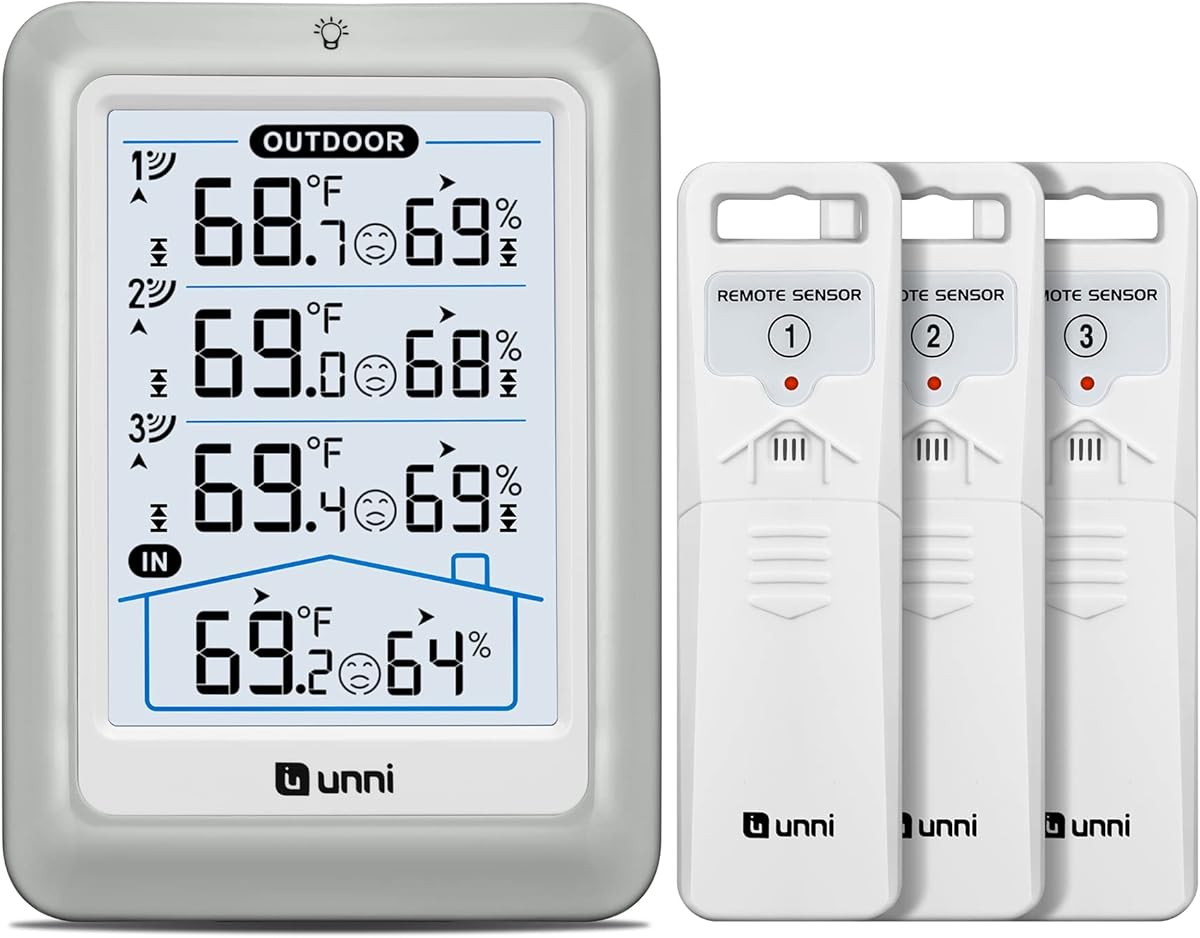
The Indoor Outdoor Thermometer Wireless 4.5 Inch Display Digital Hygrometer has a 4.4 rating and offers local rather than app-based monitoring. It includes three outdoor sensors and a large console display, allowing an owner to track several locations and compare indoor or outdoor temperature and humidity readings from one place.
We may earn a commission when you buy through this link, at no additional cost to you.
The wireless system transmits data as far as 330 feet and updates every 30 seconds. Indoor temperatures cover 14.2°F to 122°F, outdoor temperatures cover -40°F to 158°F, and humidity readings span 20% to 95%. Stated accuracy is ±2°F for temperature and ±5% for humidity. Features include trend indicators, Celsius and Fahrenheit switching, a comfort level, outdoor alerts, daily high and low records, and a low-battery indicator.
The display can run from USB power or batteries, offers three backlight brightness levels, and can sit on a table or be mounted on a wall. This makes it useful in a home where a pet has access to an indoor room while the owner monitors outdoor conditions. The included one-year warranty excludes batteries.
Unlike app-based and cellular devices, this system does not provide remote phone notifications, cloud history, or access while away. Maximum and minimum records reset automatically every 24 hours. It is best for owners seeking convenient local awareness across multiple sensors rather than comprehensive remote pet monitoring.
Three remote sensors make it possible to compare different parts of a property or distinguish indoor readings from outdoor exposure. This can help an owner understand how conditions vary around a pet's usual location.
Bold figures, selectable backlight levels, and a tabletop or wall-mountable design make the console convenient to check. A person caring for pets in the home can see changes without opening an app, although distant caregivers will not receive alerts.
We may earn a commission when you buy through this link, at no additional cost to you.
The 4G RV Pet Monitor, Remote Cellular Temperature & Humidity Sensor carries a 4.6 rating and is the premium choice in this guide. Its most notable advantage is the stated 60-day rechargeable battery backup, which provides a substantial reserve for power interruptions and extended periods away from an electrical outlet.
We may earn a commission when you buy through this link, at no additional cost to you.
The device connects over 4G without requiring Wi-Fi and is intended for RVs, pet spaces, cabins, greenhouses, freezers, and remote properties. Users can receive SMS, email, sound, and light alerts for temperature, humidity, power outages, low battery, and offline status. Thresholds are customizable, and unlimited contacts may be added for family or team coordination.
A local LCD refreshes every two seconds, while upload intervals can be adjusted from three to 160 minutes. Data can be stored locally and in the cloud, with report exports in CSV, Excel, and PDF formats. The specified measurement range extends from -4°F to 140°F with 0.6°F accuracy, and humidity from 0% to 100% relative humidity with 3% accuracy in non-condensing environments.
Two years of cellular service are included, after which an annual renewal applies. Optional FALA IOT external sensors are sold separately, so owners requiring more specialized sensing may need additional accessories. Even without them, the long battery, local display, flexible uploads, and broad alert support make this an excellent premium monitor for extended remote pet care.
A 60-day battery runtime provides a strong buffer when power is interrupted or a portable installation lacks continuous electricity. The monitor can continue collecting information and sending warnings rather than becoming an inactive thermometer during an outage.
Local and cloud storage, multiple export formats, and unlimited users suit pet-care teams, families, and shared properties. Adjustable upload intervals also help owners balance timely awareness against communication and battery demands.
We may earn a commission when you buy through this link, at no additional cost to you.
The WiFi Temperature & Humidity Sensor, Data Logger, No Subscription has a 4.3 rating and targets owners who want advanced logging without paying for cellular service. It supports 2.4 GHz Wi-Fi and is listed for greenhouses, RV pet safety, cold storage, homes, server rooms, and other monitored environments.
We may earn a commission when you buy through this link, at no additional cost to you.
The built-in sensor is specified to operate from -4°F to 140°F with ±0.6°F accuracy and from 0% to 100% relative humidity with ±3% accuracy. A seven-hour charge supports up to four months of operation, providing a useful balance between portability and maintenance. FALA IOT external probe sensors are supported when a more specialized measurement location is needed.
Alerts can be delivered through text, email, and the device's buzzer and flashing LED, covering temperature or humidity fluctuations, low battery, power outages, and offline status. Logging intervals range from one to 60 minutes, with more than 30 days of offline storage and up to one year of cloud history. CSV, Excel, and PDF exports support record keeping.
The lack of a monthly subscription is a major advantage over cellular monitors, but reliable 2.4 GHz Wi-Fi is essential. It therefore fits a pet room, home, or connected RV better than an off-grid location. For owners who prioritize long-term data, multiple users, and local as well as remote alerts without recurring service fees, it is an excellent option.
This model separates environmental tracking from cellular service, making it attractive for owners who need historical evidence but do not require remote connectivity. One year of cloud history and several export formats also help with record review and trend analysis.
The local buzzer and flashing LED provide immediate awareness near the monitor. Text and email notifications cover remote awareness, while offline storage helps preserve readings if the network briefly becomes unavailable.
We may earn a commission when you buy through this link, at no additional cost to you.
The Elitech 4G Cellular RV Pet GPS Temperature Humidity Monitor Loget260 has a 5.0 rating and brings a more advanced, data-oriented approach to remote monitoring. Although its capabilities extend beyond basic pet temperature checks, those features make it useful for owners who need reliable records from an RV, vehicle, travel setting, or other mobile environment.
We may earn a commission when you buy through this link, at no additional cost to you.
Standard sensors cover external temperature from -40°C to 85°C, humidity from 0% to 100% relative humidity, light from 0 to 52,000 lux, shock from 0g to 16g, and location through LBS. Optional humidity, pH, and carbon dioxide sensors are also supported. This wider sensing package can help distinguish environmental changes from a pet's immediate comfort conditions.
The Loget260 stores up to 100,000 offline record points and uploads them after the network returns. Shadow-data recording helps ensure that important measurements continue even if a user forgets to activate the device or accidentally stops it. Remote data can be viewed through the Elitech iCold app, while alarms may be delivered by app, SMS, email, platform notification, sound, screen, or indicator light.
Two years of cloud service and three years of data output storage are included. Upload intervals can range from one minute to 24 hours, and custom areas can use manual, timed, or electronic-fence activation. The product is more specialized and potentially more complex than a basic home hygrometer, but for buyers who value resilient records and multi-sensor data, its 5.0 rating and feature depth are compelling.
Local storage of 100,000 points and shadow recording protect the monitoring history when connectivity is interrupted. This is especially relevant to mobile use, where network gaps and unexpected stops are more likely than in a fixed home installation.
Location, light, shock, and optional pH or carbon dioxide inputs provide a broader view of the monitored environment. These measurements can make the Loget260 useful for travel, cold-chain, research, and specialized pet-care applications.
We may earn a commission when you buy through this link, at no additional cost to you.
The right remote pet temperature sensor depends on where the animal will be monitored, how quickly the owner needs to be warned, and whether dependable internet or cellular service is available.
Connectivity is the most important distinction among these products. Wi-Fi models are economical and easy to configure in a home, but they depend on a stable 2.4 GHz network and may not send useful alerts if the internet fails. Cellular monitors use a built-in SIM and 4G service, making them better for RVs, cabins, vehicles, and remote properties. The Frigga model adds the flexibility of both 4G and Wi-Fi, while the Necto, ALZUR, 4G RV Pet Monitor, and Elitech Loget260 prioritize cellular independence. The Unni thermometer uses local wireless sensors rather than internet-based remote access.
A sensor's local refresh rate is not always the same as the rate at which information reaches an app. The Govee H5179 and H5103 refresh readings every two seconds, the Unni system updates every 30 seconds, and the Necto monitors use ten-second sensor refresh intervals. The Frigga screen refreshes every five seconds, while ALZUR sends fresh readings to its app every 30 seconds. Upload timing matters when an owner needs remote awareness quickly, particularly for a pet in an RV during travel. Shorter intervals may provide faster remote information, but owners should also consider battery use and how often alerts or historical records are required.
Battery life determines how useful a monitor is during travel or an outage. The Necto monitors list three days of internal battery operation, Frigga lists up to seven days, and ALZUR offers up to 20 days in Standby Mode. The 4G RV Pet Monitor leads the cellular group with a stated 60-day rechargeable battery backup. The WiFi Data Logger can operate for up to four months after a seven-hour charge, while the Govee H5103 lists approximately six months of battery life. Several monitors are designed to remain plugged in, so owners should distinguish ordinary battery life from outage backup rather than treating the figures as equivalent.
Useful alerts depend on thresholds that match the animal, location, and season. All of the connected monitors allow temperature thresholds, while many also support humidity limits. A pet that has just been groomed, a recently transported animal, and a pet recovering in a climate-controlled room may have different safe-condition needs. Owners should avoid alarm settings that are so narrow that ordinary daily fluctuations cause constant notifications. The Govee models and all cellular products in the list support app alerts, while the 4G RV Pet Monitor also supports sound, light, email, and SMS notifications. Multiple contacts and shared access are useful when a sitter, family member, or caregiver must respond.
Accuracy specifications help determine whether a monitor is appropriate for a particular environment. The Govee H5179 and H5103 specify temperature accuracy of ±0.54°F and humidity accuracy of ±3% relative humidity. The 4G RV Pet Monitor states ±0.6°F and ±3% accuracy, with an operating range from -4°F to 140°F. The Unni system lists ±2°F temperature accuracy, ±5% humidity accuracy, and a broad outdoor range. The Elitech Loget260 provides a wider collection of sensor inputs, including external temperature, humidity, light, shock, and location. Accuracy figures from different manufacturers are not necessarily measured under identical conditions, so the range and placement should receive equal attention.
Historical readings can reveal recurring hot or humid periods, help assess whether a room is stable, and provide a record for communication with a veterinarian or pet-care professional. The Necto products store readings for one year, Frigga for up to two years, and the WiFi Data Logger offers up to one year of cloud history with CSV, Excel, and PDF exports. The 4G RV Pet Monitor supports local and cloud storage with the same three export formats. Govee devices provide online graphs and longer export windows. The Loget260 goes further with 100,000 offline record points and three years of data output storage. More history is useful for analysis, but it should complement rather than replace timely alerts.
Placement can influence both accuracy and the usefulness of a remote sensor. For a pet room, avoid direct sunlight, heating vents, air conditioners, doors, and other locations that create rapid artificial swings. In an RV or vehicle, secure the device so it cannot be moved or knocked over, but maintain airflow around its sensors. Cellular monitors need a usable signal, while Wi-Fi models need a stable 2.4 GHz connection. Local displays can help sitters check conditions without an app. Plug-in operation is convenient for fixed locations, and a portable or battery model is more useful when the animal's space changes. The Unni system is better suited to local comparison across several points than to away-from-home notifications.
Cellular monitors commonly include service for an initial period, but renewal terms vary among the products. Some include two years of service, while one lists one year, and renewal structures include monthly and annual options. Owners should treat the included period as a practical trial rather than a permanent no-fee service. App compatibility, the number of shared users, account requirements, and notification channels also deserve attention. The Govee H5179, H5103, and WiFi Data Logger avoid subscription requirements but need reliable Wi-Fi. The Unni system also operates locally. Before buying, confirm that the notifications you want are available and that the planned pet location has the required network coverage.
Begin by activating the device and creating the required app or cloud-platform account. For a cellular model, confirm that the included service is active and that the pet location has compatible 4G coverage. For a Wi-Fi model, connect the sensor to a 2.4 GHz network, or use Bluetooth where the product supports local setup. Update the app, set temperature and humidity thresholds, and add every contact who should receive warnings.
Place the sensor in a stable, ventilated position where pets cannot knock it over or chew the power cable. Keep it out of direct sunlight and away from heaters, air conditioners, exterior walls, and open doors. Set limits that account for the animal's age, coat, health, and current routine. Test a notification by temporarily moving the unit or creating a harmless threshold condition, then confirm that text, email, push, sound, or light alerts reach the intended recipients.
Check the battery, signal strength, and most recent reading regularly. Recharge or replace batteries according to the manufacturer's guidance, and keep the device connected to external power when its location allows. Clean the exterior with a dry or lightly damp cloth, avoiding liquid entry into vents or seams, and do not immerse the sensor. Review stored trends, update contacts, and verify the cellular service or Wi-Fi connection before the pet moves to a new location.
Yes, cellular models use 4G service and do not need a Wi-Fi connection. They are particularly useful in RVs, cabins, vehicles, and remote locations, provided cellular coverage is available. Wi-Fi models generally require a stable 2.4 GHz network, while the Unni system sends readings to a local display without internet access.
The ideal range depends on the species, age, coat, health, and acclimation to the environment. Rather than relying on a single universal number, observe the pet and set thresholds that identify meaningful changes without triggering constant false alarms. A veterinarian can provide guidance for an animal with special temperature or humidity needs.
Frequent local readings are useful for noticing short-term changes, while remote upload speed determines how quickly an owner receives information. Listed refresh intervals range from two seconds to 30 seconds, and cellular models may upload less frequently. For travel or high-risk locations, choose a model with timely remote uploads and test notifications before leaving.
Initial cellular service is included with each cellular model, but the length and renewal structure differ. Some provide two years of service, one lists one year, and renewal options include annual or monthly plans. Owners should compare the ongoing service cost with the value of remote alerts rather than considering the included period alone.
Most connected products in this guide support shared access or multiple recipients. Cellular and cloud-based monitors can notify several contacts, while the Govee and WiFi Data Logger products support multiple app users. The Unni display is primarily local and does not provide the same remote collaboration features.
It depends on the device. Models with internal rechargeable batteries can continue monitoring and sending alerts for a stated period, ranging from several days to as much as 60 days for the premium 4G RV Pet Monitor. Plug-in-only Wi-Fi devices may stop reporting after external power is lost, so battery specifications are important for outage readiness.
Only if the manufacturer considers the placement safe and the device is protected from chewing, moisture, impact, and blocked airflow. A carrier can create rapid temperature changes and poor circulation. The sensor should also remain accessible for servicing, and wiring should never create a strangulation or chewing hazard.
Place the sensor away from sunlight, vents, doors, heaters, and other sources of rapid change. Set realistic high and low thresholds, allow a brief adjustment period after moving the animal or changing its bedding, and test the alert system. If notifications remain disruptive, review the historical data and adjust the range rather than disabling important warnings entirely.
The ALZUR Cellular Temperature Monitor is the strongest all-around choice because it combines no-Wi-Fi cellular monitoring, a local OLED display, customizable alerts, and up to 20 days of standby operation. The Govee H5179 is the best budget option for a connected home, while the 4G RV Pet Monitor takes the premium role with a stated 60-day battery and extensive reporting features.
Before choosing, prioritize the environment where the pet will spend time. Stable home Wi-Fi favors a Govee model, local multi-sensor awareness favors the Unni display, and travel or remote monitoring generally calls for 4G cellular service. Also consider backup power, notification delivery, shared access, and whether a long-term data history will be useful.
Finally, check the current product page for availability, compatible networks, included service, and renewal terms before ordering. Prices and subscription conditions can change, and a monitor that fits the location and alert needs is more valuable than one with features that will never be used.