
Micca M-8C
4.7Editor score
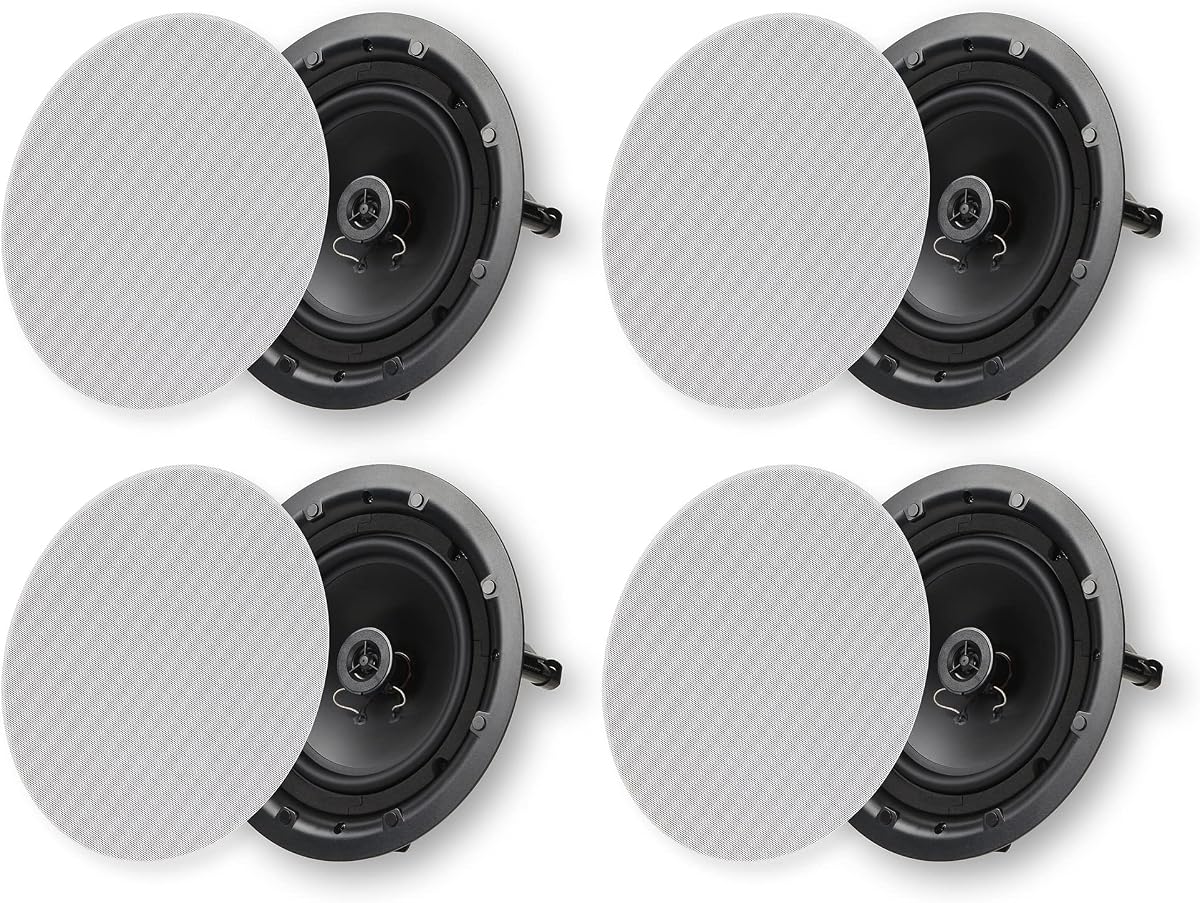
High-excursion eight-inch woofer
Pivoting silk dome tweeter
Forty-hertz low-frequency response
Minimal-profile paintable grille
Quality ceiling speakers can deliver detailed, room-filling sound without occupying shelves or competing with furniture. The right model depends on driver design, dispersion, power handling, installation depth, and the acoustic demands of your room. A capable installed speaker should combine natural tonal balance with enough output for music, movies, and distributed home audio.
We compared ten highly rated ceiling and in-ceiling options using the specifications and product details provided by each manufacturer. The guide covers driver configuration, frequency response, sensitivity, impedance, power handling, mounting requirements, grille design, weather-related features, and intended applications. It also distinguishes single speakers, pairs, and multipack systems for different installation needs.
Each selection highlights the reasons it stands out while acknowledging practical trade-offs and installation requirements. The top recommendations range from compact units for background listening to three-way home theater systems and larger models for more demanding spaces. Product availability, promotional offers, and prices can change, so confirm the current listing and specifications before purchasing.
4.7Editor score

4.7Editor score

4.5Editor score
As an Amazon Associate we earn from qualifying purchases.
The comparison below places all ten models by driver design, frequency response, installation requirements, and intended use, making it easier to identify the right speaker for a particular room or system.



The Polk Audio RC80i earns a 4.7 rating and stands out as a strong all-around ceiling speaker for music, movies, and distributed home audio. Its 8-inch Dynamic Balance woofer supplies more cone area than compact alternatives, while the 1-inch aimable tweeter gives installers useful control over where the high frequencies are directed.
We may earn a commission when you buy through this link, at no additional cost to you.
The mineral-filled polymer cone is designed to improve damping and reproduce both music and movie effects with enough body to fill a typical living space. A rubber seal helps prevent moisture from entering the enclosure, making the pair suitable for bathrooms, kitchens, and covered porches. Paintable aluminum grilles help the speakers blend into the ceiling rather than becoming visual focal points.
The main compromise is physical size. An 8-inch driver requires a larger ceiling cutout, and the listing includes a pair rather than one loose speaker, so it may be less convenient for a single unusual room or a tightly planned renovation. Ceiling height and available cavity depth should still be checked before cutting drywall.
This is our top overall recommendation because it combines a substantial woofer, adjustable high-frequency output, useful environmental protection, and a restrained appearance. It suits buyers who want one capable model for several rooms or a solid two-channel or surround-sound foundation without moving to a specialist three-way design.
The larger 8-inch woofer offers a meaningful advantage when low-frequency output and full-bodied music matter. That makes the RC80i more convincing for open-plan living areas than a smaller ceiling speaker, provided the amplifier and room dimensions support the demand.
The aimable tweeter can be directed toward the main listening area rather than relying entirely on the ceiling opening for dispersion. This is useful in rooms with unusual layouts, extended ceilings, or multiple listening positions.
We may earn a commission when you buy through this link, at no additional cost to you.
The Micca M-8C carries a 4.7 rating and offers an unusually complete specification set for a value-oriented installed speaker. It combines a high-excursion 8-inch poly woofer with a pivoting 1-inch silk dome tweeter, supported by a 6dB crossover network designed to preserve a coherent transition through the upper midrange.
We may earn a commission when you buy through this link, at no additional cost to you.
Its 40Hz-to-20kHz frequency response reaches lower than many similarly sized two-way models. Ninety-decibel sensitivity provides a useful starting point for amplifier matching, while 100-watt power handling per speaker and 8-ohm impedance make the model conventional to integrate with a range of home audio receivers and amplifiers.
The grille uses a rimed design that protrudes only slightly, and it can be painted to blend with the surrounding ceiling. Installation relies on built-in mounting tabs that grip drywall or wood panels without additional brackets or boxes. However, it is sold as a single speaker, and the listed 9.4-inch cutout is substantial.
The M-8C is our best budget selection for buyers who want high sensitivity, strong bass extension, and tweeter control without moving to a more specialized premium model. It works particularly well for background music, family rooms, and home theater, provided the amplifier can handle an 8-ohm load and the ceiling cavity accommodates its 3.5-inch mounting depth.
With 90dB sensitivity and 8-ohm impedance, the M-8C can deliver useful output from a suitably capable receiver or amplifier. The specification set also gives installers a clearer basis for matching multiple rooms without overstating its performance.
The pivoting silk dome tweeter can be aimed toward listeners, while the high-excursion woofer handles the lower frequencies. This combination is a practical alternative to a more complex three-way speaker for rooms that need strong music and movie performance without complex installation.
We may earn a commission when you buy through this link, at no additional cost to you.
The Acoustic Audio by Goldwood CS-IC83 five-speaker package has a 4.7 rating and targets home theater installations that need a coordinated set of ceiling speakers. Every unit uses an 8-inch three-way passive design, combining a high-rigidity poly woofer, poly mica midrange, and 13mm soft dome tweeter.
We may earn a commission when you buy through this link, at no additional cost to you.
Dedicated drivers for the low, middle, and high ranges can reduce the burden placed on a single driver and support clearer reproduction of dialogue, music, and effects. The stated frequency response extends from 40Hz to 20kHz, with 95dB efficiency at 8 ohms. Wide dispersion is intended to help the speakers integrate into new or existing audio systems.
The system requires an external receiver or amplifier with raw speaker-wire outputs, and the guidance calls for amplifier power between 10 and 350 watts per channel. Its 9.45-inch cutout, 3.78-inch mounting depth, and 10.83-inch overall diameter demand careful planning before ceiling work begins.
This package is ideal for buyers assembling a five-speaker ceiling-based theater system rather than adding isolated background speakers. Its strongest advantage is comprehensive driver separation and the convenience of a matched set, while the trade-off is a larger installation footprint and more deliberate amplifier and wiring coordination.
The separate midrange and soft dome tweeter provide a more specialized design than a basic two-way speaker. That configuration is valuable when dialogue clarity and detailed effects are priorities in a dedicated theater room.
The package includes five CS-IC83 speakers, removable grilles, cutout templates, and an instruction manual. It gives installers a consistent starting point for surround, front, and rear placements in a conventional theater layout.
We may earn a commission when you buy through this link, at no additional cost to you.
The Micca Architecture Series four-pack earns a 4.6 rating and is aimed at homeowners and installers who want a uniform set for several rooms. Each speaker uses an 8-inch polypropylene cone woofer with a rubber surround and a 1/2-inch PEI dome tweeter designed for clear vocals and broad dispersion.
We may earn a commission when you buy through this link, at no additional cost to you.
Its rimless grille protrudes less than 3/16 inch from the surface, creating one of the least visually intrusive options in this guide. The speakers can be painted to match the ceiling or wall. Built-in mounting tabs secure to drywall or wood, and the included instructions address installation steps, placement, and speaker-wire selection.
The trade-off is sensitivity. At 87dB and 6 ohms, the system asks somewhat more from an amplifier than the 90dB, 8-ohm Micca M-8C. Its 50Hz-to-20kHz response also starts higher than the M-8C's 40Hz specification, although both are conventional passive two-way designs.
Choose this pack when visual discretion, four-room consistency, and flexible wall-or-ceiling placement matter most. It is a strong option for background music, family rooms, bedrooms, kitchens, hallways, and covered porches where an expansive soundstage and deep low-frequency extension are less important than tidy integration.
The rimless grille is designed to sit almost flush with the mounting surface. Because the grille can be painted, the speakers can blend into a continuous ceiling plane instead of reading as separate decorative objects.
Using matching speakers across several zones makes tonal and spatial consistency easier than mixing unrelated models. The four-pack format is convenient for new construction, major renovations, and planned whole-house audio systems.
We may earn a commission when you buy through this link, at no additional cost to you.
The Klipsch CDT-5800-C II earns a 4.7 rating and distinguishes itself through Controlled Dispersion Technology and horn-loaded design. Rather than scattering sound indiscriminately, the controlled approach is intended to focus output toward a listening area, which is useful for covered outdoor spaces and home theater surround positions.
We may earn a commission when you buy through this link, at no additional cost to you.
Treble and midbass attenuation switches give installers or listeners a way to adjust the tonal balance. These controls can help accommodate different placements, nearby walls, or changing acoustic conditions. The single-speaker format also makes it possible to purchase only the number required for a particular room or zone.
The supplied information is concise and does not include a full frequency-response range, sensitivity, impedance, cutout, or depth. As a result, exact driver details and amplifier requirements cannot be compared as confidently with the more fully specified models in this guide. Confirm the current manufacturer documentation and your ceiling cavity before installation.
The CDT-5800-C II is best for buyers who prioritize controlled direction, adjustable tonal balance, and the option to use a single speaker in an outdoor or surround application. It may appeal particularly to Klipsch listeners who appreciate horn-loaded presentation, but system planners should verify dimensions and electrical details first.
Controlled dispersion can direct useful sound toward a patio or covered seating area while reducing spill into neighboring spaces. That makes the speaker more flexible than a conventional wide-dispersion model when placement and output direction are carefully considered.
Treble and midbass attenuation provide practical tuning controls. They may be helpful in rooms with reflective surfaces, changing backgrounds, or speakers mounted close to walls and other structural boundaries.
We may earn a commission when you buy through this link, at no additional cost to you.
The Klipsch R-1650-C four-pack has a 4.6 rating and offers a compact route to high-sensitivity in-ceiling performance. Each speaker pairs a 6.5-inch polymer-cone woofer and large motor structure with a coaxially mounted 1-inch polymer-dome tweeter that distributes high frequencies over a broad area.
We may earn a commission when you buy through this link, at no additional cost to you.
The compact 8.3-inch cutout makes this set easier to accommodate than the larger openings required by 8-inch models. Its paintable aluminum grille adds rust protection in moisture-prone locations such as bathrooms, kitchens, and saunas, while the mounting system is designed to simplify installation.
The smaller woofer does not offer the same low-frequency reach as an 8-inch model, and the stated frequency response begins at 50Hz. Buyers seeking forceful bottom-end output for large rooms may need a larger driver, subwoofer, or a different architectural-speaker approach.
This four-pack is well suited to distributed audio, bedrooms, offices, kitchens, and medium-sized living rooms where clean installation and broad coverage matter most. It is also a practical choice for buyers who want a consistent set of compact speakers without the larger cutouts associated with 8-inch designs.
An 8.3-inch cutout and 9.5-inch overall diameter make the R-1650-C less invasive than many large-driver alternatives. That is helpful when the ceiling has limited clearance or the existing layout constrains speaker positions.
The coaxially mounted tweeter shares the woofer's position, allowing the high frequencies to spread across a broad area. This supports flexible placement in rooms where there is no single perfectly symmetrical listening position.
We may earn a commission when you buy through this link, at no additional cost to you.
The Acoustic Audio CS-IC83 six-speaker package earns a 4.6 rating and is built for large home theater, multi-room, commercial, and outdoor-entertainment installations. Every speaker uses an 8-inch three-way configuration with a high-rigidity polypropylene woofer, progressive spider, butyl rubber surround, poly mica midrange, and 13mm soft dome tweeter.
We may earn a commission when you buy through this link, at no additional cost to you.
The three-way passive crossover separates frequency duties among the drivers and supports more detailed reproduction than a basic two-way layout. The stated frequency response is 40Hz to 20kHz, efficiency is 95dB, impedance is 8 ohms, and recommended amplifier power is 20 to 350 watts per speaker.
Six matching units allow a complete theater configuration or a larger distributed audio plan, but the cutout of 9.45 inches, overall diameter of 10.83 inches, and mounting depth of 3.78 inches demand careful ceiling inspection. Spring-loaded terminals simplify wire attachment, while removable paintable grilles support a finished appearance.
This six-pack is the logical choice for an ambitious installation that needs more speakers than the five-unit package. It offers the strongest matching flexibility in the Acoustic Audio range, but buyers should confirm amplifier capability, speaker-wire routing, and whether the available ceiling cavity can safely accommodate the substantial enclosure.
A six-speaker package supports more extensive theater, commercial, or multi-room configurations. Matching drivers also help maintain a consistent tonal character as sound is distributed through the property.
A dedicated poly mica midrange sits between the woofer and soft dome tweeter. That additional driver division is useful in home theater applications where vocal intelligibility and detailed effects are central priorities.
We may earn a commission when you buy through this link, at no additional cost to you.
The Micca M-6C has a 4.6 rating and brings a compact two-way design to bedrooms, offices, kitchens, and other spaces where a full-size 8-inch driver is unnecessary. It uses a high-excursion 6.5-inch poly woofer and a pivoting 1-inch silk dome tweeter connected through a 6dB crossover.
We may earn a commission when you buy through this link, at no additional cost to you.
Its 50Hz-to-20kHz frequency response, 87dB sensitivity, 8-ohm impedance, and 80-watt power handling provide a conventional and flexible set of system parameters. The 7.6-inch cutout, 9-inch outer diameter, and 3-inch mounting depth are easier to accommodate in many renovations than the dimensions of larger architectural speakers.
As a single-speaker listing, it allows buyers to purchase exactly the number needed rather than committing to a pair. On the other hand, its smaller woofer has less low-frequency extension and output potential than the 8-inch Micca M-8C, so it is less compelling as the sole solution for a large, demanding theater.
The M-6C is a smart choice for background music, secondary listening zones, and compact installations. It provides the same pivoting tweeter and easy mounting approach as the larger M-8C while offering a more manageable cutout, making it particularly useful when structural simplicity matters as much as sound.
The compact cutout and 3-inch mounting depth reduce the disruption involved in adding a speaker to an existing room. It is easier to find a suitable cavity position when ceiling space is constrained.
The silk dome tweeter can be aimed toward the preferred listening area, preserving placement flexibility despite the smaller woofer. This helps compensate for common ceiling layouts that are not perfectly symmetrical.
We may earn a commission when you buy through this link, at no additional cost to you.
The Bose Virtually Invisible 791 in-Ceiling Speaker II earns a 4.5 rating and emphasizes a refined, nearly invisible installation. Its near-bezel-less enclosure is designed to blend into the ceiling, with paintable grilles that allow the visible surface to match the surrounding décor.
We may earn a commission when you buy through this link, at no additional cost to you.
The unusual driver arrangement pairs a 7-inch full-range woofer with two strategically positioned 1-inch tweeters. Combined with Stereo Everywhere technology, the goal is balanced stereo sound and broad coverage with fewer obvious drop-off areas than a typical single-tweeter design.
The physical dimensions are 4.4 inches high by 10 inches in diameter, so the speaker still needs a substantial opening even though its visible profile is slim. The supplied data also omits sensitivity, impedance, frequency response, and power handling, so electrical and low-frequency comparisons should be confirmed with current documentation.
This model is our premium pick for design-sensitive spaces where visual discretion, balanced coverage, and refined installation hardware matter. It is particularly appealing for a living room, dining area, or primary listening space where a visible speaker box would interrupt the architecture but broad stereo coverage is important.
The near-bezel-less body and paintable magnetic grille keep the speaker visually restrained. This makes the 791 especially attractive where interior continuity is more important than making the audio equipment a visible feature.
Two strategically placed tweeters help the speaker spread balanced sound across the room. The Stereo Everywhere approach is designed to reduce coverage drop-offs and improve the listening experience from multiple positions.
We may earn a commission when you buy through this link, at no additional cost to you.
The Yamaha NS-IC600 pair earns a 4.7 rating and offers a well-specified conventional two-way design. Each 6.5-inch ceiling speaker combines a polypropylene mica cone woofer with a dome driver through a two-way crossover that switches at 3.20kHz.
We may earn a commission when you buy through this link, at no additional cost to you.
Rated RMS output is 110 watts, nominal impedance is 8 ohms, and maximum frequency response extends to 28kHz. The grain-finished acoustic baffle uses a spiral pattern intended to support natural sound dispersion, while the slim profile allows flush mounting in either a ceiling or wall.
A sealed back cover protects against dust and moisture, and the large mounting clamp is designed to simplify attachment to the mounting surface. The grille is paintable for a more integrated finish. One limitation is that the supplied frequency response and sensitivity are not stated, making low-frequency and amplifier-matching comparisons less complete.
The NS-IC600 is well matched to buyers seeking a refined two-speaker set with strong published power, impedance, crossover, and dimensional information. It is a good option for home theater, music, and multi-room use where a slim, conventional two-way architecture is preferable to a larger or more complex three-way design.
The sealed back cover helps protect the speaker internals from dust and moisture. That makes the design easier to consider for kitchens, bathrooms, and other installed environments where the ceiling cavity may experience changing humidity.
The 4.3-inch depth supports a relatively slim installation, while the 110-watt RMS specification provides a clear basis for amplifier pairing. A large mounting clamp further helps installers secure the speaker consistently.
We may earn a commission when you buy through this link, at no additional cost to you.
The best ceiling speaker is the one that fits the room, matches the amplifier, satisfies the required output, and blends into the intended décor. Comparing driver architecture, technical specifications, mounting needs, and application is more reliable than judging by brand or model name alone.
The size of the woofer is one of the clearest indicators of potential low-frequency output and room-filling capability. The 8-inch models in this guide, including the Polk RC80i, Micca M-8C, and Acoustic Audio CS-IC83, generally have more cone area than the 6.5-inch Micca M-6C, Klipsch R-1650-C, and Yamaha NS-IC600. A larger driver can move more air and produce greater impact, although crossover design, sensitivity, enclosure behavior, amplifier quality, and room acoustics also influence the result.
Choose a larger driver for open-plan living areas, action movies, or music playback at higher levels. A compact 6.5-inch model is usually sufficient for bedrooms, offices, and background listening.
A two-way speaker divides the signal between a woofer and a tweeter, making it a straightforward and broadly compatible design. A three-way speaker adds a dedicated midrange driver, which can improve vocal and instrumental detail in complex music or movie soundtracks. The Acoustic Audio CS-IC83 packages use a three-way passive design, while the Polk, Micca, Klipsch, Yamaha, and Bose options use two-way architectures.
Three-way designs can be advantageous in dedicated theaters, but they are not automatically the right choice for every room. Consider driver quality, system matching, placement, and the need for a subwoofer.
Sensitivity indicates how efficiently a speaker converts amplifier power into output. The Micca M-8C is specified at 90dB, the M-6C and Micca Architecture Series at 87dB, the Acoustic Audio CS-IC83 at 95dB, and the Yamaha NS-IC600 at 110 watts RMS with 8-ohm impedance. Higher sensitivity can make a speaker easier to drive at higher levels, but the receiver, number of channels, program material, and desired volume still matter.
Match nominal impedance to the amplifier and avoid exceeding the manufacturer's power guidance. For long runs or many speakers, ask the manufacturer or installer about transformer distribution and voltage-loss issues.
A wider stated low-frequency range can indicate greater bass potential, but it does not reveal distortion, speaker-to-speaker consistency, or how the speaker interacts with room boundaries. The M-8C and Acoustic Audio CS-IC83 state a 40Hz lower limit, while the M-6C, R-1650-C, and Micca Architecture Series begin at 50Hz. The Yamaha reaches 28kHz at the upper end, and the Bose listing does not provide a complete response range.
Prioritize the frequency information that reflects your use. Extended low-frequency capability matters most for full-range music and home theater, while upper-end extension is useful for cymbals, effects, and detailed vocals.
Wide dispersion spreads sound over a larger listening area, which is especially helpful in family rooms, kitchens, and rooms with irregular layouts. The Micca M-8C and M-6C use pivoting silk dome tweeters, the Polk RC80i has an aimable tweeter, and the Klipsch CDT-5800-C II relies on Controlled Dispersion Technology. The Bose uses two tweeters to create broad Stereo Everywhere coverage.
Adjustable tweeters give installers more directional control, but they still require sensible placement. Keep speakers away from obvious obstructions and consider the main listening area, ceiling height, nearby walls, and furniture.
Before selecting a model, measure the available opening and the depth of the ceiling cavity. The Micca M-6C offers a relatively compact 7.6-inch cutout and 3-inch depth, while the M-8C requires a 9.4-inch opening and 3.5-inch depth. The Acoustic Audio CS-IC83 requires a 9.45-inch cutout and 3.78-inch depth, and the Bose measures 10 inches in diameter.
Also account for wiring, mounting clamps, insulation, lighting, ducts, and structural framing. Never cut a ceiling opening until the exact model, placement, and required clearances have been confirmed.
Paintable grilles are standard across many of the selected products, allowing the visible surface to match the ceiling or wall. The Micca Architecture Series is notable for protruding less than 3/16 inch, while the Bose is described as near-bezel-less. Conventional framed grilles can still look intentional when painted correctly and aligned consistently with the ceiling plane.
For a seamless appearance, plan the grille finish with the final ceiling paint color, allow for proper drying, and install each grille evenly. In historic or design-sensitive spaces, the low-profile visual design may matter more than maximum driver size.
Bathrooms, kitchens, covered porches, and sunrooms may encounter humidity, splashes, or temperature changes. The Polk RC80i includes a rubber seal intended to prevent moisture leakage, the Yamaha has a sealed back cover for dust and moisture protection, and the Klipsch R-1650-C grille offers added rust protection in moisture-prone areas. Several Micca models are also described for kitchens, bathrooms, and covered outdoor porches.
Covered outdoor use is not the same as fully exposed outdoor use. Verify the manufacturer's current environmental guidance, avoid direct weather exposure unless explicitly permitted, and use suitable cable and connection methods.
Begin by mapping the room, identifying cable routes, and confirming amplifier channel assignments. Use the manufacturer-supplied cutout template, measure carefully, and check the cavity for framing, insulation, ducts, and wiring before making any opening. Connect each speaker according to the amplifier manual and verify polarity before securing the enclosure.
Start the amplifier at a low level and raise it gradually while listening from the intended seating area. For a large or irregular room, move the speakers rather than immediately adding substantial volume. Small changes in placement can often improve imaging and tonal balance more effectively than large changes to amplifier settings. If a subwoofer is used, establish appropriate crossover and level adjustments for the speakers and room.
Vacuum the grilles gently and keep them dry. Avoid pushing objects into the drivers, using aggressive chemical cleaners, or painting the actual moving parts. For outdoor-adjacent installations, inspect seals and connections periodically. Grilles should be removed and painted separately if the manufacturer permits it, and any moisture-related issue should be addressed before the speaker is operated again.
No. Larger drivers can provide greater output and deeper low-frequency extension, but they also require larger cutouts and may be unnecessary in small rooms. A well-matched 6.5-inch model can sound excellent for background music, while an 8-inch or three-way design is more relevant for demanding home theater playback. Room size, amplifier capability, and intended use should guide the decision.
Usually, they should complement rather than replace one. Ceiling speakers can reproduce music and lower-frequency effects, but dedicated bass management and a properly placed subwoofer usually provide stronger low-frequency impact in a dedicated theater. Many buyers use in-ceiling models for front, rear, and surround channels while assigning the deepest bass to a subwoofer.
It is useful when a ceiling speaker cannot be centered over the main listening position. A pivoting or aimable tweeter can direct sound toward listeners and improve clarity in irregular rooms. Its benefit depends on correct adjustment, since an incorrectly aimed tweeter can also create an overly directional or uneven sound field.
Not necessarily. Some products in this guide describe suitability for covered outdoor porches, while others include moisture-related seals or protective back covers. A covered location still exposes speakers to humidity and occasional rain, so consult the current manufacturer specifications and installation guidance. Do not assume a model is fully waterproof unless it is explicitly rated for that exposure.
Yes, because they are passive speakers. They require an amplifier or receiver with speaker-wire outputs to provide power and the audio signal. The amplifier should be compatible with the speakers' impedance and power requirements, and the total load must remain within the amplifier's operating limits.
Many grilles in this guide are specifically described as paintable, including those on the Polk, Micca, Klipsch, Acoustic Audio, and Yamaha models. Use an appropriate paint type and follow the manufacturer's instructions, especially for the Bose. In most cases the grille is removed for painting, and paint should not be applied to moving driver components or allowed to enter the enclosure.
The right number depends on room size, ceiling height, speaker dispersion, and whether the system is intended for music, theater, or background listening. Two well-placed speakers may work for a conventional stereo room, while a home theater may require front, surround, and rear channels. Distributed-audio rooms can use additional speakers to create consistent coverage.
Confirm the exact cutout diameter, mounting depth, grille diameter, required clearance, and wiring route using current documentation. Inspect the cavity for beams, joists, insulation, ducts, plumbing, and electrical lines. Also verify that the amplifier can support the intended number of speakers and that the selected placement provides useful listening coverage.
The Polk Audio RC80i is the strongest all-around choice because its 8-inch woofer, aimable tweeter, moisture-resistant seal, and paintable grille cover the major priorities in one well-balanced design. The Micca M-8C delivers impressive value through 90dB sensitivity, a 40Hz lower limit, and flexible tweeter positioning, while the Bose Virtually Invisible 791 is the premium option for buyers who prioritize nearly invisible integration and broad stereo coverage.
For dedicated theater systems, the Acoustic Audio CS-IC83 packages provide a dedicated three-way architecture and the quantities needed for substantial surround layouts. The Micca Architecture Series is attractive when visual minimalism and four matching speakers are the priority, and the compact Micca M-6C or Klipsch R-1650-C may be easier to install where ceiling space is limited.
Before buying, verify the current specifications, cutout dimensions, mounting depth, environmental rating, and amplifier compatibility. Product details and promotional terms can change, so use the current listing and manufacturer instructions to confirm that the selected speaker still meets your room, installation, and listening requirements.