
Computer Speakers with 6 Colorful RGB Lights
4.4Editor score
Six dynamic lighting modes
USB-powered 2.0 design
3.5mm headphone output
PC speakers with RGB lights combine practical desktop audio with visual atmosphere, making them especially appealing for gaming stations, streaming setups, and colorful workspaces. A strong choice should not merely look exciting; it should also deliver balanced sound, convenient controls, reliable connectivity, and a form factor suited to your available desk space.
This guide compares ten RGB-equipped desktop speaker systems across audio design, power, lighting options, connection methods, portability, and everyday usability. It includes compact 2.0 sets, powered bookshelf speakers, low-profile soundbars, and a 2.1 system with a separate subwoofer, giving shoppers several paths depending on their setup.
Each recommendation highlights the feature that makes the product most useful, along with practical limitations to consider before buying. The list identifies a budget-friendly option, an adaptable everyday favorite, and a premium choice for expanded audio, while current pricing and availability should always be verified with the retailer.
4.4Editor score

5.0Editor score

4.6Editor score
As an Amazon Associate we earn from qualifying purchases.
The comparison below places every RGB desktop audio system side by side, emphasizing the differences that matter most: sound configuration, power, lighting behavior, connection flexibility, and physical footprint. It also makes clear whether each model is a conventional speaker pair, a soundbar, or a larger system with a subwoofer.



The Nylavee 2.1 RGB System is a strong all-around recommendation for buyers who want more bass than a conventional two-speaker desktop set can provide. Its 4.4 rating reflects a well-rounded package: a 2.1 speaker arrangement, up to 60W peak output, dynamic lighting, and the flexibility of USB, AUX, and Bluetooth 5.4 connections. The separate subwoofer is the defining feature, adding weight to music, effects, and explosions that is difficult to achieve with small satellite drivers alone.
We may earn a commission when you buy through this link, at no additional cost to you.
Audio is built around two full-range satellite speakers and a dedicated low-frequency unit, with the product description emphasizing clear mids, crisp highs, and reduced distortion. The subwoofer can be positioned beside or beneath the desk because the extended cable allows some installation flexibility. For gaming, USB or AUX can provide a direct connection, while Bluetooth gives phone and laptop users a convenient wireless alternative. RGB customization includes eight dynamic modes and four brightness levels, making it possible to tone down the illumination when a subtler desk appearance is preferable.
There are a few practical trade-offs. This is not the smallest or lightest system in the guide, and the subwoofer, satellite speakers, external adapter, and connected cables will consume more attention than a simple USB-powered pair. The single rotary knob is convenient for power and volume, although buyers who want separate buttons for each lighting pattern or audio source may find the control scheme less granular. It also remains a wired desktop system for use with a PC, despite offering Bluetooth for secondary devices.
This is the most balanced recommendation for a gaming battlestation, media desk, or compact entertainment setup where meaningful low-end output matters. It gives buyers three useful connection methods, adjustable lighting, and a true 2.1 arrangement without requiring a separate receiver or amplifier. Those seeking the smallest possible footprint should choose a slim 2.0 set, but for fuller desktop sound and stronger visual impact, this Nylavee system is difficult to overlook.
Overall, it succeeds because it addresses the four main expectations of the category: engaging audio, visible RGB effects, broad device compatibility, and straightforward operation. The subwoofer and multiple inputs justify a step above basic desktop speakers, while the external power supply supports stable output during extended listening sessions.
The separate subwoofer adds the low-frequency impact that makes engine roars, bass-heavy music, and cinematic effects feel more complete. Its cable length also gives the user room to tuck it under a desk or position it near a monitor without crowding the main work area.
Eight RGB modes, four brightness levels, USB, AUX, and Bluetooth 5.4 cover both visual customization and practical device switching. The result is a system that can serve a competitive gaming PC, a laptop, and a phone without requiring different speaker hardware.
We may earn a commission when you buy through this link, at no additional cost to you.
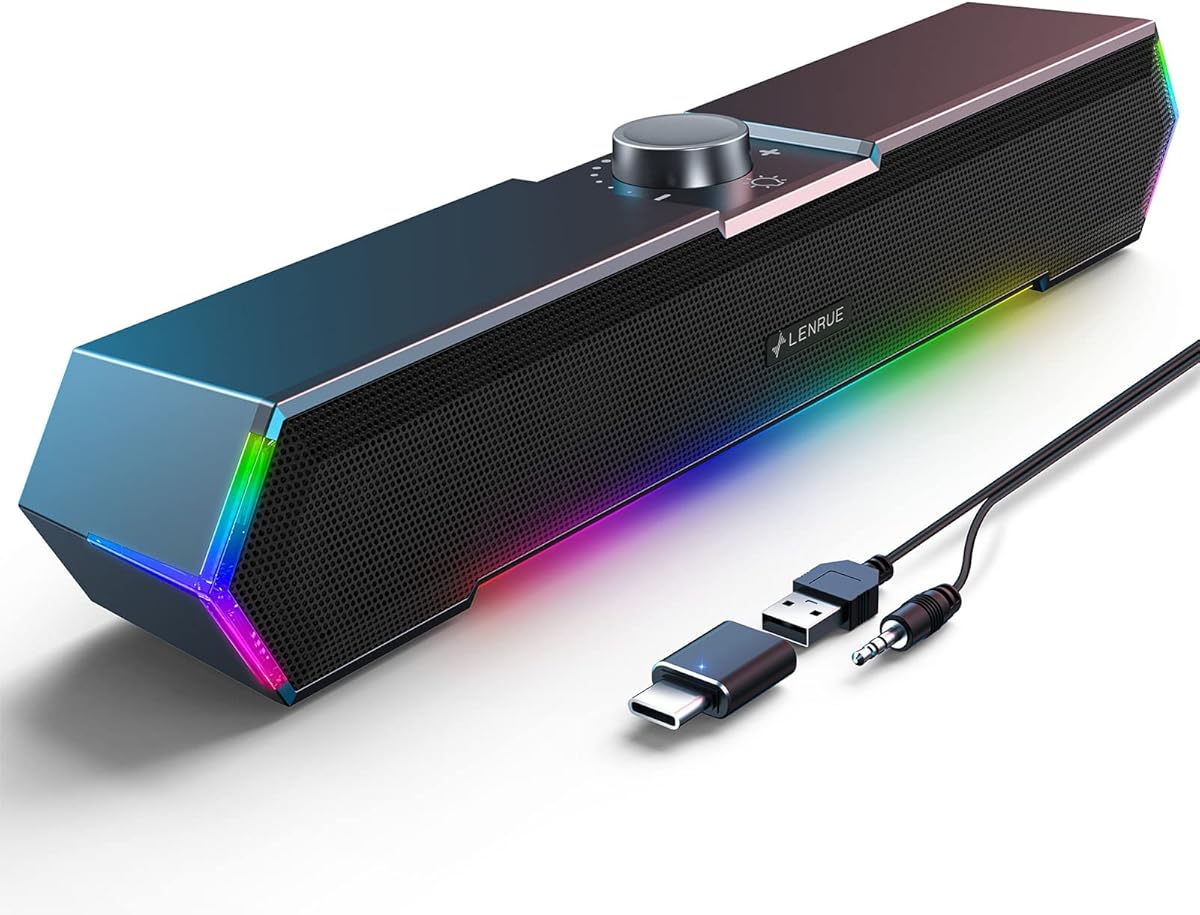
The LENRUE G11 is aimed at buyers who want RGB character without giving up valuable desk space. Its 4.2 rating reflects a straightforward 2.0 system that fits neatly beneath a monitor, uses touch-operated lighting, and connects with USB power and a 3.5mm audio cable. The angular exterior and integrated light treatment give it more visual presence than a plain office speaker while preserving a relatively compact footprint.
We may earn a commission when you buy through this link, at no additional cost to you.
Its sound configuration uses four amplifier IC horns, according to the product information, with the goal of clear, distortion-free stereo playback for games, videos, music, and movies. A top-mounted volume knob provides direct level adjustment. The USB-C adapter is included for compatibility with computers that lack a full-size USB connector, and the supplied cables are joined together to help reduce visible desk clutter. Compatibility includes Windows, Mac OS, Chrome OS, and similar systems.
The main limitations are clearly stated: there is no Bluetooth, headphone port, or microphone port, and the speakers are not designed for televisions or headphones. Buyers who want to alternate quickly between a PC and phone will need to move the 3.5mm connection manually. The lighting control is also simpler than the multi-color mode systems offered by some competitors, making it more of an atmospheric accent than a deep customization platform.
The G11 is best for a small workstation, dorm room, office, or laptop station where a full subwoofer system would be excessive. It is particularly useful for anyone who values clean installation and a low-profile appearance more than expansive connectivity. For a monitor-centered setup, it provides one of the tidier ways to add stereo sound and RGB lighting without crowding the desk. Buyers seeking wireless flexibility or private headphone listening should consider one of the more connected alternatives.
Its final appeal is straightforwardness. There are no drivers to install, no application to configure, and no complex setup sequence. The G11 concentrates on the essentials: compact stereo audio, visible touch lighting, broad computer compatibility, and simple physical volume control.
The compact enclosure can sit under a monitor without occupying the same depth as a traditional bookshelf speaker. Joined cables and the included USB-C adapter further reduce the number of separate items around the display.
Four amplifier IC horns support the G11's stereo output, while the top volume knob makes day-to-day adjustment immediate. The absence of Bluetooth keeps the connection process uncomplicated, although it also limits device flexibility.
We may earn a commission when you buy through this link, at no additional cost to you.
The Nylavee Plug-and-Play RGB speakers combine a 5.0 rating with a clean, versatile design, making them a particularly strong everyday choice. Their defining audio feature is a pair of passive radiators working alongside full-range drivers to add warmth and body. The lighting system offers nine modes, consisting of a breathing effect and eight solid colors, and the lights can be switched or turned off to suit different parts of the day.
We may earn a commission when you buy through this link, at no additional cost to you.
Installation is refreshingly simple: USB supplies power, a 3.5mm AUX cable carries audio, and no drivers or software are required. The speakers are compatible with desktop PCs, laptops, monitors, PS5, Xbox, and other devices offering a suitable connection. Their 4.5-foot cable provides enough reach for wider desks and dual-monitor arrangements. A useful physical detail is the ability to stand the speakers vertically beside a display or place them horizontally underneath it.
The main compromise is that this is a conventional 2.0 system rather than a powered bookshelf or subwoofer setup. It also lacks Bluetooth, so wireless phone playback is not part of the feature set. Users who need louder output for a large room, deeper sub-bass, or switching between a PC and mobile device without cables will need a more specialized system. Even so, the passive radiators should provide more low-frequency character than many similarly compact desktop pairs.
This model fits a broad range of buyers: students, home-office users, casual gamers, and anyone building a colorful dual-monitor station. It is particularly well suited to people who want RGB lighting without the visual complexity of an elaborate control application. The lifetime warranty and customer support listed in the product information also add reassurance for long-term everyday use.
The combination of placement flexibility, useful lighting options, straightforward wired operation, and a strong listed rating makes this a particularly balanced recommendation. It is less elaborate than the multi-input models in the guide, but that simplicity is a genuine advantage for a plug-and-play desktop upgrade.
Dual passive radiators add low-frequency weight while preserving the slim appearance of a two-speaker system. This makes the set a useful middle ground for users who want more body than basic laptop speakers without dedicating floor space to a subwoofer.
Eight solid colors and one breathing mode allow the setup to shift from a focused work appearance to a more animated gaming environment. Turning the lights off is also useful when a subdued desktop is preferred.
We may earn a commission when you buy through this link, at no additional cost to you.
The Six-Mode RGB Speakers deliver the core experience sought in this category at an accessible tier, earning a 4.4 rating. Each enclosure uses a 3W driver in a 2.0 configuration, with enhanced bass and crisp higher frequencies intended for music, movies, gaming, and general entertainment. The system is not designed to fill a large room, but it offers a noticeable improvement over many built-in computer and monitor speakers.
We may earn a commission when you buy through this link, at no additional cost to you.
Visual customization comes through six lighting modes: symphony, flowing, breathing, and three solid-color effects. A single knob handles power and volume, while the 3.5mm headphone jack allows private listening without replacing the entire speaker system. USB provides power, and the included AUX cable handles audio. A USB-C adapter broadens compatibility, and the listed operating-system support includes Windows, Mac OS, Chrome OS, Linux, and UNIX.
The compromises are evident in the specifications. A pair of 3W drivers is modest compared with the higher-output systems in this guide, and there is no subwoofer for deep bass. Bluetooth is also absent, so a phone must use the analog connection when the speakers are powered by USB. Cable length is fixed at approximately 31.49 inches between the speakers, with USB and AUX cables listed at approximately 39.37 inches, which may matter in a wide workstation.
This set is a strong choice for a small desk, dorm room, office, or secondary gaming station. It is especially useful for buyers who want a dedicated headphone jack, because many compact alternatives omit that feature. It also suits anyone who prefers a simple lighting bar with several animated options rather than extensive RGB customization.
Overall, it delivers the basic functions with very little complexity: plug in USB and AUX, adjust the knob, and choose a lighting effect. The result is a practical budget recommendation for close-range desktop listening, even though larger systems will provide more volume, deeper bass, and broader connectivity.
The dedicated 3.5mm output lets users move between shared listening and private headphones without unplugging the speakers from the computer. It is a modest but meaningful convenience in a home office or shared gaming environment.
The 2.0 driver pair and enhanced bass provide a more engaging upgrade for close-range listening than laptop or monitor speakers. The trade-off is that maximum output and deep low-end response remain limited.
We may earn a commission when you buy through this link, at no additional cost to you.
The Nylavee Nine-Mode Speakers offer a well-proportioned desktop setup for buyers who prioritize full-range clarity and bass without adding a subwoofer. Their 4.4 rating reflects a 2.0 system with two full-range dual-magnet drivers, rear speaker ports, nine touch-controlled lighting modes, and simple wired connectivity. The result feels more substantial than a pair of tiny travel speakers while remaining appropriate for a desktop environment.
We may earn a commission when you buy through this link, at no additional cost to you.
The unique speaker ports are intended to move more air and create concentrated, rich bass. Audio is described as crisp and distortion-free, making the system suitable for movies, video, gaming, and general music listening. Lighting consists of one breathing mode and eight solid colors, operated through touch controls. A single physical knob handles power and volume, while USB powers the system and the 3.5mm connection carries audio.
The lack of Bluetooth is the most obvious limitation. The speakers are compatible with PCs, laptops, phones, and tablets that can provide a 3.5mm audio connection, but the USB cable is only for power. A phone may therefore require a separate adapter depending on its available ports. At 3.23 by 4.21 by 7 inches, each enclosure is also larger than the most compact models in the list.
This system fits a stationary desk where the speakers can remain beside a monitor and serve games, videos, and music in turn. It is a good match for users who like visible lighting but do not need animated effects, extensive software controls, or a separate subwoofer. Those who frequently alternate between devices wirelessly should look toward a Bluetooth-equipped alternative.
Its central advantage is balance. The port-assisted bass, full-range drivers, adjustable lighting, and uncomplicated controls create a confident desktop package without overcomplicating installation. It remains a capable choice for close and medium-range listening while preserving a relatively traditional two-speaker footprint.
The rear ports help create stronger bass from a conventional two-speaker arrangement. This is a useful middle ground for shoppers who want more low end than a slim desktop pair but do not have room for a separate subwoofer.
Nine selectable modes provide a colorful appearance without requiring a control program. The combination of a top volume knob and touch lighting controls keeps frequently used functions close at hand.
We may earn a commission when you buy through this link, at no additional cost to you.
The Razer Leviathan V2 X is a refined soundbar option for gamers who want PC-focused audio, RGB integration, and a single uncluttered connection. Its 4.2 rating pairs a compact under-monitor design with two full-range drivers, two passive radiators, USB-C power and audio, and Bluetooth 5.0. Rather than asking users to place two separate speakers around a monitor, it concentrates the system in a low-profile enclosure.
We may earn a commission when you buy through this link, at no additional cost to you.
The major attraction is Razer Chroma RGB, which provides 14 lighting zones and supports numerous patterns and dynamic in-game effects. Users can adjust lighting, toggle audio devices, and make other settings through Razer Audio App and Razer Synapse. The result is deeper visual customization than a few hardwired touch modes can offer, particularly for an existing Razer gaming ecosystem. Audio output is listed at up to 90dB.
The trade-offs are the reliance on software and the narrower focus of a soundbar format. A soundbar is optimized for output toward a listener at one position, whereas separate speakers can provide a wider sense of stereo placement. Some buyers may also prefer physical controls or a setup that does not require ecosystem applications. Bluetooth 5.0 is a capable standard for switching to a paired mobile device, although the USB-C path remains the primary PC connection.
This model is well suited to competitive gaming, streaming, and desk-centered entertainment where visual synchronization and a low-profile footprint matter. It is particularly attractive to users who already use Razer peripherals and want their lighting to behave as part of a broader setup. For a conventional two-speaker arrangement or a system that avoids software, a simpler desktop pair may be more appropriate.
The Leviathan V2 X stands apart through its combination of full-range drivers, passive radiators, and high-detail Chroma lighting. It turns a PC speaker purchase into a more integrated component of a gaming desk rather than a pair of independent accessories.
The 14-zone Chroma system supports far more nuanced RGB patterns than conventional touch lighting. That makes the soundbar especially effective in a coordinated gaming setup where matching effects across multiple devices matters.
USB-C handles both power and audio, keeping the under-monitor installation visually clean. Bluetooth 5.0 provides a convenient secondary path for audio from a paired phone or other compatible device.
We may earn a commission when you buy through this link, at no additional cost to you.
The BESTISAN 50W*2 Active Bookshelf Speakers are the most substantial traditional desktop audio system in the guide, carrying a 4.6 rating and up to 100W maximum total output. Each enclosure combines a 1.25-inch tweeter with a 3-inch bass driver, with the active design handling amplification internally. The speakers are intended for a wide range of sources, including PCs, televisions, turntables, phones, and other compatible equipment.
We may earn a commission when you buy through this link, at no additional cost to you.
RGB lighting comes from embedded LED tubes visible through a mirrored exterior surface. Nine effects can be selected through the speaker controls, creating a more dramatic visual treatment than a conventional light bar. Connectivity is exceptionally flexible: ARC and optical inputs suit compatible televisions, RCA supports turntables and other analog sources, Bluetooth 5.2 handles wireless devices, and a subwoofer output can add more low-frequency authority. The USB port supports flash drives, although it does not accept a USB audio cable.
These capabilities introduce trade-offs. The speakers measure 9.5 by 6 by 5.5 inches each and weigh 10 pounds, so they need more physical room than a slim soundbar or compact two-speaker set. Some input features also apply to specific device categories rather than every computer setup. The subwoofer output is optional, and no subwoofer is included. Buyers expecting the USB port to behave like the USB-C audio input on a modern desktop speaker may be disappointed.
The system is a strong match for a serious desktop entertainment area, a larger monitor setup, or a shared media station. It also appeals to users who want to connect a turntable or television without limiting the system to computer use. A remote control and onboard buttons allow convenient operation, while the stated 33-foot remote range supports relaxed listening from across a room.
Its premium case rests on output, acoustic scale, and source flexibility. The larger drivers, internal amplification, wide selection of inputs, and optional subwoofer connection make it the most expandable option here, while the internal LED tubes ensure that it remains firmly within the RGB desktop speaker category.
ARC, optical, RCA, Bluetooth, flash-drive USB, and subwoofer output make this pair useful across a television, turntable, computer, and mobile-device ecosystem. It is a more complete active-speaker solution than a basic USB desktop set.
Embedded LED tubes illuminate the mirrored enclosure and can cycle through nine effects. The result is a more dimensional lighting treatment that complements a larger entertainment setup rather than merely adding a narrow accent strip.
We may earn a commission when you buy through this link, at no additional cost to you.
The Creative Pebble Pro retains the familiar angled form of a compact desktop speaker while adding USB-C connectivity, wireless audio, and RGB illumination. Its 4.2 rating reflects a versatile 2.0 system capable of 10W RMS and 20W peak output when connected through USB-C. With higher-power USB PD, the stated capability rises to 30W RMS and 60W peak, making it flexible for different listening ambitions.
We may earn a commission when you buy through this link, at no additional cost to you.
The audio design uses a pair of digital amplifiers, built-in processing, updated drivers, and BassFlex technology intended to produce deeper low-frequency response without obscuring dialogue. Clear Dialog processing is designed to keep vocals intelligible at different levels. Physically, the 45-degree elevated angle directs sound toward the listener, and the RGB rings offer spectrum cycling, pulsating mode, and a single-color glow that can be switched off through a dedicated control.
Connectivity is a major strength. A single USB-C cable can carry both power and digital audio, while Bluetooth 5.3 and a 3.5mm AUX input provide additional paths. A headset or microphone port allows the speakers to serve as a communications system. The trade-offs are the need for an appropriate USB-C source or a suitable USB PD adapter, and the relatively limited choice of three lighting effects. The product also does not include a subwoofer, so deep bass remains less prominent than in a 2.1 or five-driver system.
This is a polished option for a laptop or modern desktop station where visual size matters. It works particularly well for a compact office, dorm room, or gaming desk that needs a dedicated upgrade from built-in audio. Wireless support makes it more versatile than many slim alternatives, while the elevated enclosure and subtle RGB rings maintain a professional appearance.
The Pebble Pro's strongest case is balance: useful output, multiple connection methods, compact dimensions, and polished lighting in a familiar desktop format. It does not offer the deepest customization or bass of larger systems, but it is one of the most versatile compact options for mixed work and entertainment use.
The elevated 45-degree design aims the drivers toward the seated listener, helping a small pair feel more purposeful on a desk. Its relatively restrained footprint also makes it suitable for tighter workspaces.
USB-C carries digital audio and power, while Bluetooth 5.3 and 3.5mm AUX cover alternative sources. The headset or microphone port also gives the pair a useful role in calls and communication.
We may earn a commission when you buy through this link, at no additional cost to you.
The MEREDO G38 combines a low-profile desktop soundbar with a substantial 160W peak system and a five-inch wired subwoofer. Its 4.4 rating reflects a flexible entertainment product that can serve a PC, television, laptop, projector, or other compatible source. The main unit is 15.9 inches wide and only 1.6 inches high, allowing it to sit below many monitors and televisions without taking up much vertical space.
We may earn a commission when you buy through this link, at no additional cost to you.
Five drivers handle the main audio system: two 31 by 97mm drivers, two one-inch silk tweeters, and the pair in the subwoofer. USB, AUX, optical, and Bluetooth 5.3 connections are listed, along with HD-ARC for compatible televisions. A side audio output provides quick headphone access, and BASS and TREBLE controls allow tonal adjustment. The supplied remote handles both sound and lighting without requiring a phone application.
RGB illumination appears along the bottom of the soundbar, with seven colors, four dynamic modes, and two brightness levels. Optional Type-C light bars can also be connected, although the G38 supports synchronized light bars from the same brand only. The system does not support Dolby or DTS, so it is better viewed as a flexible everyday gaming and media solution than a dedicated home-cinema processor. The included subwoofer is wired rather than wireless.
This is a strong recommendation for gamers with a larger desk who want more output and bass than a compact pair can provide but do not want two large satellite speakers. It also works well for bedroom, dormitory, and small living-room entertainment areas where the low-profile main unit and wider inputs are convenient.
Its appeal lies in a high output level, broad source compatibility, and flexible lighting, all wrapped in a compact soundbar design. The trade-offs are the space required by the separate subwoofer and the absence of advanced surround-audio decoding, but for gaming, streaming, and general desktop entertainment, those limitations are usually acceptable.
The 1.6-inch-high main unit can sit beneath a display, preserving the screen area that conventional bookshelf speakers might block. Its 15.9-inch length still requires a broad but shallow position across the desk.
A 160W peak system and included five-inch subwoofer provide much more low-end authority than compact 2.0 pairs. Seven colors, four dynamic modes, and two brightness levels add visual interest, with optional same-brand light bars for synchronized effects.
We may earn a commission when you buy through this link, at no additional cost to you.
The W-206RE stands out for offering 21 dynamic RGB lighting modes in a compact two-speaker desktop design. Its 4.1 rating reflects a practical system for music, movies, streaming, gaming, and daily work, with balanced stereo sound intended as an upgrade from built-in laptop or monitor speakers. The speakers are designed to sit beside or beneath many monitors, making them useful where desk depth is limited.
We may earn a commission when you buy through this link, at no additional cost to you.
The lighting is the most distinctive feature. A top touch control switches among the 21 effects, while physical controls on the right speaker manage power, volume, and operating mode. Connectivity includes Bluetooth for wireless playback, a 3.5mm AUX input for wired sources, and USB for power. This combination allows the same speaker pair to serve a desktop PC, laptop, monitor with audio output, or a paired phone.
The main limitation is conventional 2.0 output without a subwoofer. Bass and maximum volume are therefore more modest than those of the MEREDO, BESTISAN, or Nylavee 2.1 system. The physical controls are straightforward, but the top touch surface must be used for lighting changes, and a single touch control offers less precise mode navigation than a dedicated app.
The W-206RE is well suited to a bedroom, dorm, streaming station, gaming corner, or minimalist home office. It is especially attractive for buyers who consider RGB variety a major part of the purchase and want Bluetooth without moving to a larger soundbar or bookshelf system.
Its final recommendation is for users who prioritize compact size, wireless convenience, and abundant lighting choices in roughly equal measure. The audio will not replace a high-output entertainment system, but it adds useful stereo sound and a lively visual identity to a constrained desktop.
The broad lighting selection gives users more visual variety than most conventional desktop pairs. A dedicated top touch control also separates lighting changes from the physical power and volume controls.
Bluetooth makes it easy to switch from a PC to a paired phone, while USB power and AUX cover wired operation. The compact enclosure is designed to fit neatly beside or below a monitor.
We may earn a commission when you buy through this link, at no additional cost to you.
The right RGB desktop speakers depend on how you listen, how much room you have, and which devices you need to connect. Sound quality, illumination, controls, and installation should be evaluated together rather than treating lighting as the only visual feature.
A 2.0 system uses two speakers and is the most practical option for close-range desktop listening. It usually takes less space, needs fewer cables, and works well for video calls, general productivity, and moderate gaming. A 2.1 system adds a subwoofer for stronger low-frequency response, making it better for bass-heavy music, action games, and films. Larger bookshelf or soundbar systems can provide higher output and more advanced tonal control, but they require additional desk space and sometimes more setup. Consider both the maximum output and the type of bass response you need rather than focusing only on loudness.
RGB lighting varies significantly among the products in this guide. Some systems offer a handful of fixed colors, while others include breathing, flowing, pulsating, and other dynamic effects. Software-controlled platforms can synchronize lighting with games and other peripherals, which is valuable for coordinated setups but adds complexity. A single-color option or an ability to turn the lights off is also useful for users who want the speakers to work in professional environments. The quantity of modes matters less than whether the available effects suit your preferred aesthetic and whether the controls are easy to reach.
A wired USB plus 3.5mm AUX arrangement is dependable for desktop PCs and laptops, but it requires the correct audio output and can limit wireless device switching. Bluetooth is useful for moving between a computer and phone, although the PC may still require a separate USB power connection. USB-C audio can provide a cleaner single-cable setup on modern computers. For television use, look for ARC, optical, or compatible analog inputs. Systems with RCA can serve turntables and other legacy sources, while a subwoofer output provides room for later bass expansion. Always verify the ports on the computer or display before purchasing.
Desktop audio must coexist with a monitor, keyboard, mouse, and often a gaming mouse pad. Compact speakers can be placed beside a display or under it, while tall bookshelf models may require dedicated stands. Soundbars are particularly effective when a wide but shallow space is available, and they direct sound toward a single seated listener. Some two-speaker models can be turned vertically or placed horizontally, allowing buyers to optimize their layout. Also consider the subwoofer footprint, the distance between satellites, and the direction of included cables before finalizing a purchase.
Physical controls are dependable and immediate, while application-based customization can offer deeper control over lighting and sound. A top-mounted volume knob is useful during meetings or games because it avoids navigating operating-system menus. Touch lighting controls can be convenient but may be less discoverable than a dedicated button. Software ecosystems are valuable for synchronizing RGB effects and switching devices, though they add dependencies and may require compatibility checks. Choose the control method that matches your technical comfort level and the degree of customization you actually intend to use.
Listed wattage provides only a rough indication of potential output, but it helps distinguish basic desktop speakers from higher-powered systems. Small enclosures and low driver wattage are appropriate for a desk, dorm room, or home office where listeners remain close. Larger rooms, competitive gaming, and group viewing benefit from stronger amplification and a subwoofer. Excessive output is not always desirable, particularly in a small room where the goal is clear dialogue and balanced music rather than maximum volume. Pair the system's capacity with your listening distance and typical source content.
A headphone output can be highly useful for private listening and work calls, while a microphone or headset input adds communication flexibility. A remote control is helpful when the speakers sit across a desk or serve a television. An included USB-C adapter can prevent a connection problem with newer laptops, and a bundled Type-C adapter may broaden compatibility with phones or tablets. Subwoofer outputs offer an upgrade path without requiring an immediate larger system. These features are not equally important to every buyer, so prioritize accessories that solve a problem in your actual setup.
Start by positioning the speakers at the two sides of your monitor or placing a soundbar directly beneath the display. For a two-speaker system, keep the left and right units separated and angle them toward your normal listening position. Place a subwoofer on or under the desk, away from the exact center of the monitor, and route its cable along a wall or desk support. Read the included instructions before connecting unfamiliar inputs, particularly ARC, optical, RCA, or USB drive connections.
Connect the selected audio source and power the system using the supplied cables. USB or USB-C may provide power and, in some models, digital audio, while a 3.5mm AUX cable usually carries analog audio separately. When using Bluetooth, pair the speakers through the specified control and confirm the correct playback device in the computer's sound settings. For soundbars, select the appropriate source with the remote or top control, and verify that the display's audio output is being routed to the speakers.
Keep the drivers protected from dust, liquid, and sustained high volume. Clean the enclosure with a soft, dry cloth rather than spraying cleaner directly onto the surfaces. Avoid placing the speakers beside a heat source or in a damp area, and do not block rear ports or subwoofer openings. Use the lighting controls responsibly by selecting a suitable brightness level, turning the lights off for work, and updating any required control software when doing so improves compatibility or stability.
Most models in this guide use a straightforward USB power connection and a 3.5mm audio cable, with no operating-system drivers required. Bluetooth, USB-C audio, and software-controlled systems add slight variation, but the basic process remains simple. Position the speakers, connect the cables, select the correct computer audio output, and adjust the volume.
RGB lighting itself does not improve or reduce the underlying acoustic performance. However, poorly placed LED effects can be visually distracting, and some larger illuminated enclosures may occupy more desk space than standard speakers. Judge audio quality by driver design, amplification, connectivity, and room placement rather than by the lighting feature.
Choose a 2.0 pair for a compact desk, close-range listening, and straightforward setup. A 2.1 system is preferable for stronger bass in games, films, and bass-heavy music. The added low-frequency impact comes with extra equipment, more space, and another cable to manage.
That depends on the model's connections. A 3.5mm AUX input can serve many laptops and phones with an appropriate adapter, while Bluetooth-equipped systems offer a wireless option for phones. Some USB-powered models still require a separate analog or USB audio connection, so check the speaker specifications and your device ports before buying.
Standard RGB modes provide atmosphere regardless of the game being played. Some systems, particularly the Razer Leviathan V2 X, offer software-driven lighting and dynamic effects that can integrate more closely with a gaming setup. For competitive play, the most important factors remain low latency, clear directional audio, and appropriate volume.
Bluetooth is more convenient for switching between a computer and a phone, while wired audio is typically simpler and can avoid wireless interruptions. The best choice depends on how often you change devices. A system offering both USB power with AUX audio and Bluetooth gives buyers flexibility without forcing a single workflow.
Only models with compatible television inputs should be used for that purpose. The Razer Leviathan V2 X, MEREDO G38, and BESTISAN system include options such as Bluetooth, optical, RCA, or ARC, depending on the model. Confirm that the television supports the selected connection and that any required adapter is available.
Many systems provide solid-color, breathing, and off settings that can create a subtler appearance. Lower brightness where available, select a calm color for work periods, and switch the lights off during meetings or video calls. Software-controlled systems can also be tuned to match a less animated profile.
The Nylavee Plug-and-Play RGB system is the most versatile everyday recommendation, combining dual passive radiators, nine lighting modes, flexible placement, and driver-free operation. The Six-Mode RGB Speakers stand out as the budget choice with useful dynamic effects and a headphone jack, while the BESTISAN 50W*2 system is the premium option for higher output, extensive inputs, and bookshelf-style scale.
Prioritize the audio and layout that suit your daily use before focusing on the number of RGB modes. A compact 2.0 pair works well for close-range listening, a subwoofer system adds impact for games and media, and a soundbar reduces visual clutter beneath a monitor. Check physical dimensions, source compatibility, control methods, and cable placement so the speakers integrate cleanly with your desk.
Ratings, promotions, product availability, and current pricing can change over time, so verify the latest listing and specifications before making a final decision. With those checks completed, choosing from these ten systems becomes a matter of matching the right balance of sound, lighting, connectivity, and footprint to your workspace.