
ASUS ROG Strix XG27ACDNG
4.5Editor score
QHD QD-OLED display
True 10-bit color rendering
99% DCI-P3 color gamut
A monitor for AI development must balance readable interfaces, accurate color, useful screen area, and dependable performance across long technical sessions. The most suitable display depends on whether you prioritize code visibility, data visualization, model testing, or a flexible mix of development and gaming workloads.
We compared the featured monitors using their stated resolution, panel technology, refresh rate, response time, color coverage, adaptive-sync support, connectivity, ergonomic features, and warranty coverage. The list covers Full HD IPS models, curved QHD displays, fast high-refresh gaming panels, and premium QD-OLED and WOLED options.
Each pick reveals how a different architecture can support an AI development setup, from space-efficient workstations to color-accurate OLED screens. Ratings and specifications reflect the supplied product information, while current prices, availability, and promotional terms should be checked before purchasing because they can change over time.
4.5Editor score

4.6Editor score

4.4Editor score
As an Amazon Associate we earn from qualifying purchases.
This side-by-side comparison highlights the major differences in resolution, panel type, refresh rate, color capability, and practical features, helping AI developers match a monitor to their workstation, visualization tasks, and preferred desk setup.



The ASUS TUF Gaming VG259QMR5A carries a 4.6 rating and stands out as a responsive, adaptable display for AI developers who divide their time between terminal-heavy work, model visualization, and demanding interactive applications. Its 24.5-inch Fast IPS panel combines Full HD resolution with an overclocked 310Hz refresh rate and a minimum 0.3ms GTG response time.
We may earn a commission when you buy through this link, at no additional cost to you.
The high refresh rate provides more than enough headroom for smooth interface movement, window dragging, and interactive previews. Adaptive synchronization is supported through both FreeSync Premium and G-SYNC compatibility, while ELMB Sync can operate with variable refresh rates to reduce ghosting and tearing. The stated 99% sRGB coverage also provides a practical color foundation for code, dashboards, and general content creation.
The central compromise is resolution. A 1920×1080 canvas can feel restrictive when multiple IDE panels, notebooks, model dashboards, and system monitors need to remain visible at once. Although its speed is exceptional, the monitor does not offer the deep blacks, wide DCI-P3 gamut, or high-resolution canvas of the OLED alternatives. It is also a gaming-first product, so professionals requiring calibrated reference workflows would need to verify their own color needs and calibration process.
This is a strong recommendation for an AI development workstation where responsiveness, dependable synchronization, and a modest physical footprint matter more than maximum screen area. It also suits users who want one display to handle coding, training dashboards, and games without changing their primary setup. For those willing to trade workspace density for exceptional motion performance, it remains the most balanced high-refresh option in this group.
The 0.3ms minimum GTG response and 310Hz overclock make menus, traces, and application windows feel highly responsive. That speed is particularly useful when an AI workflow includes live rendering, debugging visualizations, or frequent transitions between windows.
DisplayWidget Center gives mouse-based access to on-screen settings, reducing time spent navigating physical controls. The package also includes a DisplayPort cable, power cord, screwdriver, quick-start guide, and warranty card, while FreeSync Premium and G-SYNC compatibility support fluid graphics.
We may earn a commission when you buy through this link, at no additional cost to you.
The ASUS ROG Strix XG27ACDNG is the premium choice in this roundup, earning a 4.5 rating for its combination of a 26.5-inch QHD QD-OLED panel, 360Hz refresh rate, and 0.03ms response time. For AI development, its principal advantage is the combination of a wide 99% DCI-P3 color gamut, true 10-bit color, and a stated Delta E below two.
We may earn a commission when you buy through this link, at no additional cost to you.
The QD-OLED panel can make text, traces, plots, and interface elements appear exceptionally crisp, while the high refresh rate keeps motion and live previews fluid. VESA DisplayHDR 400 True Black compliance adds an HDR-oriented workflow, which may be useful when comparing generated imagery or inspecting visualization output. G-SYNC compatibility supports smooth gameplay, and a custom heatsink with advanced airflow is designed to help manage the demanding panel.
Developers should understand that OLED displays require a more considered content workflow than a standard office monitor. The monitor includes OLED Care+ functions intended to reduce burn-in risk, and the manufacturer provides a three-year warranty with advanced replacement and burn-in coverage. Static code editors, long-running dashboards, and always-visible terminal windows should be managed carefully rather than left unchanged indefinitely.
The XG27ACDNG is ideal for developers who want premium visual quality, extensive color capability, and exceptional motion in a single screen. It is particularly compelling for visualization, creative AI, image comparison, and hybrid workstation use. Buyers should pair it with sensible screen habits and verify their desktop placement, but the specification set makes it the strongest premium choice here.
True 10-bit color and 99% DCI-P3 coverage provide richer gradients and more nuanced output than a basic sRGB-focused display. These characteristics suit image-generation review, comparative visualization, and content workflows in which subtle tonal differences matter.
OLED Care+ functions work alongside a custom heatsink and advanced airflow design to reduce burn-in risk. The three-year warranty includes burn-in coverage, making careful setup and the included protection features especially important for prolonged technical work.
We may earn a commission when you buy through this link, at no additional cost to you.
The Samsung Odyssey G55C is a practical large-screen choice for AI developers who want to keep code, terminal output, and training dashboards visible together. It has a 4.4 rating, a 32-inch 1000R curved panel, QHD 2560×1440 resolution, a 165Hz refresh rate, and a stated 1ms MPRT response time.
We may earn a commission when you buy through this link, at no additional cost to you.
Its larger canvas offers more room for an IDE beside documentation, a browser, a system monitor, or live training metrics. The QHD resolution provides more usable workspace than Full HD while remaining less demanding than 4K. AMD Radeon FreeSync keeps the display and graphics card refresh rates synchronized to reduce tearing, and HDR10 support adds brighter highlights and more nuanced shadows for visualization-oriented work.
The 1000R curve is the model's defining feature, wrapping the display around the viewer to occupy more peripheral vision. That can feel immersive for interactive applications and large media, although developers accustomed to flat panels may need time to adjust. Eye Saver Mode limits blue light, and the monitor is designed to reduce tiring screen flicker during extended sessions.
The G55C is well suited to budget-conscious developers who prioritize screen area and resolution over ultra-fast gaming or reference-grade color. It also works for students and engineers running local model demonstrations where a broad QHD workspace matters. The result is a useful compromise for mixed coding, monitoring, visualization, and entertainment duties.
The 32-inch QHD format is particularly useful when an AI development workflow requires several windows to remain open. Its larger screen can reduce the need to repeatedly switch between an editor, terminal, notebook, and performance dashboard.
The 1000R curve surrounds the viewer more closely than a flat display and can improve visual immersion. The tradeoff is that desk depth and viewing position become more important, so users should verify that the curve works well in their specific workspace.
We may earn a commission when you buy through this link, at no additional cost to you.
The ASUS ROG XG27AQDMGR earns a 4.6 rating and offers a compelling mix of QHD resolution, WOLED technology, and 240Hz refresh performance. Its 26.5-inch 2560×1440 TrueBlack Glossy WOLED panel has a 0.03ms gray-to-gray response time, making it well suited to smooth development interfaces and live technical previews.
We may earn a commission when you buy through this link, at no additional cost to you.
Color capability is a major strength. The monitor is VESA DisplayHDR 400 True Black compliant, covers 99% of DCI-P3, supports true 10-bit color, and has a stated Delta E below two. Those specifications make it attractive for AI-generated image assessment, color-aware dataset work, and general content production in addition to ordinary code review.
The glossy finish can produce reflections under bright ambient lighting, and the OLED format deserves sensible screen management. ASUS addresses longevity with OLED Care Pro and a Neo Proximity Sensor that detects when the user is away and switches the screen to black to reduce burn-in risk. A three-year warranty with advanced replacement and burn-in coverage adds additional reassurance.
This monitor is a strong fit for developers who value visual quality and response speed without moving to a 360Hz panel. It is less suitable for brightly lit rooms where a matte display would be easier to view. For a controlled workstation with mixed coding, visualization, and content-review responsibilities, the XG27AQDMGR is a refined and capable option.
A 99% DCI-P3 gamut, true 10-bit output, and Delta E below two provide a strong basis for detailed visual review. This is useful when comparing model-generated images, inspecting gradients, or working with visual datasets rather than viewing code alone.
The Neo Proximity Sensor can turn the display black when the user leaves, reducing unnecessary static-image exposure. OLED Care Pro adds further panel management, while the supplied three-year coverage includes burn-in protection.
We may earn a commission when you buy through this link, at no additional cost to you.
The ASUS TUF Gaming VG249QML5A is a compact 23.8-inch Fast IPS monitor rated 4.4 by users. Its 1920×1080 resolution, 240Hz refresh rate, and 0.3ms minimum response time make it a responsive option for developers who want a smaller primary display or a secondary panel beside a larger workstation screen.
We may earn a commission when you buy through this link, at no additional cost to you.
FreeSync Premium and G-SYNC compatibility allow the monitor to synchronize with compatible graphics hardware for smooth, tear-free output. ELMB Sync combines motion-blur reduction with variable refresh rates, which benefits fast interaction and live application previews. The stated 99% sRGB color coverage is suitable for standard interfaces and general content work.
The main limitation is pixel density. Full HD across 23.8 inches offers less room for code, documentation, and dashboards than a QHD panel, so users working on complex architectures may need to scale interface elements or use a larger display. The product is also designed primarily around gaming performance rather than maximum professional color coverage.
This model makes the most sense for compact desks, dual-monitor arrangements, and developers who value quick response and flexible refresh rates more than workspace density. Its height-adjustable stand supports better positioning during long sessions, and DisplayWidget Center streamlines on-screen configuration. For a compact secondary AI development display, it is a capable and practical choice.
A 23.8-inch footprint is easy to position beside a laptop or main display. Developers can dedicate it to terminal output, documentation, API testing, or system monitoring while keeping the larger screen focused on the editor.
FreeSync Premium and G-SYNC compatibility make the display adaptable to different graphics environments. ELMB Sync can operate alongside variable refresh rates, helping maintain clarity during rapid movement and interaction.
We may earn a commission when you buy through this link, at no additional cost to you.
The Samsung Odyssey OLED G6 has the highest listed rating in the group at 4.7, combining a 27-inch QD-OLED panel with QHD resolution, a 240Hz refresh rate, and a 0.03ms response time. It is an attractive display for AI developers who want a compact premium format and strong visual output.
We may earn a commission when you buy through this link, at no additional cost to you.
Pantone Validated color reproduction is the standout feature. The screen is stated to reproduce more than 2,100 lifelike colors and over 110 skin-tone shades, while HDR10 provides brighter highlights and nuanced shadows. Those characteristics can help when reviewing generated imagery, comparing color treatments, or working with visual AI output as part of a larger engineering workflow.
AMD FreeSync Premium reduces choppiness, lag, and tearing, while the 0.03ms response time supports very fluid motion. OLED Safeguard uses thermal modulation to help prevent burn-in, and Glare Free Technology is designed to limit reflections from external light. As with other OLED panels, however, responsible management of long-lived static interfaces remains important.
The G6 is well suited to developers who place high value on color validation, compact dimensions, and smooth motion. Its adjustable ergonomic stand pivots, tilts, and swivels, allowing it to fit a variety of desks. It is a particularly balanced premium option for creators, hybrid developers, and engineers who regularly evaluate visual outputs but do not need an ultra-wide canvas.
Pantone validation and a stated reproduction of more than 2,100 colors make the G6 useful for reviewing visual content without immediately adding a separate calibrated reference display. It can provide a stronger color foundation than a basic office monitor.
The height-adjustable stand supports better ergonomics, and the ability to pivot, tilt, and swivel helps align the display with the workstation. Glare Free Technology can also make the glossy-style OLED format easier to use under moderate ambient lighting.
We may earn a commission when you buy through this link, at no additional cost to you.
The ASUS ROG XG27ACS is a 4.4-rated 27-inch monitor whose most important feature for a clean AI development desk is its USB Type-C hub. It supports video transmission using DisplayPort signals and can act as a hub for wired peripherals, helping reduce cable clutter around a laptop-based development setup.
We may earn a commission when you buy through this link, at no additional cost to you.
Its 2560×1440 HDR panel provides a practical balance of workspace and desktop footprint. A 180Hz refresh rate and 1ms GTG response time support smooth movement, while G-SYNC compatibility and ELMB Sync provide options for adaptive synchronization and motion-blur reduction. These characteristics are useful when switching between development, browser testing, visualization, and interactive applications.
Compared with the OLED models, its main limitation is that the supplied specifications do not emphasize a wide DCI-P3 gamut, true 10-bit color, or deep black levels. It is therefore better suited to general development and productivity than color-critical image evaluation. Users who create visual AI output but prioritize a practical single-cable workstation may still find that balance effective.
The XG27ACS is a strong recommendation for developers connecting a laptop or compact workstation and needing a cleaner desk arrangement. Its QHD panel offers more usable code space than Full HD, and DisplayWidget Center provides mouse-based control of settings. Among the listed options, it is the clearest choice for users who prioritize USB-C hub functionality over a premium OLED color specification.
USB Type-C video transmission allows a compatible laptop to connect through a single cable while the monitor serves as a wired peripheral hub. This can simplify a mobile AI development station with keyboards, storage, and other accessories.
The 180Hz refresh rate and 1ms GTG response provide a fluid interface even when the display is not used exclusively for gaming. G-SYNC compatibility and ELMB Sync offer additional flexibility for compatible graphics systems.
We may earn a commission when you buy through this link, at no additional cost to you.
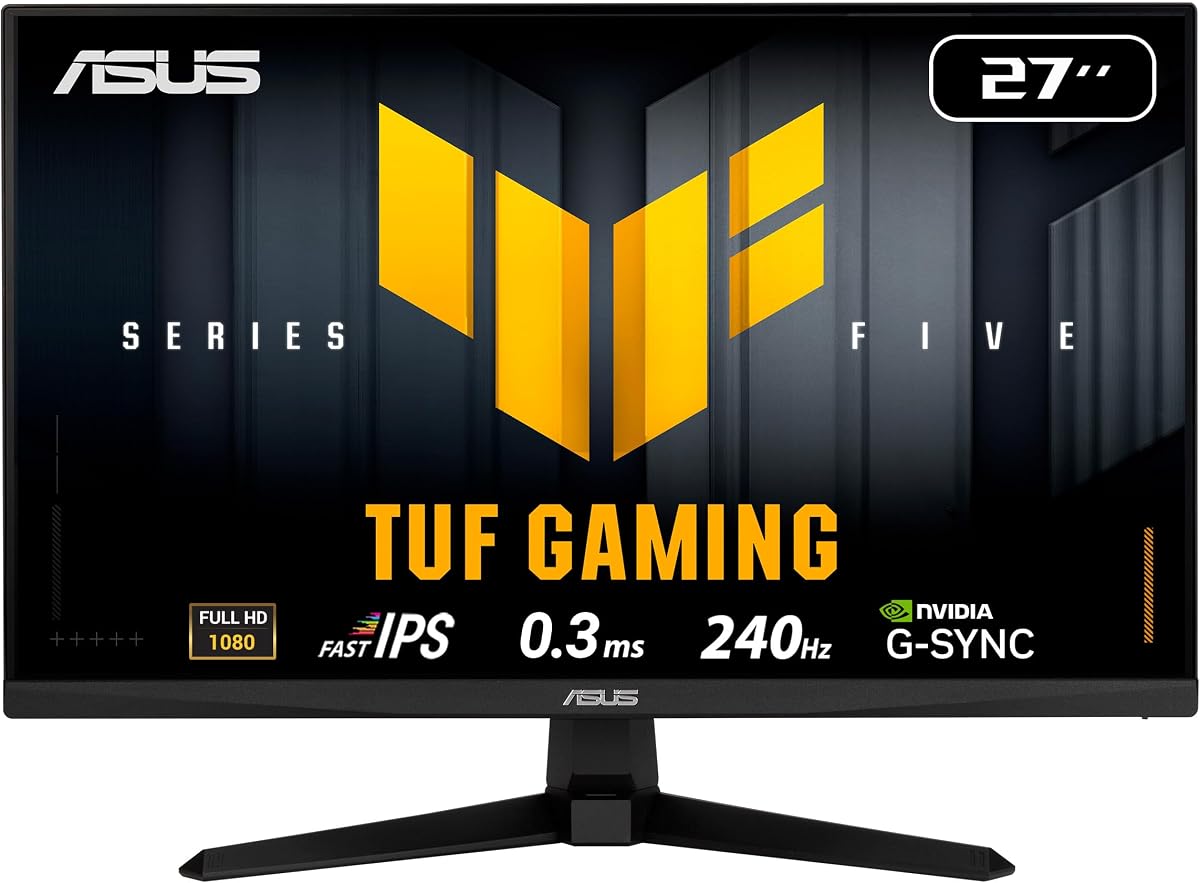
The ASUS TUF VG279QM5A provides a 27-inch Full HD Fast IPS display rated 4.5, combining a 240Hz refresh rate with a 0.3ms minimum response time. It is a practical choice for developers who prefer a larger window over a higher-resolution desktop without moving into premium OLED pricing.
We may earn a commission when you buy through this link, at no additional cost to you.
The panel supports FreeSync Premium and G-SYNC compatibility, while ELMB Sync works with variable refresh rates to reduce ghosting and tearing. Its 99% sRGB coverage is appropriate for standard interface rendering, content work, and general productivity. DisplayWidget Center enables convenient mouse-based control of on-screen settings, and the supplied package includes a DisplayPort cable, power cord, screwdriver, and documentation.
The main limitation is that Full HD spread across 27 inches produces fewer pixels per inch than a QHD or 4K display. Text-heavy workflows can still be comfortable, but large code files, extensive logs, and dense dashboards benefit from more resolution. The product also does not list a USB-C hub, so cable consolidation is less convenient than with the XG27ACS.
This monitor suits users who value size, fast motion, and familiar IPS performance in a general-purpose workstation. It can handle coding, browser-based model testing, remote workstation access, and entertainment without the burn-in considerations associated with OLED. The three-year manufacturer warranty and responsive feature set make it a strong general-purpose choice for AI developers.
At 27 inches, the display offers more physical workspace than compact Full HD models while preserving the consistent viewing characteristics of an IPS panel. It is a sensible middle ground for users who do not need QHD pixel density.
Adaptive synchronization, ELMB Sync, and a 240Hz refresh rate make the monitor adaptable to interactive applications. The included DisplayPort cable and straightforward DisplayWidget Center setup simplify initial configuration.
We may earn a commission when you buy through this link, at no additional cost to you.
The Samsung Essential S3 S36GD is a 27-inch 1800R curved monitor rated 4.5, designed for developers who want an immersive desktop without moving to a premium panel. Its Full HD resolution and 100Hz refresh rate are modest by gaming standards but remain appropriate for code, documentation, browser testing, and training dashboards.
We may earn a commission when you buy through this link, at no additional cost to you.
The 1800R curve wraps more closely around the field of vision, creating a wider visual experience and reducing peripheral distraction. A 100Hz refresh rate reduces lag and motion blur compared with many conventional office displays, which can make terminal output, scrolling, and application transitions feel smoother. Adjustable color and contrast settings plus Game Mode provide additional flexibility.
TÜV-certified eye-comfort technology is designed to minimize blue light and reduce irritating screen flicker during long sessions. That makes the monitor relevant to developers who spend extended periods reading code or watching automated processes. The trade-off is that Full HD provides less screen density than QHD, and the 100Hz rate is not aimed at high-end interactive gaming.
The S36GD is a sensible choice for an entry-oriented development environment, a compact office, or a secondary display where a curved view and smooth everyday motion are desirable. Users with complex dashboards or multiple side-by-side code files may eventually prefer more pixels, but this display provides a comfortable and visually engaging foundation for lighter AI workflows.
The 1800R radius creates a more encompassing visual field than a flat Full HD display. It can help focus attention on a central editor or dashboard while the curved edges occupy peripheral vision.
TÜV-certified eye-comfort features minimize blue light and screen flicker. The 100Hz refresh rate also provides smoother everyday motion during long reading, scrolling, and monitoring sessions.
We may earn a commission when you buy through this link, at no additional cost to you.
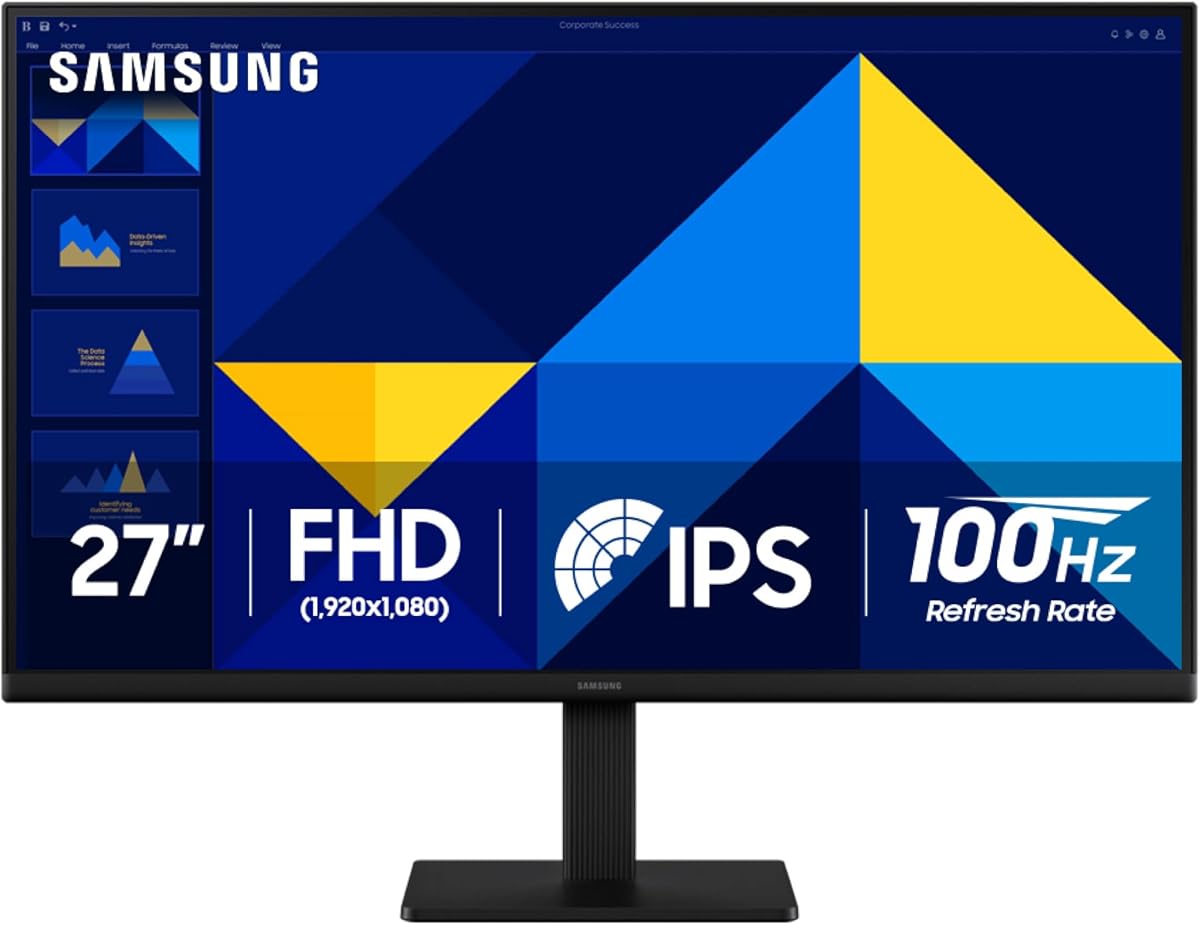
The Samsung Essential S30GD is a straightforward 27-inch IPS monitor with a 4.5 rating, offering Full HD resolution and a 100Hz refresh rate. It is the most conventional choice in the roundup and can serve developers who value a flat panel, familiar desktop layout, and uncluttered design more than specialized gaming or OLED features.
We may earn a commission when you buy through this link, at no additional cost to you.
The IPS panel is stated to maintain bright, clear colors across the screen as viewing angles change, reducing color washing when the user leans or shifts position. This consistent viewing is useful for comparing code, charts, and dashboards. A 100Hz refresh rate reduces lag and motion blur, while adjustable color and contrast controls and Game Mode provide basic options for visual tuning.
Reduced blue light and screen flicker are designed to support comfortable long sessions, which is valuable for extended coding or model-monitoring work. The super-slim design and ultra-thin border bezels give the screen a modern appearance, although the specification does not list extensive height, pivot, or swivel adjustment. Buyers should also confirm ergonomic needs before purchase.
The S30GD is best for general AI development, remote workstation use, and users who need a dependable 27-inch IPS display without a premium price. Its limitations are a Full HD canvas and modest refresh rate, so very dense interfaces or high-end interactive applications may benefit from QHD. Within those boundaries, it is a clean, uncomplicated choice.
The IPS panel is designed to preserve color brightness and consistency across viewing angles. That makes the display a practical option for users who frequently shift position or compare information on different parts of the screen.
Ultra-thin bezels and a lightweight construction give the monitor a streamlined appearance. The 100Hz refresh rate provides smoother movement than a conventional office panel without adding a complex gaming feature set.
We may earn a commission when you buy through this link, at no additional cost to you.
Choosing a monitor for AI development means balancing pixel density, color capability, responsiveness, connectivity, and comfort. The most important factors depend on whether your work centers on code, data visualization, generated imagery, remote GPU access, or a mixture of these activities.
Choose QHD when workspace density matters, and consider a larger Full HD panel when physical size takes priority.
Prioritize IPS for straightforward productivity and OLED for deeper contrast, provided you manage static content carefully.
Use sRGB for general development, DCI-P3 for wider visual work, and 10-bit color when subtle gradients matter.
Choose a higher refresh rate for fluid interaction and visual testing; use adaptive sync for compatible graphics systems.
Prioritize USB-C docking for laptop setups and confirm the required video, data, and power connections.
Adjust the stand, viewing distance, and room lighting before committing to a shape or finish.
For OLED displays, use built-in care features, vary static content, and confirm the warranty's burn-in terms.
Check the warranty, included cables, and control software before installation to avoid unnecessary extra purchases.
Begin by connecting the display with an interface that supports the intended resolution and refresh rate. Use the included DisplayPort cable where available, and use USB-C video and data connections when the monitor includes a hub and your computer supports the required protocol. After the image appears, update the graphics driver, select the correct input, and adjust the operating system scaling to make code, terminals, and dashboards comfortable to read.
Use the on-screen display controls or the manufacturer's desktop utility to fine-tune brightness, contrast, color, and response-related settings. AI developers often switch among dark terminals, browser-based documentation, and bright model visualizations, so separate profiles can help maintain consistent legibility. If color accuracy is important, measure the display in its final room position and follow a repeatable calibration process rather than relying solely on advertised specifications.
For OLED models, use the available OLED care functions, allow brightness or blanking features to manage prolonged static content, and avoid leaving terminal logs or dashboards unchanged for excessive periods. For IPS displays, periodically adjust the viewing angle and clean the panel with a soft, dry microfiber cloth. Confirm that the stand is stable, cables have adequate slack, and the screen is not positioned where glare or direct light reduces readability.
Yes, because a high refresh rate makes code scrolling, terminal output, browser interactions, and live visualizations appear smoother. It is particularly useful when the same system is also used for game-engine testing or interactive model demonstrations. The extra refresh rate is less important than resolution, color, and connectivity for a developer who only reads code all day.
QHD is generally the more practical choice for a primary development display because 2560×1440 provides noticeably more usable workspace than 1920×1080. Full HD remains suitable for smaller desks, secondary screens, and users who prioritize a larger physical panel or lower-resolution workflow. Consider how many IDE panels, notebooks, and dashboards must remain visible at once.
They can be, provided static content is managed and the available protection features are enabled. The models in this guide include OLED care, burn-in coverage, or thermal modulation options intended to reduce risk. Users should vary static interfaces, use task or screen-blanking features, and confirm the warranty's burn-in terms.
It depends on the project. General code, terminal, and web development are adequately served by a standard sRGB display, while image-generation review, video analysis, or visual dataset work benefits from a wide DCI-P3 gamut and 10-bit color. Professional color-critical work should still include a suitable calibration and verification process.
USB-C is especially useful with a laptop because a single connection can carry video and provide wired peripheral connectivity when supported by the monitor and computer. The ASUS ROG XG27ACS specifically supports DisplayPort video transmission through USB Type-C and hub functionality. Buyers should confirm cable, power-delivery, and peripheral requirements before purchasing.
Yes, and every product in this guide has gaming-related features or performance characteristics. Fast IPS models prioritize refresh rate, response time, and adaptive synchronization, while the OLED options add stronger contrast, wide color, and very fast response. The best balance depends on whether workspace density, motion speed, or visual color quality matters most.
Only when the work depends on precise visual judgment. Coding and ordinary dashboard review rarely require extensive calibration, but generated-image comparison, medical-style visualization, or other color-sensitive tasks may. Start with a correctly configured display, measure it in its final position, and keep a repeatable profile for more demanding work.
A flat panel generally provides conventional code alignment and works well in a typical rectangular desk arrangement. A curved display can feel more immersive and reduce some peripheral distraction, particularly on larger 27-inch and 32-inch models. Users should consider desk depth, viewing distance, and personal comfort before choosing the curvature.
The ASUS TUF Gaming VG259QMR5A is the strongest all-around choice for developers who value exceptional responsiveness, while the ASUS ROG Strix XG27ACDNG leads the premium group with QD-OLED color, deep contrast, and a 360Hz refresh rate. The Samsung Odyssey G55C provides a large, curved QHD workspace that balances multitasking, smooth motion, and affordability.
Before purchasing, prioritize the features that directly affect your work. Developers writing dense code benefit most from QHD resolution, while those reviewing generated images or visual data should examine DCI-P3 coverage and 10-bit output. Laptop-based users can place added value on USB-C docking, and OLED buyers should account for burn-in prevention and responsible screen management.
Specifications and ratings provide a strong starting point, but the final decision should also account for desk size, viewing habits, graphics hardware, and the applications used every day. Check current prices, availability, warranty terms, and included accessories at the time of purchase, since product conditions and promotional details can change.