
KATA Mini Flush Cutters
4.4Editor score
10 mm angled micro jaw
Flush cuts soft wire
Spring-loaded one-handed operation
Protective storage cap
Micro flush wire cutters are compact precision tools designed to leave soft wire, component leads, plastic ties, and model parts close to the surface with minimal cleanup. A quality cutter combines a sharp bevel-free edge, narrow angled jaws, controlled spring action, and a comfortable grip, making it especially useful for electronics, jewelry, crafts, and detailed repairs.
This guide compares ten micro flush cutters using the specifications and product information supplied for each model. The evaluation considers cutting capacity, jaw design, spring-loaded operation, handle construction, material, intended applications, and the compromises that come with each design, without suggesting that every option suits the same user.
Each review identifies the tool's strongest benefits and practical limitations so you can choose according to your work. The Hakko models stand out for specialized micro cutting, the KNIPEX options emphasize fine electronics work, while several compact alternatives offer convenient two-packs or broader craft versatility. Product availability and pricing can change, so confirm current details before purchasing.
4.4Editor score
4.6Editor score

4.7Editor score
As an Amazon Associate we earn from qualifying purchases.
The comparison covers ten compact cutters designed for soft wire, electronics leads, plastic ties, craft stems, and model parts. It highlights differences in jaw length, cutting capacity, steel type, spring operation, and grip design to help identify the most suitable tool for detailed work.


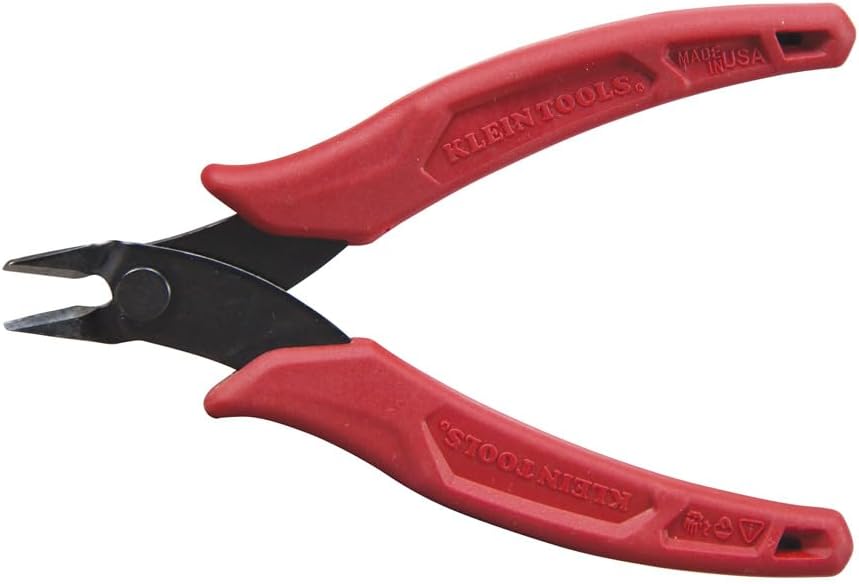
The Klein Tools D275-5 is a five-inch diagonal flush cutter with a 4.6 rating and an emphasis on clean, flat cuts. Its standout qualities are the pinch-cutting feature, narrow profile, and ability to cut fine material such as zip ties, small wire, and component leads without leaving long projecting ends.
We may earn a commission when you buy through this link, at no additional cost to you.
The flat side of the cutters is designed to sit close to the material being trimmed, reducing the amount of filing or secondary cleanup needed afterward. A slim profile also makes the tool easier to maneuver around crowded boards and other confined work areas, while the stated capacity extends to 16 AWG.
Its primary trade-off is that this is a general-purpose diagonal flush cutter rather than an extremely narrow specialist nipping tool. Although it handles fine materials well, users needing the absolute shortest reach into tight spaces may prefer a purpose-built micro jaw. It should also be reserved for materials within its stated capacity.
This is the strongest all-around recommendation for electricians, electronics hobbyists, crafters, and maintenance workers who want one compact cutter for wires, zip ties, and small plastic or component details. Its combination of clean cutting, access, and useful capacity makes it a practical first choice.
The flat flush cut and pinch-cutting design are especially useful when projecting wire ends would otherwise interfere with assembly. This makes the D275-5 practical for trimming electrical leads and plastic ties close to a finished surface.
Its slim five-inch profile helps when the cutter must approach a component from a restricted angle. That accessibility is valuable around crowded circuit boards, narrow craft assemblies, and confined repair areas.
We may earn a commission when you buy through this link, at no additional cost to you.
The KATA Mini Flush Cutters combine a five-inch body with a 10 mm angled jaw and a 4.4 rating. They are designed for flush-cutting soft wire up to 16 AWG while remaining small enough for jewelry, model kits, floral crafts, and other detailed tasks.
We may earn a commission when you buy through this link, at no additional cost to you.
The blade is forged from 2.5 mm-thick 65# manganese steel, then heat-treated and given a black electrophoretic parkerized surface for durability and corrosion protection. A spring-loaded design supports one-handed use, while the dolphin-style TPR handle is intended to reduce slipping and hand fatigue during repetitive cuts.
This tool should not be pushed beyond its stated material limits. The manufacturer specifically warns against cutting wire above 16 AWG, very hard or thick steel wire, and especially stainless steel. Its capacity is generous for a micro cutter, but edge longevity still depends on respecting that boundary.
Choose the KATA model if you want a capable, compact cutter for jewelry making, plastic ties, artificial flower stems, model kits, component pins, and light electrical work. It is particularly appealing for users who need a portable tool with a grippy handle and a protective cap.
The angled 10 mm jaw gives the tool a focused approach to small wire and component pins. That geometry helps reduce the projecting ends left after trimming, which is important when parts need to sit neatly inside a finished assembly.
Spring assistance and a nonslip TPR grip support controlled one-handed work. These features are useful during repeated trimming sessions involving jewelry, wiring, models, or artificial-flower stems.
We may earn a commission when you buy through this link, at no additional cost to you.
The Hakko CHP-170 two-pack is purpose-built for flush-cutting micro soft wire and leads up to 16 gauge. With a 4.7 rating, an 8 mm angled jaw, and a 21-degree head, it appeals to users who prioritize a compact approach and consistent movement over general-purpose cutting width.
We may earn a commission when you buy through this link, at no additional cost to you.
Heat-treated carbon steel provides the core blade strength, while precision-ground holes and surfaces support smooth operation. The spring returns the tool to an open position after each squeeze, reducing fatigue during repetitive work. Dolphin-style nonslip grips, curved edges, and parkerized surfaces add control and help limit glare.
As with other micro flush cutters, the narrow geometry and stated wire limit make this a specialist rather than a heavy-duty cutting solution. Buying a two-pack is most useful when you need a spare, share the tool between work areas, or expect frequent use in a professional setting.
The Hakko CHP-170 is an excellent choice for electronics repair, hobby assembly, and repeated trimming of fine soft wire. Its specialized jaw and smooth action make it a strong option when a narrow tip and close approach matter more than handling thicker material.
The 8 mm jaw and 21-degree head are designed to get close to the base of a fine lead. That narrow profile is useful where excess wire could obstruct a board, connector, model, or compact assembly.
Precision-ground movement surfaces and the opening spring help create a consistent operating cycle. The shaped grips also promote control when many consecutive cuts are required.
We may earn a commission when you buy through this link, at no additional cost to you.
The ARROW 5-inch Precision Micro Wire Cutters pair a compact angled-head design with a 4.5 rating. Their extra-long, precision-ground jaws are intended to produce clean cuts in soft copper and aluminum wires, plastic zip ties, electronic components, jewelry wire, craft flowers, and model parts.
We may earn a commission when you buy through this link, at no additional cost to you.
The blade is made from SK5 steel with a stated hardness of 46–48 HRC, offering a useful combination of durability, springiness, and wear resistance. A black phosphate coating adds rust and corrosion protection, while a contoured TPR handle supports comfortable one-handed control.
The stated capacity reaches 12 AWG, so it offers less capacity than several 16 AWG alternatives. The manufacturer also advises against cutting steel wire or extra-hard materials. Those limits make it better for general craft and electronics trimming than for attempting to shear resistant wire.
This cutter suits users who want one small tool for a mixture of electronics, crafts, models, and light electrical tasks. The spring-loaded handle and ergonomic grip are especially helpful for extended work or users who appreciate reduced hand strain.
The stated applications range from PCB trimming and electrical repair to jewelry, artificial flowers, model parts, and plastic ties. That breadth makes the tool convenient when projects do not justify separate specialist cutters.
A built-in return spring sends the jaws open after each squeeze, reducing the effort involved in repeated operation. The contoured TPR grip also supports stability and comfort.
We may earn a commission when you buy through this link, at no additional cost to you.
The Small Wire Cutters two-pack includes two five-inch micro 170-style flush cutters and carries a 4.6 rating. Their 12 mm high-frequency-hardened carbon steel jaws and angled head are designed to trim close while cutting soft wire up to 18 AWG.
We may earn a commission when you buy through this link, at no additional cost to you.
An internal spring creates a restricted opening, which can make the tool easier to hold and quicker to position. PVC-covered handles offer a comfortable, lightweight grip, and the five-inch size remains portable for craft benches, repair kits, and tool bags.
The 18 AWG rating gives this set a notable advantage over many micro cutters, although cutting harder material can damage the edge. Users should not attempt hard steel. If only occasional trimming is needed, two cutters may be more than necessary, but the pack can be useful for keeping one in each workspace.
This pair is a practical choice for artificial-flower stems, wired craft products, small wire, PCB trimming, plastic components, and zip ties. It combines useful capacity with the convenience of having a backup available.
The stated 18 AWG limit provides more cutting scope than many similarly sized flush cutters. That makes the tool suitable for slightly heavier soft wire while retaining a narrow working profile.
The internal spring limits how far the jaws separate, allowing the tool to remain close at hand. This can be useful when working around small components or making frequent short cuts.
We may earn a commission when you buy through this link, at no additional cost to you.
The two-piece wire cutter set pairs a five-inch Micro 170 Flush Cutter with a five-inch Standard Side Cutter. With a 4.5 rating, it offers a broader setup than a single-purpose model by addressing both close trimming and general soft-wire cutting.
We may earn a commission when you buy through this link, at no additional cost to you.
Both tools use high-carbon steel construction and high-frequency-hardened blades rated at 58–62 HRC. The micro cutter handles soft wire up to 18 AWG and plastic sprues, while the standard diagonal cutter is stated to manage copper and soft metal up to 14 AWG.
Internal reset springs allow the jaws to reopen automatically, which reduces hand fatigue during extended work. The lightweight nonslip handles are intended for control, although the standard cutter will naturally provide a broader cutting approach than the micro member of the set.
Choose this set when your work alternates between precise flush trimming and ordinary soft-wire cutting. It is also attractive for a shared workshop because one user can handle fine details while another uses the standard cutter, reducing the need for multiple tool types.
The micro cutter provides close access for leads and plastic sprues, while the standard side cutter offers broader handling for soft copper and soft metal. The pairing reduces tool switching across mixed projects.
High-frequency hardening gives both cutters a wear-resistant cutting edge for suitable soft materials. The reset springs support a steady workflow when trimming many small components.
We may earn a commission when you buy through this link, at no additional cost to you.
The ENGINEER NS-04 is a compact 4.75-inch precision nipper with a 4.8 rating, the highest among the listed products. It is explicitly designed for PCB and electronics work, with cutting edges intended for flush trimming of electronic components, copper wire, and soft component leads.
We may earn a commission when you buy through this link, at no additional cost to you.
Heat-treated carbon steel forms the cutting body, while an opening adjuster lets the user set how widely the jaws separate when the handles are released. That adjustment can improve productivity and reduce fatigue during repetitive work by allowing a closer default opening.
Its optimization is also a limitation: it is a precision mini nipper rather than a general-purpose heavy wire cutter. The supplied specifications do not state an AWG capacity, so users should judge it according to the listed component and soft-wire applications rather than assuming it will accept heavier wire.
This is an excellent choice for PCB assembly, hobby electronics, and detailed craft work where clean component trimming matters. The adjustable opening, compact body, and ESD-safe grips make it particularly suited to controlled electronics environments.
The angle-opening adjuster changes how far the jaws remain apart when the grips are released. A narrower setting can make repetitive trimming faster and reduce the distance the hand must move for each cut.
Purpose-ground flush-cutting edges and shaped tips are intended to trim electronic components and soft leads close to the board. ESD-safe comfort grips add a practical layer for sensitive assembly work.
We may earn a commission when you buy through this link, at no additional cost to you.
The Hakko CHP-170 three-pack is built for users who need several dedicated micro soft-wire cutters. Its 4.7 rating and stated 16 AWG maximum cutting diameter reflect a focused tool for electronics, hobby work, and repeated fine trimming.
We may earn a commission when you buy through this link, at no additional cost to you.
This listing emphasizes the quantity of three micro cutters, a maximum size of 16 AWG, Rockwell hardness of 56, and cutting force of 5 kg. The same CHP-170 model is also described elsewhere in the supplied data with an 8 mm angled jaw, heat-treated carbon steel construction, precision-ground surfaces, and a return spring.
The obvious trade-off is redundancy. A person who trims wire only occasionally may not benefit from owning three units, while the specialized geometry is not intended for hard or heavy wire. The pack is most valuable for busy technicians, repair facilities, classrooms, or teams that want backups and separate tools for different workstations.
For frequent micro cutting, the three-pack offers a convenient way to maintain tool availability. Its consistent specialized design and 4.7 rating make it especially attractive to professional users who repeatedly work with soft component leads and fine wire.
Three units make it easy to keep tools at separate benches or retain a spare when one is being cleaned or stored. This convenience is particularly helpful in active electronics and repair environments.
The documented 16 AWG limit and 56 Rockwell hardness provide clear expectations for suitable work. The CHP-170 platform remains focused on soft wire rather than hard or thick materials.
We may earn a commission when you buy through this link, at no additional cost to you.
The KNIPEX 78 13 125 is a five-inch Electronics Super-Knip with a 4.6 rating and a distinctive lead catcher. Built for ultra-fine cutting in electronics and fine mechanics, it combines very sharp bevel-free edges with precision-shaped tips for close cutting.
We may earn a commission when you buy through this link, at no additional cost to you.
Its INOX steel construction provides a premium material choice, while the lead catcher is intended to retain clipped component leads. That feature can help contain tiny offcuts near sensitive circuit boards and reduce the need to chase loose pieces after trimming.
The added catcher contributes more bulk than a conventional micro nipper, and the tool remains tightly specialized for ultra-fine applications rather than general wire cutting. Its value depends on whether lead retention and very precise tip geometry justify that more elaborate design.
This KNIPEX model is best suited to electronics professionals, serious hobbyists, and fine-mechanical users who regularly trim component leads. The lead-catching feature and extremely fine edges make it particularly useful where tiny cut pieces could become a nuisance or risk a short.
The integrated lead catcher helps retain small wire fragments as they are cut. On a populated circuit board, keeping loose slivers under control is a meaningful convenience.
Ground, very sharp edges without a bevel are intended to produce a flush result. Precision-shaped tips can also cut wire sitting extremely close to another component or connection point.
We may earn a commission when you buy through this link, at no additional cost to you.
The KNIPEX 78 03 125 Electronics Super Knips combines a five-inch format with a 4.7 rating and an ultra-fine cutting profile. Its ground, bevel-free edges and precision-shaped tips are aimed at flush cutting in electronics and fine mechanics.
We may earn a commission when you buy through this link, at no additional cost to you.
The cutting-edge hardness is approximately 54 HRC, providing a documented measure of the blade treatment. An opening spring and restricted opening support quick positioning, while extremely smooth movement is designed to minimize operator fatigue during sustained precision work.
The product information does not provide an AWG rating, so it is best evaluated for the specific fine applications named rather than for general wire snipping. As a specialist electronics nipper, it may feel less versatile than a micro cutter with a stated soft-wire capacity.
This model is a strong premium recommendation for PCB work, electronics repair, and other detailed assemblies requiring a very clean, close cut. It particularly suits users who value refined tip geometry, smooth action, and precise flush results over bulk cutting.
The shaped tips are designed to cut wire sitting close to its connection point. Ground edges without a bevel support the clean finish sought in controlled electronics work.
Smooth movement and a restricted opening spring help the tool return consistently to a controlled position. These features can reduce strain during long sequences of small cuts.
We may earn a commission when you buy through this link, at no additional cost to you.
Choosing a micro flush wire cutter starts with the material, wire size, and precision required by your projects. Jaw geometry, cutting capacity, spring action, steel treatment, grip design, and intended specialty should all influence the decision.
Begin with the gauge and composition of the material you expect to cut. Most options in this guide are designed for soft wire, component leads, plastic ties, model parts, or craft stems, with stated limits ranging from 16 to 18 AWG for several models. The ARROW cutter lists 12 AWG capacity, while the ENGINEER and KNIPEX options emphasize ultra-fine applications without providing a comparable AWG figure.
Jaw length determines how deeply the cutter can reach, while the head angle influences the approach to a component lead. The KATA has a 10 mm jaw, the Hakko CHP-170 has an 8 mm angled jaw, and the two-pack includes a 12 mm hardened jaw. Longer jaws can accommodate broader trimming tasks, whereas a short angled head may provide better access around crowded boards and very small assemblies.
A flush cutter is valuable because it leaves little projecting material. The Klein model emphasizes a flat cut and pinch-cutting feature, while both KNIPEX options use ground, very sharp edges without a bevel for flush cutting. Precision-ground jaws are also highlighted on the ARROW, KATA, Hakko, and Small Wire Cutters models, supporting clean results on suitable soft materials.
Spring assistance can reduce the effort required for repeated cuts and make one-handed positioning easier. The ENGINEER NS-04 goes further with an adjuster that changes the jaw opening when the handles are released. Other products use internal or built-in return springs, while the KNIPEX models combine an opening spring with restricted opening for controlled access.
Material treatment affects edge durability and resistance to wear. The KATA uses forged, heat-treated 65# manganese steel; the ARROW uses SK5 steel with stated hardness of 46–48 HRC; the Hakko uses heat-treated carbon steel; and the KNIPEX 78 13 125 features an INOX steel body. The two-piece set specifies high-carbon steel with high-frequency-hardened blades rated at 58–62 HRC.
Fine cutters are often used for many consecutive cuts, so grip comfort matters. The ARROW has contoured slip-resistant TPR handles, the KATA uses a dolphin-style nonslip TPR grip, and the Hakko provides curved nonslip grips. The ENGINEER features ESD-safe comfort grips, while the two-pack uses thin, lightweight nonslip handles and the Small Wire Cutters set uses PVC comfort grips.
Compact tools are easier to carry between a workbench, repair area, and client site. The KATA includes a protective cap that allows the cutter to be stored in a pocket or bag, and all five-inch models offer a relatively compact format. Packs of two or three are useful when maintaining a spare or supplying several workstations, but they make the most sense for frequent users.
Some features solve narrower workflow problems. The KNIPEX 78 13 125 includes a lead catcher to retain clipped wire fragments, the ENGINEER offers adjustable jaw opening, and the two-piece set combines a micro cutter with a standard side cutter for mixed tasks. These specialized features can be more valuable than extra capacity when your work consistently involves tiny lead fragments, repetitive bench tasks, or changing material demands.
Start by identifying the material and selecting a cutter whose stated capacity and intended applications include it. Hold the tool in one hand, use the spring to keep the jaws open, and position the tips close to the intended cut point before applying pressure. Stable support beneath the workpiece can help keep the cut controlled.
Close the handles steadily rather than twisting the tool or pulling against the wire. A flush cutter works best when the edge remains perpendicular to the material and the force is concentrated at the jaw. Afterward, inspect the workpiece for a short projection and avoid pulling off remaining material with the cutter, which can damage the edge or leave marks.
Wipe the blades with a clean, dry cloth after use and store the tool in a dry place. Do not cut hard steel, thick wire, or stainless steel with tools specified only for soft materials. Keep the cutting edges free of adhesive and debris, and avoid striking or prying with the jaws because mechanical damage can spoil alignment even when the steel itself appears undamaged.
A micro flush wire cutter trims fine wire, electronics leads, plastic zip ties, model parts, jewelry wire, and craft components close to their attachment point. Its narrow jaws help access crowded areas, while the flush-cutting edge minimizes leftover projections. It is best suited to soft, relatively thin materials rather than hard steel or heavy wire.
Flush cutters are designed to leave a cut end close to the surface, whereas diagonal cutters generally create a sloped or angled end. Some models, such as the Klein D275-5, combine diagonal-style geometry with a flat cutting action. The best choice depends on whether a neat, low-profile finish or a broader cutting approach matters more.
Yes, several models are explicitly intended for soft component lead wires and electronics work. The Hakko CHP-170, ENGINEER NS-04, and KNIPEX models are particularly focused on fine electronics cutting. Always confirm that the lead material and wire size fall within the tool’s stated applications before trimming.
No. In the American Wire Gauge system, a higher gauge number refers to a smaller-diameter wire. For example, 18 AWG is thinner than 12 AWG. When comparing micro cutter capacities, use the stated maximum gauge carefully and select a tool rated above the wire size you plan to cut.
Spring-loaded cutters can be easier to operate repeatedly because the jaws reopen after each squeeze. They also support one-handed positioning. The ENGINEER NS-04 adds an opening adjuster, allowing the user to tune the default spread, while several other models use fixed return springs for a consistently compact operating position.
Most tools in this guide are intended for soft wire and expressly warn against hard or thick materials. Cutting stainless steel, hardened wire, or steel beyond the stated capacity risks dulling or chipping the jaws. Choose a cutter specifically rated for the material and wire diameter when such work is required.
Fine jewelry wire and most model-kit leads generally benefit from a micro cutter rated for small-gauge wire, but the exact diameter and material determine the correct tool. Many listed models reach 16 AWG, while some reach 18 AWG. Check both the wire gauge and hardness before making repetitive cuts.
A multipack is useful for frequent users, shared workshops, or keeping spare cutters in separate work areas. The Hakko two-pack and three-pack are particularly convenient for this reason. Occasional users may be better served by one specialized cutter, such as the ENGINEER NS-04 or KNIPEX 78 03 125, chosen for the work they perform most often.
The Klein Tools D275-5 is the most versatile overall option for clean flush cuts and restricted spaces, while the KATA Mini Flush Cutters offer a budget-conscious combination of compact jaws, a grippy handle, and broad craft utility. The KNIPEX 78 03 125 stands out as a premium choice for refined electronics work with very sharp, bevel-free edges.
For specialized needs, the Hakko CHP-170 emphasizes narrow micro cutting, the ENGINEER NS-04 adds adjustable opening and ESD-safe grips, and the KNIPEX 78 13 125 adds a lead catcher. Prioritize the material and gauge you will cut, the clearance available around the workpiece, and whether repeated operation, portability, or specialized features matter most to your workflow.
Product availability, configurations, and prices can change over time, so check the current listing before ordering. Confirm the stated cutting capacity, included quantity, dimensions, and intended materials so the tool you select is appropriate for the work you actually plan to perform.