
FotoZ Macro Conversion Lens
4.6Editor score
8-diopter close-up attachment
Broad filter-thread compatibility
Tool-free spring-loaded mounting
Multi-coated optical design
Compare the best macro lens for insect photography, including smartphone, filter, conversion, APS-C, and full-frame options for every skill level in 2026.
Macro photography lets photographers reveal structures that are invisible to the naked eye, from the facets of a compound eye to the hairs on a caterpillar. A useful macro lens must combine magnification, focusing control, optical clarity, and a practical working distance, while remaining compatible with the equipment you already own.
The products in this guide represent several routes into close-up photography. We compared dedicated full-frame and APS-C lenses, clip-on smartphone optics, filter-based attachments, and front-mounted conversion lenses, focusing on magnification, aperture, focus method, compatibility, and field-of-view characteristics relevant to insects.
Each review explains where that option stands out and where its limitations may matter. The top three picks cover premium, compact, and budget approaches, while the remaining entries show how changing the camera system or attachment method can reshape your macro results. Prices and availability can change, so confirm current listings before purchasing.
4.6Editor score

4.4Editor score

4.7Editor score
This side-by-side comparison covers phone-mounted, camera-mounted, filter-based, and dedicated macro options. The differences in magnification, focus control, stabilization, and camera compatibility matter more than any single specification when deciding which approach fits an insect photographer's workflow.




The APEXEL 100Ultra Macro is a clip-on smartphone lens aimed at photographers who want dramatic insect and flower close-ups without carrying a dedicated camera. Its 4.0 rating places it below several higher-rated options, but its feature set is unusually ambitious: 10x magnification, a 50–110mm focal range, and a stated f/1.05 aperture within a universal phone clip.
We may earn a commission when you buy through this link, at no additional cost to you.
Its main appeal is access. The attachment can be fitted to compatible iPhone and Samsung Galaxy models without tools, making it a convenient option for backyard observation, nature walks, and quick documentation. The large aperture is intended to support shallow depth of field and low-light shooting, while the multi-lens construction is described as reducing reflections and flare to improve transmitted light.
The compromise is that a phone clip is not the same thing as a dedicated macro lens. Magnification and field of view depend partly on how precisely the accessory aligns with the phone's camera, and a phone's built-in focusing system may be less decisive at extreme close range. Edge quality can also be affected by fingerprints, smudges, and small alignment errors, making careful installation essential.
This is a practical pick for mobile-first photographers who prioritize magnification and portability over complete manual control. It is less suitable for a photographer who wants repeatable results across multiple camera systems, but it offers a low-barrier route into close-up photography. For phones, verify the clip and camera arrangement carefully before working close to insects.
The 10x stated magnification can make small wing patterns, flower structures, and surface textures more visible than the phone camera produces on its own. Because the system clips directly onto a phone, it also travels easily and avoids the need for a separate body, lens, and close-up filter.
The stated 50–110mm focal range is designed to let users frame tiny subjects from a short distance. The f/1.5-style depth effect promised by the large aperture can also help separate a sharply rendered insect from a softer background, although final results depend on alignment, subject distance, and the phone's processing.
We may earn a commission when you buy through this link, at no additional cost to you.
The TTARTISAN 40mm f/2.8 Macro is a dedicated APS-C prime for Sony E-mount cameras, earning a 4.4 rating and a place among the most balanced selections here. It provides 1:1 magnification, a minimum focusing distance of 6.7 inches, and a bright f/2.8 aperture in a relatively compact all-metal body.
We may earn a commission when you buy through this link, at no additional cost to you.
True 1:1 reproduction is the central strength. A subject can be recorded at life size on the sensor, which is valuable for insects whose legs, antennae, scales, and wing veins deserve a detailed but not excessively enlarged treatment. The optical formula uses seven groups and eight elements, including dual LD glass, to control aberrations and support clarity across the image.
Its 11-blade aperture can create smoother background blur than a basic seven-blade design, while the f/2.8 maximum aperture offers more flexibility in shaded habitats and at dawn or dusk. The trade-off is that this is a manual-focus lens. At high magnification, even a slight movement can shift focus, and the narrow depth of field can make precise manual focusing demanding.
This is an excellent choice for an APS-C Sony photographer who wants dedicated macro performance without the size and expense of a professional telephoto macro lens. It is best suited to deliberate working methods: use a support, focus carefully, and select a small aperture when greater depth of field is more important than maximum light or background separation.
A 1:1 magnification ratio gives insect photographers a conventional way to inspect fine structures without the extreme framing produced by high-diopter accessories. The 6.7-inch minimum focusing distance also helps keep enough space between the front element and a delicate subject.
Seven groups and eight elements, including dual LD glass, form a deliberate approach to aberration control. The f/2.8 aperture and 11-blade design also make the lens suitable for portraits, still life, jewelry, and low-light subjects whenever the camera remains in the Sony E-mount system.
We may earn a commission when you buy through this link, at no additional cost to you.
The ULANZI CL-003 is a 75mm phone macro lens designed to deliver 10x optical magnification for insects, plants, jewelry, and crafts. Its 4.3 rating reflects a solid mobile accessory with an adjustable 45–90mm focusing range, an aluminum alloy housing, and a more deliberate mounting system than a basic spring clip.
We may earn a commission when you buy through this link, at no additional cost to you.
Tele-focusing is a useful feature. Rather than relying entirely on the phone's automatic focus, the photographer can adjust the working distance and hold the subject at the desired point in the image. The upgraded multi-element construction is intended to improve light throughput, reduce distortion, and preserve clarity, while the 10x magnification makes millimeter-scale details more accessible.
The main limitation is equipment compatibility. The included 17mm adapter can work with a compatible lens clip, 17mm threaded phone case, or rabbit cage, so the phone must support one of these arrangements. The lens may also sit at a precise distance from the subject, making small movements and hard sunlight more likely to create focus changes or reflections.
The ULANZI CL-003 is best for mobile creators who want more deliberate focus control than a simple clip-on lens provides. It suits travel kits and social-content workflows where a dedicated camera is inconvenient. For consistent laboratory or field results, a true macro lens with interchangeable camera hardware offers greater control.
The 45–90mm focusing range lets the user alter subject distance rather than relying on one fixed position. That control is particularly useful when fitting a beetle, flower, or insect wing into the frame, though a tripod or stable support remains valuable at the closest settings.
The universal 17mm adapter supports a lens clip, threaded phone case, or rabbit cage. This gives mobile photographers more mounting choices than a narrow proprietary clip, which can improve stability and help position the optical axis over the phone's active camera.
We may earn a commission when you buy through this link, at no additional cost to you.
The FotoZ Macro Conversion Lens is an 8-diopter close-up attachment for camera lenses, and its 4.6 rating makes it one of the highest-rated products in this guide. Unlike a phone accessory or a filter limited to one thread size, it can be mounted in front of a broad range of compatible camera lenses through included adapter rings.
We may earn a commission when you buy through this link, at no additional cost to you.
The optical design uses three elements in three groups with multi-coated glass. That construction is intended to control distortion, maintain light transmission, and provide clearer close-up detail. Because it attaches to the filter ring, a photographer can retain the focal length, exposure characteristics, and stabilization of an existing lens while adding close-focus capability.
The most important limitation is that it is not a dedicated macro lens. Effective magnification and image quality depend on the base lens, its minimum focus distance, focal length, and optical characteristics. A long telephoto lens can produce a more compressed and magnified result, while a wide or kit lens may provide less magnification and a shallower working distance.
The FotoZ is a compelling budget approach for photographers who already own a camera with a compatible filter thread. It is especially useful for casual insect, flower, jewelry, and coin photography. For demanding professional output, a native 1:1 macro lens offers more predictable framing and image quality.
The attachment transforms a compatible filter ring into a close-up platform, allowing photographers to experiment with magnification without replacing an entire lens. The spring-loaded, tool-free design makes it quick to remove when normal photography is needed again.
Included support for 37mm, 40.5mm, 43mm, 46mm, 49mm, 52mm, 55mm, 58mm, 62mm, 67mm, and 72mm threads covers many popular setups. Matching the correct ring and confirming the lens's own filter diameter are the first steps toward a properly centered image.
We may earn a commission when you buy through this link, at no additional cost to you.
The Canon RF100mm F2.8 L Macro is the premier specialist option here, combining a 4.7 rating with a maximum magnification of 1.4x. As a Canon RF-mount telephoto macro lens, it is built for photographers who want high-resolution insect portraits, intricate wing detail, and the ability to fill the frame without extreme close focusing.
We may earn a commission when you buy through this link, at no additional cost to you.
Its fixed f/2.8 aperture is a major practical benefit because photographers can maintain a consistent exposure while changing magnification. The lens also adds optical stabilization with up to five stops of shake correction and a Hybrid IS system designed to address both angular and shift camera shake, problems that become more visible as magnification increases.
This capability comes with considerable bulk and a specialist price. The dedicated macro design requires a compatible Canon RF body, and its weight can become tiring during long field sessions. It also does not make a non-macro lens unnecessary: a smaller, lighter prime may be more convenient for general use, while the RF100mm is reserved for demanding close-up work.
For professional insect photographers, wildlife specialists, and serious hobbyists working with Canon RF cameras, this is the strongest all-around performance choice in the list. The combination of 1.4x magnification, bright optics, stabilization, and bokeh control justifies the premium for users who will use those capabilities regularly.
A 1.4x reproduction ratio can render small subjects at 140 percent of life size on the sensor. That extra reach is valuable for tiny insects, individual wing sections, and small patterns on leaves without relying on extreme digital cropping.
Ordinary stabilization may not fully address the movement problems created by close focusing. The lens's optical system and Hybrid IS features target angular and shift shake, helping produce more consistently sharp frames when magnification is high.
We may earn a commission when you buy through this link, at no additional cost to you.
The Canon RF35mm F1.8 Macro STM combines a 4.7 rating with a compact approach to close-up photography. Its 0.5x magnification and 0.56-foot minimum focusing distance make it less extreme than a dedicated 1:1 macro lens, but also allow it to serve as a normal wide-angle prime when insects are not the subject.
We may earn a commission when you buy through this link, at no additional cost to you.
The fixed f/1.8 aperture supports bright exposures and shallow depth of field, useful for separating subjects in shaded vegetation. A control ring provides direct adjustment, while the STM focusing system is suited to smooth operation with compatible camera autofocus. The optical stabilization system offers up to five stops of shake correction.
Because the maximum reproduction ratio is only half life size, this lens is not ideal for filling the frame with a very small insect or resolving minute scales from a normal viewing distance. It is more effective for larger insects, flower centers, leaf surfaces, and environmental close-ups where context remains important.
The RF35mm is a good choice for Canon RF users who want one compact lens for street, travel, family, and moderate macro work. It is particularly attractive for beginners who want to learn close-focus photography without committing to a larger dedicated macro lens.
Unlike a specialist macro prime, this lens can be used normally for wider scenes and then moved close for a 0.5x macro view. That flexibility makes it useful when an insect should appear within its habitat rather than as an isolated extreme close-up.
The f/1.8 aperture is well suited to low light and shallow depth of field, while the stabilization system helps when handholding at close distances. Together, they make the lens more approachable for everyday Canon RF photography.
We may earn a commission when you buy through this link, at no additional cost to you.
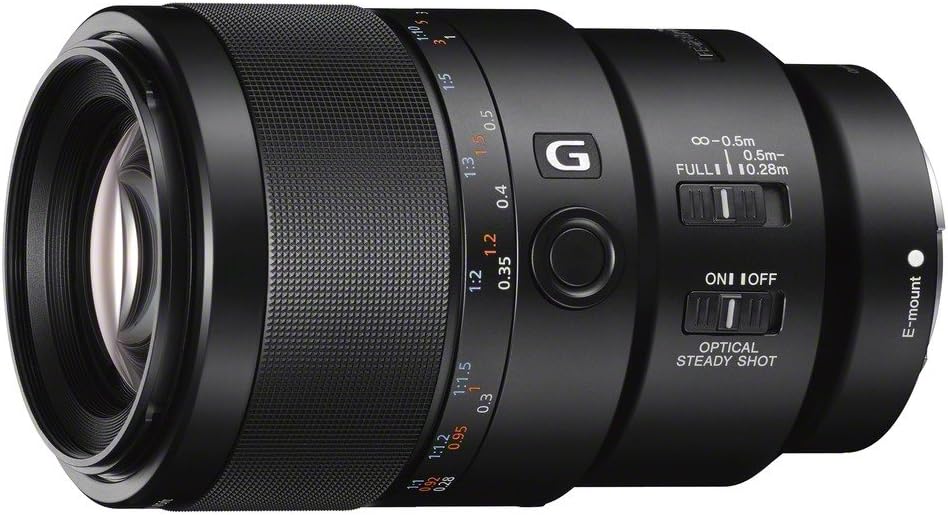
The Sony FE 90mm F2.8 Macro G OSS is a full-frame E-mount macro lens with a 4.6 rating and a proven 1.0x magnification ratio. It targets photographers who want a conventional dedicated macro option with a bright aperture, stabilization, and a minimum focus distance of 0.28 meters.
We may earn a commission when you buy through this link, at no additional cost to you.
At 90mm, the lens provides a useful balance between magnification and working distance. An insect is not pressed against the front element, making it easier to reposition a moving subject. The f/2.8 aperture and nine-blade circular diaphragm can create smooth background blur, while Nano AR coating and specialized glass elements are designed to suppress reflections, flare, and ghosting.
Manual and automatic focus can be selected through a sliding focus ring, while the Direct Drive SSM provides quiet, precise focusing. Optical Steady Shot assists handheld work. The trade-off is weight: at 602 grams, the lens is substantial, and the dedicated macro design remains a specialist purchase rather than an inexpensive add-on.
For full-frame Sony photographers, this is a dependable choice for insects, jewelry, flowers, and product details. It is less suitable for APS-C users who want a compact kit, but its 1:1 capability and familiar 90mm perspective make it a well-balanced professional macro tool.
The 1.0x maximum magnification records subjects at life size, while the 90mm focal length offers enough separation to reduce the chance of scattering a delicate insect with a lens hood or front element.
The sliding focus ring supports rapid switching between manual and automatic focus, and the nine-blade aperture contributes to rounded highlights in the background. Special glass and coating elements help preserve contrast and color in close-up scenes.
We may earn a commission when you buy through this link, at no additional cost to you.
The 67mm Close-up Filter Kit includes plus 1, plus 2, plus 4, and plus 10 diopter filters for photographers who already own a 67mm-threaded camera lens. Its 4.4 rating reflects a versatile, low-complexity approach to insect, flower, coin, and small-object photography.
We may earn a commission when you buy through this link, at no additional cost to you.
Having four strengths allows the user to choose a modest close-up effect or combine filters for greater magnification. The filters are double threaded, so they can accommodate additional optics such as a polarizer or skylight filter and can be combined into stronger diopter values. A nylon pouch, lens cap, and microfiber cloth round out the package.
The principal constraint is compatibility. The kit is marked for 67mm threads, so it cannot be used with lenses of another diameter unless an additional adapter is available. Increasing diopter strength also reduces the working distance, which can make it difficult to keep a moving insect in focus and may expose a kit lens's weaker close-up performance.
This kit is most useful for photographers who want inexpensive experimentation or already work with 67mm threaded glass. It is less appropriate as the sole macro solution for a varied camera kit, but the range of strengths makes it useful for experimenting with composition and magnification.
The plus 1, plus 2, plus 4, and plus 10 filters allow the user to match magnification to the subject and working distance. Stacking them creates stronger effects, although a single filter is often easier to control and can reduce light loss.
A 67mm thread is required for direct use. The filter diameter is normally marked on the lens barrel or lens cap, so checking it before ordering prevents the disappointment of buying a kit that cannot mount to the intended lens.
We may earn a commission when you buy through this link, at no additional cost to you.
The Xenvo Pro Lens Kit is a broad mobile photography bundle with a 4.1 rating. It combines a 15x Clarus macro lens, a 0.45x wide-angle attachment, a universal grip clip, a rechargeable LED fill light, a lanyard, a travel case, and several small accessories for phones, tablets, and laptops.
We may earn a commission when you buy through this link, at no additional cost to you.
The macro lens is designed for very close work, with the instructions recommending placement approximately half an inch from the subject. That limitation is important: it is not a distant-subject zoom and cannot be used like a telephoto macro lens. Its value comes from revealing nearby details with a phone while the included LED helps illuminate subjects in darker settings.
Compared with a bare clip-on macro lens, the kit offers more complete support. The TruGrip clip is intended to improve grip, the LED provides three brightness levels of warm continuous illumination, and the travel case protects the components during transport. The wide-angle option broadens the kit's use beyond macro photography.
The trade-off is that the macro specification is not matched to a camera lens's dedicated 1:1 standard, and phone image processing can vary by device. This kit is a good choice for travelers and casual photographers who want multiple phone functions in one package, especially when a dedicated camera is impractical.
The included GlowClip LED can provide warm, continuous fill light at low, medium, and high settings. Continuous light is often easier to manage than a brief phone flash when photographing insects at close range, particularly under leaves or inside flowers.
The package adds a wide-angle lens, universal grip, lanyard, and protective case. These additions make it practical for travel and everyday mobile photography rather than limiting the purchase to a single close-up accessory.
We may earn a commission when you buy through this link, at no additional cost to you.
The AstrHori 25mm f/2.8 Ultra Macro is built for extreme close-up work rather than everyday photography. Its 4.2 rating accompanies a dedicated 2:1 to 5:1 magnification range, a fixed f/2.8 aperture, manual focusing, and compatibility with full-frame Sony E-mount mirrorless cameras.
We may earn a commission when you buy through this link, at no additional cost to you.
At up to five times life size, this lens can reveal details that a conventional 1:1 macro lens would frame less closely. Its wide-angle configuration is also useful because it provides greater depth of field than a telephoto macro design, helping keep more of a tiny insect's body acceptably sharp at the specified magnification.
The defining limitation is that the lens does not support infinity focus. It is designed to commit to close-up work rather than act as a general-purpose prime. Manual focus also requires careful movement because magnification amplifies both subject motion and camera shake, particularly at the upper end of the range.
This lens is best for photographers who deliberately want magnified textures, small body sections, and laboratory-style detail. It is less convenient for field sessions that alternate between distant subjects and extreme close-ups, but it can produce views that a standard macro optic cannot reach without cropping.
The 2:1 to 5:1 range makes the lens useful for tiny scales, compound-eye structures, and minute patterns on a wing. The ability to work beyond 1:1 gives photographers a closer optical view without relying entirely on digital cropping.
A wide-angle macro arrangement can provide more depth of field than a telephoto macro lens. That benefit is important when an insect is curved or irregular, although manual focus and support remain necessary to keep the critical details sharp.
We may earn a commission when you buy through this link, at no additional cost to you.
The right macro lens depends on your camera, desired magnification, and tolerance for manual control. Consider optical performance and compatibility before choosing an accessory based only on a headline magnification number.
Start with the device you already use. Dedicated lenses require the correct camera mount, while phone attachments must align with the active camera and accommodate the phone's housing. Sony E-mount appears across several choices here, Canon RF options cover compatible Canon bodies, and the FotoZ approach depends on the filter-thread diameter of an existing lens. A product cannot deliver its intended magnification if it does not mount securely or sit correctly over the optical axis.
A true 1:1 macro lens records a subject at life size, which is a useful standard for insects, jewelry, and flowers. Clip-on smartphone lenses and close-up filters may advertise much larger headline figures, but those numbers often describe optical magnification before considering crop, framing, and digital resolution. Extreme macro lenses can reach several times life size, yet they usually have a much shallower working distance and narrower focus tolerance. Choose magnification based on how much of the insect you want to fill the frame.
Insects are vulnerable subjects, so the distance between the front element and the insect matters. A 90mm or 100mm telephoto macro lens generally provides a comfortable working distance, while high-diopter phone attachments may require the device to sit within an inch or two of the subject. Extra magnification can also reduce the light reaching the sensor, making brighter apertures and careful exposure more important. Check the stated minimum focus distance before committing to a setup.
A wide aperture such as f/1.8 or f/2.8 helps in shaded vegetation and low light while producing a shallow depth of field. That shallow focus can isolate a patterned wing or glossy beetle, but it can also make precise focus more difficult. A smaller aperture generally increases depth of field, though it requires either more light or a slower shutter speed. The best choice balances subject separation with the amount of the insect that must remain sharp.
Dedicated macro lenses may use electronic focusing, manual focus, or both, while phone attachments usually depend on the phone's autofocus. High magnification makes small movements more consequential, so manual focus, a tripod, a beanbag, or a stable surface can materially improve results. The Sony FE 90mm includes stabilization, and the Canon RF100mm adds specialized macro stabilization, but stabilization cannot replace careful technique.
Look for a credible optical design, effective coatings, and features intended to control distortion, flare, chromatic aberration, and reflections. The TTARTISAN uses dual LD glass, the FotoZ has a multi-coated three-element design, and the Sony FE 90mm includes specialized glass and coating. These features cannot guarantee identical results across every camera, but they provide a stronger basis for image quality than magnification alone.
Macro subjects are often found in difficult light under leaves, on flowers, or near the ground. A bright lens, image stabilization, and a fill light can all help. The Xenvo bundle includes a rechargeable LED, while dedicated f/2.8 lenses offer a reasonable compromise between light gathering and depth of field. Diffused light is generally easier to manage than direct flash, and a small reflector can reveal detail without overwhelming the insect.
A dedicated macro lens gives repeatable framing and closer working distances, but full-frame models can be heavy and specialized. Compact primes and general-purpose lenses are easier to carry, while phone attachments and filter kits are the simplest travel options. Consider how often the lens will be used and whether you also need wide-angle, portrait, travel, or normal photography. A specialized tool that remains in a cabinet is less useful than a versatile lens you can carry to every walk.
Begin by learning the normal focusing range of your camera and lens before moving close to a subject. Set the camera to manual focus or use a single autofocus point over the insect, then move the camera or lens slowly until the eye, wing, or other chosen feature becomes sharp. At macro distances, small forward and backward movements can change magnification noticeably, so steady support and short adjustment strokes are more effective than rapid reframing.
Keep the subject safe by maintaining enough distance for the lens and any attached filter or clip. Look for wind, vibration, and sudden subject movement, and never force an insect to remain in place. Diffused fill light or a reflector can reveal detail with less harshness than a direct flash. Shoot a few test frames and inspect the eyes and antennae for sharpness before changing the setup.
Clean the front element gently with a blower and an appropriate lens cloth, avoiding pressure that could damage coatings. Keep adapters, phone clips, and threaded filters free of dust and fingerprints because even small particles can create haze or flare. After field use, cap the lens, remove external attachments when practical, and store everything in a dry, padded case. Check that the mount, threads, and adapter remain tight before the next session.
A dedicated 1:1 macro lens is a strong general-purpose choice because it reproduces subjects at life size while preserving a practical working distance. Higher magnification can reveal extremely small features, but focusing becomes harder and the lens must remain closer to the insect. Phone attachments with advertised magnification of 10x or 15x can be useful for quick close-ups, although their framing and image quality depend heavily on the phone and alignment.
A dedicated macro lens generally provides more predictable magnification, better close-range image quality, and more deliberate focusing control. A close-up filter is less expensive and can reuse an existing lens, but it may expose weaknesses in the base lens and reduce working distance. A conversion attachment occupies a useful middle ground when the photographer already owns a compatible camera lens.
Some options are specialized and work best only at close focus. The Canon RF35mm and Sony FE 90mm can both serve broader photographic roles, while the AstrHori 25mm is explicitly focused on extreme macro work and does not support infinity focus. Phone kits and clip-on attachments are naturally more flexible because the phone's normal camera remains available when the accessory is removed.
Blurriness often comes from camera movement, inaccurate manual focus, limited depth of field, or a dirty front element. Stabilization can help with movement but cannot rescue a missed focus point. Use a tripod or solid support, illuminate the subject, focus on a visible feature, and check the image at full size before increasing magnification further.
More light improves the chances of keeping the shutter speed fast enough to freeze insect movement. A bright f/2.8 macro lens or a fill light can help in shaded settings, while a wider aperture simplifies exposure but reduces depth of field. Diffused light is often more revealing and less harsh than direct flash, especially on shiny insect bodies.
Move slowly, keep a respectful distance, and avoid sudden gestures or vibrations. A telephoto macro lens with a comfortable minimum focus distance lets you work from farther away, while a high-magnification attachment may require you to stay very close. Never restrain a subject, and accept a wider environmental composition if a closer image would disturb the insect.
Compatibility depends on the attachment system and the dimensions of the case. Some lenses use a broad clip, while others require a 17mm threaded case, lens clip, or cage. The camera opening must remain unobstructed, and the lens must line up with the active camera. Check the included mounting options and measure the case before ordering.
Autofocus is convenient for moving subjects and quick phone-based work, but manual focus often gives more precise placement at high magnification. A hybrid approach works well: autofocus to acquire the subject, switch to manual focus for the final adjustment, and use a support to minimize movement. A large screen or magnified display also makes precise focus easier.
The Canon RF100mm F2.8 L Macro is the strongest premium choice for photographers who need 1.4x magnification, a bright fixed aperture, and specialized stabilization. The TTARTISAN 40mm f/2.8 offers a more balanced route into true 1:1 macro photography for compatible Sony APS-C bodies, while the FotoZ conversion lens provides the best budget-oriented way to reuse existing camera glass.
The right choice for the rest depends on the equipment and result you need. The Sony FE 90mm serves full-frame Sony users, the Canon RF35mm offers compact flexibility, and the AstrHori 25mm reaches beyond life-size magnification. For phones, the APEXEL and ULANZI emphasize magnification and distance control, the Xenvo bundle prioritizes accessories and illumination, and the 67mm filter kit provides inexpensive, stackable close-up options.
Before buying, confirm mount or thread compatibility, expected working distance, focusing method, and the amount of magnification your subject truly requires. Product availability, promotions, and prices can change, so review the current listing and seller details before making a final purchase.