ECO-WROETHY Cubix100
4.7Editor score
Thirty-point-seven-two-kWh battery capacity
Up to thirty-two parallel units
Bluetooth and WiFi monitoring
UL9540 and UL1973 certifications
This guide compares 10 LiFePO4 server rack backup battery kit options, covering capacity, monitoring, safety, scalability, and inverter compatibility.
A LiFePO4 server rack backup battery kit combines lithium iron phosphate storage with the organized form factor used for data-center equipment. A capable system should provide dependable backup power, fit a standard rack, communicate with compatible inverters, and offer the protections needed for long-term residential or commercial use.
The products in this guide range from individual 5.12kWh rack batteries to complete systems with two batteries, inverters, MPPT solar charging, and split-phase output. We compared their stated capacities, power ratings, rack designs, battery-management features, monitoring options, safety functions, expansion limits, and inverter communications.
Each review identifies the product's strongest use case while also noting important limitations, such as installation complexity, separate-shipping requirements, or the need to confirm electrical compatibility. Ratings and specifications reflect the supplied product information, and current prices and availability can change at any time.
4.7Editor score

4.2Editor score

5.0Editor score
The table below compares all ten options across their core battery configuration, rack form factor, monitoring features, expansion capability, and principal application, making it easier to distinguish standalone batteries from complete inverter-and-battery systems.


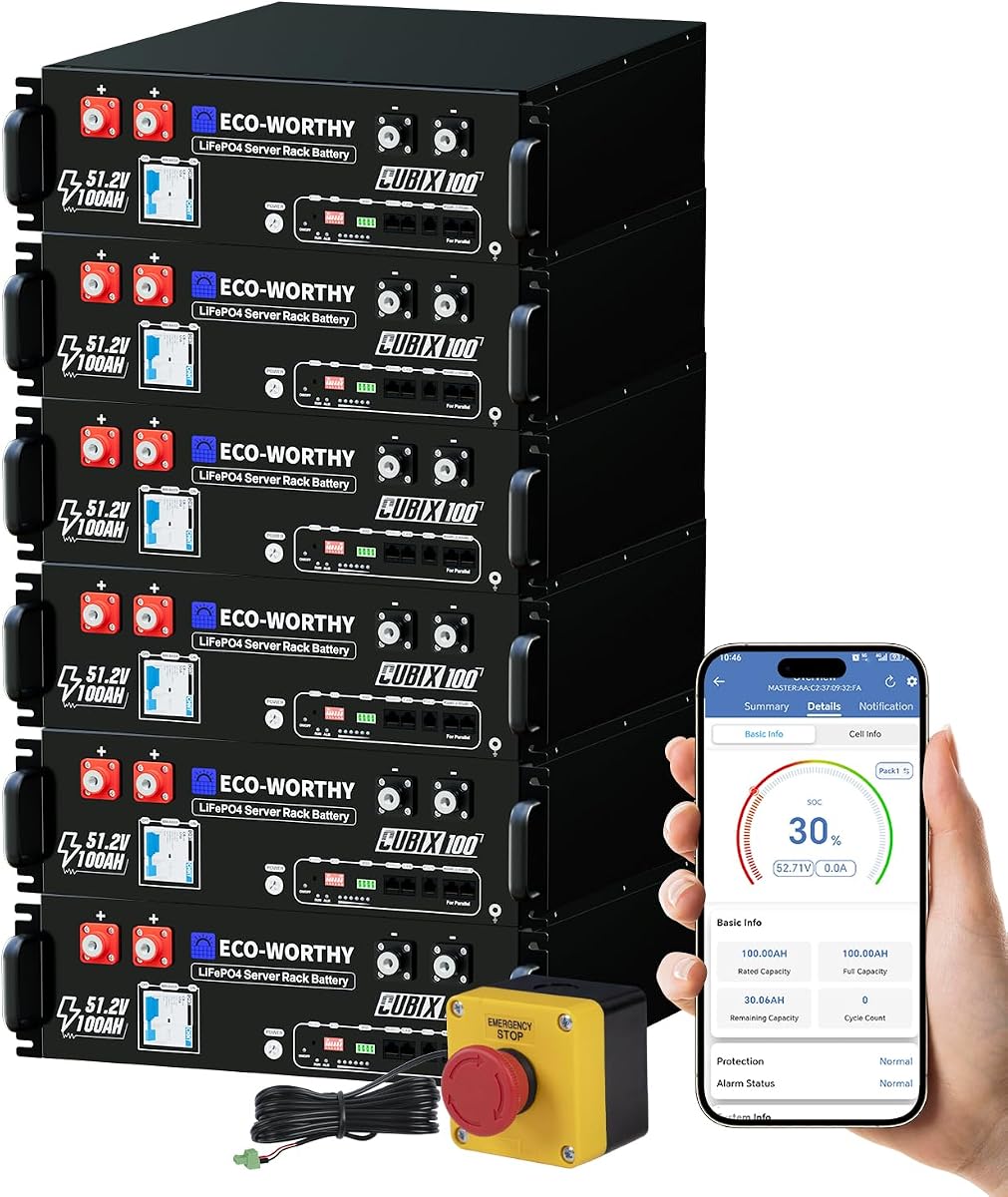
The ECO-WROETHY Cubix100 is a substantial server-rack energy-storage package built around a six-pack of 51.2V 100Ah batteries. With a 4.7 rating, its standout qualities include 30.72kWh of stated capacity, Grade A LiFePO4 cells, and a design intended for whole-home off-grid use, making it one of the most comprehensive choices in this guide.
We may earn a commission when you buy through this link, at no additional cost to you.
Its most persuasive feature is the combination of capacity and expandability. The included six batteries can operate as a 30.72kWh system, while as many as 32 units may be paralleled for a potential 163.8kWh installation. Vertical server-rack mounting improves space utilization, while CAN, RS485, Bluetooth, and WiFi support allow communication with compatible solar inverters and status checks through the ECO-WORTHY app.
Safety is another major strength. The battery is listed to UL9540 and UL1973 and has CEC listing, while the product information specifically addresses electrical safety and thermal-runaway management. A complete accessory package includes parallel and communication cables, grounding wires, protective terminal covers, screws, and a manual. These details can make installation more straightforward than sourcing small components separately.
The trade-off is physical scale. A six-battery system needs more rack space, and installation should be planned around weight, ventilation, cable routing, and service access. It is best for buyers who want a high-capacity foundation and recognize that a properly designed inverter, solar, transfer, and protection system is still required. For a premium whole-home foundation, it is our strongest overall selection.
The six-pack provides 30.72kWh of usable stated capacity, substantially more than the single-battery options in this guide. That makes it a practical starting point for households seeking to carry larger loads through extended outages or operate essential appliances without frequent grid dependence.
Bluetooth and WiFi monitoring make the battery easier to check remotely, while CAN and RS485 interfaces support more sophisticated inverter communication. The stated limit of 32 parallel units gives owners a long-term path for increasing storage as their needs grow.
We may earn a commission when you buy through this link, at no additional cost to you.
The ECO-WORTHY Liber 10KP is a complete 48V home-backup package combining two 51.2V 100Ah LiFePO4 batteries with a 10,000W inverter. Its 4.2 rating reflects a capable system offering 10.24kWh of battery capacity, high inverter output, solar charging, and compatibility with whole-home backup configurations.
We may earn a commission when you buy through this link, at no additional cost to you.
The inverter is a true three-in-one unit, combining a pure sine-wave inverter, two independent MPPT controllers, and a maximum 200A battery charger. It supports 120V single-phase or 120V/240V split-phase output, has a 20kW peak rating, and can operate alongside up to six parallel inverters for an aggregate output of 60kW. That flexibility makes the kit relevant to homeowners who need both outage support and solar integration.
The battery side is equally well developed, using Grade A LiFePO4 cells, CAN and RS485 communication, Bluetooth, and WiFi monitoring. Up to 32 batteries can be connected in parallel, taking the stated maximum storage capacity to 163.84kWh. The battery and inverter are stated to have passed UL1973 and UL1741 testing and to meet CEC standards, adding confidence for residential installation.
This is not a simple plug-in appliance. Each item is shipped separately for safety, and the product includes an RSD button and necessary accessories. Buyers must confirm that their service panel, transfer equipment, generator interaction, solar design, and local electrical requirements are compatible. It earns the Editor's Choice badge because the package is more complete and flexible than a battery-only purchase for a buyer ready to design a full system.
The inclusion of two batteries, a 10kW inverter, charging controls, and an RSD button gives buyers a more cohesive starting point than a standalone battery. It is particularly useful when the goal is a residence-wide system rather than a small UPS or a single essential-circuit arrangement.
Two independent MPPT controllers can accept a substantial solar array, while the inverter supports both single-phase and split-phase configurations. These are important advantages for installers designing around renewable charging, larger loads, or future system expansion.
We may earn a commission when you buy through this link, at no additional cost to you.
The WT5100 48V 100Ah is a standalone 51.2V server-rack battery offering 5.12kWh of stated capacity and up to 5.12kW maximum output. It carries a 5.0 rating, the highest numeric score in the group, and stands out for its roomy LCD, extensive parallel capacity, integrated 100A BMS, and stated 6000-plus-cycle cell performance.
We may earn a commission when you buy through this link, at no additional cost to you.
Its smart display provides visibility into voltage, capacity, operating status, and other system information directly on the battery. Integrated CAN and RS485 ports allow it to work with many solar inverter systems, which is important because server-rack batteries do not automatically communicate with every inverter. The Grade A LiFePO4 cells and 100A BMS support long-term use, while protections cover overcharge, over-discharge, over-current, overheating, and short circuits.
The claimed expansion ceiling distinguishes it from many competitors. Up to 63 batteries may be connected in parallel, enabling a highly ambitious rack-based installation. Standard server-rack dimensions and vertical installation support make it suitable for homes, workshops, telecom applications, and other systems where organized equipment placement matters. A 10-year limited warranty also provides a stronger stated support term than several alternatives.
This product does not include an inverter, charge controller, transfer switch, or the balance of equipment needed for immediate backup operation. Buyers must assemble those components and ensure the chosen inverter supports the battery's voltage, charging profile, and communication protocol. Even so, it is our Best Budget selection for a flexible single-battery platform: the combination of a 5.12kWh starting capacity, sophisticated monitoring, and unusually broad expansion potential is compelling.
At 5.12kWh, the WT5100 can support a meaningful portion of a typical household's daily energy use when paired with correctly sized equipment. Starting with one unit also makes it easier to phase a larger installation as backup requirements become clearer.
The built-in 100A BMS, LCD, and CAN/RS485 interfaces make this more than a passive battery block. These features support safer installation, easier troubleshooting, and better coordination with compatible renewable-energy equipment.
We may earn a commission when you buy through this link, at no additional cost to you.
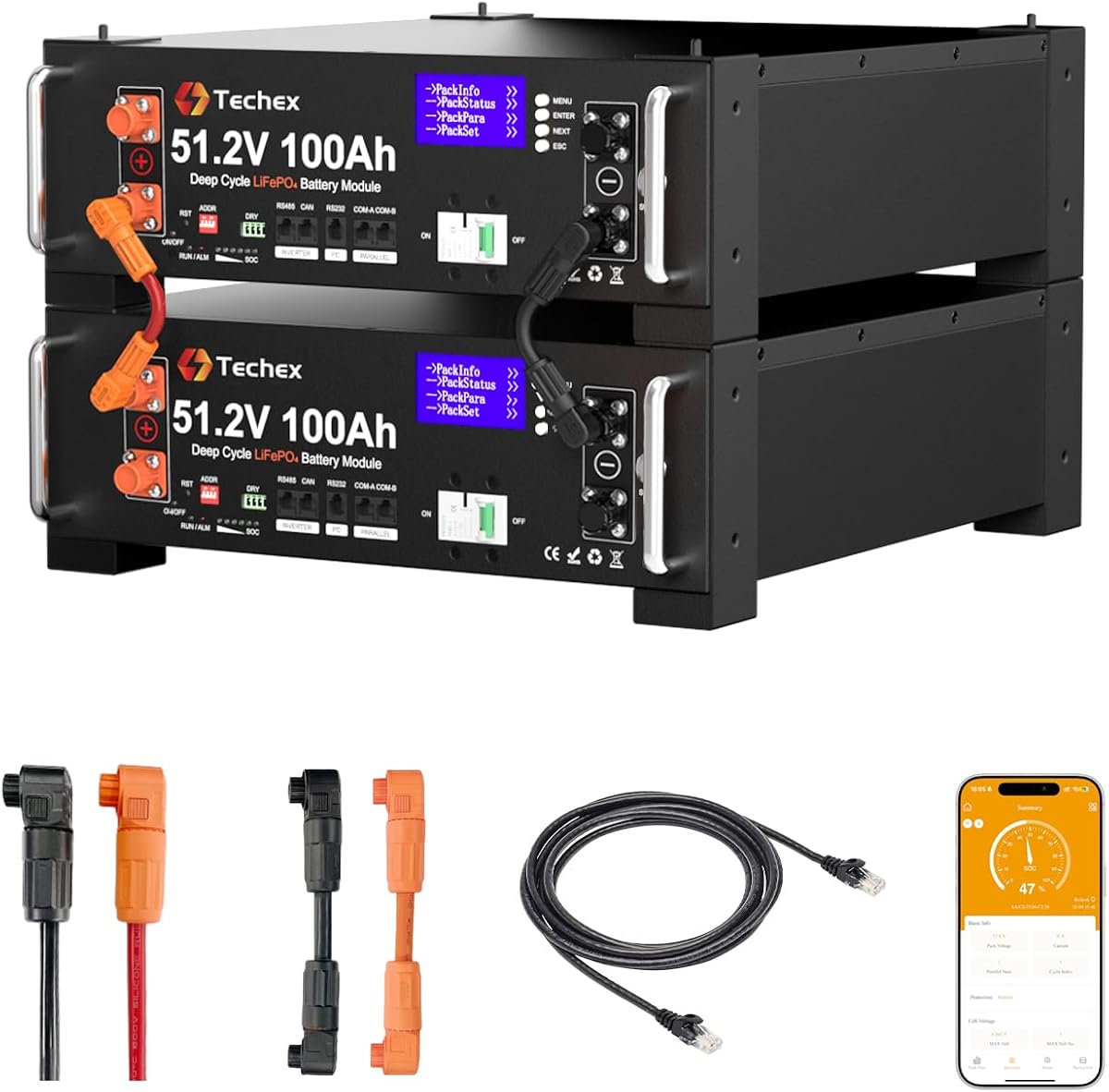
The Techex 48V 100Ah V2 is a 3U rack-mount battery with a 4.7 rating, a 5.12kW maximum output, and a feature set oriented toward technically capable installers. Its defining additions are WiFi remote monitoring, built-in automatic fire suppression, anti-explosion protection, and clearly labeled positive and negative terminals.
We may earn a commission when you buy through this link, at no additional cost to you.
Monitoring is unusually comprehensive. The LCD reports voltage, current, temperature, and protection status, while a touchscreen menu allows the BMS communication protocol to be selected between RS485 and CAN. Bluetooth offers phone-based control, and WiFi allows remote status checks after configuration. The battery is listed as compatible with Victron, Pylontech, Luxpower, Sol-Ark, DEYE, GoodWe, and other inverter brands.
The electrical design also receives attention. Sixteen Grade-A EV LiFePO4 cells feed an upgraded 100A smart BMS, with stated operation from 0°C to 55°C during charging and from -20°C to 60°C during discharge. Dual terminals are intended to balance current and lower heat, a 125A breaker adds overcurrent control, and fast plug connectors are designed to be conductive, anti-reverse, and tool-free. Each unit includes parallel communication and power cables.
At 100 pounds, the battery is not especially light for frequent handling, and the inclusion of multiple communication methods does not guarantee compatibility with every inverter revision or firmware. Users should verify the manufacturer's protocol and communication address settings before installation. Even with those caveats, this is an appealing option for buyers who prioritize remote visibility, inverter interoperability, and layered thermal protection in a compact 3U format.
WiFi, Bluetooth, and a local LCD give users several ways to inspect operating data. That redundancy is useful when diagnosing a system, confirming state of charge, or checking BMS protection events without relying entirely on a cloud connection.
The automatic suppression system is stated to activate within milliseconds when temperature exceeds 170°C. It does not eliminate installation responsibility, but it adds an engineered response to a serious failure condition inside a compact energy-storage installation.
We may earn a commission when you buy through this link, at no additional cost to you.
The VPauexii 48V 400Ah is presented as a 20.48kWh server-rack battery with automatic fire suppression and a 5.0 rating. It also includes a 3U stacking-mount kit, preassembled cables, grounding wires, terminal covers, and a manual, giving it one of the more installation-focused packages in the comparison.
We may earn a commission when you buy through this link, at no additional cost to you.
The battery's high capacity makes it relevant to larger solar-storage, off-grid, and backup systems. It is advertised as compatible with more than 99% of inverters, with closed-loop CAN or RS485 communication cited for EG4, Victron, Sol-Ark, GoodWe, DEYE, SUNGOLDPOWER, and other major brands. Users can monitor the system through WiFi or cellular connectivity, Bluetooth, and a built-in LCD that shows voltage, current, and power.
Safety and after-sales support are the standout selling points. A 12g aerosol fire-retardant canister is stated to activate automatically within milliseconds above 170°C, while the supplied rack kit and wiring reduce the need for separate accessory shopping. The stated support package includes 30-day free returns, price protection, a five-year warranty, and rapid technical assistance.
There is an important documentation inconsistency: the product title states 400Ah and 20.48kWh, while one description line refers to a 48V 100Ah battery. A prospective buyer should verify the exact model label, nominal voltage, capacity, and breaker arrangement before ordering. The 3U enclosure also needs to be checked against the actual battery's weight and rack-loading requirements. Subject to that verification, it is a high-capacity option with one of the most useful bundled accessory sets.
The stated 20.48kWh capacity could reduce the number of physical battery units needed in a large installation. Fewer enclosures may simplify rack planning, although electrical requirements and the exact model configuration still need professional verification.
The stacking rack, preassembled cables, grounding wires, terminal covers, and manual create a more complete package than a bare battery. This is particularly helpful for technicians and remote-site managers who need standardized components on site.
We may earn a commission when you buy through this link, at no additional cost to you.
The ECO-WORTHY 5000W Backup combines two 51.2V 100Ah LiFePO4 batteries with a 5000W inverter, producing a stated 10.24kWh capacity. Its 4.5 rating and balanced 5kW output make it a practical middle ground between a small UPS-style setup and the substantially higher-output Liber 10KP package.
We may earn a commission when you buy through this link, at no additional cost to you.
The inverter combines a pure sine-wave inverter, a 100A MPPT controller, and a 100A battery charger. Its PV input range is listed as 120–500V DC, maximum rated output is 5000W, and peak output reaches 10,000W. The recommended battery-charging voltage is 57.6V with a recommended charging current of 50A. A single inverter provides 120V output, while two or more parallel inverters can support 120V, 208V, or 240V.
The batteries use Grade A LiFePO4 cells with CAN and RS485 communication, Bluetooth, and WiFi monitoring. Up to 32 batteries can be paralleled for a stated 163.84kWh maximum, while up to six inverters can be combined for 30kW AC output. The battery and inverter are stated to have passed UL1973 and UL1741 testing and to meet CEC standards.
Compared with the 10kW ECO-WORTHY kit, this model has one MPPT controller and half the continuous inverter output, but it can still cover basic household loads during an outage. Each component ships separately, and the package includes an RSD button and necessary accessories. It is a sensible choice for buyers who want more than a battery-only installation but do not need the higher continuous output of the flagship system.
A 5000W continuous rating is well suited to many essential circuits and selected household appliances, while the 10kW peak rating adds headroom for surge loads. Buyers should still inventory their appliances and start surge requirements before selecting the inverter.
The integrated 100A MPPT controller means the system can be designed for direct solar charging without adding a separate controller. Its 120–500V DC PV range also provides flexibility when choosing a residential array configuration.
We may earn a commission when you buy through this link, at no additional cost to you.
The Wattcycle 51.2V 100Ah is a single-battery option with a 4.0 rating, 5.12kWh of stated usable energy, and up to 5.12kW of output. Its standard 3U rack format and relatively modest 91.9-pound weight make it easier to incorporate into mobile, workshop, cabin, UPS, or residential storage applications.
We may earn a commission when you buy through this link, at no additional cost to you.
The battery uses 102Ah EV-grade A+ LiFePO4 cells and makes a notably strong cycle-life claim of more than 15,000 charge-discharge cycles at 60% depth of discharge. A 100A smart BMS protects against overcharge, over-discharge, over-current, short circuits, and temperature extremes. The all-metal enclosure adds mechanical and vibration protection, while the chemistry is also described as resistant to leakage and thermal instability.
Monitoring and communications make it suitable for professional integration. The LCD touchscreen offers local status checks, Bluetooth 5.0 provides voltage, current, and capacity data through a mobile app, and CAN, RS485, and RS232 protocols support different equipment. Compatibility is specifically highlighted with Victron and Schneider systems. Up to 16 batteries can be paralleled, reaching a stated 81.9kWh.
Its 4.0 rating is the lowest among products that have a numeric customer score, and it lacks the WiFi or cellular remote access offered by several rivals. Bluetooth still requires close proximity for many monitoring functions. Nevertheless, the lightweight enclosure, broad protocol support, high stated cycle figure, and flexible inverter pairing make this a flexible option for users comfortable with communication-rich equipment.
Supporting CAN, RS485, and RS232 gives the battery more ways to integrate with professional solar, UPS, and inverter-based systems. Buyers should still confirm the exact protocol, baud rate, and addressing method required by their chosen controller.
The stated 15,000-plus-cycle life at 60% depth of discharge is a major strength for frequently cycled solar and time-shift applications. Actual service life will still depend on temperature, charge discipline, depth of discharge, and the quality of the system surrounding the battery.
We may earn a commission when you buy through this link, at no additional cost to you.
The Wattcycle Dual 100Ah is a two-pack of 51.2V 100Ah server-rack batteries totaling 10.24kWh of stated usable energy. It is designed for home backup, off-grid systems, industrial equipment, and commercial UPS applications, with up to 10.24kW of continuous output and each battery supporting a 1C full charge and discharge rate.
We may earn a commission when you buy through this link, at no additional cost to you.
Each unit uses genuine BYD prismatic LiFePO4 cells and an intelligent 100A BMS with more than 20 stated protections, including overcharge, over-discharge, short circuit, low-temperature cutoff, and overheating. A 200A two-second peak-current capability gives the pack some additional surge headroom. Two independently managed batteries operating in parallel also provide a degree of redundancy that a single unit cannot offer.
The pack includes touchscreen displays, Bluetooth app monitoring, and support for CAN, RS232, and RS485 communications. A 50A PPS expansion adapter cable with 8AWG wire is included. Its 3A active balancing system is designed to minimize cell imbalance, improve charging efficiency, and support longevity. Each enclosure measures 19.09 by 17.72 by 5.24 inches and weighs 91.9 pounds, allowing two units to occupy six rack units.
There is no numerical customer rating for this listing, so it cannot be compared directly on rating strength. The stated 102.4kWh expansion figure also refers to each battery's parallel capacity rather than the capacity of the two-pack itself. Buyers need to use the appropriate manufacturer's configuration guidance when paralleling additional units. Even so, the matched two-battery bundle offers a simple path to 10.24kWh without separately sourcing identical batteries.
Buying a matched pair reduces the need to source two separate units and can make initial configuration more consistent. The included communication and power accessories also help create a standardized installation.
Three-amp active balancing helps keep cells closer to a common state of charge, which supports efficient charging and useful long-term capacity. Independent BMS systems add operational resilience if one battery is isolated or becomes unavailable.
We may earn a commission when you buy through this link, at no additional cost to you.
The WattCycle Dual 48V 100Ah and 12kW Split Phase Inverter is an integrated residential energy package with two rack batteries, 10.24kWh of total storage, and a 12kW inverter. It is designed for larger household loads and combines battery backup, solar charging, split-phase output, and short-transfer uninterruptible behavior in one coordinated offering.
We may earn a commission when you buy through this link, at no additional cost to you.
The inverter supports 120V and 240V pure sine-wave output, making it a natural choice for homes with both single-phase and split-phase appliances. Its UPS transfer is stated to occur in under 10ms, which can help sensitive electronics continue operating during a transfer. Dual MPPT controllers accept up to 24,000W of photovoltaic input, offer more than 98% efficiency, and support charging currents up to 250A.
The battery portion uses premium BYD LiFePO4 cells, an intelligent 100A BMS, Bluetooth monitoring, an LCD touchscreen, and 3A active balancing. The system can expand to six parallel inverters for 72kW of aggregate output and twenty parallel batteries with a stated maximum of 102.4kWh. That scalability makes it appealing for buyers envisioning a system that can grow over time.
No numerical customer rating is available for the listing, and the package still requires correct sizing of breakers, conductors, transfer equipment, solar disconnects, and grounding. A fast transfer time does not mean every appliance will behave identically during a grid transition, so load testing and design review remain important. Overall, this is the most explicitly residential-focused complete system in the group and a strong candidate for larger homes and technically confident installers.
A 12kW continuous rating gives the system more headroom for large household loads than the 5kW and 10kW packages in this guide. Split-phase support allows 120V and 240V equipment to be served from one coordinated inverter architecture.
The stated 24kW PV input across dual MPPT controllers can refill the battery bank quickly when solar production is strong. Proper array design, shading control, and charge settings are essential to achieve the intended charging behavior.
We may earn a commission when you buy through this link, at no additional cost to you.
The Techex 48V 200Ah is a high-output 3U rack-mount battery with a 5.0 rating and a stated maximum output of 10.24kW. It carries the same advanced feature set as the 100Ah Techex model, including WiFi, Bluetooth, a smart display, inverter communication, fast connectors, and automatic fire suppression, but in a larger-capacity listing.
We may earn a commission when you buy through this link, at no additional cost to you.
Its monitoring and safety design provide the clearest reasons to consider it. Once WiFi is configured, users can check battery status remotely, while Bluetooth and the local display provide closer diagnostic access. The built-in suppression system is stated to activate within milliseconds when temperature exceeds 170°C, and the communication interface supports CAN and RS485 for brands such as Victron, Pylontech, Luxpower, Sol-Ark, DEYE, and GoodWe.
A 100A smart BMS, 16 Grade-A EV LiFePO4 cells, a 125A breaker, and dual terminals provide the core electrical architecture. The stated charge range is 0°C to 55°C and discharge range is -20°C to 60°C. Fast plug connectors support quick installation and reduce the risk of reversed connections, while the positive-left, negative-right layout makes parallel wiring easier to inspect.
The product information contains inconsistencies: one bullet refers to a 48V 100Ah battery even though the title states 200Ah, and the listed parallel accessories and enclosure dimensions match a different description than the title suggests. These issues make pre-purchase verification essential. A buyer should confirm the model number, capacity label, rated current, physical dimensions, and accessories in the final package. If those details align, this product offers a rare combination of high output, remote monitoring, and active thermal protection in one rack enclosure.
The stated 10.24kW maximum output is among the highest for an individual battery in this guide. It may reduce the number of physical units needed for a high-power installation, although continuous and thermal limits should be confirmed with the manufacturer.
Because the title and bullet points refer to different nominal capacities, installation should not begin until the physical label and documentation have been checked. Confirming the correct model also ensures that the selected inverter communication settings, cables, and parallel plan match the delivered unit.
We may earn a commission when you buy through this link, at no additional cost to you.
The right server-rack battery system depends on more than capacity. Buyers should evaluate electrical compatibility, continuous and surge output, rack constraints, monitoring, safety engineering, expansion, and whether a complete inverter package is needed.
Battery capacity determines how much stored energy is available for essential loads, but the usable amount depends on inverter limits, state-of-charge settings, conversion losses, and the depth of discharge permitted by the manufacturer. A single 48V 100Ah battery in this group is generally described as 5.12kWh, while two-battery packages provide approximately 10.24kWh. Larger configurations reach 20.48kWh or more. For a home, begin by listing essential appliances, their running wattage, and expected outage duration rather than selecting capacity only by comparing nominal numbers.
Choose enough usable energy for the load you actually need to operate, plus a sensible reserve for conversion losses and future needs. Also check whether the inverter limits battery discharge below the battery's rated output, since a larger bank does not automatically produce a longer runtime.
A battery is only one part of a functional backup system. The inverter must support the battery's nominal voltage, charge profile, discharge current, and communication protocol. Continuous output is more important than peak output for refrigerators, computers, pumps, and other sustained loads, while surge capability matters for motors and compressors. Complete packages in this guide pair batteries with 5000W, 10kW, or 12kW inverters.
Match continuous inverter output to the calculated demand of the connected loads and leave reasonable headroom. If the system includes 120V and 240V loads, verify whether the inverter supports split-phase operation and how multiple inverters are configured. Always follow the inverter manufacturer's battery compatibility requirements.
Most products use a 3U rack form factor, but a nominal rack designation does not guarantee that every cabinet, shelf, or location will work. Compare exact width, depth, height, and weight, then account for ventilation, front and rear clearance, cable bend radius, and access to terminals. Some packages also include a separate stacking or mounting kit. Household installations may also require a secure floor or wall-mounted enclosure rather than a conventional data-center rack.
Measure the intended cabinet and confirm the battery's listed dimensions and weight with the seller. Check whether the supplied mounting hardware is suitable for the cabinet and whether additional structural support is required. A neat rack format cannot compensate for poor clearance or unsafe handling.
A quality BMS is central to controlling a high-capacity lithium battery. Look for protection against overcharge, over-discharge, over-current, short circuits, and temperature extremes, and verify the rated continuous and peak discharge currents. A 100A BMS appears across many selections, but the 125A breaker mentioned by Techex may impose a different usable limit. Protection specifications should be considered alongside conductor sizing, fuses, disconnects, and inverter settings.
Choose a battery whose BMS current rating is appropriate for the intended design and parallel configuration. Do not assume that two batteries with individual 100A BMS systems can each deliver the full battery nameplate current without checking the inverter, cables, breakers, and manufacturer instructions.
Local displays, Bluetooth apps, WiFi remote access, and open communication protocols provide different levels of visibility. A local LCD is useful for commissioning and troubleshooting, Bluetooth is convenient without internet service, and WiFi can support remote monitoring. CAN or RS485 communication may be necessary for a solar inverter to receive battery data and automatically adjust charging or operating behavior.
Confirm the exact inverter brands, protocol, baud rate, addressing, and connector requirements before ordering. A battery advertised as compatible with leading inverters is not necessarily approved for every model or firmware. If communication is not required, simpler monitoring may be adequate, but for solar and tightly coordinated systems it remains a key buying criterion.
Residential energy storage should use equipment with credible safety certification and listing. Products in this guide reference UL9540, UL1973, UL1741, CEC, and related testing or certifications, although the exact certification scope and model designation must be verified. Built-in fire suppression and anti-explosion protection can add another layer, but they do not replace proper siting, ventilation, separation, and installation according to local requirements.
Prioritize products with clearly documented certifications and coordinated thermal management. Ask the manufacturer for documentation if the listing is ambiguous. Confirm local electrical, fire, and permitting requirements because a listing statement alone is not permission to install a system in every jurisdiction.
Expansion limits show how a system can grow, but the advertised maximum should be treated as a starting point for manufacturer review. Parallel capacity ranges from 15 batteries in the Techex and VPauexii listings to 63 for the WT5100, while inverter counts range from six to 32 battery units in the ECO-WORTHY systems. Parallel operation can improve redundancy, but it also increases balancing, communication, protection, and installation complexity.
Choose a system with enough expansion for realistic near-term goals without committing to a design that creates unnecessary complexity today. If future expansion is important, ask for written parallel-installation instructions and recommended communication cables. Larger parallel banks generally deserve professional design and commissioning.
A standalone battery is appropriate when the buyer already has a compatible inverter, charge controller, transfer system, wiring, and enclosure. A complete kit can simplify procurement, but it may still exclude essential balance-of-system equipment. The ECO-WORTHY packages include inverters, MPPT charging, batteries, an RSD button, and accessories, while the Techex, Wattcycle, WT5100, and VPauexii selections are primarily batteries. Consider what each package actually contains instead of assuming a battery with an inverter description is turnkey.
Create a bill of materials before buying and identify every missing component. A reliable installation also needs appropriately sized conductors, overcurrent protection, disconnects, grounding, transfer or grid-tie equipment as appropriate, and sometimes an automatic generator-start interface. The most convenient kit is the one that matches the system you are actually building.
Before installation, identify every load, estimate its running and starting power, and confirm that the inverter, battery voltage, charge settings, and circuit design agree. Read the current manufacturer manual and compare the delivered model label with the product listing. Verify the rack dimensions, available ventilation, grounding provisions, cable lengths, and whether the battery and inverter are intended to be configured in parallel.
Install the battery on a stable, approved surface with the terminals protected and the enclosure accessible for service. Use correctly rated conductors, breakers, disconnects, and grounding equipment, observing polarity throughout. Configure CAN or RS485 communication using the inverter manufacturer's required address and protocol, and ensure every parallel unit is supported by the specified cables. Commissioning should include a controlled charge, load test, state-of-charge verification, and shutdown procedure.
For ongoing care, use the LCD or app to review state of charge, current, temperature, and protection status. Keep vents unobstructed, maintain a clean and dry installation area, and avoid exposing the battery to extreme conditions outside its specified range. Do not ignore repeated BMS faults, unusual heat, swelling, damaged cables, or abrupt capacity changes. Schedule periodic capacity testing and follow the manufacturer's warranty and maintenance requirements rather than assuming sealed lithium chemistry requires no attention.
It is a lithium iron phosphate battery designed to fit a rack-oriented enclosure and operate on a nominal 48-volt storage system. A 51.2V 100Ah configuration provides approximately 5.12kWh of stated energy. It normally requires a compatible inverter, charging equipment, wiring, protection, and transfer or grid-interactive controls to function as a complete backup system.
No. Compatibility depends on nominal voltage, charge profile, maximum current, connector type, and the battery's communication protocol. Many products support CAN or RS485, but the protocol, baud rate, addressing, and approved inverter models may differ. Confirm compatibility with both the battery and inverter manufacturers before installing the system.
Several products in this guide state maximum output of approximately 5.12kW, although the usable result depends on the BMS, inverter, wiring, temperature, and battery condition. In a parallel system, additional output may be available, but the inverter and each battery's protection limits still apply. High-power loads should be checked against continuous and surge ratings rather than nominal capacity alone.
Yes, unless the battery is being used in a specially designed DC system. An inverter converts the battery's direct current into the AC electricity used by most household and commercial appliances. Solar charging also generally requires a compatible MPPT controller or an inverter that includes one.
Many of the listed batteries support parallel operation, but the stated limit varies by model. Correct parallel setup requires matched batteries, communication cabling, correct settings, suitable conductors, and appropriate protection. Follow the manufacturer's procedure rather than simply connecting positive terminals and negative terminals without first configuring addresses and verifying every unit.
WiFi is convenient for remote status checks but is not essential to the basic battery function. A local LCD and Bluetooth can still provide useful information, while CAN or RS485 may be more important for inverter integration. Choose the monitoring options that match the level of control and remote visibility you actually need.
Add the average running watts of the loads you intend to operate, then divide that load by the inverter's usable efficiency to estimate the real battery power required. Next, compare the available usable battery capacity with the required watt-hours and account for low temperatures, battery age, and planned reserve. Runtime will be shorter during heavy sustained loads and longer when the system also receives meaningful solar charging.
Professional installation is strongly recommended for whole-home, split-phase, solar-integrated, or parallel systems because of the high voltages, current, code requirements, and risk of improper wiring. Even a simple single-battery installation should be reviewed against the battery and inverter manuals, local electrical codes, grounding requirements, fire rules, and permitting obligations.
The ECO-WROETHY Cubix100 is the strongest premium foundation for buyers who want substantial capacity and a long expansion path, while the Liber 10KP offers a more complete battery-and-inverter package for higher-power residential use. The WT5100 stands out as a budget-conscious single-battery platform with a 5.12kWh starting capacity, extensive monitoring, and unusually broad parallel potential.
Prioritize confirmed inverter compatibility, usable rather than merely nominal capacity, continuous output for your actual loads, and the protection features appropriate to the installation location. Rack fit, cable and breaker sizing, monitoring, and manufacturer support are just as important as cycle life. If documentation conflicts with the listing, resolve the discrepancy before ordering rather than relying on assumptions.
Finally, check current prices, availability, included accessories, and warranty terms at the time of purchase because all three can change. Product listings may also be updated as manufacturers revise specifications, so use the seller's current manual and certification documents as the final authority for installation and compatibility.