
Wacom One Standard Pen
4.6Editor score
4,096 pressure levels
Natural tilt response
Two programmable pen buttons
Battery-free operation
Stylus for Photo Editing guide comparing pressure sensitivity, compatibility, precision, battery design, and key features for artists editing photos on any
A stylus for photo editing can make retouching, masking, selection, and navigation feel more controlled than using a fingertip or trackpad. The right pen depends on pressure response, tip accuracy, palm rejection, shortcut buttons, device compatibility, and whether it works as an active or passive accessory.
This guide compares ten styluses across key editing considerations, including pressure levels, tilt response, charging requirements, supported screens, writing angles, replacement tips, and workflow features. It covers dedicated drawing tablets, Windows laptops, and universal touch-screen pens so readers can match the tool to their editing setup.
Each pick reveals what that model offers, from detailed brush control to inexpensive navigation and marking. Ratings reflect the supplied product information, while practical differences matter more than a single number. Product availability and prices can change, so confirm the current listing before buying.
4.6Editor score

4.3Editor score

4.7Editor score
The table below compares every included stylus by pen type, pressure response, compatibility, and workflow features, making it easier to identify the right option for photo-editing software and hardware.




The Lenovo Digital Pen 2 combines 4,096 levels of pressure sensitivity with an elastomer tip, making it one of the most convincing all-round choices in this guide for detailed photo work on a compatible Windows laptop. Its supplied rating of 4.3 reflects a practical balance of responsive drawing, shortcuts, and comfortable hardware rather than a specialty accessory.
We may earn a commission when you buy through this link, at no additional cost to you.
Pressure sensitivity is the pen's strongest feature for photo editing. It allows brush opacity and size changes to respond more naturally to applied force, which is valuable when switching between cleanup, dodge, blur, and paint tools. The two side buttons can be mapped to shortcuts, reducing repeated keyboard or menu navigation during longer editing sessions.
The frosted metal body and 17.3-gram weight make the Digital Pen 2 comfortable for extended work, while the elastometer nib aims to reproduce a natural writing feel. Its single AAA battery removes charging downtime, although that means users will eventually need a fresh battery. Compatibility is limited to Windows 10 or later devices supporting AES 1.0 pen technology.
This is a strong recommendation for a Windows laptop user who wants pressure-aware editing and configurable controls without needing a tablet-specific pen. It is less suitable for iPad, Android, or Windows devices lacking AES 1.0 support. Check the computer specifications and editing application before purchasing so the expected pressure and button behavior is available.
The 4,096 pressure levels and elastomer tip can give editors more nuanced brush behavior than a simple finger. That makes the pen useful for retouching, masking, and localized tonal adjustments on supported Windows devices.
Two customizable side buttons place commonly used commands close to the working hand. Their value grows during intensive masking or brush-based sessions, where repeatedly opening menus can interrupt concentration.
We may earn a commission when you buy through this link, at no additional cost to you.
The MEKO 3-in-1 Stylus is a versatile passive pen for users who want to mark up photos, navigate documents, and sketch on numerous capacitive screens without charging. Its 4.6 rating is supported by a simple design, a transparent disc tip that reveals the contact point, and several replaceable rubber tips.
We may earn a commission when you buy through this link, at no additional cost to you.
The transparent disc is intended to improve visibility and responsiveness, especially when selecting small interface elements or placing precise marks. Two silicone rubber tips measure 0.18 and 0.27 inches, offering a finer end for writing and a broader end for scrolling or general navigation. The stated 180-degree flexible writing angle also supports more natural positioning.
This is a passive capacitive pen, so it does not provide true pressure sensitivity or palm rejection. That means it can work well for annotations, signatures, simple drawing, and basic screen navigation, but it is not the appropriate tool for brush-opacity dynamics that depend on variable force. Its broad device support and lack of Bluetooth setup compensate for that limitation in general-purpose workflows.
Choose the MEKO for an inexpensive, travel-friendly editing companion when your photo work mostly involves annotations or light retouching on a touchscreen. Editors who rely on pressure-sensitive brushes, shortcuts, or full palm rejection should look toward an active pen or a dedicated tablet instead. It is particularly useful for people moving between an iPad, Android tablet, Kindle, Switch, or touch-screen laptop.
Because the disc tip is transparent, the user can see exactly where the stylus contacts the display. This visibility is helpful when selecting small icons, placing reference marks, or navigating tightly arranged editing controls.
Universal capacitive compatibility and interchangeable tips make this pen convenient for mixed-device workspaces. It requires no battery, pairing, or applications, so it can be ready for use almost immediately.
We may earn a commission when you buy through this link, at no additional cost to you.
The JAMJAKE Stylus is designed for iPad users who want a more natural drawing posture, with palm rejection allowing a hand to rest on the screen while editing. It has a supplied rating of 4.4 and a 1.5mm tip that supports finer instructions than a typical finger.
We may earn a commission when you buy through this link, at no additional cost to you.
Palm rejection is its defining benefit for photo editing. Instead of lifting the free hand or avoiding accidental contact, an editor can place the palm naturally while making selections, sketches, and touch-up marks. The tip is easy to remove and replace without tools, which helps maintain consistent interaction if the original nib wears down.
Activation occurs with a touch of the cap button, and Bluetooth must be enabled on the iPad without requiring a pairing process. A quick five-to-15-minute charge is said to deliver up to 15 hours of use. The pen does not have pressure-sensitive design, so it cannot reproduce force-based brush transitions as accurately as an active pressure pen.
The JAMJAKE works well for annotations and touch-first editing on listed 2018-2026 iPad models, especially when palm rejection is important. It is not compatible with older iPad generations, iPhones, Android devices, or Microsoft devices, and the 10th-generation iPad does not support its magnetic attraction. Verify the exact model before ordering.
Palm rejection reduces accidental screen contacts while the palm rests beside the working area. This creates a steadier workflow for extended selection, sketching, and annotation sessions on a supported iPad.
Touch activation and a short charging cycle keep setup uncomplicated. Bluetooth needs to be on, but no pairing routine is required, making the pen practical for intermittent mobile editing work.
We may earn a commission when you buy through this link, at no additional cost to you.
The Fine-Tip Touchscreen Stylus combines a 1.5mm nib, tilt sensitivity, and a rechargeable design for iOS and Android editing. Its supplied rating of 4.1 makes it a practical mobile option, particularly for editors who work across several Apple or Android devices and want more precision than a fingertip.
We may earn a commission when you buy through this link, at no additional cost to you.
Tilt sensitivity can make the pen feel more natural when changing the perceived direction of a stroke, while the fine nib is useful for detailed selection, annotation, and touch-up. Magnetic suction is included for specified iPad Pro models, providing a convenient way to reduce the chance of leaving the pen behind.
The built-in battery is said to provide 20 hours of use after one hour of charging. Automatic sleep and shutdown features help conserve power, while the package includes a replacement nib, Type-C cable, and manual. It operates without installation of dedicated applications, although some editing apps may require the Apple Pencil setting to be disconnected.
This stylus is best for mobile photo markup and lightweight touch editing on supported iPhones and tablets. It does not support Windows, and compatibility with every editing application cannot be assumed. Users working in Notability, GoodNotes, or another app may need to adjust the Apple Pencil preference before the pen responds as intended.
Tilt sensitivity can give lines and annotations a more expressive feel as the pen angle changes. It is a useful distinction from basic capacitive pens that treat every contact in the same way.
A one-hour charge is stated to support as much as 20 hours of operation. Automatic sleep and shutdown also make the pen convenient for intermittent editing away from a desk.
We may earn a commission when you buy through this link, at no additional cost to you.
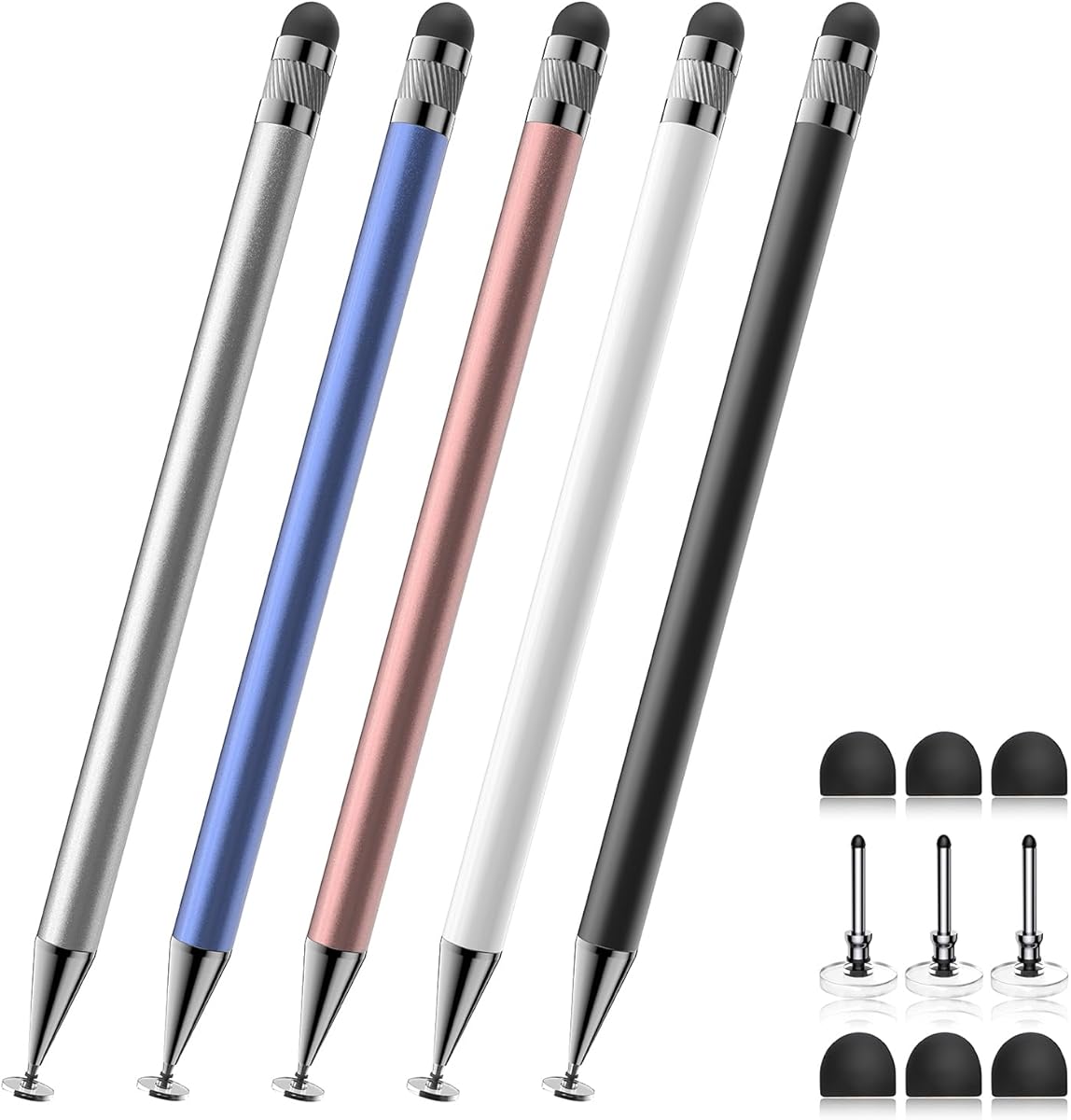
The Bopomofo 2-in-1 Stylus is a battery-free capacitive pen offered in a five-pen set, making it useful for classrooms, studios, or households where several people need an editing accessory. Its 4.6 rating reflects a straightforward design with both disc and rubber contact options.
We may earn a commission when you buy through this link, at no additional cost to you.
The flexible transparent disc tip reveals the contact point, while the rubber tip offers a softer, broader way to interact with a display. Moderate pressure is recommended when using the rubber tip, particularly when a screen protector is installed, because full contact helps maintain a stable capacitive signal.
The package includes five differently colored pens, six replacement rubber nibs, and three replacement disc nibs. That arrangement reduces downtime and makes it easy to assign a pen to a particular person or editing station. The pens also work across iPad, iPhone, Galaxy, Android tablets, Kindle, and other capacitive screens.
This is a good shared accessory for annotations, scrolling, note-taking, and basic drawing, but it is not intended for professional pressure-sensitive illustration. It provides neither pressure sensitivity nor palm rejection, so advanced brush dynamics and relaxed hand placement are outside its feature set. Choose it for straightforward touch interaction rather than high-end digital painting.
Five colored pens make distribution simple in a classroom or shared studio. The included replacement nibs also help each user maintain a consistent feel over time.
The disc tip is suited to visible contact and detailed control, while the rubber tip feels more familiar and works well for scrolling. Having both styles in one pen expands its usefulness.
We may earn a commission when you buy through this link, at no additional cost to you.
The DAXINGXING 10-Pack delivers a strong 4.7 supplied rating and an unusually generous collection of passive styluses for basic photo annotation and touch editing. Each pen combines a 0.27-inch rubber tip with a 0.21-inch precision tip, giving users a practical balance between scrolling and detail work.
We may earn a commission when you buy through this link, at no additional cost to you.
The broad tip is suited to navigation, color filling, and everyday screen interaction, while the narrower end supports handwriting, detailed sketching, and small selections. Because these are passive capacitive pens, they need neither charging nor Bluetooth pairing and can be used as soon as they are removed from the package.
The alloy bodies measure 5.31 inches and come in mixed colors for easy identification. Twenty matching replacement rubber nibs are included, and the tips can be changed without tools. Their soft material is intended to glide smoothly while avoiding screen scratching and reducing the fingerprints associated with direct finger contact.
This package is an excellent choice for basic annotations, touch navigation, and lightweight retouching across iPads, iPhones, Android devices, touch-screen laptops, and e-readers. It does not provide pressure sensitivity, tilt response, or shortcut buttons, so it is not suitable for editors who need realistic brush dynamics. For simple tasks and multiple users, however, the assortment is exceptionally useful.
The dual rubber design lets one pen move from smooth navigation to more detailed screen interaction. The 0.21-inch end is particularly useful when marking smaller photo elements.
Ten colors and twenty replacement nibs make this an appealing option for shared workspaces. Separate pens reduce contention and make it easier to keep one available for travel or a different device.
We may earn a commission when you buy through this link, at no additional cost to you.
The MOSWAG 3-in-1 Stylus is a compact passive tool built for switching among screen browsing, sketching, and ordinary paper writing. Its supplied rating of 3.7 is the lowest in this guide, but the unusual ballpoint end and included storage pouch give it a distinct travel-oriented role.
We may earn a commission when you buy through this link, at no additional cost to you.
The disc end supports webpage browsing and video scrolling, the nano cloth tip is intended for tapping, outlining, and precise editing, and the ballpoint end writes on paper. That combination can be useful for an editor who moves from app annotations to handwritten notes without carrying several tools.
The 16cm body weighs approximately 18 grams and is made from aluminum alloy with an anti-slip design. No charging, pairing, or extra application installation is necessary. A spare disc tip, spare fiber tip, and storage pouch are included, though the stylus does not offer the pressure response or shortcut controls found in active editing pens.
The MOSWAG is most appropriate for light touchscreen editing, video timeline navigation, and users who also want a paper writing tool. Its lower supplied rating warrants careful consideration, especially for precision-dependent work. Confirm that your intended apps support generic capacitive input before relying on the pen for a critical editing workflow.
A disc tip, nano cloth tip, and paper ballpoint make the stylus useful beyond the tablet. That versatility is especially handy during mobile review sessions involving both digital and handwritten notes.
The short aluminum body and included pouch reduce the need to carry a larger accessory. Passive operation means there is no battery to charge or pairing sequence to complete.
We may earn a commission when you buy through this link, at no additional cost to you.
The 3-in-1 High-Precision Stylus combines 0.18-inch and 0.27-inch rubber tips with a transparent disc tip for general touch interaction. Its 4.5 rating and replaceable design make it a capable choice for annotations and light photo work on many different screens.
We may earn a commission when you buy through this link, at no additional cost to you.
The transparent disc shows where contact is occurring, which helps when making small selections or interacting with compact editing controls. The two rubber tips provide alternative levels of precision, while the stated 180-degree writing angle is intended to support comfortable positioning. All three tips can be replaced quickly without tools.
The passive design works without batteries, charging, or Bluetooth and supports capacitive touchscreens ranging from iPads and iPhones to Galaxy devices, Kindles, Fire tablets, Chromebooks, and Nintendo Switch systems. It is intended as a finger alternative for navigation, writing, and general interaction rather than a substitute for a pressure-sensitive artist pen.
This is a helpful option for users who have difficulty operating a screen directly, including some senior users or people with limited hand mobility. It also works well for children learning to annotate images and for basic editing tasks. Editors needing pressure response, palm rejection, or application shortcuts should choose a more specialized active stylus.
Seeing the disc tip's contact location helps with fine interface tasks. This makes it easier to keep marks aligned or select small on-screen controls.
The stylus avoids the smudges and accidental touches associated with using a finger directly. Its light, ready-to-use format can make ordinary navigation and annotation more comfortable.
We may earn a commission when you buy through this link, at no additional cost to you.
The Wacom One Standard Pen is a strong premium choice for photographers and illustrators who want natural brush response on a compatible Wacom One display. Its 4.6 rating reflects a capable 4,096-level pressure system, tilt response, programmable buttons, and the freedom of battery-free operation.
We may earn a commission when you buy through this link, at no additional cost to you.
Pressure sensitivity enables more convincing changes in line weight, opacity, and brush size. Tilt response further supports expressive mark-making, making this pen relevant for retouching tasks that require subtlety rather than only selecting controls. Two quick-access buttons can be customized to reduce reliance on the keyboard during intensive editing.
The pen never needs charging, removing both downtime and battery anxiety from the workflow. It is compatible with the Wacom One 12, Wacom One 13 Touch, Wacom One Small, and Wacom One Medium, so buyers should confirm their display model before ordering. Additional pen rears are available in different colors and clips for personalization.
This is a compelling recommendation for a Wacom One owner seeking precise, natural input without a rechargeable stylus. It is less appropriate for a general tablet, laptop, or phone because compatibility is specific to listed Wacom products. For professionals using brush-heavy retouching, its pressure and tilt support justify prioritizing it over generic passive alternatives.
The combination of 4,096 pressure levels and tilt response helps create strokes that feel more deliberate. This is especially useful for detailed brush work, tonal cleanup, and shape-based adjustments.
Programmable buttons place common actions near the pen tip, while battery-free technology keeps the editing process uninterrupted. There is no charging interval to plan around during a creative session.
We may earn a commission when you buy through this link, at no additional cost to you.
The Wacom Intuos Pen LP1100K is a dedicated 4,096-level pressure pen for compatible Intuos drawing tablets, making it a solid choice for photo retouching performed on a Wacom surface. Its 4.6 rating aligns with its established feature set of EMR technology and two shortcut buttons.
We may earn a commission when you buy through this link, at no additional cost to you.
The pressure levels offer meaningful variation in brush size and opacity. EMR technology operates without a battery, keeping the pen light and allowing uninterrupted work. Two buttons near the tip provide quick access to frequently used commands, which can streamline repeated actions during detailed masking or brush-based corrections.
This pen is not compatible with every drawing tablet. The listed support covers Wacom Intuos Small CTL4100, Intuos Small Bluetooth CTL4100WLK0 and CTL4100WLE0, and Intuos Medium Bluetooth CTL6100WLK0 and CTL6100WLE0. Matching the exact tablet model is important because similar tablet names can conceal important differences.
Existing Intuos users should prioritize this pen when they need reliable pressure control without charging. It is also a sensible way to replace a missing or worn compatible pen while retaining the tablet's native workflow. Do not choose it for an iPad, Android device, Windows laptop, or unsupported Intuos model, as its capabilities depend on compatible tablet hardware.
With 4,096 pressure levels, the LP1100K gives editors finer control over the visual result of brush strokes. That precision is valuable for subtle cleanup, dodging, and other tonal adjustments.
Two buttons are positioned near the user's fingertips for common actions. Keeping those commands accessible can reduce repetitive menu navigation during demanding editing sessions.
We may earn a commission when you buy through this link, at no additional cost to you.
The right editing stylus should match your device, application, and working style. Consider pressure response, palm support, tip design, controls, power requirements, and compatibility before making a choice.
Pressure sensitivity is one of the most important features for brush-based photo editing. The Lenovo Digital Pen 2, Wacom One Standard Pen, and Wacom Intuos Pen LP1100K each offer 4,096 pressure levels, allowing editors to vary stroke size, opacity, and density more naturally than a passive pen can. This matters for retouching, dodging, burning, masking, and cleanup work where subtle force changes affect the result.
Prioritize a pressure-aware pen whenever your application supports it. Verify that the connected tablet or laptop also recognizes pressure input, because the pen and host hardware must work together.
Compatibility extends beyond simply calling a device a tablet. Some products work with broad capacitive touchscreens, while others require Windows AES 1.0, a specific iPad generation, or an exact Wacom tablet model. App support can also differ when software automatically recognizes an Apple Pencil or requires that connection to be disabled.
Check the full device list, operating system requirements, and your chosen editing application before purchasing. The narrowest compatibility may deliver superior input, but only if it matches the hardware you already own.
Palm rejection allows the supporting hand to rest naturally on the display without creating unwanted input. The JAMJAKE Stylus includes this feature for listed iPads, which can make selection and annotation more comfortable. Most passive capacitive pens do not offer palm rejection, so their users may need to lift the palm or employ workarounds.
If long editing sessions or detailed brush work are expected, palm rejection is worth prioritizing. Otherwise, a softer rubber tip and a stable writing angle may be enough for occasional touch-based adjustments.
Tip design affects visibility, glide, and the size of the mark. Transparent disc tips on the MEKO and other 3-in-1 pens reveal the contact point, which helps with small selections. Fine rubber tips can support handwriting and detail work, while broader tips suit scrolling and larger strokes. Soft silicone or rubber materials are also designed to reduce screen scratching.
Choose the tip according to the smallest control you need to hit and the amount of drawing you expect to do. A visible contact point is especially useful when working on a tablet without a physical mouse or trackpad.
Pen buttons can place commonly used tools or commands directly under the user's fingers. The Lenovo Digital Pen 2 offers two customizable buttons, as does the Wacom One Standard Pen, while the Wacom Intuos Pen LP1100K provides two shortcut buttons. These controls can reduce repeated trips to menus or the keyboard during masking, brush selection, zooming, and undo operations.
Button usefulness depends on the editing software's mapping support. Confirm that the relevant commands can be assigned before relying on the shortcuts as a major part of your workflow.
Passive capacitive styluses never require charging and work by mimicking a fingertip. Active styluses may offer pressure, tilt, or palm rejection, but usually require pairing and periodic charging. The Fine-Tip Touchscreen Stylus uses a USB Type-C charging port, while the JAMJAKE uses Bluetooth activation and a short charging cycle. Battery-free Wacom pens avoid both charging and pairing concerns on compatible devices.
For infrequent mobile use, a passive pen may be simplest. For daily professional editing, pressure and palm rejection may justify an active pen, provided its charging and connectivity requirements suit the workflow.
Tilt response can make strokes feel more expressive by responding to the angle at which the pen is held. The Wacom One Standard Pen and the Fine-Tip Touchscreen Stylus explicitly list tilt support. This feature can improve the appearance of tapered strokes, shading, and broad brush movements, although its usefulness depends on the application and device.
Tilt is most valuable for editors working with expressive brushes rather than only tapping interface elements. Confirm support in both the hardware and editing application to avoid expecting behavior the software cannot use.
Portability can include more than compact size. A multi-pen bundle helps a classroom, studio, or traveling team avoid sharing a single accessory, while a ballpoint end can support paper notes during reviews. The DAXINGXING pack includes ten pens and replacement nibs, the Bopomofo set includes five pens, and the MOSWAG combines screen tips with a paper-writing end.
Choose based on how many people will use the stylus and whether it must travel. Replacement tips, a carrying pouch, and tool-free nib changes can be more valuable than a larger stylus count for a single dedicated editor.
Begin by confirming compatibility and charging the pen if it has an active battery. Install any required software updates, open the editing application, and test the pen on a separate layer. For active models, disconnect an Apple Pencil or other native pen when the application offers that option, and use a short calibration or test stroke to establish pressure response.
Use light, controlled movements when marking small areas. A wider tip is better for navigation, broad strokes, and color filling, while a finer tip or visible disc helps with small selections. Keep the screen protected with a compatible guard, and avoid pressing hard enough to damage a screen protector. When palm rejection is available, rest the palm naturally but keep it outside the active area when the pen does not support that feature.
Store the stylus in a case or safe location, and do not leave a rechargeable model in extreme heat or use damaged charging equipment. Replace worn rubber tips rather than forcing them over a damaged nib. Clean the exterior with a dry or lightly damp cloth, but avoid sending liquid into an active pen. For pressure-sensitive tools, periodically test different force levels in a brush preset to confirm consistent response.
An active stylus with pressure sensitivity and palm rejection is generally most suitable for brush-heavy editing. The Wacom One Standard Pen, Lenovo Digital Pen 2, and Wacom Intuos Pen LP1100K offer 4,096 pressure levels. Compatibility with the display and editing application remains essential, because a sophisticated pen cannot provide its full feature set on unsupported hardware.
A passive stylus can replace a finger for tapping, scrolling, annotation, and simple drawing, but it cannot reproduce pressure-sensitive or tilt-sensitive input. It also generally lacks palm rejection and native application integration. For intensive retouching, use an active pen matched to the device; for occasional markup and navigation, a passive model may be sufficient.
Pressure sensitivity is not essential for every photo task, but it adds useful control when using brushes, erasers, masks, dodge tools, and tonal adjustments. It allows a single tool to produce a wider range of effects. If your workflow focuses on cropping, selections, and interface navigation, device compatibility and a precise tip may matter more than pressure levels.
Palm rejection is especially valuable when the hand naturally rests on the display during detailed work. It prevents the palm from being interpreted as a separate touch. The JAMJAKE includes palm rejection for supported iPads, while most universal passive styluses in this guide do not, so hands-on comfort may require a different pen or careful hand placement.
A universal stylus may work for basic touch input, but app-level support can depend on how the software detects native pens. Some applications require an Apple Pencil to be disconnected before a generic stylus appears. Test the pen in a scratch document after purchase and keep the return policy in mind if your chosen application does not recognize it.
Battery-free passive pens offer the simplest setup and are ideal for annotations, navigation, and light drawing. Wacom EMR pens also operate without a battery while providing advanced pressure response, but they require compatible Wacom hardware. Other active pens may need charging or Bluetooth, so consider how frequently you edit and how important pressure and palm rejection are.
A fine rubber tip is generally easier for handwriting and detailed marks, while a transparent disc tip can improve contact visibility for small selections. Broad rubber tips are useful for scrolling and larger strokes. The MEKO, DAXINGXING, Bopomofo, MOSWAG, and high-precision 3-in-1 products provide different combinations for these tasks.
Use a screen protector rated for stylus use and avoid a damaged protector whose edges could catch a tip. Many included rubber tips are designed to glide without scratching, but sharp accessories or excessive pressure can still cause damage. Clean both the tip and screen so grit does not create abrasion during an editing session.
The Lenovo Digital Pen 2 stands out as the most versatile all-round recommendation for compatible Windows laptops, combining pressure sensitivity with customizable buttons. The Wacom One Standard Pen is the premium option for supported Wacom One displays, while the DAXINGXING 10-Pack delivers the best budget assortment for shared or lightweight touch workflows.
Your priority should determine the category: choose pressure and tilt for expressive brushwork, palm rejection for long sessions, and a passive pen for straightforward navigation and annotation. Always verify device generations, operating systems, and application behavior because broad phrases such as universal compatible can conceal important exclusions.
Ratings and product availability can change, and current prices also vary across listings. Review the latest product details, compatibility notes, included accessories, and return terms before purchasing so the chosen stylus fits both your editing hardware and the way you work.

