
Wireless Motion Sensor Door Chime
4.5Editor score
32 selectable alert sounds
Up to 500ft signal range
Expandable sensor system
Discover the best indoor motion sensor alarm options, comparing loudness, detection range, wireless reach, alerts, power options, and installation ease.
Indoor motion sensor alarms combine a compact PIR detector with a siren, chime, or plug-in receiver to provide an immediate alert when movement is detected. The best models offer dependable coverage, useful control options, flexible power, and straightforward installation without requiring a complicated security hub.
We compared all ten products by examining detection distance and angle, wireless transmission range, alert volume, available sounds, receiver or remote-control functions, power options, installation methods, expansion potential, and intended uses. The list includes standalone sirens, wireless business-entry chimes, and caregiver-oriented monitoring systems.
Each review identifies the product's most useful characteristics, practical limitations, and best-fit setting, while the comparison table makes the main specifications easier to scan. Product features and availability can change, and prices fluctuate over time, so readers should confirm current listings and terms before purchasing.
4.5Editor score

4.3Editor score

4.1Editor score
This side-by-side comparison highlights detection reach, alert capability, wireless control, and installation flexibility across ten indoor motion alarm options.


The TECKNET 125dB Loud Indoor Motion Sensor Alarm combines a substantial siren, a visual strobe, remote operation, and two operating modes in one compact unit. With a 4.3 rating, it stands out as the most adaptable standalone option in this guide because it can function as a security alarm or a less intrusive doorbell chime without requiring a separate receiver.
We may earn a commission when you buy through this link, at no additional cost to you.
Its most notable strength is the combination of a 125dB alarm setting with a remote that can operate from up to 328 feet in open areas. Users can arm or disarm the unit, change modes, select among 80dB, 100dB, and 125dB levels, and trigger an SOS alert without walking toward the sensor. PIR detection covers approximately 16–26 feet within a 120-degree field of view, while the alarm body rotates 360 degrees to accommodate different room layouts.
Power flexibility is another practical advantage. The alarm can run on AAA batteries for temporary or portable use, or remain connected to USB-C power for longer indoor coverage. The USB-C connection only supplies power and does not recharge installed batteries, so users must keep that distinction in mind. The detector also cannot detect reliably through glass or walls, and the stated range can change with mounting height, angle, and environmental conditions.
This is a strong recommendation for someone who wants a self-contained siren with remote arming rather than a chime-only receiver system. It suits hallways, garages, shops, entryways, storage rooms, and van interiors where a loud local alert is desired. Buyers who need long-distance receiver notifications from multiple detectors should instead examine the expandable systems farther down the list.
The 328-foot remote lets users manage the alarm from another part of a home, garage, or vehicle. This reduces the need to approach the detector after an alert and makes temporary arming or disarm routines easier to maintain.
Alarm Mode provides a continuous siren for approximately two minutes after triggering, while Doorbell Chime Mode offers a gentler notification. Three volume settings add useful control for homes, offices, and shops with different tolerance for audible alerts.
We may earn a commission when you buy through this link, at no additional cost to you.
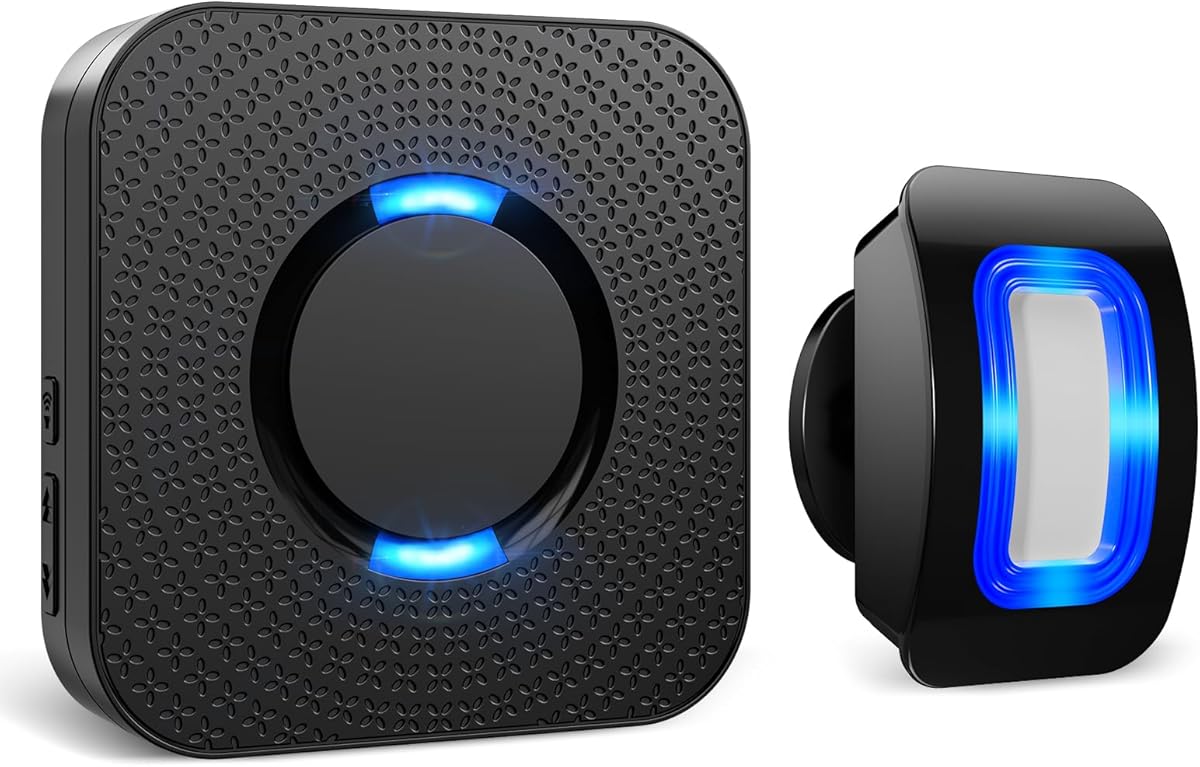
The Wireless Motion Sensor Door Chime is a receiver-based alert system built primarily for business entrances, doorways, and larger indoor spaces. Its 4.5 rating reflects a well-received combination of flexible sounds, long wireless communication, visual alerts, and expandable sensor support. It offers a gentler experience than a permanent hardwired security installation.
We may earn a commission when you buy through this link, at no additional cost to you.
The detector recognizes movement within approximately 16–26 feet across a 110-degree area and can communicate with the plug-in receiver from as far as 500 feet. The receiver offers 32 unique sounds, including alarm-style tones, conventional doorbell rings, and longer chimes. Five adjustable levels range from silent operation to 110dB, while a flashing LED creates a visual notification for situations where an audible cue may be overlooked.
Its most valuable business feature is expansion. One receiver can coordinate with up to 20 sensors, and the described system allows multiple receivers to be paired, making it practical for covering several entrances, offices, retail counters, mailboxes, garages, and storage areas. The sensor mounts by a doorway using screws, while the receiver requires only a standard wall outlet.
This model is a sensible budget choice for a shop, office, warehouse, or home that wants notifications delivered inside another room rather than a siren sounding at the detector. The trade-off is the lack of a handheld remote and the ongoing need to check the included AAA batteries. It also should be installed where its sensing zone is unobstructed.
A receiver-to-sensor distance of up to 500 feet allows the detector to remain near an entrance while the audible alert stays in a back office, kitchen, or main living area. Real-world performance depends on walls, doors, and the installation environment.
Thirty-two ringtones let users distinguish visitors, business arrivals, and alerts without relying on one generic chime. The visual LED and silent setting are helpful in offices and homes where nighttime sound should be restrained.
We may earn a commission when you buy through this link, at no additional cost to you.
The CPVAN CP2 Pro is a portable 125dB PIR alarm with a stated detection ceiling of 40 feet and a 328-foot remote-control range. Its 4.1 rating is slightly lower than the leading receiver-based models, but it offers a compelling combination of strong siren output, flexible placement, and unusually generous detection specifications.
We may earn a commission when you buy through this link, at no additional cost to you.
Infrared PIR sensing is designed to distinguish human movement from some environmental interference, although the listed performance is strongest within approximately 10–26 feet. The alarm has two principal modes: a loud security mode and a gentler chime mode. Because it operates locally without Wi-Fi, an app, or a hub, it is particularly useful in temporary locations where a receiver-based multi-point system would be excessive.
Installation is flexible. The unit can be fixed with the included adhesive pad or screws, placed on a shelf or table, or carried into a van. Its potential uses include homes, garages, sheds, shops, boats, vans, stairways, kitchens, and storage areas. However, it is explicitly not waterproof, and PIR sensors do not detect through walls, windows, or glass doors.
Choose the CP2 Pro when a loud, immediately audible siren and broad portable placement matter more than remote receiver notifications. Buyers should verify that the space is suitably dry and unobstructed, and they should not interpret the 40-foot maximum as guaranteed performance in every room. For most users, the stated 10–26-foot operating zone is the more realistic target.
The battery-powered design operates without a hub, application, or internet connection. That makes it convenient for a rental, temporary storage area, vehicle, garage, or other location where hardwired alarm equipment is inconvenient.
The sensor can detect up to 40 feet, but the listed best-performance zone is generally 10–26 feet. Mounting height, direction, obstacles, airflow, and room geometry can materially change the usable range.
We may earn a commission when you buy through this link, at no additional cost to you.
The Wireless Motion Sensor LED Light stands out for its extensive library of 58 ringtones and its ability to pair a receiver with as many as 20 sensors. The product carries a 4.3 rating and serves as both a motion detector alarm and a customizable indoor door chime, with a flashing LED providing a secondary visual alert.
We may earn a commission when you buy through this link, at no additional cost to you.
Signal communication between the detector and receiver extends up to 500 feet. Detection coverage is approximately 13–16.5 feet over a stated 110-degree area, and the receiver can produce a maximum 110dB alarm. The sensor operates with two included AAA batteries, while the receiver connects directly to a standard electrical outlet. That combination makes placement around doors and corridors relatively straightforward.
Its strongest advantage is customization. A large tone library can make it easier to distinguish different entrances or routines, and the described procedure allows users to press the receiver's volume or down button, hold the volume button for five seconds, or briefly press both buttons before waving a hand in front of the sensor. This is more involved than simply choosing a tone from a standard doorbell, so the manual is worth consulting.
The system is best for a home or small business that wants a receiver indoors while placing a sensor near an entry. Its main limitation is the relatively short PIR detection distance compared with several competing products. Coverage should be tested before the sensor is fixed, and the zone should be kept free from obstacles that could interrupt sensing.
The receiver can serve as a central notification point for up to 20 sensors. This is useful for monitoring several doors without placing a loud speaker beside each detector.
The flashing LED supplements the selected ringtone or alarm. This dual alert design can be valuable in noisy work areas and for situations where hearing an audio cue is difficult.
We may earn a commission when you buy through this link, at no additional cost to you.
The M120 Motion Sensor Alarm is designed to serve as a welcome chime, a security siren, and a business-entry alert. Its 4.2 rating reflects a flexible three-mode design, remote control, adjustable volume, and a claimed ability to filter pets and airflow while detecting human movement as far as 26 feet.
We may earn a commission when you buy through this link, at no additional cost to you.
Welcome mode provides a friendly visitor notification, alarm mode uses a louder anti-theft siren, and a third no-repeat mode is intended to avoid repeated notifications for continued activity. The product supports 11-language chimes and four volume levels, giving it a more tailored feel than a basic single-tone alarm. Remote control allows users to switch modes, adjust volume, and arm or disarm the sensor from across the room.
Installation is presented as a quick tool-free process that does not require wiring or drilling, while batteries or USB 5V power offer two operating approaches. A low-battery voice reminder is intended to help prevent an unnoticed power failure. The stated PIR filtering and 26-foot reach should still be treated as design specifications rather than guarantees in every environment.
This alarm is a good fit for homes, offices, shops, retail spaces, counters, hallways, and stairways where the user wants one compact unit to handle several notification styles. It is less suitable for a multi-zone property requiring one central receiver and dozens of individually identified sensors. For basic indoor alerts with convenient remote operation, it offers a versatile feature set.
The same detector can greet customers, announce arrivals, or emit a security alarm depending on the selected mode. No-repeat operation adds another way to control how frequently an alert sounds.
Users can change volume, switch operating modes, and arm or disarm without walking directly to the detector. This is convenient when the sensor is positioned high, inside a shop, or near an entry where frequent access would be inconvenient.
We may earn a commission when you buy through this link, at no additional cost to you.
The EverNary Caregiver Pager is an indoor monitoring system built around a plug-in receiver and a movable PIR sensor. With a 4.5 rating, it is particularly relevant to families monitoring elderly relatives, people living with dementia, children, or anyone who may move unexpectedly around the home. It can also function as a conventional entry alert.
We may earn a commission when you buy through this link, at no additional cost to you.
The sensor detects movement within approximately 16.4 feet over a 110-degree area. It sends a signal to the receiver from up to 260 feet in an open area, with reduced transmission distances through walls or doors. That distinction makes careful placement especially important. The product supports 58 ringtones, five volume levels, and a flashing LED, offering both audible and visual notifications.
Installation is flexible because the sensor can operate on batteries or through USB power and includes an optional adjustable mounting bracket. Pairing is scalable: each receiver can be associated with up to 20 transmitters, and each transmitter can be paired with up to 20 receivers. This makes it possible to expand beyond a single bedside or doorway as monitoring needs change.
The best fit is a caregiver who needs a simple indoor movement notification rather than a professionally monitored security service. It should not be treated as a medical device or as a substitute for direct supervision. Testing the range before fixing the sensor is essential, particularly when walls, doors, furniture, or different floor levels separate the transmitter and receiver.
The receiver can notify a caregiver when movement occurs near a bed, doorway, stair area, or other monitored zone. It is intended to add awareness between routine check-ins, not to provide diagnosis or emergency response.
The stated pairing capacity lets a household add transmitters and receivers as needs develop. Each product in the paired system can help support several monitored locations without requiring a dedicated unit for every room.
We may earn a commission when you buy through this link, at no additional cost to you.
The Four-Sensor Electric Doorbell System is notable because the package includes four motion detectors, two alarm receivers, and mounting screws. Its 4.2 rating reflects a capable multi-point configuration for a home or small property. It can serve as an entry chime, garage alert, intruder warning, or caregiver notification system.
We may earn a commission when you buy through this link, at no additional cost to you.
The detectors provide approximately 20 feet of infrared detection, while the receiver can receive the sensor signal from up to 300 feet. Thirty-eight ringtones and three volume levels give users meaningful control over the notification. Silent mode is particularly useful because it leaves only the LED visual warning active, helping avoid a sudden loud alert in shared or quiet environments.
The multi-detector bundle is valuable for monitoring several zones such as a front door, back door, garage, driveway, or window frame. Two receivers provide notification in more than one location. However, each detector requires AAA batteries, which are not included, and the units should be kept out of rain because the motion detector is not waterproof.
This system makes the most sense for buyers who want immediate multi-location coverage rather than a single portable alarm. It may require more setup than one stand-alone unit, but the included hardware reduces the need to source separate sensors and receivers. Users should test detection near airflows and obstructions, as the manufacturer specifically advises avoiding wind-triggered activation and keeping the sensing area clear.
A four-sensor package can monitor multiple entrances, hallways, garage areas, or other indoor approaches. Separate placement gives users broader awareness than a single detector positioned in one central room.
The LED-only setting avoids sudden sound while still indicating that movement was detected. It is useful at night, in a quiet office, or in homes where a full-volume alarm could be disruptive.
We may earn a commission when you buy through this link, at no additional cost to you.
The Wireless Business Motion Chime is a receiver-based system designed for offices, stores, warehouses, corridors, and home entrances. It has a 4.3 rating and combines 32 regular sounds, three alarm ringtones, five volume levels, and a 500-foot receiver-to-sensor signal range. That combination makes it a flexible alternative to a loud local-only siren.
We may earn a commission when you buy through this link, at no additional cost to you.
The detector covers approximately 13–26 feet, with a stated distance adjustment from about 4–8 meters. Its rotatable base supports a 30–110-degree detection angle, allowing users to narrow or widen the active area. Mounting can be handled with adhesive or screws, and the receiver operates through a plug-and-play connection to a wall outlet.
One receiver can coordinate with up to 20 motion sensors. Users can assign unique or shared tones to sensors placed around entrances, offices, garages, or rooms. Shared tones are simpler for a general arrival notification, while distinct tones can help staff identify different locations if the system supports their programming workflow.
This product is best for a business that wants an indoor signal when a customer or employee enters a monitored area. Its 500-foot communication distance provides flexibility between the doorway and receiver. The tradeoff is that adhesive mounting may not suit every surface, and the product is designed for indoor installation rather than exposed outdoor use.
A 360-degree rotatable base and adjustable 30–110-degree angle help users limit detection to a meaningful area. This is valuable near wide doorways where a narrower zone can reduce irrelevant movement triggers.
Supporting up to 20 sensors allows one receiver to serve many monitored locations. Assigning separate tones can help staff understand where movement occurred, while shared tones simplify general notifications.
We may earn a commission when you buy through this link, at no additional cost to you.
The Luckydeer 125dB PIR Alarm is a compact, stand-alone detector with a 125dB siren, 328-foot remote control, and two operating modes. Its 4.2 rating reflects a straightforward product that can sound a security alarm, act as a door chime, or function as a basic caregiver pager without Wi-Fi or a central receiver.
We may earn a commission when you buy through this link, at no additional cost to you.
The detector uses infrared sensing with intelligent signal analysis intended to distinguish human movement from interference. Its stated sensing range is 16–26 feet, while the remote operates up to 328 feet in an open area. Alarm mode provides the high-volume security warning, while doorbell mode supplies a gentler chime. The remote also incorporates an SOS panic button that immediately activates the host alarm.
Installation is straightforward, with included double-sided tape, screws, three AA batteries, and a remote control. The unit is marketed for indoor use in homes, sheds, garages, kitchens, bedrooms, shops, and vans. It can also address household routines involving children leaving a room or pets entering restricted areas, although those uses still depend on placement and correct sensitivity.
This alarm is a good option for one compact area where a local siren is preferred over receiver-based alerts. Its limitations are simpler sound customization and no multi-sensor expansion. Users should follow the instruction manual, test the unit before relying on it, and avoid expecting the alarm to detect movement through walls, windows, or glass.
A dedicated panic control lets a user trigger the alarm remotely. This provides an additional way to summon attention when movement detection alone is not the only concern.
The package includes batteries, adhesive tape, screws, instructions, and the remote. That combination reduces the need to source basic installation accessories before setting up the detector.
We may earn a commission when you buy through this link, at no additional cost to you.
The METAK PIR Motion Alarm balances generous detection and transmission specifications with a receiver-based design. Its 4.5 rating makes it one of the strongest-rated products in the group. It suits homes and businesses that want a door chime or security notification delivered indoors while the PIR detector remains near a doorway or other monitored point.
We may earn a commission when you buy through this link, at no additional cost to you.
The sensor has a stated 110-degree detection angle and a 26-foot diameter range. It communicates with the plug-in receiver from as far as 500 feet, making the two components flexible to position. The receiver offers 32 selectable ringtones and five volume levels from 0 to 110dB, allowing the alert to be tailored for a home, office, shop, or garage.
Power flexibility is a clear strength. The detector runs on AAA batteries for wireless placement and also supports Micro USB for continuous operation. It can be expanded to as many as 20 motion sensors on one receiver, which is useful for covering several entrances or rooms without creating a separate alarm network for each location.
The METAK is a balanced choice for buyers who want long-distance receiver alerts without sacrificing tone selection or expansion. Its main trade-off is the need for a powered receiver in a separate location. It is therefore less convenient than a self-contained siren for a single portable alarm, but more versatile for coordinated indoor monitoring.
The 500-foot transmission distance allows the detector to sit near an entrance while the receiver sounds elsewhere. Walls, doors, and other obstructions can reduce actual range, so testing before permanent placement is advisable.
AAA batteries make the sensor easy to deploy quickly, while Micro USB supports a fixed installation without frequent battery changes. The choice depends on whether mobility or uninterrupted operation is the greater priority.
We may earn a commission when you buy through this link, at no additional cost to you.
The right indoor motion sensor alarm depends on where it will be installed, how you want to be alerted, how many zones need coverage, and whether you prefer a local siren or a remote receiver. Comparing these factors before buying prevents an unsuitable alert style or installation method from undermining the system.
Choose enough coverage for the intended space without paying for unnecessary maximum distance. Accurate placement is usually more valuable than a larger headline range.
Prioritize local sound for one temporary zone and receiver-based alerts for multiple entrances or rooms. Choose the architecture that matches how the alert will actually be used.
Treat wireless maximums as open-area estimates. Measure the real installation route and leave a comfortable margin for walls and floors.
Match the alert to the environment: flexible chimes for routine arrivals, loud sirens for isolated security, and mute or LED modes for quiet hours.
Choose a remote when the detector is difficult to reach. Confirm which functions it controls rather than assuming every setting is accessible remotely.
Use batteries for mobility and continuous power for permanent locations. Confirm what is included and whether any USB connection also charges the batteries.
Match mounting hardware to the location and expansion needs to the number of zones. More sensors increase coverage but also add setup and battery maintenance.
Choose for the people and space involved. Caregiver awareness, customer greetings, and local deterrence call for different combinations of sound, reach, and visibility.
Begin by identifying exactly what the device should monitor and what response you want. For a local siren, choose an unobstructed location near an entry, storage area, garage, or hallway. For a receiver system, place the sensor where movement must be detected and the receiver where an authorized person can hear it clearly. Before fixing anything, check the battery compartment, pair the components, select a sound or mode, and test the stated detection range from several points in the intended zone.
Mount the sensor at the recommended height and angle, keeping the detection field clear of walls, windows, glass, moving objects, strong airflow, and direct outdoor weather. Use screws for a permanent mounting point, adhesive for a convenient temporary installation, or a shelf or table for a portable unit. After mounting, walk through the coverage area and confirm that normal movement triggers the intended response while irrelevant movement does not. In receiver-based systems, also test the signal through doors and walls because the open-area maximum will not represent every real installation.
For ongoing care, check batteries on a regular schedule and replace them before the unit reports a low-battery condition. Clean the sensor lens gently and keep the housing free of dust, adhesive residue, or obstructions. Re-test the remote, alarm mode, chime mode, and receiver volume after moving or reconfiguring the system. Do not expose non-waterproof devices to rain, and replace batteries in both paired units promptly if the model uses them. Periodic testing is the simplest way to ensure that a successful installation remains reliable over time.
Generally, no. These products use passive infrared sensing to detect changes in infrared energy associated with movement, and walls, windows, and glass doors can block or distort that signal. Install the sensor with a clear view of the area you want to monitor. If you need to cover a space beyond a wall, use a receiver-based system and position the sensor in the same open area as the movement.
Alarm mode is intended to create a loud security warning, while doorbell chime mode provides a gentler arrival notification. Stand-alone alarms can also include an SOS function through the remote. The right choice depends on the location: a loud mode is useful in a garage or storage room, while a chime mode is often better for a customer entrance, office, or home doorway.
The maximum distances listed by these products apply mainly to open areas and may range from approximately 260 feet to 500 feet. Walls, doors, floors, and furniture can reduce the practical range. Test the connection at the planned locations before mounting permanently, and avoid positioning the receiver or remote exactly at the advertised maximum if regular obstacles are present.
Yes, several products support up to 20 motion sensors on a single receiver. Some systems also permit multiple receivers, allowing different household members to receive notifications in separate rooms. Compatible systems may support unique or shared tones, which can help identify where movement occurred. Check the pairing instructions because sensor and receiver limits vary by model.
Most products in this guide are intended for indoor installation and are not waterproof. Wind, rain, changing light, and moving vegetation can also increase unwanted triggers. If any outdoor portion is necessary, use a weather-rated outdoor sensor and place the indoor receiver within the stated wireless range rather than exposing a non-waterproof detector.
Replace batteries when the product reports a low-battery condition or when testing reveals an unreliable response. Replacement frequency depends on movement in the area, battery quality, temperature, and how often the unit is triggered. Models that support continuous USB power can simplify long-term installation, though it is still wise to keep the power supply accessible and test the system regularly.
Some products use PIR signal analysis or claimed human-motion filtering to reduce irrelevant triggers, but no indoor sensor can eliminate every false alert. Place the detector away from direct airflow, moving curtains, heating vents, and rapidly changing heat sources. Test the area with normal household movement, including pets if applicable, before relying on the alarm for security.
No. The products reviewed here are designed as local wireless systems rather than internet-connected devices. Stand-alone alarms operate with their own siren and remote, while receiver-based systems communicate directly between the sensor and plug-in receiver. That simplicity can be useful in rentals, shops, garages, and locations without reliable network coverage.
The TECKNET 125dB Loud Alarm is the most adaptable stand-alone choice because it combines a powerful siren, a strobe, three volume levels, two operating modes, and a long-range remote. The Wireless Motion Sensor Door Chime stands out for business-entry flexibility, custom sounds, a 500-foot signal, and expansion to 20 sensors. The CPVAN CP2 Pro offers extended stated PIR reach, portable placement, and a 125dB local siren for users who value coverage and deployment flexibility.
The most important choice is whether the system needs to sound where movement occurs or send a notification to a receiver elsewhere. Local sirens are simpler for one room, garage, van, or storage area. Receiver-based systems are better for multiple entrances, offices, stores, and caregiver monitoring. From there, prioritize usable detection coverage, a connection that survives the actual walls and floors of the property, an alert style suited to the environment, and a power method that matches how long the device will remain in use.
Current prices, package contents, ratings, and product availability can change, so readers should review the latest listing before purchasing. Confirm battery inclusion, mounting hardware, detector limits, remote functions, and waterproofing status for the chosen model. A short installation test can prevent surprises and help ensure that the selected indoor motion sensor alarm provides the intended coverage without unnecessary alerts.