
Hikers 27-inch Curved Monitor
4.2Editor score
170Hz QHD refresh rate
Dual HDMI 2.1 connectivity
FreeSync variable refresh
A gaming monitor with HDMI 2.1 can give modern consoles a smoother, sharper, and more versatile connection than many older television-based gaming displays. Resolution, refresh rate, VRR, HDR support, and input performance all matter, but the most useful model depends on the console, PC habits, and preferred screen size.
We compared ten monitors using their stated specifications, focusing on the qualities that affect console play: native resolution, maximum refresh rate, response time, adaptive synchronization, HDR, port configuration, color performance, and ergonomics. The list includes 4K, QHD, and ultrawide IPS, VA, and OLED options for different budgets and play styles.
Each recommendation reveals where that model stands out and where compromises may apply. Ratings reflect the supplied customer feedback, while technical performance comes from the listed specifications rather than personal testing. Prices and promotions can change, so check the current listing and verify console support before purchasing.
4.2Editor score

4.6Editor score

4.6Editor score
As an Amazon Associate we earn from qualifying purchases.
The comparison below covers ten HDMI 2.1 gaming monitors across resolution, refresh rate, panel technology, HDR capability, and connectivity, making it easier to identify the right fit for PS5, Xbox Series X, PC, and mixed-use setups.




The ASUS TUF Gaming VG27UQ1A combines a 4K LCD panel with a 160Hz refresh rate, making it one of the most versatile choices in this guide. Its 4.2 rating is supported by a specification sheet that directly addresses modern console requirements, including 4K 120Hz visuals over HDMI 2.1 without chroma subsampling.
We may earn a commission when you buy through this link, at no additional cost to you.
The Fast IPS panel is specified at 1ms response time, while ELMB Sync works with variable-refresh technologies to reduce visible ghosting and tearing. NVIDIA G-SYNC compatibility, AMD FreeSync Premium, and ASUS Variable Overdrive give PC and console users several ways to manage frame delivery according to the connected hardware.
Color performance is another strength. HDR support and a listed 95% DCI-P3 gamut make the display suitable for vivid console games, while wide viewing angles help it remain practical when sharing a screen. The trade-off is that 4K pixels spread across 27 inches demand a capable graphics card for demanding PC games, and the high-refresh specification is not universally reachable by current consoles.
This is our overall recommendation for buyers who want a sharp 4K picture, dependable HDMI 2.1 support, and enough PC-oriented speed for a mixed gaming setup. It is particularly compelling for PS5 and Xbox Series X owners who value 4K 120Hz support more than an ultrawide field of view. Check the current listing for cable inclusions and the latest package details.
HDMI 2.1 support up to 4K 120Hz without chroma subsampling is the central attraction. It gives compatible consoles a cleaner image than HDMI 2.0 configurations that may reduce bandwidth or compromise color detail.
A 160Hz Fast IPS panel, 1ms rated response, and multiple synchronization options provide a strong foundation for competitive PC play while retaining the visual benefits expected from a premium 4K console monitor.
We may earn a commission when you buy through this link, at no additional cost to you.
The LG 27GX704A-B UltraGear pairs a glossy 27-inch QHD OLED panel with a 240Hz refresh rate and 0.03ms response time. Its 4.6 rating makes it one of the strongest-rated products in the roundup, while the feature set is particularly compelling for console players who value contrast, motion clarity, and responsive-feeling images.
We may earn a commission when you buy through this link, at no additional cost to you.
VESA DisplayHDR True Black 400, a stated 1.5M:1 contrast ratio, and up to 98.5% DCI-P3 color coverage give the monitor a serious HDR proposition. The listed brightness reaches 1300 nits at peak, though real-world HDR performance depends on the game, room conditions, and display settings. Dark scenes should benefit from the OLED panel's naturally deep black levels.
Connectivity is well suited to a modern console rig, with dual HDMI 2.1 ports, DisplayPort 1.4, USB 3.2 upstream, and two downstream ports. The main limitation is resolution: this is a 2560×1440 monitor rather than a 4K model, so a compatible 4K console cannot present its full native 4K canvas here. The glossy finish may also show reflections more readily than a conventional matte gaming display.
Choose this model if you prioritize excellent blacks, high color saturation, instant response, and a rich QHD image over native 4K resolution. It also serves competitive PC players exceptionally well. For a mixed PS5 and Xbox setup, make sure your game library and personal preferences favor QHD scaling and HDR quality over pixel density.
True Black 400 certification, deep contrast, and bright highlights make this OLED especially well suited to cinematic console games. The combination can reveal shadow detail and produce a more dimensional image than conventional LCD gaming monitors.
The 240Hz refresh rate and 0.03ms response specification are especially attractive for competitive PC gaming. For consoles, the same quick pixel response helps keep fast action and camera movement visually clean.
We may earn a commission when you buy through this link, at no additional cost to you.
The MSI MAG 274QP QD-OLED combines a 27-inch 2560×1440 quantum-dot OLED panel with 240Hz gaming and HDMI 2.1 connectivity. Its 4.6 rating and strong specifications make it a particularly convincing high-end option for buyers who want many of the visual benefits of OLED without paying for a larger or more elaborate premium display.
We may earn a commission when you buy through this link, at no additional cost to you.
Color is a major strength. The monitor is listed with 10-bit color, 1.07 billion colors, 99% DCI-P3 coverage, and a Delta E of two or less. A 1,500,000:1 native contrast ratio and 400-nit peak brightness support strong HDR contrast, while the 0.03ms GtG response and 240Hz refresh rate serve fast competitive games.
The specification sheet emphasizes console modes, Gaming Intelligence software, and OLED Care 2.0, which can help mitigate image-retention concerns. A four-way adjustable stand and VESA 100mm support make the display practical for a dedicated gaming station. As with other OLEDs, image retention and brightness behavior deserve attention during long sessions, and its QHD resolution cannot match a 4K monitor's pixel density.
This is our best-value OLED recommendation, balancing premium picture characteristics, high refresh, useful console features, and strong customer feedback. It suits players who want an immediate visual upgrade over a standard LCD and who can accept QHD rather than 4K. Confirm the current configuration and software features on the listing before ordering.
Quantum-dot color conversion and 10-bit output support smoother gradients and a broad color range. The listed 1,500,000:1 native contrast adds impact that is difficult to match with conventional gaming LCDs.
HDMI 2.1 and DisplayPort 1.4a make the monitor suitable for current consoles and high-refresh PC gaming. Console modes and adjustable stand controls help it serve both entertainment and competitive use.
We may earn a commission when you buy through this link, at no additional cost to you.
The SANSUI 34-inch Curved Monitor uses a 3440×1440 UWQHD panel with a 240Hz refresh rate, a 1ms response specification, and a 21:9 aspect ratio. Its 4.4 rating makes it a strong alternative for buyers who want more horizontal space than a standard 16:9 display without moving to a 4K canvas.
We may earn a commission when you buy through this link, at no additional cost to you.
Two HDMI 2.1 ports are specified for output up to 2K at 240Hz, and two DisplayPort 1.4 connections provide similar high-refresh PC options. FreeSync, HDR400, and VRR support for Xbox, PlayStation, and Switch are listed, with a note that variable refresh through those console platforms requires HDMI 2.1.
The main tradeoff is resolution. A 3440×1440 signal cannot deliver the pixel density of a 4K screen, and ultrawide support in console games can vary by title. On the positive side, the extra width may show more of a game world without the scaling compromises associated with forcing 16:9 content onto a very wide display. AI Crosshair, sniper scope, picture enhancement, and game mode options add utility for competitive play.
This monitor is a good fit for PC-first gamers who also own a console and enjoy games with broad environments, racing, simulators, and competitive shooters. Its 178-degree viewing angle, VESA 100mm compatibility, tilt adjustment, and PIP/PBP support also make it useful beyond gaming. Buyers should verify the current VRR and console compatibility details in the product listing.
The 21:9 format is useful for supported ultrawide games, giving players a wider field of view and more room for HUD elements. It can also present 16:9 content as a larger centered image, though it does not provide native 4K detail.
Dual HDMI 2.1 and DisplayPort 1.4 connections support demanding PC configurations. The listed FreeSync and console VRR functions make the monitor versatile, provided the source, cable, and selected mode support the required feature.
We may earn a commission when you buy through this link, at no additional cost to you.
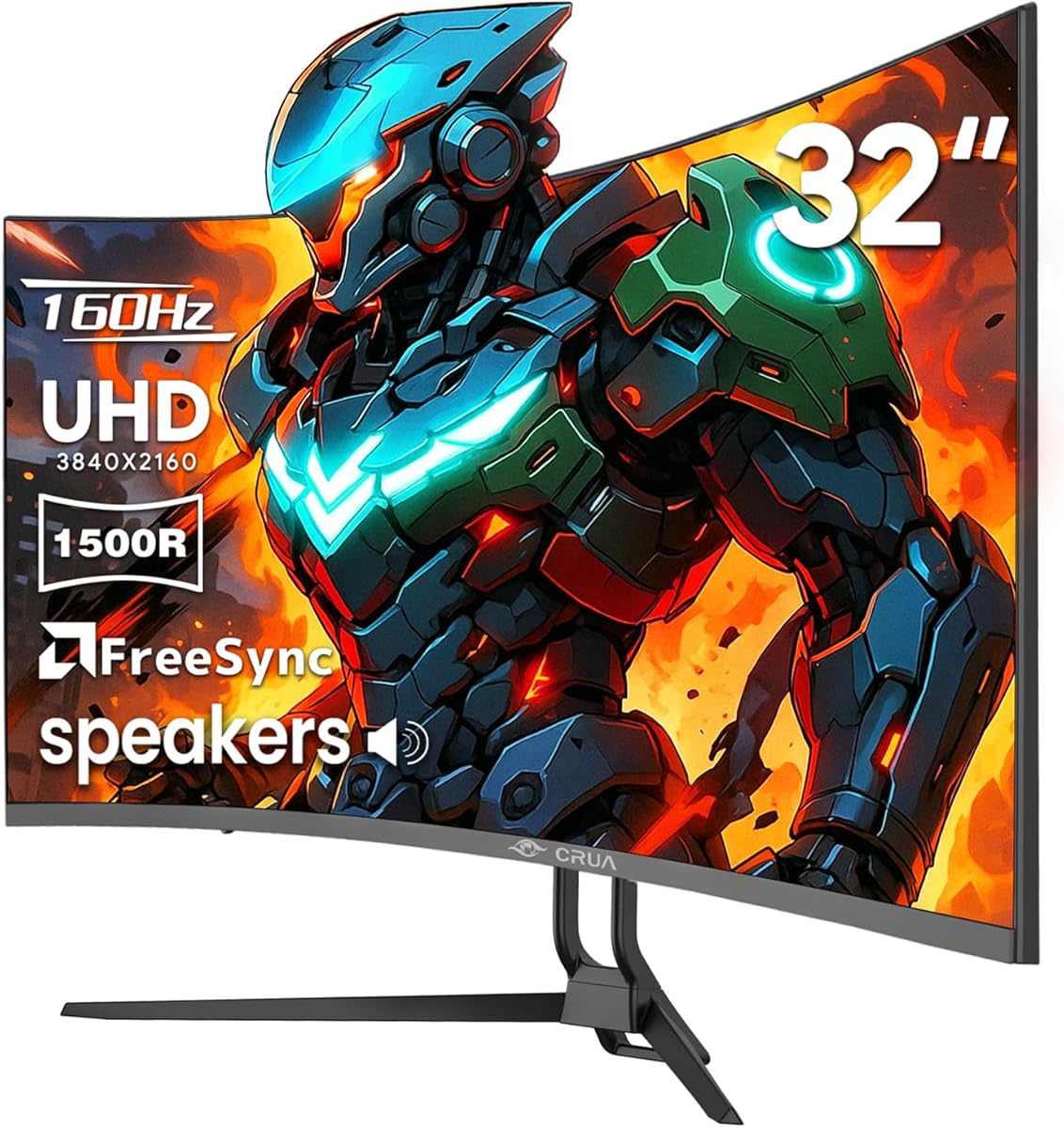
The CRUA 32-inch 4K Curved monitor combines a 3840×2160 panel with a 160Hz refresh rate, AMD FreeSync, and 1500R curvature. Its 4.3 rating and 32-inch footprint make it a practical choice for console players who want a large image and high pixel density in a single screen.
We may earn a commission when you buy through this link, at no additional cost to you.
The 1500R curve is intended to surround the viewing area more closely, which can make open-world games, racing titles, and movies feel more immersive. Color is listed at 120% sRGB, 320cd/m² brightness, and 3000:1 contrast, giving the monitor respectable specifications for mixed gaming and media use.
Connectivity includes HDMI 2.1 and DisplayPort 1.4, along with a 75x75mm VESA mounting pattern. Built-in speakers add convenience for system sounds, although dedicated speakers or headphones will usually provide a better gaming experience. The trade-off is that console output generally depends on 4K 120Hz support, making the 160Hz headline figure more relevant to PC connections.
Choose this model for a large 4K command center, couch-friendly console gaming, and simultaneous use with productivity applications. It may be less ideal for competitive players who want the lowest possible latency and the highest refresh rates, particularly if their main device is a console. The 160Hz specification and FreeSync support remain attractive for hybrid PC setups.
A 32-inch 4K display offers more room for detailed environments than a 27-inch model while remaining smaller than many conventional televisions. The 1500R curve wraps the image around the viewer for a more encompassing gaming experience.
Integrated speakers, broad color claims, and VESA compatibility expand the monitor's appeal for streaming, video, and everyday productivity. A PC connected through DisplayPort can also take advantage of the higher 160Hz refresh rate.
We may earn a commission when you buy through this link, at no additional cost to you.
The Hikers 27-inch Curved Monitor offers a 2560×1440 fast VA panel, a 170Hz refresh rate, and two HDMI 2.1 ports. It is our best budget recommendation because it focuses on the essentials of high-refresh console and PC gaming while adding several practical competitive assists.
We may earn a commission when you buy through this link, at no additional cost to you.
FreeSync support is included, along with listed G-SYNC compatibility over HDMI 2.1 for systems using an NVIDIA GPU. The monitor is described as compatible with the PS5, Xbox, PC, laptops, and Switch, and one HDMI 2.1 cable is included. Its stated 4000:1 contrast, 135% sRGB, 99% DCI-P3, and 350-nit brightness provide a solid VA-based image foundation.
The main limitation is that QHD is below the native resolution of today's premium consoles. It can still provide a sharp 1440p gaming image, but it does not deliver the detail of 4K. The 170Hz rate is also primarily useful through PC connections, as console output usually tops out lower. This model includes no speakers, although it includes a headphone connection and VESA 100mm support.
This is a sensible choice for gamers who want a high-refresh 1440p screen, useful console connectivity, and competitive features without spending on OLED or 4K. It also works well as a secondary PC display. Confirm the exact refresh-rate compatibility for your preferred console and the included cable configuration before buying.
The 170Hz refresh rate and low-latency VA panel make this monitor well suited to competitive PC games. Console owners still benefit from the fast response, FreeSync, and the ability to use a single display across different devices.
A 2560×1440 picture can be an effective console compromise when the main priority is smooth performance rather than maximum pixel density. Wide color claims and 4000:1 contrast make it more versatile than a basic office-style gaming screen.
We may earn a commission when you buy through this link, at no additional cost to you.
The Amzfast 32-inch 4K Curved monitor is explicitly positioned for PS5 and Xbox gaming, with dual HDMI 2.1 FRL ports supporting output up to 4K 120Hz. Its 4.5 rating and feature set make it an appealing all-round option for console owners who also need productivity functions.
We may earn a commission when you buy through this link, at no additional cost to you.
A 1500R curve, 4K resolution, and 120Hz refresh rate align closely with the output capabilities of current high-end consoles. Adaptive Sync is included to reduce lag and motion blur, while PIP and PBP let users divide the screen for console gaming, work, or secondary tasks. The monitor also supports HDR, although the stated 300-nit brightness is more modest than premium OLED and high-end LCD alternatives.
Color is listed at 131% sRGB, 3000:1 contrast, and 8-bit color across 16.7 million colors, which is suitable for gaming, streaming, and general creative viewing. Three-watt speakers, an audio jack, and 75x75mm VESA compatibility add convenience. On the other hand, the maximum 120Hz refresh makes this less compelling for a competitive PC setup that can drive the display faster.
This monitor is recommended for a living-room or mixed-purpose gaming station where 4K 120Hz console output and multitasking matter more than ultra-high refresh rates. It is also a practical choice for owners who want a large curved display without moving to an ultrawide aspect ratio. Review current HDR behavior, port labeling, and the exact console mode options before purchase.
Dual HDMI 2.1 FRL connections and support for 4K 120Hz output directly address the requirements of current premium consoles. That makes the display a more natural fit than older HDMI 2.0 models when high-resolution, high-refresh play is the priority.
PIP and PBP functions let users keep a console visible while performing another task on the same display. Built-in speakers, eye-care features, and a wall-mount pattern add convenience for a shared or flexible workspace.
We may earn a commission when you buy through this link, at no additional cost to you.
The Acer Nitro VG270K V4 is a 27-inch 4K IPS gaming monitor with a 160Hz native refresh rate and an unusual Dynamic Frame Rate feature that can reach 320Hz at a reduced 1920×1080 resolution. Its 4.2 rating reflects a balanced specification set designed for both high-detail PC work and console gaming.
We may earn a commission when you buy through this link, at no additional cost to you.
At 3840×2160, the panel can run at 160Hz, and the supplied information says the higher 320Hz mode operates at 1920×1080. This DFR approach gives competitive players an option for very high frame rates when maximum resolution is less important. Response is listed at up to 0.5ms GtG, with a separate 1ms G-to-G specification also provided.
Two HDMI 2.1 ports, DisplayPort 1.4, and an included HDMI cable provide flexible connectivity. AMD FreeSync Premium and HDR10 support are useful for PC and compatible console scenarios. The near-bezel ZeroFrame design supports neat multi-monitor arrangements, but the listed ergonomic adjustment is limited to tilt, so buyers who value height, swivel, or pivot should note that limitation.
This Acer is a strong all-round choice for a mixed PC-and-console desk. It handles 4K console output, offers high-refresh PC gaming, and includes adaptive sync in a relatively practical 27-inch form. It is best for buyers who want flexibility between resolution and refresh rate rather than a fixed ultrawide or ultrahigh-refresh competitive format.
The DFR function allows a choice between detailed 4K output at 160Hz and an extremely high 320Hz mode at 1080p. This flexibility can suit both cinematic and competitive play, though changing modes may require different settings for each source.
The ZeroFrame design reduces visual bulk around the panel, making this a good candidate for a compact multi-screen setup. VESA 100mm mounting and included cable further simplify installation.
We may earn a commission when you buy through this link, at no additional cost to you.
The AOC Q27GAZDV combines a 27-inch QD-OLED panel with QHD resolution, a 240Hz refresh rate, and a 0.03ms response time. Its 4.5 rating places it among the strongest products in the guide, and its mix of rich color, fast motion, and console connectivity suits both gaming and entertainment.
We may earn a commission when you buy through this link, at no additional cost to you.
The listed color coverage of 147% sRGB and 110% DCI-P3 is unusually broad, helping saturated game worlds and HDR scenes look vivid. QD-OLED's self-emitting pixels provide deep blacks and effectively infinite contrast according to the product description, making the display especially effective for dark environments and cinematic games.
HDMI 2.1 and DisplayPort 1.4 connectivity are present, and the product is described as suitable for PC, PS5, and Xbox Series X. G-SYNC compatibility helps with synchronization on compatible PC systems, while the 240Hz rate and 0.03ms response are major advantages for competitive gaming. The stand supports height, tilt, swivel, and pivot adjustment, and a USB 3.2 hub expands device connectivity.
This model is a good recommendation for a serious gamer who wants a fast OLED but does not need native 4K. It is especially well suited to fast competitive PC games and console action titles where contrast and response matter. As with other OLED monitors, sensible brightness management and long-session habits remain important.
The combination of deep blacks, broad sRGB and DCI-P3 coverage, and 240Hz performance creates a monitor capable of handling both bright competitive games and atmospheric console titles. Its wide gamut gives colorful content a distinct visual advantage.
Full stand adjustment makes it easier to align the panel with a console setup or a multi-monitor desk. The USB hub and dual refresh-rate connections also make switching between PC and console sources more convenient.
We may earn a commission when you buy through this link, at no additional cost to you.
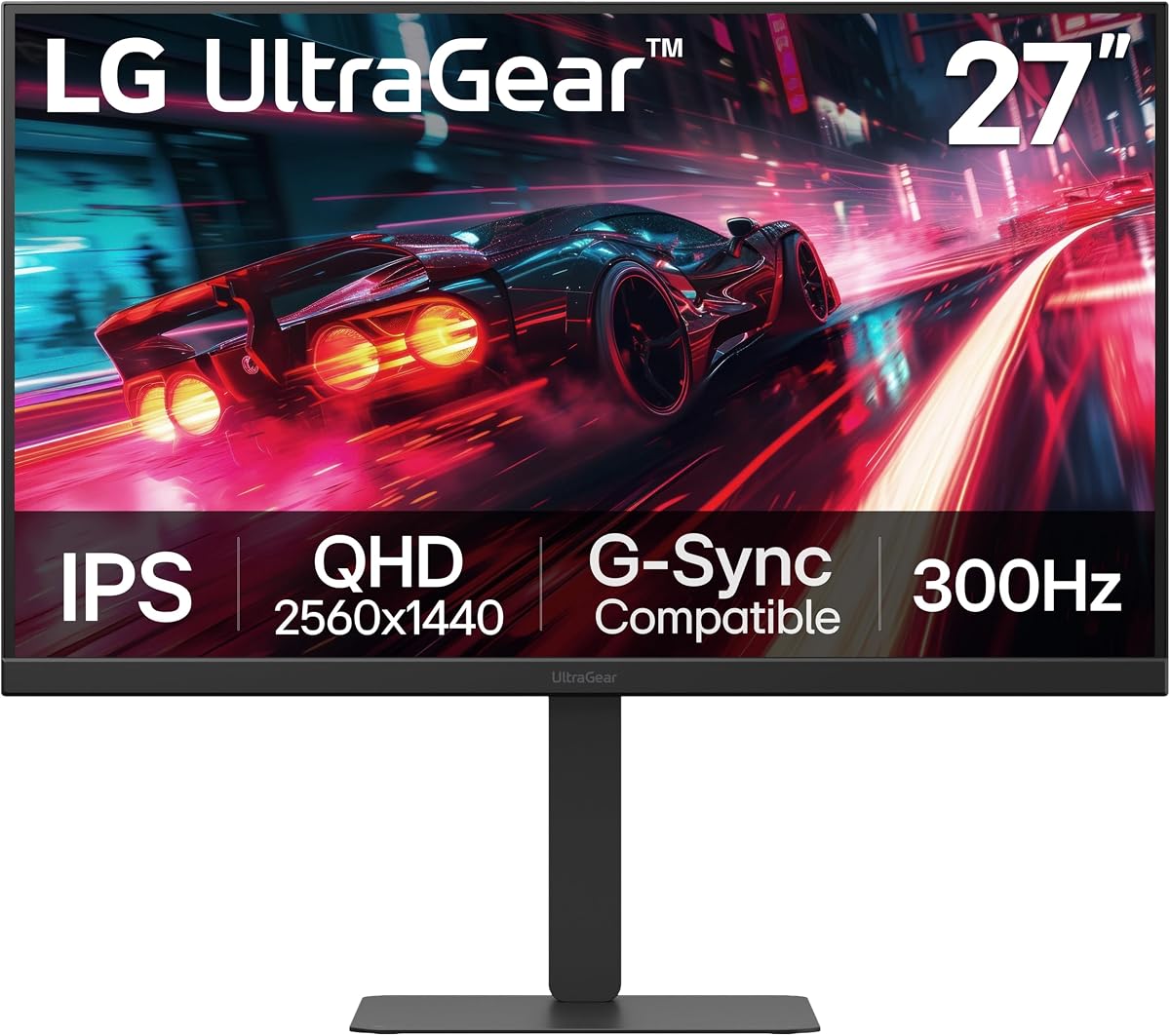
The LG 27G640A-B UltraGear is a 27-inch QHD IPS gaming monitor built around a 300Hz refresh rate and 1ms GtG response time. Its 4.4 rating and unusually high refresh specification make it a compelling choice for competitive PC players who also want a capable console display.
We may earn a commission when you buy through this link, at no additional cost to you.
The monitor supports NVIDIA G-SYNC compatibility and AMD FreeSync Premium, giving PC builders broad synchronization options. Dynamic Action Sync is included to reduce input lag, while Black Stabilizer, an FPS counter, and a crosshair feature are useful competitive tools. Its 300Hz capability, however, applies to compatible PC signals rather than current console output limits.
VESA DisplayHDR 400, up to 95% DCI-P3 color, and wide IPS viewing angles provide a balanced image for gaming and media. Dual HDMI 2.1 ports, DisplayPort 1.4, and USB Type-C with 15W power delivery create a versatile connection set. The main limitations are QHD rather than 4K resolution and the relatively modest HDR400 brightness target.
Choose this monitor when competitive speed matters most and you plan to game extensively on PC, while still retaining HDMI 2.1 for PS5 or Xbox use. Its height, tilt, swivel, and pivot adjustments support a personalized desk setup. It is a less natural fit for buyers whose sole priority is maximum console resolution and richer premium OLED contrast.
A 300Hz refresh rate and 1ms rated response make this one of the strongest specifications for fast PC games. The high frame rate can reduce motion perception and give competitive players more opportunities to react when paired with a capable system and low-latency input device.
Dual HDMI 2.1, DisplayPort 1.4, and USB-C power delivery let the display serve console, PC, and productivity connections. Adjustable ergonomics and the narrow-bezel design also suit a clean workstation.
We may earn a commission when you buy through this link, at no additional cost to you.
Choosing the right console gaming monitor means balancing native resolution, refresh rate, VRR, HDR, image quality, and connectivity. The most important factors depend on whether console performance, competitive PC gaming, cinematic presentation, or a mixed setup comes first.
Resolution determines how much fine detail a display can show. A 4K monitor provides 3840×2160 pixels and can show a compatible current console at its full native output, often with a 120Hz refresh rate. A QHD monitor uses 2560×1440 pixels, which can deliver a sharp console image while making high-refresh PC gaming easier to drive. Ultrawide 3440×1440 adds horizontal space and can improve immersion in supported games, but some console titles do not support that format.
Refresh rate controls how many times the display updates each second. Compatible PS5 and Xbox Series X consoles can support 4K at up to 120Hz through suitable HDMI 2.1 equipment, so a 120Hz monitor is a practical baseline for modern console gaming. Competitive PC gaming benefits much more from 144Hz, 170Hz, 240Hz, 300Hz, or higher. Look for a monitor that pairs high refresh rates with adaptive synchronization rather than treating refresh rate as the only measure of performance.
Variable refresh rate lets the display match its refresh timing to the frames delivered by the source, reducing tearing and stuttering. Compatibility depends on the console, game, graphics card, cable, and monitor implementation. AMD FreeSync, FreeSync Premium, NVIDIA G-SYNC compatibility, and console VRR labels are not interchangeable. For mixed systems, check whether the selected HDMI port and mode support both the desired resolution, refresh rate, and synchronization behavior.
IPS panels offer accurate color, wide viewing angles, and a conventional balance of speed and clarity. Fast VA models can provide deeper blacks and strong contrast, though their listed response specifications should be compared carefully with real-world behavior. OLED monitors offer the fastest pixel response, exceptional contrast, and wide color, but they require more attention to brightness and image-retention management. A low manufacturer-rated response time is useful, but it should be considered alongside refresh rate and synchronization.
HDR support improves the range between dark and bright areas when a game supports it and the display has enough brightness to show the benefit. Certifications such as DisplayHDR 400 and VESA DisplayHDR True Black 400 describe different standards, while OLED models naturally achieve exceptional black levels. For ordinary console use, accurate sRGB and DCI-P3 coverage, usable brightness, and restrained blooming matter more than a certification label alone. The content should also be viewed in a room with appropriate ambient lighting.
The presence of an HDMI 2.1 label does not tell the whole story. For high-bandwidth 4K 120Hz console use, the monitor and source must negotiate the required bandwidth, and the cable must also support it. Some listings mention dual HDMI 2.1, full-bandwidth HDMI 2.1 FRL, or a maximum resolution and refresh combination. USB hubs, headphone outputs, DisplayPort, and USB-C power delivery are useful additions, but they should not replace confirmation of the core video connection.
A 27-inch monitor is a common compromise between pixel density, viewing distance, and physical footprint. A 32-inch 4K display offers a larger image with reasonable pixel density and is often comfortable at a desk or farther console viewing position. A 34-inch 21:9 ultrawide model prioritizes horizontal immersion and works best for PC gaming, simulation, racing, and multitasking. Curved panels can feel more immersive, but desk depth, mount clearance, and the size of nearby furniture should be considered before ordering.
Height adjustment, tilt, swivel, and pivot are especially useful because a fixed monitor can be difficult to position comfortably. VESA compatibility broadens mounting options, while PIP and PBP can support console gaming alongside work or communications. Built-in speakers offer convenience, though they rarely replace good external audio. For OLED models, look for pixel-care features and sensible brightness controls. For shared spaces, consider anti-glare, low-blue-light features, and a stand that suits the available desk.
Start by identifying the intended signal path. Connect the console to a monitor input explicitly associated with the highest supported HDMI bandwidth, use a certified high-speed HDMI cable, and select the matching picture mode. On PC, set the graphics card to the desired resolution and refresh rate before changing in-monitor settings. If VRR does not activate, check the game, source device, cable, port, and monitor menu in that order.
For the best console image, leave the console responsible for its native 4K output when the monitor supports it, and avoid adding unnecessary in-monitor scaling. Use HDR and VRR only when the connected game and device support them. On IPS and VA panels, select a normal operating mode during desktop use, and avoid leaving static menus or paused images on screen for long periods. OLED owners should use the available pixel-care and screen-protection features.
Maintain the display by cleaning with a soft microfiber cloth, avoiding liquid directly on the panel, and keeping vents unobstructed. Leave adequate space around the rear of the cabinet and use the included or specified power supply. Periodically check firmware and monitor-menu updates through the manufacturer's support resources, and recheck display settings after connecting a new console, game, or graphics card.
HDMI 2.1 is highly recommended when you want 4K at 120Hz, but it does not unlock every capability on its own. The console, monitor, cable, and selected display mode must all support the required bandwidth. A compatible HDMI 2.0 setup may work at lower resolutions or refresh rates. Check the monitor's stated maximum console output before purchasing.
A 4K monitor can show the current console's native 3840×2160 output, producing more visible detail. A 1440p monitor may be easier to drive at very high refresh rates on PC and can still look sharp on a suitably sized screen. The best choice depends on your console priorities, viewing distance, and whether competitive PC performance matters more than pixel density.
For current premium consoles, 120Hz at 4K is the major target for the new console generation. Competitive PC gaming benefits from 144Hz and above, and the guide includes models reaching 240Hz and 300Hz. Check whether the high refresh rate applies at your preferred resolution, because some monitors change resolution or disable features in special modes.
No. HDMI 2.1 provides bandwidth, while variable refresh rate and compatible synchronization features manage frame timing. A monitor can advertise HDMI 2.1 without offering every form of VRR, and console or PC support varies by game and device. Enable the correct adaptive-sync mode in both the source and monitor when it is supported.
OLED generally offers deeper blacks, stronger perceived contrast, wider viewing angles, and exceptionally fast pixel response. IPS is often more restrained, can be brighter in ordinary settings, and may be more practical for long sessions or mixed office use. The best panel depends on the room, content, sensitivity to reflections, and willingness to manage OLED-specific care.
Yes, and all products in this guide are gaming monitors designed for PC use as well as console connections. DisplayPort is generally preferred for high-refresh PC gaming because it commonly supports more bandwidth, while HDMI 2.1 remains useful for consoles and other devices. Check the maximum resolution and refresh rate supported by each input.
A 27-inch model offers higher pixel density and typically fits more easily on a desk. A 32-inch 4K monitor gives a larger image and remains reasonably sharp, making it useful for couch-distance console play and immersive PC gaming. Consider desk depth, viewing distance, panel curvature, and your available mounting space when deciding.
Verify the native resolution, maximum refresh rate at that resolution, VRR support, HDR format, and HDMI port bandwidth. Also review response-time claims, color coverage, brightness, stand adjustment, and included cables. Console support can depend on the exact model and firmware, so confirm the latest manufacturer and retailer information before ordering.
The ASUS TUF VG27UQ1A is the most versatile overall recommendation because it combines 4K detail, 160Hz PC performance, 4K 120Hz console support, fast IPS response, and extensive synchronization options. The LG 27GX704A-B and MSI MAG 274QP stand out when OLED picture quality is the priority, while the Hikers model delivers a more budget-conscious route to high-refresh QHD gaming.
Prioritize the features your source device can actually use. Modern console owners should focus on 4K 120Hz capability, full-bandwidth HDMI 2.1, VRR, HDR, and low input lag. Competitive PC players should compare refresh rate, response time, and synchronization more closely, while cinematic and mixed-use buyers should examine contrast, color gamut, brightness, and ergonomics.
Specifications are only one part of the buying decision. Read the current listing, check the manual for port and VRR limitations, confirm included cables, and consider how the display will fit your room or desk. Prices, promotions, and availability can change, so review current retailer listings and manufacturer updates before making your final choice.