
Sinocare Upper Arm Monitor
4.3Editor score
One-button daily operation
Large 3.6-inch display
Dual-user reading storage
A blood pressure monitor is only useful when you can take a reading confidently and understand the result. Easy operation depends on more than a single-button design: a visible display, comfortable cuff, clear setup instructions, dependable power options, and understandable alerts all contribute to a smoother daily routine.
This guide compares ten upper-arm and wrist monitors selected for their approach to convenience, readability, measurement features, memory, and connectivity. The list includes basic one-button models, voice-assisted devices, rechargeable travel options, and app-enabled monitors, so readers can compare the features that matter most in their home.
Each product entry explains the strongest advantages, practical limitations, and the type of user most likely to benefit. Ratings and specifications reflect the supplied product information, while availability and prices can change. Always verify the current listing, included accessories, cuff range, and compatibility before purchasing.
4.3Editor score
4.4Editor score
4.3Editor score
As an Amazon Associate we earn from qualifying purchases.
The table below compares monitor placement, controls, power, memory, and standout usability features to help you identify the model that best fits your routine.



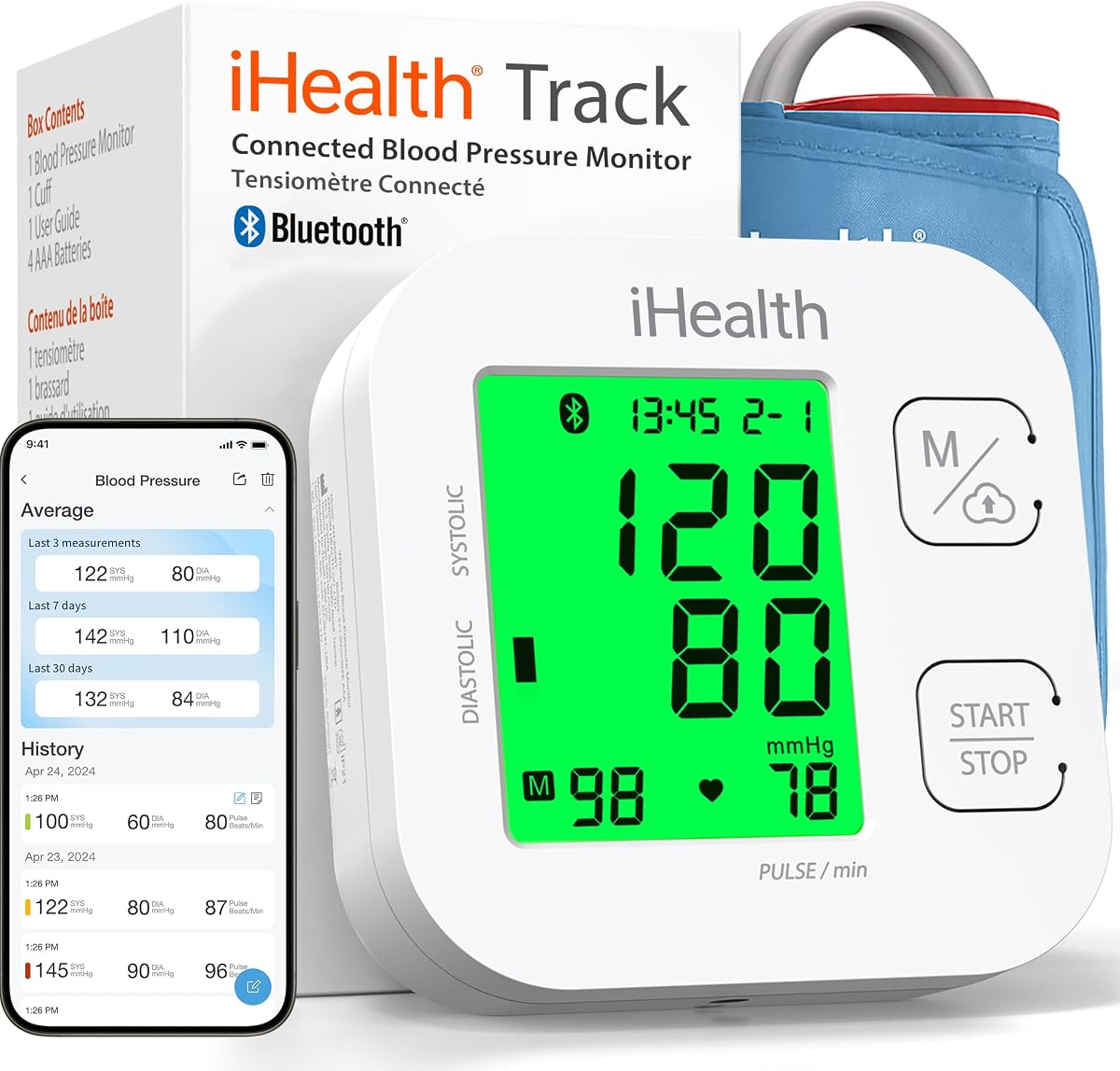
The iHealth Track combines approachable physical controls with one of the clearest monitoring experiences in this guide. Its 4.4 rating reflects a well-rounded feature set, including two-button operation, a large multicolor backlit display, up to 99 readings on the monitor, and unlimited readings through the free iHealth apps. The coded green, yellow, and red display gives users an immediate visual indication of how a result falls, reducing the need to interpret every number without context.
We may earn a commission when you buy through this link, at no additional cost to you.
Its strongest feature is the balance between at-a-glance information and connected record keeping. The oversized digits are easy to read, while the app expands storage beyond the monitor's 99-reading limit. A warning symbol can also appear when the device identifies a heart rhythm disturbance. These features make it particularly useful for people who want a straightforward device but still want a long-term history to review or share. Bluetooth 4.0 or higher and a compatible iOS or Android device are required for the app experience.
The trade-off is that this is not the simplest option for someone who wants no screen or phone at all. Two buttons and four AAA batteries keep the physical routine uncomplicated, but app syncing adds a separate digital step, and a compatible phone is necessary. The wide cuff fits upper arms from 8.7 to 16.5 inches, or 22 to 42 centimeters, which should cover a broad range of adult users. The included manual should be read before the first measurement to help preserve accuracy.
This is an especially good recommendation for users who want clear results, dual-scale tracking, and shared smartphone history without navigating a complicated interface. It may be less attractive to someone who prioritizes rechargeable power or voice-assisted readings, but its large display, useful alerts, broad cuff range, and simple two-button layout make it a strong overall choice for daily home monitoring.
The large backlit screen presents oversized numbers and color-coded guidance, making the result easier to interpret at a glance. This is valuable for users who do not want to rely on a small screen or a separate chart after every check.
The monitor retains 99 readings while compatible iOS and Android apps provide unlimited storage. Bluetooth syncing makes it easier to organize recurring measurements and discuss a meaningful history with a healthcare professional.
We may earn a commission when you buy through this link, at no additional cost to you.
The Oklar Rechargeable Wrist is designed for people who value compact operation, spoken results, and freedom from disposable batteries. It carries a 4.2 rating and uses a fully automatic wrist cuff with a single START/STOP control. A measurement takes about 35 seconds, after which the numbers appear on a large LED backlit display and can be heard through the adjustable voice broadcast. The automatic shutdown after 60 seconds of inactivity also helps avoid accidental power drain.
We may earn a commission when you buy through this link, at no additional cost to you.
The dual-user memory is unusually generous for this category, holding up to 240 readings across two profiles. That makes the device practical for couples or households that want to compare trends without constantly erasing old results. Its rechargeable battery and included Type-C cable remove the routine inconvenience of finding replacement batteries. The adjustable wrist cuff spans 4.92 to 8.46 inches, and the large screen improves visibility in dim rooms. Users who struggle to read small print may find the voice function especially valuable.
There are two practical limitations to keep in mind. First, a charging adapter is not included, so access to a suitable USB power source is needed. Second, wrist positioning matters more than it does with an upper-arm model: the palm should face upward and the cuff must sit correctly at heart level. Although the device promises fast and accurate results, no monitor can compensate fully for an inconsistent wrist position or an unsuitable cuff size.
Choose this model if portability, spoken readouts, and rechargeable convenience matter more than the traditional preference for upper-arm measurement. It is a particularly accessible choice for users with poor eyesight, provided they follow the positioning instructions carefully and are willing to establish a consistent measurement habit.
The voice broadcast reports measurement information and can be adjusted or switched off using the SET and MEM buttons. It offers a helpful alternative for users who have difficulty reading the display.
A built-in rechargeable battery supports repeated use without disposable replacements. The included Type-C cable adds convenience, although buyers will need their own compatible charging adapter.
We may earn a commission when you buy through this link, at no additional cost to you.
The Oklar FDA Cleared Upper Arm monitor puts simplicity at the center of the design. Its 4.3 rating reflects a device that can produce a reading in about one minute using a single button. A large backlit LED screen presents clear digits, making it approachable for older adults and anyone who prefers a plain numeric display without a complicated interface. The operating routine is easy to summarize: position the cuff, press the button, wait, and read the result.
We may earn a commission when you buy through this link, at no additional cost to you.
Power flexibility is one of its most useful distinctions. The monitor can operate with three AA batteries or through a Type-C connection. It is important to understand that this Type-C option is not a built-in rechargeable battery: the product listing notes that it is not rechargeable, and the supplied cable should be used when no batteries are installed. That caveat matters for buyers who want to avoid disposable batteries, since the cable provides power rather than stored charging capacity.
The monitor supports two users and stores 120 readings for each profile, producing a total capacity of 240 readings. Its adjustable upper-arm cuff fits circumferences from 8.7 to 15.7 inches, or 22 to 40 centimeters, which is suitable for most adults but does not extend as far as several competing wide-range cuffs. The smaller upper limit is the main reason people with larger arms should verify fit before ordering.
This is a good recommendation for a buyer who wants an uncomplicated upper-arm monitor, generous two-user memory, and the ability to choose between batteries and cable power. It is not the ideal match for someone who needs rechargeable operation or a cuff beyond 15.7 inches, but its one-button design and highly legible display make it one of the most approachable choices in the guide.
The single-button design removes menu navigation from the measurement routine. Once the cuff is positioned correctly, the user can start a reading without navigating screens or selecting a profile in advance.
Three AA batteries offer a familiar alternative for households that do not want a dedicated charging setup. The Type-C option can be helpful when the monitor is used near a compatible power source.
We may earn a commission when you buy through this link, at no additional cost to you.
The Oklar Grey Wrist is a compact, rechargeable option with a 4.3 rating and the same user-focused approach as the other Oklar wrist monitor in this guide. It uses a fully automatic cuff and a single START/STOP button. The reading process takes approximately 35 seconds, and results are shown on a large LED backlit screen. Voice broadcast can be adjusted or disabled, offering a helpful spoken alternative for users who have trouble reading the display.
We may earn a commission when you buy through this link, at no additional cost to you.
Its internal memory stores up to 240 readings across two users, which supports regular tracking by two people. The rechargeable battery removes replacement battery costs and makes the unit convenient to keep in a drawer or carry in a travel bag. A Type-C cable is included, and the device automatically turns off after 60 seconds of inactivity. The grey color is a minor cosmetic distinction, but the broader feature set is what makes this model competitive.
As with any wrist monitor, correct placement is essential. The cuff range is 4.92 to 8.46 inches, so buyers should measure their wrist before ordering. A snug but comfortable fit is necessary, and the palm should be oriented upward during the reading. The absence of an included charging adapter may also be inconvenient for a first-time owner, even though a phone charger or other compatible USB source is commonly available.
This model suits travelers, couples, and users who want spoken results plus a rechargeable design in a compact package. It is less suitable for a buyer who strongly prefers the familiarity of an upper-arm cuff or does not want to pay attention to wrist height. Within those parameters, it offers an easy workflow, clear display, and useful memory capacity.
The dual-user mode keeps measurements organized for two people. Up to 240 readings can be stored, reducing the need to delete data frequently when two family members use the monitor.
The automatic 35-second process, inactivity shutdown, illuminated numbers, and adjustable voice broadcast reduce the effort required for each routine measurement.
We may earn a commission when you buy through this link, at no additional cost to you.
The Alcedo Upper Arm has the highest listed rating in this roundup at 4.5, and its combination of voice assistance, automatic averaging, and a wide cuff makes it an easy-to-use option for regular home monitoring. The LCD displays clear numerical values during measurement, while a live voice broadcast can report blood pressure levels with adjustable volume. A single push button starts the process, reducing the learning curve for new users.
We may earn a commission when you buy through this link, at no additional cost to you.
The automatic averaging of three values is a notable feature for anyone seeking a more stable result. Rather than relying on one reading alone, the monitor can calculate an average, which may help reduce the influence of temporary variation. Self-checking cuff positioning and movement detection add visual symbols when the setup may affect measurement quality. The device also supports two users, with memory for 120 readings per person.
Its wide-range cuff accommodates upper arms from 8.7 to 16.5 inches and is designed to wrap comfortably around the arm. That broad fit is more accommodating than the smaller range offered by some upper-arm choices. The main limitation is the absence of listed smartphone or Bluetooth support. While 240 on-device readings provide useful history, there is no stated option for unlimited app storage, report exports, or integration with a broader health platform.
The Alcedo is a strong recommendation for users who want a traditional upper-arm monitor with a wide cuff, voice guidance, and automatic averaging. It may be less attractive for people who want automatic data syncing, and the speech function could be inconvenient in a shared environment unless the volume is lowered. Overall, it balances useful automation with a highly approachable control layout.
Automatic averaging of three measurements offers a more stable reference than relying on a single reading. It is a useful feature for people establishing a routine and monitoring changes over time.
The 8.7-to-16.5-inch cuff accommodates a broad range of upper arms. Built-in position and movement checks also help users recognize when positioning may need adjustment.
We may earn a commission when you buy through this link, at no additional cost to you.
The Rechargeable Wrist Monitor focuses on clear presentation and accessibility, earning a 4.3 rating. Its large LCD and pronounced digits make numerical results easy to inspect, while a spoken female voice reports the high-pressure reading, low-pressure reading, and heartbeat. That combination is especially helpful for older adults or users who do not want to rely entirely on visual interpretation. The voice can be turned off using the manual if a quieter environment is preferred.
We may earn a commission when you buy through this link, at no additional cost to you.
The one-button process is refreshingly direct. The user wears the cuff with the palm facing upward, presses the central control, and receives results within a minute. Rechargeable power eliminates the recurring task of replacing disposable batteries, and the package includes both a storage box and a USB charging cable. A full charge generally takes two to three hours when connected through a notebook, power bank, or another compatible source.
The device stores 90 readings for each of two users, allowing 180 measurements in total. That is enough for many household routines, though it is less than the 240-reading capacity of several competing models. The wrist cuff also demands more attention to placement than an upper-arm device. Level positioning, a palm-up orientation, and a secure fit are necessary for dependable results, and users who cannot maintain that position may prefer an upper-arm model.
This is a good fit for anyone who values spoken results, portable storage, rechargeable convenience, and uncomplicated one-button operation. It is less suitable for people who need unlimited digital history or who prefer the familiar upper-arm placement. With its large screen, included case, and accessible feedback, however, it remains a practical option for household and travel monitoring.
The monitor speaks the systolic and diastolic values along with heartbeat information. This gives users another way to confirm a result without repeatedly reading small digits or remembering the order of the numbers.
A storage box and USB charging cable are included, making the monitor easier to pack and manage away from home. The rechargeable battery further reduces the number of loose accessories required.
We may earn a commission when you buy through this link, at no additional cost to you.
The Sinocare Upper Arm delivers a focused, no-fuss experience with a 4.3 rating. One-button operation eliminates setup menus and calibration steps, while the 3.6-inch display presents readings in large, clear characters. The monitor is designed to feel routine-friendly: position the adjustable cuff, press the button, and review the result. Its power options include four AAA batteries or a Type-C charging port for flexibility at home or while traveling.
We may earn a commission when you buy through this link, at no additional cost to you.
The supplied specifications add useful layers of guidance. Cuff pressure accuracy is stated as ±3 mmHg, pulse rate accuracy is within ±5%, and the monitor detects incorrect posture during measurement. Color-coded indicators classify blood pressure levels, while an irregular-heartbeat alert provides another useful signal. Two profiles can each store up to 99 readings, creating a total capacity of 198 and allowing two people to track their histories separately.
One detail to verify before buying is that the Type-C cable is not included. The product supports wired power through that connection, but it is not described as having a built-in rechargeable battery. The adjustable cuff spans 8.6 to 16.5 inches, giving it one of the broadest ranges in the guide and making it a practical choice for a wide range of adult upper arms. There is no listed app connectivity, so data remains on the monitor.
This is the strongest budget-oriented recommendation in the guide for users who prioritize a large display, one-button operation, helpful posture feedback, and broad cuff compatibility. It is less appropriate for someone who wants automatic app syncing or a rechargeable battery. Its combination of error prompts, color coding, and generous physical range makes it feel more sophisticated than a bare-bones basic monitor.
The 3.6-inch display and one-button workflow keep the monitor understandable from the first measurement. Color-coded level indicators add context without requiring a separate interpretation guide.
Posture detection and irregular-heartbeat alerts can help users recognize conditions that may deserve attention. These prompts are most useful when paired with regular tracking and professional medical guidance.
We may earn a commission when you buy through this link, at no additional cost to you.
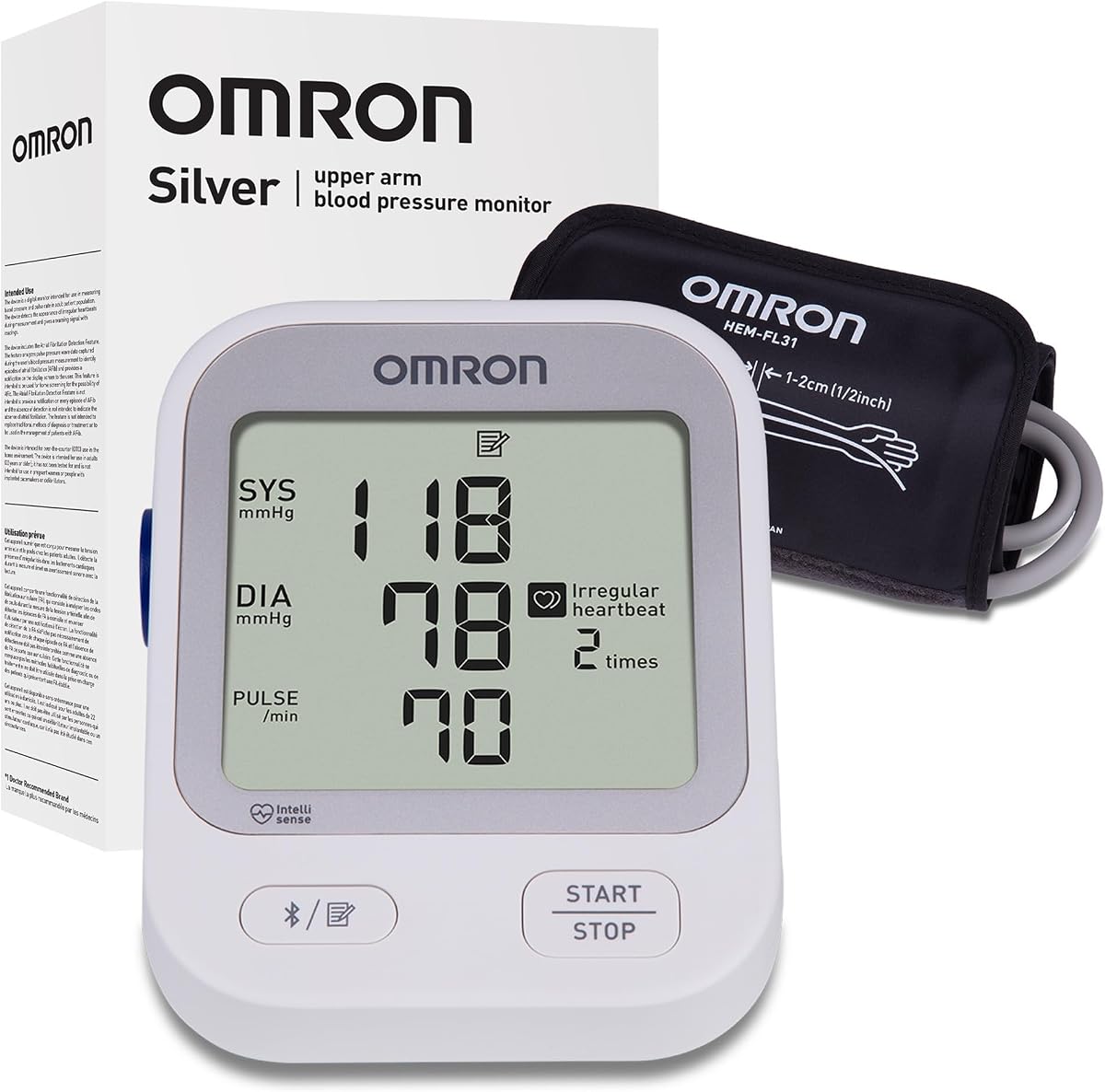
The OMRON Silver is the most feature-rich connected option in this guide and earns a 4.3 rating. It combines an upper-arm monitor, advanced accuracy technology, irregular-heartbeat detection, and a hypertension indicator with Bluetooth support. The included ComFit cuff fits arms from 9 to 17 inches, the storage case supports organized travel, and four AA batteries are included. A quick start guide and instruction manual make the package ready for home use.
We may earn a commission when you buy through this link, at no additional cost to you.
Its premium advantage comes from the OMRON connect app. The monitor can store unlimited readings digitally, track trends, and share reports with a doctor. Compatibility with Apple Health and Google Fit extends the option for people who already use those platforms. Thirty readings can also be retained directly on the device, giving users immediate access to recent values even before syncing. The upper-arm format and easy-wrap cuff avoid some of the placement demands associated with wrist monitors.
The main limitation is that 30-device readings is relatively modest compared with the 180 to 240 reading capacities offered by many other monitors here. Another consideration is app dependence: while the physical monitor remains useful on its own, the strongest tracking and sharing features require Bluetooth pairing and a compatible phone. Users who dislike smartphone setup may find a simpler device preferable.
The OMRON Silver is a compelling premium recommendation for people who want a trusted upper-arm format combined with long-term digital tracking. It works especially well for users of Apple Health or Google Fit and for anyone who plans to share reports with a healthcare professional. Those who want a large local memory and no phone connection should examine the higher-capacity alternatives in the comparison.
The OMRON connect app expands beyond the monitor's 30-reading internal memory. Trend tracking, report sharing, and health-platform integration make the data easier to use over time.
The easy-wrap ComFit cuff, wide 9-to-17-inch range, storage case, batteries, and quick-start materials create a well-rounded package for regular home monitoring.
We may earn a commission when you buy through this link, at no additional cost to you.
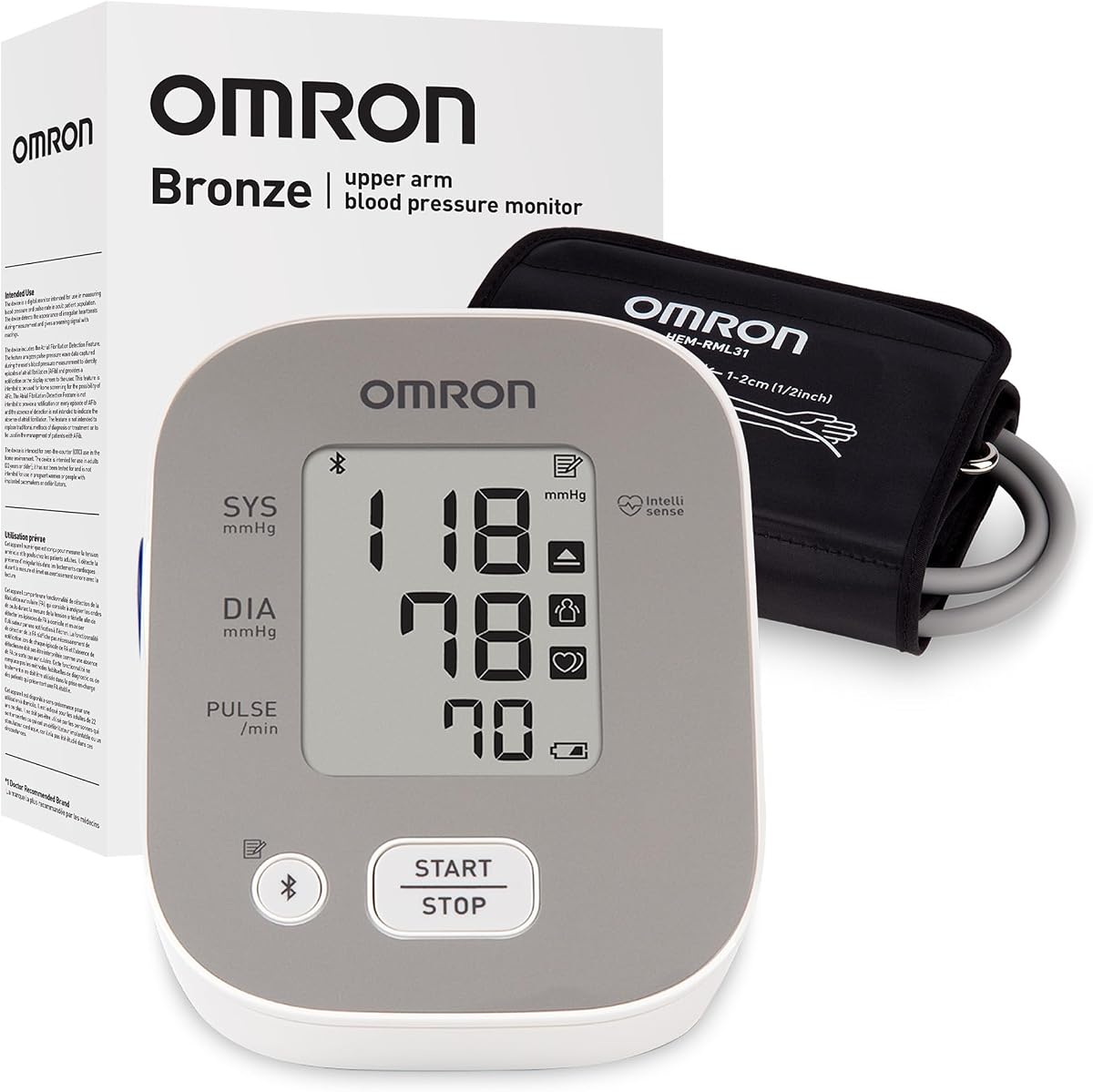
The OMRON Bronze earns a 4.5 rating and provides the same broad connected-monitoring framework as the Silver model, including advanced accuracy technology, irregular-heartbeat detection, hypertension indicator alerts, and Bluetooth connectivity. Its on-device memory is smaller, holding 14 readings, but the free OMRON connect app provides unlimited storage. Compatibility with Apple Health and Google Fit further broadens its appeal to users who want to incorporate blood pressure data into an existing health routine.
We may earn a commission when you buy through this link, at no additional cost to you.
The included wide-range D-ring cuff fits upper arms from 9 to 17 inches. The D-ring construction helps position the cuff consistently, while the familiar upper-arm design is generally reassuring for first-time users. A storage case, instruction manual, quick start guide, and four AA batteries are included, so the basic package supports both home organization and travel.
The lower internal memory can be a meaningful limitation for households that want to review several recent results without opening the app. It stores only 14, compared with 30 for the Silver, 180 for the Rechargeable Wrist Monitor, and 240 for several other choices. The Bronze also has no listed voice output, which may matter for users who benefit from spoken measurements. Neither issue prevents regular use, but both influence which workflow feels most convenient.
This monitor is a strong choice for anyone who values OMRON's connected features, familiar upper-arm operation, and integration with major health platforms but does not need substantial local memory. It is particularly suitable for a single primary user who syncs readings regularly. Compared with the Silver, it offers a similar digital ecosystem with a smaller built-in history and a slightly different cuff design.
Bluetooth syncing, unlimited app storage, and health-platform compatibility make this a modern connected option. It is a good fit for users who are comfortable reviewing results digitally.
The wide-range D-ring cuff is designed for consistent placement and supports upper arms from 9 to 17 inches. This familiar format reduces the positioning demands of a wrist device.
We may earn a commission when you buy through this link, at no additional cost to you.
The iHealth Neo is the most travel-oriented model in the guide, with a 4.2 rating, an ultra-thin design, and a rechargeable 950mAh lithium battery. One-button operation and gentle inflation make the physical measurement process straightforward, while the large display becomes visible in 30 to 60 seconds. A full charge can support up to 130 measurements, making it a convenient option for people who monitor away from home or do not want to keep spare batteries nearby.
We may earn a commission when you buy through this link, at no additional cost to you.
Its principal strength is the MyVitals app. Measurements sync through Bluetooth 4.0, and the app provides unlimited data storage rather than a small rotating local history. It can also export readings to CSV, XLS, or PDF files, allowing users to organize or share their records. That flexibility is useful for anyone who wants to maintain a detailed log or prepare information for a healthcare appointment.
The thin, lightweight construction comes with a tradeoff: the monitor offers little built-in storage compared with models that retain dozens or hundreds of readings. Users who often take measurements without syncing or who prefer not to use a phone may find this less convenient. App compatibility and Bluetooth setup are also required to unlock the full data-management feature. The supplied information notes clinical validation and conformance to relevant certification standards, and no calibration is needed.
Choose the iHealth Neo for travelers, app-focused users, and anyone who values portable construction, rechargeable power, and flexible report exports. It is less attractive for someone who wants a large local memory or a voice-assisted display. Within the app-centered category, its combination of gentle measurement, easy operation, and exportable records makes it a distinctive final recommendation.
The slim profile and rechargeable battery make the Neo convenient to carry. Its one-button operation also preserves a simple measurement routine when the monitor is used away from home.
The MyVitals app stores unlimited measurements and exports data in CSV, XLS, or PDF formats. These options provide more control over how a personal blood pressure record is organized and shared.
We may earn a commission when you buy through this link, at no additional cost to you.
The easiest monitor is the one you will position correctly, operate consistently, and understand clearly. Compare placement, display, power, memory, and connectivity alongside cuff fit and the features that support your daily routine.
Upper-arm monitors generally use a cuff around the upper arm and are the familiar standard for home readings. They tend to be easier to position consistently because the arm remains relatively still and the cuff does not depend on precise wrist height. Wrist monitors are smaller and often more convenient for travel, but they require the wrist to be held at heart level and the cuff to fit snugly. Choose based on your ability to maintain the correct position rather than on size alone.
Look for large, high-contrast digits, a backlit screen, and simple result layouts. The best displays make systolic and diastolic values easy to distinguish without forcing users to squint. Color-coded indicators can provide a useful visual summary, while voice output offers an alternative for poor eyesight or low-light situations. Consider whether a plain number display is sufficient or whether spoken and color feedback would make your routine more comfortable.
A cuff that is too small or too loose can undermine measurement quality and comfort. Compare the stated circumference range with your upper arm or wrist and measure before ordering. Several models in this guide fit upper arms as small as 8.6 or 8.7 inches, while OMRON models extend to 17 inches. Wrist cuffs here span approximately 4.92 to 8.46 inches. A snug, correctly positioned cuff should be used without forcing the arm or restricting circulation.
One-button operation is the most direct way to simplify routine measurements, while two-button control may provide slightly more separation between functions. Check whether startup requires profile selection, date entry, or other configuration. Automatic inflation, automatic shutoff, and automatic averaging reduce active involvement. The strongest simplicity comes from a device that makes the normal path obvious without removing useful feedback such as posture warnings or heartbeat alerts.
Battery-powered monitors are familiar and easy to keep in a drawer, but disposable cells must be replaced. Rechargeable models are more convenient for frequent use and travel, provided charging time and access to a cable are acceptable. Some dual-power devices accept a Type-C cable without containing a rechargeable battery; in those cases, the monitor still needs a power source while connected. Check the package contents carefully because a charging adapter or Type-C cable may not be included.
Internal memory makes it possible to review recent readings without an app, while dual-user profiles prevent one person's results from being mixed with another's. Capacities in this guide range from 14 and 30 device readings to 180, 198, or 240. App-connected monitors may provide unlimited cloud or phone storage instead. Consider how often you measure, how many people share the device, and whether you want to maintain a local history when a phone is unavailable.
Bluetooth and app support can make long-term tracking more convenient by storing unlimited readings, charting trends, and creating reports. The OMRON connect app also supports Apple Health and Google Fit, while the MyVitals app can export data in several file formats. Connectivity is helpful when you already use a smartphone but adds pairing, compatibility, and syncing steps. A nonconnected monitor can still be highly usable and may better suit someone who wants a private, self-contained routine.
Accuracy claims, clinical validation, FDA clearance, and stated performance standards can help distinguish products, but no device should be treated as a substitute for professional medical advice. Features such as irregular-heartbeat detection, hypertension indicators, posture checks, and averaging can be useful supplementary signals. Compare stated accuracy specifications when available and consider whether a clearly stated standard provides more confidence than vague promotional language.
Before the first reading, read the instruction manual and identify the correct cuff placement. Sit quietly for several minutes with feet flat on the floor, back supported, and arm resting at approximately heart level. Avoid caffeine, exercise, smoking, and other activities that may temporarily affect a reading when possible. Use the same arm for routine comparisons, wear the cuff on bare skin, and make sure it fits snugly without being painful.
Start the monitor as directed and remain still until the measurement finishes. For an upper-arm model, keep the supported arm relaxed and avoid talking or moving. For a wrist model, place the cuff according to the manual, turn the palm upward, and hold the wrist at heart level. Note the systolic value, diastolic value, pulse rate if displayed, and any warning symbol. Wait for the recommended interval before repeating a measurement, and record the result if it differs substantially from your usual reading.
Treat irregular-heartbeat warnings or repeated out-of-range results as reasons to follow the advice in the manual or contact a healthcare professional. Do not change medication based only on a home reading. Clean the cuff and monitor with a dry or lightly damp cloth, avoid immersing the device, and store it in a dry place. Replace batteries as needed, keep a rechargeable model charged, and follow the manufacturer's guidance for pairing, software updates, and periodic checks.
Usually, yes. A one-button design removes several steps from the normal measurement routine and is especially useful for people who do not want to navigate menus. A monitor with one button can still include useful automatic functions such as inflation, averaging, posture prompts, and memory. The key is to position the cuff correctly and remain still while the device completes the measurement.
Upper-arm monitors are generally easier to position consistently because the cuff wraps around the upper arm and does not need to be held precisely at heart level. Wrist monitors are more compact and can be convenient while traveling. They are best for users who can follow the positioning instructions and maintain a steady wrist height throughout each reading.
A larger display can make numbers easier to distinguish, especially for older adults or anyone with limited vision. Backlighting, high-contrast digits, and color-coded indicators are also useful. Voice broadcast provides another option when reading the screen is inconvenient, although it may not suit every home environment.
An app is optional rather than necessary for taking a reading. It can be valuable for unlimited storage, trend charts, automatic syncing, and sharing reports with a healthcare professional. If you prefer a self-contained routine, choose a model with useful internal memory and no required phone connection.
The right amount depends on how often you measure and how many people use the device. Thirty or more readings can be sufficient for an individual who syncs regularly, while 180 to 240 readings are more convenient for shared use or offline tracking. Consider both total capacity and whether the monitor separates user profiles.
Rechargeable power can reduce the recurring cost and inconvenience of replacing disposable batteries. It is especially useful for frequent travelers or users who want to keep one device ready at all times. Check charging time, connector type, and whether a charging cable or adapter is included before deciding.
Measure the circumference of the arm or wrist where the cuff will sit, then compare it with the manufacturer's stated range. A cuff that is too loose or too small may reduce consistency and comfort. Position the cuff as instructed, secure it without overtightening, and replace it if it becomes damaged or no longer fits properly.
First, remain still and repeat the measurement using the proper technique, making sure the cuff is correctly positioned. Contact a healthcare professional if a warning continues or if readings remain outside the range recommended for you. Seek urgent medical care for symptoms that may indicate a serious problem rather than relying on a home monitor to assess them.
The iHealth Track is the strongest all-around choice for readers who value a highly visible, color-coded display, straightforward controls, and unlimited phone-based tracking. The Sinocare Upper Arm stands out as a budget-friendly option with a large screen, posture detection, heartbeat alerts, and a broad cuff range. For users who want a premium connected experience, the OMRON Silver combines an easy-wrap upper-arm cuff with app storage, health-platform compatibility, and report sharing.
Prioritize the factors that will affect your daily adherence: choose an upper arm if consistent positioning is the priority, a wrist model if portability and spoken results matter more, and an app if you want organized long-term records. Match the cuff range to your body, confirm how the device is powered, and make sure the display and controls suit your vision and comfort. A simpler setup you understand is often more valuable than a feature-rich model you find confusing.
Finally, check the current listing before ordering because prices, availability, package contents, and product details can change. Review the included instructions, verify the cuff size, and consider which app or connectivity requirements you are willing to manage. A reliable routine built around a monitor you can use comfortably is the most useful outcome for long-term home tracking.
