
SwimJoy Industrial Grade Solar Pool Heater
4.5Editor score
Strapless roof mounting system
Patented connection clamps
Low-head-loss open flow
A DIY solar pool heating system can extend the swimming season by moving warm pool water through sun-heated collectors and returning it to the pool. The right system depends on pool volume, pump capacity, available mounting space, climate, plumbing layout, and how much hands-on maintenance you are prepared to perform.
We compared ten products using only the supplied manufacturer and listing information, focusing on collector design, water-flow approach, mounting requirements, included hardware, material construction, pool compatibility, and installation complexity. The list includes complete kits, add-on systems, flexible roll-up panels, roof-oriented collectors, and a vacuum-tube alternative for careful comparison.
Each review explains the product's strongest benefits, important limitations, and the type of DIY installer it best suits. Ratings and specifications reflect the available listing data, while practical performance still depends on sunlight, temperature, flow rate, insulation, and correct setup. Prices and package contents can change, so verify current details before purchasing.
4.5Editor score
4.7Editor score

3.7Editor score
As an Amazon Associate we earn from qualifying purchases.
This side-by-side comparison highlights the collector formats, mounting approaches, flow features, and intended pool setups represented in the top ten products.



The SwimEasy DIY Solar Pool Heater Kit combines a 4-by-12-foot collector, a molded header, mounting hardware, connection pieces, and expert support in one package. Its 4.7 rating is the highest among the products with available numerical feedback, while the listed design emphasizes high heat performance, efficient water movement, and long-term durability.
We may earn a commission when you buy through this link, at no additional cost to you.
The most important feature is the manifold molded directly around the absorber tubes. According to the product information, this eliminates internal flow barriers and allows water to move freely from the header into each tube. That matters because solar heating depends on adequate circulation: a collector can only transfer the heat it absorbs when pool water moves through it consistently.
The kit also includes the hardware needed to mount the panel, connect multiple panels, secure the installation, and tie into supply and return plumbing. It is manufactured in the United States with UV stabilizers, and the seller states a 15-20 year life expectancy. Those claims make the system appealing for a permanent roof or rack installation where a disposable seasonal panel would be less desirable.
This is the strongest all-around choice for an installer who wants a purpose-built system, values efficient flow, and is willing to perform permanent plumbing work. It is less suitable for renters, temporary pools, or anyone unable to provide a stable mount and compatible circulation equipment. With correct orientation and flow, its comprehensive design makes it our leading recommendation.
The complete kit also reduces the likelihood of discovering that essential fittings are missing after the collector is already positioned. Installation specialists and a comprehensive manual add practical support for a project that involves roof work, solar orientation, plumbing, and pump flow. Buyers should still confirm that their existing filtration system and pipe layout are compatible before ordering.
The molded header is designed to remove flow barriers between the manifold and absorber tubes. Better-supported circulation can improve the amount of pool water exposed to the heated collector surface, making flow design as important as panel area.
The package includes mounting, panel-linking, tie-down, and plumbing components plus installation guidance. That completeness makes it more convenient for a first-time DIY builder than a bare collector that requires sourcing every accessory independently.
We may earn a commission when you buy through this link, at no additional cost to you.
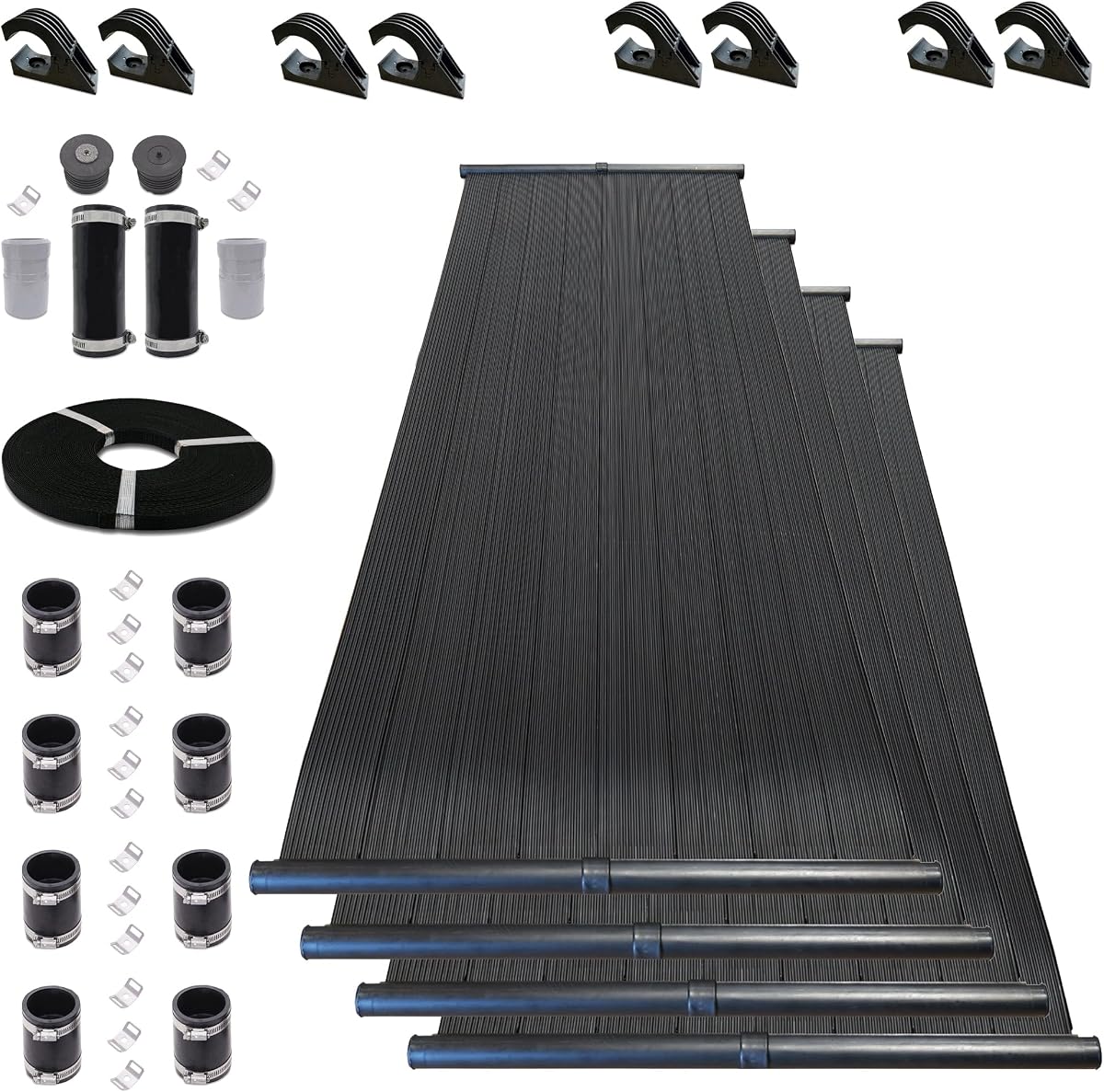
The SwimJoy Industrial Grade Solar Pool Heater DIY Kit is a two-panel system covering 52 square feet and carrying a 4.5 rating. Its distinguishing feature is the strapless, flush-mounting approach, designed to accommodate different roof types while reducing the need for external tie-down straps that normally require inspection and maintenance.
We may earn a commission when you buy through this link, at no additional cost to you.
Its specialized square headers and open-flow design are intended to maximize flow and virtually eliminate backpressure. Low-head-loss riser tubes also reduce the risk of clogging. The panels use a patented construction process that joins headers and risers into one solid piece, eliminating the seams and welds that the listing identifies as potential aging and stress points.
The system uses patented panel clamps for linking panels to one another and to PVC pipe. Unlike a hose-based layout, this arrangement avoids maintenance associated with deteriorating rubber hoses and repeatedly serviced metal clamps. The flush configuration can also place panels closer together, potentially making more productive use of limited roof space.
This kit best suits a confident DIY installer with a permanent rooftop area who values wind resistance, low maintenance, and a compact arrangement. Roof work still requires safe access, proper flashing or support, secure attachment, and compliance with local building guidance. The system is less attractive for a small temporary above-ground pool or a renter who cannot alter the roof.
Its construction and mounting claims position it as the premium option in this group. The most persuasive advantages are not merely a larger collector area but the reduction of recurring hardware maintenance. If the budget supports a long-term installation and the mounting surface is suitable, the system offers a polished solution with fewer exposed connection components.
Patented panel clamps connect the collectors and PVC plumbing without relying on conventional rubber hoses. This can reduce the number of exposed connections that need periodic tightening, inspection, and eventual replacement.
Flush, strapless mounting allows the panels to sit closer together and use the roof more efficiently. The two-panel arrangement provides 52 square feet of collection area while keeping the installed footprint relatively compact.
We may earn a commission when you buy through this link, at no additional cost to you.
The Goplus 2.5-by-20-foot roll-up solar heater offers an accessible starting point for DIY pool heating. It combines two collector panels into a 20-foot-long, 2.5-foot-wide installation and carries a 3.7 rating. The product information claims it can heat pools containing up to 6,816 gallons and raise water temperature by 10.8 degrees under suitable conditions.
We may earn a commission when you buy through this link, at no additional cost to you.
Its polyethylene construction is advertised for operating temperatures from minus 20 to 90 degrees Celsius and for use on a rooftop, ground, or inclined frame. Because the collectors roll up, they are easier to carry and store than rigid panels. The system can also serve both aboveground and inground pools, expanding its usefulness for different household installations.
The package includes end caps, hose clamps, connector hoses, elbow connectors, and hose adapters. A water pump is not included, however, and the listing specifies a pump of at least 0.75 horsepower with pressure below 1.5 bar, or 21 PSI. The DIY installer must confirm that the existing pump and filtration setup meet those limits.
This is the best budget-oriented choice for a homeowner seeking a simple, movable collector without committing to a large permanent roof installation. Its main compromises are the 3.7 rating and the need to carefully manage flexible connections and pump compatibility. It is better suited to seasonal use than to a polished permanent rooftop array.
Its roll-up format also gives owners an option to reposition the collectors as sunlight conditions change. Installation should still keep the panels directed toward the sun, protect connections from sharp edges, and ensure unrestricted water movement. When those practical requirements are met, the Goplus kit provides a straightforward solar-heating project for many pool owners.
The roll-up collectors can be moved between a ground location, an inclined support, and a rooftop. That flexibility is useful for renters, seasonal pools, and installations where permanent mounting is not desired.
The included hardware simplifies hookup, but the pump is not supplied. The installer should verify at least 0.75 horsepower and operating pressure below 1.5 bar to match the stated requirements.
We may earn a commission when you buy through this link, at no additional cost to you.
The SwimEasy Universal Solar Pool Heater Panel is a 4-by-12-foot replacement collector with a 4.6 rating. It is designed for systems that use rubber hoses, hose clamps, and a round header with a 1.5-inch inner diameter, making it a targeted option for homeowners repairing or upgrading an existing panel rather than planning an entirely new installation.
We may earn a commission when you buy through this link, at no additional cost to you.
The absorber combines characteristics of loose-tube and flat-plate systems while seeking to avoid their weaknesses. Its header is molded directly around the absorber tubes to remove flow barriers. The listing also highlights flexible zip joints every six inches, allowing movement between absorber sections as temperatures vary and reducing stress on the panel structure.
Manufactured in the United States with high-grade materials and UV stabilizers, the panel is positioned for prolonged outdoor exposure. The stated 15-20 year life expectancy and leak-focused single-piece header construction make it appealing where replacing a failed collector is less attractive than installing a durable component.
This panel is best for a DIY installer who has already confirmed the required 1.5-inch round header and hose-clamp connections. It is not the most flexible choice for an entirely new custom system, and compatibility must be checked before purchase. For a matching existing installation, though, its strong rating and thoughtful flow design make it a leading replacement option.
Unlike the first SwimEasy kit, this product is presented as a panel rather than a full mounting-and-plumbing package. Accessory requirements therefore depend on what the existing solar system already contains. Confirm header diameter, connection spacing, mounting provisions, and pump flow before removing an old collector.
The panel is specifically aimed at systems using rubber hoses, standard clamps, and a round 1.5-inch header. Measuring these three connection details before ordering can prevent an incompatible purchase.
Zip joints spaced every six inches allow the absorber sections to move as temperatures change. This flexibility is intended to reduce stress caused by expansion and contraction across the collector.
We may earn a commission when you buy through this link, at no additional cost to you.
The vidaXL Curved Pool Solar Heating Panels consist of two black collectors measuring 43.3 by 25.6 inches and carry a 3.6 rating. Their most convenient feature is an integrated support system with adjustable aluminum legs that extend from 8.9 to 14.2 inches, allowing the panels to be raised toward the sun without constructing a full frame.
We may earn a commission when you buy through this link, at no additional cost to you.
The listed construction combines high-density polyethylene, polycarbonate, and aluminum. The black finish is designed to absorb sunlight, and the product information says the panels can raise above-ground pool temperatures by as much as five degrees. Their curved shape and understated appearance are intended to blend into an outdoor pool environment.
Installation hardware is reasonably complete: the package contains two solar heaters, two hoses, four hose clamps, four connectors, four seals, and four screw caps. Users can mount the panels on the ground, on a roof, or on a rack. Adjustable legs are especially useful for seasonal setups where the sun's angle changes over the year.
This product is a good fit for a DIY owner who wants a moderate and reversible installation rather than a permanent roof array. The lower rating and smaller collectors make it less compelling for large pools or users seeking the highest collector area. Wind stability, secure footing, and safe positioning remain the installer's responsibility.
The complete accessory package reduces setup friction, while the adjustable legs make it easier to optimize sun exposure. It is especially practical for above-ground pools, where a portable ground-level arrangement can be simpler than roof work. For larger pools, multiple units or a more substantial permanent system may be needed.
Legs adjustable from 8.9 to 14.2 inches let the installer change the collector angle through the season. This portability makes the panels convenient for ground, roof, or rack placement.
Two hoses, four clamps, four connectors, four seals, and four caps cover the stated basic hookup. Installers should still confirm pipe dimensions and circulation requirements before beginning.
We may earn a commission when you buy through this link, at no additional cost to you.
Doheny's 2.5-by-20-foot collector kit is designed specifically for above-ground pools and carries a 3.3 rating. Its main strength is the unusually clear sizing guidance, which links collector dimensions and BTU ratings to round and oval pool sizes, helping DIY buyers estimate how much collector area their installation may need.
We may earn a commission when you buy through this link, at no additional cost to you.
The system can be mounted beside the pool on plywood or installed on a roof. A separate roof or rack mounting kit is required, and PVC or flexible pipes are not included. The listed mounting hardware includes straps, stainless steel brackets, and screws, while the related diverter valve can serve as an on-or-off control within the filter and solar-heating circuit.
For a 12- to 15-foot round pool or a 12-by-24-foot oval pool, the guide identifies a 2.5-by-20-foot collector as the 40,000 BTU option. Larger pools are matched with wider or combined configurations. This structured approach is useful because solar output depends not only on sunshine but also on how much collector area is available relative to pool volume.
The product is best for an above-ground pool owner who values straightforward sizing and is prepared to source plumbing and mounting components separately. It is less convenient than a complete kit, and its 3.3 rating suggests more buyer variability. Correct flow, a diverter, and secure mounting are essential to using the system effectively.
Unlike many portable products in the list, this one emphasizes a more structured pool setup and provides a detailed sizing chart. That makes it a good educational starting point, particularly for owners of larger above-ground pools. The need for separate accessories means the final project cost and complexity should be evaluated as a complete installation rather than as a single panel purchase.
The supplied chart maps common round and oval pool dimensions to collector widths, lengths, and BTU ratings. This is a useful starting point for estimating how much solar collection area the installation should provide.
A roof or rack mounting kit is required, and PVC or flexible plumbing is not included. The complete installation therefore involves both the collector and separately sourced support and connection components.
We may earn a commission when you buy through this link, at no additional cost to you.
Doheny's Solar Grid System uses a contoured clear cover to create a greenhouse effect over the solar collector, concentrating the heating process within a compact structure. The listing says it can increase pool temperatures by up to five degrees in four days, although actual results depend on sunlight, starting temperature, circulation, and pool size.
We may earn a commission when you buy through this link, at no additional cost to you.
The system stays at an angle on sturdy legs to maximize exposure. Adapters for Intex pools are included, which simplifies that brand of above-ground installation. A bypass is required for inground pools and for pumps rated at 1.5 horsepower or greater, making plumbing preparation an essential part of the project.
Its most attractive feature is the small, space-conscious footprint compared with a large flat collector array. A freestanding unit can also be moved or adjusted as needed. The greenhouse-style cover visually differs from conventional black panels and may appeal to owners who want a less industrial appearance near the pool.
This system suits above-ground pool owners with limited space and no numerical customer rating was supplied for comparison. It is less straightforward for inground pools because of the bypass requirement and higher pump compatibility concerns. Before ordering, verify the bypass configuration, plumbing connections, and expected flow through the unit.
The product listing places strong emphasis on compactness, clean design, and simple setup. These attributes make it an attractive alternative to a broad roof-mounted array. It is best considered a focused solar add-on rather than a guarantee of a specific temperature gain in every climate.
The clear contoured cover traps warmth around the internal collector surface. This greenhouse effect is the defining design feature and supports the system's compact form.
The product information specifically calls for a bypass with inground pools and pumps of 1.5 horsepower or greater. Plumbing the unit into a proper circulation loop is essential for safe, effective operation.
We may earn a commission when you buy through this link, at no additional cost to you.
The FAFCO Solar Cub 2-by-20 add-on kit is a 4.5-rated system intended to warm above-ground pools using solar energy. Its compact two-foot width makes it comparatively easy to place on the ground or on a rack, while the existing pool pump handles circulation through the collector.
We may earn a commission when you buy through this link, at no additional cost to you.
The product listing recommends tilting the collector between 10 and 30 degrees toward the south for best results. This orientation reflects the goal of collecting useful solar energy rather than merely providing a surface for water to pass through. Correct placement, unobstructed sunlight, and adequate flow are as important as the panel dimensions.
Because it is presented as an add-on kit, it may appeal to owners who want to expand a solar-heating arrangement rather than build a very large permanent array. It also offers a straightforward alternative to electric or gas heating, using the pool's circulation equipment to move water through the Solar Cub.
This pick is best for a DIY installer with an above-ground pool, a workable rack or ground location, and an orientation plan that keeps the collector facing useful sunlight. It is less suitable where roof space is abundant and a broad collector array is preferred, or where seasonal repositioning is difficult.
The 4.5 rating provides a positive customer signal, and the installation concept is easy to understand. The main work is planning a stable support and an efficient plumbing route. As with any solar pool collector, the system depends on the pool pump moving enough water through the panel to collect and return the available heat.
The listed recommendation of a 10- to 30-degree southward tilt can help the collector receive more direct sunlight. The chosen angle should also account for local site conditions and the support being built.
The pool pump circulates water through the heated collector and back into the pool. The installer should confirm that the pump provides adequate flow without creating excessive backpressure in the complete circuit.
We may earn a commission when you buy through this link, at no additional cost to you.
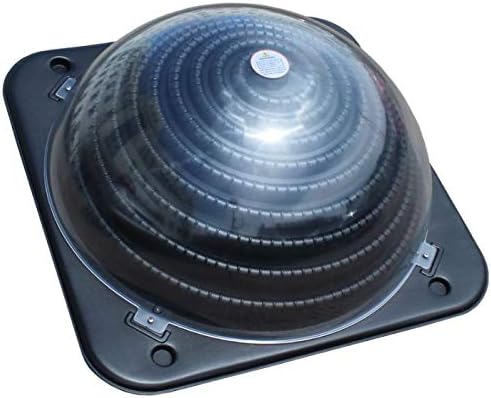
Doheny's Solar Dome Heating System is a compact above-ground pool collector measuring 28 inches long, 28 inches wide, and 12 inches high. It carries a 3.4 rating and uses solar energy to warm circulating pool water, with the listing claiming the dome can raise pool temperature by up to 10 degrees in approximately seven days.
We may earn a commission when you buy through this link, at no additional cost to you.
The dome can be connected with other collectors in series, offering an expandable approach for owners who want to increase collection area. A bypass kit is required when connecting two or more heaters or when working with a pool that has a pump of 1 horsepower or greater. That requirement makes proper hydraulic planning essential.
The listing also covers larger flat-collector configurations, including 2.5-by-20-foot, 5-by-20-foot, and 5-by-10-foot arrangements. These collector options can be mounted on plywood or on a roof, although a roof or rack mounting kit is required and PVC or flexible pipes are not included.
This dome is best for an above-ground pool owner who values a small, scalable system and is willing to add a bypass when expanding. It is less convenient than a complete kit because plumbing and optional mounting components must be considered. The relatively low rating also supports comparing several options before making a final choice.
Its principal advantage is flexibility: a single compact dome can serve as a starting point, while the listing supports series installation for greater output. As with the other Doheny's options, the system performs best when collectors face the sun and the circulation loop is properly balanced.
The dome's compact dimensions make it practical for above-ground pools with limited space. When more heat is needed, the listing supports connecting multiple collectors in series.
A bypass is required for two or more heaters and for pumps of 1 horsepower or greater. This allows the installer to manage flow and isolate the solar circuit as the system expands.
We may earn a commission when you buy through this link, at no additional cost to you.
The Thirty-Tube Water Heater Pool Collector uses evacuated glass vacuum tubes and carries the lowest numerical rating in the group at 2.9. Its three-target copper and aluminum absorber construction is listed with 93-96% sun absorption efficiency, giving it a technically distinct approach compared with the black polymer collectors in this roundup.
We may earn a commission when you buy through this link, at no additional cost to you.
The tubes measure 58 millimeters in diameter and 1,800 millimeters long and use high-boron silicon glass. A 316L stainless steel inner manifold is specified for resistance to corrosion in chlorinated water. One-inch male NPT inlet and outlet ports provide defined plumbing interfaces, and the tubes can be disassembled for individual maintenance or replacement.
Hail resistance of up to one inch and a four-PSI maximum operating pressure are stated. The very low pressure limit demands careful attention to pump head, valves, fittings, and any restriction in the circulation loop. A high-capacity pump without proper pressure control could create operating problems rather than improve the installation.
This collector is best for a technically experienced DIY builder who understands vacuum-tube solar systems and can maintain pressure well below the maximum. It is less attractive for a simple garden-hose hookup or a pool with a high-head pump. Its 2.9 rating also warrants careful investigation of current customer feedback and the seller's support terms.
The product listing gives a lifespan figure expressed as 70% performance after more than 15 years, which is different from a simple warranty statement. The strong absorption claim and stainless manifold are attractive, but installation discipline is essential. Confirm pool chemistry compatibility, flow, pressure, freeze protection, and local code requirements before selecting this design.
Evacuated tubes reduce convective losses compared with an exposed absorber and use an internal aluminum target for solar transfer. The listing specifies three target layers and a 93-96% absorption range.
The maximum operating pressure is only four PSI. Plumbing, valves, pump head, and restrictions must be selected and monitored so the collector remains within its stated pressure limit.
We may earn a commission when you buy through this link, at no additional cost to you.
The most effective solar pool heater is not simply the largest collector available. Pool size, expected seasonal demand, pump performance, roof or ground constraints, and installation skill all determine whether a system will work well and remain maintainable.
A larger pool generally needs more collection area because it contains more water that must be warmed. Doheny's sizing chart illustrates this relationship by assigning 40,000, 80,000, or 120,000 BTU collector options to common round and oval pool dimensions. A small pool may be adequately served by one compact panel, while a large pool may need multiple collectors or a broader permanent array.
Consider not only pool dimensions but also local weather, starting temperatures, shading, and how early or late you want to extend the season. Coverage in square feet is useful for comparing layouts, but it does not guarantee a particular temperature increase. Correct sizing improves the chance that the pool receives enough solar energy to remain comfortable.
Solar heating requires continuous circulation. The Goplus listing requires a pump of at least 0.75 horsepower and pressure below 1.5 bar, while the 30-tube collector has a much lower four-PSI maximum operating pressure. Other systems rely on clamps, PVC, or flexible hoses, so connector size and routing must be planned before mounting anything.
Inspect the filter, pump, valves, and existing plumbing for restrictions and confirm that the complete solar loop will not starve the filter or create excessive backpressure. Larger pools often need more than one parallel or series-connected collector, but parallel plumbing is generally useful when equal flow through each panel is the goal. Follow manufacturer plumbing diagrams and local safety requirements.
Heat transfer depends on water moving through the collector. SwimEasy emphasizes a manifold molded around the absorber tubes, while SwimJoy highlights an open-flow design, low-head-loss risers, and reduced backpressure. A collector that is cheap or large but poorly matched to the pump may deliver disappointing results.
Look for clear flow-path descriptions, compatible connection methods, and guidance on pipe sizing. Avoid restrictive elbows and unnecessary adapters, and secure hoses so they do not kink. When a system permits multiple collectors, use the recommended arrangement so every panel receives adequate circulation. Correct flow is one of the most important controllable installation factors.
The ideal collector location receives direct sunlight, faces the appropriate direction, and remains stable without obstructing the pool area. Roof mounting saves ground space but introduces safety and leak concerns. Ground or plywood mounting is easier to service, while portable adjustable panels can be repositioned through the season.
Consider access for cleaning, the height of the plumbing, wind exposure, roof material, drainage, and whether a bypass is available. The SwimJoy system emphasizes strapless mounting, whereas Doheny's flat collectors require a separate roof or rack kit. A mounting method should be secure, compatible with the structure, and safe for the installer to maintain.
Pool-side equipment is exposed to ultraviolet radiation, heat, wind, moisture, and seasonal temperature changes. Several products use UV-stabilized materials, while the Goplus panel is made from polyethylene advertised for broad temperature tolerance. The vacuum-tube model uses a stainless steel manifold for chlorinated-water resistance and glass tubes for solar collection.
Material claims should be evaluated together with the construction method. One-piece molded headers and integrated risers can reduce potential seam failures, while clamp-based connections can eliminate routine rubber-hose maintenance. Confirm the stated operating temperature range, corrosion resistance, hail or wind provisions, and whether the local climate exceeds the product's recommended conditions.
The difference between a panel and a complete kit can be substantial. The SwimEasy kit includes mounting, linking, tie-down, and supply-and-return components, while the Goplus and vidaXL products include connection accessories. Doheny's systems may require separate mounting hardware, pipes, and valves.
Make a list of every required item before ordering: panels, headers, clamps, hoses, adapters, elbows, end caps, bypass components, diverter valves, fasteners, supports, and plumbing tools. A complete package is convenient, but even included hardware may not cover the exact pipe sizes or configuration in your pool area. Account for both the purchase and the labor required to install it.
Some systems are essentially ground-level panels connected with hoses, while others require roof attachment, rigid PVC, pressure-aware plumbing, and a bypass. The most advanced design is not automatically the easiest or most reliable choice. The best DIY system is one you can safely plumb, support, inspect, and winterize according to its instructions.
Vacuum-tube systems require particularly careful attention to pressure and assembly. Clamp-based systems reduce connection maintenance but still need visual inspections. Flexible or roll-up panels are portable but need protection from punctures, kinks, and wind. Review the supplied manual, watch applicable installation guidance, and enlist qualified help for roof access or electrical work near the filtration equipment.
Solar heating is most useful during sunny stretches when the air is warmer than the pool water. A bypass or diverter can help direct flow through the collector when conditions favor solar heating and route water elsewhere when they do not. A cover helps retain warmth after the sun goes down, while insulation can preserve the temperature gained during the day.
Before purchase, plan how you will drain or protect exposed lines during cold weather. Look for a valve arrangement that allows the collector to be isolated without dismantling the main pool plumbing. Seasonal maintenance, panel cleaning, connection checks, and cover management can influence results as much as the nominal collector rating.
Begin by confirming that the pool pump, filter, valves, and pipes can support the required flow and pressure. Follow the collector manufacturer's plumbing diagram, use compatible fittings, and install any required bypass or diverter before connecting the solar loop. Test the circulation with the pool operating and inspect every joint for leaks, kinks, restriction, and abnormal vibration.
Position the collectors in direct sunlight and at the recommended angle, then secure the supports or roof attachments without obstructing drainage. Run the pump and verify that water moves evenly through each panel. When conditions are favorable, use the diverter or bypass to send water through the solar circuit; when clouds, rain, cold weather, or pump concerns intervene, isolate the collector as directed.
Clean the collectors periodically, remove debris, inspect clamps and hoses, and tighten or replace damaged components according to the manual. Keep the system protected during freezing conditions, and follow all local plumbing, roof-access, and equipment instructions. A pool cover and good baseline insulation can preserve the heat collected during sunny periods and extend the benefit of the solar system.
The increase depends on sunlight, starting temperature, pool volume, collector area, flow, weather, and cover use. Individual listings make claims ranging from about five degrees to more than ten degrees, but these are not guarantees. A correctly sized and well-directed system can meaningfully extend the season, especially when the pool is covered after swimming.
Many systems use the existing pool pump to circulate water through the collectors, so a separate pump is not always necessary. The pump must provide sufficient flow while staying within any pressure limit specified for the collector. For example, the 30-tube vacuum-tube option lists a four-PSI maximum, while the Goplus option requires at least 0.75 horsepower and pressure below 1.5 bar.
A roof offers good sun exposure and saves ground space, but it adds structural, leak, and access considerations. Ground, plywood, rack, or portable installations can be easier to service and may be better for temporary setups. Choose the location based on sunlight, safe access, stable support, plumbing distance, local requirements, and the mounting method supplied with the system.
Yes. Several products in this guide are specifically intended for aboveground pools, including the Goplus, vidaXL, Doheny's collector, Doheny's dome, and FAFCO Solar Cub products. The system must have a suitable circulation pump, secure collector support, and compatible plumbing. Pool size should also determine whether one panel is adequate or multiple collectors are needed.
A bypass gives the installer control over how water moves through the solar circuit. It may allow the collector to be isolated during cold conditions, unfavorable weather, maintenance, or a pump problem. Several listings require a bypass for inground pools, larger pumps, or systems with multiple collectors, so it should be planned before panel installation.
Follow the manufacturer's cold-weather procedure, which may include draining exposed collector lines, isolating the circuit, or protecting it with a bypass arrangement. Do not assume the pool pump can safely circulate water during freezing conditions. Secure all drain points, protect valves and fittings, and use an appropriate cover to reduce heat loss and inspect the installation after severe weather.
They can still collect some energy, but output is much lower than in direct sunlight. Cloudy conditions are one reason to use a diverter and avoid expecting the same temperature increase. Solar heating works best as a complement to a pool cover and sensible water-temperature management rather than as a constant, guaranteed source of heat.
Use the connection method specified by the manufacturer, which may involve patented clamps, PVC fittings, hoses, or a series arrangement. Parallel plumbing can help maintain similar flow through each panel, while the manufacturer's diagram may require a specific series configuration. Confirm pipe dimensions, flow requirements, and bypass requirements before joining multiple units.
The SwimEasy complete kit is the best overall choice because it combines a high 4.7 rating, a carefully molded flow design, long stated service life, included installation components, and expert support. SwimJoy is the best premium option for permanent roof installations that prioritize strapless mounting and low-maintenance clamped connections, while the Goplus roll-up system is the best budget pick for flexible, accessible use with aboveground or inground pools.
Before choosing, prioritize collector area relative to pool volume, pump flow and pressure compatibility, safe mounting, and access to the system for maintenance. A smaller system with suitable plumbing and excellent sun exposure may serve a household better than an oversized collector with restrictive connections. Aboveground pool owners should also consider expandable configurations, while more advanced vacuum-tube systems require greater technical confidence.
Finally, verify the current price, package contents, dimensions, ratings, warranty terms, and installation instructions at the time of purchase because availability and specifications can change. Use the reviews as a comparison tool, but treat the manufacturer's current manual as the final authority for safe installation and operation.