
5 Pack LM2596 DC to DC Buck Converter
4.5Editor score
Five adjustable converter modules
3V–40V input range
Up to 92% conversion efficiency
Terminal-ready DIY design
Our DC Step Down Voltage Converter guide compares 10 models for voltage range, current capacity, efficiency, protection, displays, and installation needs.
A DC step down voltage converter reduces a higher DC voltage to a lower voltage suitable for 12V equipment, electronics, lighting, audio, or vehicle accessories. The right model must match your source voltage, expected load, wiring, enclosure, and environmental conditions rather than simply offering the largest advertised wattage.
The products in this guide were compared using their stated input ranges, output ratings, efficiency, protection features, display capabilities, installation methods, and intended applications. The list covers waterproof vehicle-rated units, fixed 12V converters, adjustable modules, multi-packs, and higher-power models with monitoring or active cooling.
Each review explains where the converter is strongest, where its specifications require careful attention, and the projects it best suits. Ratings reflect published customer feedback, while technical claims come from the supplied product information; availability, configurations, and prices can change, so verify current listing details before purchasing.
4.5Editor score
4.5Editor score

4.3Editor score
This side-by-side comparison highlights each converter's input range, output flexibility, rated power, monitoring features, and physical design, making it easier to identify the right model for a specific electrical system.




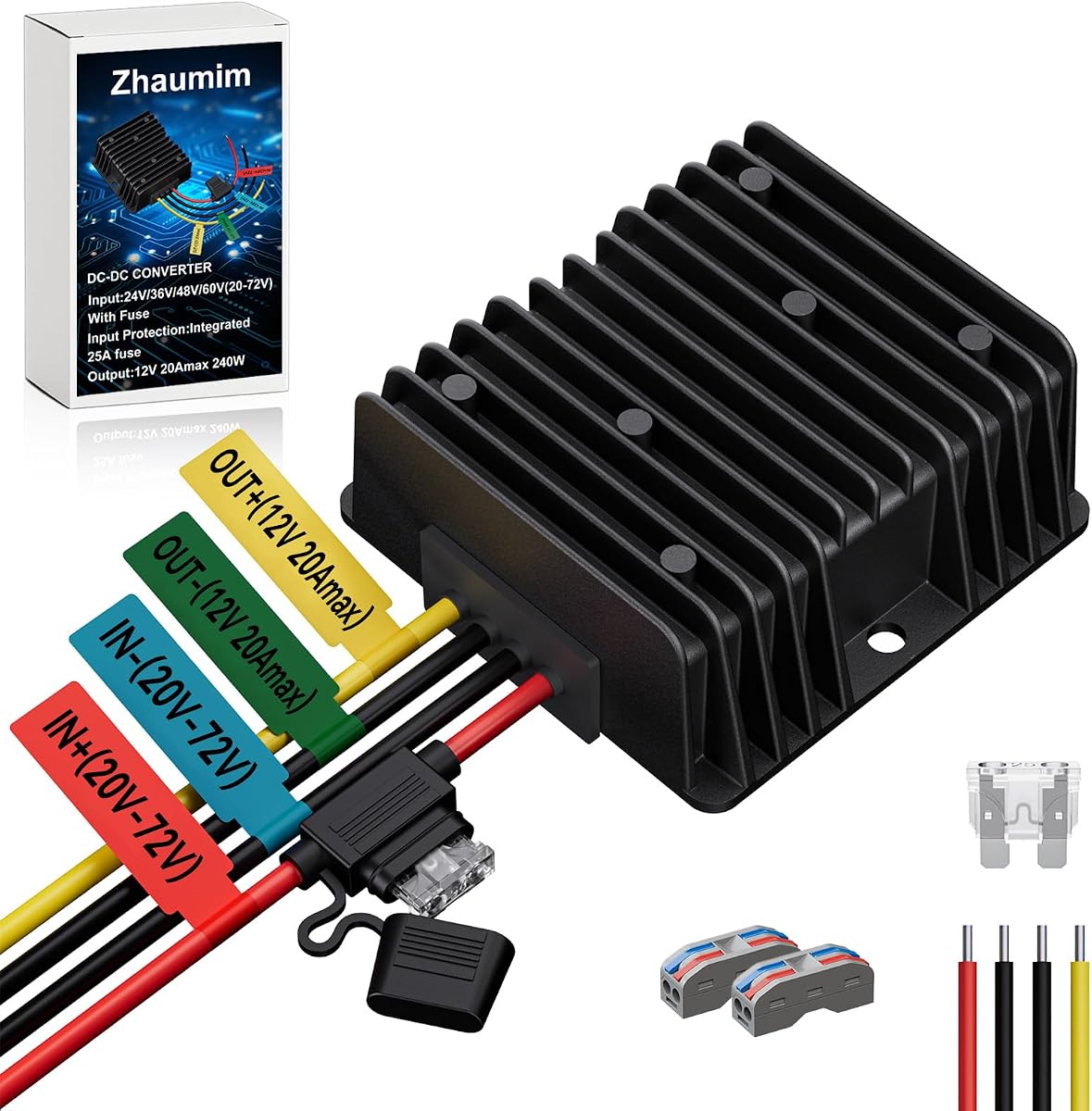
This is the strongest all-around choice in the guide for users who need a dependable fixed 12V supply from a higher-voltage battery system. It is rated for 20A and 240W, accepts a broad 20–72V DC input range, and has a 4.5 customer rating. Its combination of sealed construction, a built-in fuse, and broad protection coverage makes it particularly relevant to golf carts, RVs, scooters, forklifts, and outdoor electrical installations.
We may earn a commission when you buy through this link, at no additional cost to you.
The main advantage is the balance between operating range and installation simplicity. Unlike an adjustable bench-style module, this converter provides a stable 12V output, which is useful when powering multiple 12V accessories that are not designed for voltage adjustment. The die-cast aluminum case, silicone potting, and IP68 rating support heat dissipation and resistance to water, dust, moisture, and shock. Stated peak efficiency of 96% also indicates a relatively efficient design for a converter handling substantial power.
There are trade-offs, beginning with the fact that a fixed 12V unit cannot accommodate equipment requiring another output voltage. Its 240W capacity may also be more than a small lighting or audio installation needs, while larger loads could demand careful attention to wire gauge, fusing, and source capacity. The product information also combines several application examples, so buyers should confirm that their actual input voltage, current draw, and wiring environment fit the stated limits.
Choose this converter when you want a robust, ready-oriented 12V system rather than an adjustable hobby module. It is particularly compelling for mobile or exposed installations where moisture resistance and a broad input range matter. For modest electronics projects, one of the LM2596 modules may be more economical and easier to adjust; for active monitoring or very high power, the premium DROK CNC model offers more control.
The wide 20–72V input range accommodates many common 24V, 36V, 48V, and 60V systems, while the IP68 enclosure suits exposed battery compartments. Its robust construction makes it a practical choice for mobile accessories and solar-related 12V loads.
A built-in input fuse and protections against over-current, overload, over-voltage, under-voltage, temperature extremes, and short circuits provide multiple layers of control. None eliminates the need for correct installation, but the feature set supports safer integration into a larger electrical system.
We may earn a commission when you buy through this link, at no additional cost to you.
The DC House converter delivers the same practical combination of high current and a fixed 12V output while emphasizing a compact, connector-based installation. It supports a 20–60V DC input range, provides up to 20A or 240W, and carries a 4.4 rating. It is a natural fit for 24V, 36V, and 48V systems feeding 12V lights, audio, monitoring equipment, motors, or other utility-vehicle accessories.
We may earn a commission when you buy through this link, at no additional cost to you.
Its installation story is notably straightforward. The product information describes a four-wire, plug-and-play connector arrangement, reducing the need to design and terminate custom connections. The die-cast aluminum housing is also said to be IP68 waterproof, dustproof, and shockproof, making the converter more appropriate for tight compartments and harsh conditions than an exposed open-frame module. Up to 95% stated conversion efficiency helps limit waste and heat.
The missing display is not a major limitation for a fixed-output converter, especially if the source system is stable. However, users who need to verify output voltage or current under load will not receive that information from an integrated meter. It also cannot supply 5V, 24V, or another adjustable level, and the 240W ceiling means the entire connected load must remain within the converter's current and thermal limits.
This model is best for installers who value ready-made connections and sealed construction over real-time monitoring. It works especially well when the required output is known to be 12V and the source falls between 20V and 60V. Choose the first converter if its wider 20–72V input range or listed fuse is important, or select an adjustable module when output flexibility matters more than rugged fixed-output performance.
The supplied connector approach is valuable in vehicles and field installations where soldering or fabricating specialized terminals would be inconvenient. It also makes the converter easier to remove for inspection or replacement.
The die-cast enclosure and IP68 rating support use in battery compartments and exposed areas. Its stated efficiency of up to 95% also helps reduce heat when operating near its rated output.
We may earn a commission when you buy through this link, at no additional cost to you.
This 120W converter offers a middle ground between compact adjustable modules and 240W vehicle converters. It accepts 16–58V DC, including many 18V, 20V, 24V, 36V, and 48V sources, and supplies a fixed 12V output up to 10A. Its 4.5 rating and IP68 aluminum construction make it appealing for golf-cart accessories, LED products, surveillance systems, and other moderate 12V loads.
We may earn a commission when you buy through this link, at no additional cost to you.
The waterproof and dustproof enclosure is a key benefit for installations exposed to rain, moisture, dust, vibration, or shock. The aluminum shell and silicone potting are also intended to improve heat dissipation and durability. Protection against undervoltage, overload, low load, short circuits, and overheating gives the module a more comprehensive safety profile than many inexpensive open-frame alternatives.
The important limitation is its 10A rating. A collection of lights, a small audio system, fans, and several accessories can collectively exceed that limit, even when each individual device appears modest. The fixed 12V output also prevents reuse with non-12V electronics. Because the product title describes a broad range of applications, installers should size the entire load and account for startup surges rather than judging it by one accessory alone.
This converter is a good selection for a smaller golf cart or compact vehicle system that needs a protected 12V accessory circuit. It may be preferable to a 20A model when lower draw, smaller size, and cost efficiency matter. For more than 120W, multiple independent circuits, or real-time electrical readings, move up to a higher-capacity model.
At up to 10A and 120W, the converter is sized for a meaningful group of 12V accessories without the footprint and heat demands of the 20A options. It is best treated as a system limit rather than a per-device allowance.
Silicone potting, an aluminum shell, and an IP68 rating improve suitability for outdoor and mobile use. These physical protections are especially relevant in carts, surveillance installations, and other exposed systems.
We may earn a commission when you buy through this link, at no additional cost to you.
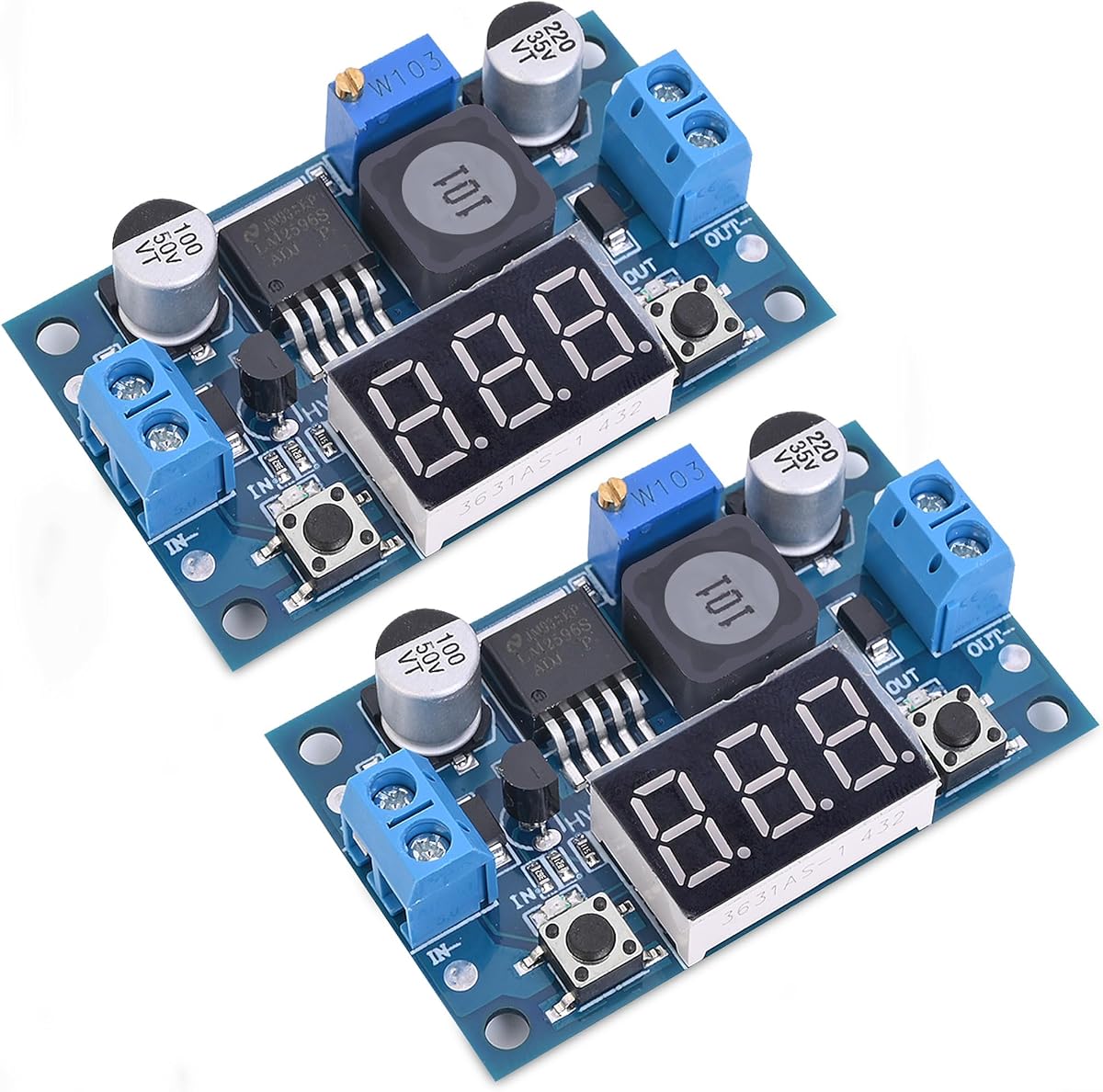
This two-pack of LM2596 modules is the most approachable option for electronics builders who need adjustable output in an inexpensive, recognizable format. Each module accepts 4–40V and can be adjusted from 1.25–37V. The pair has a 4.6 customer rating, and the integrated LED voltmeter is a meaningful convenience for a module in this category.
We may earn a commission when you buy through this link, at no additional cost to you.
The display provides a stated measurement error of ±0.1V and can be switched off by holding its button for more than one but less than four seconds. A short press restores it. Terminal blocks eliminate the need to solder basic connections, while a small screwdriver or similar tool permits output adjustment. The product information also mentions two input-protection diodes, overheat protection, and short-circuit protection.
Its open-module construction is the central compromise. It does not offer the IP68 sealing found in the vehicle-focused converters, so it should be kept away from moisture, dust, and conductive debris. The source specifically advises improved heat dissipation for power above 15W. That makes it appropriate for prototyping and low-to-moderate loads, but not automatically for a fully sealed automotive or outdoor installation.
This is an excellent budget pick for students, hobbyists, technicians, and makers working on car power supplies, bench projects, or custom electronics. The two-module pack also allows separate circuits without buying two single units. For a permanently exposed, high-current application, select a higher-rated sealed converter instead of relying on the open LM2596 design.
The LED voltmeter removes much of the guesswork from setting an adjustable output. Its stated ±0.1V measurement error is useful for checking a setting, although the display does not measure current or power.
Terminal blocks make the modules approachable for newcomers and convenient for repeated bench work. Output can be tuned with a small screwdriver, reducing the need for soldering or replacing fixed-voltage converters.
We may earn a commission when you buy through this link, at no additional cost to you.
The five-module LM2596 pack is ideal when one project will not occupy the available space. Each board accepts 3–40V DC and provides an adjustable output from 1.25–35V, giving it broad usefulness for power banks, monitors, communications equipment, solar-related builds, and general electronics. The product has a 4.5 customer rating and a stated efficiency of up to 92%.
We may earn a commission when you buy through this link, at no additional cost to you.
The multi-turn potentiometer provides finer voltage adjustment than a simple one-turn control, which is helpful when a load requires a precise level. SANYO solid capacitors, a 36-micrometer-thick PCB, and high-Q inductors are listed as construction features, while an LED output indicator provides basic operating feedback. Thermal shutdown and current limiting add useful safeguards for experimental work.
These are open modules without a display or sealed case. Each needs a suitable enclosure if used where moisture, dust, accidental contact, or conductive debris could be present. The input must also remain at least 1.5V above the selected output because the unit cannot boost voltage. As with other adjustable modules, heat management and accurate load sizing remain the installer's responsibility.
Choose this pack for workshops, classrooms, multiple low-power circuits, or builders who want spare modules available. Its value is strongest when all five boards will be used. If you need only one project, a two-module pack with a voltmeter may be more convenient; if the converter must survive weather or vibration, a sealed fixed-output model is the better choice.
Five modules can serve separate loads, prototype alternatives, or replacement stock. This is especially useful for educators and makers who prefer to experiment with several output settings without repeatedly buying individual boards.
A multi-turn potentiometer makes it easier to settle on a stable output level. Combined with the broad input range, that flexibility supports many low-power automotive, solar, and DIY configurations.
We may earn a commission when you buy through this link, at no additional cost to you.
This DROK module is designed for users who want more visibility and control than a basic LM2596 provides. It accepts 5.3–32V DC, adjusts from 1.2–32V, and displays input voltage, output voltage, current, and power on an LCD. Its customer rating is 4.4, and the feature set is especially useful for solar panels, RVs, battery chargers, LEDs, and experimental vehicle systems.
We may earn a commission when you buy through this link, at no additional cost to you.
The stated continuous output is 8A and 120W. With enhanced heat dissipation, the listing says it can reach 12A and 160W, making thermal design an important part of using the upper end of that range. A heat sink and acrylic enclosure support sustained operation and help limit dust exposure, while the stated display precision is 0.05V for voltage and 0.005A for current.
A notable feature is the adjustable constant-current and constant-voltage behavior, with the current-limit setting controlled by a potentiometer. Reverse connection, short circuit, and over-current protection help reduce damage from wiring mistakes. The LCD and buttons add complexity compared with a simple fixed converter, so users should set the intended values carefully and verify them with an appropriate meter when precision matters.
Choose this model for a controlled installation where live measurements are valuable. It is a strong middle ground between inexpensive hobby modules and the fully featured 1,200W DROK unit. It suits installers who want adjustable output and status feedback but do not need a fan-cooled enclosure or the broadest input range.
Showing input voltage, output voltage, current, and power makes troubleshooting much easier than relying on a single indicator light. The stated 0.05V and 0.005A display precision also supports more careful setup.
The adjustable constant-current limit lets the converter act as a more defined protection boundary for a connected device. Setting it thoughtfully can help prevent excessive draw, although users should still verify the actual load behavior.
We may earn a commission when you buy through this link, at no additional cost to you.
The DROK CNC converter is the most capable premium unit in this roundup, combining a 6–70V input range with an adjustable 0–60V output and a stated maximum of 20A or 1,200W. It can be set to common fixed levels including 5V, 9V, 12V, 24V, 36V, 48V, and 60V. Its 4.3 rating is the lowest among the top selections, but its specifications target demanding, feature-conscious installations.
We may earn a commission when you buy through this link, at no additional cost to you.
The color LCD provides a clear view of operating status, and the large heat sink with a temperature-controlled cooling fan addresses a central challenge at high power: moving heat away from the electronics. Low-ripple output is another important feature for sensitive loads. The product information also lists a large group of safeguards, including input over- and under-voltage, output over-voltage, over-current, over-power, over-temperature, timeout, over-capacity, and over-energy protection.
This much capacity and complexity come with trade-offs. The unit is more elaborate than a fixed 12V converter, and it may be excessive for a small accessory circuit. The 1,200W figure is a maximum rather than a guarantee for every environment, so continuous-load operation still requires adequate ventilation, source capacity, and wiring. The lower customer rating may reflect the complexity of a feature-rich unit, though customer feedback alone does not reveal the cause.
This converter makes the most sense for advanced users who need substantial power, multiple output choices, and real-time system visibility. It is a compelling option for large RV, workshop, solar, or vehicle projects where active cooling and detailed protections justify the additional complexity. For straightforward 12V accessory power, the first and second models are simpler and more purpose-built.
A 1,200W maximum output and 20A current rating create substantial room for clusters of equipment. The 0–60V output range and selectable standard levels also make the module reusable across projects with different voltage requirements.
A temperature-controlled fan and large heat sink help sustain higher output levels while controlling heat buildup. This cooling system is a meaningful advantage over compact modules that depend entirely on ambient airflow.
We may earn a commission when you buy through this link, at no additional cost to you.
This converter is built for the specific need to produce a rugged 5V supply from virtually any common vehicle battery voltage. Its 11–90V DC input range covers 12V, 24V, 36V, 48V, 60V, and 72V systems, while its fixed output supplies 5V at up to 6A. The 4.8 customer rating is among the highest in the guide.
We may earn a commission when you buy through this link, at no additional cost to you.
The sealed aluminum housing and listed IP68 characteristics make it especially suitable for exposed automotive or outdoor installations. Product protections include over-current, over-temperature, reverse connection, and short-circuit handling, while stated conversion efficiency exceeds 95% at maximum. The result is a compact, purpose-built module for car audio, media devices, navigation equipment, LED displays, fans, and other low-voltage electronics.
Its fixed 5V output is the defining limitation. It cannot power a 12V accessory or be adjusted to another level, and it lacks an integrated display for live readings. The stated 6A rating also means the connected load should remain within that limit, with appropriate attention to inrush behavior and wiring. The broad input range does not mean the converter boosts a low source voltage above the minimum.
Choose this unit when 5V is the exact output you need and the source may come from many different battery systems. It is a particularly attractive option for mobile electronics and rugged installations where moisture and dust are concerns. If you need 12V or adjustable output, use one of the dedicated 12V or LM2596 products instead.
The unusually broad 11–90V input range allows the same module to serve a fleet or a project involving several voltage standards. It is useful for 12V, 24V, 36V, 48V, 60V, and 72V sources when a stable 5V output is required.
Its IP68 construction, aluminum case, and reverse-connection protection suit mobile and outdoor electronics. The fixed 5V output simplifies wiring, although it offers no adjustment for other equipment.
We may earn a commission when you buy through this link, at no additional cost to you.
The EAGWELL converter is a compact, fixed 12V solution for projects that do not need the capacity of a 20A unit. It accepts 8–40V DC, delivers 12V at up to 6A, and has a maximum stated output of 72W. Its 4.8 rating indicates strong published customer satisfaction and makes it a compelling small-to-medium-load option.
We may earn a commission when you buy through this link, at no additional cost to you.
Its aluminum shell and organic silicone sealing provide an IP68 waterproof, dustproof, moisture-proof, and shockproof design. Protection includes overload, over-current, over-temperature, short-circuit, and over-voltage handling. The stated use cases include robots, pumps, CNC equipment, motors, and printers, where a sealed converter can be valuable around moving machinery or in a less protected workshop environment.
The 72W output ceiling is the key constraint. Even a handful of high-draw accessories, a small motor, or several lighting circuits may approach or exceed that limit. Because the output is fixed, it also cannot be used for 5V electronics or another required voltage. There is no integrated meter, so users who need to see real-time output values should use separate instrumentation.
This converter suits compact installations, automation equipment, and accessory circuits with moderate draw. It is a better fit than a 120W model when the load is modest and physical size matters, but it is not a substitute for higher-output alternatives. Verify startup current for motors and pumps before installation, because continuous capacity alone does not capture startup demand.
At 6A and 72W, the converter is sized for smaller accessories and control equipment without the bulk of a high-current unit. It works well when a known group of loads stays comfortably below the rating.
Silicone sealing and an aluminum shell make the module suitable for robots, printers, pumps, and workshop machinery. The protection features help manage common electrical faults in active equipment environments.
We may earn a commission when you buy through this link, at no additional cost to you.
This converter is a high-output, fixed 5V option with a 4.7 customer rating. It accepts 8–40V DC and turns an unstable source into a stated stable 5V output at up to 15A. That combination makes it relevant to automotive electronics, car audio, surveillance equipment, LED products, railway signals, instruments, and low-power test systems.
We may earn a commission when you buy through this link, at no additional cost to you.
A major selling point is the 15A output rating, which exceeds every other 5V converter in this guide. The broad 8–40V input also supports both conventional 12V and 24V vehicle systems. The module includes automatic protection for over-voltage, over-current, over-temperature, and short circuits, with automatic recovery when conditions return to normal, reducing the need for manual reset after a temporary fault.
The lack of a display means users cannot directly monitor voltage or current. The output is fixed at 5V, so the module cannot accommodate 12V accessories or projects requiring another level. It also does not have the sealed enclosure or environmental rating of the fixed-output vehicle converters in this roundup, making installation environment an important consideration.
Choose this model for a 5V system that needs substantially more current than the 6A waterproof option can provide. It is a particularly good match for 24V vehicles that need a dependable 5V accessory rail. For adjustable output, choose an LM2596 module; for exposed outdoor use, confirm that the installation will be suitably protected.
The 15A rating provides useful headroom for demanding 5V electronics and grouped accessory circuits. It is a better choice than a lower-current 5V unit when several devices may operate together.
Automatic recovery can restore operation after a temporary overload, over-temperature condition, or other protected fault clears. This is convenient in vehicle and monitoring systems where manual reset would be inconvenient.
We may earn a commission when you buy through this link, at no additional cost to you.
A useful converter is defined by more than its headline wattage. Input range, output stability, thermal design, protection, wiring method, and environmental exposure all determine whether it can safely and reliably power the intended equipment.
Begin with the voltage of the source battery or power supply and its possible variation. A converter rated for 20–72V can accommodate many 24V, 36V, 48V, and 60V systems, while the 11–90V waterproof 5V unit offers even broader coverage. The 3–40V LM2596 modules and 8–40V converters are better suited to lower source voltages. Verify both the minimum and maximum input, and remember that a step-down converter cannot raise a source below its required operating level.
Decide whether the load requires a fixed output or an adjustable one. Fixed 12V and 5V models are simpler and less likely to be misconfigured, while LM2596 and DROK adjustable modules can produce voltages suited to experimental circuits. Adjustable units require calibration and correct input-to-output headroom; the five-pack LM2596 specifically states that input voltage must be at least 1.5V higher than output. For multiple accessories, a fixed 12V converter may ultimately be easier to manage.
Calculate the combined current draw of every device, then add reasonable headroom for startup surges and future additions. The selections range from the 6A EAGWELL unit to 20A models rated for 240W or 1,200W. Do not infer continuous capacity merely from a maximum figure: motor-based loads, converters with enhanced cooling, and modules with stated heat-management requirements may have different sustained limits. A converter selected for continuous operation should have ample margin above the normal load.
Efficiency determines how much input power becomes heat. The featured fixed-output converters claim peak efficiency between 95% and 96%, while the five-pack LM2596 is listed up to 92% and the larger DROK modules emphasize cooling. Heat is a function of power loss and load, not efficiency alone. Open modules may need an enclosure, airflow, or additional heat sinking, and the product information for the LED-display LM2596 pair specifically recommends improved heat dissipation above 15W.
An IP68 rating indicates a design intended to resist dust and water under the stated test conditions, but it does not mean the converter is immune to every environment. The 20A, DC House, 10A golf-cart, 6A EAGWELL, and waterproof 5V DROK models offer sealed construction. Open LM2596 boards are better for dry, protected enclosures. For roadside, marine-adjacent, or industrial use, consider corrosion, condensation, vibration, and the availability of sealed cable connections alongside the stated rating.
Look for protections that correspond to realistic installation risks. Short-circuit, over-current, over-voltage, under-voltage, reverse-connection, and thermal protection are valuable in vehicle and battery-powered systems. The DROK CNC model has the broadest listed protection suite, while the 5V 15A converter emphasizes automatic recovery. Protection is a safeguard rather than a substitute for correct fusing, polarity checks, adequate wire gauge, and sound source protection.
A display can make setup and troubleshooting much faster. The LED-display LM2596 pair shows voltage with a stated error of ±0.1V, the DROK LCD module reports input voltage, output voltage, current, and power, and the CNC converter adds a color status screen. These are particularly useful for adjustable projects. Fixed-output models are simpler and often less expensive, but external meters may be needed if live operating data is important.
Consider how the converter will be mounted and connected. The DC House model uses a four-wire connector arrangement, and the LED-display LM2596 pair includes terminal blocks for tool-free connections. Sealed automotive models may use permanent wiring that requires careful strain relief and insulation. Open modules usually need a separate enclosure, and all installations need ventilation appropriate to the load. A compact footprint can be decisive in a crowded battery compartment, but it should not come at the expense of cooling.
Before installation, identify the source voltage range, required output voltage, total current draw, and expected operating environment. Confirm that the source can support the converter and connected load, especially during startup. Disconnect power while wiring, observe polarity, use appropriately sized wire, and install any required input fuse close to the source. For adjustable modules, set the output with the load disconnected and verify it with a reliable meter before reconnecting the equipment.
Mount the converter where air can circulate as required by its instructions. Open LM2596 boards belong in a nonconductive protective enclosure, while sealed models can be mounted in harsher locations. Avoid placing a hot converter against fuel lines, batteries, combustible surfaces, or heat-sensitive wiring. Secure cables to prevent vibration and abrasion, leave service clearance around heat sinks and fans, and ensure the enclosure's entry points do not compromise the stated environmental protection.
Operate the converter within all stated input, output, current, power, and temperature limits. If output voltage becomes unstable, the enclosure becomes unusually hot, the fan behaves abnormally, or protection repeatedly activates, reduce the load and disconnect the system when appropriate. Periodically inspect wiring, connectors, seals, mounting points, and corrosion. Keep ventilation paths clear, and replace damaged cables or compromised sealed components rather than attempting to defeat the original safeguards.
A conventional step-down converter only reduces the input voltage, so the source must always be higher than the required output. Some adjustable modules specify additional headroom, such as the LM2596 pack's requirement that input be at least 1.5V above output. A boost or buck-boost converter is needed when the input can fall below the desired output.
Add the current draw of every 12V device and include enough margin for startup surges and future loads. A 6A converter can handle a group of small accessories, while a 10A or 20A model suits more substantial equipment. Check both the converter's current rating and its continuous wattage, and never use the maximum output claim as a target load.
A converter with an IP68 rating is designed to resist dust and water under specified test conditions, but installation quality still matters. Cable entries, connectors, mounting damage, and condensation can undermine enclosure protection. For exposed systems, follow the manufacturer's instructions and consider adding a drip loop, secure strain relief, and an additional covered enclosure.
A fixed converter is simpler and better for a known 12V or 5V accessory circuit. An adjustable module is more useful for electronics, prototypes, and projects involving several output levels. Adjustable units need correct setting and adequate input headroom, while fixed units reduce the risk of accidentally supplying the wrong voltage.
They are not essential for every installation, but they can make setup and troubleshooting much easier. A voltmeter confirms that the output is correct, while an ammeter helps determine actual draw and whether the converter is operating near its limit. Models with integrated displays provide this information more conveniently, although an independent meter remains useful for verification.
Keep the load within the converter's continuous rating, preserve airflow around exposed boards and heat sinks, and provide additional cooling when the manufacturer calls for it. Do not assume a maximum wattage rating applies continuously in every enclosure. Check connections, reduce the load, and improve enclosure ventilation if the converter becomes too hot to touch comfortably.
Yes, provided the combined current and power remain within the converter's ratings and all devices accept the same output voltage. Add allowance for devices with high startup current, such as motors and compressors. If one device fails, it could affect the entire shared circuit, so separate protection may be appropriate for critical or valuable equipment.
A fuse limits current when a wiring fault or short circuit occurs, helping protect wiring and the converter. Use the appropriate fuse rating and placement recommended by the manufacturer, and do not replace a protective fuse with a higher-rated one. Electronic protections inside the module supplement, but do not replace, properly sized circuit protection.
The 20A 240W sealed converter is the strongest overall recommendation for a robust fixed 12V installation, while the five-pack LM2596 modules offer the best budget starting point for adjustable DIY projects. The DROK CNC unit stands out as the premium choice when 1,200W capacity, active cooling, extensive protection, and detailed monitoring justify the added complexity.
Prioritize the match between your source voltage, required output, continuous load, and installation environment. A converter with ample power headroom, suitable protections, effective cooling, and correct wiring is more valuable than one with a larger headline rating but poor fit. Sealed models suit vehicles and exposed systems, while open adjustable modules are best used in protected project enclosures.
Finally, verify the current listing, exact output configuration, connector arrangement, included accessories, and environmental claims before ordering. Ratings, prices, and product availability can change over time, so current product information should guide the final purchase. Match the converter to your complete system rather than choosing solely on wattage or display features.