
galphi 4K Front
4.4Editor score
Screen-free compact design
4K front camera recording
Included 32GB memory card
Our Dash CAM for Teenage Drivers guide compares 10 dual, front-only, and 360-degree models for video quality, parking protection, GPS, night use, and setup.
A dash cam can be especially useful for teenage drivers because it provides an independent record of the road, traffic, and surrounding vehicles. A good model should capture readable details, resist distraction, operate reliably in poor light, and record continuously without making the driver manage files manually.
We compared the included cameras by channel count, resolution, sensor and lens specifications, low-light performance, parking surveillance, GPS availability, wireless transfers, storage support, display design, and installation requirements. The list includes front-only, front-and-rear, three-channel, and 360-degree systems for different vehicle and coverage needs.
Each review explains the strongest reason to consider the camera, along with practical limitations involving power, storage, displays, or installation. The ratings reflect the supplied customer feedback, while product configurations and availability may change as manufacturers update their models.
4.4Editor score

4.5Editor score

4.4Editor score
The comparison below highlights the differences that matter most for a teenage driver: how much of the vehicle is covered, whether the system records inside the cabin, how footage is handled, and which parking or location features are built in.


The ROVE R2-4K Dual is our overall choice for teenage drivers who want a balanced, front-and-rear system without dealing with several separate accessories. It carries a 4.5 rating, and its most persuasive specifications are the Sony STARVIS 2 front sensor, wide apertures, HDR support, built-in GPS, and rapid dual-band wireless transfers. It also includes a 128GB memory card and a three-inch IPS screen for checking recordings and system information.
We may earn a commission when you buy through this link, at no additional cost to you.
The front camera records at 2.5K and then intelligently upscales the image to 4K, while the rear camera records at 1080P. That distinction matters when comparing the ROVE with cameras that capture native 4K. The STARVIS 2 IMX675 sensor, F1.5 front aperture, F1.8 rear aperture, and HDR processing are particularly valuable for evening commutes, tunnels, and dim residential streets. The 5.8GHz and 2.4GHz WiFi combination also makes it easier to retrieve a clip quickly through the ROVE app.
There are a few trade-offs. The advertised 4K front resolution is upscaled rather than native, and parking surveillance requires a hardwire kit that is not included. Its visible screen is useful for setup and status checks, but some drivers who want the least possible windshield obstruction may prefer a screen-free camera. Despite those caveats, the combination of two cameras, GPS, strong low-light hardware, and quick wireless review makes this one of the most complete systems in the roundup.
This is a strong recommendation for a teen whose first priority is dependable front-and-rear evidence. It suits students commuting to school, part-time workers, and families who want a front screen for basic operation without sacrificing rear coverage. The included storage and built-in GPS remove several common setup obstacles, while the app simplifies downloading and route review. Among the choices here, it offers the most versatile combination for everyday driving.
Recording ahead and behind gives a teenage driver context after a sudden stop, parking dispute, or low-speed collision. The rear camera is especially useful when another vehicle approaches from behind or when the driver needs evidence about a situation that is not visible from the windshield alone.
Dual-band WiFi and app-based downloads reduce the inconvenience of moving incident footage to a phone. Built-in GPS adds location, speed, route, and compass information, allowing relevant trips to be reviewed more easily than an unlabelled collection of clips.
We may earn a commission when you buy through this link, at no additional cost to you.
The galphi 4K Front is the budget-minded pick in this guide, offering native 4K UHD recording in a compact, screen-free body. It has a 4.4 rating and is aimed at drivers who want straightforward evidence collection without a distracting display. The included 32GB card, 160-degree lens, 5GHz WiFi, F1.6 aperture, and WDR form a useful feature set for everyday commutes.
We may earn a commission when you buy through this link, at no additional cost to you.
Its lack of a screen is arguably an advantage for a teenage driver because it reduces visual clutter on the windshield. Video can be reviewed through the companion app, with transfer speeds stated at up to 8 MB/s over 5GHz WiFi. Automatic loop recording keeps the system running, and the G-sensor locks footage associated with sudden movement or a collision. The camera also offers night-oriented exposure balancing for rain, snow, and low-light conditions.
The main limitation is obvious: it records only the road ahead and has no rear camera. Parking mode also depends on a separately sold Type-C hardwire kit. Storage capacity is another consideration because 4K video consumes more room, although the system supports cards up to 256GB. A screen-free layout may also be less convenient for a new driver who wants immediate system feedback, but it remains straightforward to use once the app connection is understood.
Choose the galphi when simple installation, minimal windshield obstruction, and a capable front camera matter more than multi-angle coverage. It is a sensible option for a teen driving a shared family vehicle or a first-time driver who primarily needs an unobstructed view of traffic ahead. The included card means the system can be used without immediately buying another memory card, while the app handles downloads and playback.
A screen-free body keeps the camera compact and the windshield visually cleaner. For a new or younger driver, reducing tempting controls near the road can support a more focused cockpit without removing essential recording or incident-lock features.
The F1.6 aperture and WDR work together to balance dark and bright areas. While image quality depends on real-world lighting, the camera is designed for clearer low-light evidence than a basic dashboard recorder.
We may earn a commission when you buy through this link, at no additional cost to you.
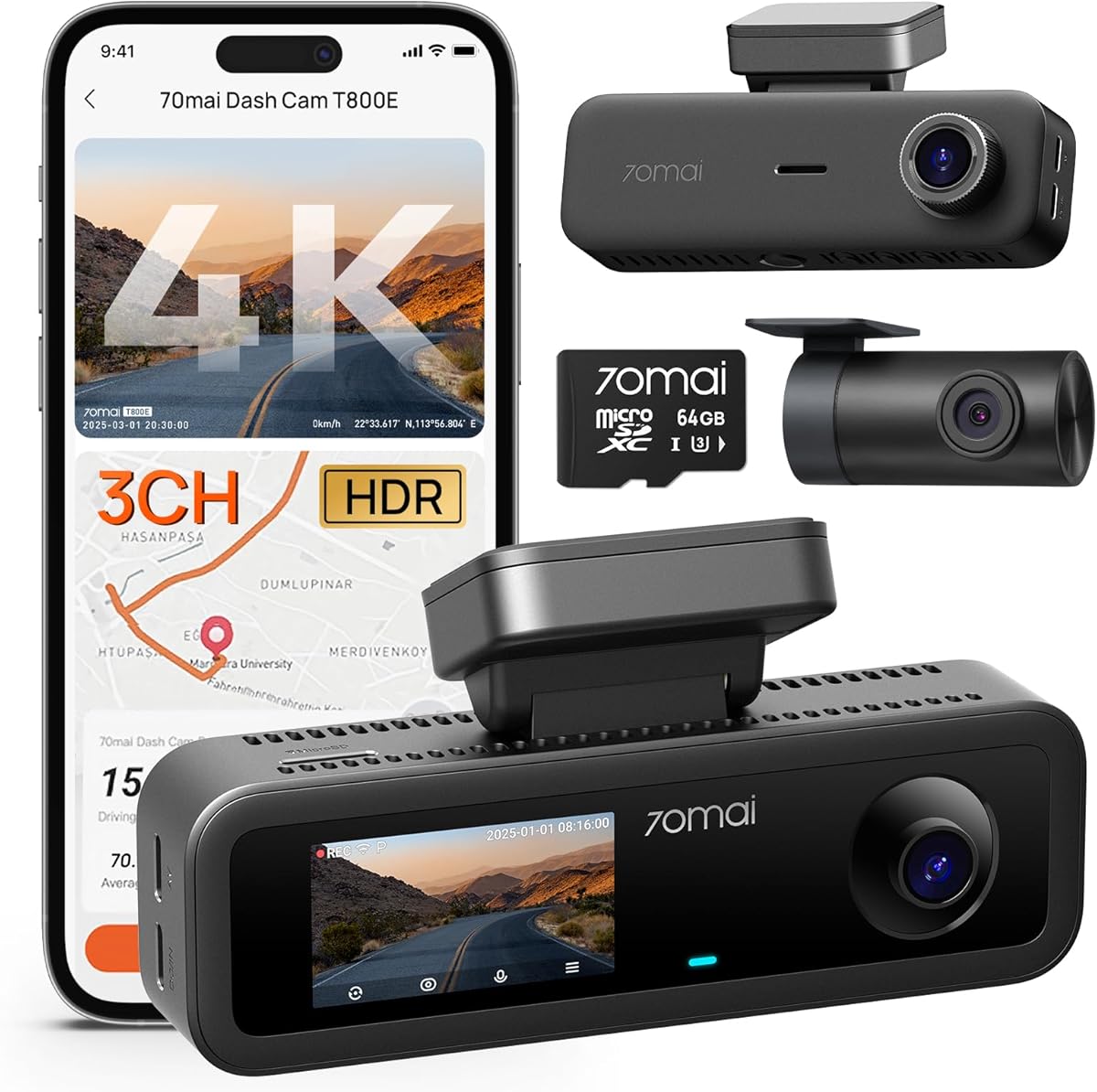
The 70mai T800E is our premium pick because it combines 4K front recording with 1080P rear and interior cameras. It carries a 4.5 rating, and the three-channel layout provides broad coverage without requiring a large multi-camera housing. Built-in GPS, WiFi 6, voice control, parking monitoring, a supercapacitor, and 64GB of included storage make it a particularly comprehensive system.
We may earn a commission when you buy through this link, at no additional cost to you.
Its front, rear, and cabin cameras use ultra-wide lenses, while the front camera has an F1.5 aperture. HDR and 3D noise reduction are designed to improve visibility in low light. The interior camera's switchable infrared is particularly interesting after dark, when it can improve visibility within the cabin. Transfers through the 70mai app are stated at up to 10 MB/s, and the five-mode GPS records location, speed, and route information.
The main extra cost is complexity. This is a three-camera system with more wiring, more mounting decisions, and more storage demands than a compact front-only model. Parking monitoring requires a compatible hardwire kit, and 4K front footage will fill the included card more quickly than lower-resolution video. The 4G limitation noted in the product information also means the system should not be treated as a cellular monitoring service. Despite these considerations, the three viewpoints and cabin IR remain compelling for complete documentation.
The T800E is ideal for a teenage driver who regularly carries passengers, drives at night, or wants evidence from every main direction. It also works well for family vehicles because the rear camera captures following traffic and the cabin camera records the passenger compartment. For buyers who prioritize coverage, connectivity, and night visibility over a minimal installation, this is the strongest all-around premium option in the roundup.
The front camera handles the road ahead, the rear camera records traffic following the vehicle, and the cabin camera captures passenger activity. This arrangement gives a driver more context than a conventional front-and-rear setup without requiring a separate interior camera.
Switchable infrared provides an additional option when the cabin is dark. It can be enabled for clearer interior detail and turned off when it is unnecessary, giving the owner some control over the appearance and use of nighttime recordings.
We may earn a commission when you buy through this link, at no additional cost to you.
The 360 View 4 Channel system is built for drivers who want to monitor the front, rear, left side, and right side of a vehicle at the same time. It has a 4.3 rating and uses four 1080P cameras rather than concentrating all of its recording resolution on one channel. The system also includes a 128GB card, 5GHz WiFi, WDR, night vision, and a supercapacitor.
We may earn a commission when you buy through this link, at no additional cost to you.
Its broad coverage is useful in situations where the driver cannot know where an incident originates. Side cameras can help document a vehicle alongside the car, while the front and rear channels retain the conventional road views. Adjustable front-camera angles provide some flexibility, and the app allows users to download and share recordings. Infrared lights and WDR are intended to improve the system's performance in darkness and rapidly changing light.
The trade-off is that four separate channels generate a significant amount of footage and require a more involved installation. The listed product title mentions GPS, but the supplied details clarify that the GPS logger is a separate accessory. Parking mode likewise requires an optional ACC hardwire kit. As a result, buyers should verify the full contents of the package rather than assuming that every mentioned accessory is included.
This system makes the most sense for a teen who spends substantial time in busy traffic, parking lots, or an unfamiliar vehicle and wants visibility on both sides. It is less attractive for a simple daily-commute camera because front and rear coverage would be sufficient. For drivers who value maximum situational awareness, however, the four-camera approach offers a level of coverage unmatched by most of the dual-camera systems in this list.
Side-facing cameras record events that a conventional front-and-rear dash cam may miss. That wider perspective is helpful near intersections, drive-throughs, parking spaces, and narrow roads where vehicles can approach from either side.
Time-lapse mode compresses 60 minutes of footage into one minute, reducing storage demands during parking surveillance. It provides a broad overview of the vehicle's environment rather than the same continuous detail provided by standard driving recordings.
We may earn a commission when you buy through this link, at no additional cost to you.
The PRUVEEO 4-Channel camera combines four 1080P views with integrated GPS, making it a natural choice for drivers who want both extensive vehicle coverage and route information. Its 4.2 rating reflects a solid overall reception, while the included features cover front, rear, left, right, and interior perspectives. A 128GB card is included, and the system has built-in WiFi for phone-based review.
We may earn a commission when you buy through this link, at no additional cost to you.
The front three cameras can be adjusted, allowing the owner to emphasize a particular side or include more of the cabin. The integrated GPS displays speed, location, and route on a map, which is valuable for reconstructing a journey. An F1.8 cabin lens and four infrared lights support low-light recording, while loop recording and collision locking help preserve relevant footage.
As with other multi-camera systems, the installation requires more attention than a compact front camera. The ACC hardwire kit is sold separately, and constant four-channel capture can consume storage rapidly. A system without an internal battery avoids some heat-related battery concerns, but it also depends on the vehicle's power connection. Owners who dislike visible cabling may need to route the wires carefully along the headliner and trim.
Buy the PRUVEEO if complete vehicle awareness is the priority and the family can accept a more involved setup. Its integrated GPS removes the need for an extra logger, while the four camera angles can be valuable for a teen who spends time in crowded lots or travels in varied traffic conditions. It is less suited to drivers seeking a single simple camera, but the included coverage and route logging create a solid package for comprehensive documentation.
Built-in GPS can associate footage with a route, speed, and location, which makes incident review more informative. This is especially useful when a driver needs to establish where a trip took place or reconstruct the sequence of a longer journey.
Adjusting three of the cameras allows the owner to respond to different vehicle layouts and recording priorities. The result is a more adaptable installation than a fixed four-camera arrangement, provided the mounting positions are planned before the wires are hidden.
We may earn a commission when you buy through this link, at no additional cost to you.
The REDTIGER F7NP is a front-and-rear system for drivers who prioritize native 4K resolution and a capable low-light sensor. Its 4.1 rating is the lowest among this group, but the underlying specifications are strong. The front camera records at 4K with a STARVIS 2 sensor and 170-degree lens, while the rear records at 1080P through a 140-degree lens.
We may earn a commission when you buy through this link, at no additional cost to you.
WDR and HDR help balance bright and dark portions of the scene, and the F1.5 aperture and six-layer lens support nighttime visibility. Built-in 5.8GHz WiFi is specified at up to 20 MB/s, allowing quick app-based access to recordings. The system also includes a memory card, supports seamless loop recording, and uses the G-sensor to lock footage associated with impacts.
The important trade-offs are parking-mode requirements and the need to follow the manufacturer's guidance about original or recommended cables and accessories. A hardwire kit is required for continuous parking surveillance but is not included. The rear camera also requires additional wiring, and 4K files require more storage than standard-resolution recordings. These are meaningful considerations for a first-time dash cam owner, although the core dual-camera package is complete.
The F7NP is a good match for a teen driver who often travels after dark or wants high-resolution front footage. Its wide lenses provide broad road context, and the fast wireless connection makes incident review more convenient. The supercapacitor is also preferable to a traditional lithium battery for a unit expected to remain in a hot vehicle. It is a strong dual-camera option, though the ROVE offers more built-in route features and a larger included card.
The STARVIS 2 sensor, F1.5 aperture, HDR, and WDR work together to improve the camera's response in dim conditions. These features are particularly relevant for school commutes at dawn, winter driving, and nighttime travel on poorly illuminated roads.
The 5.8GHz connection and stated transfer rate can reduce the wait when a driver needs to retrieve a short incident clip. Faster access is useful when a collision needs to be documented promptly or when a parent reviews the trip soon after it occurs.
We may earn a commission when you buy through this link, at no additional cost to you.
The IIWEY N5 is a four-channel system offering front, rear, side, and interior coverage. It has a 4.4 rating, includes a 128GB card, and can record in either 1080P across all four channels or a mixed 2.5K front and 1080P mode. Its 170-degree front and rear lenses and 150-degree side lenses provide a broad view of the vehicle's surroundings.
We may earn a commission when you buy through this link, at no additional cost to you.
The N5 also has a three-inch IPS screen, 5GHz WiFi, automatic loop recording, and G-sensor incident locking. Its supercapacitor is designed to handle temperature extremes without relying on a conventional internal battery. Two parking modes are offered, including a one-frame-per-second time lapse and impact detection that records a ten-second event. A separate hardwire kit is necessary for parking surveillance.
The N5 has a few important restrictions. It does not include GPS, and it must use the original cigarette-lighter charger because USB and Type-C power sources are not supported. The rear camera also needs to be wired to the front unit. WiFi must be activated with the indicated physical button and automatically switches off after five minutes without an app connection, a heat-management measure that may require a short learning period.
This camera is most appealing to a teen whose family wants full vehicle coverage without moving to a premium three-channel model. The included storage and broad angle selection provide a strong foundation, while the 2.5K mode improves front detail. It is less convenient for users who prioritize GPS route data or flexible power options, but for a vehicle that spends time in busy traffic or crowded parking areas, the N5 delivers impressive channel coverage in a complete package.
The ability to record four 1080P channels or prioritize a 2.5K front view lets the owner balance detail against storage use. That makes the N5 adaptable to different driving situations without requiring another camera.
Replacing a lithium battery with a supercapacitor reduces one common source of heat-related concern. The camera is still dependent on continuous power, so a stable charger connection and careful cable routing remain important.
We may earn a commission when you buy through this link, at no additional cost to you.
The Affver A4 delivers 4K recording at the front and an upgraded 2.5K rear view, making it a particularly strong dual-camera specification. It carries a 4.4 rating and includes built-in GPS, WiFi 6, a 3.59-inch IPS screen, and a 64GB memory card. A low-profile housing is intended to reduce its visual effect on the windshield.
We may earn a commission when you buy through this link, at no additional cost to you.
The five-band WiFi 6 setup is specified at transfer speeds of up to 10 MB/s, allowing clips to move to a phone more quickly than many conventional systems. Built-in GPS records speed, route, and real-time coordinates that can be reviewed in the app or a computer-based GPS player. The F1.5 front aperture, six-layer lens, and WDR are designed to improve low-light clarity.
The visible screen is one trade-off for drivers who prefer a completely screen-free setup. A rear camera also means additional wiring and another point of installation, while the included 64GB card will fill more quickly when recording high-resolution video. There is no stated parking mode in the supplied information, so buyers who require continuous surveillance while parked should not assume that capability is present.
The A4 is a strong recommendation for a teenage driver who wants clear front footage, better-than-1080P rear coverage, and useful GPS information without moving to a four-camera system. The extra USB port in the car charger is also useful for keeping a phone charged, although the dash cam should still receive power from the intended connection. Overall, it offers a modern and balanced feature set for school commutes and everyday family driving.
Recording the rear at 2.5K provides a meaningful step up from a basic 1080P rear camera. That extra detail may help when reviewing a following vehicle, a parking incident, or traffic directly behind the vehicle.
Built-in GPS records the trip's path, speed, and coordinates. For parents reviewing a teenage driver's journey or for incident documentation, that context can make individual clips easier to organize and interpret.
We may earn a commission when you buy through this link, at no additional cost to you.
The REDTIGER F7N Touch distinguishes itself with both a touchscreen and voice commands. It has a 4.3 rating, records 4K UHD through the front STARVIS 2 camera and 1080P through the rear, and includes a 128GB card. Built-in GPS and 5.8GHz WiFi further distinguish it from simpler dual-camera designs.
We may earn a commission when you buy through this link, at no additional cost to you.
A 170-degree front lens and 140-degree rear lens provide broad coverage, while WDR and HDR improve the balance between highlights and shadows. Voice commands can reduce the need to handle the camera manually. The touchscreen can lock emergency footage, activate WiFi, or capture a still image, and the app supports preview, downloading, and sharing. Stated wireless transfer speeds reach up to 20 MB/s.
A touch display needs to be used responsibly, especially by a young driver, because interacting with it while the vehicle is moving can create distraction. It is also visually more prominent than a screen-free design. The rear camera requires wiring, and parking monitoring needs a separately purchased hardwire kit. Voice control addresses some of the interaction concern, but the safest practice remains to configure the camera before driving and avoid touching it in motion.
The F7N Touch is well suited to a teen or family member who values convenient controls and quick access to clips. Its front STARVIS 2 sensor, broad lens, 4K recording, and included storage make it a capable all-weather dashboard camera. Those wanting cabin coverage should look to a three-channel model, but for front-and-rear evidence with convenient controls, this REDTIGER is a strong option.
Voice commands are useful for saving a clip or initiating recording without handling the unit. They also complement the touchscreen, giving the driver a choice between physical and spoken control when the camera is configured in advance.
The combination of a 128GB card, rapid 5.8GHz transfers, and built-in GPS helps move important footage from the camera to a phone quickly. Route and speed data can then provide context for the trip that produced the clip.
We may earn a commission when you buy through this link, at no additional cost to you.
The REDTIGER F17 is a three-channel system that records through 4K front, 1080P rear, and 1080P interior cameras. It has a 4.4 rating and uses the STARVIS 2 IMX675 sensor in the front unit, with a 150-degree front lens, 160-degree cabin lens, and 155-degree rear lens. A 64GB card is included, and dual-band WiFi supports fast file transfers.
We may earn a commission when you buy through this link, at no additional cost to you.
The sensor works with HDR and WDR to improve dynamic range and low-light performance. The app can replay all three channels together, while built-in GPS presents real-time route and location data. Its dual recording modes provide useful flexibility: 2.5K front plus rear channels are available, or the interior camera can be turned off to prioritize 4K front and 1080P rear recording.
The main trade-offs are storage and installation complexity. Three channels and 4K resolution will consume the included 64GB card relatively quickly, making larger storage or regular file review important. A parking hardwire kit is also required for time-lapse or collision-detection monitoring. As a three-camera system, it requires more mounting and wiring than a conventional front-and-rear dash cam.
The F17 is an excellent choice for a teenage driver who wants front, rear, and cabin evidence in one system. It is especially useful for night drives, passenger transport, and family vehicles where interior context may matter. Compared with the 70mai T800E, this REDTIGER offers a similar channel concept with a different application interface and recording configuration, making the choice largely a matter of app preferences and installation needs.
The STARVIS 2 front sensor provides the strongest emphasis on road detail, while the F17 can reallocate channels when maximum front resolution matters. That flexibility is useful when the driver values a clearer road view more than continuous cabin coverage.
Playing back the front, rear, and cabin channels together can show how an event unfolded from multiple perspectives. This is especially helpful for conversations about following vehicles, passenger behavior, or events that happen outside the driver's immediate field of view.
We may earn a commission when you buy through this link, at no additional cost to you.
The right dash cam balances recording quality, coverage, distraction control, installation effort, and reliable power. These factors matter more for a teenage driver than headline resolution alone because the system must work consistently every day without creating unnecessary complexity.
A front-only camera is the simplest option and concentrates recording on the road ahead. A front-and-rear system adds evidence of traffic following the vehicle, which can be useful in rear-end or parking situations. Three-channel models add an interior camera for passenger and cabin context, while four-channel systems can record the front, rear, left, and right sides. More cameras do not automatically mean better image quality because processing power and storage capacity must be shared among the channels.
Resolution determines the amount of image information available, but lens quality, sensor sensitivity, aperture, HDR, and WDR also affect clarity. Native 4K front recording offers more detail than an upscaled 4K image, while the STARVIS 2 IMX675 sensor used by several models here is designed for improved low-light performance. Compare the front and rear specifications rather than focusing on a single headline number, because many systems record the front at 4K and the other cameras at 1080P.
Teenagers often commute during darker winter mornings, and ordinary commutes can include tunnels, rain, or unlit suburban roads. Look for F1.5 or F1.6 apertures, modern low-light sensors, WDR or HDR, and infrared illumination for an interior camera. These specifications can improve visibility, but actual performance also depends on the vehicle's windshield, street lighting, motion, and how quickly the footage is reviewed.
A screen-free camera produces a smaller, cleaner dashboard area and can reduce visual distraction for a new driver. A touchscreen is convenient for reviewing warnings, locking clips, and changing settings, but it should only be operated while safely parked. Voice commands can provide a middle ground by allowing selected functions to be performed without touching the camera. Consider the housing size, mounting position, and visibility of controls before installation.
Every serious dash cam relies on loop recording to remain active over time. A G-sensor can automatically lock incident footage so it is not overwritten, and an included card makes setup more convenient. High-resolution and multi-channel recording consume space quickly, so compare the supported card capacity, file format, segment length, and whether footage must be manually deleted. A larger included card can be especially valuable in a three- or four-camera system.
GPS records route, speed, and location information, which can help establish where an incident occurred. WiFi allows the driver or a parent to retrieve and share clips through a phone rather than removing the card. Faster wireless standards and dual-band connections can shorten transfers, especially for 4K clips. Check whether GPS is built in, whether it is an optional logger, and whether the manufacturer's app supports the phone being used.
Parking surveillance typically requires a hardwire kit, and most hardwire kits are sold separately. This installation connects the camera to a constant power source and usually requires careful routing or professional installation. A supercapacitor is preferable to a conventional lithium battery because it is better suited to prolonged heat exposure. For a teenage driver, a stable power connection is essential, and the supplied power adapter may impose specific requirements.
Simple adhesive or suction mounting, clear diagrams, included trim tools, and understandable power instructions matter for a first-time owner. A front-and-rear or multi-camera system requires more cable planning, and concealed wiring can take additional time. Warranty periods and support availability also provide useful reassurance. The supplied ratings reflect customer feedback, but a complete package with clear instructions can make ownership easier for a young driver and the parent helping with setup.
Install the camera while the vehicle is parked, read the included instructions, and test every view before driving. Clean the inside of the windshield, attach the mount securely, and position the lens so it does not block the driver's view of traffic signals or pedestrians. Route rear and side cables along the headliner or trim, and confirm that the supplied power connector matches the system requirements before inserting anything.
Format a compatible memory card in the dash cam, set the date and time correctly, and adjust the recording resolution, exposure, and channel preferences. Download a short test clip through the app, then check the front, rear, and interior views as needed. Learn where loop recording and incident locking are stored, and establish a routine for reviewing important footage without waiting until the memory card is full.
Check the mount, cable connections, lens, and windshield position regularly, especially after a crash, a road with rough pavement, or a temperature change. Avoid leaving a card, adapter, or loose accessory in direct heat. If the camera is used in parking mode, confirm that the hardwire installation does not drain the vehicle battery and disconnect the system when the vehicle will remain unused for an extended period.
A front-only camera is simpler, smaller, and often easier for a new driver to manage. A front-and-rear system provides evidence from both directions and is more useful after a rear-end incident or parking dispute. Choose the dual-camera setup if the extra wiring and storage demand are acceptable for the vehicle and family.
Native 4K can preserve more detail in the front image, particularly when license plates or distant traffic need to be examined. Resolution alone does not determine overall quality, however. Sensor sensitivity, aperture, lens construction, HDR processing, nighttime conditions, and windshield cleanliness all affect the footage a driver actually receives.
Most systems can enter parking mode when they are connected to constant power through a compatible hardwire kit. Parking mode may use collision detection, motion detection, or time-lapse recording. Because the hardwire kit is usually separate, verify compatibility and installation requirements before relying on surveillance while the car is unattended.
Only models with a dedicated interior camera record cabin footage. The 70mai T800E, REDTIGER F17, and the four-channel systems in this guide include interior views. Front-and-rear dual cameras generally cover only the windshield and the area behind the vehicle, not passengers inside the cabin.
The G-sensor detects sudden movement or impact and can automatically lock the associated recording. Locked files are protected from the normal loop-recording process that overwrites older files. It is useful for preserving evidence, but the driver should still understand where protected clips are stored and review them promptly.
A supercapacitor is generally better suited to a camera that remains installed in a vehicle exposed to high temperatures. It avoids relying on a conventional lithium battery for heat-intensive parking operation. It does not provide independent power, so the camera still needs a stable connection to the vehicle.
Review important clips as soon as practical and check card capacity regularly. Multi-camera and 4K systems can fill their storage quickly, making manual review or app-based file management important. Incident files should be backed up before the card is formatted, and the card should also be checked for damage or recording errors.
These products are primarily local dash cams, and the supplied information does not indicate that they provide continuous remote monitoring. A phone app can make downloaded footage, route information, speed data, and locked incidents easier to review. Check the manufacturer's current feature list carefully if remote cellular access is important.
The ROVE R2-4K Dual is the most balanced overall recommendation because it combines front-and-rear coverage, a low-light-oriented STARVIS 2 sensor, built-in GPS, dual-band WiFi, and an included 128GB card. The galphi 4K Front stands out for young drivers who want a compact, screen-free, front-facing system, while the 70mai T800E is the premium option for buyers who value interior coverage and switchable infrared.
Prioritize the features that solve a real daily problem: readable nighttime footage, front-and-rear evidence, a windshield that is not overly cluttered, a stable power connection, and an easy way to retrieve important clips. GPS is valuable when route context matters, and parking surveillance is useful only if the owner is prepared to add and correctly install a compatible hardwire kit.
Product configurations, included accessories, and available offers can change, so verify the current listing and package contents before buying. The ratings in this guide reflect the supplied customer feedback, while the recommendations are based on the stated specifications, practical limitations, and coverage needs relevant to teenage drivers.