
dbx DBX286SV
4.5Editor score
Four independent signal processors
Flexible XLR and TRS inputs
Compact one-rack-unit format
This guide compares the best channel strips for recording, covering preamps, EQ, compression, connectivity, rack format, and workflow flexibility.
Channel strips combine the front end of a recording chain into a focused signal path, typically bringing together a microphone or instrument preamp, equalization, dynamics control, and sometimes routing or monitoring features. A well-chosen strip can simplify a studio setup, streamline tracking, and provide useful tonal shaping before a signal reaches the console or audio interface.
The products in this guide were compared using their supplied specifications, control layouts, signal-flow features, connectivity, rack configuration, and intended studio roles. The list includes traditional 1U processors, compact mixers, a software plug-in controller, and a channel-strip-style audio interface so readers can compare practical options without limiting the search to one format.
Each review explains what distinguishes the product, where it fits best, and which compromises may matter to a particular workflow. The top three selections represent a budget-oriented rack processor, a versatile tube-based channel strip, and a premium dual-path analogue design. As with all audio equipment, availability, configurations, and prices can change, so readers should confirm current details before purchasing.
4.5Editor score

4.1Editor score

5.0Editor score
This side-by-side comparison covers hardware channel strips, a compact mixer, a plug-in controller, and a channel-strip audio interface, with particular attention to signal processing, I/O, and studio applicability.




The dbx DBX286SV is a feature-rich 1U channel strip processor built around a microphone and instrument preamp with four independent effects. Its combination of compression, de-essing, enhancement, and gating gives it more processing flexibility than many conventional preamp-and-compressor units, while the balanced XLR and TRS connections suit both tracked sources and line-level material.
We may earn a commission when you buy through this link, at no additional cost to you.
The most appealing aspect is the range of tools available in such a compact enclosure. Classic dbx compression can control a vocal or instrument's dynamics, the de-esser targets harsh high frequencies, the enhancer increases perceived detail across the spectrum, and the expander or gate can suppress unwanted noise. The insert connection also creates a loop-out path for placing an external processor between the preamp and the internal dynamics section.
There are trade-offs. The processor's feature set is extensive, but many secondary functions are accessed through menu-based controls rather than dedicated front-panel knobs. That makes it more involved than a simple one-knob compressor, and the single TRS output provides less flexibility than a stereo or multi-channel strip. Nevertheless, the combination of processing, metering LEDs, and a 1U form factor delivers exceptional utility for a focused project studio.
This is a compelling choice for home studio owners, podcast producers, and engineers who want a single rack unit to handle vocals, guitars, drums, and line-level sources. It is particularly useful when a project needs repeatable dynamics control and noise reduction but does not justify a larger console or interface with more routing. For buyers seeking the most functionality per rack space in this guide, the DBX286SV leads the field.
Compression, de-essing, enhancement, and gating can all contribute to a cleaner recorded source. Keeping those tools together reduces the need to recall several external devices, although the menu structure rewards deliberate setup rather than rapid experimentation.
The floating XLR microphone input and two quarter-inch TRS inputs accept balanced or unbalanced connections. An insert jack provides a loop-out for an external processor, making the strip useful as the center of a more flexible recording chain.
We may earn a commission when you buy through this link, at no additional cost to you.
The PreSonus STUDIOCHANNEL combines a 12AX7 vacuum-tube microphone and instrument preamplifier with a flexible equalizer, VCA compressor, high-pass filter, pad, phantom power, and polarity control. It is a conventional mono 1U channel strip, but its controls make it approachable enough for project-studio users while retaining the tools experienced recording engineers expect from a serious front end.
We may earn a commission when you buy through this link, at no additional cost to you.
The three-band EQ is one of the strip's strongest features. Its variable-Q midrange can address a focused vocal or instrument problem, while the low and high sections can shift between shelving and peak behavior. The compressor includes automatic attack and release timing, a variable threshold, and selectable knee characteristics, allowing the user to move between softer and more assertive dynamic behavior without searching through a complicated menu.
Its tube preamp adds another layer of appeal, although the dedicated drive control is more limited than a continuously variable saturator. The rugged steel chassis is also worth noting because it suggests the unit is intended to remain in a rack and travel between sessions. The single-channel architecture and one main output do not suit a stereo or multitrack console on their own, but that limitation is normal for a channel strip.
The STUDIOCHANNEL is an excellent general-purpose choice for vocalists, guitarists, producers, and engineers building a small rack of outboard processors. It offers more immediately accessible tone and dynamics controls than the dbx while remaining a more conventional standalone processor than the plug-in controller in this list. That balance makes it the most versatile overall recommendation here.
A 12AX7-based preamp can add harmonic texture to a recorded source, while the pad and gain structure help the user place microphones more deliberately. The tube drive setting is not as granular as a continuously variable saturation control, but it adds character without complicating the basic gain workflow.
A switchable high-pass filter helps reject rumble, and the low and high bands can serve broad tonal shaping. The variable-Q middle band is the more precise tool, allowing a boost or cut to focus on a congested frequency without radically reshaping the rest of the spectrum.
We may earn a commission when you buy through this link, at no additional cost to you.
The Solid State Logic Super 9000 is an ambitious analogue channel strip that offers two microphone preamp approaches and a substantial set of shaping tools. Its SuperAnalogue path provides a clean SSL-style starting point, while the VHD path introduces a different saturation and distortion character. The ability to move the VHD preamp between the microphone and line paths makes it unusually versatile.
We may earn a commission when you buy through this link, at no additional cost to you.
Its input flip function is a particularly interesting feature. Rather than committing the VHD circuit to only one point in the signal chain, the user can redirect it to process line-level material at the mix stage. That opens the door to analog-style saturation on guitars, bass, drum buses, or other sources that might benefit from controlled harmonic density. The strip therefore extends beyond the conventional task of recording a single microphone.
A THAT 2181A VCA compressor and a four-band EQ with fully parametric mid sections provide a serious outboard toolkit. The compressor can be linked across two Super 9000 units to operate as a stereo pair, which is a valuable workflow for maintaining consistent dynamics and shared sidechain behavior. The complexity is the main drawback for newcomers, and the premium class of the hardware puts it beyond many home studios.
The Super 9000 is best suited to commercial studios, project rooms seeking a premium signal chain, and engineers who want more routing flexibility than a standard one-channel strip. It combines two premium preamp philosophies, flexible processing placement, detailed EQ, and stereo compressor linking. For those needs, it represents one of the most complete options in this guide.
The SuperAnalogue and VHD paths serve different recording needs, from transparent amplification to harmonic saturation. Routing the VHD section into the line path broadens its usefulness beyond microphone recording and makes it possible to revisit a mix with a different front-end color.
Sidechain linking lets two Super 9000 compressors behave as a stereo pair. This can create a more unified image across a stereo source and gives the engineer another way to establish a shared response between channels.
We may earn a commission when you buy through this link, at no additional cost to you.
The SSL SiX 500 Series is designed around a simplified SSL channel-strip workflow. It provides phantom power, a 75 Hz high-pass filter, EQ curve switching, and a compressor controlled primarily by one knob. The result is a front panel that can be learned quickly, which makes it useful for engineers who want SSL-style processing without navigating a dense set of parameters.
We may earn a commission when you buy through this link, at no additional cost to you.
Its front-panel TRS line input includes a Hi-Z switch, a practical feature for recording electric guitars directly without relying on a separate DI box. The high-pass filter offers a quick way to remove low-frequency rumble, and the ability to switch the EQ from a shelf to a bell curve helps the channel adapt to different sources with fewer micro-adjustments.
The single-knob compressor prioritizes speed over fine-grained adjustment. That works well for basic vocal or instrument leveling, but engineers who rely on a variable threshold, multiple attack and release settings, or selectable knee behavior may want more control elsewhere. The reduced feature set also makes the SiX less attractive as a comprehensive outboard dynamics processor.
This channel strip is a strong fit for songwriters, teaching studios, rehearsal rooms, and engineers who want a fast SSL workflow in a compact format. It is particularly useful when the main goal is a dependable front end with quick EQ and compression decisions rather than extensive tonal experimentation.
Switchable EQ curves, a fixed high-pass point, and a single compressor control reduce the number of decisions required for a basic tracking chain. This streamlined approach can help new operators move from microphone placement to a monitored signal more quickly.
The Hi-Z switch makes the front-panel line input more practical for electric guitar recording. It provides a convenient alternative to an external instrument interface while preserving the strip's simple front-panel operation.
We may earn a commission when you buy through this link, at no additional cost to you.
The ART Pro Channel III is a mono tube channel strip with switchable microphone impedance, selectable opto or FET compression voicings, and a four-band semi-parametric equalizer. Its appeal lies in offering several classic processing approaches within a compact channel-strip format, making it possible to change the character of a source rather than relying on one fixed signal chain.
We may earn a commission when you buy through this link, at no additional cost to you.
The compression selection is especially useful because opto and FET circuits are commonly associated with different responses. An opto design can offer a smooth, slower-moving character, while FET compression is often chosen for a faster, more assertive result. The switchable microphone impedance adds another degree of interaction between the source and preamp, potentially changing how a microphone presents itself to the amplifier stage.
The four-band semi-parametric EQ provides more tonal latitude than a basic two-band design. However, the supplied customer rating is low, and the available product information is much more limited than for many other units in this guide. That makes careful research about current construction, support, and exact revisions especially important before buying. The channel is also inherently mono, limiting its use as a complete stereo front end.
The ART Pro Channel III may suit an engineer who wants a flexible mono voice channel and values the choice between tube, opto, and FET approaches. Its value proposition depends on the user's comfort with the limited published information. Those who need a modern, extensively documented channel strip with broad connectivity will likely find other options more straightforward.
Switching between opto and FET voicings lets the operator compare two fundamentally different dynamic responses. This is useful when deciding how a vocal, bass, or guitar should sit within a mix without adding another large outboard unit.
The switchable microphone impedance can influence how a source interacts with the tube preamp. It gives the operator another input-stage variable to explore when matching a microphone to a particular performance or room.
We may earn a commission when you buy through this link, at no additional cost to you.
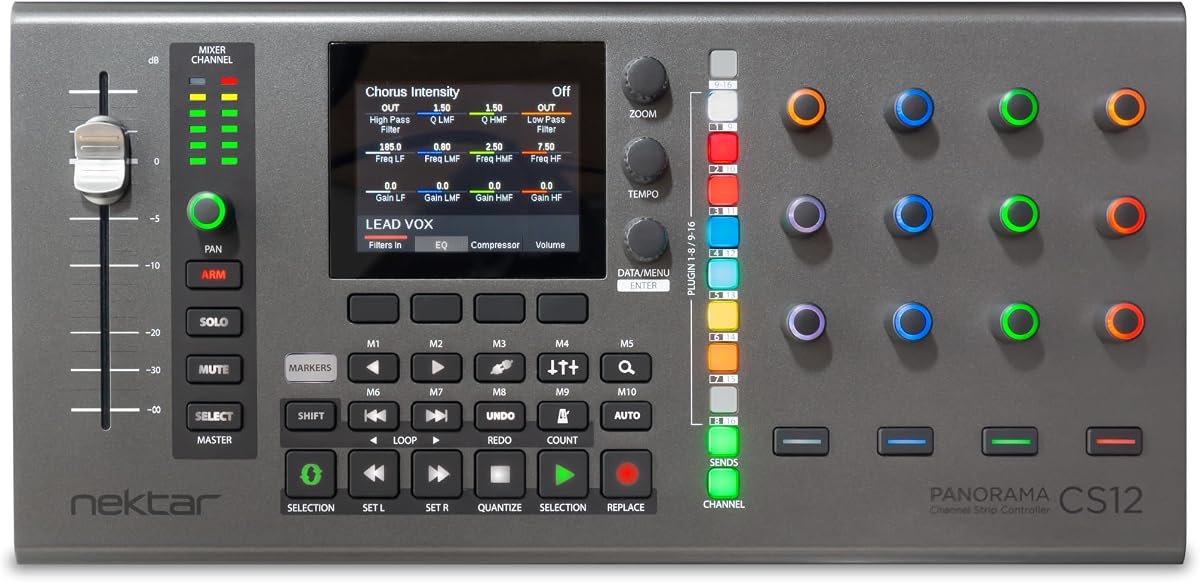
The Nektar Panorama CS12 is not an analogue processor but a channel-strip controller for a digital audio workstation. Its motorized fader, rotary encoders, 3.5-inch TFT display, and transport buttons bring common mixing actions closer to the user's hands. It is best understood as a physical control layer for plug-ins and DAW channels rather than a standalone recording processor.
We may earn a commission when you buy through this link, at no additional cost to you.
The motorized fader is the defining feature. It can mirror selected DAW parameters and provides a more tactile way to adjust volume or a compatible plug-in parameter than clicking through software. The TFT display gives useful visual feedback, while the rotary encoders fill the gaps between dedicated buttons and the primary fader. Transport controls can also reduce mouse movement during recording and playback.
Its limitations are equally important. There is no microphone preamp, EQ, compressor, or signal converter built into the hardware, so it does not replace a rack channel strip. DAW integration and mapping also determine how useful the controller feels, and setup may take more effort than a conventional hardware processor with immediate audio-path controls. The 3.9 supplied rating suggests that some users may find the software experience less compelling than the physical design.
The Panorama CS12 is best for a modern home or project studio where the recording chain lives in software and the main problem is workflow friction. It is a strong companion to an audio interface, not a replacement for one. Buyers should confirm compatibility with their DAW and preferred plug-ins before purchasing.
A motorized fader can follow a selected channel and communicate changes directly to the workstation. This makes it easier to compare settings, perform live adjustments, and keep attention on the performance rather than the mouse.
The integrated TFT display can present information and controls for the selected channel. Combined with the rotary encoders, it provides a compact alternative to navigating small software windows during mixing or tracking.
We may earn a commission when you buy through this link, at no additional cost to you.
The YAMAHA MG10XU is a compact 10-input stereo mixer that brings recording essentials into a portable desktop format. It combines discrete class A D PRE preamplifiers, three-band EQ, high-pass filters, and one-knob compressors across multiple channels. USB connectivity and built-in SPX effects make it especially convenient for small sessions, rehearsals, podcasting, and mobile recording.
We may earn a commission when you buy through this link, at no additional cost to you.
The high-pass filters help isolate sources from low-frequency vibration and handling noise, while the three-band EQ provides broad high- and low-frequency shaping. Compressors can add consistent level and punch to vocals, guitars, bass, and drums without requiring separate rack devices. The 10-channel input count also gives a small ensemble or compact session more room than a typical four-channel desktop mixer.
This is not a traditional rack channel strip, and the distinction matters for buyers with an established console. It is a standalone mixer with its own signal flow, physical dimensions, and input and output architecture. USB output quality and converter performance may also fall short of the dedicated interfaces and high-end studio processors included in this guide. Those limitations are reasonable for a portable all-in-one package.
The MG10XU is best for home recordists, mobile musicians, educators, and podcasters who want to record several sources quickly in one box. It offers a much more complete package than an interface alone, while its compact metal chassis and straightforward controls make it practical for rooms where a rack is unavailable. It is the list's strongest choice for portable, integrated recording rather than high-end outboard processing.
Ten inputs make the mixer useful for a singer, instrumentalist, and other sources in a single session. Multiple gain stages, EQ sections, and compressors allow several channels to be shaped independently before the stereo mix.
The impact-resistant powder-coated metal chassis and compact dimensions support use in rehearsal rooms, home studios, and mobile setups. USB connectivity provides a direct route to a computer, while SPX effects add a finishing layer without another processor.
We may earn a commission when you buy through this link, at no additional cost to you.
The Solid State Logic Revival 4000 is a compact all-analogue microphone channel strip inspired by SSL's iconic 4000 Series. Its compact 1U format and classic design language appeal to engineers who want recognizable hardware styling and an analogue signal path, although the supplied product information does not spell out the complete control set in the same detail as the other channel strips.
We may earn a commission when you buy through this link, at no additional cost to you.
The premise is straightforward: combine a microphone preamp and channel-strip processing in a space-efficient format associated with premium studio consoles. For buyers who value the visual and functional character of a classic SSL front end, that heritage can be as important as the individual controls. It may also pair naturally with other SSL processors in a project room or control room.
The principal concern is the 1 rating shown in the supplied data and the limited amount of published specification available here. Those factors warrant closer investigation of the exact feature list, warranty information, and customer feedback before committing. A classic name and a 1U enclosure do not by themselves reveal whether the unit offers adjustable EQ, compression, high-pass filtering, or specific routing options.
The Revival 4000 is best considered by buyers who already understand the intended 4000-series-inspired feature set and can verify the current manual. It may be appealing as a stylish premium channel strip, but the Super 9000 offers much more clearly documented flexibility. For a confident purchase, this model should be compared against the current detailed specifications and support package.
Drawing on the 4000 Series gives the unit a recognizable connection to a celebrated console lineage. That heritage appeals to engineers who value established studio design cues and want their rack to look and function as part of a professional signal chain.
The all-analogue approach and 1U format are the product's central concepts. Without more detailed supplied specifications, buyers should confirm the available processing and connectivity against their recording requirements before finalizing the choice.
We may earn a commission when you buy through this link, at no additional cost to you.
The Universal Audio LA-610 Mk II is a premium vacuum-tube channel strip built around a microphone, instrument, and line preamplifier with an optical compressor. Its appeal comes from combining a classic tube front end with a dynamics processor known for a smooth, natural approach. It is aimed at engineers who value tonal character and outboard pedigree over a minimal control surface.
We may earn a commission when you buy through this link, at no additional cost to you.
The optical compressor can help a vocal or instrument sit more consistently in the mix without the abruptness often associated with more aggressive dynamics circuits. Because the product information identifies the preamp and compressor but does not enumerate every front-panel control, buyers should consult the current manual for exact EQ, routing, and output details. The broad source compatibility remains a clear advantage.
As with other premium tube processors, the cost places it beyond many home studios. A tube preamp and optical compressor also need time to be understood and heard critically; buying hardware merely because it uses a specific circuit type is not enough. The user needs a solid mic, sensible gain staging, and a good monitoring environment to judge the difference.
The LA-610 Mk II is best suited to a professional or serious project studio seeking a characterful mono recording chain. It may serve a vocalist, acoustic source, or mix bus that benefits from the interaction of tube amplification and optical level control. For users unable to audition it, a detailed feature and return-policy check is essential.
The vacuum-tube preamp supports microphone, instrument, and line-level sources. This makes it possible to use the same characterful front end for different parts of a session rather than limiting it to vocal recording.
Optical compression can provide a gentler form of level control than many solid-state or FET circuits. It is well suited to natural dynamics, though exact threshold, ratio, and release behavior should be confirmed in the product documentation.
We may earn a commission when you buy through this link, at no additional cost to you.
The Neve 1073SPX-D combines the character of a 1073-style channel strip with the practical connectivity of a USB audio interface. It supports 24-bit/192kHz conversion, insert send and return, headphone amplification, and ADAT I/O. That makes it more of a complete recording endpoint than a processor that expects another interface to handle conversion.
We may earn a commission when you buy through this link, at no additional cost to you.
Class A circuitry provides the foundation for the preamp section, while USB makes the unit practical for a computer-based studio. ADAT I/O creates a path for expanding the recording system with additional converters. The insert points let an engineer insert external processing after the preamp and before the recording chain, offering a familiar routing option without relying entirely on software effects.
The product data does not state the total number of recording channels or fully describe the physical control layout. The absence of a customer rating also means there is no supplied rating to help gauge owner experience. As with the other premium and newly listed products here, buyers should verify the current channel count, operating system requirements, included accessories, and exact signal flow before purchase.
The 1073SPX-D is best for a home or project studio that wants a recognizable channel-strip front end and USB recording in one device. It may be especially attractive to producers who want the perceived character of a classic Neve-style preamp without building a separate rack and interface chain. It is less suitable for a large, already established console system that needs comprehensive multichannel routing.
USB audio at up to 24-bit/192kHz positions the unit as a direct interface for a computer studio. It removes the need for separate conversion in a simple chain, allowing the preamp to feed the recording workflow directly.
ADAT I/O provides a means of extending the system, while the insert send and return allows outboard processing within the channel path. Together, these features make the unit more adaptable than a basic one-input interface.
We may earn a commission when you buy through this link, at no additional cost to you.
The right channel strip depends on the source, room, signal flow, and operator. Comparing preamp architecture, equalization, dynamics, connectivity, and workflow is more useful than choosing by format or brand alone.
A channel strip's preamp determines how a microphone or instrument signal enters the processing chain. Clean solid-state designs can be precise and repeatable, while tube circuits may add harmonic density and a different response to transient material. Dual-path designs offer more options because the engineer can compare a clean preamp with a saturating path. Consider whether the primary sources are vocals, acoustic instruments, electric guitars, drums, or line-level signals, and favor a strip whose input flexibility matches those sources rather than assuming one architecture sounds best for everything.
Choose a preamp that suits the recording environment, the microphones being used, and the level of control required. Tube color is useful, but gain range, impedance, and reliable gain staging matter more to every recording.
EQ can be the most frequently used processor in a channel strip, so its range and control style deserve careful attention. A three-band layout is versatile because it combines broad tonal shaping with a focused midrange. Four-band designs may offer greater detail, while simplified shelf and bell switches can be useful for quick decisions. Look for a high-pass filter as well, since preventing rumble, room vibration, and unwanted low-frequency energy at the source is often more important than making a broad low cut.
Favor enough EQ resolution to solve a specific problem without encouraging excessive gain boost. A midrange sweep and accessible high- and low-frequency controls usually offer the most versatile combination.
Compressor design can be as important as the preamp. Optical, VCA, FET, and opto-emulator circuits respond differently to transients and level changes. A variable threshold, selectable knee, and independent timing controls provide a greater ability to shape the result, while a single-knob compressor makes quick leveling much easier. Consider the material being controlled: a lead vocal may need transparent level control, a snare may benefit from assertive peak shaping, and a bass part may require slower, more deliberate behavior.
Match compressor flexibility to the operator's skill and routine. Fast one-knob control is useful for simple sessions, while detailed compressors serve engineers who shape every channel deliberately.
Connectivity determines how naturally a channel strip joins the rest of the studio. A floating balanced XLR input is useful for a broad range of microphones, while TRS line inputs support instruments, returns, and other line-level material. Hi-Z switching can be valuable for electric guitars. Outputs should match the intended console or interface, and insert or loop-out points allow external processors to be placed within the chain. Check balanced versus unbalanced support, the number of available inputs, and whether an external processor can be inserted without adapters.
Choose connections that match the actual signal path. A good-sounding strip is less useful if it requires inconvenient patching or fails to accept the source being recorded.
Most dedicated channel strips occupy one rack unit, making them easy to combine in a compact outboard rack. Compact mixers and desktop controllers serve different needs, however. A mixer combines several inputs and a stereo bus, while a DAW controller has no audio path of its own. A channel-strip audio interface provides recording conversion but may offer a smaller channel count. Match the hardware to the size and routing demands of the studio rather than treating every device with “channel strip” in its description as interchangeable.
A 1U processor is ideal for building a flexible outboard collection. Choose a mixer or interface when fewer records, portable operation, or computer connectivity is more important than a modular rack.
Reliable monitoring and metering help an engineer set gain and dynamics without repeatedly checking software or another display. LED level indication is valuable for showing signal presence and processor status, while a headphone amplifier can make a channel-strip interface more convenient for close tracking. Headphones do not replace a good monitor path, but they are essential for many solo and overdub workflows. Consider whether the unit provides enough metering to reveal clipping and whether the output stage integrates naturally with the rest of the monitoring system.
Choose visible, trustworthy status feedback and practical monitoring connections. They reduce guesswork during tracking and help prevent gain mistakes before they reach the recording chain.
A software controller can provide the familiar benefits of a channel strip without adding analogue processing. Motorized faders, displays, rotary encoders, and transport controls can make digital mixing more efficient, but the experience depends on DAW compatibility, plug-in support, and mapping quality. A hardware controller cannot improve a recording chain unless suitable converters and preamps already exist, so it belongs later in the signal chain than an interface or standalone preamp. Confirm exactly which applications and parameters are supported before buying.
Choose digital control when tactile workflow is the priority. Treat it as a companion to the audio hardware, not a substitute for a preamp, converter, or signal processor.
A channel strip is often expected to remain in a studio for many years, making construction and support important long-term considerations. Rack chassis material, removable sections, balanced I/O, and straightforward repair access can all influence long-term usefulness. New or less established products may have limited long-term customer histories, while older designs may benefit from extensive collective knowledge. Review the manufacturer's warranty, authorized-dealer status, manual availability, and included hardware. Also consider whether the product can grow with the studio through additional inputs, inserts, or linked processing.
Prioritize dependable support and a signal path that still meets your needs after the initial novelty fades. A useful channel strip should be a lasting tool, not a temporary trend in the rack.
Begin with the source rather than the processor. Place the microphone properly, confirm the preamp gain, and listen to the untreated signal as far as practical. Set a conservative input level, engage the high-pass filter if rumble is present, and make broad EQ adjustments before moving to compression. This order prevents later dynamics and tone changes from masking a basic gain or placement problem.
Treat each processor as part of a controlled signal path. Make one adjustment at a time and compare against the original signal at a consistent monitoring level. If using multiple identical channels, copy the starting settings rather than assuming a related source needs identical treatment. For linked compressors, dual preamps, inserts, and external processors, document the routing and check that every output reaches the intended converter or console channel.
Power the equipment according to its manual, provide adequate ventilation, and secure rack-mounted units with the appropriate screws. Keep controls in a neutral position before power-up when the manufacturer recommends it, and avoid abrupt gain changes. Clean the panel with a soft, dry cloth, keep liquids away from controls and connectors, periodically inspect cables, and consult the manual for tube hours, fuse replacement, calibration, and authorized service.
A channel strip combines several front-end functions, usually a microphone or instrument preamp, EQ, and compression, into a single unit. It can simplify a studio signal path, give each source a consistent processing chain, and reduce the rack space needed for separate devices. Some models also add gating, insert routing, metering, digital conversion, or plug-in control.
A channel strip is more convenient when a repeatable, all-in-one processing chain is desired. Separate devices are preferable when each component must be selected independently, shared across multiple channels, or upgraded at different times. The best choice depends on the size of the studio, the available rack space, and how much hands-on control the engineer needs.
No. Tube circuits can add harmonic richness, but the appropriate preamp also depends on the microphone, room, performance, gain requirements, and mixing context. A clean channel strip may be better for a large, controlled vocal chain, while a tube design can help a thinner or less harmonically rich recording. Auditioning with familiar sources is more informative than choosing by circuit type alone.
A conventional mono channel strip usually processes and outputs one channel at a time, although it may accept both microphone and line-level sources. A compact mixer such as the YAMAHA MG10XU can handle several inputs and create a stereo mix, while a DAW controller does not process audio itself. Check the input and output count before assuming that similar terminology means identical capability.
Prioritize the preamp, EQ flexibility, compressor behavior, balanced inputs and outputs, and any insert or routing options. Rack format and metering are also important for practical operation. Finally, make sure the unit accepts your microphones and instruments and integrates with the console or interface already serving the rest of the studio.
Not necessarily. A model with USB audio conversion, such as the Neve 1073SPX-D, can act as the computer recording endpoint. A separate interface may still be needed if the channel-strip interface has too few inputs, lacks required routing, or does not provide the monitoring and conversion features demanded by the project.
Set the source and preamp gain so the signal reaches the dynamics section with adequate headroom and no clipping. Use a pad when a source is too loud, avoid excessive gain, and make level reductions before adding significant compression. Monitoring in context is essential because a signal can look acceptable in isolation and still lack sufficient space in the mix.
No. The Nektar Panorama CS12 controls compatible software channels and plug-ins, but it does not contain an analogue microphone preamp or its own audio-processing path. A hardware channel strip processes real audio signals. A controller can still be valuable, but it complements rather than replaces recording hardware.
The dbx DBX286SV stands out as the best budget-oriented option because it packs preamp, compression, de-essing, enhancement, gating, insert routing, and status LEDs into one rack unit. The PreSonus STUDIOCHANNEL is the most versatile all-around choice, offering a tube preamp, useful three-band EQ, and a conventional compressor in an approachable 1U package.
At the premium end, the Solid State Logic Super 9000 provides the widest set of distinctive routing and processing options, including two preamp paths, movable VHD saturation, four-band parametric EQ, and stereo compressor linking. Buyers should prioritize input compatibility, the kind of dynamic response they need, and the size of their monitoring system rather than treating one processor as ideal for every source.
Before purchasing, verify the manufacturer's current specifications, included accessories, warranty terms, and availability through an authorized seller. Prices, configurations, and support details can change, so checking the latest listing ensures that the chosen channel strip still fits the intended studio, budget, and recording workflow.