
Digital Waterproof Golf Cart Monitor
4.8Editor score
Highest listed customer rating
Digital backlit capacity display
Broad battery-type compatibility
Our Battery Meter for Golf Carts guide compares ten options for voltage range, displays, alarms, waterproofing, battery types, and installation ease.
A battery meter gives golf cart owners an immediate view of remaining capacity, helping them recognize when a pack needs charging before the vehicle is left stranded. The most useful models combine accurate voltage-based readings with clear displays, selectable battery settings, water resistance, and alerts for unusually low charge.
The ten products in this guide were compared using the information supplied for each model, including supported battery voltages and chemistries, display format, alarm functions, waterproofing, memory features, and installation method. The list covers LED bar displays, compact digital meters, and multifunction units with alarms, backlights, and temperature readings.
Each review explains the strongest feature of its selected meter, along with installation considerations, compatibility details, and possible trade-offs. Product ratings and availability can change over time, and prices also fluctuate, so readers should confirm current specifications and costs on the linked listing before purchasing.
4.8Editor score

4.2Editor score

4.2Editor score
The comparison below highlights supported voltage ranges, display styles, protection features, alerts, and installation options to make it easier to match a battery meter with a particular golf cart and battery configuration.





This IPX7 battery monitor combines a broad electrical range with features that are especially useful on a golf cart. It carries a 4.2 customer rating and supports a 7-100V measurement range, including common 12V, 24V, 36V, 48V, 60V, 72V, and 84V systems. The standout additions are a temperature display and a configurable buzzer alarm.
We may earn a commission when you buy through this link, at no additional cost to you.
The meter works with ternary lithium, lead-acid, AGM, and LiFePO4 batteries, with 12V lead-acid as its default setting. Its protected shell is dustproof and rated IPX7 for water resistance. Low and high voltage alarm points can be configured, while the M key switches between voltage and Celsius temperature. Reverse connection protection adds another layer of safety during installation.
Wiring is straightforward: red connects to positive, black to negative, and the leads measure 23.62 inches long. A bracket, screws, and double-sided adhesive are supplied for mounting, while the power-off memory function preserves settings when the cart is turned off. The main trade-off is that the initial setup is essential; an incorrect configuration can leave the percentage display at 100%.
This is a strong recommendation for owners who want more than a basic percentage gauge, particularly if they value audible warnings, temperature information, and broad pack compatibility. Anyone purchasing it should follow the included instructions carefully and verify the selected voltage and battery type before relying on the displayed percentage.
The configurable buzzer can be set for low and high voltage thresholds, giving the driver audible notice before a charge-related problem becomes urgent. Shorting the M key switches the display between voltage and temperature, adding useful context when monitoring a battery pack outdoors.
The included bracket and 23.62-inch leads provide flexibility for dashboard or panel placement. Power-off memory means the selected battery profile and alarm configuration can remain in place when the vehicle is restarted.
We may earn a commission when you buy through this link, at no additional cost to you.
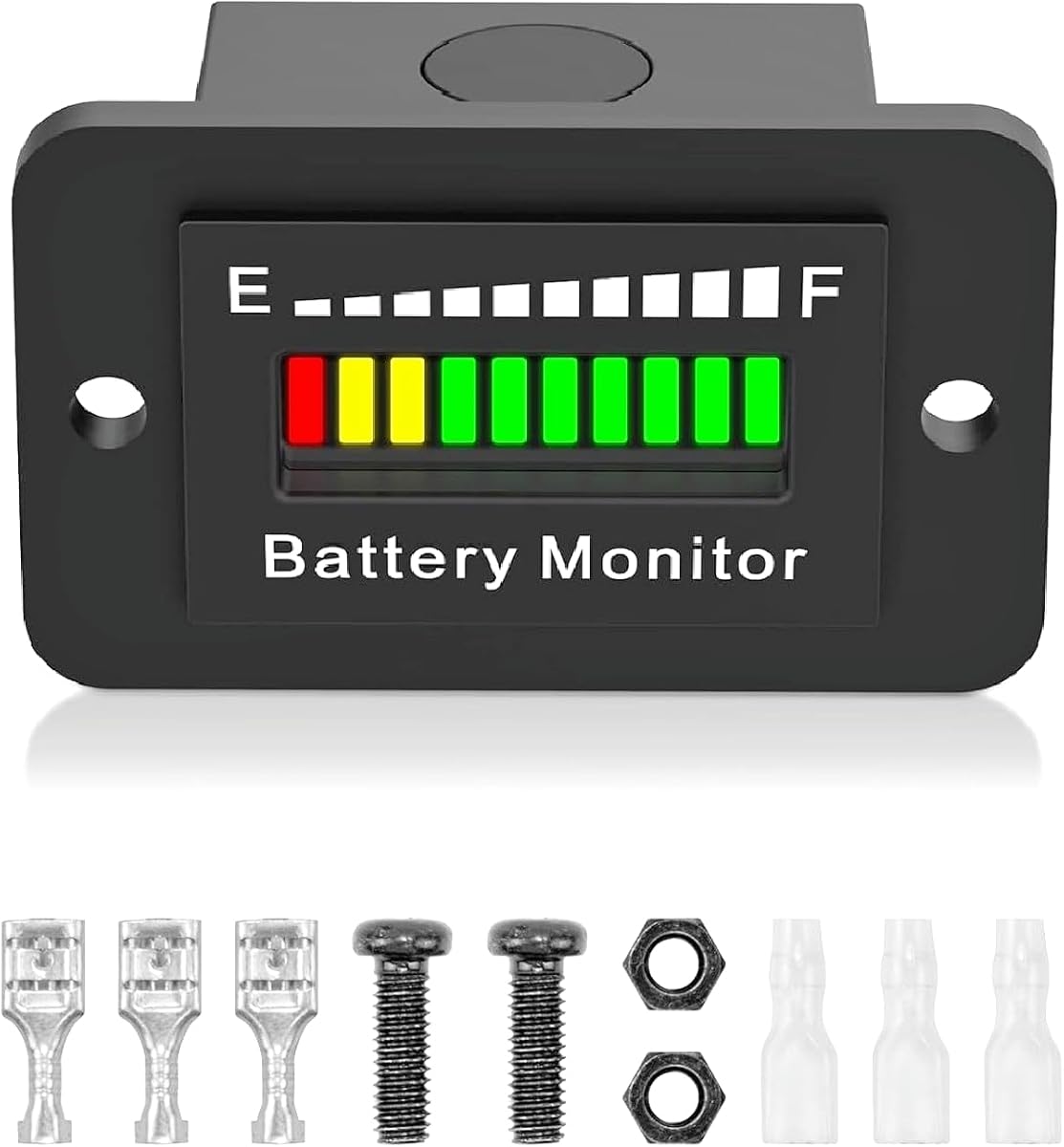
This LED capacity gauge is designed for quick visual status checks and carries a 4.1 customer rating. It supports 12V, 24V, 36V, 48V, 60V, and 72V systems, making it a versatile choice for golf carts, club cars, sightseeing vehicles, boats, scooters, and forklifts. Its ten-segment bar graph gives a clear indication of remaining charge.
We may earn a commission when you buy through this link, at no additional cost to you.
Each segment represents 10% of capacity, with one red, two yellow, and seven green sections. A PVC screen protector and bright backlight improve visibility from different angles. The meter supports direct battery connection or connection through a key or keyless switch, and it does not require a separate external power supply.
Installation is straightforward when the dashboard already has a compatible slot. Otherwise, the specified panel cutout is 37 by 25 millimeters, or 1.5 by 1 inch. IP65 waterproofing, heat resistance, reverse polarity protection, and overvoltage protection support outdoor use, while automatic sleep lowers power consumption.
This gauge is best for drivers who prefer an at-a-glance LED display and do not require an audible alarm. It works especially well in a golf cart dash where space is limited and a permanent, clean panel installation is desired. Buyers should measure the opening carefully before drilling.
The ten LED segments make changes in remaining capacity easy to recognize during a round. Green dominates at higher levels, while yellow and red provide a visible warning as the pack approaches depletion.
A pre-existing slot allows direct insertion, while carts without one can use the precise 37 by 25 millimeter cutout. Installation accessories are included, and switch-based wiring helps control when the gauge is active.
We may earn a commission when you buy through this link, at no additional cost to you.
This universal LED meter is a practical choice for owners of EZGO, Club Car, and other battery-powered vehicles. It has a 4.0 rating and supports 12V through 72V systems, including lithium, lead-acid, LiFePO4, storage, water, and other battery types. The display uses a ten-segment bar graph to communicate remaining capacity.
We may earn a commission when you buy through this link, at no additional cost to you.
The bright backlight and PVC waterproof screen protector make the readout visible from several angles. Operating consumption is listed at a maximum of 5mA, and the unit can be connected directly or through a key switch. Reverse polarity protection is included to reduce the risk of damage if the wires are accidentally reversed.
The most important installation consideration is choosing the correct voltage setting. The product information warns that a meter continuing to show full power may have been configured incorrectly. Owners should consult the referenced setting instructions before relying on the gauge, rather than assuming the display is faulty.
This model is a good fit for a golf cart owner who wants a simple, widely compatible LED indicator and may use the meter across more than one vehicle. It provides useful monitoring without a complicated interface, provided the correct setup is completed before use.
Support for several chemistries and voltage levels makes this a flexible option for carts and other vehicles. That versatility is useful for owners who may encounter different battery configurations over time.
The protected backlit screen remains legible from different viewing angles, while the 5mA maximum working draw helps limit the meter’s own impact on the battery. The ten segments offer a simple percentage-based visual guide.
We may earn a commission when you buy through this link, at no additional cost to you.
The Frienda meter combines a low-cost approach with several features usually associated with more elaborate monitors. It has a 4.1 rating and supports 12V, 24V, 36V, 48V, 60V, 72V, and 84V systems. A front button switches between a voltage reading and battery percentage, while additional controls manage the backlight and sleep mode.
We may earn a commission when you buy through this link, at no additional cost to you.
Its most useful golf cart feature is the low-battery alarm. The display flashes when capacity becomes critically low, giving the driver an early warning and reducing the chance of a complete discharge. The meter also supports Lead-Acid, Ternary Lithium, Li-ion, and AGM batteries when the proper battery code is selected.
Installation is intended to be simple, and the compact unit can also be used with e-bikes, scooters, motorcycles, RVs, trolling motors, and solar systems. A sturdy housing and straightforward button interface support regular use. The supplied information does not state a formal waterproof rating, so owners should avoid exposing it to more water than its installation environment reasonably allows.
This is a compelling budget choice for a cart owner who prioritizes an audible warning and broad voltage support over a sophisticated digital screen. Correct battery-code selection remains essential for accuracy. With that configuration handled carefully, it offers a helpful and approachable way to monitor remaining charge.
The flashing critically-low capacity warning gives drivers time to stop and charge before the pack is depleted. This is particularly valuable on longer routes where an unnoticed low charge could leave the cart stationary.
A front button cycles between voltage and percentage, while separate options control the backlight, sleep behavior, and battery profile. The interface is designed to remain accessible for routine checks.
We may earn a commission when you buy through this link, at no additional cost to you.
This digital voltage meter is a feature-rich option with a 4.2 rating. Its DC measurement range extends from 7V to 100V, allowing it to handle 12V, 24V, 36V, 48V, 60V, 72V, and 84V lead-acid systems as well as lithium and LiFePO4 packs. It also supports specified series configurations for those chemistries.
We may earn a commission when you buy through this link, at no additional cost to you.
The LCD shows both battery voltage and remaining power, with a backlight that improves visibility in low-light conditions. IP67 protection covers water and dust resistance, while a low-voltage warning activates when the battery falls below 10%. Daily operating consumption is less than 15mA, and low-power mode uses less than 1mA.
Installation can be handled on a dashboard panel or another mounting surface using the included nuts and bracket. The power-off memory retains settings and the prior data state after power is removed, reducing the need to repeat configuration after every charge or shutdown.
This is an excellent recommendation for owners who want a digital voltage-and-capacity display, strong physical protection, and a low-battery warning in one package. It is especially appropriate for carts with higher-voltage lithium or lead-acid packs, subject to checking the detailed battery-series compatibility information.
Showing voltage and remaining capacity together gives users both a direct electrical reading and an easier state-of-charge overview. The backlit LCD supports night driving, while sub-15mA operation limits the meter’s ongoing consumption.
IP67 dust and water protection makes the unit suitable for exposed dashboard positions where dust, humidity, or occasional moisture may occur. The included hardware supports a stable panel or surface installation.
We may earn a commission when you buy through this link, at no additional cost to you.
This compact LCD meter offers two display modes: a battery symbol with voltage, or a battery symbol with percentage. It has a 4.1 rating and accepts DC input from 12V to 84V for lead-acid batteries, while also supporting 3S through 26S ternary lithium, polymer, and lithium-ion configurations. The green backlight helps make readings easy to see in darker conditions.
We may earn a commission when you buy through this link, at no additional cost to you.
The right-side switch cycles through voltmeter mode, battery percentage, and off. A left-side setting key controls the display, backlight, sleep mode, and battery type. Low power consumption makes it suitable for a regularly used cart, and the integrated 30cm power cable simplifies the physical connection.
A PVC film provides a water-resistant surface, although the supplied information does not state a formal ingress-protection rating. Reverse connection protection is built in, reducing the likelihood of damage if the positive and negative leads are accidentally interchanged.
This meter suits owners who want a small, lightweight display with both numerical voltage and percentage information. It is a particularly practical option for carts using a supported lithium series count, while lead-acid users can also benefit from its broad voltage input. The fixed cable simplifies installation but limits routing flexibility.
Switching between voltage and percentage gives the driver a precise electrical reading when needed and a quicker capacity view during normal operation. The large backlit screen is designed for straightforward dashboard checking.
Battery-type selection makes the meter useful across lead-acid and several lithium configurations. Owners should match the selected profile to the actual pack so that the percentage interpretation remains useful.
We may earn a commission when you buy through this link, at no additional cost to you.
This LED gauge is aimed at common golf cart platforms, including Yamaha, EZGO, and Club Car, and carries a 4.2 rating. It supports selectable 12V, 24V, 36V, 48V, 60V, and 72V systems. The meter works with lead-acid, lithium, LiFePO4, and specified lithium-ion series configurations, giving it broad appeal for converted or upgraded carts.
We may earn a commission when you buy through this link, at no additional cost to you.
Its ten-segment display uses one red, two yellow, and seven green LEDs, with each segment representing 10% of capacity. During startup, all LEDs flash three times to confirm initialization before the meter identifies the current battery level. The DIP switch must be set to the cart’s actual voltage; the product information states that an incorrect setting will not cause a short circuit.
Two wiring methods are available, including key-switch and keyless-switch arrangements, and the meter draws power directly from the battery. Installation can use an existing slot or a panel cutout of 37 by 25 millimeters. IP65 waterproofing, heat resistance, automatic sleep, and installation accessories round out the feature set.
This is a good recommendation for owners who want a conspicuous LED status gauge and have a cart in one of the listed voltage configurations. The lack of an audible alarm may be a drawback for some drivers, but the simple visual format is excellent for quick checks and is easy to read at a glance.
The red, yellow, and green bar provides an immediately recognizable charge status without requiring the driver to interpret a number. It is well suited to quick pre-round and mid-round checks.
Compatibility with Yamaha and EZGO carts, along with the stated voltage selection, makes this a relevant option for many mainstream golf cart owners. Existing-slot or cutout installation allows flexibility across different dashboards.
We may earn a commission when you buy through this link, at no additional cost to you.
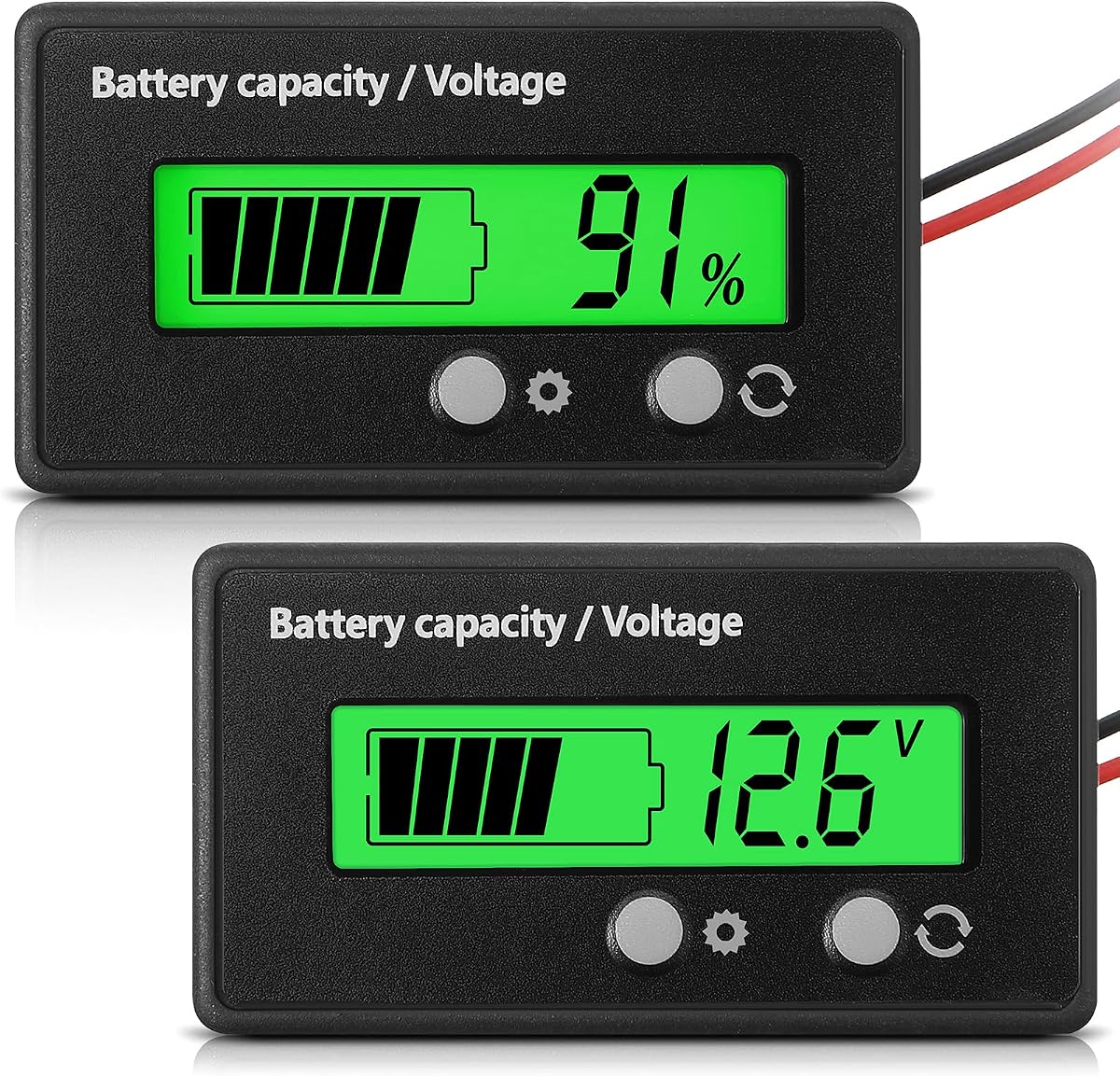
This digital monitor stands out with the highest customer rating in the group, 4.8. It supports 12V, 24V, 36V, 48V, 60V, and 72V systems and is compatible with lithium-ion, lead-acid, LiFePO4, specified 3-to-15-series lithium-ion, storage, and flooded batteries. It is intended for a wide range of golf carts and utility vehicles.
We may earn a commission when you buy through this link, at no additional cost to you.
The high-definition digital display monitors remaining capacity in real time and has a high-brightness backlight. A PVC waterproof screen protector supports clear viewing from multiple angles, which is useful for a driver checking the meter while seated. Before use, the user must long-press the switch for three seconds and set the meter to the vehicle’s voltage.
Installation is designed to be straightforward, with direct and ignition-switch wiring methods available. Supporting accessories are included, and reverse polarity protection helps prevent burnout if the positive and negative leads are reversed. The stated applications also include Yamaha, Club Car, and EZGO carts, motorcycles, electric carts, lawn trimmers, sightseeing vehicles, forklifts, stackers, and electric vehicles.
This is our leading recommendation for a buyer who prioritizes a polished digital readout and the strongest listed customer feedback. It combines broad compatibility with easy configuration and safer wiring. The main limitation is the absence of a stated audible alarm, so drivers who prefer a buzzer may need to consider the IPX7 model instead.
The bright digital readout presents live capacity information in a format that is easy to interpret while operating the cart. The protected screen and multiple viewing angles add practical value during frequent status checks.
Holding the switch for three seconds opens the setting mode, where the voltage can be matched to the cart. Completing this step is essential for the displayed capacity to reflect the installed battery system.
We may earn a commission when you buy through this link, at no additional cost to you.
The BM210 is a straightforward LED meter with a 3.8 customer rating, the lowest in this comparison. It supports 12V through 72V batteries and can be used in cars, SUVs, pickups, boats, RVs, motorcycles, and golf carts. Its ten-segment bar graph shows remaining capacity in 10% increments using one red, two yellow, and seven green segments.
We may earn a commission when you buy through this link, at no additional cost to you.
The backlit display is covered by a PVC waterproof screen protector, and the product information states that it can be read from different angles. Maximum working consumption is listed at 5mA. Installation accessories are included, and reverse connection protection is designed to keep the meter from burning if the wires are attached incorrectly.
The most important limitation is configuration. Like several other products in this category, the BM210 may continue to display full power if the voltage code is not set correctly. The product instructions include a referenced setting diagram, which owners should consult before installation or when troubleshooting the capacity display.
This meter is best for a user who values a simple LED gauge, broad vehicle application, and a straightforward ten-segment charge display. It is less compelling for buyers who place the greatest weight on customer feedback or require an audible warning, but it remains a functional option for compatible battery-powered vehicles.
The bar graph divides capacity into ten equal segments, allowing a driver to recognize remaining charge without focusing on precise decimal values. Its color progression naturally signals when the pack enters the warning range.
A maximum 5mA working draw limits the meter’s consumption, while compatibility with numerous vehicle types broadens its usefulness. Reverse polarity protection adds installation reassurance.
We may earn a commission when you buy through this link, at no additional cost to you.
This meter is a strong choice when water exposure is a primary concern. It has a 4.2 rating and an IP68 waterproof rating. The blue-backlit LCD simultaneously shows voltage and remaining capacity beneath a durable acrylic cover, giving owners both electrical and state-of-charge information in one display.
We may earn a commission when you buy through this link, at no additional cost to you.
Compatibility is extensive. It supports specified L03-L20 lithium packs, L04-L24 lithium-iron packs, and 12V, 24V, 36V, 48V, 60V, 72V, and 84V lead-acid batteries. A custom mode covers a DC 7-100V range, extending the meter’s usefulness across carts, cars, motorcycles, boats, and RVs with supported configurations.
A flashing low-voltage warning appears when power falls below 10%, giving the driver a clear prompt to recharge. Power-off memory restores the previous configuration after a restart. Normal operating consumption is under 15mA, and the power-saving mode falls below 1mA, helping minimize drain when the cart is not being used.
This is a recommended model for outdoor golf carts, docks, or storage areas where moisture resistance is especially important. It combines a strong water-protection rating with dual information, a low-voltage warning, and memory. The main responsibility falls on the installer to select the correct battery profile and custom settings.
The IP68 rating is a notable advantage over meters with lower or unspecified water-protection levels. It makes the unit particularly appealing for carts regularly exposed to rain, spray, or damp storage areas.
Displaying voltage and remaining capacity together reduces the need to switch modes. The blue backlight and durable acrylic cover support convenient, protected reading during routine operation.
We may earn a commission when you buy through this link, at no additional cost to you.
The right battery meter depends on the cart voltage, battery chemistry, display visibility, installation method, and protection requirements. Comparing these factors before purchasing helps prevent inaccurate readings and an installation that does not suit the dashboard.
Start by identifying the nominal voltage of the entire battery pack, not merely the voltage of one battery. Golf cart systems commonly appear in the supplied meters’ supported ranges of 12V, 24V, 36V, 48V, 60V, 72V, and 84V, but a custom 7-100V mode may provide additional flexibility. The meter must be configured for the same voltage as the installed pack or its percentage display can be misleading. This matters especially for carts converted from lead-acid to lithium or LiFePO4, since the same pack voltage can contain a different number of series-connected cells.
A voltage range alone does not guarantee that the meter will interpret every battery type correctly. Some units support lead-acid, AGM, flooded, ternary lithium, lithium-ion, and LiFePO4, while others specify particular series counts such as 3S-26S lithium or L03-L20 lithium packs. The product information also repeatedly notes that the battery code should match the pack. This setting is what allows the meter to translate voltage into a more useful percentage estimate, so it should be checked whenever a cart’s battery configuration changes.
A ten-segment LED bar graph is excellent for quick recognition, especially for a driver who wants to know whether to charge without interpreting a number. Digital LCD models offer more detailed information, and many show both voltage and remaining capacity on one screen. Backlighting helps in shaded courses and low-light conditions, while viewing angle matters when the meter is mounted below the windshield or at the edge of a dashboard. A protected screen, such as a PVC film or acrylic cover, can also improve durability in a cart exposed to dust, insects, and occasional contact.
An audible or flashing warning can give a driver notice before a depleted pack leaves the cart stranded. The IPX7 monitor includes configurable low and high voltage buzzer alarms, the Frienda model flashes at critically low capacity, and the 12-84V digital meter plus IP68 model activate warnings below 10%. Models without a stated alert still provide a visual indication, but the driver must remember to check the display regularly. For extended routes or drivers who may not notice a small change in LEDs, an alarm can be an important safety and convenience feature.
Golf carts are frequently stored outdoors and used in rain, damp grass, or dusty conditions. The products in this guide range from models with no stated formal ingress rating to units rated IP65, IP67, and IP68. A higher rating offers stronger protection against water and dust, which is useful for exposed mounting locations. A waterproof screen alone should not be confused with a sealed housing, so buyers should distinguish between the rating of the full unit and the protection offered only by its faceplate or cover.
Consider the available dashboard space and whether the cart already contains a compatible opening. Several LED gauges can insert into an existing slot or fit a 37 by 25 millimeter cutout, while other digital meters include brackets, nuts, adhesive, or mounting instructions. Key-switch and keyless-switch connections can let the meter operate with the ignition, whereas direct connection keeps it powered whenever the battery is connected. The supplied wire length, including 23.62-inch and 30cm examples, should also be checked against the intended route from the battery compartment to the dashboard.
A monitor draws a small amount of power, but that draw matters if it remains connected to a battery during long storage periods. Listed operating consumption ranges from less than 15mA to a 5mA maximum, and one model uses less than 1mA in power-saving mode. Automatic sleep and manual off controls can further reduce consumption. Power-off memory is also valuable because it preserves the selected voltage, battery chemistry, alarm thresholds, and prior data state, avoiding repeated configuration when the cart is restarted.
Several listings describe a two-year guarantee or warranty and provide technical support for setup questions. This type of backing can be reassuring because battery meters require correct configuration and a secure installation. A useful support policy is especially helpful when adapting a meter to an unusual lithium series arrangement or troubleshooting a display that remains at full power. Buyers should still read the included instructions, identify the correct battery code, and retain the installation accessories so the unit can be repositioned if the dashboard layout changes.
Before installation, identify the cart’s nominal pack voltage, battery chemistry, and relevant series configuration. Connect the meter to a fully charged battery using the key switch, keyless switch, or direct connection specified in its instructions. If the unit has a DIP switch or digital setup control, select the matching voltage and battery type before interpreting the percentage display. Several listings specifically warn that incorrect settings can cause the gauge to remain at 100%.
Route the red lead to positive and the black lead to negative, taking care to keep the connections stable and away from moving or sharp components. Use the supplied bracket, screws, nuts, adhesive, or panel cutout to secure the meter where it is visible without interfering with steering, controls, or the canopy. After installation, power the unit and verify that its initialization or indicator sequence completes and that the displayed charge level matches a sensible expectation.
For routine care, inspect the wires and mounting points periodically, especially on carts used over rough terrain. Keep the display clean and avoid pressing on the protected screen. Use automatic sleep or the off setting when the cart will remain stored for long periods, and use the sleep or low-power mode to limit consumption. If readings become erratic, check the connections, reselect the correct battery profile, and consult the product instructions before assuming the battery itself is faulty.
The meter must support the nominal voltage of the complete battery pack, which may be 12V, 24V, 36V, 48V, 60V, 72V, or 84V depending on the cart. It must also be configured for the same voltage. A meter set to the wrong pack voltage may display an incorrect capacity percentage even though it can still measure voltage.
Many of the listed monitors support both lead-acid and lithium variants, including LiFePO4, AGM, flooded, and specified lithium-ion series. Compatibility depends on the exact model and its battery-setting options. Confirm the chemistry and series count in the product information, then choose the corresponding code after installation.
The most common cause is an incorrect voltage or battery-type setting. Several product descriptions specifically warn that the display may remain at full power until it is configured correctly. Check the DIP switch or digital setup instructions, confirm the wires are attached correctly, and compare the displayed voltage with the meter’s reading.
A permanent installation is common because the meter is intended to remain in the dashboard and provide ongoing status updates. Most models use either direct or ignition-switch wiring. For long-term storage, automatic sleep or an off function helps limit power consumption, and power-off memory can preserve the selected settings.
An LED bar gauge divides capacity into ten colored segments, making the status quick to recognize while driving. An LCD meter usually provides more precise information, such as numerical voltage and remaining capacity. The best choice depends on whether the owner prioritizes glanceable simplicity or detailed readouts.
Waterproof protection is useful because golf carts are often operated or stored outdoors. The included products range from models with a protected screen to units rated IP65, IP67, or IP68. A formally rated housing is more dependable in wet conditions than a waterproof screen alone, particularly when the meter is mounted in an exposed position.
An alarm can alert the driver before the pack reaches a critically low state, making it easier to stop and recharge. Some monitors provide a flashing warning below 10%, while the IPX7 model offers configurable low and high voltage buzzer thresholds. The meter cannot determine battery health by itself, but it can help avoid an unnoticed deep discharge.
They primarily estimate remaining charge from voltage and the selected battery profile. That information is useful for deciding when to recharge, but it is not the same as a full battery-health or capacity test. A meter showing a usable charge level cannot reveal every cell imbalance, aged-battery issue, or charging-system fault.
The IPX7 Waterproof Monitor is the most feature-rich option, combining a broad 7-100V range, temperature display, configurable buzzer alarms, strong water protection, and power-off memory. The Digital Waterproof Golf Cart Monitor is an excellent alternative for its 4.8 customer rating and clear digital capacity display, while the 12-84V Voltage Meter with Bracket combines IP67 protection, digital readings, a low-voltage warning, and mounting hardware.
Prioritize exact voltage and battery-chemistry support before considering appearance. Decide whether a ten-segment LED graph or a detailed LCD better matches the way you check your cart, and whether an audible alarm is important for long routes. Installation fit, dashboard space, wire routing, waterproof exposure, and automatic sleep should then narrow the field to a model that suits the vehicle.
Ratings, product availability, and prices can change, so confirm the current listing, specifications, and seller details before purchasing. Review the manufacturer instructions, set the battery profile correctly, and test the display after installation. Taking those steps will produce a more dependable reading and make the chosen battery meter genuinely useful on every round.