
CENMATE 8 Bay RAID Enclosure
3.8Editor score
Eight SATA drive bays
Eight selectable RAID modes
Dual cooling fan system
USB 3.0 and eSATA
Tool-free drive installation
An 8 bay hardware RAID enclosure combines eight drive bays with a dedicated controller, allowing large storage collections to operate as one dependable system. The strongest choices balance RAID performance, cooling, expandability, drive compatibility, and practical maintenance features for personal or professional workflows.
We compared the ten enclosures by examining their controller type, supported RAID modes, capacity, connection speed, hot-swap capability, cooling, operating-system compatibility, and expansion options. The list also distinguishes true hardware RAID from direct-attached storage and software-managed systems so buyers can select the right architecture.
Each review identifies the enclosure's strongest use case, practical limitations, and most suitable buyer, from budget-conscious users to video professionals. Product availability and pricing change over time, so verify the current listing, included accessories, drive requirements, and warranty before making a final purchase.
3.8Editor score

5.0Editor score

3.7Editor score
As an Amazon Associate we earn from qualifying purchases.
The comparison highlights each enclosure's RAID architecture, drive support, maximum connection speed, and practical expansion features. Because several eight-bay products are direct-attached or software-managed rather than dedicated hardware RAID systems, buyers should verify the controller behavior carefully.

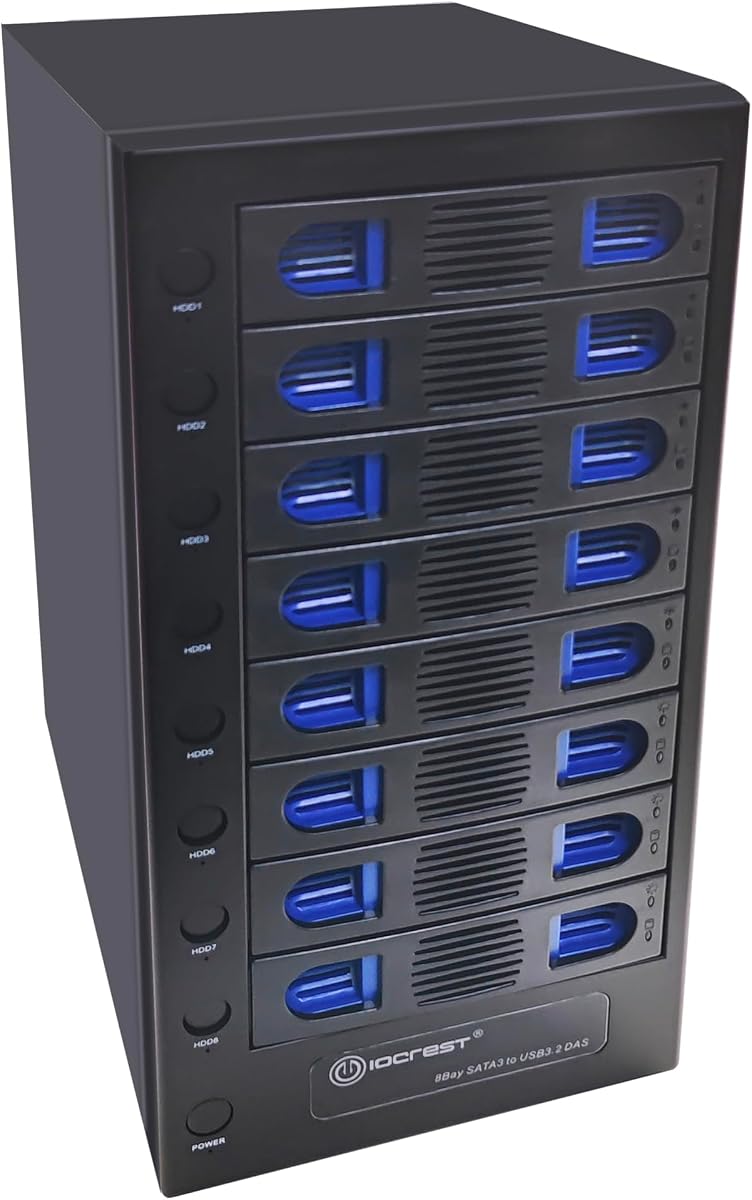


The CENMATE Aluminum 8 Bay Hard Drive RAID Enclosure stands out because it combines eight SATA bays with a broad selection of operating modes in a comparatively accessible package. Its 3.8 rating reflects a capable design, but the included warnings make clear that RAID configuration is a serious operation rather than a casual plug-and-play feature.
We may earn a commission when you buy through this link, at no additional cost to you.
The enclosure supports CLONE, LARGE, LARGE doubled, NORMAL, RAID 0 doubled, RAID 5 doubled, RAID 50, and RAID 00 according to the supplied product information. It accepts 2.5-inch and 3.5-inch SATA hard drives and SSDs, with a listed maximum of 20TB per drive and 160TB aggregate capacity. A 12V 20A adapter supplies stable power for the full complement of spinning disks.
Its USB 3.0 interface is listed at up to 5Gbps, while the included USB A/C and eSATA cables offer useful connection choices. Two 2.9-inch fans are built into the aluminum-alloy enclosure to control heat, although the stated 40–50 decibel operating noise may be noticeable in a quiet office. The tool-free design makes loading and replacing drives more convenient than a screw-fastened cage.
This enclosure is best for a technically informed buyer who wants several RAID arrangements without moving to a high-end professional array. It is less suitable for someone who expects effortless setup, completely silent operation, or unrestricted compatibility with every 20TB hard drive. Before changing RAID modes, back up all data and follow the manufacturer's instructions precisely.
The unusually broad mode list makes this enclosure useful for striped performance arrays, mirrored data protection, larger logical volumes, and direct independent-drive access. Because changing RAID can format the included drives, the mode controls should only be changed after confirming a complete backup.
Two internal fans and an aluminum-alloy body help manage the heat generated by eight hard drives. USB 3.0, USB-C, and eSATA give buyers flexibility when connecting the enclosure to different computers, although actual throughput will depend on the host interface and workload.
We may earn a commission when you buy through this link, at no additional cost to you.
The SanDisk Professional G-RAID Shuttle is the clearest dedicated hardware RAID solution in this group. Its perfect 5.0 rating is supported by an ambitious specification: eight removable Ultrastar hard drives, a hardware RAID controller, Thunderbolt 3 and USB-C connectivity, and a 160TB raw drive total for demanding production environments.
We may earn a commission when you buy through this link, at no additional cost to you.
The supplied information lists read speeds up to 1900MB/s and write speeds up to 2000MB/s, making it well suited to multistream 4K, 8K, and virtual-reality workflows. It ships preconfigured with RAID 5 and can also be configured for RAID 0, 1, 6, 10, 50, 60, or JBOD. This flexibility allows the array to shift among capacity, protection, and performance priorities.
Two Thunderbolt 3 ports support daisy chaining with as many as five additional devices, while USB-C Power Delivery can provide up to 85W to a MacBook. The removable enterprise-class drives are a major part of the package, reducing the need for buyers to source and match eight compatible disks independently. The design is aimed specifically at demanding, mission-critical footage rather than casual file storage.
The G-RAID Shuttle is the strongest recommendation for professional editors and studios that need predictable, high-speed hardware-managed storage. Buyers who want to choose their own drives may find the bundled configuration less adaptable, and those needing a quiet general-purpose desktop enclosure should look elsewhere. Even with fast media, independent backups remain essential.
Thunderbolt 3 provides a 40Gbps connection and the listed performance figures target professional media pipelines rather than basic document storage. This makes the Shuttle particularly attractive for editors who routinely move large projects between computers or work with high-resolution source files.
Eight removable Ultrastar drives provide a matched starting point for the array and simplify capacity planning. The controller's range of RAID and JBOD choices also allows the enclosure to be adapted as storage requirements or performance priorities change.
We may earn a commission when you buy through this link, at no additional cost to you.
The CENMATE Aluminum 8 Bay Hard Drive Enclosure is a direct-attached storage system rather than a hardware RAID enclosure, and its 4.3 rating makes it one of the stronger general-purpose options here. It is designed for buyers who want eight externally accessible SATA drives and do not need the enclosure to combine them into a protected logical volume.
We may earn a commission when you buy through this link, at no additional cost to you.
It accepts 2.5-inch and 3.5-inch SATA hard drives and SSDs, with a listed maximum of 20TB per drive and 160TB aggregate capacity. The enclosure uses USB 3.0 at up to 5Gbps under UASP control, includes USB A/C cables, and works with Windows, Mac OS 9.1 and 10, and Linux without a separate driver installation.
Hot-swappable trays allow a drive to be removed or replaced without shutting down the entire enclosure, while a USB host port supports daisy chaining with as many as three devices for a listed expansion capacity of 480TB. That makes the design useful for offline editing, bulk media transfer, local archives, and other workflows where each disk can be handled independently.
The 4.3 rating reflects a practical and versatile design, but the absence of RAID and NAS functions is fundamental rather than a missing feature. Buyers who need redundancy, striping, or a network share should choose a RAID-equipped product or a dedicated NAS. For straightforward high-capacity direct access, however, this CENMATE model is approachable and expandable.
Direct-attached operation keeps the eight disks visible as individual storage volumes, which can simplify media ingest and offline archive workflows. Management software and configuration flexibility will depend on the connected computer rather than on an internal RAID controller.
The USB host port lets additional enclosures join a daisy chain, allowing capacity to grow without replacing the existing device. Buyers should confirm that their host computer and connection arrangement support the intended number of chained units.
We may earn a commission when you buy through this link, at no additional cost to you.
The OWC ThunderBay 8 is a high-bandwidth external storage enclosure with eight universal drive bays. Its 3.9 rating reflects solid Thunderbolt performance and flexible expansion, although the enclosure itself does not provide hardware RAID; users normally combine the drives through the connected Mac or Windows system.
We may earn a commission when you buy through this link, at no additional cost to you.
Each bay accepts 2.5-inch or 3.5-inch SSDs and hard drives. Two Thunderbolt 3 ports, which are backward compatible with Thunderbolt 2, provide high-bandwidth access and allow as many as six ThunderBay units to be daisy-chained for a listed capacity of 1,152TB. The second port can also connect up to five additional Thunderbolt devices.
The enclosure is plug-and-play ready, needs no drivers, and includes a Thunderbolt cable. Its thumb-screw release trays make drive swaps more convenient than permanently mounted caddies, while the listed one-year OWC limited warranty provides a basic level of manufacturer support. Cross-platform compatibility makes it useful for temporary editing or shared production environments.
This is a strong choice for creative professionals who want fast, high-capacity external storage and the freedom to arrange RAID with software. It is less suitable for someone requiring a self-contained hardware RAID controller that continues to manage the array independently of a host computer. The eight drives are presented individually and require suitable host-based configuration.
The ability to chain up to six units turns the ThunderBay 8 into a scalable building block for large editing archives. The second Thunderbolt port can simultaneously serve other peripherals, helping conserve the limited connection options available on many laptops.
Thunderbolt bandwidth suits large media files, while thumb-screw trays simplify routine swaps. Because there is no internal RAID controller, users must create and manage striped, mirrored, or JBOD arrays through software on the attached computer.
We may earn a commission when you buy through this link, at no additional cost to you.
The CENMATE Aluminum 8 Bay 10Gbps enclosure is a direct-attached system for users who prioritize connection speed and convenient drive replacement over built-in RAID. Its 4.1 rating indicates a balanced feature set, with USB 3.2 Gen 2, hot-swapping, cooling, and expansion forming the core design.
We may earn a commission when you buy through this link, at no additional cost to you.
The controller is listed at up to 10Gbps under UASP control, using a USB-C 3.2 Gen 2 output. It supports 2.5-inch and 3.5-inch SATA hard drives and SSDs, with a stated maximum of 20TB per drive and 160TB total. A USB host port also enables daisy chaining with up to three devices and a listed expanded capacity of 480TB.
Two 2.9-inch cooling fans sit within the aluminum-alloy enclosure, although the stated 40–50 decibel noise may be distracting in a quiet room. Hot-swappable trays let operators replace individual drives without powering down the complete unit. The included DC 12V 20A adapter provides stable power for the full drive set.
The enclosure works with Windows 7 and later, Mac 9.1 and later, and Linux. Its USB-C connection also supports host interfaces including USB 3.0, USB 3.1, USB 3.2, Thunderbolt 3, and Thunderbolt 4. It is a good high-speed DAS option, but buyers seeking hardware-managed redundancy must choose the RAID-equipped CENMATE model or another true RAID enclosure.
A 10Gbps USB-C connection offers more headroom than a 5Gbps USB enclosure, particularly for SSDs and mixed workloads. The connection will still be limited by the slowest host port, drive performance, RAID software, and the type of data being transferred.
Hot-swapping, tool-free installation, and a high-capacity power adapter make the enclosure practical for ongoing media ingestion. Two internal fans help preserve drive longevity, though the enclosure is better suited to a studio than a sound-sensitive office.
We may earn a commission when you buy through this link, at no additional cost to you.
This 8 Bay Tool Less Tray enclosure combines a 4.3 rating with several controls that are especially useful in multi-drive environments. It supports up to eight 2.5-inch or 3.5-inch SATA hard drives at up to 22TB each, but it is explicitly a direct-attached enclosure without RAID or NAS functions.
We may earn a commission when you buy through this link, at no additional cost to you.
USB-C 3.2 provides a listed maximum of 10Gbps and supports SATA I, SATA II, SATA III, UASP, and USB 3.0. A built-in thermal sensor works with a smart fan function in automatic or manual modes, offering three fan-speed levels. That adjustment helps balance cooling and noise according to the environment.
One of its most distinctive features is the independent power switch for each drive, allowing selected disks to be powered down without shutting off the entire unit. The steel housing and tool-less trays support serviceability, while the hot-swappable design should appeal to users who routinely move media or replace failing drives.
Compatibility extends across numerous Windows versions, Apple OS X releases, Linux, and Google Chrome OS. This is a capable storage consolidation box for users who prefer independent volumes and operating-system-level management. It is not the right selection for RAID protection, but its drive controls, thermal sensor, and generous capacity support make it worth considering for high-capacity direct access.
The built-in sensor and three fan levels make it easier to tune cooling to the workload and ambient environment. Automatic mode is convenient for routine use, while manual control can reduce noise when the enclosure is not under heavy load.
Individual power switches let operators isolate specific drives, which can simplify testing and storage management. The enclosure remains a DAS product, so these controls do not create striped or mirrored arrays.
We may earn a commission when you buy through this link, at no additional cost to you.
The OWC ThunderBay Flex 8 is the most versatile premium platform in the group, though its 3.7 rating and software-based RAID architecture require careful evaluation. It supports SATA, SAS, U.2, and M.2 NVMe drives, with the top four bays able to use U.2 SSDs and the entire enclosure capable of up to 144TB.
We may earn a commission when you buy through this link, at no additional cost to you.
Real-world speeds are listed at up to 2750MB/s, making it appropriate for high-end media and storage workflows. The front panel includes USB-C and two USB-A 10Gbps ports for peripherals and mobile devices. SD 4.0 and CFexpress readers can transfer data at up to 985MB/s, a valuable feature for photographers and filmmakers working with removable media.
A PCIe x16 connector operating at x4 lane width creates room for capture, networking, SSD, hardware RAID, or other I/O cards. SoftRAID provides setup, notifications, and drive-integrity monitoring. The supplied information notes that RAID 4, RAID 5, and RAID 10 are currently available for Mac only, an important limitation for Windows users considering those specific configurations.
The Flex 8 appeals to advanced creative professionals who need more than a basic drive box. Its mix of high-speed ports, removable media readers, modern drive support, and expansion capability is unusually comprehensive. It is not a self-contained hardware RAID product because SoftRAID manages the arrays, so buyers who need controller independence should select the SanDisk G-RAID Shuttle instead.
Supporting SATA, SAS, U.2, and M.2 NVMe media allows the enclosure to serve as both a high-capacity archive and a fast scratch workspace. The four U.2-capable bays are particularly relevant to media professionals who want to combine large hard-drive volumes with fast solid-state performance.
Front USB ports, removable-media readers, and a PCIe expansion slot turn the enclosure into a compact workstation hub. These features add complexity, so first-time users should verify that their computer supports the selected accessories and software configuration.
We may earn a commission when you buy through this link, at no additional cost to you.
The QNAP TL-D810TC4-US is an eight-bay desktop expansion enclosure built for Direct Attached Storage and JBOD use. Its 4.0 rating reflects a focused design for extending compatible QNAP systems or connecting a large drive pool to Windows, macOS, and Ubuntu or Linux workstations.
We may earn a commission when you buy through this link, at no additional cost to you.
A USB 3.2 Gen 2 Type-C interface provides up to 10Gbps for file access, backup, and media archiving. The desktop tower supports high-capacity 3.5-inch and 2.5-inch SATA 6Gb/s hard drives and SSDs, allowing organizations to scale storage without replacing an entire NAS system.
Drive health, system information, and JBOD configurations can be viewed through the free QNAP JBOD Manager utility or the QTS and QuTS hero Storage & Snapshots applications. That management focus distinguishes it from generic DAS units and makes it particularly attractive to users who already rely on the broader QNAP ecosystem.
This enclosure is ideal for media libraries, backup repositories, surveillance data, and other growing storage collections. It is not a hardware RAID appliance and does not independently create a protected striped array. Buyers who need a complete NAS should consider a QNAP system with an integrated controller, while current NAS owners can use this model for straightforward capacity expansion.
The included JBOD Manager and integration with QNAP storage applications make drive monitoring easier for existing QNAP users. The hardware provides a consistent way to add capacity, but RAID management remains the responsibility of the connected NAS or workstation.
The Type-C connection and plug-and-play design reduce setup friction across major desktop operating systems. This makes the enclosure useful for teams that need shared local storage but do not want to install a full network appliance.
We may earn a commission when you buy through this link, at no additional cost to you.
The 8 Bay Mini ITX Micro ATX NAS Case is a DIY enclosure rather than a ready-to-use RAID product. Its 4.0 rating reflects a flexible chassis for builders who want to create a custom home media server, private cloud, backup system, or small-business storage appliance.
We may earn a commission when you buy through this link, at no additional cost to you.
Eight hot-swap bays support 3.5-inch hard drives and 2.5-inch SSDs. A dual independent air-channel design separates cooling for the hard drives and motherboard, while three temperature-controlled silent fans help maintain operating temperatures. Each bay has dedicated power and read/write indicator lights, and the front panel includes a USB 3.0 port and power button.
Compatibility extends to Mini-ITX and Micro-ATX motherboards, 1U or FLEX small power supplies, and CPU coolers up to 58mm high. The package includes rear fans, rear panels, eight hard-drive stands, SATA data cables, and assorted screws. Motherboard, processor, memory, power supply, operating system, and storage are not included.
This case offers the most freedom to design a purpose-built storage system, but buyers must handle assembly, operating-system configuration, and software RAID themselves. It is best for technically confident DIY enthusiasts and small organizations that need a tailored NAS or backup server. Beginners seeking a simple plug-and-play enclosure should choose a complete storage product instead.
Separate upper and lower airflow paths reduce interference between heat from the drives and heat from the mainboard. This thoughtful design supports sustained operation, although final performance still depends on the selected fans, motherboard, and installed drives.
By selecting the motherboard, CPU, power supply, and expansion card, builders can create storage hardware tailored to a specific budget and workload. The enclosure supplies the bays and chassis, but software, storage devices, and careful assembly remain the owner's responsibility.
We may earn a commission when you buy through this link, at no additional cost to you.
The ICY DOCK MB998SK-B is a specialized eight-bay 2.5-inch backplane cage with a perfect 5.0 rating. Unlike desktop DAS units, it is intended to be integrated into a compatible computer or workstation, making it particularly interesting to builders who need dense, hot-swappable storage in a smaller chassis.
We may earn a commission when you buy through this link, at no additional cost to you.
All eight bays support 2.5-inch SATA hard drives and SSDs. The product also lists SATA and SAS compatibility, including single-channel SAS operation, which provides more flexibility than a basic SATA-only cage. Its full-metal structure is designed for a stable fit and physical protection, while locking trays help prevent drives from being released accidentally.
The cage occupies one external 5.25-inch drive bay and draws power through two 15-pin SATA power connectors. A host SATA data connection is also required, along with compatible controller and system support. Because the enclosure does not include a complete external chassis or RAID controller, it is not a standalone product for casual users.
This backplane is best for compact servers, workstations, and DIY projects where density and hot-swappable 2.5-inch drives are priorities. Its locking trays and strong rating make it appealing for repeatable media or database access, but the 5.0 score should not be interpreted as evidence of built-in RAID. Software or a separate host controller must provide the desired array configuration.
Eight 2.5-inch bays fit into a single external 5.25-inch opening, making the cage useful where space is limited. It is optimized for small form-factor drives and cannot accept the larger 3.5-inch disks used by many desktop eight-bay arrays.
Locking trays keep each drive more secure during transport or heavy use. The backplane reduces the need for separate cable connections at each drive position, although a compatible host controller and appropriate data connection are still required.
We may earn a commission when you buy through this link, at no additional cost to you.
The most important decision is whether you need a self-contained hardware RAID controller, software-managed storage, or a customizable backplane. Capacity, interface speed, cooling, and serviceability should then be matched to your drives, host devices, and tolerance for configuration complexity.
A true hardware RAID enclosure contains a controller that manages how the operating system sees the drives. The SanDisk Professional G-RAID Shuttle is the clearest dedicated hardware RAID product in this list, with selectable RAID 5, 0, 1, 6, 10, 50, 60, and JBOD modes. Several other eight-bay units are direct-attached storage systems, while the OWC Flex 8 uses software-managed RAID and the DIY NAS case leaves management entirely to the installed system.
Choose hardware RAID when the array must present a single logical volume, maintain a defined redundancy model, or remain independently manageable. Choose DAS or software RAID when individual disks should remain accessible or when the host operating system already provides reliable storage management.
Eight-bay enclosures can consume considerable desk space, so buyers should estimate not only current data needs but also the expected growth over the enclosure's service life. Listed capacities range from support for eight 22TB drives to an included 160TB set of eight 20TB drives. The CENMATE models generally list up to 20TB per drive, although one explicitly excludes certain WD 20TB models.
Capacity is a shared limit rather than a guarantee. Check whether every planned drive is supported, whether the enclosure includes drives, and whether a future upgrade will require reconstructing an array. Keep an independent backup because adding capacity or changing RAID can expose the risks of operating without one.
The slowest part of the storage path limits real-world results, even when an enclosure advertises a fast connection. USB 3.0 models are listed at up to 5Gbps, USB 3.2 Gen 2 models at up to 10Gbps, and the SanDisk Shuttle uses Thunderbolt 3 for a listed 40Gbps link. The OWC Flex 8 advertises real-world speeds up to 2750MB/s.
Thunderbolt is advantageous for high-resolution video and other large sequential transfers, while USB-C is more broadly compatible with modern computers. Software RAID, drive mechanics, file sizes, and host controller support can reduce performance substantially, so treat headline interface figures as maximum conditions rather than guaranteed application speeds.
Eight hard drives moving continuously generate meaningful heat, and a RAID rebuild or sustained transfer can increase the load further. Aluminum-alloy construction and multiple fans are common among the CENMATE products, while the generic eight-bay enclosure offers a thermal sensor with automatic or manual fan control and three speed levels. Fans add protection but can also create audible noise in a workroom.
Place the enclosure where airflow can circulate around it, and avoid enclosing it in a tight cabinet. If silence is essential, look for an enclosure with controllable fan speeds or position the unit away from recording and listening areas. Always follow the manufacturer’s ventilation and operating-environment guidance.
Hot-swappable trays are valuable when a drive must be replaced without shutting down the complete system. Tool-free or tool-less installation also reduces maintenance time, while locking trays can protect drives in portable or densely built systems. The CENMATE DAS models, the generic USB-C enclosure, the DIY NAS case, and the ICY DOCK all emphasize serviceable drive access in different ways.
Confirm whether the enclosure supports hot-swapping at the operating-system level as well as in the hardware. RAID arrays still require the correct controller and drive procedures, and a hot swap should never be used to conceal a failing disk without confirming that the array can rebuild safely.
Expandability comes in several forms: extra drives within the enclosure, daisy-chained enclosures, USB peripherals, PCIe cards, or network storage. The CENMATE DAS products support daisy chaining, the OWC ThunderBay 8 can chain as many as six units, and the Flex 8 includes a PCIe expansion slot and front USB connections. The G-RAID Shuttle supports additional Thunderbolt devices and laptop charging.
Do not assume every extra connection works simultaneously at full speed. Host-interface limits, the number of available ports, RAID software, and power requirements can affect the final arrangement. For a business, favor a growth path that does not require dismantling the entire system each time storage demand increases.
The listed systems range from Windows and macOS to Linux, Ubuntu, Mac OS 9.1, and Google Chrome OS. Compatibility is more than simply recognizing the enclosure: each drive must use a supported format, and the host must be able to mount or manage the selected RAID or JBOD configuration. Some older operating-system versions may lack current security updates even when the enclosure remains operational.
Check the full manual for supported modes, installation procedures, and any platform-specific limitations. The G-RAID Shuttle and high-end OWC products are particularly relevant to professional Mac workflows, while the CENMATE enclosures list broad cross-platform support. Software RAID also depends on the host operating system rather than only the enclosure.
A full eight-drive enclosure requires a dependable power supply. The CENMATE products include DC 12V 20A adapters, while the ICY DOCK receives power through dual SATA connectors. A suitable power source is especially important when creating RAID 5, 6, 10, or other arrays whose data must remain available during a drive replacement or rebuild.
No enclosure removes the need for backups. RAID improves availability or performance, but it cannot protect against accidental deletion, malware, controller failure, power problems, or loss of the entire unit. Use independent backup media, verify that the array's protection level matches the importance of the data, and document the recovery procedure before putting important files into service.
Begin by checking the enclosure's manual, drive compatibility list, power requirements, and included cables. Confirm that every drive is healthy before installing it, and make a complete backup of any data that will be reformatted during RAID creation. For the CENMATE RAID enclosure, follow the specified mode-switching procedure rather than moving drives while the unit is powered.
Install the drives securely, connect the enclosure to the host with the fastest mutually supported interface, and then power it on. If the system offers drive-health monitoring, confirm that all eight devices appear correctly before transferring important files. For software-managed arrays, create the desired RAID or JBOD layout through the host operating system and verify the capacity and status of the resulting volume.
Leave adequate space around the enclosure for airflow, periodically check temperatures and drive health, and clean dust from vents without disrupting powered components. Replace failing drives using the enclosure's documented procedure, and never assume a hot swap alone proves that the array will survive without data loss. Keep independent backups current and test that a backup can actually be restored.
The SanDisk Professional G-RAID Shuttle is the clearest dedicated hardware RAID option because it has a built-in controller with multiple selectable RAID modes and JBOD. The CENMATE 8 Bay RAID Enclosure also advertises eight operating modes, while the CENMATE DAS models explicitly do not include RAID. The OWC ThunderBay Flex 8 uses SoftRAID, and the remaining products are direct-attached, JBOD, backplane, or DIY enclosure designs.
No. RAID can improve performance, availability, or fault tolerance, but it does not protect against accidental deletion, malware, enclosure failure, theft, or corruption affecting every copy. A RAID array should still be backed up to separate media, ideally following the 3-2-1 approach of keeping three copies on two types of storage with one copy kept separately.
Most of the desktop models in this guide support both 2.5-inch SATA SSDs and 3.5-inch SATA hard drives. Mixing them within one RAID set can produce inconsistent performance because the drives have very different latency and speed characteristics. The ICY DOCK is limited to 2.5-inch drives, and the SanDisk Shuttle comes with a matched set of eight 20TB Ultrastar hard drives.
Daisy chaining connects one enclosure to another through an additional host or data port so several drive boxes can appear from one computer. The CENMATE DAS products list support for up to three devices, while the OWC ThunderBay 8 supports up to six units. Confirm that the host interface, power supply, and operating system can handle the intended configuration.
Thunderbolt is beneficial for high-volume professional media because it offers substantially more bandwidth than a 5Gbps USB connection. It is not automatically required for backups, archives, or ordinary document storage. Choose it when transfer time and large sequential workloads matter, and ensure the host computer includes a compatible port for the best results.
Several products support hot-swappable or hot-swappable trays, including the CENMATE DAS units, the generic USB-C 3.2 enclosure, the DIY NAS case, and the OWC models. Compatibility still depends on the host controller, operating system, and active array configuration. Follow the manual's removal procedure and confirm that the array has begun a safe rebuild before moving on.
Identical drives simplify capacity calculations, performance consistency, and rebuild behavior, especially in striped or parity-based RAID sets. The SanDisk Shuttle includes eight matched removable Ultrastar drives, while other enclosures generally accept user-supplied media. Check whether the manufacturer requires equal capacities, and never mix drives without understanding the consequences for usable capacity and redundancy.
No. Continuous hard-drive activity and cooling fans can produce noticeable sound, and the CENMATE products specifically mention fan noise around 40–50 decibels. An enclosure with adjustable fan speeds may be easier to quiet, while a desktop environment separate from recordings or customer-facing areas is often the simplest solution.
The SanDisk Professional G-RAID Shuttle is the strongest choice for a buyer specifically seeking dedicated hardware RAID, high-speed Thunderbolt connectivity, and a matched set of enterprise-class drives. The CENMATE 8 Bay RAID Enclosure offers the broadest mode selection in a more accessible design, while the OWC ThunderBay Flex 8 serves advanced users who value mixed-drive support and extensive expansion options.
Before buying, distinguish actual hardware RAID from DAS, JBOD, software-managed RAID, and DIY backplane systems. Prioritize the protection level, interface speed, drive compatibility, cooling, and serviceability that your actual workload requires rather than selecting solely by the number of bays or the highest advertised transfer rate.
Product listings, included components, and prices can change, so confirm the current specifications and accessories before purchasing. Most importantly, keep an independent backup of every important file and verify your recovery plan before relying on any RAID array for long-term storage.