
Yamaha RX300A
4.0Editor score
Five-channel surround configuration
Dolby Atmos and DTS Virtual:X
4K120 and 8K60 HDMI
Bluetooth Multipoint streaming
Explore the best 3 Zone AV Receiver options for 2026, comparing zone support, surround formats, HDMI capabilities, streaming, calibration, and setup tools.
A 3 zone AV receiver is best understood as a home theater hub that can serve multiple listening areas, though only some models provide three independently controlled zones. The right unit balances surround-channel power, immersive audio decoding, HDMI support, streaming features, and practical room calibration while matching the way your speakers are distributed.
We compared all ten featured receivers by examining amplifier configuration, stated zone capability, surround decoding, HDMI inputs and outputs, high-resolution video support, network functions, calibration tools, and control options. The list includes dedicated multi-zone models, capable seven-channel receivers, compact five-channel units, and a stereo receiver that can switch between two speaker zones.
Each review shows how the receiver fits a particular use rather than presenting every model as a literal three-zone system. The top choices highlight the strongest combinations of zone flexibility, performance, and feature set. Product prices and configurations change frequently, so verify the current listing and confirm your wiring plan before purchasing.
4.0Editor score
4.2Editor score

4.0Editor score
The comparison highlights amplifier layout, genuine multi-zone capability, immersive audio support, HDMI connectivity, and calibration features. It also makes clear which products need external speakers, amplifiers, or additional zone hardware for a whole-home setup.


The Onkyo TX-NR6100 is a 7.2-channel network receiver built for users who want a capable main theater and a dedicated second listening area. Its 4.1 rating reflects a balanced mix of substantial amplification, modern HDMI connectivity, immersive audio support, and the unusual convenience of discrete Zone 2 audio and video for secondary spaces.
We may earn a commission when you buy through this link, at no additional cost to you.
Its 210-watt-per-channel THX Certified Select Dynamic Audio Amplification system is the headline feature for a home theater where speaker loads and room size matter. The receiver decodes 5.2.2-channel Dolby Atmos and DTS:X, while three HDMI 2.1 inputs offer 40-gigabit bandwidth for 8K video. Discrete Zone 2 output lets another room enjoy a source without occupying the main theater system.
The limitation is the meaning of three-zone use. This model directly provides a main zone and a second zone, not three separately amplified zones. A third area would require another compatible device, speaker connectivity decisions, and potentially separate amplification. Buyers who equate three zones with three powered outputs should examine that requirement carefully before choosing it.
It is best for a mixed-use household with a strong main theater, a secondary family room or kitchen, and a desire for discrete rather than network-based zone control. Compared with the larger models in this list, it offers a focused feature set without pursuing the very latest channel-count extremes, making it a practical all-around recommendation.
The discrete Zone 2 audio and video output is more versatile than sending a network stream to another room. It can give a nearby kitchen, office, or exercise area its own source while the main theater continues playing a movie.
Three full-bandwidth HDMI 2.1 inputs, 8K support, and 5.2.2-channel decoding cover the central requirements of a modern mixed theater without requiring the very large processing platform found in premium nine-channel receivers.
We may earn a commission when you buy through this link, at no additional cost to you.
The Yamaha RX300A is a 5.2-channel receiver aimed at buyers who want modern movie formats and flexible speaker placement without stepping into a large premium chassis. Its 4.0 rating reflects a capable foundation built around Dolby Atmos, DTS Virtual:X, high-resolution HDMI, room correction, and uncomplicated setup controls.
We may earn a commission when you buy through this link, at no additional cost to you.
Most notably, it supports flexible 3.1.2-channel layouts, including up-firing or in-ceiling height speakers. Its 70-watt amplifier can support a conventional five-speaker theater with two powered or passive subwoofers, while Dolby Atmos and DTS Virtual:X expand the presentation. Four custom scene presets make it convenient to switch between movies, games, music, and other listening styles.
This is not a genuine three-zone receiver in the powered-output sense. There is no stated dedicated Zone 2 or Zone 3 output. If separate areas need independent sound, the owner must add compatible network audio hardware or another receiver. Its modest five-channel layout also means it cannot drive the full range of channels found in the Onkyo, Yamaha AVENTAGE, Sony, and Denon seven-channel models.
The RX300A makes sense for a dedicated living room, secondary media room, or compact home theater where Atmos height effects and clean HDMI support matter more than elaborate whole-home distribution. Its included microphone and guided setup also make it approachable for first-time receiver owners.
Support for up-firing and in-ceiling height speakers lets a 5.2 system become a 3.1.2 configuration. That flexibility is valuable in apartments and rooms where upward-firing modules are more practical than installing dedicated overhead speakers.
Bluetooth Multipoint allows two source devices to remain connected, while scene buttons preserve useful combinations of sound mode, input, and settings. These are small conveniences that can make daily operation more satisfying.
We may earn a commission when you buy through this link, at no additional cost to you.
The JBL MA310 is a straightforward 5.2-channel receiver for a secondary theater, living room, or straightforward home cinema setup. Its 4.0 rating is supported by a useful combination of four HDMI inputs, 4K video, native Dolby and DTS decoding, Bluetooth 5.1, and a simple connection scheme for televisions and common source devices.
We may earn a commission when you buy through this link, at no additional cost to you.
The receiver includes five 60-watt channels, which can serve front left, front right, center, and two surround speakers while accepting a subwoofer. Four HDMI inputs and one output with ARC provide enough switching for a game console, streaming box, disc player, and television without demanding a large input panel.
Its major compromise is that the supplied information does not identify any dedicated zone output. The MA310 is therefore not a true multi-zone model, and its limited 5.2 layout offers less flexibility than the seven- and nine-channel alternatives. Its 60-watt rating is also modest for demanding rooms or large speakers, so room size should influence the decision.
Choose the MA310 when a clean, compact receiver and straightforward 5.1-style theater matter more than extensive network features or multiple independently controlled zones. It can serve as the central component in a modest room, but buyers with a larger space or a whole-home plan should consider a higher-power model.
Four HDMI inputs cover the devices most households use every day, and ARC sends television audio back through the receiver. The arrangement keeps the setup uncomplicated without omitting the current-generation 4K video capability.
Native decoding of Dolby and DTS formats provides familiar surround processing, while Bluetooth adds convenient wireless playback. The feature set is intentionally restrained, making the receiver easier to understand than a larger network model.
We may earn a commission when you buy through this link, at no additional cost to you.
The Denon AVR-S570BT combines a 5.2-channel amplifier with a remarkably current HDMI and streaming feature set. Its 4.2 rating is among the strongest in the group, reflecting a 70-watt-per-channel design, four HDMI 2.1 8K inputs, support for VRR and Quick Frame Transport, and broad music-service compatibility.
We may earn a commission when you buy through this link, at no additional cost to you.
Four full-bandwidth inputs are particularly useful for current game consoles and televisions. The receiver also supports HDR, HLG, Dolby Vision, HDR10+, Dynamic HDR, Dolby TrueHD, DTS-HD Master, and 5.1 surround. An on-screen setup assistant, specific equalization controls, and the Denon Remote App help simplify configuration and operation.
Although the description mentions creating a multi-room audio system through Bluetooth, it does not specify discrete Zone 2 or Zone 3 amplifier outputs. Buyers needing simultaneous local programs in several rooms should not treat that network-streaming language as equivalent to full three-zone control. The five-channel amplifier also has fewer speaker connections than the larger Denon AVR-X1700H.
This model is a strong fit for a modern living room, family theater, or gaming setup where 8K-ready HDMI and extensive streaming support are priorities. It delivers more current feature value than the similarly sized JBL MA310 while retaining a conventional surround layout that is easy to pair with familiar speakers.
Four HDMI 2.1 inputs reduce the need to constantly reconnect a high-bandwidth game console. Support for 4K120, VRR, and Quick Frame Transport creates a more modern foundation for gaming than a basic 4K receiver.
Built-in access to services including Spotify, TIDAL, and Pandora makes the receiver useful for music as well as movies. The app and television-control options make it easier to manage volume, sources, and listening modes.
We may earn a commission when you buy through this link, at no additional cost to you.
The Yamaha RX-A2A is a premium 7.2-channel AVENTAGE receiver with a 4.3 rating, the highest among the models with a stated dedicated secondary zone. It combines strong surround amplification with discrete Zone 2 output, refined room calibration, extensive music services, and a high-end presentation for a main theater.
We may earn a commission when you buy through this link, at no additional cost to you.
Its seven-input, one-output HDMI section supports 8K60B and 4K120AB on three inputs, along with eARC, ALLM, and VRR. Dolby Atmos, DTS:X, Dolby Vision, HDR10+, HLG, and BT.2020 cover modern home-cinema formats. YPAO R.S.C. with multipoint measurement and SurroundAI provide a high level of automatic optimization.
The zone limitation remains important. Like the Onkyo TX-NR6100, it provides a main zone plus discrete Zone 2, not three fully powered zones. A third area would need a separate network player, an additional amplifier, and a source-sharing plan. It also requires enough speaker outputs or external amplification to build a larger distributed audio system.
Choose the RX-A2A when the main home theater is the priority and one additional listening area is enough. Its high rating, mature calibration system, broad source support, and AVENTAGE positioning make it a refined all-around option for households that value both movies and music.
YPAO R.S.C. multipoint measurement examines the room at several positions, which can produce a more balanced result than a single-point setup. SurroundAI then adjusts effects and characteristics in real time for different content.
MusicCast, AirPlay 2, Spotify Connect, Roon Tested status, and a broad selection of streaming services make this more than a basic movie hub. A phono input also supports a direct turntable connection.
We may earn a commission when you buy through this link, at no additional cost to you.
The Sony STRDH190 is fundamentally a high-quality stereo receiver rather than a conventional home theater component. Its 4.5 rating is the highest in this group, and its 100-watt-per-channel amplifier, phono input, FM radio, and four-speaker A/B switching make it compelling for music-focused homes.
We may earn a commission when you buy through this link, at no additional cost to you.
The receiver can connect as many as four speakers and use A/B switching to play all of them together or separate them into two zones. That is useful for choosing between two pairs of stereo speakers, but it does not provide simultaneous, independent control of three rooms. There is no stated surround decoding, HDMI switching, Dolby Atmos, or DTS:X support.
Its analog connections are generous for a stereo unit: four stereo RCA inputs, a 3.5-millimeter input, stereo RCA output, and a phono input. Bluetooth supports convenient wireless playback, and the low-profile chassis is designed to fit in a conventional AV cabinet. The included remote, batteries, and FM antenna support immediate use.
This model suits a listener who prioritizes stereo performance, vinyl, radio, and uncomplicated room switching over cinematic formats. Despite appearing in a 3 Zone AV Receiver guide, it should be understood as a two-speaker-zone alternative rather than a genuine multi-zone theater receiver.
A 100-watt-per-channel amplifier and large-capacity power transformer support a more ambitious music setup than most five-channel budget receivers. The design remains dedicated to two-channel playback rather than trying to simulate a cinematic surround field.
A/B switching can operate two pairs together or separately. The limitation is that switching changes the selected set rather than delivering three independently controlled audio areas with separate programs.
We may earn a commission when you buy through this link, at no additional cost to you.
The Yamaha RX-V4A combines a 5.2-channel amplifier, four HDMI 2.1 inputs, extensive network streaming, and automatic room calibration. Its 3.8 rating is the lowest in the group, but the supplied specifications show a capable home-cinema package with a particularly broad selection of music and voice-control options.
We may earn a commission when you buy through this link, at no additional cost to you.
All four HDMI inputs support 4K60, 4K120AB, and 8K60B with HDCP 2.3 and eARC. Dolby TrueHD, Dolby Digital, and DTS-HD Master Audio cover mainstream surround formats, while Dolby Vision, Hybrid Log Gamma, and BT.2020 support current high dynamic-range video. YPAO calibration adjusts the system to the room.
No dedicated Zone 2 or Zone 3 output is stated. Its MusicCast, AirPlay 2, MusicPlay, and Spotify Connect functions can support a network-based multi-room approach, but those capabilities differ from a receiver with dedicated powered outputs and direct zone control. The 5.2 layout also provides fewer channels than the Yamaha RX-A2A.
The RX-V4A is most appropriate for buyers who want modern HDMI, music streaming, voice assistance, and room correction in a conventional five-channel theater. It may appeal to a household with two people who strongly value different content services, though buyers should account for the lower user rating.
MusicCast, AirPlay 2, MusicPlay, and Spotify Connect give users several ways to move familiar music apps into the main listening environment. Voice support through Alexa, Google Assistant, and Siri adds another control path.
Four HDMI 2.1 inputs with 4K120 and 8K60 support keep the main theater ready for modern consoles and displays. The trade-off is that there is no dedicated powered zone output stated in the specifications.
We may earn a commission when you buy through this link, at no additional cost to you.
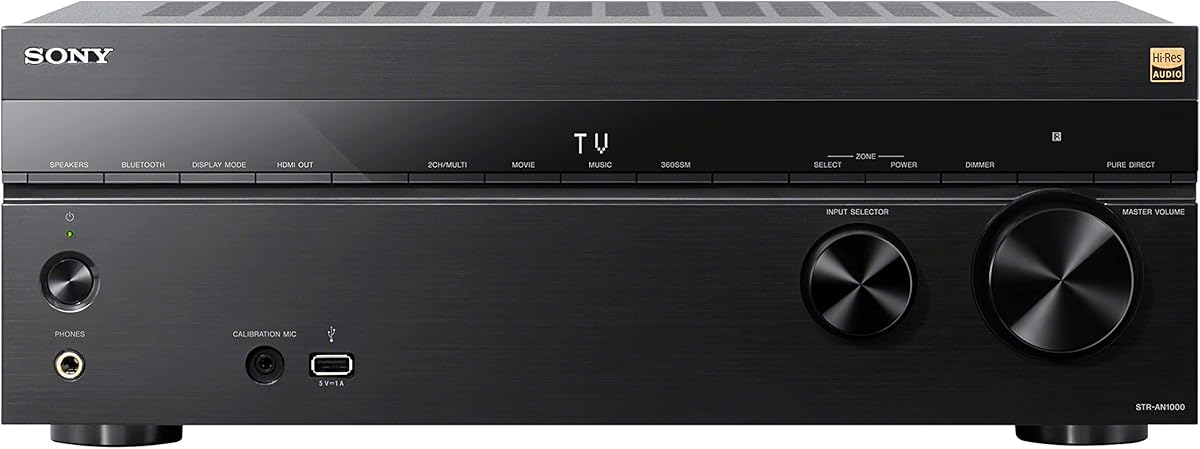
The Sony STR-AN1000 is the clearest match for this guide because its specifications explicitly identify both Zone 2 and Zone 3. It pairs a 7.2-channel home-theater amplifier with flexible multi-zone distribution, 8K and 4K/120 HDMI, and a 4.2 rating, making it the most complete three-zone option here.
We may earn a commission when you buy through this link, at no additional cost to you.
Its six HDMI inputs and two HDMI outputs are unusually flexible for a mid-to-high-end receiver. Dolby Atmos, DTS:X, Digital Cinema Auto Calibration IX, and 360 Spatial Sound Mapping create a strong theater platform. Bluetooth, Wi-Fi, Chromecast built-in, Spotify Connect, and Apple AirPlay cover convenient streaming paths.
The 165-watt rating is listed for six ohms, 1 kHz, one channel, and 0.9 percent total harmonic distortion, so it should not be treated as a guarantee of full output in every configuration. Zone 2 and Zone 3 also do not necessarily mean that every zone receives identical amplifier power or the same number of channels. Exact speaker and source assignments require verification in the setup menu and documentation.
This is the best recommendation for a household that genuinely wants a main theater plus two additional areas, particularly when the second area may carry video. It is also a strong standalone 7.2-channel receiver for rooms that never use the extra zones.
Unlike models that merely mention network multi-room streaming, the STR-AN1000 names dedicated Zone 2 and Zone 3 capabilities. That makes it the most practical choice in this list for distributing entertainment beyond the main theater.
Two HDMI outputs add useful routing options for a television in the main room and another display in a secondary area. Six inputs reduce source-switching limitations when several consoles, streamers, and disc devices are in use.
We may earn a commission when you buy through this link, at no additional cost to you.
The Denon AVR-X1700H is a polished 7.2-channel receiver with a 4.4 rating, strong 80-watt-per-channel amplification, extensive HDMI connectivity, and capable multi-room streaming. It is a particularly strong main-theater choice for buyers who want networked audio in other rooms but may not require three dedicated local zones.
We may earn a commission when you buy through this link, at no additional cost to you.
Three dedicated 8K inputs, one 8K output, and 8K upscaling on all six inputs provide generous high-resolution video support. Dolby Atmos, DTS:X, DTS Virtual:X, and Dolby Atmos Height Virtualization Technology expand the soundstage even without physical height speakers. The quick setup guide, color-coded rear connections, and two pre-outs make installation approachable.
HEOS, Wi-Fi, AirPlay 2, and Bluetooth enable simultaneous music in another zone while the main theater continues with a movie. The distinction is important: a HEOS zone streams compatible network music services rather than carrying every local source, and the supplied specifications do not identify a third dedicated local output.
The AVR-X1700H suits families wanting a polished central theater, flexible network music, voice control, and home-automation compatibility. It is also a strong general recommendation for gamers because of HDMI 2.1 features, 4K120, 8K60, VRR, and fast frame transport support.
Dolby Atmos Height Virtualization Technology can create virtual height effects when the physical speaker layout lacks dedicated overhead channels. This can make the system more immersive while leaving room for a later upgrade.
External control, IP control, remote monitoring, and voice support make the receiver practical for a connected home. HEOS also separates music listening in another room from full movie viewing in the theater.
We may earn a commission when you buy through this link, at no additional cost to you.
The Sony STRAZ3000ES is a premium 9.2-channel receiver designed for serious home theaters, complex installations, and buyers who want extensive processing and control. Its 4.0 rating reflects a high-end specification sheet rather than a simple application, with nine powered channels, dual HDMI outputs, and IP control integration.
We may earn a commission when you buy through this link, at no additional cost to you.
Its stated output includes 120 watts per channel into eight ohms under a two-channel test condition. Dolby Atmos, DTS:X, Digital Cinema Auto Calibration IX, and 360 Spatial Sound Mapping form the core of its sound system. Six HDMI 2.1 inputs and two outputs support 8K and 4K120 video, while the dual outputs allow more advanced display routing than most models here.
The premium ES positioning also brings a dense control and feature set, including a graphical setup interface, front-panel display, Chromecast built-in, Spotify Connect, Apple AirPlay, Bluetooth, Wi-Fi, and voice-assistant compatibility. However, the supplied information does not explicitly identify dedicated Zone 2 and Zone 3 outputs, so it should not be purchased on the assumption that it is a true three-zone receiver.
Choose the STRAZ3000ES for a dedicated premium cinema with enough speakers to justify a 9.2 layout and a custom installer who values control. It is less appropriate for a small room, a simple living-room system, or a buyer whose priority is a straightforward three-zone distribution network.
A 9.2-channel amplifier can create a more complete surround field than a 5.2 or 7.2 system, particularly with careful speaker placement. The extra channels must be used intentionally rather than treated as a substitute for good room design.
Seamless IP control integration and flexible setup options distinguish this model for custom-home environments. These capabilities are valuable when the receiver must work with a broader automation and control infrastructure.
We may earn a commission when you buy through this link, at no additional cost to you.
The most important decision is defining what three zones must do. A genuine multi-room home theater, a music-focused network system, and a receiver with two secondary speaker areas have different requirements, so channel count and zone terminology should be evaluated before comparing features.
Start by listing every room that needs sound, the sources each room must receive, and whether those areas need to operate at the same time. A receiver with Zone 2 and Zone 3 outputs, such as the Sony STR-AN1000, is a more direct fit than a model offering only network streaming. If secondary rooms mainly need music, a HEOS, MusicCast, or AirPlay 2 system may be sufficient and less complicated.
In short, count simultaneous local zones first. Do not assume that every multi-room streaming feature is equivalent to a dedicated amplifier zone.
A 5.2 receiver is appropriate for a straightforward theater with five speakers and subwoofers, while 7.2 models can add rear height effects. The 9.2-channel Sony STRAZ3000ES provides even greater channel depth but demands a large, carefully positioned speaker system. Also consider whether a secondary zone has room for a full surround layout or merely a pair of speakers.
Choose the smallest layout that supports your actual plan. Extra unused channels add cost, setup complexity, and no practical benefit.
A useful multi-zone receiver may allow different inputs, volume levels, and power states in each zone. Dedicated analog or HDMI zone outputs generally provide more predictable local control than a network player that must receive the source over a home network. HDMI routing also matters if a secondary room has its own television.
Verify whether zone controls are independent and whether the amplifier powers the zone directly. These details can determine whether extra equipment is required.
For modern displays and game consoles, look for the number of full-bandwidth HDMI inputs, eARC support, 4K120, and 8K60 where appropriate. VRR, ALLM, and Quick Frame Transport improve the gaming experience, while additional outputs enable separate displays. The Sony STR-AN1000 and STRAZ3000ES each provide six inputs and two outputs, which is useful for complex source arrangements.
Prioritize input count and supported gaming features over headline resolution alone. A receiver with the right connections can save constant cable changes.
Published wattage figures are often measured under specific conditions and should not be compared without context. Room dimensions, speaker sensitivity, impedance, and how many channels are active all affect real performance. A model rated at 60 or 70 watts per channel may be adequate for a modest room, while larger spaces may benefit from a receiver with a higher-rated power supply and more headroom.
Consider both amplifier output and speaker requirements. More watts do not correct poor placement, but adequate power can prevent distortion during demanding scenes.
Dolby Atmos and DTS:X are the two most relevant object-based formats to check, but height-speaker support and virtual height processing also affect the experience. A 5.2 receiver can often add Atmos height channels, as the Yamaha RX300A supports, while a 7.2 system can also provide rear overhead effects. DTS Virtual:X or Atmos Height Virtualization can help layouts with fewer physical height channels.
Match the processing to your speaker plan. Virtual effects cannot fully duplicate the placement and dimensionality of carefully installed overhead speakers.
Automatic calibration measures speaker placement, levels, and room characteristics to improve system balance. The Yamaha RX-A2A uses multipoint YPAO R.S.C., while Sony models use Digital Cinema Auto Calibration IX. A setup microphone is supplied with the Yamaha RX300A, and Denon provides an on-screen Quick Setup process. The sophistication of calibration is useful, but it cannot compensate for poor speaker placement.
Use calibration as a final refinement, not a substitute for correct distances, toe-in, crossover settings, and room treatment.
HEOS, MusicCast, AirPlay 2, Spotify Connect, Chromecast built-in, Bluetooth, and voice assistants determine how easily the system fits into daily life. Bluetooth Multipoint on the Yamaha RX300A can switch between two phones, while multiroom streaming on the Denon AVR-X1700H can let one person watch a movie as another plays music. For custom installations, IP control and graphical setup interfaces may matter more than consumer streaming services.
Choose the control ecosystem you already use. A familiar app, remote, and voice assistant can be more valuable than a long list of unfamiliar platforms.
Begin with a physical plan. Identify the main theater speakers, subwoofers, secondary rooms, television locations, and every source device. Assign each source to an input and determine which zone should receive it. Label cables at both ends, keep the receiver ventilated, and place it in a cabinet with enough clearance for its ventilation openings. Connect one device at a time and confirm that it appears on the intended television before moving to the next.
Run the receiver's calibration microphone from the primary listening position after setting speaker distances, levels, and crossovers. Listen to test passages before making permanent adjustments, and save separate calibration or sound profiles for different rooms if the model allows it. For independent zones, verify source selection, volume, mute, and power commands in each area. Confirm that a television in a secondary zone has the correct HDMI route and that its return-audio path is enabled or disabled intentionally.
Maintain the unit by keeping the ventilation path clear, avoiding stacked equipment that traps heat, and checking speaker-terminal connections periodically. Update the receiver's software and firmware when updates are offered, especially for streaming services and network features. Use streaming services that support the account's playback quality, and avoid pushing the amplifier to maximum volume for extended periods. When changing cables or moving equipment, power off the receiver and disconnect mains power first.
A three-zone receiver has dedicated controls and outputs for multiple local listening areas. Multi-room streaming generally sends compatible music services to separate network speakers or displays. The two methods can work together, but network streaming does not automatically carry local television audio, disc-player sources, or every surround channel.
The Sony STR-AN1000 is the clearest match because its supplied specifications explicitly list Zone 2 and Zone 3, along with two HDMI outputs. The Onkyo TX-NR6100 and Yamaha RX-A2A provide a dedicated Zone 2 but not a stated third zone. Always verify the exact output and source-routing behavior before purchase.
It can serve as the main theater while another compatible device handles music in another room. However, its five powered channels cannot simultaneously provide full surround sound in several areas. A network player, soundbar, powered speakers, or additional receiver may be required depending on the sources and control requirements.
It depends on the television, source devices, and viewing distance. A 4K120-capable television and current game console may benefit from the wider bandwidth even when most content is 4K. If the display and sources are 4K-only, prioritize amplifier power, speaker quality, calibration, and the number of useful connections instead.
Most households need one input each for a game console, streaming device, disc player, and television or tuner, with a fifth useful for another source. The Denon AVR-S570BT, Sony STR-AN1000, and Sony STRAZ3000ES provide four, six, and six inputs respectively. Count every permanent source rather than choosing only by today's minimum.
It depends on the receiver and its configuration. Some secondary-zone outputs are stereo only, while others can carry additional channels, but HDMI capabilities and the number of powered outputs also matter. Check the manual and connection guide to confirm whether a secondary zone supports surround playback, video, and independent source selection.
Room correction can improve tonal balance, speaker-level matching, and overall coherence, especially in a symmetrical or challenging room. It works best after accurate speaker placement, appropriate crossovers, and basic level adjustments. Automatic correction cannot overcome severe acoustic problems, so room treatment and careful speaker positioning remain important.
A stereo receiver with A/B switching can be useful for selecting between two pairs of speakers, as shown by the Sony STRDH190. It does not provide simultaneous independent control of three areas or cinematic surround decoding. A dedicated multi-zone receiver or a network-based speaker system is generally more appropriate when several rooms must operate at once.
The Sony STR-AN1000 stands out for buyers who genuinely need a main theater plus two additional zones, combining explicit Zone 2 and Zone 3 support with seven-channel amplification and flexible HDMI routing. The Yamaha RX300A is the most approachable value-oriented choice for Atmos, room correction, and flexible speaker layouts, while the Sony STRAZ3000ES represents the premium path for large theaters and custom installations.
Prioritize the type of zone coverage you actually need, not merely the largest channel count or the longest feature list. Verify speaker outputs, independent controls, source routing, and secondary-room video requirements. Then choose the amplifier power, immersive formats, calibration tools, streaming platform, and connectivity that suit your room and the rest of your equipment.
Finally, review the current listing and manufacturer documentation before ordering because receiver models, firmware, bundles, and prices can change. Confirm the exact zone count, included accessories, HDMI specifications, and speaker-terminal assignments so the selected system delivers the multi-room experience you intend.