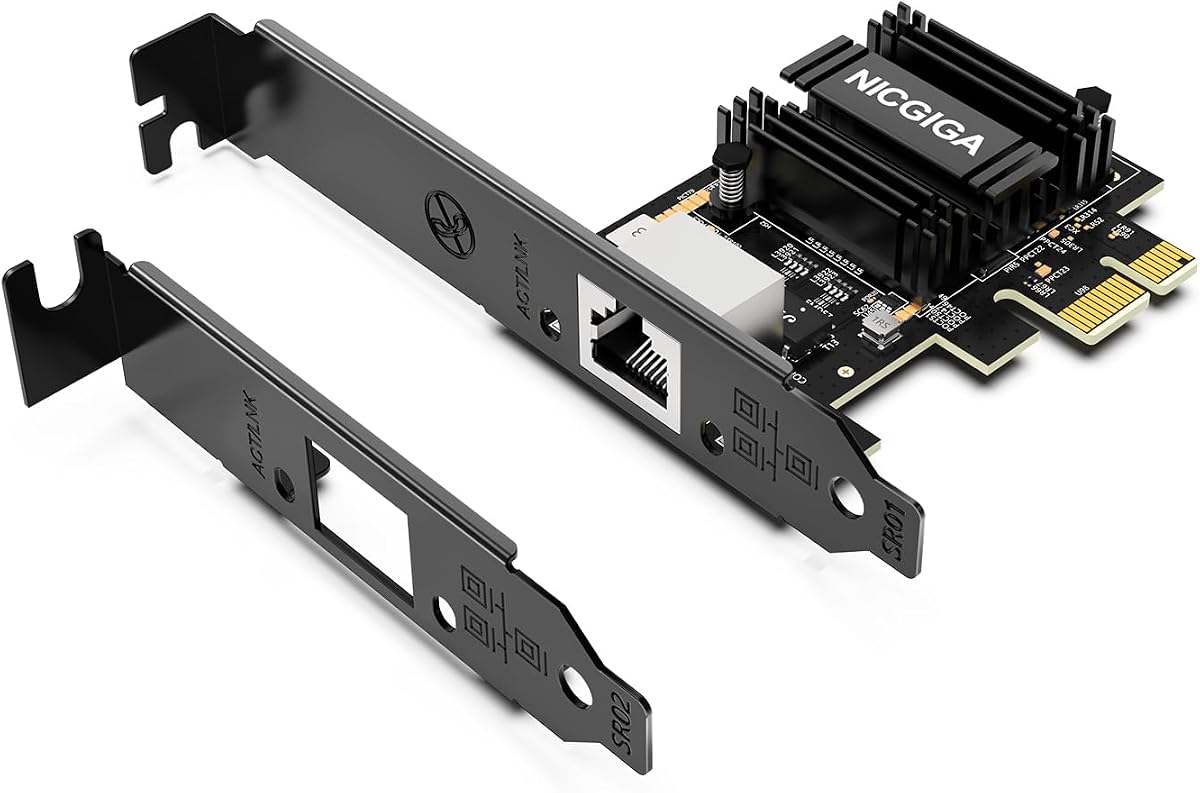
NICGIGA RTL8127
4.3Editor score
Compact PCIe 4.0 x1 design
Broad multi-gig support
Windows and Linux support
Our 10GB Ethernet Card guide compares 10 PCIe, RJ45, SFP+ and USB-C adapters for speed, compatibility, ports, features and fit.
A 10GB Ethernet Card can transform a compatible computer by adding fast, reliable wired networking for NAS storage, large backups, media workflows, home labs and gaming. The right card depends on connector type, PCIe fit, operating system, cooling, cable requirements and whether you need one or two ports.
We compared ten options using their supplied specifications, covering single-port and dual-port RJ45 cards, SFP+ fiber adapters, server-focused models and a USB-C alternative. The guide considers link speeds, multi-gig support, included brackets, chipset capabilities, operating-system compatibility and installation constraints.
Each pick reveals which users it best serves, from a compact PCIe 4.0 x1 upgrade to a purpose-built Synology storage option. Ratings and product details reflect the supplied marketplace information, while availability and pricing can change, so verify the current listing and hardware requirements before ordering.
4.3Editor score

4.2Editor score

4.3Editor score
This side-by-side comparison highlights each adapter's interface, port configuration, speed support and intended installation environment, helping you narrow the field before checking fit, drivers and cabling.



The TP-Link TX401 is a single-port PCIe 10GB Ethernet Card rated 4.2 stars. It combines 10GBase-T performance with automatic negotiation across 10, 5, 2.5, 1Gbps and 100Mbps, making it a practical choice for systems that may not yet have matching 10G infrastructure.
We may earn a commission when you buy through this link, at no additional cost to you.
Its strongest practical advantages are an included 1.5-meter CAT6A cable, QoS prioritization and compatibility with both standard and low-profile brackets. The supplied information also lists Windows 10, 8.1, 8 and 7, several Windows Server releases and Linux, giving it broad relevance for desktop, workstation and server-style installations.
The main limitation is that a single RJ45 port cannot provide the immediate link redundancy or aggregation of a dual-port adapter. Its supplied rating is also modest compared with several newer options. Nevertheless, the TX401 avoids the narrower speed limitations of some X540-based cards while offering useful installation flexibility.
Choose the TX401 when you want a recognizable-brand, single-port upgrade with a high-quality cable included and backward compatibility with existing multi-gig equipment. For most home and professional users building one fast wired connection, it offers the most balanced package in this list.
Automatic negotiation allows the TX401 to operate with 10G switches while remaining compatible with 5G, 2.5G, 1G and 100Mbps links. This is useful when upgrading before the entire network is ready for 10Gbps.
Including both full-height and low-profile brackets makes the card more adaptable to mini towers and compact systems. A free PCIe slot and adequate case clearance still need to be confirmed before purchase.
We may earn a commission when you buy through this link, at no additional cost to you.
The VIMIN 10G PCI-E Network Card has a 4.5-star rating and stands out with two 10Gbps RJ45 ports. It uses the Intel X540-T2 controller and is aimed at servers and high-end devices that need more than one high-speed copper connection.
We may earn a commission when you buy through this link, at no additional cost to you.
Its dual-port layout provides options for separate networks, link redundancy where supported by the configuration, or a second high-speed link. A heat sink is included for sustained operation, while standard and slim brackets accommodate different server and device heights. The supplied data lists Windows, Windows Server, Linux and VMware compatibility.
The important caveat is explicit: this card does not support 2.5G or 5G operation. Against a 2.5G or 5G network device, it will operate only at 1Gbps. It also requires a physically appropriate PCIe x8 slot, even though it can operate in a compatible x16 slot.
This is a compelling budget-oriented choice for a server or workstation that specifically needs two 10G RJ45 connections and has a suitable Intel X540 environment. It is a poor match for an upgrade built around 2.5G or 5G multi-gig hardware, where the RTL8127 alternatives make more sense.
The twin RJ45 configuration offers more connection flexibility than a single-port card. It can support dual high-speed segments or be paired with a second adapter for a redundant topology, subject to software and switch configuration.
The included heat sink and gold-finger interface are intended to promote stable operation during heavy use. Server ventilation and an unobstructed card position remain important because a cooler chassis is still necessary.
We may earn a commission when you buy through this link, at no additional cost to you.
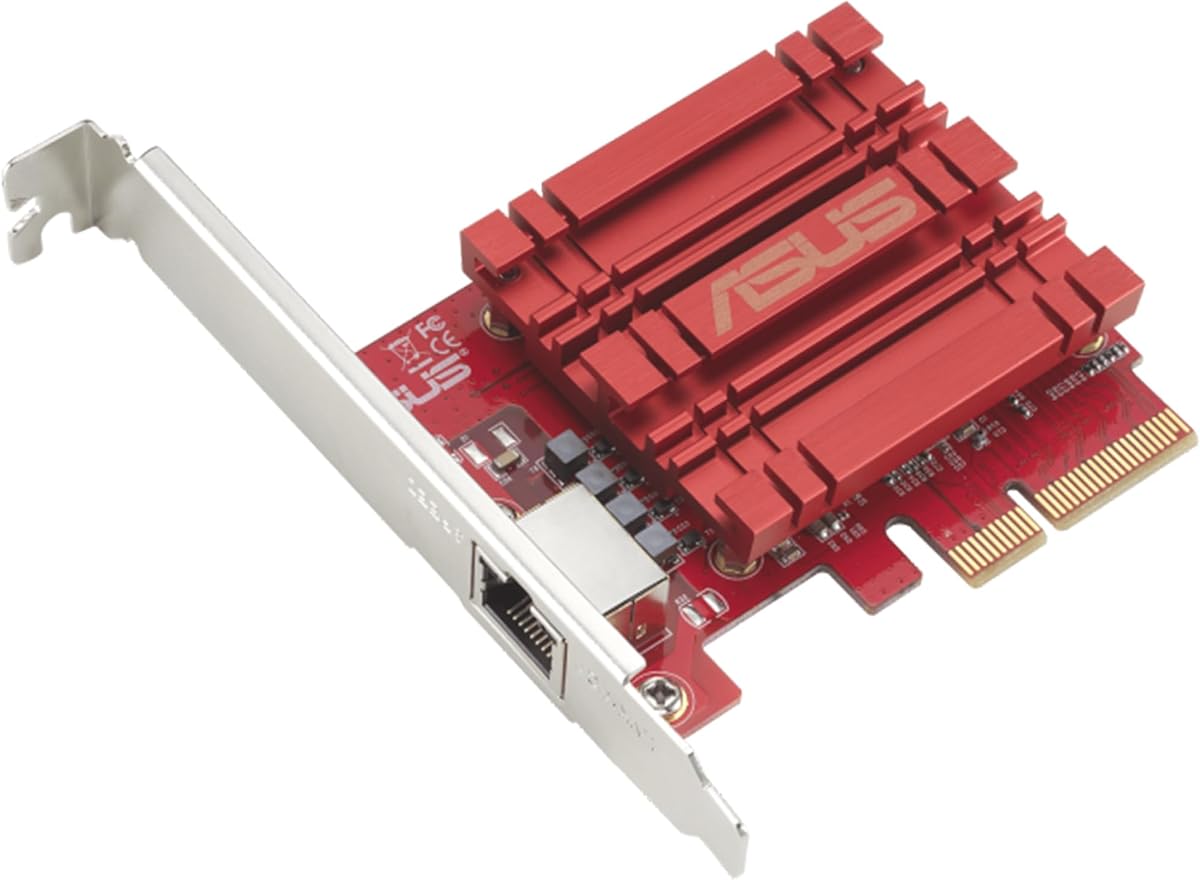
The Asus NADACA0140 is a single-port RJ45 card rated 4.1 stars. It offers the full speed ladder from 10Gbps down to 100Mbps, allowing it to fit into mixed 10G, 5G, 2.5G, 1G and 100Mbps environments without changing adapters.
We may earn a commission when you buy through this link, at no additional cost to you.
Its compatibility list includes Windows 10, 8.1, 8 and 7 plus several Linux kernel versions, giving it broad desktop and server applicability. QoS can prioritize selected data and supported packets, while the standard RJ45 connection makes it easier to deploy with familiar copper cabling.
Unlike the VIMIN and 10Gtek X540 cards, this model is not presented as a dual-port server adapter. It also has a lower supplied rating than the leading alternatives, and its older platform compatibility list does not mention newer Windows releases. The buyer should still validate the current driver path for the exact operating-system version.
The NADACA0140 suits a desktop that needs one high-speed RJ45 connection and benefits from backward compatibility across every common multi-gig rate. It is especially sensible when the local switch or NAS may be upgraded gradually rather than all at once.
Supporting the complete multi-gig range reduces the risk of buying a card that locks onto 1Gbps with a faster switch. The final negotiated rate still depends on the adapter, peer device, cable and switch configuration.
Built-in QoS gives selected applications or packet classes priority. That can be helpful when latency-sensitive traffic shares a link with large transfers, although correct configuration is essential.
We may earn a commission when you buy through this link, at no additional cost to you.
The 10Gtek X540-10G-2T is a dual-port RJ45 server card built around the original Intel X540 controller. Its 4.1-star rating reflects a feature-focused option for Windows, Linux and ESX environments that need two 10G copper connections.
We may earn a commission when you buy through this link, at no additional cost to you.
The card supports server operating systems including Windows Server 2003 through 2012 and Windows 7, 8 and 10, along with Linux and ESX/ESXi. Storage-over-Ethernet protocols such as iSCSI, FCoE and NFS are listed among supported use cases, and the included low-profile bracket broadens case compatibility.
One notable limitation is the lack of hot-swap support. Windows 11 can be used, but the supplied information says manual setup and an installation guide are required. The stated cable reach is also specific: Category 6A supports up to 100 meters, while Category 6 is listed up to 55 meters.
This card is a strong candidate for an existing server or homelab that values the Intel X540 feature set, dual ports and broad virtualization support. It is less convenient for a modern desktop requiring simple plug-and-play behavior in every supported operating system.
Using the original X540 controller provides access to the established offload features highlighted in the product information. Those capabilities are particularly relevant to storage-heavy servers and sustained network workloads.
Windows Server, Linux and ESX/ESXi coverage makes this more useful in infrastructure-oriented systems. Confirm the exact operating-system build, driver and virtualized hardware passthrough requirements before deploying it.
We may earn a commission when you buy through this link, at no additional cost to you.
The NICGIGA RTL8127 combines a compact PCIe 4.0 x1 interface with a single 10Gbps RJ45 port. Its 4.3-star rating and support for the complete multi-gig speed range make it particularly interesting for mini PCs, ITX builds and compact workstations.
We may earn a commission when you buy through this link, at no additional cost to you.
The card fits physically compatible x1, x4, x8 and x16 slots without requiring a full x16 lane allocation. It supports 10, 5, 2.5, 1Gbps and 100Mbps, Wake-on-LAN, Windows 11 and 10, Windows Server 2019 and 2022, and modern Kernel 6.x Linux distributions.
Older Linux Kernel 5.x systems may require the Realtek official driver source, so operating-system version deserves particular attention. The supplied description also emphasizes efficient operation and reduced heat relative to older 10GbE chips, although actual workload and chassis cooling still determine temperatures.
This is an excellent selection for a compact system that lacks a native 10G port but has an available PCIe slot. It combines modern multi-gig flexibility with a narrower physical requirement than many full-size server adapters.
A PCIe 4.0 x1 interface makes 10GbE accessible in systems where lane allocation is limited. The card can fit several physical slot sizes, although users should verify that the installed card does not obstruct neighboring components.
Native support for current Windows and Kernel 6.x Linux systems simplifies adoption on newer machines. Legacy distributions may need additional driver work, making the operating-system check an essential part of buying.
We may earn a commission when you buy through this link, at no additional cost to you.
The VunLink RTL8127AT is a compact, single-port 10GbE card intended for NAS, server, workstation, gaming and home-lab systems. Its 4.3-star rating reflects a well-rounded combination of multi-gig support, a PCIe 4.0 x1 interface and broad modern platform compatibility.
We may earn a commission when you buy through this link, at no additional cost to you.
Automatic negotiation covers 10, 5, 2.5, 1Gbps and 100Mbps, making it practical for both current 10G infrastructure and slower transitional equipment. The card supports Windows 10 and 11, Windows Server and mainstream Linux systems, while the supplied details note that driver installation may be required.
Compatibility with specific NAS platforms, virtualization environments and Linux distributions can vary by OS version and kernel. That makes this a card to buy only after checking the exact system, rather than relying solely on the broad Windows and Linux labels. The single-port design also cannot provide native dual-link redundancy.
The RTL8127AT is a good general-purpose choice for a PC that needs one high-speed wired connection and values future compatibility with lower-speed network equipment. It is especially useful for high-speed file transfers, cloud storage access and NAS workflows when the surrounding hardware can sustain 10G.
The full multi-gig range makes the adapter adaptable to routers, switches and NAS systems at different stages of upgrade. A Cat6a cable and compatible 10G peer are recommended for the advertised maximum link rate.
The controller is designed for lower power consumption and reduced heat output. The enclosure and system airflow still matter, but the compact design is beneficial in smaller workstations and servers.
We may earn a commission when you buy through this link, at no additional cost to you.
The Asus XG-C100F is an SFP+ network card that supports 10Gbps networking through fiber optic or Direct-Attach Copper connections. Its 4.3-star rating and flexible cage make it the premium choice here for installations that value connection-path options over simple RJ45 convenience.
We may earn a commission when you buy through this link, at no additional cost to you.
Fiber support allows high-speed transmissions over greater distances than ordinary copper cabling, which can benefit building-to-building links, server rooms and long runs. The SFP+ cage also accepts compatible direct-attach copper solutions, while an aluminum heatsink helps control temperature during performance-intensive work.
This is not a standard RJ45 card, so the target device and switch need compatible SFP+ connectivity or appropriate modules and cabling. The specifications also describe a 0 to 40°C operating range, making environmental placement relevant in managed infrastructure installations.
The XG-C100F is best for administrators who need fiber flexibility, long-distance links or a deliberate SFP+ topology. For a conventional desktop connected directly with copper, an RJ45 model will usually be simpler and less demanding to deploy.
The SFP+ cage accepts both fiber optic and Direct-Attach Copper connections, allowing the physical network path to evolve without changing the card. Module, switch and cable compatibility must all be verified.
The integrated aluminum heatsink is intended to dissipate heat during high-performance tasks. Good chassis airflow remains valuable, particularly in tightly packed servers and rack-mounted equipment.
We may earn a commission when you buy through this link, at no additional cost to you.
The Synology E10G30-T2 is a two-port 10GbE RJ45 adapter designed specifically for Synology systems. It carries the highest supplied rating in the group at 4.6 stars and is aimed at users who want to expand high-performance storage networking within a compatible Synology platform.
We may earn a commission when you buy through this link, at no additional cost to you.
Both ports support storage applications, while automatic negotiation moves between 10Gbps and 1Gbps links. The focused design and five-year warranty add confidence for users who want an adapter designed around a known hardware ecosystem rather than a generic PCIe card.
Its scope is narrow. It requires a compatible Synology system, and the supplied information specifies DSM 7.1.1-42962 Update 5 or later. Buyers outside the Synology ecosystem should treat the product's strong rating and warranty as ecosystem-specific rather than evidence of universal compatibility.
This is the clear choice for a compatible Synology user who needs two dedicated 10GbE connections for storage. It is not a general-purpose desktop upgrade, but within its intended environment it offers focused hardware and a stronger supplied rating than the alternatives.
Two 10GbE ports allow compatible Synology systems to expand fast storage connectivity. Users can aggregate or bond links only when their DSM version, switch, cabling and storage configuration support the intended topology.
Purpose-built hardware and a five-year warranty can simplify ownership within the Synology environment. Always consult the current compatibility list and DSM release notes before installation.
We may earn a commission when you buy through this link, at no additional cost to you.
The TRENDnet TEG-10GECTX is a single-port 10GbE adapter rated 4.1 stars. It uses a PCIe 3.0 x4 interface and supports 10, 5, 2.5, 1Gbps and 100Mbps, combining broad speed flexibility with a simple RJ45 connection.
We may earn a commission when you buy through this link, at no additional cost to you.
The card supports modern Windows releases, including Windows 11 and 10, Windows Server 2022, 2019, 2016 and 2012 R2, plus listed earlier Windows versions. Standard and low-profile brackets support different case designs, and LED indicators provide a visible connection status.
Its physical x4 interface means a system must provide an appropriate PCIe x4 slot or a compatible larger slot. Although 2.5GBASE-T can run over standard Cat5e for up to 100 meters, full 10G performance still requires a suitable cable and network peer. The listed standards include 10GBASE-T, 2.5GBASE-T, VLAN and link aggregation features.
The TEG-10GECTX is a balanced general upgrade for a desktop or server that needs one flexible multi-gig port. Its three-year manufacturer protection and broad operating-system list are useful, although newer RTL8127-based cards may appeal more to users seeking a narrower x1 footprint.
Support for 10GBASE-T and 2.5GBASE-T provides a useful migration path. Existing Cat5e can serve 2.5G or 5G links in suitable runs, while 10G generally calls for higher-grade cabling.
The operating-system list includes current client and server releases, while included brackets support compact and full-size cases. Verify driver availability for your exact Windows build or alternative operating system.
We may earn a commission when you buy through this link, at no additional cost to you.
The Cable Matters USB-C to 10Gb Ethernet Adapter is the most portable entry in this guide. Rated 3.9 stars, it uses a Realtek RTL8159 USB 10G controller to add wired networking to compatible USB-C, USB4 and Thunderbolt systems without opening a computer case.
We may earn a commission when you buy through this link, at no additional cost to you.
It negotiates 10, 5, 2.5, 1G and 100M, making it useful for NAS access, backups, media workflows and gaming. The supplied information recommends USB 3.2 Gen 2×2 with 20Gbps bandwidth or higher for the best results, while noting that real Windows throughput is commonly around 7Gbps depending on the setup.
macOS behavior differs. The product information says a Mac may report a 5Gb link with typical real-world throughput around 5Gbps, depending on the model, equipment, cable and test method. It is also incompatible with Android and Xbox One S, so USB-C alone does not guarantee universal support.
This adapter is ideal for a laptop or compact workstation that lacks a usable PCIe slot and has a high-bandwidth USB-C port. It is less appropriate when maximum 10G throughput is the only goal, because the USB bus and host implementation introduce a different performance ceiling.
The adapter turns a modern high-speed USB-C port into a multi-gig RJ45 connection. This makes it convenient for travel kits, docks and systems where installing an internal card would be inconvenient.
An aluminum housing, thermal silicone and a heat sink help dissipate heat from the RTL8159 controller. The fanless design operates silently, but adequate clearance around the connector is still important.
We may earn a commission when you buy through this link, at no additional cost to you.
The best 10GB Ethernet Card depends on your system layout, network hardware, cable standards and performance goals. Start with the connector and PCIe requirements, then examine speed negotiation, thermal design, driver support and the number of ports you actually need.
Check the card's physical interface before considering network speed. Options range from the compact PCIe 4.0 x1 design used by the NICGIGA and VunLink cards to x4, x8 and x16 server cards. A card may fit a larger lane slot, but the physical connector still needs to match and adequate clearance must remain for neighboring components.
Also verify bracket requirements and case depth. Several products include both standard and low-profile brackets, which helps with mini towers and compact systems, but a bracket alone cannot guarantee a fit. Measure the available slot area and check whether the card would interfere with a graphics card, cooler or expansion card.
Choose a slot and bracket combination that matches your chassis.
RJ45 cards work with conventional copper Ethernet cabling and are generally the simplest choice for a home or office network. SFP+ cards require a compatible cage, module, switch and cabling, but they provide greater deployment flexibility, including long-distance fiber links. USB-C adapters are portable and avoid internal installation, although the host USB connection influences performance.
Match the connector to the equipment already in your network rather than buying a more specialized card than you need. A high-speed RJ45 adapter is ineffective without a 10G switch, router or NAS, and an SFP+ card cannot connect directly to an ordinary RJ45 port without the appropriate module or cable.
Use the connector already supported by your network gear.
Maximum 10Gbps is only one part of a functioning connection. The card, switch, peer device, cable and operating system must all support the intended rate. Multi-gig auto-negotiation is useful because it allows the same card to work with 5G, 2.5G, 1G and 100Mbps equipment during a gradual upgrade.
Full 10G over copper generally calls for high-quality CAT6A or better, although the acceptable distance depends on the installation and standards. The 10Gtek specification specifically lists Category 6A up to 100 meters and Category 6 up to 55 meters. For lower multi-gig rates, Cat5e may be sufficient in appropriate runs.
Budget for a suitable cable and compatible network endpoint.
A single-port card is sufficient when the computer needs one high-speed uplink. It may be easier to install, less expensive and more appropriate for a laptop replacement or a simple NAS workstation. Dual-port models provide more options for separate network segments, link aggregation or redundancy, but they often occupy more space and require careful software and switch configuration.
Do not assume two physical ports automatically create a redundant connection. The operating system, driver, switch, VLAN plan and application traffic must support the intended use. For a Synology storage system, a specifically compatible dual-port adapter may provide a cleaner path than configuring a generic server card.
Choose extra ports only for a defined networking need.
Check compatibility for the exact operating-system release, not merely the product family. Some cards list broad Windows and Linux support, while the newest Realtek options emphasize modern Windows 11 and Kernel 6.x systems. Older Linux kernels may require installation through the manufacturer's driver source, and virtualized environments may impose additional requirements.
Synology's E10G30-T2 is intentionally limited and specifies a minimum DSM update level. The 10Gtek card works with Windows 11 according to its listing but requires manual setup. USB adapters may need a current Realtek driver on older Windows versions or certain Linux kernels, so keep the latest operating-system updates installed.
Verify exact OS, kernel and driver requirements first.
Fast Ethernet controllers can generate meaningful heat, especially during sustained transfers. Cards with an integrated heat sink or aluminum housing have an advantage in compact cases and rack-mounted servers. The X540-based options are particularly relevant to demanding server workloads, while the RTL8127 cards are described as lower-power and cooler-running alternatives.
Thermal performance depends on the entire system, not just the advertised chipset. Confirm that the card has clearance for airflow, avoid placing it directly beside a hot component, and make sure the chassis has adequate ventilation. A low-profile position may also have less airflow than an open full-height slot.
Prioritize cooling for servers and compact builds.
Quality-of-Service features can prioritize latency-sensitive or important traffic when a link carries mixed workloads. The TX401, Asus NADACA0140 and XG-C100F explicitly highlight QoS. This is useful for gaming, interactive applications and storage transfers, but it only helps when traffic is classified and configured correctly.
For NAS and server systems, also examine protocol support, offload capabilities and virtualized networking features. The 10Gtek X540 card lists iSCSI, FCoE and NFS, while the VIMIN card emphasizes server and VMware compatibility. These platform-specific details can be more meaningful than headline speed for infrastructure buyers.
Match traffic controls to your application mix.
Support and warranty terms can matter significantly when a card is installed in a server or used for critical storage workflows. The Synology adapter includes a five-year warranty, the TP-Link TX401 includes a two-year warranty and 24/7 technical support, while 10Gtek lists a three-year warranty and lifetime technology support.
Look beyond the warranty to the availability of installation guidance and compatibility documentation. A recognized vendor with clear operating-system lists, brackets and driver instructions can make installation smoother. For proprietary hardware, ecosystem-specific documentation may be even more valuable than a longer generic warranty.
Compare support, documentation and warranty together.
Before installation, power the computer down completely, unplug the power cable, discharge residual power and open the case according to its manual. Identify a compatible PCIe slot, remove the appropriate rear-panel cover and attach the correct bracket. Check that the card, cooler and graphics card will have sufficient clearance.
Seat the PCIe card firmly and secure it with the appropriate screw or latch. Reconnect power, boot the system and install any required driver. For an RJ45 card, connect a compatible switch or peer and confirm the negotiated link rate in the operating system's network settings. For SFP+ and USB-C solutions, install the correct module or connect the specified cable and verify that the host supports the required bandwidth.
After installation, monitor adapter speed, link stability, temperature and system performance. Keep the card area clear of dust, use supported cables without sharp bends and retain low-profile or full-height brackets for future system changes. Update drivers and operating-system software as needed, and test both the negotiated rate and real workload throughput rather than assuming the advertised link speed is always available.
Only if the rest of the connection can support the higher speed. A local NAS, switch, server and client may benefit from 10Gbps transfers, while a slower internet package remains the limiting factor. A local or internet provider can also impose its own speed limits.
The system needs a compatible physical PCIe slot and an operating system with suitable driver support. Slot size requirements vary from x1 to x8 or x16 among the listed products, and proprietary cards such as the Synology E10G30-T2 require compatible Synology hardware. Check the full system requirements before buying.
You need at least one compatible 10G network endpoint on the other side of the link. That could be a switch, router, NAS, server or directly connected PC with a matching adapter. If the connected device only supports 1Gbps, the card normally negotiates downward even if it is capable of 10Gbps.
Use high-quality CAT6A or better for dependable full 10Gbps copper networking over appropriate distances. Some installations can achieve 10G over CAT6 under favorable conditions, but cable quality and installation matter. The 10Gtek specification lists Category 6A up to 100 meters and Category 6 up to 55 meters.
A PCIe card usually provides a more direct and potentially more consistent path to the host than a USB-C adapter. USB-C is easier to carry and works without opening a case, but throughput depends on the USB standard, controller, cable and host. A USB 3.2 Gen 2×2 or higher connection is recommended for the fastest USB option.
Yes, provided the card supports lower speeds and auto-negotiation. Most choices listed here can operate at 1Gbps or 100Mbps, while the VIMIN X540 card specifically states that it will use 1Gbps with 2.5G or 5G devices. The connection will be limited by the slower device and cable.
Driver requirements depend on the card and operating system. Newer Windows and mainstream Linux systems may recognize compatible Realtek devices automatically, while older Linux kernels or certain Windows versions may need a manufacturer-provided driver. Windows 11 use of the 10Gtek card is listed as requiring manual setup.
It may be possible if the motherboard has enough compatible PCIe slots, adequate power, space and cooling, and the operating system supports multiple adapters. You would also need the intended networking configuration, such as separate links, aggregation or redundancy, supported by the switch, drivers and applications.
The TP-Link TX401 is the strongest all-around choice for a single-port desktop upgrade because it combines broad multi-gig negotiation, included CAT6A cabling and both bracket styles. The NICGIGA RTL8127 stands out when a compact PCIe 4.0 x1 design matters, while the Asus XG-C100F leads the premium field for flexible SFP+ fiber and copper connectivity.
Prioritize the parts of the system that can prevent a 10G link from forming: the motherboard slot, operating-system drivers, switch, peer device and network cable. Multi-gig support provides useful flexibility, while dual ports, X540 offloads or SFP+ modules should be selected only when the intended workload genuinely needs them.
Marketplace listings, ratings, availability and pricing can change, so confirm the current product page, driver instructions and compatibility list before purchasing. Also review the advertised 10Gbps link rate separately from real-world throughput, which depends on the host interface, cable, equipment and workload.