
6000W Power Inverter 12V DC to 120V AC
4.3Editor score
6000W continuous modified sine output
12000W peak surge capacity
Four AC outlets and charging ports
Wired LCD remote controller
Temperature-controlled quiet cooling
Compare 10 6000W Inverter, with key specifications, product ratings, pros and cons to help you choose.
A 6000W inverter can provide substantial off-grid capability for an RV, truck, backup system, or mobile worksite, but advertised wattage does not tell the entire story. Continuous output, input voltage, waveform quality, cooling, protection, and charging options all shape real-world usefulness.
This guide compares ten inverters selected for the 6000W category, covering pure sine wave, modified sine wave, and integrated solar models. The comparison considers power ratings, electrical configuration, outlets, displays, remote controls, cooling, protection, and suitability for different appliances and mobile or stationary systems.
Each review explains the model's strongest use case, notable limitations, and the equipment it is best equipped to serve. Ratings are included only when supplied, and unavailable ratings are represented as zero. Retail pricing and availability change over time, so confirm current listing details before purchasing.
4.3Editor score

3.9Editor score

3.7Editor score
The table below compares all ten models by output type, system voltage, connectivity, and primary strengths, making it easier to separate basic vehicle inverters from advanced off-grid and home backup systems.
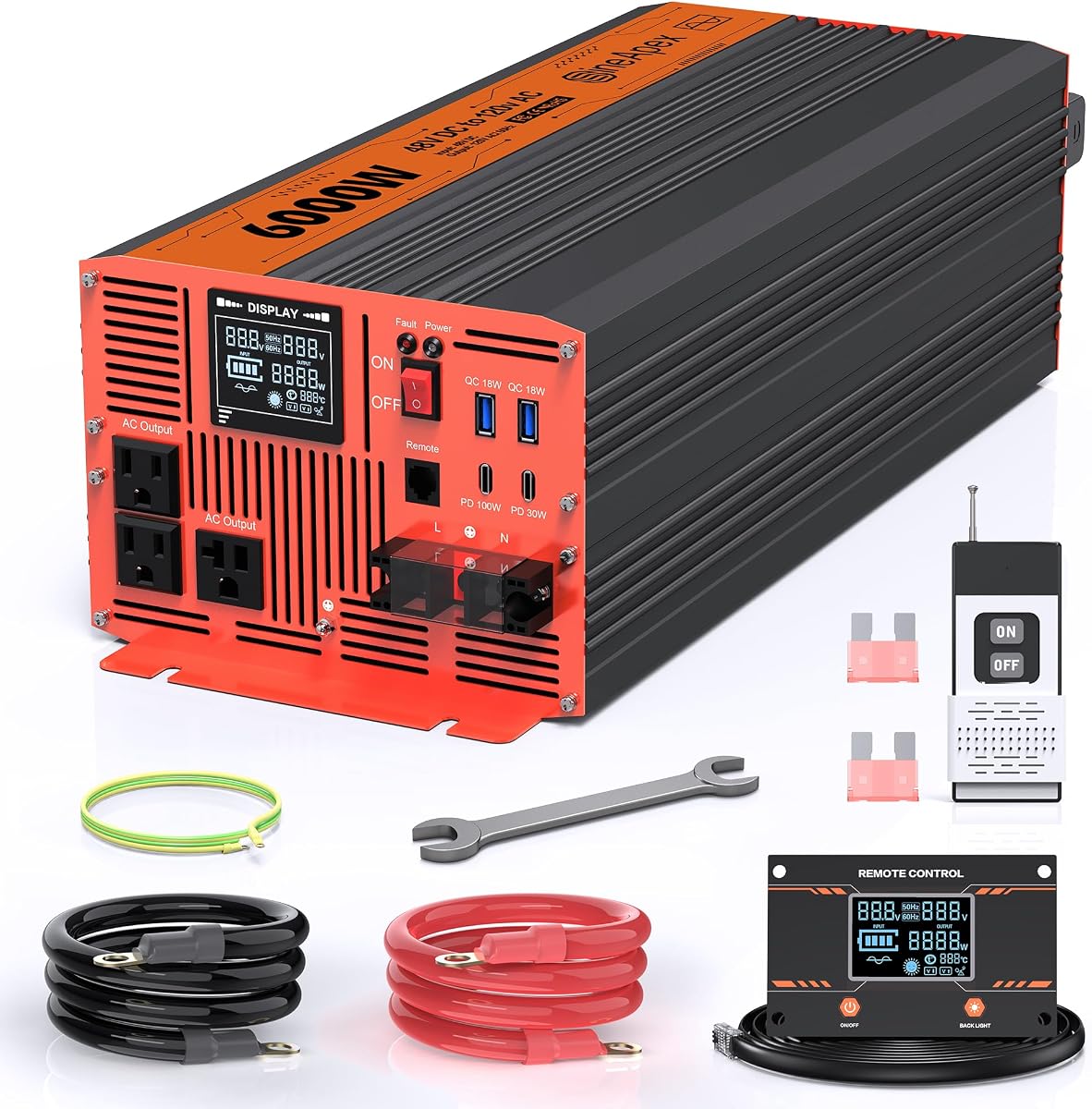




The SineApex listing is a feature-rich pure sine wave inverter aimed at RV, truck, emergency, and mobile power users. No customer rating was supplied, but the specification highlights a clean waveform, a bright status screen, multiple charging outputs, and a 21-foot remote-control cable.
We may earn a commission when you buy through this link, at no additional cost to you.
Its most appealing feature is the combination of dual AC receptacles, a 20A outlet, USB-A charging, and USB-C power delivery. The screen reports input and output voltage, battery condition, load status, and operating conditions, while the remote makes it possible to manage the unit when it is mounted outside immediate reach.
The main complication is naming and output clarity. Although the product title emphasizes 6000W and 12000W surge power, the detailed description identifies 3000W as continuous output from a 12V source. The title also refers to 48V input while the feature text discusses a 12V-to-120V configuration and a 12V-to-110V version. Buyers should therefore verify the exact variant received rather than assuming the headline describes continuous power.
This is a compelling choice for someone who values clean output, flexible charging, remote operation, and protection features more than uncomplicated labeling. It is best suited to sensitive electronics and mobile installations, provided the battery, cable, ventilation, and actual continuous-output configuration match the user's requirements.
Pure sine wave output is especially relevant to televisions, audio equipment, medical devices, and other loads that may behave poorly with abrupt waveform transitions. The stated efficiency above 91% also makes the inverter relevant to battery-powered installations where conversion losses matter.
The included remote and real-time display reduce the need to reach into a dark cabinet, crowded truck bed, or RV compartment. Input voltage, output voltage, battery status, and load information can help users identify undersized batteries, overloads, or changing operating conditions.
We may earn a commission when you buy through this link, at no additional cost to you.
This 6000W pure sine wave inverter is positioned for RV, truck, SUV, and home-backup applications. It has no supplied customer rating, but its listed THD of 3% or less, 92% conversion efficiency, LED status display, and six protection functions make it relevant to users who value clean and monitored power.
We may earn a commission when you buy through this link, at no additional cost to you.
The inverter is designed around the restricted electrical environment of a moving vehicle. Low battery voltage, over-battery voltage, overload, short circuit, excessive temperature, and reverse polarity are monitored, with red alerts and alarms intended to prevent continued operation under unsafe conditions. An auto-adjusting fan is also described as reducing noise inside occupied cabins.
Its charging provision is less elaborate than that of several rivals, consisting of 18W USB ports for phones and tablets. A 6000W continuous rating and 12000W surge capacity are attractive for car refrigerators, GPS equipment, CPAP machines, stereos, and small appliances, although the title's mention of 60V and the absence of a clearly stated input voltage warrant verification before installation.
The model makes the most sense for travelers who need pure sine wave output, clear fault reporting, and quiet cooling in an RV or truck. It is less compelling for a stationary installation that needs multiple AC sockets, advanced charging modes, or a wired system display, but it remains a focused automotive solution.
Automotive use brings constant vibration, changing battery voltage, heat, and limited installation space. The stated protective monitoring and auto-recovery behavior are therefore important features for anyone running continuous or sensitive equipment inside an RV, truck bed, or SUV.
A temperature-responsive fan that increases cooling only when needed helps limit cabin noise. This is particularly useful when powering refrigerators, stereos, communications equipment, or health-related devices during travel and overnight stops.
We may earn a commission when you buy through this link, at no additional cost to you.
The 6000W 60V model is a pure sine wave converter designed for RVs, trucks, cars, camping, emergency use, and solar installations. Its LCD screen displays temperature, battery status, input and output voltage, consumed power, and protection reasons, offering one of the more informative monitoring interfaces in this group.
We may earn a commission when you buy through this link, at no additional cost to you.
Dual temperature-controlled fans stop when the inverter is at or below 45°C and start at or above that threshold. A soft-start function is also included, alongside protection for overvoltage, overload, overcurrent, undervoltage, excessive temperature, and short circuits. These features make the unit appealing for users who want visible diagnostics rather than a simple power switch.
The selected configuration is 60V DC to 110V AC, which narrows its audience compared with a 12V automotive model. A 60V battery bank requires careful voltage matching, appropriate cabling, and compatible charge and battery systems. The enclosure is described as an aluminum-magnesium alloy shell designed to resist drops and collisions.
This inverter is a strong option for technical off-grid users who already use a 60V system and value comprehensive status information. It is less convenient for someone expecting to connect directly to a standard vehicle battery, although the product family indicates that other voltage variants are available.
The LCD makes it possible to see why protection has activated instead of guessing from a silence or shutdown. Monitoring battery state, output voltage, load use, and temperature gives operators useful information when diagnosing an overloaded circuit or undersized battery bank.
The two-fan system starts around 45°C, balancing thermal management with noise reduction. A durable housing and controlled cooling are useful for mobile installations subject to vibration, confined mounting spaces, and changing ambient temperatures.
We may earn a commission when you buy through this link, at no additional cost to you.
The Smart Display Inverter is presented as a portable pure sine wave unit for cars, camping, outdoor work, and mobile power. It supports 12V, 24V, 48V, and 60V input options and provides 220V AC output, making it more adaptable than a conventional 12V vehicle inverter.
We may earn a commission when you buy through this link, at no additional cost to you.
Its digital screen provides operating feedback, while cooling fans help prevent overheating. The thickened shell uses a raised surface design intended to improve heat dissipation and resist compression or impact, both useful qualities in a portable product that may be moved frequently.
The listing includes references to both 6000W and 3000W or 4000W options, which suggests a family of configurations rather than one fixed specification. Exact continuous output, surge behavior, port details, and protection functions are not fully defined in the supplied information. Users should therefore treat the selected 220V configuration as a starting point and verify the physical label before connecting important equipment.
The model appeals to buyers who need portable AC power from several possible DC sources. It is especially relevant for camping, mobile workshops, and outdoor projects where 220V appliances are needed, but it is less ideal for buyers seeking a fully specified 12V RV package with multiple AC receptacles and an included remote.
Supporting several DC input voltages makes the inverter useful across automotive, trailer, solar, and stationary battery configurations. Buyers should still match the chosen version to the battery voltage and use appropriately rated cabling and fusing.
The portable format and cooling fans suit travel and outdoor work. Its textured shell is intended to improve heat dissipation while offering better resistance to the knocks and compression associated with mobile use.
We may earn a commission when you buy through this link, at no additional cost to you.
The 6000W Power Inverter is a modified sine wave model with a listed 4.3 rating. It claims 6000W continuous output, 12000W surge capacity, four AC outlets, USB charging, a 30W USB-C port, and a wired remote with an LCD for real-time system monitoring.
We may earn a commission when you buy through this link, at no additional cost to you.
Its broad outlet arrangement makes it practical for camps, road trips, storm outages, remote workplaces, and mobile power systems. The remote displays battery voltage, AC output voltage, load wattage, and fault warnings, while the cooling fans activate above 45°C or 40% load and stop after cooling.
The central compromise is waveform quality. Modified sine wave output is most appropriate for resistive and simple electronic loads such as lights, televisions, phone chargers, and some small appliances. Sensitive motors, medical equipment, audio electronics, and other devices that react poorly to abrupt waveform transitions are better served by a pure sine wave inverter.
The product is a compelling choice for users who prioritize continuous capacity and several outlets over waveform purity. A 500Ah-or-greater 12V battery bank is recommended, so buyers should also account for cable size, ventilation, fusing, and battery charging. It is a flexible emergency and off-grid unit rather than a universal replacement for utility-quality power.
Four AC receptacles reduce the need for extension cords when several devices need power. Combined with USB-A and 30W USB-C outputs, the unit can serve a mix of conventional appliances and modern personal electronics from one installation.
The 14.76-foot wired remote places voltage, wattage, and warning information near the operator. This is useful in an RV, under a workbench, or inside a vehicle where the inverter itself is mounted away from the equipment being powered.
We may earn a commission when you buy through this link, at no additional cost to you.
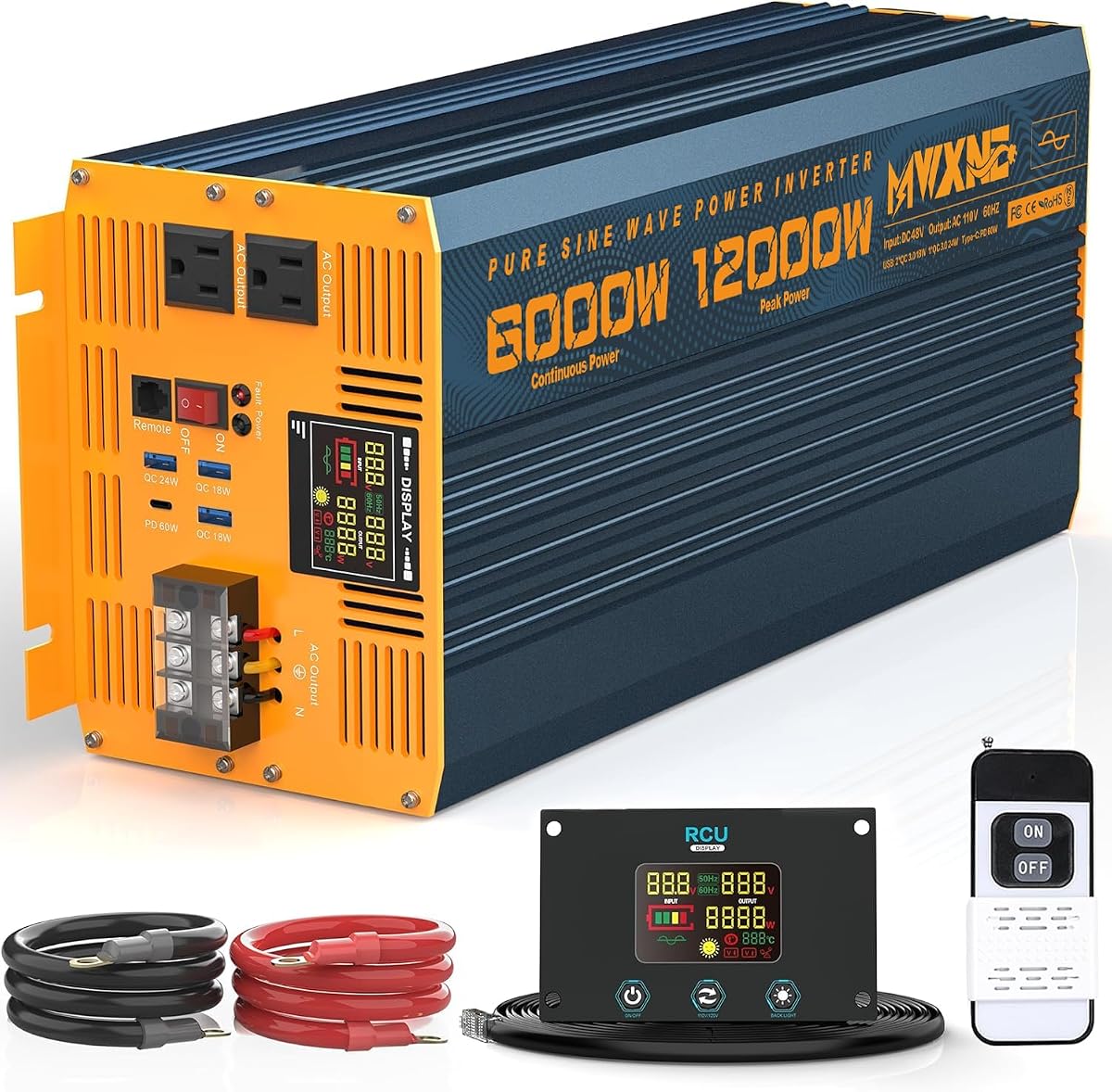
The MWXNE 6000W model is a 48V pure sine wave inverter with a 3.6 rating. It converts a 48V DC battery system to 110V or 120V AC and emphasizes efficient conversion, multiple charging ports, comprehensive protection, and convenient remote operation.
We may earn a commission when you buy through this link, at no additional cost to you.
Charging options are unusually varied: two 18W USB-A ports, one 24W USB-A port, and a 60W USB-C PD port are listed, along with three AC outlets in the detailed description. Even though the product title says two AC outlets, the feature section identifies three, so the package should be checked for the exact port count supplied.
A bright LCD reports voltage, frequency, protection status, and operating conditions. Both wireless and wired remote controllers are included, offering flexibility for installations where the inverter is either nearby or mounted out of reach. Protection includes undervoltage, overvoltage, overload, overheating, and short circuit handling.
This is a strong option for builders of 48V mobile or stationary systems who want clean output, efficient conversion, and extensive device connectivity. The battery system must be designed for the appropriate input voltage, and the installation should use suitable high-current conductors, fusing, ventilation, and grounding.
The stated efficiency of 94.2% is attractive for 48V systems because reduced conversion loss leaves more usable energy in the battery. Pure sine wave output also supports a broader range of household and electronic loads than modified wave models.
The included wireless and wired remotes offer different installation paths. Wireless control is convenient for a vehicle or RV, while a wired remote can provide a stable display and control interface at a fixed distance.
We may earn a commission when you buy through this link, at no additional cost to you.
The NOVOPAL 6000W inverter is a 24V-to-120V pure sine wave model intended for cars, boats, camping, travel, and outage emergencies. Its 3.0 rating is the lowest among the rated products in this guide, although the supplied specification includes 6000W continuous output and 12000W peak power.
We may earn a commission when you buy through this link, at no additional cost to you.
Four AC output sockets are the standout feature for mobile use, allowing several household-style devices to operate without an extension strip. High-power terminals support a more substantial battery connection than a simple cigarette-lighter lead, which is important when operating at significant loads.
A 16-foot wired remote places the LCD and control functions away from the inverter. The display provides operating status, while the unit includes overheat, short circuit, undervoltage, overvoltage, overload, and reverse-connection protection. A sound prompt and automatic restart are also listed.
This model is most appropriate for users with a 24V vehicle, bus, boat, trailer, or mobile installation who need multiple AC outlets and a pure waveform. The lower supplied rating encourages a careful review of recent customer feedback, while the package also includes protective covers, fuses, a ground wire, and a one-year workmanship warranty.
Four AC receptacles make it easier to operate a refrigerator, television, vacuum, lighting, and electronics during a trip or outage. The high-power terminals are especially relevant when the inverter must draw meaningful current from a substantial battery bank.
The 16-foot wired remote makes the LCD and operating controls accessible from the driver's seat, a work area, or another part of a vehicle. That separation is valuable when the inverter is securely mounted in a trunk, under a bench, or inside a protected enclosure.
We may earn a commission when you buy through this link, at no additional cost to you.
The Ampinvt model is a low-frequency, pure sine wave inverter/charger intended for home and off-grid solar systems. Its 3.9 rating reflects a capable but installation-intensive product that combines power conversion, battery charging, and automatic transfer functions in one enclosure.
We may earn a commission when you buy through this link, at no additional cost to you.
It supports SLA, AGM, gel, flooded lithium, and LiFePO4 battery types. Charging current is adjustable from zero to 35A, with zero used to disable charging. Users can choose AC priority, battery priority, generator, ECO, or unattended mode, allowing the inverter to fit different grid, generator, and solar operating strategies.
The built-in AVR stabilizer helps maintain a stable waveform, and the listed protections cover low and high battery voltage, temperature, overload, and short circuit behavior. The ability to maintain 110% to 120% output for 30 seconds before bypassing provides useful overload tolerance in a properly sized installation.
This is the strongest option in the group for a stationary off-grid or backup system that needs integrated charging and operating-mode control. It is less appropriate for a quick automotive installation because the low-frequency architecture, battery configuration, transfer behavior, and wiring requirements demand more planning than a basic plug-in inverter.
Combining an inverter, battery charger, and automatic transfer switch reduces the number of separate components in a home or solar installation. Adjustable charging and configurable priorities make it easier to shape how grid, generator, solar, and battery power interact.
The five operating modes address common power-system goals, including preserving batteries during outages, accepting utility power first, reducing consumption, or allowing unattended operation. These choices make the unit more versatile than a basic one-purpose power converter.
We may earn a commission when you buy through this link, at no additional cost to you.
The 6000W 24V model is a pure sine wave inverter designed for trucks, homes, RVs, and off-grid solar systems. Its 3.8 rating is accompanied by an important distinction: the detailed specification states 3000W continuous output and 6000W peak output rather than 6000W continuous power.
We may earn a commission when you buy through this link, at no additional cost to you.
This model supports 12V, 24V, 48V, 60V, and 72V DC input families, with the selected version converting 24V to 230V AC. Conversion efficiency is stated above 90%, and low no-load loss makes it relevant to battery systems where standby consumption should be minimized.
Protection covers short circuits, input overvoltage and undervoltage, output short circuits, overload, overcurrent, and excessive temperature. A large aluminum-alloy shell is intended to withstand drops and bumps, while smart cooling fans help control heat. Unlike several competitors, the supplied information does not list a remote control or display.
The inverter is a good fit for international-style 230V appliances in a 24V mobile or off-grid installation. It is less suitable for buyers who need 120V household output, numerous charging ports, remote monitoring, or a full 6000W continuous rating. Checking the exact variant is essential because the product family supports many voltage combinations.
Understanding that 3000W is continuous and 6000W is peak prevents battery and equipment from being overloaded. A larger battery bank, heavier cables, and suitable fusing are required to handle the continuous rating responsibly.
The aluminum-alloy enclosure and smart cooling fans support use in vehicles, RVs, and remote installations. Low no-load loss and conversion efficiency above 90% also help maintain useful battery runtime when the inverter spends time waiting for a load.
We may earn a commission when you buy through this link, at no additional cost to you.
The ECO-WORTHY 6KW is an all-in-one, split-phase solar inverter with a 3.7 rating. It converts 48V DC to 120V or 240V AC, includes a 9000W MPPT solar charge controller, and provides the controls and connectivity expected from a home energy system rather than a simple vehicle converter.
We may earn a commission when you buy through this link, at no additional cost to you.
Its MPPT section accepts up to 500V open-circuit PV voltage, operates in a stated 125V to 425V range, and supports up to 120A solar charging. AC charging can reach 100A. A capacitive touchscreen displays real-time operating data and error codes, while three LED indicators provide at-a-glance status and the WiFi module supports remote monitoring.
Grid priority, solar, solar-battery-utility, and solar-battery priority modes give users several ways to manage energy flow. Charging choices include hybrid, limited solar, and pure solar operation. Communication with a Battery Management System is also supported, which is useful for compatible server-rack battery installations.
This inverter is the most complete choice for a home backup, off-grid cabin, or solar system requiring split-phase appliances. It is not a direct substitute for a compact RV inverter, and large loads such as air conditioners, water heaters, and washing machines require careful load calculation and a professionally designed battery and solar array.
The integrated 9000W MPPT controller simplifies the relationship between panels, batteries, and household loads. With a 500V maximum PV input, it is intended for larger arrays and permanent installations rather than a small solar suitcase.
The touchscreen makes it easier to inspect real-time data, configure system parameters, and interpret fault codes. WiFi monitoring extends that visibility beyond the installation location, while BMS communication helps coordinate the inverter with compatible battery systems.
We may earn a commission when you buy through this link, at no additional cost to you.
Choosing a 6000W inverter requires matching the electrical system, load type, and installation environment to the converter's actual capabilities. The most important distinctions are continuous versus peak power, input voltage, waveform quality, and the role the unit will play in the overall energy system.
Choose continuous capacity with comfortable headroom above expected demand, and confirm that peak output covers the largest starting load.
Verify the exact input voltage and permitted range before connecting the inverter to any battery system.
Use pure sine wave output when equipment is sensitive or when the inverter must serve a mixed household load.
Treat the inverter, battery bank, cable set, and protection hardware as one correctly sized power system.
Choose port types and quantities that match the actual devices, and confirm the physical configuration of the ordered model.
Prioritize visible voltage and fault information, with remote control or connectivity when the inverter is mounted out of reach.
Allow cooling airflow and verify that the inverter's protection functions cover the electrical system it will serve.
Choose the simplest architecture that reliably covers the intended loads, then add integrated charging only when the installation needs it.
Before connecting anything, identify the inverter's exact voltage variant, confirm the battery voltage, and review the load instructions for every device. Calculate the combined running wattage and the largest possible startup surge. Use appropriately rated battery cables, secure connections, correctly sized fuses, a disconnect, and protective grounding. Do not use a lightweight extension setup or household power strip to carry inverter output beyond its rating.
Mount the unit in a dry, ventilated location where cooling fans can draw and exhaust air without obstruction. If the inverter is installed in a vehicle or RV, secure it against movement and protect its controls from accidental activation. When operating sensitive or high-draw equipment, bring the load online gradually where possible and observe the display for voltage warnings, overload messages, abnormal fan activity, or unusual heat.
For care, disconnect the DC source before changing wiring or adding accessories, and allow the unit to cool before handling it. Keep vents clear of dust, bedding, tools, moisture, and combustible material. Check connections periodically for looseness, corrosion, or heat discoloration, and verify battery condition and system voltage during storage. The supplied remote and display should also be used to confirm operating status rather than assuming an illuminated indicator means every part of the installation is working correctly.
Not necessarily. In this roundup, some products state 6000W continuous output, while others describe 3000W continuous and 6000W peak. Peak power is intended for short startup surges and should not be treated as a sustained load. Check the detailed specification and label of the exact model before connecting equipment.
A pure sine wave inverter is generally the safer choice for an RV because it provides smoother power for electronics, audio equipment, refrigerators, medical devices, and motor-driven appliances. Modified sine wave models may work well with simple lights and chargers, but they can cause noise, heat, or unreliable behavior in more sensitive equipment.
It depends on their running and startup requirements. A refrigerator may cycle at a modest load, but an air conditioner can consume substantial power and draw a strong surge when its compressor starts. Add the running loads of everything else, compare the total with continuous inverter output, and confirm peak capability before relying on the system during an outage.
There is no single battery size because runtime, battery chemistry, starting load, and acceptable voltage drop all matter. A 12V model may require a very large battery bank to support high output without immediately triggering undervoltage protection. Choose cables and fusing for the current, size capacity for the desired runtime, and use a charge source compatible with the battery chemistry.
No. Solar panels require a charge controller with an appropriate input voltage, current rating, and charging algorithm. Some inverters, such as the ECO-WORTHY model in this guide, include an MPPT controller. Others are designed only to convert DC from an already-managed battery, so a separate controller is necessary.
The output voltage determines which appliances can be connected safely. A 120V inverter suits standard North American household equipment, while a 230V or split-phase 240V inverter supports higher-voltage appliances and larger residential systems. Appliance voltage, plug type, and local electrical requirements must all match the inverter's output.
That depends on the inverter's input range, battery charging method, and BMS compatibility. A battery can provide DC power without being charged directly by the inverter, but charging lithium batteries safely usually requires a charger designed for their chemistry and voltage. Verify the battery manufacturer's guidance and the inverter or charger's supported battery types before connecting them.
The shutdown may be caused by low battery voltage, overload, excessive temperature, short circuit, or insufficient cable capacity. Start with a smaller load and monitor input voltage, output voltage, and any displayed fault code. If the battery is weak, the cables are undersized, or the combined load exceeds the continuous rating, the system requires correction rather than repeated reset attempts.
The 6000W Power Inverter stands out as a budget-oriented choice for basic resistive loads, multiple outlets, and remote monitoring, while the Ampinvt model is the strongest all-in-one option for a dedicated off-grid or backup system. The ECO-WORTHY 6KW offers the most advanced solar integration, including an MPPT controller, touchscreen, WiFi, and split-phase output for home-scale applications.
Before choosing, prioritize the actual continuous rating, battery voltage, waveform quality, and intended load. Sensitive electronics and mixed household use favor pure sine wave output, portable vehicle use favors 12V or 24V models, and permanent solar installations justify the added complexity of integrated charging and system monitoring. Cable and battery design are just as important as the inverter itself.
Retail pricing and availability change, and the supplied configurations may include several variants within the same listing. Confirm the exact model label, port arrangement, included remote, continuous output, peak output, and input voltage before ordering. Those checks will help ensure that the selected inverter fits both the immediate equipment and the larger electrical system.