
QWORK 4/0 Gauge Wire Cutter
4.5Editor score
Cables up to 4/0 AWG
Forged steel cutting blades
Textured non-slip handles
Shear-action cable cutting
A cable cutter for thick wire must deliver more than sheer cutting force. Blade material, jaw geometry, handle leverage, cutting capacity, and safety features all influence whether a tool cuts cleanly without deforming the conductor, bruising insulation, or leaving a hazardous end. The right choice depends heavily on cable type and diameter.
We compared ten cable cutters using their stated construction, cutting limits, handle design, application guidance, and customer ratings. The list covers long-arm tools for copper and aluminum, compact ratchet cutters for very large conductors, conventional electricians’ shears, and specialized options for steel wire, aircraft cable, and wire rope.
Each pick highlights the reason it stands apart, while the reviews also identify important limitations such as unsuitable steel applications, restricted capacity, or limited portability. Ratings and product availability can change over time, and current prices should always be checked before purchasing.
4.5Editor score

4.7Editor score

4.7Editor score
As an Amazon Associate we earn from qualifying purchases.
The comparison below organizes all ten options by their most useful practical characteristics, including maximum cable capacity, supported materials, tool length, cutting mechanism, and best-fit applications.




The HKS Ratchet Cable Wire Cutter is a standout option for users who regularly work with very large electrical conductors. It carries a 4.7 rating and is built around a ratchet driving unit intended to make repeated straight cuts with minimal effort. Its stated capacity reaches 300mm², equivalent to AWG 600MCM, while also accommodating copper and aluminum single conductors and multistranded cable. That combination of reach and controlled cutting makes it one of the most specialized and useful tools in this guide.
We may earn a commission when you buy through this link, at no additional cost to you.
The ratchet principle is the tool’s defining advantage. Instead of requiring the user to close the handles through the entire cut, the mechanism advances the blade incrementally and helps maintain consistent pressure. Its high transmission ratio reduces hand fatigue, which is particularly valuable when trimming large battery, feeder, or service cables. The quick-release lever permits the blade to be reopened at any time, while the relatively lightweight and compact body is easier to maneuver than a long-arm cutter in a crowded panel or junction area.
There are important boundaries. HKS explicitly states that the cutter should not be used on steel, steel wire, or iron wire, and that even though the handle is rated for 1000 volts of insulation, live cables must never be cut. Those are non-negotiable operating restrictions rather than minor shortcomings. The ratchet mechanism may also feel unnecessary for someone cutting only a few 4/0 cables, and buyers who need a general-purpose steel wire rope cutter will need a different design.
This is the strongest recommendation for electricians, solar installers, industrial maintenance teams, and serious DIY users who regularly cut unusually thick copper or aluminum cable. Its capacity is the decisive advantage, and the ratchet action improves both control and fatigue resistance. For smaller electrical projects, a more compact conventional cutter may be more convenient, but for genuinely thick conductors this HKS model offers a specialized combination that conventional diagonal cutters struggle to match.
The 300mm² rating gives the HKS cutter a clear advantage when working with large single conductors or heavily bundled multistrand cable. Its ratchet-driven blade is intended to produce rapid, straight cuts while reducing the force needed from the operator.
Unlike a 24-inch lever cutter, this model can be maneuvered around cable trays, switchgear, and service panels where handle reach is limited. The quick-release lever also makes it practical to reset the tool between cuts.
We may earn a commission when you buy through this link, at no additional cost to you.
The MAXPOWER 24-Inch Wire Rope Cutter is built for hard wire and offers the highest customer rating among the products assigned a top-three award. Its long, high-leverage configuration gives the user substantial mechanical advantage, while a 14mm maximum cutting capacity and hardened edge allow it to address steel wire, iron mesh, and single or multistrand steel wire rope. The 24-inch form factor is less convenient than a compact plier, but it is purposeful when force and clean shearing are the priority.
We may earn a commission when you buy through this link, at no additional cost to you.
Its construction is a notable strength. The body uses chromium-molybdenum steel, while the 60Si2Mn blades receive high-temperature quenching and high-frequency induction hardening. According to the product information, this combination improves shear strength, sharpness, durability, and cutting capacity. The anti-slip rubber handle provides a secure grip during the considerable force required to close the long handles, and the one-handed cutting design is intended to improve efficiency rather than force the user into an awkward two-person operation.
The trade-offs relate mainly to size and specialization. At 24 inches, the cutter will not fit into a standard compact tool pouch and may be difficult to use inside a shallow enclosure or crowded work area. Its stated 14mm limit is substantial but still much lower than the 300mm² electrical capacity of the HKS ratchet model. The tool is designed around steel wire rope and similar hard material, so users cutting only ordinary household copper wire may find it excessive.
MAXPOWER is best suited to construction crews, fence installers, mechanics, metalworkers, and maintenance professionals who encounter hard wire regularly. It is a convincing premium choice when a compact shear cannot generate enough leverage for the material. The tradeoff is straightforward: accept a longer, less portable tool in exchange for dedicated heavy-duty cutting performance and the ability to handle steel wire rope.
The extended handles multiply the user’s input force, reducing the effort needed to pass the hardened blade through steel wire rope or iron wire. This makes the tool more practical for repeated work than a short plier-style cutter.
The induction-hardened cutting edge is designed to retain sharpness under repetitive loads. A contoured rubber grip helps the user maintain control as the handles close under high force.
We may earn a commission when you buy through this link, at no additional cost to you.
The QWORK 4/0 Gauge Wire Cutter is a practical, economical choice for common heavy electrical cables, making it our best budget recommendation. It has a 4.5 rating and uses forged steel blades with precision-ground edges to cut copper and aluminum cable. Its stated capacity reaches 9.5mm, or 4/0 AWG flexible cable, while the 14-inch body offers enough leverage and control for battery cables, welder leads, building wiring, and SO cord.
We may earn a commission when you buy through this link, at no additional cost to you.
The cutter is designed around a shear-style action intended to produce clean cuts through relatively thick conductors. Forged steel provides a durable foundation, while the precision-ground blade edges help the jaws meet cleanly and reduce the chance of a crushed or badly distorted cable end. Textured, non-slip handles are intended to reduce fatigue during repeated cutting, and the yellow coating is described as improving grip and resisting corrosion rather than providing electrical insulation.
The main limitation is that the yellow-coated handle is explicitly non-insulated. Users may mistake the bright coating for a safety feature, but it should be treated as a grip and corrosion-resistant finish only. The cutter is also not described as a steel-wire tool, and its 4/0 capacity is modest beside the HKS ratchet model. This makes it better for frequent electrical work than for extreme conductors, though 4/0 cable is substantial in many residential and automotive applications.
QWORK fits electricians, mechanics, welders, and homeowners who need a dependable conventional cutter for thick copper and aluminum cable without carrying a specialized ratchet tool. It offers the strongest balance of accessibility, useful capacity, and straightforward handling in this group. Buyers should verify the exact conductor dimensions and material before use and never rely on the coated handle as protection from energized conductors.
A 4/0 AWG rating covers demanding battery, welding, feeder, and branch-circuit work while keeping the tool compact enough for routine tool bags. It fills the gap between lighter diagonal cutters and oversized ratchet systems.
Precision-ground edges on forged steel blades are intended to shear rather than crush the conductor. This helps preserve a more orderly cable end and supports smoother installation in terminals or connectors.
We may earn a commission when you buy through this link, at no additional cost to you.
The AUPREX 24 Inch Heavy Duty Cable Cutter is a long-arm tool built around substantial leverage and a generous stated cutting diameter. It has a 4.6 rating, measures 600mm, or 24 inches, and is described as cutting cables up to 2 inches in diameter. That makes it especially relevant to users seeking a high-capacity cutter for large copper, aluminum, and telecom lines, as well as battery, welder, construction, and electrical cable.
We may earn a commission when you buy through this link, at no additional cost to you.
Its hardened carbon-steel construction and heat treatment are intended to improve blade strength and durability. A fine, dense coating on the cutting surface adds resistance to corrosion and wear, while the long arms reduce the force needed to close the jaws. The non-slip ergonomic grip is shaped to improve control, and the sharp blades are designed to leave a flat, clean cut. Its versatility across several cable constructions makes it useful for electricians, mechanics, metalworkers, and serious DIY enthusiasts.
The crucial limitation is explicit in the product information: it is not suitable for steel wire. Its long dimensions can also be inconvenient in tight work areas, where a short, compact cutter or ratchet model would be easier to position. Users should distinguish a stated 2-inch cutting diameter from the physical thickness of every cable; the actual fit depends on cable construction, stranding, insulation, and the way the material is presented to the blades.
AUPREX is a good fit for farm, construction, telecom, and general maintenance work involving large soft-metal conductors. Its main appeal is the combination of long-arm leverage and a broad working diameter without a ratchet mechanism. If the task involves large copper or aluminum cable and the workspace offers room to use the full 24-inch tool, it is a capable choice.
The 600mm handle length creates a strong mechanical advantage, allowing the user to apply more force to the blade with less hand travel. This is useful for dense or large aluminum cable that can be demanding to shear.
The tool is listed for copper core cable, aluminum core cable, telecom lines, battery and welder cables, construction wire, SO cord, and electrical wire. That versatility makes it useful across several trades rather than a single narrow task.
We may earn a commission when you buy through this link, at no additional cost to you.
The Klein Tools 63050 Cable Cutter is a conventional professional cable-cutting solution with a 4.6 rating. It cuts up to 4/0 aluminum, 2/0 soft copper, and 100-pair 24 AWG communications cable using a precision, one-hand shearing action. Unlike a large ratchet or long-arm tool, its principal appeal is compact professional ergonomics, particularly for electricians and technicians working in confined spaces.
We may earn a commission when you buy through this link, at no additional cost to you.
Cable-gripping shear-type jaws help control the material as the cut begins, while beveled jaw tips are designed to mate properly and protect the leading jaw edges. The tool is made in the USA using custom US-made tool steel, and its cutting surfaces are through-hardened rather than case-hardened. According to the product information, that treatment supports longer-lasting performance by improving the cutting surface more thoroughly than a shallow outer layer would.
The compact form is both a strength and a limitation. It is easier to carry than a 24-inch cutter and can be positioned where larger tools cannot fit, but it does not provide the mechanical advantage or capacity of the HKS ratchet model. The cutter is optimized for aluminum, copper, and communications cable rather than steel wire or extremely large conductors. Its listed capacities also differ by material, so a 4/0 rating should not be applied automatically to every cable type.
This cutter is best for professionals who already recognize Klein Tools and want a familiar, portable shearing tool for routine electrical and communications work. It is particularly attractive for technicians who value a tool that can live in most pouches and cut common heavy cable without complicated setup. For very large bus, feeder, or multistrand cable, buyers should look toward a higher-capacity ratchet cutter instead.
The one-hand shearing action and compact profile make the tool practical for panel work and crowded installation sites. Its smaller size is especially useful where a long lever or bulky ratchet mechanism cannot be positioned correctly.
Through-hardening is intended to support edge retention over repeated use. Cable-gripping jaws and beveled tips help the tool maintain a controlled cut while reducing damage to the working edges.
We may earn a commission when you buy through this link, at no additional cost to you.
The DISEN Wire Cutters are a compact but broad-purpose option for fence work, wire rope, aircraft cable, and smaller thick-cable projects. They have a 4.6 rating and are constructed from 50CR alloy structural steel with a stated hardness of HRC 58-63. The listed capacity reaches 3/16 inch for aluminum and copper cable and 5/32 inch for stainless steel wire rope, with additional capability for hard steel wire and aircraft cable.
We may earn a commission when you buy through this link, at no additional cost to you.
A retractable spring-loaded mechanism allows the cutter to open automatically, and the ergonomic non-slip handle is shaped for one-handed use. The safety lock is especially noteworthy because it helps prevent accidental opening during storage or transport. The package also includes aluminum wire rope sleeves, which can connect wire rope after cutting, secure the rope head, or be crimped into a ring with a suitable crimping plier. This added accessory makes the set more complete for fence and rigging tasks.
The primary compromise is capacity. A 3/16-inch limit suits many fence, aircraft, and stainless rope applications, but it cannot address the very large conductors handled by a 300mm² ratchet cutter or the stated 2-inch diameter of a 24-inch lever tool. The spring return also means the user’s hand remains engaged with the tool throughout the cycle, which some users find tiring during extended repetitive cutting.
DISEN is a sensible pick for electricians, mechanics, fence installers, and DIY users who need one compact cutter for several wire types rather than separate tools for copper and steel. The safety lock and included sleeves add practical value. Choose it when portability and material flexibility matter most; for large electrical feeder cable, select a cutter engineered for the conductor dimensions involved.
The ability to cut aluminum, copper, stainless steel wire rope, hard steel wire, and aircraft cable makes the tool adaptable to fence, repair, and rigging work. Users still need to remain within the stated limits for each material.
The lock helps keep the cutter closed when it is not being used. Included aluminum sleeves add immediate utility for reconnecting or terminating wire rope, provided they are properly crimped with a compatible tool.
We may earn a commission when you buy through this link, at no additional cost to you.
The ValueMax 10-Inch Cable Cutter combines a useful 4/0 AWG capacity with a compact high-leverage body. It has a 4.6 rating and is designed for electricians, contractors, first responders, and industrial users who need to cut 4/0 aluminum, 2/0 soft copper, and 100-pair 24 AWG communications cable without carrying an oversized tool.
We may earn a commission when you buy through this link, at no additional cost to you.
Heat-treated shear-type jaws are precision sharpened to create a smooth cut with minimal distortion. The high-leverage geometry is intended to reduce cutting effort and hand fatigue, while a slip-resistant handle offers stability during repeated use. A black coating resists rust, adding a practical layer of protection for storage and use in environments where moisture or handling could affect an untreated finish. The result is a conventional tool that emphasizes efficient one-handed operation.
Its limitations are similar to those of other compact electrical cable cutters. It is explicitly not for steel, so users who work regularly with wire rope, fence wire, or aircraft cable should choose a dedicated hard-wire tool. Although the handles are longer than those of basic diagonal cutters, the 10-inch frame cannot deliver the leverage of a 24-inch model or the force multiplication of a ratchet cutter for very large cable.
ValueMax is best for routine electrical installation, repair, and maintenance where 4/0 cable is already large enough to require a serious cutter but a full ratchet system would be unnecessary. It is also attractive for users who value a lightweight, easy-to-store tool. The recommendation is strongest for soft-metal cable within the listed range; steel applications and extreme conductor sizes call for a more specialized alternative.
The 10-inch format provides a meaningful upgrade over general-purpose diagonal cutters while remaining easier to carry than a long-arm model. That balance suits maintenance kits and jobs requiring frequent access to a cable cutter.
Sharpened shear jaws and high-leverage handles work together to reduce the effort required during each cut. The textured grip helps control the tool when substantial closing pressure is necessary.
We may earn a commission when you buy through this link, at no additional cost to you.
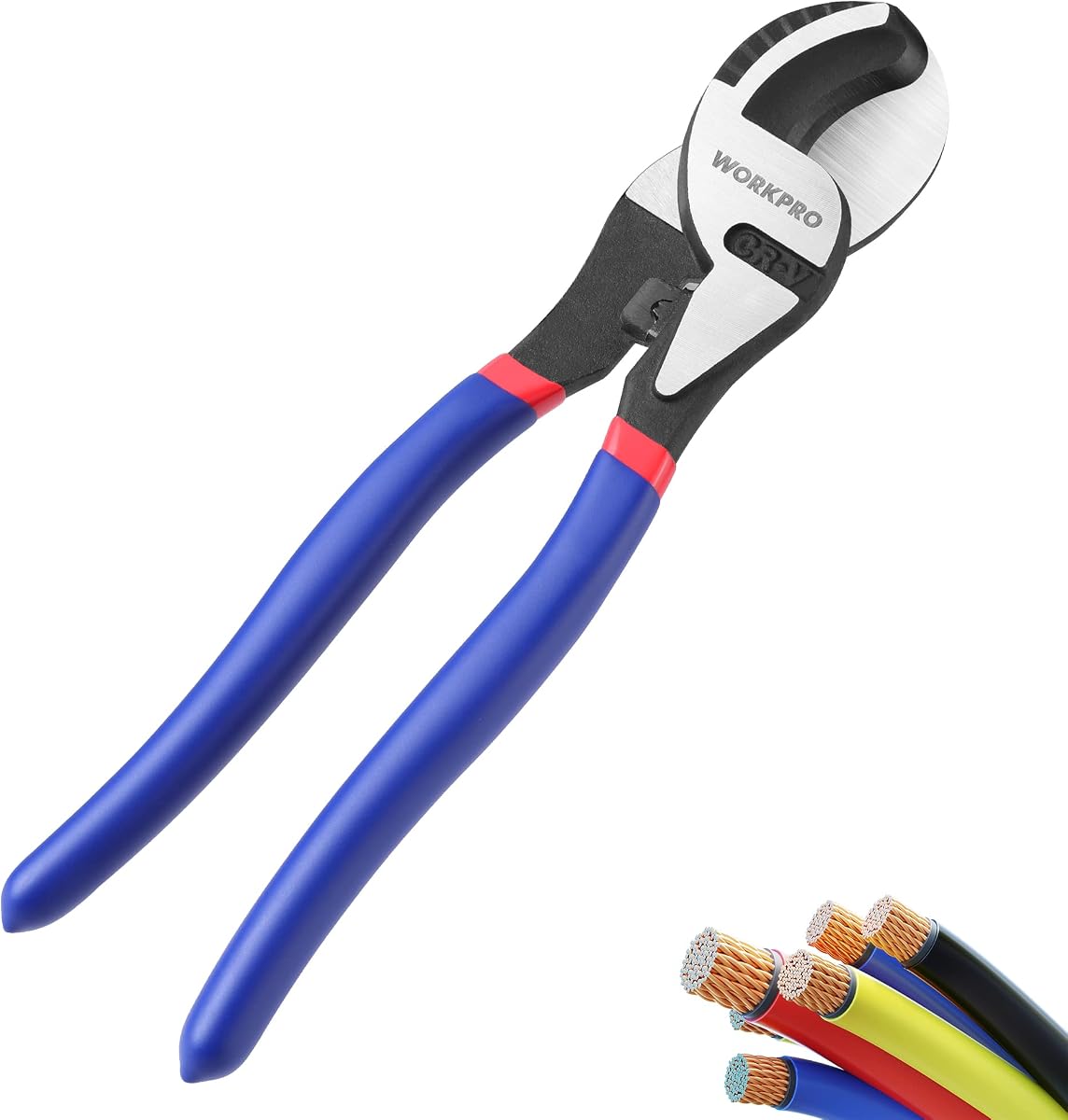
The WORKPRO 9-1/4 Inch High Leverage Cable Cutter is a compact option built for 4/0 aluminum, 2/0 soft copper, and 100-pair 24 AWG communications cable. It carries a 4.6 rating and emphasizes forged, polished chrome vanadium steel with heat-treated cutting edges. Those materials are intended to provide durability and maintain a sharp cutting profile through repeated use.
We may earn a commission when you buy through this link, at no additional cost to you.
The jaws use a shear-style design with precision-sharpened blades rated at HRC 63-65. The product information says this supports clean, sharp cuts with minimal cable distortion. High-leverage handles provide additional mechanical advantage, and plastic-coated non-slip grips offer a secure, comfortable hold. The 9.25-inch length keeps the tool more manageable than a long-arm cutter while giving it more leverage than a very short diagonal cutter.
The tool does not have the extreme capacity of a dedicated ratchet cutter, and it is explicitly not suitable for cutting steel. It is therefore best viewed as a compact electrical cable cutter rather than a general hard-wire solution. Users who cut only occasional 10 or 12 AWG wire may find it more tool than necessary, while those who regularly terminate large soft-metal conductors may appreciate its stronger construction and leverage.
WORKPRO is a good recommendation for electricians, contractors, technicians, and advanced DIY users who want a manageable cable cutter with a higher-grade steel body. It is especially suitable for tool bags and mobile work where every extra inch matters. Just ensure the cable falls within the listed copper, aluminum, or communications limits, and reserve hard-wire tasks for a cutter expressly rated for them.
Forged and heat-treated chrome vanadium steel is designed to resist deformation and support edge retention. Combining that construction with a short profile makes the cutter easier to store without sacrificing heavy-cable capability.
Longer handles and shear-style jaws help the tool cut common heavy electrical cable with less effort. Precision-sharpened edges are intended to minimize distortion and keep the finished end orderly.
We may earn a commission when you buy through this link, at no additional cost to you.
The GRENPRO 7.5-Inch Cable Cutter is the most compact option in the group, but it is not limited to ordinary electrical wire. It has a 4.4 rating and is listed for hard steel wire, stainless steel rope, aircraft cable, 3/16-inch aluminum and copper cable, and 5/32-inch stainless steel wire rope. That makes it interesting for mechanic repair, deck railing installation, fence work, bicycle brake cable trimming, and daily household projects.
We may earn a commission when you buy through this link, at no additional cost to you.
Forged and heat-treated chromium vanadium jaws have a stated hardness of 63-65 HRC, while a precision-ground shear edge is intended to reduce fraying and produce a smooth cut. A spring rebound mechanism allows the tool to open automatically for one-handed use, and the yellow-and-black non-slip handle is designed to limit fatigue. A built-in lock keeps the cutter closed during storage and transport, which is a useful detail for portable tools.
Its short 7.5-inch body is the defining compromise. While easy to carry, it offers less leverage than 9.25-, 10-, and 14-inch cable cutters and far less than a 24-inch model. Its stated material capacity is also smaller than the HKS ratchet cutter’s. The 4.4 rating is the lowest among the ten products, though it still reflects generally favorable customer sentiment and does not alone establish poor performance.
GRENPRO makes the most sense for users who need a small, versatile cutter for mixed wire rope, aircraft cable, fence material, and household tasks. Mechanics and mobile repair technicians may appreciate the easy-carry format and locking feature. For large electrical conductors or dense steel cable, a longer lever or higher-capacity tool is the safer and more effective choice.
The 7.5-inch body fits easily into small tool bags and is convenient for mechanics or maintenance workers who need to trim wire rope, aircraft cable, or fence material on the move.
Unlike many compact electrical cable cutters, this model is also listed for hard steel wire, stainless wire rope, and aircraft cable. That versatility makes it useful for mixed-material maintenance tasks.
We may earn a commission when you buy through this link, at no additional cost to you.
The QUAXLENT 10-Inch Large Cable Cutter offers one of the strongest customer ratings in this comparison at 4.7. It is built to cut 4/0 aluminum, 2/0 soft copper, 100-pair 24 AWG communications cable, and wires up to 70mm². The 55 steel body is thickened for additional torque resistance, while fine grinding, surface polishing, overall heat treatment, and high-frequency quenching produce a sharp, burr-free cutting edge with stated hardness of HRC 45-52.
We may earn a commission when you buy through this link, at no additional cost to you.
Its ergonomic handles measure 5.51 inches and use a frosted, non-slip surface to improve grip and reduce effort. The product information claims the design can save up to 30% effort. A second set of smaller jaws can strip the sheath from small wires, allowing the tool to handle both cutting and limited stripping tasks. An anti-friction safety design is also included to help protect the jaws and fingers when substantial force is applied.
The important limitation is that steel wire is expressly excluded. The cutter also cannot address the very largest electrical conductors, and its stripping function is limited to small wires rather than serving as a full heavy-cable preparation system. The quoted effort-saving figure comes from the product description rather than an independently documented test, so buyers should judge it as a design claim rather than a guaranteed result.
QUAXLENT is a good pick for electricians, contractors, and DIY users who want a compact cutter with a useful 4/0 rating and the convenience of a basic stripping function. It may be particularly attractive for general repair kits where one tool can cover several common conductor sizes. The final recommendation is to confirm the exact cable dimensions, avoid steel wire, and use the small stripping jaws only on the wire sizes for which they were designed.
Large jaws handle heavy cable while smaller jaws can remove insulation from lightweight wire. This dual-function arrangement can reduce tool changes during basic electrical preparation.
A thickened steel body, long ergonomic handles, and a quenched cutting edge are intended to provide a stable, low-distortion cut. The frosted handle texture helps maintain grip when greater pressure is needed.
We may earn a commission when you buy through this link, at no additional cost to you.
The right cable cutter depends on conductor material, diameter, strand construction, workspace, and how frequently you cut it. Capacity and leverage should be considered together, because a long tool that exceeds the required rating can be awkward while an undersized tool may be unsafe or ineffective.
Match the cutter to the material first, then check the size. Never use a copper-and-aluminum cable cutter on steel wire merely because the cable physically fits between the jaws.
Use the manufacturer’s material-specific limit, and leave extra margin when a cable is unusually stiff, compressed, or tightly bundled.
Choose long arms for reach, ratchets for high force and large cable, or compact springs for portability; do not prioritize mechanism over the cable rating.
Prioritize a true shear-style jaw, a hardened edge, and material-specific guidance over decorative coatings or vague heavy-duty wording.
Choose a grip that feels secure under load, and consider spring return, locking, or insulated coverings as secondary benefits rather than substitutes for correct capacity.
For confined spaces, favor compact or ratchet designs; for open work and very hard wire, a long-arm cutter may be the more practical choice.
Use locking and quick-release features where helpful, maintain a clean dry mechanism, and always disconnect power before cutting any cable.
Begin by identifying the conductor, measuring its true diameter or cross-sectional area, and checking that it falls within the cutter’s material-specific limits. Place the cable squarely in the jaws without twisting. For a ratchet cutter, engage the mechanism and close the handle steadily; for a long-arm cutter, use a smooth two-handed pull when the material requires maximum force. Keep fingers clear of the jaws and allow the tool to complete the cut rather than forcing a partially closed blade.
Inspect the finished end before proceeding. A clean, square cut should show an orderly conductor end without loose strands, severe crushing, or a long oval deformation. If the cable shifts or the jaws begin to slip, release the tool and reposition it instead of applying more force. Never angle the blade against a hard surface, and never attempt to cut a bundle of conductors that exceeds the tool’s rating merely because the individual wires could fit.
After use, remove metal particles and cable fragments from the jaws and pivot, then wipe the tool with a clean dry cloth. Store spring-action or ratchet cutters in a dry location and use the lock or closed position when appropriate. Inspect the edge periodically for nicks, deformation, or excessive wear, and stop using the tool if its capacity no longer appears reliable. A qualified technician should assess damaged blades, and energized electrical work should only be performed under appropriate electrical-safety procedures.
Only if the manufacturer specifically rates the tool for steel or hard wire. Many cutters designed for 4/0 aluminum and copper use jaws that can be damaged by steel. The MAXPOWER, DISEN, and GRENPRO models list hard-wire or wire-rope applications, while several electrical cable cutters explicitly exclude steel. Always follow the individual product guidance rather than judging suitability from the tool’s appearance.
The QWORK, ValueMax, WORKPRO, and QUAXLENT cutters all list compatibility with substantial 4/0-class electrical cable, while the Klein model lists 4/0 aluminum and 2/0 soft copper. The correct choice also depends on whether the cable is stranded, how tight the workspace is, and how much force the user wants to apply. Verify the precise construction and conductor dimensions before purchasing.
A ratchet cutter is often easier to operate on very large cable because its geared mechanism multiplies force and can help keep the blade moving in a controlled path. A long-arm cutter is simpler, lighter in some configurations, and effective on wire rope or large soft-metal cable where maximum leverage is useful. Ratchets suit confined spaces; long arms suit open areas and hard materials, provided the tool can be fully positioned.
It indicates that the HKS tool is stated to handle conductors up to 300mm², a size commonly expressed as AWG 600MCM. The rating applies to the copper and aluminum single and multistranded cables described by the manufacturer. It does not mean the cutter can cut 600 MCM steel wire or any cable regardless of insulation, strand count, or physical diameter.
No. A handle described as insulated to 1000 volts does not make it acceptable to cut energized conductors. The HKS manufacturer explicitly warns against cutting live cables. Power should be disconnected, verified as de-energized, and the work area made safe before any cable-cutting tool is used.
Use a cutter rated for the material and size, place the cable squarely in the jaws, and apply steady pressure through the tool’s designed cutting action. Do not twist the cable or force a partially closed blade. If the cable slips, open the cutter and reposition it. A clean result should have minimal deformation, and any frayed or crushed end should be inspected before installation.
A standard aluminum-and-copper electrical cutter may not be appropriate because stainless wire rope and aircraft cable require harder, specifically rated jaws. The DISEN, MAXPOWER, and GRENPRO options list at least some stainless, aircraft, or hard-wire capabilities. Check the exact diameter and material rating before use, especially if the rope is tensioned or heavily stranded.
Remove debris after each use, especially fragments that can lodge between the jaws or inside a ratchet drive. Wipe the tool dry, store it away from moisture, and use a safety lock or closed position when available. Inspect the blade for nicks and deformation, and discontinue use if the tool struggles within its stated limits. Damaged or poorly performing cutters should be checked by a qualified repair professional.
The HKS Ratchet Cable Wire Cutter is the leading choice for exceptionally large copper and aluminum conductors, combining a 300mm² stated capacity with a compact, high-ratio ratchet mechanism. MAXPOWER is the strongest premium option for hard steel wire and wire rope, while QWORK delivers a more budget-oriented way to handle common 4/0 copper, aluminum, battery, and welder cables. Each of these tools serves a meaningfully different type of work.
For most electrical installations, prioritize the manufacturer’s material-specific capacity before price, mechanism, or styling. A compact 4/0 cutter may be ideal for routine work, but it cannot substitute for a ratchet model on very large feeder cable. Conversely, a heavy steel-wire rope cutter may be unnecessarily specialized for an electrician who only terminates soft-metal conductors. Workspace, portability, leverage, and safe handling should all influence the decision.
Customer ratings can offer a useful snapshot of buyer experience, but the technical limits and proper application remain the most important criteria. Availability, ratings, and prices change over time, so check the current listing and manufacturer information before purchasing. Select the tool whose approved materials and capacity match the specific cable, then maintain it carefully to preserve clean, reliable cuts.