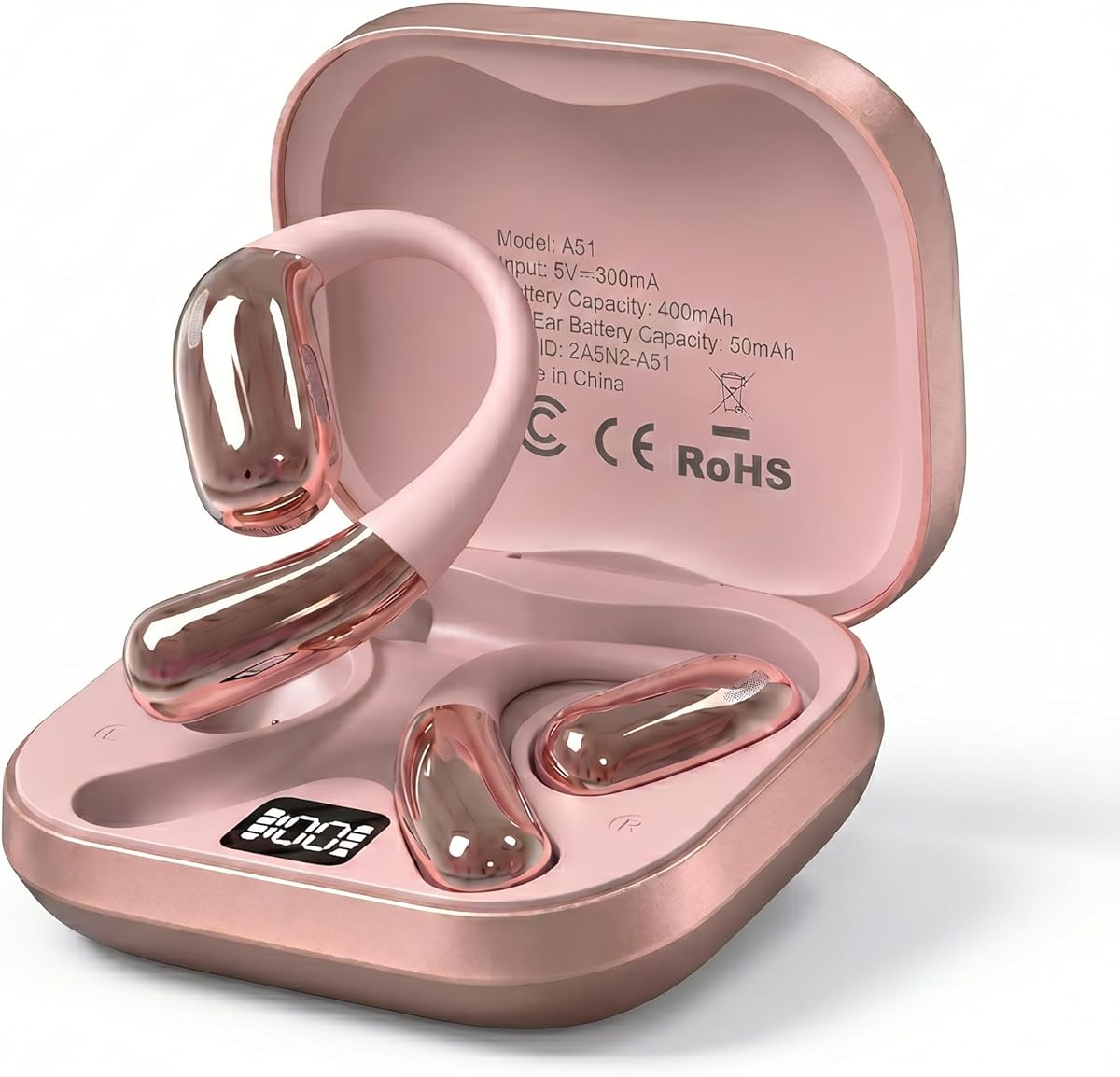
Open Ear Headphones Digital Display
4.6Editor score
35 hours total playback
LED charging-case display
Lightweight earhook design
This expert guide compares the best Bluetooth open ear earbuds for sound, comfort, battery life, water resistance, controls, connectivity, and everyday fitness
Bluetooth open ear earbuds let you enjoy music, podcasts, and calls without sealing the ear canal. Their lightweight, hook-style designs can feel more comfortable than conventional earbuds while keeping you aware of traffic, gymmates, coworkers, and other surroundings. The right pair depends on fit, sound, controls, battery life, and resistance to sweat and rain.
We compared all ten products using the information supplied for each listing, focusing on design, audio hardware, wireless version, playback claims, water-resistance rating, microphone features, control methods, charging options, and intended activities. The list includes clip-on, earhook, and over-ear styles, with several models particularly suited to running, cycling, commuting, glasses wearers, and long listening sessions.
Each review explains the product's strongest attributes and practical trade-offs so you can match the design to your priorities. The top picks range from a feature-rich budget model to an earhook option and a more premium established choice. Product specifications and availability can change, so confirm the latest listing details and current price before purchasing.
4.6Editor score

5.0Editor score

4.0Editor score
The table below compares all ten models by physical design, wireless technology, battery capacity, and outdoor readiness, making it easier to identify the most suitable option for commuting, exercise, office use, or extended wear.


This open ear sports model earns the Editor's Choice position with a 5.0 rating and an unusually balanced set of features. It combines an earhook design, Bluetooth 5.4, ENC-equipped calls, IPX7 water resistance, touch controls, and a total playback claim of up to 80 hours. Those characteristics make it a strong all-rounder for listeners who divide their time between workouts, travel, and daily calls.
We may earn a commission when you buy through this link, at no additional cost to you.
Its most persuasive feature is the combination of battery endurance and physical security. The earhooks are intended to remain in place during running and workouts, while the open-ear format lets environmental sound reach the listener without inserting a tip into the ear canal. Bluetooth 5.4 supports fast pairing and a stable connection, and the ENC microphones are intended to improve call clarity in busy surroundings. Fast charging further reduces the inconvenience of a long listening schedule.
The trade-offs are typical of the category. Because the earpieces do not seal the canal, bass and ambient noise can mix more freely than they would with sealed in-ear models. The secure hooks may also take a little practice to position correctly, and the substantial playback claim depends on real-world volume and usage. Even so, none of these points undermines the model's value as a durable everyday sports option.
This is the most versatile recommendation for someone who wants one pair of Bluetooth open ear earbuds for running, gym sessions, commuting, and regular music use. The long battery life reduces charging anxiety, the water-resistance rating suits active routines, and the touch interface keeps common controls accessible. Buyers who prioritize secure placement, endurance, and outdoor usefulness should give this model particular attention.
The supplied listing credits the earbuds and charging case with up to 80 hours of total playback, offering one of the strongest endurance claims in this roundup. That makes the set well suited to travel, frequent workouts, and users who dislike charging their audio equipment often.
The wraparound earhook is the central design element, adding stability while leaving the ear canal open. It should appeal to runners and cyclists who prefer hearing their surroundings, although personal comfort can vary with ear shape and eyeglass frames.
We may earn a commission when you buy through this link, at no additional cost to you.
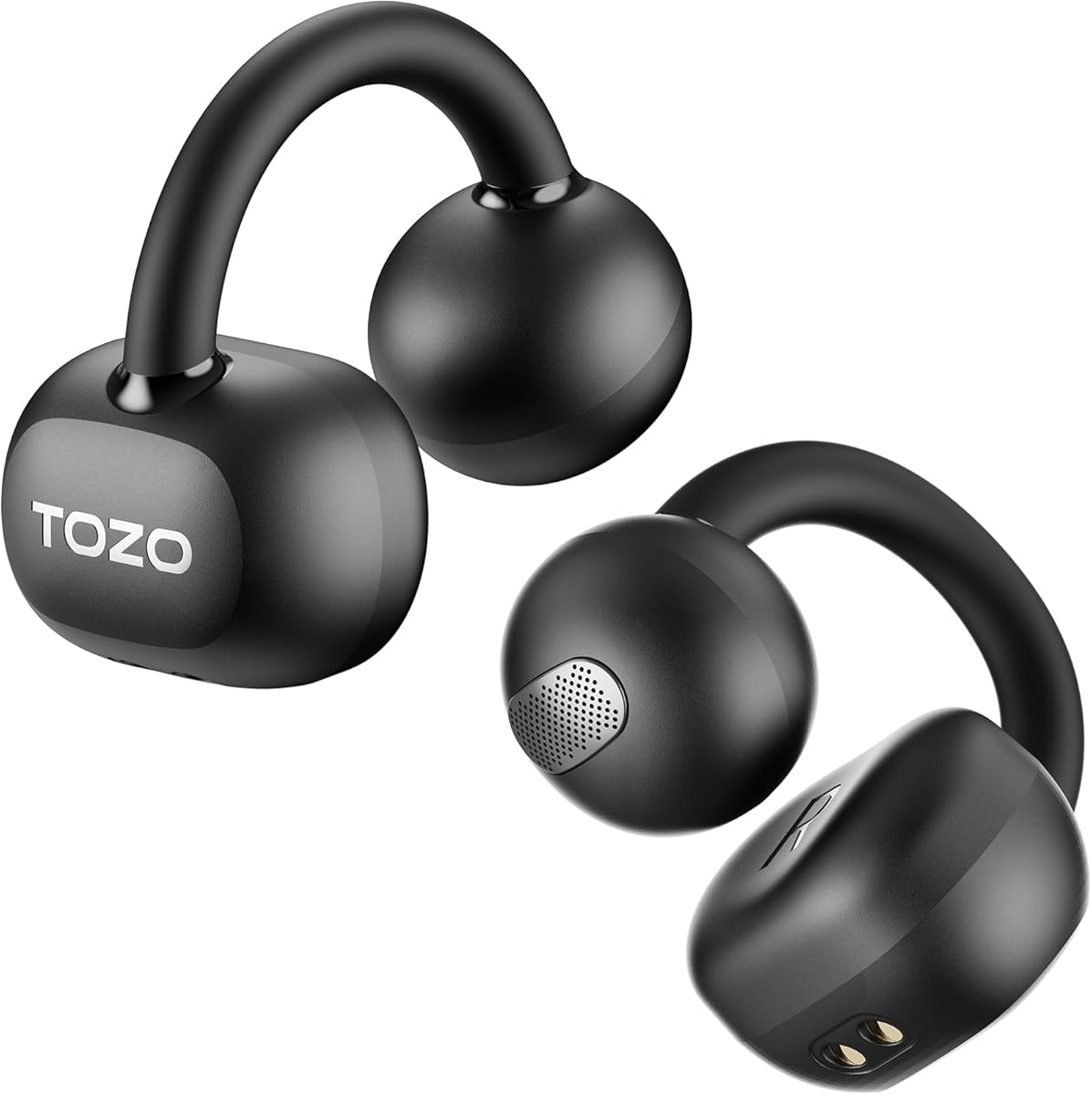
The TOZO OpenEarRing combines a 4.3 rating with a particularly light clip-on design, weighing just 5.1 grams per earbud. It is especially interesting for glasses wearers because the supplied product information says the contours are designed to avoid clashing with frames. The model also supports app-based equalization, giving it more personalization than many similarly priced open-ear alternatives.
We may earn a commission when you buy through this link, at no additional cost to you.
Its feature set is centered on practical daily use. OrigX acoustic technology is included for stereo presentation, while the charging case adds a digital battery display and up to 30 additional hours of playback. Bluetooth 5.4 is designed to provide stable connectivity up to the stated 15-meter range. The skin-friendly silicone construction, automatic pairing, and IPX5 water resistance round out a convincing package for commuting, exercise, and extended wear.
The main compromises concern protection and control precision. IPX5 is suitable for sweat and light rain but is not the strongest rating represented here, so the earbuds should not be treated as suitable for immersion. The listed button controls are simple, but users accustomed to broad touch panels may need to press deliberately. Open-ear listening also sacrifices some environmental isolation and bass control by design.
This is a compelling budget recommendation for listeners who wear glasses, want a pressure-free fit, and value EQ customization. It is less oriented toward rugged use than the earhook models, but it provides a refined, lightweight alternative for office sessions, walks, travel, and everyday workouts. The combination of 40-hour total playback and a display-equipped case makes it easy to monitor and maintain.
At 5.1 grams per earbud, the OpenEarRing places a strong emphasis on low weight. The supplied details specifically identify glasses compatibility and a contoured silicone fit, making it worth considering for readers who find many earhook designs awkward with everyday eyewear.
The companion app provides 32 EQ modes, allowing listeners to adjust the presentation for genres such as jazz, blues, or classical music. This is a meaningful advantage for anyone who wants more control than a fixed sound profile.
We may earn a commission when you buy through this link, at no additional cost to you.
The OHAYO T10 stands out for its quad-speaker arrangement, using two 15mm dynamic drivers per earbud and a dedicated headphone amplifier chip. That emphasis on component-level audio design distinguishes it from many generic open-ear models. Its 4.3 rating, ergonomic hooks, IPX6 rating, and 40-hour total battery life also make it a well-rounded choice for active users.
We may earn a commission when you buy through this link, at no additional cost to you.
The open-ear layout is designed to keep the canal unobstructed while directing the drivers toward the ear. Each earpiece weighs eight grams, and the product information highlights suitability for extended wear. For outdoor use, the hooks offer more security than a basic clip, while IPX6 protection handles sweat, rain, and splashes. A smart digital display on the charging case provides visible battery and charging information.
Those benefits come with practical compromises. The hardware is more substantial than ultra-light clip-on alternatives, which could make the earhooks less discreet and potentially less comfortable beside glasses. A single multifunction button also means more presses may be needed for certain actions. Furthermore, open-ear architecture does not provide the noise isolation of sealed earbuds, so listeners in very loud settings should not expect the same environmental blocking.
The T10 is best for runners, cyclists, and gym users who want richer internal audio hardware without giving up environmental awareness. Its water resistance, secure fit, and useful case display support active routines, while the multi-driver setup may satisfy listeners who are more demanding about sound. It is a strong middle ground between the category's simplest clips and more elaborate earhook designs.
Four 15mm dynamic drivers across the two earbuds provide a more involved hardware specification than a single-driver open-ear design. The included amplifier chip is intended to drive the system while the open placement sends audio toward the ear without entering the canal.
An IPX6 rating makes the T10 appropriate for intense exercise, outdoor riding, and commutes exposed to rain or splashes. It offers stronger water protection than IPX5 models, although no open-ear rating should be interpreted as permission for swimming or submersion.
We may earn a commission when you buy through this link, at no additional cost to you.
This Bluetooth 6.1 model pairs a 5.0 rating with a bone-conduction open-ear format, 14.2mm dynamic drivers, dual HD microphones, and a claimed 80 hours of total playback. Its modern wireless specification and automatic reconnection make it appealing for anyone who wants long-lasting, uncomplicated listening across phones, tablets, and laptops.
We may earn a commission when you buy through this link, at no additional cost to you.
The primary advantage is endurance. The supplied information states that a full earbud charge supports up to 10 hours of continuous listening, while the portable case expands total playback to as much as 80 hours. Bluetooth 6.1 is positioned as providing fast, stable transmission with low latency for video synchronization. The ENC microphones and touch controls support everyday calling and media management without requiring frequent phone interaction.
As a bone-conduction product, it may appeal to listeners who dislike inserted ear tips, though the perceived bass and sound texture can differ from conventional dynamic-driver earbuds. It also does not offer the four-driver configuration of the OHAYO model. Environmental sound remains part of the listening experience, which is useful outdoors but less desirable when privacy and isolation matter.
This model is a strong choice for long commutes, focused work sessions, and users sensitive to ear-canal pressure. Its 80-hour total claim reduces the need for frequent charging, while the stable wireless platform and synchronized video mode make it versatile. Choose it when endurance and low-profile open-ear listening matter more than maximum internal audio complexity.
A ten-hour earbud runtime and an 80-hour total figure provide a useful balance between untethered listening and reduced charging frequency. The compact case is particularly convenient for people who travel or divide time between home, work, and exercise.
The open bone-conduction design keeps the canal free while dual HD microphones with ENC are intended to improve speech pickup. It is a practical pairing for outdoor calls, although microphone performance still depends on wind, traffic, and background noise.
We may earn a commission when you buy through this link, at no additional cost to you.
This TOZO OpenEarRing listing shares the core strengths of the model appearing earlier in the roundup: a 5.1-gram clip-on profile, OrigX stereo processing, Bluetooth 5.4, app-based EQ, and 40 hours of total playback. Its 4.3 rating supports its position as a polished everyday option, particularly for people who prioritize weight, app control, and glasses compatibility.
We may earn a commission when you buy through this link, at no additional cost to you.
The digital display makes remaining power easier to monitor, while the case contributes up to 30 hours beyond the earbuds' stated 10-hour runtime. TOZO's acoustic technology is designed to bring out vocal detail and background layers in music and film. The skin-friendly silicone and low-pressure fit make it useful for all-day wear, and the one-step automatic pairing reduces setup friction.
The main limitations are the modest IPX5 water rating and the nature of clip-on stabilization. While sweat and light rain should not be a major concern under normal exercise conditions, intense water exposure requires more care than with an IPX6 or IPX7 model. A clip can also feel less secure than a hook during abrupt movements, so runners should test the fit before a long outing.
This is a strong recommendation for office workers, commuters, and glasses wearers who want rich feature support in a light format. It is less compelling for swimmers or for listeners who prioritize maximum hook security, but it offers excellent versatility for everyday office, travel, and casual exercise use. The app-based EQ is especially useful for users who enjoy adjusting the sound to different genres.
At 5.1 grams per earbud, the clip-on design minimizes the sensation of bulk around the ear. That makes the model attractive for extended office wear, particularly for users who do not want an earbud inserted into the canal.
The compact case includes a digital display, while the TOZO app provides 32 equalization modes. Together, these features make the OpenEarRing easy to tailor and monitor without opening a companion menu for every small adjustment.
We may earn a commission when you buy through this link, at no additional cost to you.
The Digital Display Open Earphones pair a 4.6 rating with a balanced set of everyday features. Their 35-hour total playback, LED charging-case display, earhook stability, touch controls, and 10-meter wireless range make them an attractive value-oriented option. The design is aimed at users who want a more secure open-ear fit without moving into the largest hook-based models.
We may earn a commission when you buy through this link, at no additional cost to you.
The charging case is unusually useful because its display shows remaining power and charging status, reducing uncertainty when the earbuds are stored between sessions. A low-latency connection supports mobile media, and the earbuds can quickly connect to phones, tablets, or laptops. Their lightweight open construction reduces canal friction, while the stable hook is intended to stay in place during running, fitness, and cycling.
The main limitation is endurance. At 35 hours of total playback, the model falls short of the 40-, 45-, 60-, 80-, and 36-hour totals claimed elsewhere in the list, though it still provides more than several days of typical use. The listing also gives a general sweat and splash resistance description without the more specific IPX rating used by many competitors, making it less straightforward to compare for wet conditions.
This is a smart budget pick for buyers who prioritize a display, stable fit, and straightforward controls without needing a large battery total. It works well for commuting, gym sessions, and office use where keeping the ear canal open is valuable. The model is particularly convenient for people who dislike opening a case and discovering only when the earbuds are depleted.
The LED display provides a clear view of remaining case power and charging status. That small feature improves routine usability and makes it easier to decide when to top up the earbuds before leaving the house.
The stable earhook is intended to resist movement during exercise. It also leaves the ear canal open, supporting awareness of traffic, gym activity, and nearby people while still delivering private-enough directional audio for many listening environments.
We may earn a commission when you buy through this link, at no additional cost to you.
The Bluetooth 6.0 Sports Earbuds differentiate themselves with a charging case only 24.7 millimeters thick, described as roughly the depth of a credit card. A 4.2 rating, 45-hour total playback, IPX7 protection, and a 15mm dynamic driver make this a practical choice for travelers and active listeners who want compact storage and reliable outdoor protection.
We may earn a commission when you buy through this link, at no additional cost to you.
Its wide-area tap technology is designed to distinguish deliberate fingertip commands from accidental contact, such as adjusting glasses. Three tapping zones provide playback, call, and volume management with tone or haptic confirmation. The 10-hour earbud runtime and 45-hour total battery are supplemented by a slim case that fits easily into tight pockets or small handbags. ENC microphones are intended to improve voice pickup on streets and during drives.
The trade-offs are modest but worth considering. A more elaborate control layout can take longer to learn than a single-button model, and the open-ear architecture naturally allows more environmental sound into the listening experience. Although IPX7 provides a strong water-resistance level, the model should still be kept away from saltwater and direct marine exposure unless the manufacturer specifically permits it.
This is a well-matched option for runners, gym users, commuters, and anyone who values pocketability. The compact case is especially useful for travel, and the Bluetooth 6.0 platform targets fast, stable connections across phones, tablets, and laptops. It is also a sensible office choice because environmental awareness can help workers remain responsive to conversations and office alerts.
The 24.7mm-thick case is one of the most concrete portability advantages in the roundup. Its slim profile reduces the bulk created by carrying a traditional charging case and makes the earbuds easier to keep close at hand.
Three wide-area tapping zones are intended to separate real commands from incidental touches. This can be particularly helpful for users who wear glasses, although the supplied manual is the right reference for learning the exact gesture assigned to each zone.
We may earn a commission when you buy through this link, at no additional cost to you.
Another TOZO OpenEarRing configuration offers the same 4.3-rated core platform: 5.1-gram clip-on earbuds, OrigX stereo processing, a digital-display case, 40-hour total playback, and 32 EQ modes in the TOZO app. It is best viewed as a strong option for users who prioritize sound customization and a low-weight fit over rugged hook construction.
We may earn a commission when you buy through this link, at no additional cost to you.
The app can tailor the sound for jazz, blues, classical, and other listening styles, which is more flexibility than a fixed preset provides. Bluetooth 5.4 is designed for stable connectivity and low latency, while the advertised 15-meter range gives listeners room to move around a home or gym. Automatic pairing and a skin-friendly silicone finish further improve the daily experience.
Its weaknesses remain the moderate IPX5 rating and the possible security limitations of a clip-on form. While the supplied details mention sweat and rain resistance, they do not support treating the earbuds as waterproof for immersion. Users performing high-impact training may also prefer a larger earhook that cannot rotate as readily around the ear.
This listing is a sensible choice for a listener who wants meaningful EQ control, strong stereo features, and low weight. It works particularly well for office use, travel, casual workouts, and all-day wear. The case display helps with battery management, while the app's extensive mode selection makes it easy to keep separate profiles for music, films, and spoken content.
With 32 modes available in the companion app, the OpenEarRing can serve different genres and media types without relying on a single fixed tuning. This is particularly valuable for users who alternate between detailed acoustic tracks, dialogue-heavy films, and spoken podcasts.
Bluetooth 5.4 and the stated 15-meter range support a stable connection in common living and exercise spaces. The auto-pairing behavior means the earbuds can be ready to use as soon as they are removed from the compact display-equipped case.
We may earn a commission when you buy through this link, at no additional cost to you.
The Raycon Essential Open Ear Earbuds bring a polished, minimalist approach to the category, combining an ultra-lightweight ear-hugging design with 36 hours of battery life. Their 4.0 rating is the lowest among the ten products, but the listing's emphasis on comfort, motion, and a pocket-sized case makes this the most premium-focused option in the roundup.
We may earn a commission when you buy through this link, at no additional cost to you.
The comfort hook sits behind the ear and holds the open earbud in position without inserting a tip into the canal. The supplied information highlights sweat and water resistance for running, cycling, gym sessions, and everyday activity. A 36-hour battery claim covers all-day listening, while the compact case is designed to fit in a hand or pocket. The clean visual design also resembles the more streamlined sports models on the market.
The trade-off is a comparatively restrained feature set. Unlike several competitors, the supplied details do not highlight an app, detailed EQ controls, a digital case display, or explicit microphone specifications. Its 4.0 rating also suggests the most potential room for personal preference. The open-ear format remains less private than sealed earbuds, and exact placement of the hook must be adjusted to each ear.
This model is worth considering for buyers who value a refined appearance, light weight, and a clear focus on secure active wear over software extras. It should appeal to runners and commuters who want a simple, portable pair of Bluetooth open ear earbuds. The result is a straightforward premium-style option for people who do not need extensive equalization controls.
The minimalist ear-hugging construction keeps visual bulk to a minimum while placing a comfort hook behind the ear. It is a discreet alternative to larger sports earhooks and can be adjusted using the product guide to find a stable position.
The case is described as fitting easily into a hand or pocket, complementing the earbuds' suitability for running, cycling, and daily travel. A 36-hour battery life supports extended use without requiring access to a cable every day.
We may earn a commission when you buy through this link, at no additional cost to you.
The Monster AC225 combines a 5.0 rating with 13mm dual-composite drivers, directional audio, an adaptive bridge, and Bluetooth 6.0. Its most interesting proposition is the attempt to direct sound toward the ear while minimizing leakage, giving open-ear listeners a more private audio experience without the pressure of an inserted earbud.
We may earn a commission when you buy through this link, at no additional cost to you.
Each earbud weighs 5.1 grams, and the adaptive bridge is designed to conform to different ear shapes. The product listing also highlights compatibility with glasses and accessories, making it a contender for users whose previous hooks have caused conflict. ENC microphones, smart touch controls, and Bluetooth 6.0 support clear calls, low-latency use, and convenient access to music, volume, and voice-assistant functions.
The compromises come from the clip-on format and the absence of listed app-based sound customization. Although the bridge is adaptive, securing a pair consistently during vigorous running may still require careful placement. The 36-hour total playback is competitive but not the longest available, and open-ear listening cannot completely prevent nearby people from hearing some audio despite the directional design.
The AC225 is a strong all-around choice for commuters, office users, and light exercisers who value a lightweight profile, clear calls, and reduced sound leakage. It is especially appealing to glasses wearers because the supplied information explicitly addresses compatibility. Its strong rating and advanced wireless platform make it a worthy final selection for listeners who want a balanced feature set without a large case display.
Directional audio technology is designed to channel sound into the ear while reducing leakage to nearby listeners. This does not create the isolation of sealed earbuds, but it can make shared offices and public spaces more practical than conventional open designs.
The self-conforming bridge and 5.1-gram weight emphasize secure, pressure-free placement. The supplied details specifically note compatibility with glasses, making this a practical option for users who cannot comfortably wear traditional earhooks alongside frames.
We may earn a commission when you buy through this link, at no additional cost to you.
The best Bluetooth open ear earbuds for one listener may not be ideal for another, because comfort, stability, sound preferences, and outdoor protection matter differently. Consider the following factors before choosing a model.
Open-ear products come in several physical formats. TOZO-style clips wrap gently around the outer ear, Monster's AC225 uses a lightweight adaptive bridge, and the OHAYO, Raycon, and other sports models use hooks that sit behind or around the ear. The most secure design is usually the larger hook, while the smallest clip may feel more discreet but can move during abrupt exercise. You should also consider whether you wear glasses, because frame arms can interfere with a large hook or change how a clip sits.
Choose a stable earhook for running, cycling, and high-intensity gym work. Choose a compact clip for office use, commuting, and listeners who prioritize low weight. A secure, comfortable fit matters more than a fashionable shape.
Open-ear earbuds in this roundup claim total playback ranging from 35 to 80 hours when the charging case is included. Longer totals can be valuable for travel, but real endurance varies with volume, EQ settings, calls, and the age of the battery. A case with a digital or LED display is useful because it lets you check remaining power before a workout or commute. Type-C charging appears across the stronger feature sets, while charging speed varies by model.
Prioritize at least 35 hours of total runtime for regular use, and consider a longer claim if you travel frequently. Check the single-charge figure as well, since a longer total can still depend on frequent case recharging.
Water-resistance ratings range from IPX5 to IPX7 among the products listed. IPX5 is designed to handle sweat and light rain, IPX6 offers stronger protection against sweat, rain, and splashes, and IPX7 indicates a higher level of water protection. These figures should not be treated as permission to swim unless the manufacturer expressly says the product is swim-ready. Saltwater and soapy water can also affect seals and electronics.
For frequent workouts and exposed outdoor runs, IPX6 or IPX7 provides greater confidence. For indoor use, IPX5 can be sufficient. Always keep charging contacts dry and follow the product care instructions.
Open-ear listening can never fully reproduce the sealed, bass-heavy experience of a good in-ear monitor because outside sound remains present. Instead, evaluate clarity, vocal definition, high-frequency detail, and whether the audio remains satisfying at moderate volume. The OHAYO T10 lists four 15mm drivers and an amplifier, the Monster uses 13mm dual-composite drivers, and TOZO emphasizes its OrigX processing and app-based EQ. These specifications suggest different approaches rather than guaranteeing one universal sound signature.
For customization, favor a model with app EQ. For hardware complexity, examine driver size and configuration. In all cases, keep expectations aligned with the inherently open and environmentally aware design.
Call-focused features include ENC, dual HD microphones, dedicated mic processing, and directional audio. These can help reduce distracting background noise, but performance varies with wind, traffic, gym noise, and the placement of the microphone relative to your mouth. The TOZO, OHAYO, Bluetooth 6.1, Bluetooth 6.0 Sports, and Monster models all make explicit microphone or ENC claims, making them sensible starting points for frequent callers.
If you take calls in noisy places, prioritize ENC and a stable boom-free design. Test microphone quality in a realistic environment if possible, and remember that open-ear speakers do not automatically provide excellent call privacy.
The category offers several control styles. Touch controls can provide volume, playback, call, and voice-assistant access, while physical buttons may be easier to operate with wet hands or while moving. The OHAYO and Monster use touch-oriented interfaces, TOZO uses simple button controls, and the Bluetooth 6.0 Sports model divides the surface into three wide tap zones. TOZO's app stands out for 32 EQ modes, giving its users the greatest listed sound-customization depth.
Choose a simple interface if you value predictable gestures, and choose a multi-zone or app-supported model if customization matters. Review the manual because open-ear designs may assign different commands to different touch areas.
Bluetooth 5.4 appears in the TOZO, OHAYO, and other mainstream models, while Bluetooth 6.0 and 6.1 feature on some newer alternatives. The supplied listings emphasize fast pairing, stable links, reduced interference, and low latency. TOZO specifies a range of up to 15 meters, while the Digital Display Open Earphones state a 10-meter range. Actual stability depends on the device, environment, obstructions, and antenna positioning.
For modern phones, tablets, and laptops, Bluetooth 5.4 or newer should provide a capable everyday experience. Pay more attention to reliable reconnection and low-latency video behavior than to a maximum-range claim alone.
A large earhook or a chunky charging case can be frustrating on a small run or in a tight pocket. The Bluetooth 6.0 Sports model has an exceptionally thin 24.7mm case, while Raycon emphasizes a pocket-sized case. TOZO and Monster both mention glasses compatibility, and TOZO's 5.1-gram contour is designed to avoid frame conflicts. The best choice is the one whose dimensions and contact points suit your ears, eyewear, and routine.
Try the earbuds with your usual glasses before committing, if possible. For travel, prioritize a small case. For all-day office wear, prioritize a contour that does not press against frame arms.
Begin by fully charging both earbuds and the case, then remove the earbuds from their case to activate automatic pairing. Select the relevant Bluetooth entry on your phone, tablet, or laptop. Once connected, adjust each earhook or clip so the earpiece sits securely without pressing painfully against the outer ear. The product guides are especially helpful for wide-area tap controls, unusual button layouts, and clip positioning.
Use the controls according to the supplied manual, taking care not to tap an area accidentally while adjusting glasses or touching your face. Charge the case regularly rather than waiting until the earbuds are completely depleted. Keep the charging contacts clean and dry, and avoid leaving the earbuds in a hot car, under direct sunlight, or in a damp container. If the earbuds become wet, disconnect them from power and allow them to dry fully before charging.
For the best active fit, place the hooks or clips before starting vigorous movement and make small adjustments if they begin to rotate. Clean the contact points gently according to the manufacturer's guidance, and do not submerge the earbuds unless the product information explicitly permits it. For calls, speak toward the microphones and use ENC in a reasonably quiet position for the clearest result. Store the earbuds in their case when they are not being used to protect them from scratches and loss.
They are often better for running, cycling, long work sessions, and listeners who dislike inserted ear tips because they keep the ear canal open and can feel less intrusive. They are not necessarily better for noise isolation, deep bass, or private listening, since the open design lets sound in and can allow some audio out. Your priorities and activity should determine which category is more suitable.
Yes, but the specific design matters. TOZO's OpenEarRing and Monster AC225 explicitly mention glasses compatibility, while some larger earhooks may conflict with frame arms. Adjust the clip or hook gradually and compare the model's dimensions with your eyewear. If discomfort persists, choose a lower-profile clip-on design.
IPX7 indicates a strong level of protection against water, making the product better suited to sweat, rain, and splashes than lower-rated models. It does not mean the earbuds can be worn while swimming, and saltwater or soapy water may still damage the seals. Always follow the manufacturer's care instructions and keep charging contacts dry.
They can provide clear vocals, balanced stereo sound, and satisfying listening at moderate volume, although their sound signature differs from sealed in-ear models. Models with multiple drivers, larger dynamic drivers, or app-based EQ may provide more tuning options. Expect environmental sound to remain part of the listening experience by design.
The most secure earhook models are generally the safest choice for running because they resist movement and keep the canal open for environmental awareness. The Bluetooth 5.4 Earhook Earbuds, OHAYO T10, Bluetooth 6.0 Sports Earbuds, and Raycon Essential all target active use. Water resistance and a comfortable fit with your ear shape should guide the final decision.
For regular commuting and workouts, at least 35 hours of total playback is a useful baseline, while longer life reduces charging frequency. Pay attention to single-charge runtime as well as the case total, especially if you take many calls or listen at high volume. A digital case display can also make it easier to monitor remaining power.
Many models in this roundup include microphones and ENC processing intended to isolate your voice from background noise. Call quality will still depend on wind, traffic, gym noise, and how close your mouth is to the microphone. Models with explicit dual microphones or ENC, such as the Bluetooth 6.1, Bluetooth 6.0 Sports, and Monster AC225, are the most relevant starting points.
They can be excellent for calls, podcasts, and light music because the open design preserves awareness of colleagues and office alerts. They are less suitable when strict sound privacy is required, though directional models such as the Monster AC225 are designed to reduce leakage. Lightweight clips and TOZO's EQ app may be particularly convenient for long office sessions.
The Bluetooth 5.4 Earhook Earbuds stand out as the most complete all-rounder, combining an 80-hour total battery claim, IPX7 protection, ENC, secure hooks, touch controls, and Bluetooth 5.4. The TOZO OpenEarRing is an attractive budget-focused alternative for people who prioritize 5.1-gram weight, glasses compatibility, a digital case display, and app-based EQ. For a simpler premium-style experience, the Raycon Essential emphasizes a refined lightweight design, motion-ready fit, and 36-hour battery.
Prioritize the factors that affect your routine rather than focusing on a Bluetooth version alone. Runners should consider secure hooks, water resistance, and stable placement; office users should think about light weight, call features, and limited leakage; glasses wearers should check frame compatibility; and frequent travelers should look at total battery life and case size. App EQ, case displays, and wide-area controls are useful additions, but they cannot compensate for a poorly fitting design.
Before buying, review the latest product listing, included accessories, control instructions, and care guidance. Specifications, ratings, software behavior, and product availability can change, and current prices vary between sellers. Comparing those current details with the priorities in this guide will help you select a Bluetooth open ear earbud pair that fits your listening, fitness, and communication needs.