Emergency Blanket Mylar 4-Pack
4.7Editor score
Retains up to 90 percent
Four reusable blankets
Folds compactly for storage
Discover the best emergency preparedness items, with 10 practical products compared for water, shelter, communication, lighting, first aid, and power.
Emergency preparedness works best when useful supplies are easy to reach, simple to operate, and suited to the hazards most likely to affect you. The right kit balances drinking water, warmth, weather alerts, lighting, first aid, and portable power while considering storage space, family needs, and the difference between daily use and true emergencies.
This guide compares ten emergency preparedness products using their stated specifications, included components, intended uses, and customer ratings. It covers a personal water filter, purification tablets, three hand-crank radios, two thermal shelters, two multi-item survival kits, and a topical bleeding-control powder to help readers assemble a practical setup.
Each pick highlights a different way to improve emergency readiness, from a low-cost heat-retaining blanket to a preassembled two-person kit. Ratings indicate customer feedback at the time of research, while prices and availability can change, so confirm current details before buying.
4.7Editor score

4.8Editor score

4.6Editor score
The table below compares all ten selections by their primary emergency function, portability, power or capacity, and most notable capability. It is a quick orientation tool; the detailed reviews explain limitations and the situations in which each product is most useful.



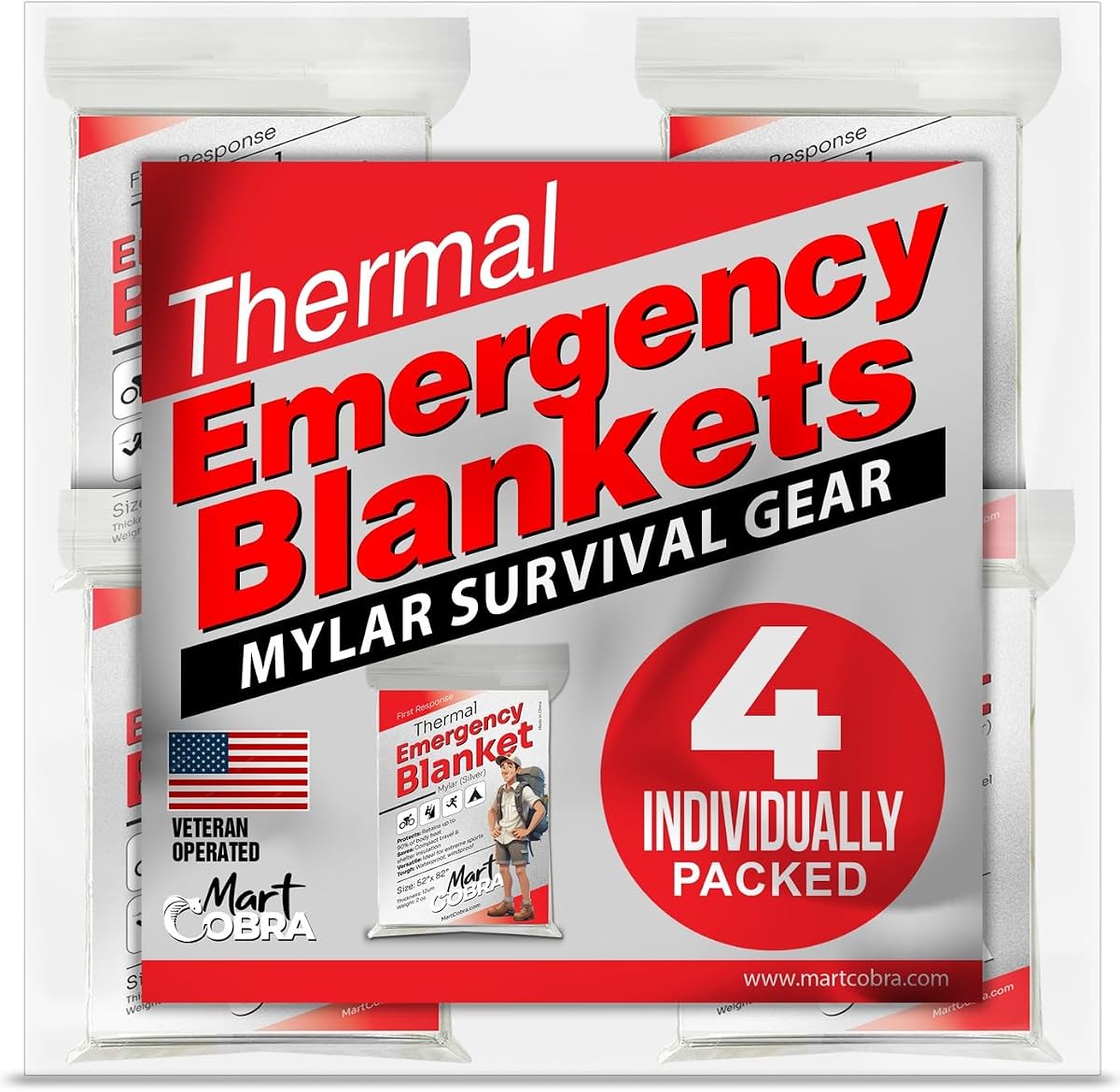
This four-pack of aluminized Mylar emergency blankets is a straightforward way to improve warmth coverage in a vehicle, hiking pack, home kit, or evacuation bag. Its 4.7 customer rating reflects a well-regarded combination of thermal retention, low weight, and easy storage. Each unfolded blanket measures 82 by 52 inches, giving it enough surface area to wrap around one person or use as ground cover and improvised shelter material.
We may earn a commission when you buy through this link, at no additional cost to you.
The stated design can retain up to 90 percent of body heat, making it particularly relevant when cold exposure, power loss, or unexpected overnight shelter becomes a concern. The four-pack format is more flexible than a single blanket because family members can each have one, while a spare remains available for a vehicle or second location. The material is described as tear-resistant and reusable, and the blankets fold into a compact bundle that can move easily between a bug-out bag, backpack, car, or emergency cabinet.
The primary trade-off is that a foil blanket is an emergency layer, not a replacement for a proper sleeping bag, rain shell, or insulated tent. Its thin construction offers limited comfort during long stays and should not be treated as a permanent shelter. Users also need reasonable practice with wrapping and ventilation, because overheating can become an issue in warm conditions even when the original goal is heat retention.
This is the best budget choice for readers who want an inexpensive, broadly useful emergency preparedness item. It is particularly valuable for cars, day hikes, travel kits, and households that need multiple people covered without assembling a large survival package. The four blankets also offer a practical redundancy: if one is lost, damaged, or needed at another site, the remaining units can still fulfill the same role.
The blankets deliver a useful emergency layer without the size of conventional sleepwear. Store them compressed near clothing or in a go bag so they remain immediately accessible when temperature becomes a concern.
A four-pack is easier to distribute than a single unit. Place one in each vehicle, assign one to each household member, and keep an extra where it can be reached without unpacking the entire kit.
We may earn a commission when you buy through this link, at no additional cost to you.
The LifeStraw Personal is designed for a common emergency bottleneck: obtaining drinkable water when bottled supplies are unavailable. It earns a 4.8 customer rating and stands out for a combination of compactness, stated laboratory-based filtration claims, and a 4,000-liter purification capacity. Its narrow personal format is particularly convenient for hiking, travel, and individual go-bag use.
We may earn a commission when you buy through this link, at no additional cost to you.
The microfiltration membrane is stated to remove 99.999999 percent of waterborne bacteria, including E. coli and Salmonella, and 99.999 percent of parasites, including Giardia and Cryptosporidium. It also removes microplastics down to one micron and reduces turbidity to 0.2 microns. These specifications make it more versatile than a simple strainer intended only to catch sediment, while the BPA-free construction suits frequent portable use.
Users should understand what the product is designed to do rather than treating it as a universal laboratory purifier. The listed capabilities do not mean it removes every chemical, virus, or contaminant that might occur in contaminated water. It also requires a reasonably clean source, and slower or highly turbid water may require more attention. Keeping a second purification method can provide redundancy if the filter is damaged, exhausted, or used on water outside its intended conditions.
This is the editor's choice for readers who want a highly portable water treatment tool for everyday outings and emergencies. It works best for active individuals, travelers, and families that can assign a filter to each person. For stationary household emergency planning, purification tablets may offer a lower-volume backup, but the LifeStraw's larger capacity and personal drinking format make it an especially versatile starting point.
Because the filter operates without a battery, it avoids one common emergency failure point. Carry it where a group can reach it quickly, and keep the intake and outlet protected from dirt when not in use.
A stated 4,000-liter capacity provides a long treatment runway for routine travel. Confirm current product instructions and guidance on storage, cleaning, and use because filter performance and maintenance needs can change over time.
We may earn a commission when you buy through this link, at no additional cost to you.
The FosPower NOAA Emergency Radio combines weather information, portable lighting, radio reception, and an internal power bank in one device. Its 4.6 rating reflects a well-rounded emergency communications option, while the 7400mWh capacity is the main feature that separates it from simpler hand-crank radios. That capacity makes it useful for keeping small devices operational when household electricity and conventional charging are unavailable.
We may earn a commission when you buy through this link, at no additional cost to you.
Three operating options are provided: a hand crank, a solar panel, and AAA batteries. The crank and solar panel are intended to regenerate enough power to support radio listening, lights, and the SOS alarm, while disposable batteries offer another fallback. The device also includes a four-LED reading light and a one-watt flashlight, allowing it to serve as a lighting hub during outages rather than functioning only as a communications receiver.
NOAA emergency forecasts and AM/FM broadcasts are its principal information sources. That makes it valuable for receiving local updates, but it should complement rather than replace multiple ways of obtaining alerts, including official phone notifications and local authorities. Its size and multifunction design may also be less convenient than a pocket radio when weight and space are the overriding priorities. Users should regularly operate the crank and verify the battery rather than assuming stored power will remain usable indefinitely.
This is the best premium choice in the lineup for readers who want a radio that also serves as a power bank and lamp. It fits well in a home emergency cabinet, vehicle kit, or go bag for a household that values combined functions. Buy it as a central communication and lighting device, then maintain a separate small radio as a redundancy for cases in which the main unit is lost, damaged, or carried elsewhere.
The internal power bank is more useful than a conventional radio battery alone. It can provide emergency power to a phone or small tablet, although users should verify cable compatibility and charge critical devices before a crisis.
Solar, crank, and AAA power create useful redundancy when the grid is down. Test each method periodically, learn the controls, and record the most reliable local NOAA frequencies for the area where the radio will be used.
We may earn a commission when you buy through this link, at no additional cost to you.
The Ready America 70280 is a coordinated emergency backpack intended to support two people for the first 72 hours after a disaster. Its 4.7 rating reflects a broad collection of essentials organized in a format that can be moved quickly. Rather than requiring a buyer to research and assemble individual categories, it brings food, water, shelter, first aid, lighting, and signaling equipment together.
We may earn a commission when you buy through this link, at no additional cost to you.
Food and hydration account for two emergency food bars totaling 4,800 calories and 12 sealed drinking-water pouches. Two emergency ponchos and two survival blankets add basic protection from rain, wind, and cold. The medical and safety layer includes a 33-piece first aid kit, dust masks, nitrile gloves, two 12-hour lightsticks, and a whistle, covering several needs that can otherwise be overlooked.
The strongest advantage is organization, though a preassembled package cannot be tailored perfectly to every household. Two people may need different clothing sizes, dietary considerations, medications, and amounts of water. It also excludes the personal documents, prescription medicines, and specialized equipment that many emergency plans require. Users should inspect package expiration dates, replace consumed items, and add locally relevant essentials before relying on it.
This backpack is well suited to couples, roommates, or a two-person household that wants a fast-moving evacuation option. It is less appropriate as the only kit for a family because its stated capacity and food allocation are focused on two people. For those users, it can serve as a ready-to-go base that is supplemented with prescription medication, extra clothing, identification, and any specialized equipment.
The package addresses the major categories associated with the first 72 hours without requiring the owner to make dozens of initial choices. Treat it as a base, then customize it around the people and hazards that matter locally.
Keeping supplies together makes the kit easier to find during a fast departure. Store it near an exit, check it seasonally, and ensure everyone knows where it is and who is responsible for retrieving it.
We may earn a commission when you buy through this link, at no additional cost to you.
The 262-piece survival kit is built for readers who want broad coverage in a single package. Its 4.6 rating reflects an extensive inventory that spans first aid, shelter, warmth, water storage, food acquisition, lighting, tools, navigation, and signaling. The components are divided between a bright red emergency pouch and a multi-compartment crossbody bag, helping the owner find high-priority supplies more quickly.
We may earn a commission when you buy through this link, at no additional cost to you.
First aid items include tweezers, scissors, pins, a non-woven pad, triangular cotton cloth, cotton swabs, cotton balls, and adhesive strips. Shelter and utility equipment include an emergency tent, blanket, rope, compass, wire saw, fire starter, and collapsible water container. The 17-inch detachable axe with hammer and 2-in-1 shovel with pick are made from carbon steel, while a flashlight, camping lamp, and glow sticks provide lighting intended to support navigation and signaling for up to 72 hours.
A large component count should not be confused with equal usefulness in every scenario. Some tools may be unnecessary for a household near dense urban services, while other kits still lack essential personal supplies such as medications, identification, extra food, and prescription eyeglasses. The weight and number of loose items can also make organization harder. Users should review the inventory, remove what cannot be used safely, and add locally relevant equipment rather than simply trusting the total.
This kit is best for hikers, campers, hunters, and households wanting a broad self-contained outdoor supplement. Its crossbody format, detachable strap, MOLLE-compatible straps, and D-rings make it adaptable to a larger backpack. For a streamlined daily carry, divide only the relevant pieces into smaller pouches; for a stationary emergency cabinet, the complete bag may be more practical.
The assortment covers useful categories that may otherwise be missing from a basic kit. Prioritize tools the household members are trained to use, particularly the axe, shovel, wire saw, and fire-starting equipment.
The detachable strap and attachment points allow the user to wear the bag or connect it to a tactical-style backpack. Repackaging frequent-access items in smaller pouches can prevent the entire collection from being dumped onto the ground during an urgent search.
We may earn a commission when you buy through this link, at no additional cost to you.
The Mylar Bivy Sleeping Bag provides a more body-oriented emergency shelter than a simple rectangular blanket. Its 4.7 rating and 84-by-36-inch dimensions make it a compelling choice for people who want to retain warmth while lying down, particularly during an unexpected cold night, vehicle exposure, or temporary outdoor shelter need.
We may earn a commission when you buy through this link, at no additional cost to you.
Constructed from Mylar foil and described as a full-body bivy design, the product is positioned for adults and children. Its stated versatility includes use as a sleeping bag, bivy blanket, or lightweight emergency shelter without a separate tent. That makes it a complementary item for a hiking pack or go bag because it adds insulation in a less bulky format than a conventional sleeping bag.
The material is intended as emergency equipment rather than a regular sleeping system. It does not offer the comfort, moisture management, or ventilation of a padded sleeping bag, and condensation may be a concern. It also cannot address every condition on its own: a bivy does not replace a rain layer, and cold-weather preparation should include insulating layers beneath it. Users should learn how to enter it while remaining dry and should not restrict ventilation unnecessarily.
This product is best for hikers, travelers, commuters, and emergency-kit builders who need a small shelter that can cover the body. It offers a practical middle ground between a full-size blanket and a tent. Adding it to a vehicle kit and a separate go bag gives the user more than one place to access warmth without significantly increasing pack volume.
The elongated shape better accommodates a person lying down, which can reduce exposed surface area. Pair it with a moisture-resistant layer to address wet ground and condensation.
A lightweight bivy is easier to carry than conventional shelter for short emergency use. Keep it compressed with the same clothing layer that provides insulation from beneath.
We may earn a commission when you buy through this link, at no additional cost to you.
Potable Aqua tablets offer a chemical backup for treating questionable water during travel, hiking, camping, and disasters. This package includes one bottle of 50 Potable Aqua Water Purification Tablets and one bottle of 50 PA Plus tablets, providing a substantial number of treatments in a compact format. Its 4.7 rating reflects a well-established option for emergency water planning.
We may earn a commission when you buy through this link, at no additional cost to you.
The tablets are stated to make questionable water bacteriologically suitable to drink when used correctly. They are effective against bacteria and Giardia lamblia, covering two important categories of concern in untreated outdoor water. When used according to the instructions, the product is described as leaving no iodine taste or color, a practical consideration for people who may need to drink treated water during an already stressful event.
Correct use is essential. Tablets require the right dose, adequate treatment time, and clean handling; the user should consult the current label rather than estimate. These tablets should not be described as removing every chemical, virus, or environmental contaminant, and cloudy or heavily contaminated water may require filtration, settling, or another treatment method first. Packaging also needs to remain sealed, dry, and within its stated storage conditions.
This is a strong secondary water solution for go bags, travel kits, and camping supplies because it takes little space and requires no filter housing or replacement cartridge. It complements rather than necessarily replaces a personal filter, particularly for households that want two distinct treatment methods. Store the bottles where they will remain sealed, and make sure household members know the correct treatment time before they need it.
Tablets are easy to distribute because they occupy much less space than a filter and containers. The two-bottle format provides room for primary and backup treatment supplies in the same category.
Write the required dose and waiting time on the kit inventory or instruction sheet. A simple reminder improves the likelihood that users will treat water properly when conditions are difficult.
We may earn a commission when you buy through this link, at no additional cost to you.
The RunningSnail hand-crank radio is a compact communications and lighting option for home, outdoor, and vehicle kits. Its 4.5 rating reflects a useful combination of NOAA, AM, and FM reception, a 2000mAh rechargeable battery, and multiple ways to keep the device available when conventional power fails. At approximately 5 by 1.8 by 2.4 inches and 0.5 pounds, it is easier to carry than larger multifunction radio models.
We may earn a commission when you buy through this link, at no additional cost to you.
The radio includes a retractable antenna intended to improve signal reception in remote or weak-signal locations. It can receive real-time local weather alerts, forecasts, news, and emergency broadcasts, while the one-watt LED flashlight provides illumination for dark conditions. The three power modes—hand crank, solar panel, and built-in rechargeable battery—give users several levels of redundancy during a prolonged outage.
The 2000mAh battery offers less reserve power than the larger power-bank radios in this guide, so it is better viewed as a compact backup communicator than a central charging station. Although it is described as compatible with many USB devices, actual charging speed and compatibility vary. Solar and hand-crank generation also depend on sunlight, cranking effort, and duration, so users should preserve the internal charge rather than treating either alternative as unlimited.
This radio is best for backpackers, travelers, and households seeking a lightweight second radio. It can live in a vehicle, office, or small go bag without taking much room. Pairing it with a larger NOAA radio creates a useful redundancy because a portable model can accompany one person while the more powerful unit remains with the main supplies.
Its small size makes this radio practical for a personal bag or vehicle glove box. Keeping it separate from the main household radio protects against a single loss or failure.
The retractable antenna helps users optimize reception when broadcast signals are weak. Learn to tune manually and note reliable local stations before an emergency.
We may earn a commission when you buy through this link, at no additional cost to you.
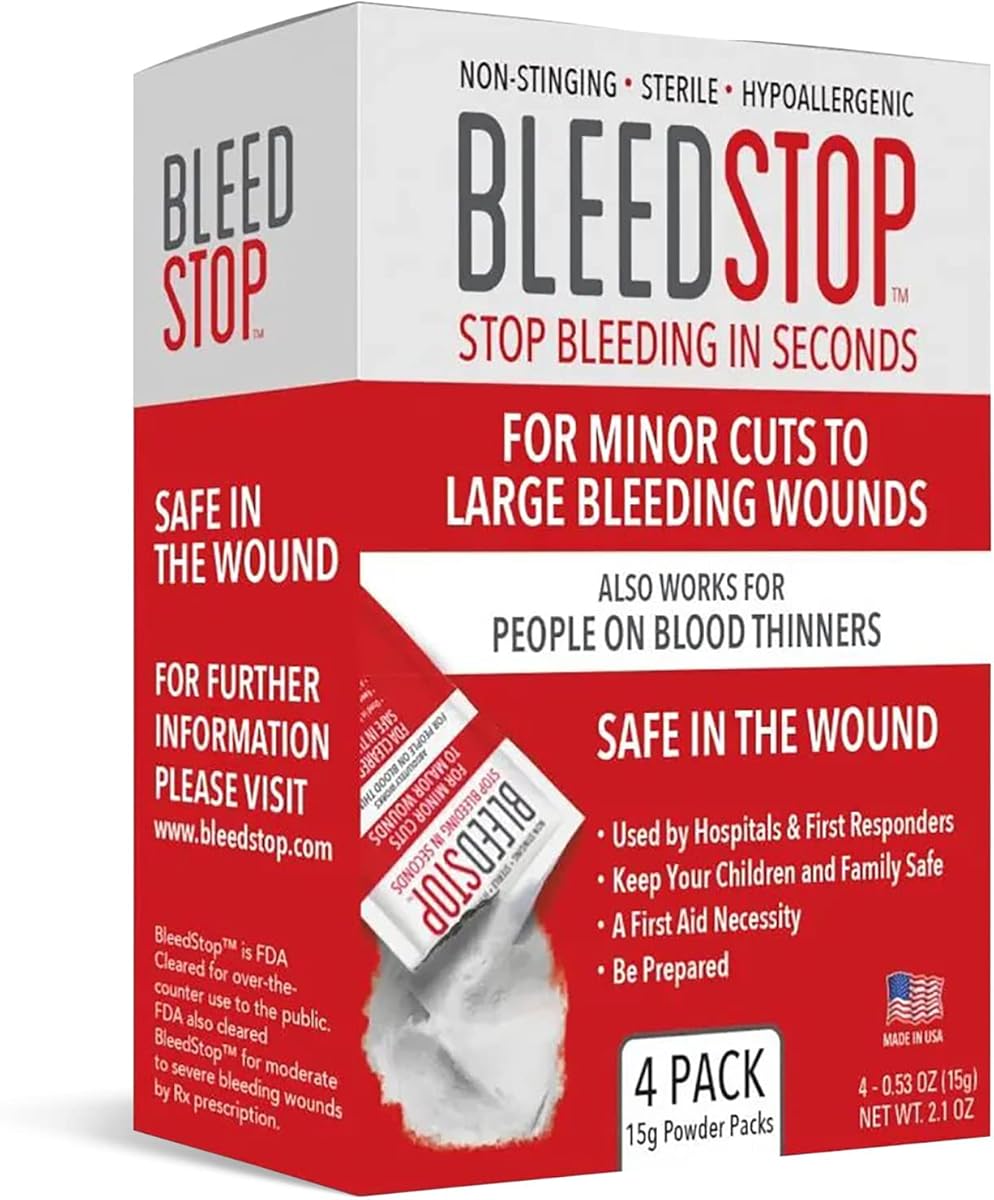
BleedStop First Aid Powder is a compact bleeding-control aid intended for moderate to severe wounds, lacerations, cuts, scrapes, and nosebleeds according to its supplied information. Its 4.8 rating places it among the strongest customer-rated products in this guide. Four individual 15-gram pouches also make it easier to place in several first aid kits rather than storing all of the powder together.
We may earn a commission when you buy through this link, at no additional cost to you.
The stated benefit is rapid action upon contact with a bleeding site. Users apply a layer over the entire wound and then use firm pressure with sterile gauze or a bandage. The powder is described as safe to leave in place under the dressing, which simplifies the process compared with a product that must be removed and rinsed away. The formula is also described as safe and non-stinging for adults and children.
This is an adjunct, not a replacement for professional medical treatment or emergency services. People taking blood thinners may have special needs that deserve discussion with a healthcare professional, and severe bleeding can become dangerous quickly. The package directions should be read before use, and the instruction to seek emergency medical treatment if bleeding does not stop after a prolonged period is important. Users should also consider training in direct pressure and basic wound care.
BleedStop is a strong addition to daily first aid, camping, hiking, cycling, and vehicle kits where bleeding control may be needed before professional help arrives. It is particularly practical for travelers because four pouches can be distributed across bags. It should sit alongside sterile gauze, adhesive bandages, gloves, and a clear method for contacting emergency services rather than replace those foundational supplies.
The powder is designed for quick application at the point of injury. Pair it with sterile gauze, gloves, and a firm-pressure technique to make the most of the available first aid supplies.
The product states that it can help control bleeding for people taking blood thinners. That makes it relevant to travelers and older adults, although it should complement—not delay—urgent medical advice for serious bleeding.
We may earn a commission when you buy through this link, at no additional cost to you.
The Leaton radio is built around a 10000mAh rechargeable battery, making it the most power-focused radio in this guide. Its 4.5 rating reflects a broad feature set that includes NOAA, AM, and FM reception, a flashlight, a reading lamp, a compass, and USB output for emergency phone charging. The larger internal battery distinguishes it from compact units designed mainly for radio reception.
We may earn a commission when you buy through this link, at no additional cost to you.
The radio can be charged through USB-C, its built-in solar panel, or its hand crank. It is rated IPX6 for protection against water spray and splashing, though the supplied information explicitly notes that it is not intended for heavy rain, immersion, or underwater use. The flashlight has high, low, and SOS modes, while the 1.3-watt reading lamp offers softer illumination for maps and supplies. Its dimensions and weight remain practical for a vehicle, RV, or larger go bag.
There are important operating limitations. NOAA reception requires manual tuning, and the radio does not support SAME technology, automatic alerts, or location-based warnings. It also lacks a headphone jack and cannot charge multiple devices simultaneously. The stated emergency output is 5V at 1A, with realistic expectations of approximately one to one and a half iPhone 14 charges after conversion losses. These restrictions make advance setup and familiarization essential.
This radio is best for households or campers that want significant battery-based emergency power and can accept manual NOAA tuning. It is particularly compelling for long road trips, RV travel, and homes preparing for outages. Users should fully charge it before storage, recharge it every three to six months, learn the tuning controls, and treat the phone-charging feature as an emergency convenience rather than a guaranteed full-day power source.
The 10000mAh cell provides a meaningful reserve for radio use, lighting, and limited device charging. Actual output varies with conversion losses, so critical users should test their own phone and cable before relying on it.
Because the radio does not provide automatic NOAA alerts, owners should tune it before an emergency and record the clearest local station. Extend the antenna and turn the control slowly when conditions make reception difficult.
We may earn a commission when you buy through this link, at no additional cost to you.
The most useful emergency kit is not necessarily the one with the most equipment. Start with likely hazards, the people who need protection, and the duration of an evacuation, then choose products that solve clearly defined gaps and can be maintained over time.
Emergency priorities vary by location. Households in areas prone to hurricanes may focus on NOAA alerts, power, and waterproof storage, while travelers may need water treatment and compact thermal protection. Consider the hazards that can affect your home, vehicle, workplace, school route, and regular outdoor activities. Include less obvious threats such as prolonged outages, extreme heat, winter exposure, contamination, injury, and separation from normal services. A useful plan identifies the first three likely problems and makes sure each has more than one solution where practical.
Water is the foundation of a credible preparedness plan because people cannot remain safe for long without it. Determine how much each person may need for drinking, cooking, sanitation, first aid, and pets, then compare that estimate with available stored water. A personal filter offers high treatment capacity for streams and other sources, while tablets add compact chemical backup. Neither product removes every possible contaminant, and both require appropriate source conditions, so carrying both methods offers useful redundancy.
A survival item that cannot be carried may have limited value during an evacuation. Foil blankets and Mylar bivies provide substantial thermal protection with little weight, whereas comprehensive kits with axes, shovels, tents, and many small components require more space. Decide whether the product will remain in a fixed home cabinet, a vehicle, a backpack, or a personal go bag. For mobile use, prioritize the items needed for the first hours and separate bulky tools from frequently used essentials.
Radios become especially valuable when cellular networks, televisions, and household electricity fail. Look for NOAA access, AM and FM reception, a readable display or straightforward tuning, and at least two methods of recharging. A larger battery can support lighting and limited phone charging, but capacity alone does not guarantee strong reception. Manual NOAA tuning, absent automatic alerts, is an important limitation to understand. Keep phone-based alerts active when possible and own a separate radio as backup.
First aid products are most effective when the purchaser knows how to use them. Bleeding-control powder can complement sterile gauze, gloves, direct pressure, and a trained response, but it cannot replace emergency services. Build the medical section around commonly needed items and current manufacturer instructions. Add personal prescription medications, allergy treatments, mobility aids, and contact information. Review expiry dates, replace used components, and ensure instructions are understandable to every adult in the household.
Emergency shelter should protect against cold, wind, and rain while remaining light enough to carry. A foil blanket can wrap a person or cover the ground, while a Mylar bivy gives more complete body coverage for lying down. Neither is a full replacement for a tent, sleeping bag, rain layer, and insulating clothing. Look at dimensions, reusable material, tear resistance, and whether the product is intended for a stationary emergency or regular outdoor use. Layering clothing beneath thermal material improves comfort and heat retention.
The most complete kit is ineffective if nobody can locate a needed item. Use transparent pouches, printed inventory lists, color coding, and separate modules for water, medical care, lighting, communication, and shelter. Keep frequently needed tools near the top, and place the kit beside a primary exit or in an accessible vehicle location. Every household member should know what the kit contains, where it is, and what to do first. Large multi-item kits benefit from subdivision so urgent supplies do not get buried.
Preparedness equipment can degrade even when it is never used. Batteries lose charge, tablets and food have shelf lives, fabrics weaken, and instructions may change. Set a recurring check every three to six months for radios and power banks, and inspect water, food, medical, and treatment supplies according to their labels. Test lights, antennas, and charging methods. Replace leaking, expired, damaged, or depleted items, and document the check so maintenance does not depend on memory alone.
Begin by placing each item in the location where it is most likely to be needed, then attach a simple inventory card listing contents, quantities, expiration dates, and basic operating instructions. Keep the emergency kit near an exit rather than buried in a closet, and keep a smaller version in the vehicle, office, or backpack. Household members should know which products provide water, warmth, weather information, lighting, and first aid without having to unpack everything.
Learn the products before conditions become difficult. Practice lighting the radio, tuning a NOAA station, operating the hand crank, filtering a known quantity of water, and applying first aid using the supplied directions. Place emergency batteries and spare power sources in the correct compartments, and make sure cables for any radio charging function remain available. For water purification, follow the exact dose, waiting time, container, and storage requirements printed on the product.
Inspect and maintain the kit on a fixed schedule, ideally every three to six months and after any use. Recharge rechargeable radios, check the hand crank and flashlight, replace used tablets or medical supplies, and review water and food dates. Keep foil shelters dry before packing, keep filtration equipment from freezing or becoming contaminated, and store radios in accessible locations with their antenna and controls protected. After use, restock from the bottom of the list rather than assuming the kit is complete again.
The priorities depend on the situation, but drinking water, a communication method, lighting, first aid, warmth, and basic tools are a strong foundation. A preparedness plan should also include food, medication, identification, and cash that are outside this guide's product list. The best approach is to assemble several categories rather than relying on one large product or one type of protection.
Carrying both is a strong redundancy strategy because they use different treatment methods. A filter offers high capacity for suitable outdoor sources, while tablets are compact and can treat water without pumping equipment. Neither removes every possible contaminant, so users should follow the instructions, assess the source, and carry additional treatment when traveling into remote areas.
No. Some radios tune NOAA channels manually and do not support SAME or location-based automatic alerts, as is the case with the Leaton model reviewed here. Owners should test reception, note the clearest local station, and keep phone-based official alerts enabled whenever possible. A separate radio can provide useful backup if the primary device is lost or damaged.
Check rechargeable emergency radios every three to six months and recharge them according to the manufacturer's instructions. During each check, test the radio, flashlight, reading lamp, antenna, and charging inputs. Replace disposable batteries that are expired, corroded, or unable to hold a charge, and do not leave a radio stored for months without any maintenance.
They are best treated as emergency supplies because they are thin, can retain heat rapidly, and are not designed for the comfort and moisture management of regular sleep systems. For camping, use an appropriate sleeping bag, tent, and clothing, then carry a foil blanket or bivy as a compact backup. The bivy reviewed here offers more body coverage but shares many of the same comfort and ventilation limitations.
No. It is a bleeding-control aid intended for use with firm pressure, sterile gauze, and a bandage, but severe or persistent bleeding requires immediate professional help. Anyone using it should follow the package directions, seek emergency medical treatment when needed, and avoid delaying a call for assistance. Basic first aid training is more valuable than carrying equipment without knowing how to use it.
Yes. A preassembled package provides a useful starting point, but households should add prescription medications, identification, appropriate clothing, extra food and water, and tools suited to local hazards. Check all expiration dates, inspect the inventory, and account for the number of people and pets being supported. Personalization usually matters more than adding a few extra generic accessories.
Store the main kit in a dry, accessible location near an exit, with smaller kits in vehicles, offices, and personal bags. Keep the location known to every responsible household member and ensure it can be reached if the primary route is blocked. Avoid damp basements, hot attics, and locked storage that could delay access during a fast evacuation.
The strongest overall approach is to combine specialized items rather than search for one universal product. The LifeStraw Personal Water Filter leads the water category with a high 4.8 rating and stated filtration capacity, the FosPower NOAA radio offers a capable combination of alerts, lighting, and power, and the four-pack of emergency blankets provides an efficient warmth solution for individuals, families, and vehicles.
Prioritize the gaps in your current plan. Secure safe drinking water and two treatment methods, establish a communication channel, provide light without depending entirely on wall power, and assemble a medical section that includes sterile dressings and useful training. Then add shelter and warmth appropriate to the climate, and organize everything so it can be found and carried during a hurried evacuation.
Finally, check current product details, ratings, availability, and prices before making a purchase, because all can change over time. Keep the completed kit accessible, inspect it on a recurring schedule, and replace consumed or degraded supplies. Preparedness is an ongoing maintenance practice, not a single shopping decision, and a modest kit that is well understood and regularly checked is more valuable than a large collection that is rarely inspected.