
FlexSolar 25W Portable Solar Panel Charger
4.4Editor score
25W portable solar output
Dual USB charging ports
Compact 1.2-pound design
Discover the best solar backpacking charger options by comparing power, portability, ports, durability, efficiency, and outdoor features.
A solar backpacking charger can provide a dependable source of power for phones, navigation tools, lights, and other small electronics when camping far from conventional outlets. The most useful models balance usable solar output, low weight, durable construction, convenient charging ports, and enough weather resistance for exposed trails.
This guide compares ten solar backpacking chargers using the specifications and feature details supplied for each product. The evaluation considers rated panel wattage, conversion efficiency, port configuration, folded size, weight, weather rating, charging safeguards, included accessories, and suitability for backpacks, campsites, and emergency kits.
Each review identifies the product's strongest qualities and practical limitations, helping you determine which model best fits your route, device mix, and tolerance for changing sunlight. Solar performance remains dependent on weather, panel angle, and shading, while current prices and availability may change without notice.
4.4Editor score

4.5Editor score

4.5Editor score
The comparison below summarizes panel output, charging options, portability, and environmental protection for all ten solar backpacking chargers.


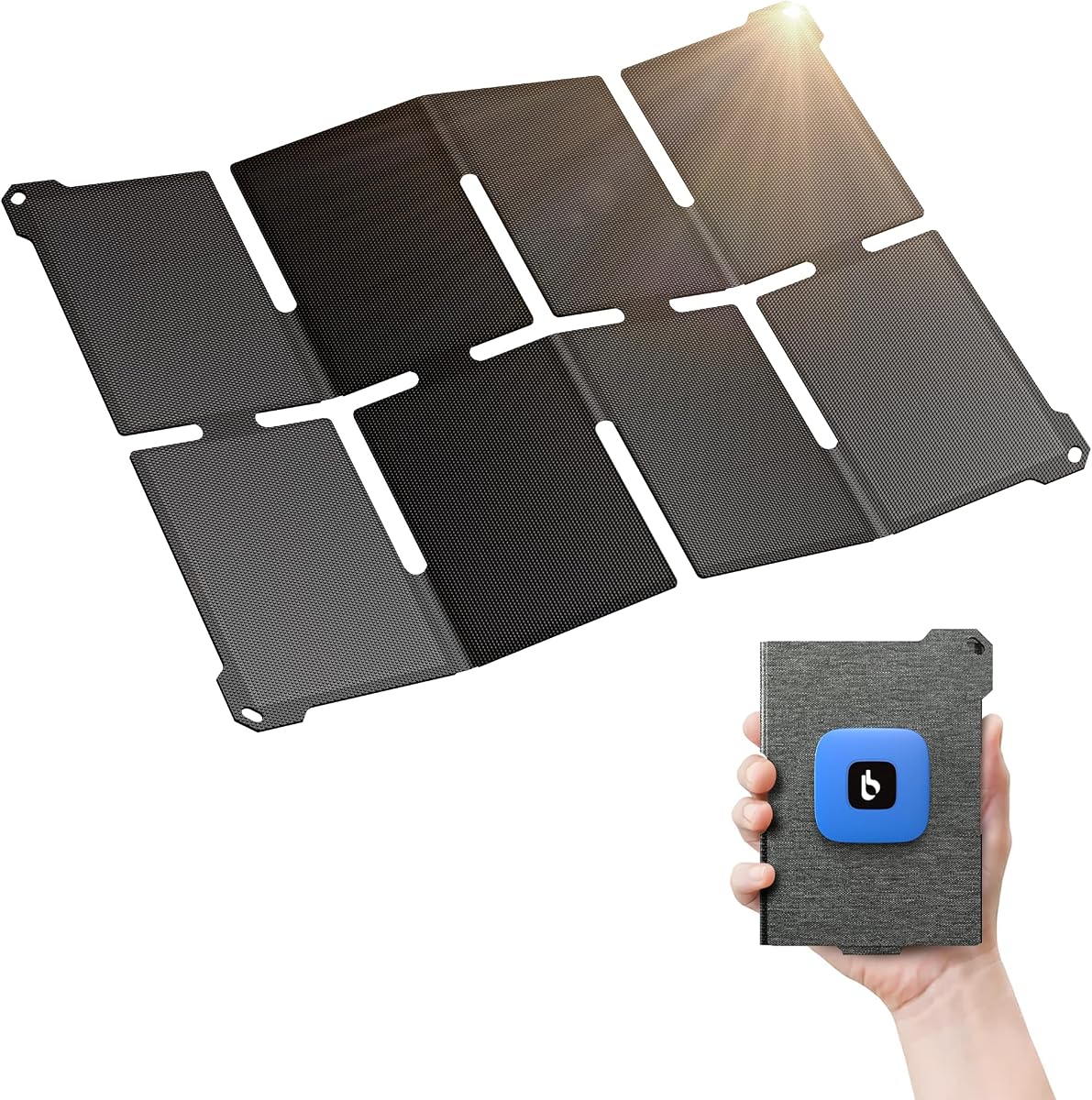

The BigBlue 28W High-Efficiency Solar Panel Charger combines a 28W panel, three USB outputs, and a relatively compact format, earning a 4.3 rating. Its most appealing feature for backpackers is the combination of two USB-C ports and one USB-A port, allowing compatible phones, tablets, GPS units, and power banks to share the panel.
We may earn a commission when you buy through this link, at no additional cost to you.
BigBlue specifies 25.4% sunlight-to-power conversion and a shadow-free panel surface without front-facing metal lines. The two USB-C ports and one USB-A port each support up to 5V/3A, with a stated collective maximum of 5V/4.8A. A 50cm USB-C cable, two carabiners, and a manual are included.
The main limitation is that this is a direct-charging panel rather than a solar generator with an integrated battery. Output fluctuates with sunlight, orientation, temperature, and connected equipment, and the USB junction box is not waterproof. It also cannot adequately charge laptops or large power stations, making it better suited to phones and small electronics.
Choose this model when you want a strong mix of output, ports, and pack weight without moving to the largest panels. It is a practical all-rounder for campers who regularly travel in reliable sunlight and need to top up several small devices during the day.
The three-port layout reduces the need to carry multiple adapters or repeatedly swap cables. It is particularly useful for groups carrying different connector types or for charging a phone and a power bank at the same time.
The unfolded panels offer a useful collecting surface, while the folded dimensions of 11 by 6 by 1.4 inches and 1.5-pound weight remain manageable for an external pack position. Keep the ports and junction box protected during heavy rain.
We may earn a commission when you buy through this link, at no additional cost to you.
The FlexSolar 40W Foldable Solar Panel Charger has a 4.4 rating and stands out for offering USB-C, USB-A, and 19V DC output from one 40W panel. That wider selection of connections makes it more adaptable than a basic dual-USB phone panel, particularly for campers carrying smaller portable power stations.
We may earn a commission when you buy through this link, at no additional cost to you.
The USB-A port supports QC3.0, and the USB-C port supports PD2.0, with up to 18W per port. The 19V DC connection can deliver up to 40W, though the product guidance recommends prioritizing a single port for peak efficiency. An integrated chip detects connected devices, while protection covers overcurrent, overheating, and short circuits.
FlexSolar claims 24% conversion efficiency and IP67 protection with an ETFE laminate. The junction box is not fully waterproof and should be stored indoors during heavy rain. The listed 40W is panel capacity rather than guaranteed real-time output, and the manufacturer warns that shade or partial coverage may reduce performance by as much as 70%.
This is a strong choice for a hiker who needs flexible outputs and reasonably high panel capacity without moving to a much larger system. It is less attractive for ultralight travelers, and users should confirm that their small station accepts the 19V DC connection and suitable current.
USB-C and USB-A cover common personal electronics, while the 19V DC socket expands compatibility with compatible small stations. This broad interface selection can simplify a mixed-device kit.
FlexSolar recommends a 45-degree angle toward direct sunlight. That advice matters because a partially shaded panel may lose a substantial portion of its usable output, even when the weather appears clear.
We may earn a commission when you buy through this link, at no additional cost to you.
The GEYOTO 45W Solar Panel Charger has a 4.5 rating and offers the highest nominal output in this group alongside a stated conversion efficiency of up to 26%. Its two USB-C ports and one USB-A port can charge up to three compatible devices at once, making it appealing for shared campsites and families.
We may earn a commission when you buy through this link, at no additional cost to you.
The primary USB-C connection supports up to 25W Power Delivery, while the three-port layout accommodates phones, tablets, power banks, and other USB devices. Advanced monocrystalline cells are paired with an IP68-rated laminated surface, and the package includes an extension cable, storage pouch, two carabiners, and a manual.
At 1.65 pounds, the panel folds to 8.44 by 12.52 by 1.26 inches, giving it an iPad-sized footprint and a reasonable external-pack burden. The trade-offs are its lack of integrated battery storage and the instruction to keep the ports dry. Output also varies with sunlight, weather, panel angle, and device conditions.
This model makes sense when charging speed and panel capacity are priorities, or when several people need to replenish devices during a sunny trip. A compatible power bank is recommended for collecting energy when devices cannot remain connected.
The 45W rating and 25W PD connection provide more headroom than a basic phone panel. The advantage is most meaningful in unobstructed sunlight, where the cells can operate closer to their stated conversion potential.
Three ports reduce cable contention around camp. Because the panel has no internal battery, coordinating direct charging times is important when multiple devices are waiting for power.
We may earn a commission when you buy through this link, at no additional cost to you.
The FlexSolar 25W Portable Solar Panel Charger delivers a 4.4 rating and targets hikers who prioritize weight and volume. It folds to 7.7 by 5.1 inches and weighs 1.2 pounds, making it one of the most compact options in this guide and easy to attach to a backpack or tent.
We may earn a commission when you buy through this link, at no additional cost to you.
Integrated USB-A and USB-C outputs can charge two devices simultaneously at up to 5V/3A. MPPT technology is used to improve energy collection, and the intelligent power-management system is described as Qi and PD compatible. A triple-layer construction includes a scratch-resistant surface, UV-stabilized encapsulation, and an impact-absorbing baseplate.
FlexSolar states 23.2% photovoltaic efficiency and IP67 protection, with testing cited for more than 2,000 folds. The trade-off is capacity: a 25W panel collects less energy than 35W, 40W, or 45W alternatives, and it offers only two connections. The stated operating range is from -4 to 149 degrees Fahrenheit.
This is a compelling option for solo backpackers carrying light electronics and accepting slower charging. It is particularly useful as a supplementary panel for a power bank rather than a sole high-energy source for several devices.
The 1.2-pound weight reduces bulk compared with most 35W to 45W models here. It is a sensible compromise for travelers who regularly carry one phone, a small light, and a power bank.
The layered surface and baseplate are designed to tolerate folding and field handling. IP67 certification adds useful protection against dust and temporary water exposure, although the ports should still be shielded during heavy rain.
We may earn a commission when you buy through this link, at no additional cost to you.
The BigBlue 28W Solar Panel Charger with Digital Ammeter has a 4.3 rating and adds a practical feature not present on every competitor: a digital display for monitoring real-time current output. That visibility helps users understand how sunlight, position, and device draw affect actual charging performance.
We may earn a commission when you buy through this link, at no additional cost to you.
The panel uses high-efficiency cells with a stated 25.4% conversion rate. It provides USB-A output up to 5V/2.4A and USB-C output up to 3A, with combined output up to 5V/4A. An intelligent chip identifies connected devices, and the foldable four-panel body includes a secured zippered compartment.
The 1.47-pound panel folds into a packable form and includes a USB-C cable and two carabiners. Its IP44 protection handles occasional rain and damp conditions, but the ports and ammeter must remain dry. Only two charging ports are offered, and the panel cannot store energy.
Buy this version if you value visibility into current flow more than having a third connector. It is well suited to campers who want to compare conditions or confirm that a device is receiving power during a sunny break.
The integrated ammeter is useful for diagnosing weak charging caused by shade, poor angle, or an incompatible device. It also makes the panel more educational for users learning how field conditions affect solar output.
A secured zippered compartment helps keep small cables and accessories together. BigBlue advises against placing phones inside during charging because heat can build in the enclosure.
We may earn a commission when you buy through this link, at no additional cost to you.
The FlexSolar 36W Ultra-Portable & Lightweight Solar Panel Charger has a 4.0 rating and combines a midrange 36W panel with USB-A, USB-C, and 5.5 by 2.1mm DC outputs. This broad connection selection gives it a useful role for campers who want more flexibility than a standard dual-USB charger.
We may earn a commission when you buy through this link, at no additional cost to you.
MPPT technology is used to maximize harvested energy, including in partial shade, and an intelligent system adjusts output to reduce overcharging risk. FlexSolar specifies 24% photovoltaic efficiency, triple-layer circuit protection, and an operating range of -4 to 149 degrees Fahrenheit.
The panel weighs 1.7 pounds and folds to 7.7 by 5.1 inches. Although that weight is acceptable for a panel in this category, it is noticeably heavier than the 25W FlexSolar and the 0.84-pound BigBlue model. The product also carries the lowest numerical rating in the comparison.
Choose this model if its mix of 36W output and DC connectivity fits your equipment better than lighter or higher-rated alternatives. Confirm the voltage and connector requirements of any non-USB device before relying on the DC socket.
The 5.5 by 2.1mm DC connection can serve compatible small DC devices in addition to standard USB equipment. It is more versatile, but it also requires more careful cable and voltage matching.
The scratch-resistant coating, EVA encapsulation, and polymer baseplate are designed to withstand regular unfolding. The stated fold-cycle testing indicates attention to the flex points that commonly cause hidden damage.
We may earn a commission when you buy through this link, at no additional cost to you.
The GEYOTO 35W Solar Charger has a 4.1 rating and offers a compact 35W format with an asserted conversion efficiency of up to 26%. Its one USB-C and one USB-A port provide 35W of combined output and allow two compatible devices to charge simultaneously.
We may earn a commission when you buy through this link, at no additional cost to you.
The panel is designed for phones, tablets, and power banks, while built-in protection covers overcurrent, overcharging, overvoltage, and short circuits. Its laminated surface carries an IP68 rating for water and dust resistance, although the ports must remain dry and the surface should be wiped before storage.
At 1.54 pounds, it folds to 4.76 by 8.29 by 1.57 inches, making it smaller than several higher-output alternatives. The package includes a USB-C extension cable, protective storage pouch, two carabiners, and a manual. Like most models in this guide, it has no internal battery and therefore charges connected devices directly.
This is a sensible middle ground for backpackers who want more capacity than a 25W panel without carrying a 45W design. It is particularly attractive for travelers with a small device set and a consistent need to top up a phone or power bank in direct sun.
The 26% claimed efficiency and compact dimensions offer a useful middle ground. Actual output still depends on direct sunlight, clean surfaces, and proper orientation.
Four types of charging protection provide reassurance when output fluctuates outdoors. The intelligent system is intended to regulate power rather than leave connected devices exposed to unmanaged spikes.
We may earn a commission when you buy through this link, at no additional cost to you.
The ELECOM NESTOUT Portable Solar Panel combines a 28W power-generation rating, high-quality SunPower MAXEON cells, and a refined four-panel fabric design. Its 4.5 rating reflects a strong balance of useful output, organization, and camping-oriented construction.
We may earn a commission when you buy through this link, at no additional cost to you.
Two USB-A ports can charge phones, tablets, and Bluetooth earbuds, while an LED current checker shows power generation entering the ports. Two adjustable stands help optimize the angle toward the sun, and the ripstop nylon bag incorporates mesh storage pockets for cables, carabiners, and small accessories.
The primary limitation is that it lacks modern USB-C connectivity, making it less future-facing for travelers whose devices rely exclusively on USB-C. Its bag is described as water-resistant rather than assigned a detailed IP rating, so exposed rain calls for greater care than with IP68 competitors.
This panel is worth considering for campers who value thoughtful organization, attractive equipment, adjustable positioning, and a durable fabric enclosure. It is less suitable for modern USB-C-only device kits unless you carry an appropriate adapter.
The built-in stands reduce the need to prop the panel against rocks or gear. A stable, correctly oriented panel can make a meaningful difference in usable solar collection.
Ripstop fabric, exterior hanging loops, and internal mesh pockets make the panel feel purpose-built for camp organization. The enclosure protects cells while giving cables and small accessories a defined home.
We may earn a commission when you buy through this link, at no additional cost to you.
The BigBlue Ultra-Light Portable 25W Solar Panel Charger stands out at just 0.84 pounds, making it the lightest model in this comparison. It retains a 4.2 rating and folds to 4.65 by 6.42 by 1.38 inches, offering a compact option for hikers who carefully control every carried gram.
We may earn a commission when you buy through this link, at no additional cost to you.
USB-A output supports up to 5V/2.4A, while USB-C supports up to 5V/3A. Smart charging technology optimizes delivery to connected devices. The N-type cells have no front-side metal lines, which is intended to increase light capture, reduce heat, and support conversion efficiency of up to 25.4%.
Durability comes from ETFE coating, UV-resistant EVA, and a solid baseplate, while IP68 protection addresses dust, splashes, and light rain. The trade-off is only 25W of rated panel output and two ports, so it will generally replenish smaller device sets more slowly than a 35W to 45W model.
Choose it for ultralight travel, short backpacking routes, or supplemental charging of a phone and small power bank. Its efficiency and low weight are compelling, but additional battery capacity remains valuable when extended cloudy weather is likely.
The 0.84-pound weight is the key attraction for fast hikers and minimalists. It can be carried without dominating pack-space decisions while still offering direct charging for common small devices.
The metal-line-free N-type design aims to capture more available light and run cooler than cells with visible front conductors. A clean, unobstructed surface remains important for maintaining that advantage.
We may earn a commission when you buy through this link, at no additional cost to you.
The Boltstar 40W Solar Panel Charger carries the highest customer rating in the comparison at 4.8. Its 40W panel is described as delivering up to 36W maximum output, combining useful capacity with a relatively light 1.48-pound weight for a device capable of serving several types of small electronics.
We may earn a commission when you buy through this link, at no additional cost to you.
The main connection is USB-C with up to 12V/3A, and a USB-A adapter is included. The listed compatibility covers iPhones, iPads, Apple Watches, Android phones, power banks, Bluetooth earbuds, and other small electronics. A 25% conversion efficiency and IP67 sealing provide a solid specification foundation.
The main compromise is the single primary port. When several devices need charging, users must take turns unless they add a compatible splitter or hub, which is not part of the stated package. The panel also lacks a built-in battery, and insufficient sunlight can produce unstable or reduced output.
This model is a good fit for a backpacker who values simplicity, portability, and a strong rating over maximum port count. It works particularly well for charging one modern device at a time or moving energy into a compatible power bank during periods of strong sunlight.
The 40W rating provides ample panel capacity for common travel electronics when sunlight is favorable. The included USB-A adapter broadens compatibility without requiring a separate charging strategy for older devices.
IP67 protection is intended to handle rain, splashes, mud, and sand. The sealed design makes the panel practical for fishing, camping, and beach trips where accidental splashes are likely.
We may earn a commission when you buy through this link, at no additional cost to you.
The right solar backpacking charger depends on the devices you carry, the weight you can accept, and the conditions you expect. Output, port coverage, weather resistance, and realistic solar behavior matter more than headline wattage alone.
Panel wattage indicates the maximum rated solar capacity, not the amount of power a device will receive at every moment. Models here range from 25W to 45W, with the GEYOTO 45W leading by headline capacity. Larger panels generally collect more energy when exposed evenly to direct sunlight, making them better for tablets, multiple phones, or power-bank charging. Smaller panels are easier to carry and may be sufficient when your load is limited to a phone, a small light, or a navigation device.
Prioritize enough capacity for your normal device load without choosing a panel that consumes space you need for shelter, water, or food.
Conversion efficiency describes how effectively the cells turn received sunlight into electrical energy. The stated figures range from 23.2% to 26%, while the ELECOM panel advertises a 24% increase relative to traditional cells rather than the same absolute metric. Higher efficiency can be valuable in limited space, but it does not override poor positioning, partial shade, heat, or a dirty surface. A less efficient panel oriented correctly may outperform a higher-rated one placed badly.
Treat efficiency as one part of system performance and always compare using the manufacturer's stated test context.
USB-C is increasingly important for modern phones, tablets, and accessories, while USB-A remains useful for older devices and many power banks. Two-port panels are easy to carry but create scheduling conflicts, whereas three-port designs can serve a group more conveniently. Some models add a DC barrel socket for compatible small stations, though you must verify voltage, connector dimensions, and current requirements before purchase.
Match every connector to your actual device list and include any adapter cables you will need in your pack.
The comparison includes panels from 0.84 to 1.76 pounds. The BigBlue Ultra-Light 25W is the strongest choice when minimizing carried weight is essential, while 1.4- to 1.7-pound models are often more practical if they provide the ports and capacity you need. Folded size also affects whether a panel fits in a side pocket, top lid, or external attachment. Add room for cables, a power bank, and protective storage when calculating total pack impact.
Choose the smallest panel that can reasonably serve your devices, rather than assuming more panels always create a better backpacking kit.
IP ratings describe resistance to solids and water under defined test conditions, but the junction box and ports can remain weak points. IP68 models offer the strongest stated protection in this group, while IP67 models are also well suited to dust, rain, and splashes. The BigBlue 28W models and the ELECOM panel have more limited or differently described protection. Even a weather-resistant panel should be dried, inspected, and stored carefully after wet conditions.
Check the rating for the entire product, not merely the photovoltaic surface, and keep connectors dry whenever possible.
Backpacking users often carry a phone, power bank, headlamp, GPS unit, and camera, creating a mixed charging load. Dual-port models cover many common combinations but require devices to share available power. Three-port panels simplify simultaneous use, and models with DC output can support another category of equipment. Smart identification, MPPT harvesting, and overcurrent or thermal protection improve convenience and device safety.
Prioritize the connector types and simultaneous-device behavior that match your regular load.
Every product in this comparison is described as a direct-charging solar panel rather than a solar generator with a substantial internal battery. You can connect a power bank and let the sun charge it, but the panel itself does not preserve excess daytime energy for nighttime use. This distinction is critical when planning device use after sunset, during an overnight stop, or through a prolonged cloudy period.
If reliable nighttime power is essential, budget for a separate power bank and treat the panel as a daytime replenishment tool.
Successful solar charging requires direct, unobstructed sunlight. A panel facing the wrong direction, resting behind a backpack, or sitting under tree cover can lose a significant portion of its potential output. Some manufacturers recommend an angle of approximately 45 degrees. The panel should also be kept clean, and connected phones may need to remain shaded to avoid heat-related charging interruptions. Protective pouches can double as storage, but they should not cover the active panel.
Plan deployment around the sun's path, carry a way to position the panel, and expect output to fluctuate throughout the day.
Before your trip, test the charger with the devices and cables you intend to use. Unfold the panel in direct sunlight, connect a compatible device, and confirm charging begins. Learn the difference between normal output fluctuations and a complete failure. Keep the photovoltaic surface clean and free of dirt, leaves, and campsite debris, since even partial coverage can substantially reduce collection.
Deploy the panel where it receives unobstructed sunlight and orient it toward the sun, using an adjustable position or a support such as a rock when appropriate. Do not leave a phone in direct sunlight while it charges; place the device in the shade with only the cable exposed. High temperatures can trigger built-in thermal protection and slow or temporarily stop charging, so periodically check the device and panel temperature.
After use, disconnect devices, fold the panel along its intended seams, wipe away moisture and dirt, and store it in a dry place. Keep the USB ports and junction box away from standing water, even on panels with high IP ratings. Inspect the folds, cables, and connectors for damage before packing, and use a compatible power bank if you need stored energy after sunset.
Yes, provided the device and cable are compatible with one of the panel's charging ports. Direct charging works best in strong, unobstructed sunlight and may slow or stop when clouds pass, the panel is shaded, or the phone becomes too hot. Keeping the phone shaded while leaving the panel exposed can improve charging continuity.
No. The products in this guide are direct-charging solar panels and do not have internal batteries for storing excess energy. You can connect a compatible power bank during the day and use it later, but you should confirm the panel can charge that power bank effectively under your expected conditions.
A 25W panel can be sufficient for a phone, navigation device, small light, or a power bank used as part of a low-consumption kit. It is less suitable for tablets, camera batteries, and several devices that need frequent charging. Consider a 35W to 45W model if your devices draw substantial power or you have limited sunny hours.
The most common causes are indirect sunlight, an incorrect panel angle, a dirty surface, high device temperature, or an incompatible cable. Output also changes with cloud cover and the power demands of connected devices. Try repositioning the panel toward direct sun, clean the cells, and move the phone or tablet into shade.
Most models in this guide have two USB ports, and the GEYOTO 45W model has three. Simultaneous charging is convenient, but the available power is shared, so each connected device may charge more slowly than it would alone. A higher-wattage panel can provide more useful headroom for multi-device use.
Weather resistance depends on the model. Several products have IP67 or IP68 ratings, but ports, cable connections, and junction boxes can still be vulnerable. Even with a high panel rating, keep connectors dry, avoid submerging the unit, and store it indoors during heavy rain. Wipe and dry it after use.
Choose the interface that matches your devices. USB-C suits most modern phones, tablets, and smaller accessories, while USB-A supports many older devices and power banks. DC barrel output is useful only when the voltage, connector size, and power requirements match a compatible small device or station. You may need to carry an adapter for one legacy connector.
A separate power bank is strongly recommended if you need power after sunset, during an overnight stop, or when cloudy weather interrupts collection. The panel can recharge the bank during daylight, giving you a flexible buffer without requiring the solar panel itself to store electricity.
The GEYOTO 45W stands out for its combination of 45W rated output, up to 26% stated conversion efficiency, three charging ports, and IP68 protection. The FlexSolar 25W is an attractive budget-oriented choice for light packs, while the ELECOM NESTOUT earns the premium distinction for its refined four-panel construction, adjustable stands, organized storage, and high-quality cells.
Prioritize connector compatibility, realistic energy demands, packed weight, and the amount of direct sunlight available on your route. A lower-wattage panel can be the better backpacking tool if it is genuinely portable and sufficient for your devices, while a higher-wattage design makes more sense for groups, tablets, or frequent power-bank charging. All ten models work best as part of a realistic system that includes direct sunlight and a separate battery when stored power is needed.
Ratings, technical specifications, promotions, and prices can change, so verify the current listing and included accessories before purchasing. Check the panel's port layout, folded dimensions, protection details, and device compatibility against your specific packing list, and review the latest seller information before making a final decision.