
BENFEI 4-in-1 USB 3.0 Reader
4.5Editor score
USB-C and USB-A connectivity
Four card slots supported
Up to 160MB/sec transfer
This Compact Flash Card Reader guide compares ten models for card support, USB connections, transfer speed, portability, and everyday use.
A Compact Flash card reader provides a convenient bridge between older camera memory and modern computers, phones, and tablets. The right model should support the exact card formats you use, connect to your preferred ports, and handle simultaneous transfers without unnecessary card swapping. Portability, build quality, compatibility, and clear file-format support are especially important when working with legacy photography equipment.
This guide compares ten Compact Flash card readers based on the supplied specifications, including supported media, connection types, maximum claimed transfer rates, simultaneous-reading support, operating-system compatibility, and physical design. It covers USB-A and USB-C models, portable adapters, desktop-friendly multi-slot readers, and options designed for cameras, iPhones, iPads, and mobile workflows.
The list begins with a well-rounded budget-friendly reader and includes faster, more specialized models for professional cards and modern USB-C devices. Ratings and specifications reflect the available product information, while practical card support should always be checked before buying. Prices and availability change frequently, so compare the current listing with the needs identified in the guide.
4.5Editor score

4.7Editor score

4.3Editor score
The comparison below highlights each reader's card coverage, connection style, transfer claims, and most important workflow consideration, from a portable three-slot adapter to a six-format professional reader.


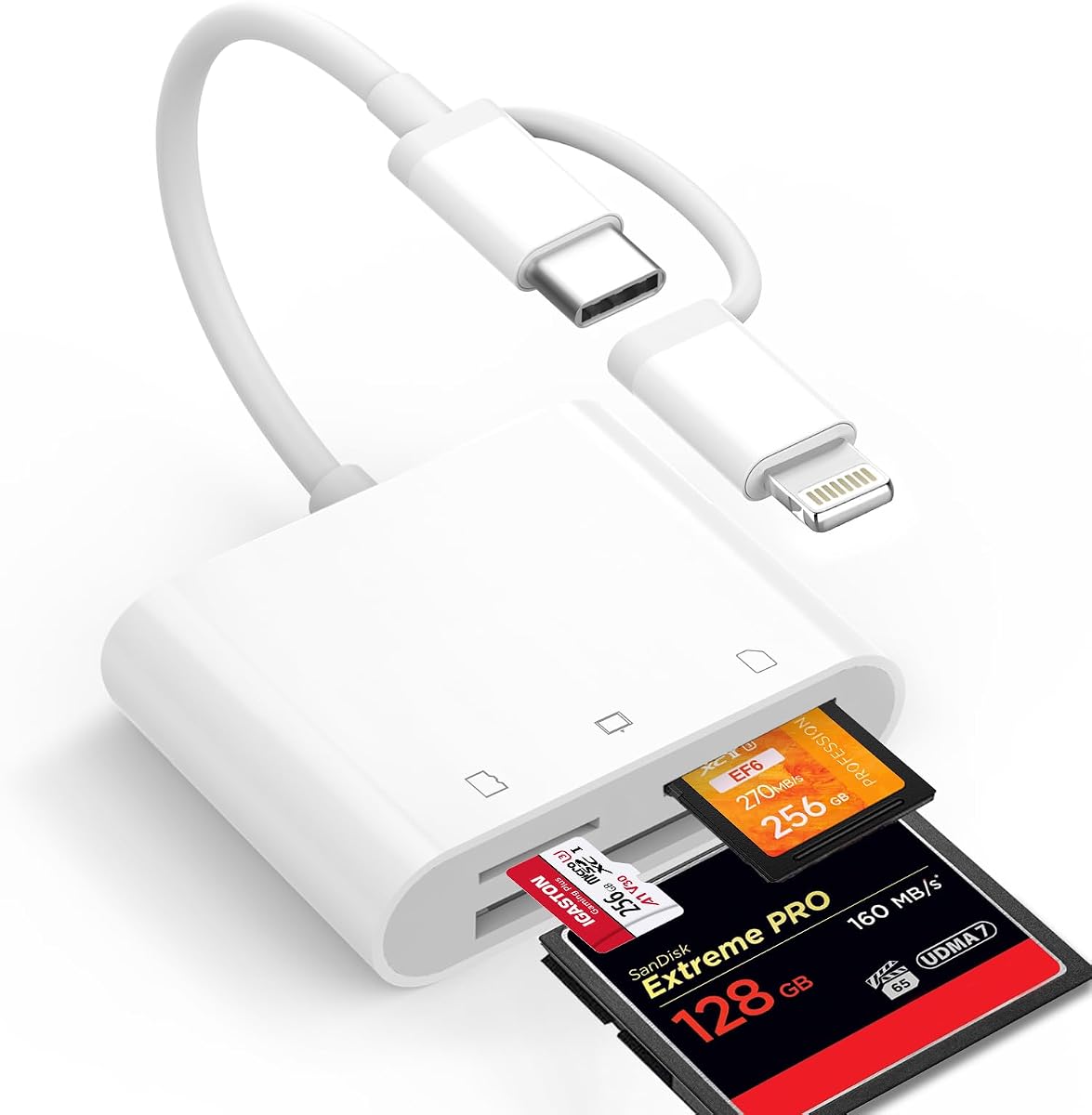

The BENFEI 4-in-1 USB 3.0 and USB-C reader combines broad card support with an integrated dual-connector design, earning a 4.5 rating among the strongest options in this guide. It is especially appealing to photographers who move between USB-C laptops, traditional USB-A computers, and compatible mobile devices while still working with Compact Flash and SD-family media.
We may earn a commission when you buy through this link, at no additional cost to you.
Its standout feature is the ability to read and write four cards at the same time. The reader includes SD, microSD, Memory Stick, and Compact Flash positions, while the integrated USB-C and USB 3.0 connection lets it work with modern Type-C systems and older USB-A ports. The supplied information reports transfer rates up to 160MB/sec in UHS-I mode, although final performance depends on the card, source device, and connection used.
There are important compatibility nuances to consider. The product information specifically says that standard Memory Stick, Memory Stick Micro M2, and CF Type I are incompatible, even though Memory Stick is included in the general slot description. Older operating systems may also require exFAT support for SDXC cards of 64GB or greater. These limitations make careful checking of your exact media essential, but they do not diminish the reader's value for standard CF, SD, and microSD workflows.
This is the most balanced budget-oriented recommendation in the list. Choose it if you want one compact adapter for multiple card types and both modern and legacy computer ports. It is less suitable for a photographer who depends on CF Type I or an uncommon Memory Stick variant, but for mainstream CompactFlash transfers and routine media management, it offers a practical combination of size, flexibility, and simultaneous access.
The integrated USB-C and USB 3.0 arrangement reduces the need to carry separate adapters. That convenience is valuable when moving from a modern MacBook or other USB-C device to a desktop that still relies on USB-A.
Simultaneous reading and writing across four slots is useful when comparing files or backing up media from more than one card. Readers with only one Compact Flash position can slow down a multi-camera workflow.
We may earn a commission when you buy through this link, at no additional cost to you.
The UGREEN SD Card Reader USB 3.0 is a four-format reader with a 4.6 rating, a broad compatibility list, and a compact body measuring 2.17 by 2.68 by 0.59 inches. It supports SD, microSD, Compact Flash, and Memory Stick media, making it a strong general-purpose choice for photographers who want more than simple CF-to-USB adaptation.
We may earn a commission when you buy through this link, at no additional cost to you.
The reader can handle four cards at the same time, which is one of its most useful characteristics. USB 3.0 is claimed at up to 5Gbps, and the product information also states that cards up to 2TB are supported. Plug-and-play operation across Windows, Mac OS, Linux, and Chrome OS makes it convenient in offices, studios, and homes where devices may run different systems.
Its main limitation is connection style. This model uses a USB 3.0 device port and a 1.7-foot attached cable, so users with modern USB-C-only computers may need an appropriate adapter. It is also a USB-A-oriented device rather than a native USB-C mobile adapter. Actual transfer speed still depends on the memory card and the USB port to which the reader is connected.
The UGREEN is a strong selection for desktop users and anyone who values broad operating-system support, simultaneous card handling, and a compact cable. It may be less convenient for a phone-centered workflow, but as a home or office card reader it is exceptionally flexible.
Support for SD, microSD, CF, Memory Stick, and multiple capacity generations makes this reader useful beyond a single camera generation. Its compatibility with Windows, Mac OS, Linux, and Chrome OS further reduces setup friction.
The small housing and short attached cable make the reader easy to place in a camera bag. Its footprint is still large enough to provide four separate card slots and stable handling.
We may earn a commission when you buy through this link, at no additional cost to you.
The Lexar Multi-Card 3-in-1 reader earns the highest rating in the group at 4.7 and stands out for clearly stated transfer speeds. It supports SD, microSD, and Compact Flash while delivering up to 312MB/sec for SD and microSD and up to 160MB/sec for CF, making it compelling for photographers who regularly move substantial image libraries.
We may earn a commission when you buy through this link, at no additional cost to you.
USB 3.1 compatibility provides a modern performance path while retaining support for USB 3.0 and 2.0 ports. The reader is also backward compatible with UHS-I SD and microSD cards rated up to 170MB/sec, which is important for photographers who still use older but capable cards. Its focused three-slot design keeps the core workflow simple rather than adding legacy formats that a particular photographer may never use.
The trade-off is narrower card compatibility than several multipurpose competitors. It does not list Memory Stick, CFast, or xD-Picture Card support. It also appears to rely on a cabled USB connection rather than an integrated dual-connector body. As a result, USB-C-only users may need a suitable adapter depending on the connector arrangement included with the device.
This is the strongest recommendation for a photographer whose priority is fast SD and microSD transfers alongside dependable Compact Flash access. It is particularly compelling for high-volume photo sorting and backup. Users who need CFast, Memory Stick, or older specialty formats should choose a broader multi-card reader instead.
The stated 312MB/sec ceiling for SD and microSD is the highest card-specific transfer rate in this comparison. It can shorten the time required to move extensive image collections when the memory card and host device are also capable of sustaining those speeds.
Concentrating on SD, microSD, and Compact Flash keeps the design focused on the formats most commonly encountered in photography workflows. That restraint can be an advantage compared with readers that include many slots for rarely used media.
We may earn a commission when you buy through this link, at no additional cost to you.
This 6-in-1 reader is the broadest traditional Compact Flash option in the guide, supporting CFast, Compact Flash, SD, microSD, Memory Stick, and xD-Picture Card. Its 4.3 rating is the lowest listed, but the product's extensive format coverage and ability to read six cards at once make it particularly relevant to photographers and videographers maintaining older and newer camera systems.
We may earn a commission when you buy through this link, at no additional cost to you.
Dual USB-C and USB-A connectors are built into the design, allowing direct use with compatible iPhones, iPads, MacBooks, Android devices, and traditional PCs. USB 3.0 is advertised at up to 5Gbps, with an aluminum alloy body intended to dissipate heat during prolonged transfers. The slot lineup extends beyond ordinary Compact Flash to include the professional CFast 2.0 format and legacy xD and Memory Stick Pro Duo media.
Its breadth introduces compatibility and workflow questions. Users may not need five of the six formats, and the supplied listing does not establish that every card generation or Memory Stick variant will work. The stated example of moving a 10GB file in approximately 16 seconds is a scenario rather than a guaranteed result, since card and host limitations still apply.
Choose this model when card variety and simultaneous access matter more than a simple, dedicated design. It is a natural fit for a mixed camera bag containing Compact Flash, CFast, and legacy media, and the dual connectors reduce the need for separate adapters. For a single-format professional workflow, a more focused reader may be easier to manage.
Supporting both CFast 2.0 and legacy Compact Flash can simplify workflows that still include older cameras alongside newer video equipment. Dedicated slots for xD and Memory Stick Pro Duo extend the same benefit to specialist photographers.
The aluminum alloy housing is designed to dissipate heat more effectively than a basic plastic shell. That construction is useful during sustained transfers involving large files or multiple cards.
We may earn a commission when you buy through this link, at no additional cost to you.
The ZIYUETEK CF Card Reader combines a 4.5 rating with five card positions and a compact aluminum design. It supports SD, microSD, M2 Memory Stick, Memory Stick, and Compact Flash cards, including UHS-I media, and allows more than one card to be read or written simultaneously for multi-card camera workflows.
We may earn a commission when you buy through this link, at no additional cost to you.
USB 3.0 is advertised at up to 5Gbps, with backward compatibility for USB 2.0 and 1.1. Hot swapping is supported, and no driver installation is required. The reader is listed as compatible with Windows XP through Windows 10, Mac OS, Linux, and Chrome OS, giving it a particularly broad operating-system profile for users who work across older and newer equipment.
The reader includes protection features for over-current, over-voltage, leakage, short circuits, and clutter. These safeguards are reassuring for a device that may be connected to valuable computers, although the wording does not amount to an independent certification. As with the other products, actual transfer rates depend on the connected cards and devices, so the 5Gbps figure should be treated as a maximum interface capability.
This is a good choice for a photographer who needs several card types but does not require CFast or xD support. Its hot-swapping and simultaneous access can simplify card rotation, while the small housing remains travel friendly. The absence of native USB-C makes it less convenient for a mobile-only setup.
Hot-swapping allows cards to be exchanged without repeatedly reconnecting the reader. This is useful during a busy shoot when alternating between camera cards, provided the device and software support safe removal procedures.
The five-position layout covers Compact Flash, SD, microSD, M2, and MS media while remaining smaller than a desktop hub. It is a practical middle ground for mixed-format camera bags.
We may earn a commission when you buy through this link, at no additional cost to you.
The UGREEN USB C 4-in-1 reader is designed around direct USB-C access, making it a natural fit for modern phones, tablets, and computers. It has a 4.5 rating and supports SD, microSD, Compact Flash, and Memory Stick formats, which gives it enough breadth for standard camera-card workflows without requiring CFast or xD hardware.
We may earn a commission when you buy through this link, at no additional cost to you.
Transfers are advertised at up to 5Gbps, and the reader allows four connected cards to be browsed, downloaded, and stored at the same time. The listed device compatibility includes current iPhone models, MacBooks, iPads, and several Android phones and cameras. It is also described as driver-free across Windows, Mac OS, Linux, and Chrome OS, so setup should be straightforward for most users.
The main limitation is that there is no built-in USB-A connector. A computer with only USB-A will require an appropriate USB-C adapter, and users should confirm that the adapter supports the required data and power standards. The reader also does not list CFast support, making it unsuitable for certain professional video cards despite its multi-card design.
Choose this model when a native USB-C connection and mobile use are the priorities. It is particularly convenient for quickly moving photos from a camera card to a compatible phone or tablet. Desktop users with USB-C ports will also appreciate the direct design, while USB-A-only users may find the cabled UGREEN four-slot reader more convenient.
Native USB-C avoids the need for a separate Type-C adapter when working with compatible phones and tablets. That can make on-location review and backup noticeably more convenient.
Simultaneous access makes it easier to organize files from several cards during one session. The benefit is greatest for users who regularly cycle through multiple camera bodies or card capacities.
We may earn a commission when you buy through this link, at no additional cost to you.
The SmartQ C368 is a straightforward four-in-one reader with a 4.6 rating. It supports SD, microSD, Memory Stick, and Compact Flash cards, reads data independently from each card, and uses a plug-and-play approach designed for travel and mobile use.
We may earn a commission when you buy through this link, at no additional cost to you.
Its USB 3.0 connection is claimed at up to 5GB per second, and it is compatible with USB 3.0 and USB 2.0 systems. The reader works with Windows, Mac OS, and Linux without requiring driver installation. A blue LED clearly indicates when the device is powered, providing a quick way to confirm that the connection is active before beginning a transfer.
The box includes the reader, a cable organizer, and a user manual. It does not include a memory card, and the product does not advertise a native USB-C connector. The unusually high speed wording should be interpreted carefully because actual file transfer performance is constrained by the card and the host connection, regardless of the reader's advertised interface maximum.
This reader is best for a traveler or desktop user who values simple operation, clear status feedback, and broad media support over specialized CFast performance. Its independent card-reading design prevents one slot from interfering with others, and the included organizer helps keep the cable manageable. It is less ideal for USB-C-only mobile workflows.
Reading data independently from each card is useful when comparing images or copying files from multiple media. It provides more flexibility than readers that treat all slots as one unified storage device.
The blue status LED confirms when the reader is powered. This small feature can prevent confusion when a user is checking a system that does not immediately display a new device.
We may earn a commission when you buy through this link, at no additional cost to you.
The 5-in-1 CFast 2.0 reader is aimed at photographers and videographers who need both professional CFast media and conventional camera cards. It supports CFast 2.0, Compact Flash, SD, microSD, and XD-Picture Card formats, earning a 4.4 rating while covering five important photographic card families.
We may earn a commission when you buy through this link, at no additional cost to you.
A dedicated CFast 2.0 position distinguishes this model from ordinary Compact Flash readers. USB 3.0 transfer rates are advertised at up to 5Gbps, and up to five cards can be read simultaneously. The included dual USB-A-to-USB-C cable connects to a wide range of MacBooks, PCs, laptops, and tablets, while the aluminum housing is designed to dissipate heat during large transfers.
Driver-free operation is specified for Windows 10, Windows 11, macOS, and Chrome OS. The package includes the reader, a dual-connector cable, and a user manual, and the product is backed by a two-year warranty. Although the title references several recognizable card brands, the safest approach is to confirm compatibility with the precise card model being used rather than relying only on the brand name.
This reader is a strong fit for video professionals who still use CFast 2.0 cards and want one device for CF, SD, microSD, and XD media. It is less suitable for Memory Stick users, but its dedicated professional slot, multi-card access, and durable housing make it well aligned with demanding offload workflows.
A dedicated CFast 2.0 slot ensures that the reader is equipped for high-capacity professional video media. It also remains useful for Compact Flash, SD, microSD, and XD cards from conventional cameras.
Reading up to five cards at once reduces repetitive plugging and unplugging. This can streamline backup sessions involving several camera bodies or card types.
We may earn a commission when you buy through this link, at no additional cost to you.
The Denlane reader is built for users who need to move camera files between Apple devices, modern USB-C hardware, and other compatible systems. It combines fixed USB-C and Lightning connectors with three card slots for Compact Flash, SD, and microSD media, giving it a 4.3 rating and a clear mobile-focused identity.
We may earn a commission when you buy through this link, at no additional cost to you.
The dual-connector arrangement is especially useful for photographers moving between iPhone models that use Lightning and newer devices based on USB-C. The product information says the two connectors cannot be used simultaneously, so the appropriate one must be selected for each device. It supports plug-and-play operation without an app, network connection, driver, or additional power, allowing photos, videos, files, and music to be transferred directly.
The reader also supports bidirectional transfers, allowing files to move from a card to a phone or from a phone back to a card. Its short integrated cable is intended to remain stable and reduce the chance of damage, while the fixed connectors remove the risk of losing a removable adapter. Compatibility is listed across numerous iPhone, iPad, Mac, Android, laptop, and tablet models, but the exact interface must still be checked.
Choose this adapter if the main goal is reviewing or moving camera files on a phone or tablet without installing a dedicated application. It is less useful as a desktop multi-slot reader, and the inability to use both connectors at once is a limitation worth remembering. It also lacks CFast, xD, and Memory Stick support.
Having both USB-C and Lightning built into one reader reduces equipment changes when moving between different devices. The correct connector remains available without carrying a separate small adapter.
The no-app, no-network approach simplifies on-location transfers. Photos and videos can be moved directly between supported memory cards and a compatible device without relying on cloud services.
We may earn a commission when you buy through this link, at no additional cost to you.
The ChiaoPio USB-C reader is a compact three-slot adapter for Compact Flash, SD, and microSD cards. It has a 4.5 rating and is intended for direct use with compatible USB-C iPhones, iPads, MacBooks, and other modern devices, making it a straightforward option for people who want fewer card formats but easier device access.
We may earn a commission when you buy through this link, at no additional cost to you.
The built-in USB-C cable is designed not to block neighboring ports, and the reader is plug-and-play on iPad, MacBook, iMac, and Windows systems. No drivers or additional power are required. Its simple construction and integrated cable are useful for travel, while three separate slots allow different media types to be inserted for easier file organization.
Compatibility is broad across current and previous USB-C devices, including several iPhone 15 variants, numerous iPad Pro, Air, and Mini models, MacBook families, Samsung Galaxy devices, and Galaxy Tab Pro models. The device is not compatible with Lightning ports, which is an important distinction for users with an older iPhone or an iPad that relies on that interface.
This is a good choice for a photographer who primarily uses Compact Flash, SD, and microSD and wants an easy USB-C adapter for a modern device. It is less versatile than a six-slot CFast reader and does not serve Lightning users. Its strength lies in a compact, low-friction design rather than specialized professional performance.
The built-in USB-C lead is designed to sit away from other ports, which can preserve access to charging or accessories. It also eliminates the need to carry a separate short cable for basic transfers.
Compact Flash, SD, and microSD cover the core formats needed by many still-camera workflows. The focused layout is easy to understand and reduces the chance of inserting a card into the wrong slot.
We may earn a commission when you buy through this link, at no additional cost to you.
The best Compact Flash card reader depends on your camera media, computer ports, transfer volume, and need for mobile access. Card-format support and connection compatibility matter more than headline speed because neither can exceed the capabilities of the inserted card and host device.
Compact Flash is only one part of the broader camera-card landscape. A useful reader may also need SD, microSD, Memory Stick, xD-Picture Card, or CFast slots, depending on the equipment you use. Check the exact format and generation rather than relying on a broad statement such as multi-card reader. The BENFEI reader, for example, lists a Memory Stick slot but specifically excludes standard Memory Stick, Memory Stick Micro M2, and CF Type I. Likewise, card size support and operating-system file-system support can affect whether a high-capacity card is accessible.
USB-A remains common on desktop computers, while USB-C is increasingly standard on laptops, tablets, and newer phones. A reader with both built-in connectors is more flexible, although the two cannot necessarily be used at the same time. The Denlane adapter uses USB-C and fixed Lightning connectors, making it especially useful across older and newer Apple devices. The ChiaoPio and UGREEN USB-C models are more compact for modern mobile workflows, while USB-A readers may be the simplest choice for a desktop. Confirm the port on the host device and whether an adapter is acceptable.
Maximum interface rates can reach 5Gbps or a stated 312MB/sec, but real performance depends on the memory card, host port, file size, controller, and file system. Older Compact Flash cards are often the limiting factor, while even a fast card cannot exceed a slower USB connection. The Lexar reader provides the clearest card-specific figures, listing up to 312MB/sec for SD and microSD and 160MB/sec for Compact Flash. Treat every other maximum as a potential ceiling rather than a guaranteed result.
Readers with several slots can read or write multiple cards at once, reducing repeated connection changes during a shoot or backup session. The UGREEN 4-in-1, BENFEI, UGREEN USB-C, and SmartQ models support four-card operation, while the 6-in-1 and CFast 2.0 readers support as many as six and five cards respectively. Simultaneous access is especially useful for multi-camera workflows, although it does not guarantee that every file operation will occur at full individual card speed.
A travel reader should be small, easy to protect, and usable without a complicated setup. The UGREEN 4-slot model measures 2.17 by 2.68 by 0.59 inches and includes a short cable, while the ChiaoPio and Denlane adapters use compact integrated connectors. The ZIYUETEK model's aluminum cover and the professional readers' aluminum housings may feel more robust, but added format coverage and connector variety can also make a device bulkier. Balance slot count against the space available in your camera bag.
A reader can be physically compatible with a card while remaining unable to display its contents because the host operating system lacks the required file system. SDXC cards of 64GB or greater commonly use exFAT, which older Windows versions and early Mac OS releases may not support. Several products explicitly list Windows, Mac OS, Linux, and Chrome OS compatibility. If you work with older equipment, check both operating-system support and the file system used by your cards before relying on the reader for critical transfers.
Sustained large-file transfers generate heat, and the housing helps determine how the reader handles that load. Aluminum-alloy models from ZIYUETEK and the professional CFast options are specifically designed to dissipate heat and provide durable construction. A simple plastic reader may be perfectly adequate for occasional photo transfers, while aluminum is more compelling for lengthy video offloads. Protective cases or camera-bag pouches remain important regardless of the housing material.
A phone-compatible reader can make it convenient to view images, copy clips, or move files while traveling. It does not necessarily provide the performance or storage capacity required for intensive editing. The UGREEN USB-C, Denlane, and ChiaoPio adapters emphasize direct mobile access, while desktop-oriented multi-slot readers are better suited to organized backup and editing on a computer. Decide whether the device is mainly a field-review tool or a workstation accessory.
Before inserting a card, confirm that the format, capacity, and physical generation match the reader's supported specifications. Connect the reader to the host device first, wait for the operating system to recognize it, and then insert the card into the appropriate slot. Some workflows work more reliably in this order because the system can assign a drive or device name before media appears.
Before removing a card, properly eject the volume or stop all active file transfers. Never pull a card out while files are being copied, formatted, recovered, or written, as interruption can corrupt files or damage the card. Keep the reader connected while the operating system completes its safe-removal process, and avoid frequent hot-swapping unless the product specifically supports it and the host software permits the operation.
Protect the connector, card slot, and contacts from dust, moisture, bending, and impact. Store the reader in a small pouch and keep inserted cards in their original cases. When a card behaves unusually, test it directly with a compatible computer and another reader, and periodically make a separate backup rather than treating the card reader as permanent storage.
Many multi-card readers support SD and microSD as well as Compact Flash, but compatibility varies by model and card generation. Check the slot list carefully, including SDXC, SDHC, UHS-I, and microSD variants. The BENFEI, UGREEN, SmartQ, ZIYUETEK, Denlane, and ChiaoPio models list SD and microSD support, while professional CFast readers add even more formats.
Only if the iPhone and reader share a compatible connection method. The Denlane reader includes both USB-C and Lightning connectors, making it suitable for supported iPhone models. The ChiaoPio and several UGREEN or BENFEI options use USB-C, which can suit newer supported iPhones. Older Lightning-only iPhones require a reader with a Lightning connector.
USB 3.0 describes a data-transfer standard, while USB-C describes the physical connector shape. A USB-C reader may use faster USB protocols internally, but a USB-C port can still be limited by the host device. A USB-A reader likewise may offer strong performance when connected to a fast USB-A port. Check both the connector and supported USB standard.
The advertised speed is usually a maximum interface or controller figure. The memory card, host port, file size, file system, and device controller can all reduce the result. Older CF cards commonly transfer more slowly than modern SD cards, so a reader that supports both may not move each format at the same rate.
Yes, if the reader supports simultaneous access. Several models handle four cards, while the 6-in-1 CFast reader supports up to six and the 5-in-1 CFast 2.0 reader supports up to five. Individual transfer speeds may decline as more devices are active, and the operating system must display each card separately.
No, a card reader normally exposes the card as removable storage and does not format it merely by being inserted. Formatting is a separate action performed through the computer or device. Formatting can erase existing files, so verify the selected card and use the appropriate file system for your operating system.
Not always. A conventional Compact Flash slot may not support the physically and electronically different CFast format. The 6-in-1 and 5-in-1 CFast 2.0 readers explicitly include dedicated CFast support, whereas most of the simpler CF, SD, and microSD readers do not list CFast compatibility.
Most readers in this guide are designed for plug-and-play use without additional drivers. The listed systems commonly include Windows, Mac OS, Linux, and Chrome OS, depending on the model. File-system support can still matter, especially for 64GB or larger SDXC cards that use exFAT on systems unable to access that format.
The BENFEI 4-in-1 reader is the best-balanced budget option because it combines USB-C and USB-A connectivity, four card positions, and simultaneous transfers in an integrated design. The UGREEN 4-slot reader is a strong cross-platform alternative, while the Lexar 3-in-1 model is the top choice when fast SD and microSD performance is the main priority. The 6-in-1 CFast reader stands apart for unusually broad format coverage.
Start by matching the reader to your actual media, especially the exact card type, capacity, and generation. Then choose the connection that fits your devices, whether that is USB-A, USB-C, Lightning, or a dual-connector design. Consider simultaneous access for multi-camera work, aluminum construction for sustained transfers, and native mobile compatibility when you need to review files away from a desk.
Finally, check the current product listing, warranty terms, compatibility notes, and price before purchasing. Ratings and specifications can change, product availability varies, and the advertised transfer maximum will always be limited by the card and host device. Those final checks will help ensure that the Compact Flash card reader you choose actually fits your equipment and workflow.
