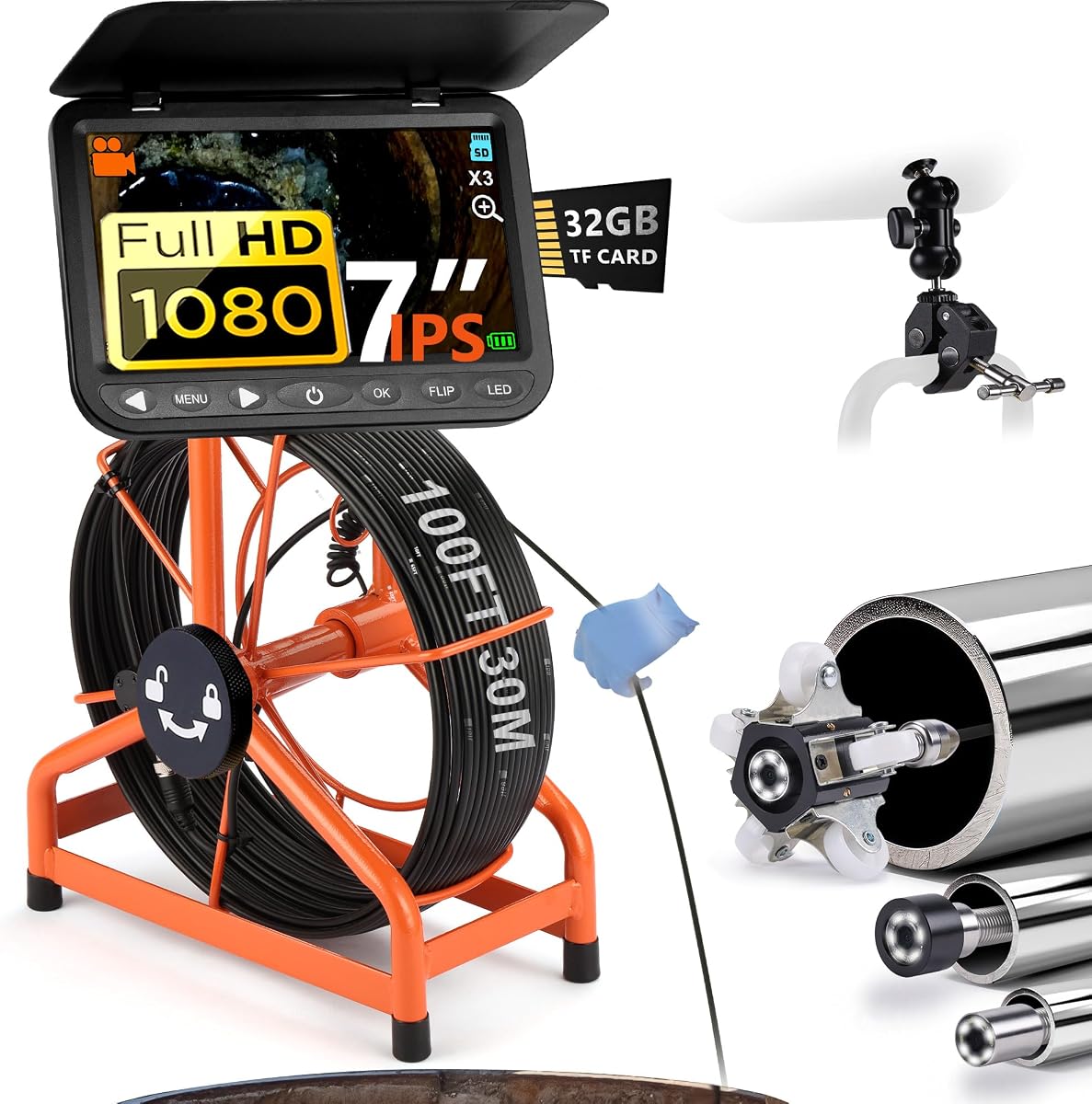
ChoosePRO 100 FT Sewer Camera
4.5Editor score
HD 1080P camera head
Seven-inch IPS inspection screen
Twist-unlock 100-foot reel
32GB DVR storage included
A sewer camera for Android turns a compatible phone or tablet into a practical inspection tool for drains, pipes, walls, engines, ducts, and other confined spaces. The most useful models combine a slim waterproof probe, a semi-rigid cable, built-in lighting, and a phone app that displays live images without requiring a separate monitor.
This guide compares ten options using their stated resolution, cable length, lighting, waterproof rating, connection method, accessories, and available customer rating. It includes phone-based borescopes for general DIY inspection, USB-C models for newer Android devices, autofocus equipment for detailed close-ups, and standalone sewer camera systems with larger screens and extended batteries.
Each review explains the product's strongest capabilities, practical limitations, and ideal user. The EIXAUP system stands out for its dedicated display, while the ChoosePRO model is aimed at intensive pipe inspection and the BAZO is a practical value-oriented phone option. Ratings, availability, and prices can change, so confirm the current listing before purchasing.
4.5Editor score

5.0Editor score

4.4Editor score
As an Amazon Associate we earn from qualifying purchases.
The comparison below highlights the central differences among phone-connected borescopes and standalone inspection systems: probe size, reach, lighting, waterproof protection, display type, recording capability, and Android compatibility.


This dual-lens phone borescope is a general-purpose inspection camera for users who want more flexibility than a standard fixed-view probe. It uses a slim 7.9mm camera head, a 16.4-foot semi-rigid cable, and a stated 1920 by 1440 image resolution. No customer rating is supplied, so its appeal rests primarily on the documented specifications and included accessory set.
We may earn a commission when you buy through this link, at no additional cost to you.
The dual lenses are the most interesting feature. One can be used for a different perspective than the other, making the probe useful when a straight-on view fails to reveal a crack, obstruction, or dropped object. Eight levels of adjustable brightness help illuminate dark pipes and cavities, while the semi-rigid cable can be bent to follow a route without behaving like a completely limp cord. The probe is rated IP67 for wet environments and can operate underwater to the stated depth and duration limit.
Its main trade-off is device-dependent image quality. The product information specifically notes that some Android phones may show slight blurriness because of system differences, while iOS devices generally offer clearer results. The camera also depends on a phone or tablet and the SUP-ANESOK app rather than providing a dedicated screen. Buyers should therefore confirm that their device supports the supplied connector and app before buying.
This is a good option for homeowners, mechanics, and renovation workers who need to inspect pipes, walls, vehicle areas, and wiring without carrying a full reel system. It is particularly useful when the 16.4-foot reach and dual viewpoints matter more than standalone operation. For users with older Android hardware or a need for a built-in monitor, one of the standalone systems may be a more dependable fit.
Switching between the dual lenses can expose surfaces and angles that a fixed camera may miss. This is especially helpful around elbows, wall cavities, engine components, and pipe interiors where the probe orientation is difficult to control.
The 16.4-foot cable provides meaningful reach while retaining enough shape to guide the camera around bends. The included magnet, hook, mirror, and protective cap broaden its usefulness beyond basic pipe viewing.
We may earn a commission when you buy through this link, at no additional cost to you.
This single-lens borescope is a straightforward phone-based option for inspecting pipes, household cavities, vehicle interiors, and other areas that are difficult to view directly. It has a customer rating of 4.3 and provides 1920 by 1440 images and video through a 7.9mm probe. The 16.4-foot semi-rigid cable gives it enough reach for many household and automotive tasks.
We may earn a commission when you buy through this link, at no additional cost to you.
Its core strengths are compact probe construction, adjustable lighting, and a reasonably complete accessory package. The camera connects to compatible iOS and Android devices, with an Android connector, Lightning connector, and USB-C connector included according to the package information. A magnet, hook, mirror, and protective cap support retrieval tasks, directional inspection, and lens protection. The IP67 probe is also suitable for wet or submerged areas within its stated limits.
The single-lens design is less versatile than a dual-lens camera. It does not offer a second viewing angle, which may matter when a blockage, crack, or loose fitting sits behind an edge. Like most phone borescopes in this group, it depends on the SUP-ANESOK app and the display capabilities of the connected device. It also has no integrated battery, reel, or stand-alone monitor.
Homeowners who need one dependable tool for drains, walls, engines, and wiring will find this model approachable and versatile. It is less compelling for professionals who regularly navigate complex pipe systems or require multiple perspectives. Its value lies in offering a useful combination of slimness, reach, lighting, and accessories without moving into a dedicated industrial display system.
The same probe can move from plumbing checks to automotive inspection, wall cavities, and household searches. That versatility makes it easier to justify as a general maintenance tool rather than a single-purpose drain camera.
Adjustable brightness helps reveal details inside unlit pipes and enclosed spaces. Because the light is controlled from the connected device, users can adapt illumination as the probe moves into different environments.
We may earn a commission when you buy through this link, at no additional cost to you.
The Acoath dual-lens borescope combines a 1920 by 1440 camera, a 16.4-foot semi-rigid cable, and eight adjustable LED lights in a phone-based package. Its 4.3 customer rating reflects a broadly positive reception, while the dual-lens arrangement gives users more choice when examining pipes, engines, walls, HVAC components, and household wiring.
We may earn a commission when you buy through this link, at no additional cost to you.
The slim 7.9mm probe is designed to enter tight openings, and the adjustable illumination makes it possible to examine dark or enclosed areas. The camera is IP67 waterproof and can be used underwater to the specified depth for up to an hour. Included Android, Lightning, and USB-C connections broaden device compatibility, while the magnet, hook, and mirror add practical retrieval and viewing functions.
The product information includes important safety guidance. The probe is not made from heat-resistant materials, so the engine must cool before inspection. Users should also avoid forceful pulling, violent impacts, and sharp protrusions that could scratch the waterproof protective layer. These cautions are reasonable for a compact borescope but require attention when working around machinery or damaged pipe interiors.
This camera is well suited to DIY enthusiasts and professionals who want dual-camera flexibility without a standalone reel. It works particularly well for drain, duct, wall, chimney, automotive, and electrical inspection tasks. Users who routinely inspect hot engines should choose equipment explicitly designed for that environment, while those needing long-distance professional pipe surveys may prefer a 100-foot standalone camera.
A second lens can provide a more useful perspective around bends and behind obstructions. That makes the camera valuable when the exact orientation of a pipe joint, wall cavity, or engine component cannot be easily established.
Allow hot equipment to cool and move around sharp edges slowly. The IP67 protective layer improves wet-location capability, but careful handling helps preserve camera life and reliable sealing.
We may earn a commission when you buy through this link, at no additional cost to you.
The BAZO is a value-oriented endoscope for Android owners who need a slim probe, useful reach, and simple phone connectivity. It carries a 4.4 rating and uses a particularly compact 6.9mm camera head to reach confined spaces. Its 18.04-foot cable is among the longer phone-based probes in the group, while eight adjustable LEDs support inspection in dark pipes and cavities.
We may earn a commission when you buy through this link, at no additional cost to you.
Connection is refreshingly direct. After downloading the UseePlus app, users can connect through the included phone or tablet adapter without Bluetooth, Wi-Fi, or a separate charging step. Compatibility extends to Android 4.4 and later as well as iOS 9.0 and later, making the camera less dependent on recent hardware than some USB-C-only alternatives. The product information recommends updating the app if connection problems occur.
The main limitation is that there is no built-in monitor, so image quality and navigation depend on the connected device. The semi-rigid cable can hold a bend and guide the probe, but it does not offer powered steering or an articulating tip. It is also not the right choice for inspecting very long, complex, or sharply obstructed commercial pipelines.
This BAZO model is an excellent general-purpose purchase for homeowners, car owners, and repair enthusiasts who want substantial reach without carrying a standalone reel. Its slim probe, app-based operation, and broad compatibility make it a strong option for drains, car interiors, walls, engines, plumbing, HVAC work, and routine household maintenance.
The camera does not depend on Wi-Fi or Bluetooth, which can simplify inspection in basements, crawl spaces, and utility areas. A direct wired connection reduces the need to troubleshoot a separate wireless link.
At 6.9mm, the camera head can enter narrow gaps that larger probes may not reach. Combined with the 18.04-foot cable, it balances access and control across many household inspection tasks.
We may earn a commission when you buy through this link, at no additional cost to you.
The Teslong 50FT borescope is designed for users with USB-C Android phones who need substantially more reach than a typical handheld borescope. Its 15-meter semi-rigid cable can extend into drains, wall cavities, vehicle areas, and other routes, while eight high-intensity LEDs illuminate dark spaces. The listed customer rating is 4.2.
We may earn a commission when you buy through this link, at no additional cost to you.
Universal USB-C support is the central advantage for newer devices. The camera is compatible with USB-C iPads and Android devices running Android 8.0 or later when OTG is supported. It is expressly not compatible with older iPhones that use Lightning, so buyers should verify their connector before purchasing. The probe has an IP67 waterproof design and a semi-rigid cable that can be molded into different shapes.
The product information appropriately notes that the borescope bends but is not as rigid as a professional sewer camera. For difficult sewer routes, it suggests using a drain snake or plastic Wiffle Ball to help navigation, although those aids are not included. The long cable can also feel more difficult to control in tight spaces, especially when searching for a precise object or negotiating multiple bends.
This model suits newer Android owners, automotive technicians, and DIY users who need greater reach than a 16-foot probe. It is less appropriate for older Lightning-based phones or anyone who expects motorized steering. It fills a useful middle ground: substantially more cable than compact phone borescopes, but still simpler and more portable than a full standalone inspection reel.
The extended cable can reach farther into drains, wall channels, and vehicle structures than shorter phone probes. Users should plan a retraction method and keep the cable straight where possible to reduce tangling.
A USB-C port alone does not guarantee full compatibility. The Android device must support OTG, and users should verify the phone model and connection requirements before ordering the camera.
We may earn a commission when you buy through this link, at no additional cost to you.
The EIXAUP 100 FT is the strongest all-around standalone system in this guide. It combines a 4.3-inch IPS HD color display, a 100-foot cable, a 23mm IP68 waterproof camera, and an 8500mAh rechargeable battery. Its supplied customer rating is 5.0, and the design directly addresses the limitations of phone-based borescopes by providing an integrated monitor and extended operating time.
We may earn a commission when you buy through this link, at no additional cost to you.
Twelve adjustable LEDs illuminate dark drains, sewer pipes, and other enclosed areas, while a stated 145-degree viewing angle helps show more of the pipe interior. The camera position can be adjusted to suit the inspection. Arabic numerals marked along the cable at one-meter intervals provide a straightforward way to estimate how far the camera has traveled, an important advantage when locating a clog or damaged section.
The 8500mAh battery is stated to last up to six to ten hours on a full charge, making the system suitable for extended work away from an outlet. Its trade-offs are size and specialization. The 23mm probe is larger than the slim phone borescopes, and the product does not include DVR recording, which may be important for users who need to document findings. The standalone display also adds bulk compared with connecting to an Android phone.
This camera is ideal for plumbers, contractors, inspectors, engineers, municipal workers, and homeowners dealing with drains, wastewater lines, stormwater systems, ducts, and pipelines. It offers the best blend of reach, standalone convenience, lighting, and battery life in the list. Users who must save video files or navigate unusually restrictive pipework should examine the ChoosePRO system as an alternative.
The integrated screen means the camera does not rely on an Android phone, a compatible connector, or a third-party app. That makes the system more consistent for plumbers and inspectors who work in wet environments or need to keep their phone available.
One-meter markings help users estimate the distance to a blockage, crack, or other concern. This is particularly useful when planning excavation or repair work and communicating the location of a fault.
We may earn a commission when you buy through this link, at no additional cost to you.
This dual-lens borescope is a versatile phone-based inspection tool for automotive work, home maintenance, pipe checks, and locating objects inside walls. It carries a 4.4 rating and provides 1920 by 1440 images through a camera connected to an Android or iOS device. Its 16.5-foot semi-rigid cable retains shape while remaining flexible enough to negotiate narrow routes.
We may earn a commission when you buy through this link, at no additional cost to you.
Operation is designed to be simple. The camera works without Bluetooth or Wi-Fi, and users can capture images with one click and switch lenses with a long press. That offline operation is useful in places where wireless connectivity is unreliable. An IP67 waterproof design also supports wet-area inspection, while the magnet, hook, and mirror help retrieve metal objects, catch debris, and view around corners.
Some stated specifications deserve careful interpretation. The description refers to underwater use up to 16.5 feet, while also identifying the camera as IP67 waterproof; buyers should consult the manufacturer's current instructions before relying on that depth. As with all phone borescopes, actual image quality can depend on the phone, app behavior, and lighting conditions. The cable also cannot steer the camera head from a remote location.
This product is a good fit for mechanics, homeowners, and repair enthusiasts who want dual perspectives and a simple wired connection. It is especially helpful for finding lost items, checking suspected pipe clogs, and examining engine or wall areas. Those needing a much longer reach, a built-in display, or video documentation should look toward one of the standalone 100-foot systems.
A direct wired connection can be more dependable in crawl spaces, utility rooms, and other areas where Wi-Fi is weak. The result is a straightforward workflow: connect the probe, open the app, and inspect.
The magnet can pick up small metal items, the hook can snag accessible debris, and the mirror helps reveal areas around corners. These additions make the camera useful after the visual diagnosis as well as during it.
We may earn a commission when you buy through this link, at no additional cost to you.
The ChoosePRO is a premium standalone sewer camera built for users who need more than a phone borescope can provide. It combines an HD 1080P camera head, a seven-inch IPS screen, a marked 100-foot cable, a 5000mAh battery, and 32GB of DVR storage. Its 4.5 rating reflects a strong overall reception, and the feature set targets plumbers, contractors, inspectors, and serious property maintenance work.
We may earn a commission when you buy through this link, at no additional cost to you.
The 16-times zoom helps reveal small cracks, clogs, and rust, while six adjustable LEDs offer three brightness levels for dark pipes. A flexible stainless-steel spring tip is designed to navigate bends and corners, and sleeves in 25mm and 84mm sizes allow use in different pipe dimensions. The IP68 camera head is suitable for wet, dirty, or flooded environments.
The twist-unlock reel is another notable feature. It is designed to lock or release the cable in about a second, reducing the effort associated with turning small fasteners. The thicker reel tubing, aluminum mounting hardware, crab-claw clamp, and peanut clamp support a more stable setup. A 32GB memory card allows footage to be reviewed immediately or transferred by card or USB-C, although a power bank for extended operation is not included.
This is the most complete documentation-oriented option in the guide and the best fit for users who need recorded evidence of pipe conditions. It is less convenient for quick household jobs because of its size and dedicated equipment. Even so, the combination of screen, zoom, storage, illumination, camera-tip flexibility, and marked cable makes it a strong choice for repeated professional or serious property inspections.
The included 32GB card allows users to record and replay inspection footage without a separate phone. Transfer options make it easier to organize evidence, share findings, and study a blockage before selecting a repair method.
The flexible spring tip helps the camera move around bends and corners, while the two sleeve sizes help it function in different pipe diameters. These details matter when the goal is to inspect beyond a simple cleanout.
We may earn a commission when you buy through this link, at no additional cost to you.
The Teslong 5.0MP autofocus endoscope is designed for close visual inspection with more attention to focus behavior than most fixed-focus borescopes. It has a 4.0 customer rating, a stated 5.0-megapixel image module, and a 16.5-foot semi-rigid cable. It is suitable for Android phones with OTG, Windows computers, and MacBook computers.
We may earn a commission when you buy through this link, at no additional cost to you.
Autofocus is the defining feature. Rather than requiring the user to hold the probe at one precise distance, the camera adjusts from far to near as the target changes. That makes it useful for inspecting carbon residue in an engine, rust in a pipe, material on a wall, or small components on a circuit board. Adjustable LED lights provide additional visibility in dark areas.
The product is less convenient as a dedicated phone sewer camera because it requires a compatible USB host and does not include a monitor or battery. The included cable and accessories make it a broader inspection tool rather than a drain-specific one. Its lower listed rating than several alternatives also suggests buyers should pay close attention to device compatibility and current customer feedback.
This endoscope is best for Android users who prioritize close-range image detail and autofocus over a long cable or dedicated display. Mechanics, electronics technicians, and careful homeowners can use it for engine, HVAC, plumbing, house, electrical, industrial, sewer, and chimney inspections. Those who need to record findings on a built-in screen should consider a standalone model.
Fixed-focus probes can blur when the target is too close or too far. Autofocus helps maintain a clearer view as the camera moves, which is useful when the operator cannot accurately judge distance in a dark or confined space.
USB, Micro-USB, and Type-C connectors expand support beyond Android phones to Windows PCs and MacBooks. This makes the endoscope useful in workshops and technical environments where a larger computer display is available.
We may earn a commission when you buy through this link, at no additional cost to you.
The 1920P Endoscope Inspection Camera is a slim phone-based borescope with a 16.5-foot cable, a rotating view, and eight adjustable LED lights. It has a 4.3 customer rating and supports Android 4.4 or later as well as compatible iOS 9 or later devices. The stated 2.0MP camera captures short-range images and video for household, automotive, and pipe inspection.
We may earn a commission when you buy through this link, at no additional cost to you.
The 7.9mm probe can enter narrow gaps, and the 360-degree rotation helps users orient the camera after it has been pushed into a confined area. The semi-rigid 16.5-foot cable provides a useful balance of maneuverability and shape retention. The UseePlus app supports live viewing and photo capture, while the included iPhone/Micro-USB adapter broadens connection options.
Fixed focus is the most important limitation. The stated useful observation range is approximately 8 to 15 centimeters, or 3.14 to 6 inches, and images may become blurry outside that range. Android phones and tablets also need OTG and USB UVC support; the product information suggests checking with a USB OTG checker before buying. The camera is not intended for computer use.
This model is a good choice for users who understand its close-range operating window and need a rotating, lightweight probe for drains, walls, vehicle areas, and household searches. It is less suitable for long sewer surveys or wide-area mechanical inspections. Checking phone compatibility and maintaining the recommended distance are the most important steps for obtaining useful results.
Once the probe is inside a pipe or wall cavity, users can rotate the camera head to examine surrounding surfaces. This is particularly helpful when the cable's natural curve determines the direction of the view.
Best results occur when the subject is roughly 3.14 to 6 inches from the lens. Bringing the camera extremely close or pushing it farther into a long pipe can cause blur because the focus is fixed.
We may earn a commission when you buy through this link, at no additional cost to you.
The right Android sewer camera depends on the space being inspected, the length and shape of the route, and whether a phone is acceptable as the display. Probe size, lighting, waterproofing, focus behavior, and documentation features should be evaluated together.
A phone-based borescope is lighter, less expensive, and convenient because the connected smartphone or tablet supplies the screen. It is a good fit for occasional household, automotive, and wall inspections, provided the device supports the required connector, OTG, and app. A standalone system is more suitable for plumbers, contractors, and repeated pipe work because it includes a larger display, rechargeable battery, reel, and longer cable. It also reduces reliance on phone compatibility, although the complete unit is bulkier and generally aimed at more demanding inspections.
Cable length determines how far the camera can travel, while stiffness determines how easily it follows bends. The phone-based options in this guide use semi-rigid cables ranging from 16.4 to 50 feet, while the standalone systems reach 100 feet. Semi-rigid construction holds a shape and can be steered around obstacles, but it is not equivalent to a powered or articulating camera tip. Longer cable can also be harder to control and more likely to tangle, so match the reach to the actual distance between the access point and suspected problem.
Probe diameter is one of the most important physical constraints. The BAZO camera has a stated 6.9mm head, while several other phone models use 7.9mm probes and the EIXAUP system uses a larger 23mm camera. A slim probe is better for small pipe openings, wall gaps, engine spaces, and narrow conduits. A larger head may offer a sturdier optical system or a wider practical view, but it will not enter openings that the smaller model can access. Check both the opening size and any bends before deciding.
Resolution is only one part of image usefulness. Most of the phone borescopes here are advertised at 1920P or 1920 by 1440, while the Teslong 5.0MP model emphasizes its image sensor and autofocus. Fixed-focus cameras are usually clearest within a defined range, so the stated 8-to-15-centimeter focus window of the 1920P model is important. Autofocus is more forgiving when the target distance changes. Actual quality also depends on the connected screen, app, lighting, and the cleanliness of the lens.
Drains, ducts, wall cavities, and engine compartments can be almost completely dark. Adjustable LED lighting is therefore essential, regardless of image resolution. Models in this guide use between eight and twelve lights, with the EIXAUP offering brightness adjustment across 12 LEDs. Viewing angle also matters: the EIXAUP has a stated 145-degree camera angle, while one phone model offers 360-degree rotation. Consider whether the camera must pan around a bend, inspect a wider pipe section, or simply look directly along the route.
Sewer and plumbing inspection usually involve moisture, so IP67 or IP68 protection is a meaningful advantage. IP67 models are intended for wet and submerged use within their specified limits, while IP68 provides stronger ingress protection for demanding pipe conditions. Waterproofing does not make a probe immune to heat, abrasion, impact, or chemical exposure. The Acoath model specifically warns that its probe is not heat resistant, and several manufacturers specify maximum depth or duration. Those limits should be followed rather than assumed away.
Compatibility extends beyond the physical USB-C or Micro-USB connector. Many Android phones require OTG, and some borescopes also require USB UVC support. Older models may run on Android 4.4 or 7, while the Teslong 50FT model requires Android 8.0 or later with OTG. Apps are also part of the workflow, and updates may be needed to resolve connection issues. Check the phone model, operating-system version, connector type, OTG status, and app requirements before purchasing.
Standalone systems offer advantages when inspection results must be saved. The ChoosePRO includes 32GB of DVR storage, a seven-inch screen, 16-times zoom, and a cable marked in feet, while the EIXAUP provides meter markings but no DVR. Marked cables help estimate the location of a fault, and recording makes it easier to review slow-moving camera movement or share findings with a client. Phone borescopes may support photo capture through their apps, but their storage and documentation workflow depends on the device and software.
Before inspection, confirm that the Android device is compatible, install the correct app, and test the live image with the probe outside the target area. Clean the lens with a soft microfiber cloth, connect the proper adapter, and verify that photos, video, lighting, and lens switching work. For a standalone camera, charge the battery fully, test the display, and confirm that the cable reel operates smoothly before entering a drain or confined area.
Feed the cable slowly while watching the live image. Keep the probe centered, avoid pulling it backward by the cable alone, and use the accessories to retrieve objects when possible. Stay within the stated focus distance for fixed-focus models, adjust the LED brightness to avoid excessive glare, and rotate the camera head or change lenses when a different angle is needed. Never force the probe past a sharp obstruction or use it in a hot engine before the equipment has cooled.
After use, disconnect the camera and wipe the probe and lens clean. Allow moisture to dry before storing the cable, coil it without a tight kink, and keep the device away from extreme heat. Do not charge a wet camera or immerse a unit beyond its stated depth and duration. If a phone-based model becomes intermittently disconnected, update the app and inspect the connector. For standalone equipment, retract the cable carefully, check the reel and camera head for damage, and recharge the battery before storage.
No. A USB-C connector alone is not enough for every borescope. The phone may also need OTG support, compatible USB video functionality, a particular operating-system version, and the correct app. Check the product requirements and run a compatibility or OTG checker before ordering.
A borescope is generally a lightweight inspection probe that displays images on a phone or tablet. A dedicated sewer camera includes a reel, integrated screen, rechargeable battery, longer cable, and often more robust recording and navigation features. The best choice depends on whether the need is occasional household inspection or repeated professional pipe work.
The useful length is the distance from the cleanout or access opening to the suspected blockage, with some extra length for bends and positioning. Phones can support around 16 to 50 feet in this group, while the standalone options provide 100 feet. Longer is not always better because a long semi-rigid cable can be harder to control.
A model with an appropriate IP67 or IP68 rating can be used in wet conditions within its stated depth and duration limits. Users should still avoid impact, abrasion, and sharp edges. A larger standalone head may be more robust for dirty or flooded commercial environments than a slim phone probe.
Blurriness can come from dirt on the lens, a fixed-focus probe being used outside its best range, insufficient lighting, or device and app differences. Clean the lens with a microfiber cloth, keep the target within the specified focus distance, and increase LED brightness. If the issue continues, test the camera with another compatible device and update the app.
They can be useful for preliminary diagnosis, automotive work, wall inspection, and shorter drain routes. Repeated pipe inspection often benefits from a standalone system with a larger display, longer marked cable, integrated lighting, stronger reel, and video recording. Choose based on the severity, frequency, and distance of the work rather than the product label alone.
Only if the manufacturer explicitly states that the probe is heat resistant. Several compact borescopes use materials that are not heat resistant, so the engine should be allowed to cool completely. A dedicated thermal camera or a heat-rated inspection tool is more appropriate for high-temperature environments.
Most of the phone-based models in this guide use a wired USB connection and do not require Wi-Fi or Bluetooth. Their operation depends on the app and device compatibility instead. Standalone cameras operate independently through their built-in display and battery.
The EIXAUP 100 FT is the best overall choice for buyers who want a complete standalone system with a 4.3-inch display, 100-foot marked cable, IP68 camera, adjustable LEDs, and an 8500mAh battery. The ChoosePRO takes the premium lead when recording, a larger screen, zoom, an articulating spring tip, and rapid reel operation are especially important. The BAZO represents the most practical value-oriented phone option, combining a slim probe, 18.04-foot reach, broad compatibility, and direct wired operation.
For occasional drain checks, wall cavities, vehicle interiors, and household searches, a phone-based borescope is usually easier to manage. Prioritize OTG and app compatibility, probe diameter, focus range, lighting, and waterproof rating. For repeated work in long or complex pipes, prioritize a dedicated screen, marked cable, integrated battery, suitable camera-tip flexibility, and recording capability over a small difference in nominal resolution.
Before ordering, measure the access point and estimate the distance to the suspected problem. Check the exact phone connector and operating-system requirements, read the current rating and recent customer feedback, and confirm the stated waterproof depth, focus distance, and heat limitations. Product specifications and prices can change, so verify the current listing before making a final purchase.